……
A: How do we compile the C files?
B: Hi, what checksum did you get for the sample input? C: using g++ also works!
D: checksum is 230? i encrypted all chacters including whitespaces.
A: But a required .h file is said to be missing...Not on Unix NOR VC++
C: Okay... Let me check it with Gary and Simon. But, could you tell me which files are missing????
……
Figure 1. An example for the message stream [10]
Conversation Extraction in Dynamic Text
Message Stream
Le Wang
Computer College National University of Defense Technology, Changsha, China Email: [email protected]
1Yan Jia, 2Yingwen Chen
Computer College National University of Defense Technology, Changsha, China 1[email protected]
Abstract—Text message stream which is produced by
Instant Messager and Internet Relay Chat poses interesting and challenging problems for information technologies. It is beneficial to extract the conversations in this kind of chatting message stream for information management and knowledge finding. However, the data in text message stream are usually very short and incomplete, and it requires efficiency to monitor thousands of continuous chat sessions. Many existing text mining methods encounter challenges. This paper focuses on the conversation extraction in dynamic text message stream. We design the dynamic representation for messages to combine the text content information and linguistic feature in message stream. A memory structure of reversed maximal similar relationship is developed for renewable assignments when grouping messages into conversations. We finally propose a double time window algorithm based on above methods to extract conversations in dynamic text message stream. Experiments on a real dataset shows that our method outperforms two baseline methods introduced in a recent related paper about 47% and 15% in terms of F measure respectively.
Index Terms—text message, conversation extraction, content
similarity, linguistic feature
I. INTRODUCTION
The convenience of exchanging information for people is a main achievement of the Internet and communication technology. The prevalent uses of Instant Messenger (IM), Internet Relay Chat Room (IRC) and Short Message Service (SMS) are good examples [1]. Ma et al have declared the prevalent usage and huge amounts of consumers in China [2]. We have the solid arguments that communication technology like IM and SMS will be popularized further in the future.
The communication method mentioned above is a kind of interactively chat method using keyboard. Participants intercommunicate by sending text content to others. The text contents said by participants in a chat group are broadcasted in time sequence to all members in this group (as shown in figure 1). It is true that most of the message streams produced through IM or IRC are casual chitchat
which are neither meant to be analyzed. However, there is a remarkable category of chat message stream containing
valuable knowledge. It relies on the apply styles of users. A Motivation
On the one hand, these technology and products facilitate communication for people to exchange rewarding information. Some corporations and educational institutions have provided IRC aiming at their specific requirements, e.g. custom service or after-sale service based on SMS [3], Chat Group for discussion after class. It is useful to analyze the contents of this kind of IM or SMS. For example, hot issues concerned by customers can be extracted from the SMS corpus of custom service, and this information can be used further to improve the product documents or optimize the product web site. Chat Group created by colleges or vocational training schools through MSN or ICQ provides a platform for professors and students to discuss the problems which are related to their class. Analyzing chat content is useful for students to share what they have learned and professors to rearrange their prelection ways. It is a meaningful study area to analyze the chat content from the motivation of information management and knowledge finding.
other outlaws [6]. Therefore, we need to monitor online chats to aid crime detection or crime prevention. Because people monitor the conversations actively for a prolonged time is expensive and usually hard for a person to keep track of all the diverse topics in the text stream. Many countries have conducted the task of monitoring and analysis to chat room, IM or SMS, and there are successful cases [7, 8, 9]. It is obligatory to monitor the chat text in chat room, IM, etc. in order to strive for public safety or criminal evidences for public litigation.
The messages from different participants on different topics are very short and heavily interwoven. It is not appropriate to analyze or mine directly on messages. Moreover, most messages in the stream are too short to be meaningful by themselves, as a single message can not convey a relatively rounded topic without considering the context information. Therefore, it is necessary to extract conversations in dynamic text message stream such that each conversation is about a specific topic pronounced by participants during a specific time period. Then the task of chat text monitoring and analysis or other mining applications can be performed on conversations.
However, chat message is radically different from various other written discourses due to its often informal nature. Furthermore, the message stream does not contain linear discussions of any single topic, but rather contains partially threaded and interwoven topics that oscillate in short, incomplete messages. Existing text mining techniques, such as TDT [11], rely on more structured, formal corpuses, such as Web documents, research papers, etc and cannot be employed for conversation extraction.
In the past, little work has been proposed to address the problem of conversation extraction in dynamic text message stream concerning both content and time characteristics of stream. An exception is [10], where the authors detected conversation (called thread in that paper) by the starting message and ending message. But the authors employed traditional TF-IDF model to represent message contents and a single-pass stream clustering algorithm to group messages into conversations. The traditional TF-IDF model would lead the deviation of similarity between messages because of the sparse terms in messages. Besides, the single-pass stream clustering algorithm cannot deal with the renewable assignments of messages to conversations. This also results to excessive penalty to small or newborn conversations.
B Contributions
There are some linguistic rules in the sequential messages in a conversation. For example, the ending sentence “Are you … ?” in message A and the beginning sentence “Yes. …” in directly following message B are valuable hints for organizing A and B into one conversation. We try to unearth this kind of linguistic features in the dynamic text messages stream by conditional probability to assist conversation extraction.
In this paper, we propose a double time windows clustering algorithm, called DWExter, to extract topic-level conversations in dynamic text message stream. DWExter dynamically constructs representations of
messages and maintains memory storage structure for processing conversations when grouping messages. The dynamic representation of messages employs the linguistic features in message stream and avoids the deviation of similarity on TF-IDF. And the storage structure for conversations, called Reversed Message Relationship structure (RMR), is developed in order to support the renewable assignments when grouping messages into conversations. We compare DWExter with the baselines on a Chinese instant message datasets, and the results indicate that DWExter outperforms the baselines proposed by Shen about 47% and 15% respectively in terms of F measure criterion.
Apart from section 1, this paper is organized as follows. Section 2 presents related works highlighting the originality of this work. In section 3, we define preliminary definitions include conversation and conversation extraction task. In section 4, we firstly design the dynamic representations of messages when measuring their similarity, and secondly propose a memory storage structure for the purpose of renewable message clustering, finally propose the DWExter algorithm. A general analysis for our instant message corpus is presented firstly at section 5, and then some experimental results are described. Section 6 summarizes our work with considerations on future directions
II. RELATED WORKS
Topic identification from text documents is a longstanding problem [11, 12]. TDT researchers try to discover and thread together topically related material in stream of text data such as regular documents or broadcast news. However, online chat, such as IM or SMS, do not contain linear discussions of single topics, but rather partially threaded, interwoven topics that oscillate in short, incomplete utterances. It is structured differently from written discourse. So the context which we consider is very different from TDT. Besides, Text segmentation aims to identify the boundaries of topic changes in long text documents and/or document stream, while in our problem, we aim to find the conversations from stream consisting of short messages.
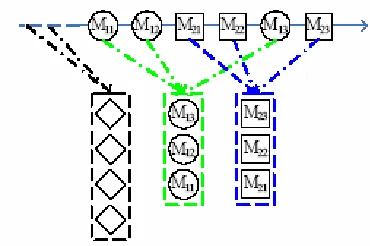
Figure 2. The example of conversation extraction employed, such as social networks and inherent links, are
not available in text message stream we study. Giuseppe C. et al proposed a framework for email summarization in [14]. They dug out a quotation graph from the quotation markers in replying mail threads and use the quotation graph to try to capture an email conversation. But this kind of quotation markers do not exist in the scene we study. R. Cooper and S. Ali attempted to process short electronic free text communication (e-mail and SMS text messages) and extract structured data so that it can readily be added to the repository [15]. The purpose they processed the text message stream is different from ours.
There are another group or work, such as [16, 17], on data which are similar to the text message stream we exploit. The data they studied are produced by Newsgroups, BBS (Bulletin Board System) or other forums. Although their data appear as a stream consisting of messages, they are organized explicitly into thread trees. The root of the thread tree is the first message posted by someone. The thread tree then expands as other people reply to this message. The data which they studied has the inherent thread structure and is reasonably very different from ours. To discover the structure of the message stream is our objective.
Our work is closely related to Shen in [10]. As described in section 1, they unearthed the linguistic and temporal features in message stream and achieved good results for thread detection in message stream. However, because of the intrinsic shortcoming of key-word sparsity and high dimension curse of TF-IDF model, their method leads likely deviation of similarity between messages. In addition, the single-pass stream clustering algorithm adopted by Shen leads penalty to small conversations when determining the group for the new coming message. T. Wu [8] employed some patterns which were provided by experts to identify thread starts in online chat stream. We borrow the idea of syntactic features from Wu to assist us in defining the similarity between message and conversation. Text content, which was not utilized by Wu, is an important factor in ours for grouping messages.
III. PRELIMINARY DEFINITION
For convenience of discussion, we first clarify the definitions of two concepts. One is the conversation, which is our final object to obtain from text message stream in order to organize messages reasonably into topic related groups. The other is the task of conversation extraction from dynamic text messages stream.
A Conversation
Message (marked as M) is a piece of short text which is produced by chatter and sent through text communication tools, such as Chat Room, IM or SMS. The message reflects chatter’s thought in course of discussing. Online chat provides a mode of talking to others using a keyboard, but it has the spontaneity of real-time interaction much like the face-face talk. The chat process produces a series of message sequences.
y Conversation: A conversation is a group of messages which are produced sequentially in chat process in a
specific time span and related with the same topic.■ As shown in Figure 2, the messages in a conversation form a group in which all messages are contributed together to a specific topic. The foregoing message is responded by the following messages sequentially not necessarily neighborly. For example, M11, M12 and M13
consist of a conversation with the starting message M11,
responding message M12 and ending message M13.
Usually, a conversation refers to the chat messages among several participants from the beginning to the end. B Conversation Extraction Task
Conversations is reasonable for chat monitoring in message stream as well as other mining application than a singer message because that the former has more integrated context information and describes more complete content of specific topic than the latter.
y Conversation Extraction: The conversation extraction is to use some methods to extract groups of sequential messages from online text message stream according to some similarity measuring. The sequential messages extracted from stream are related with the same topic and transmitted in a specific time span. The group of sequential messages extracted from message stream is the conversation (marked as C) discussed in this paper. It should be our major work to develop the extraction algorithm as well as the correlative technologies, e.g. the method of similarity measure between messages and the memory structure of data processed by extraction algorithm. Shen worked on the off-line thread detection in [10] while we study in online message stream, which is sensitive to time and resource.
A Similarity Measuring
When performing the extraction process, a criterion is required to determine whether or not one new coming message belongs to a conversation. Our criterion consists of two factors: the similarity score of cosine according to their text content and the linguistic features distilled from the pair of exploring messages.
A1 Dynamic Content Similarity
Traditional TF-IDF model for text similarity may be confronted with the challenges of high dimension curse and key term sparsity for short text segment. To conquer these shortcomings of TF-IDF, we propose a method to construct the dynamic representation for messages, and the cosine measure is used on these representations to calculate the content similarity degree between messages.
Firstly, we calculate the semantic similarity between words in vocabulary according linguistic taxonomy and training corpus. The part of similarity between two words related with taxonomy can be calculated according to Guan’s method in [18] at the aid of HowNet [19]. Let it be SWL. The part of similarity related with training
corpus, marked by SCL, is determined by the
co-occurrence probability of pair of words in training corpus. We use a simple method as shown as formula (1) to mix above similarity factors. Surely, how to measure the similarity between words based on taxonomy or corpus is an open problem as well as the problem of how to mix them, and there may be other more complex methods focusing on these issues. It can be our future work, and we do not focus on these problems in this paper.
( , ) ( , )
( , )
2
WL i j CL i j i j
S w w S w w
S w w = + (1)
Secondly, we construct the dynamic representation for pair of messages using their words when measuring their similarity. Unlike classical methods that use a precompiled word list containing hundreds of thousands of words, our method dynamically forms the semantic vectors solely based on the compared messages.
Given two messages, M1 and M2, a joint word set is
formed as formula (2). The joint word set M contains all the distinct words from M1 and M2. Since the set M is
purely derived from the compared messages, it is compact with no redundant information.
{
}
1 2 1 2 m
M=M UM = w w ⋅⋅⋅w (2) Thus, a scheme is needed to weight each word. It has been shown that words that occur with a higher frequency contain less information than those that occur with lower frequencies [20]. We weight the significance of a word using its information content, which is derived from its probability pi in containing message as formula (3).
( )i i log i
I w = − ⋅p p (3)
Each message is readily represented by the joint word set as follows. The vector of Mj(j=1, 2) derived from the
joint word set is denoted by
j M
uuur . Each entry of
j M
uuur
corresponds to a word in the joint word set, so the dimension equals the number of words in M. The value vi
(i=1, 2, …, m) of ith entry in
j M
uuur is determined by the
similarity between its corresponding word wi and the
maximal similar word wi′ in the message according to formula (4).
( , ) ( )
i i i i
v =S w w I w′ ⋅ ′ (4)
A2 Linguistic feature relationship
As discussed before, there are some linguistic rules in message stream which can be employed for conversation extraction. For simplicity, we assume the dependence satisfies the Markov chain property, which is reasonable according to the report by Shen [10]. That is, the likelihood of a feature in message Mj is entirely
determined by the proceeding message Mi in the same
conversation. For example, in Figure 2, if M11 includes an
interrogative sentence which raises a question, it is supposed that M12 will contain a declarative sentence to
answer the question and M13 may say “Ok, I got it”.
Given two messages Mi and Mj, we can define a Boolean
function f(Mi, Mj), which equals true if Mi and Mj belongs
to the same conversation and they are neighboring messages.
What we are interested in is the likelihood of f(Mi, Mj)
being true given the linguistic features describing them, that is, the probability p(f(Mi, Mj)|SLF), where SLF
denotes some linguistic feature extracted from training corpus. This equation can be defined by formula (5):
( | ( , )) * ( , )
( ( , )| )=
( )
i j i j
i j
p SLF f M M p M M p f M M SLF
p SLF (5)
Then, the similarity between message and conversation is defined by formula (6). An intuitive explanation of equation (6) is that the similarity between message and conversation is determined by not only their text contents but also the linguistic features between them. The final similarity between message Mnew and conversation C is
defined using the MAX value between Mnew and the
message in C.
( , ) (( ( , )
(1 ) ( ( , )| )) i
i M C
i
S M C max cos M M
p f M M SLF
α
α ∈
= ⋅
+ − ⋅
r r
(6)
As we know that the similarity may deviate when measuring short text using TF-IDF model because of sparse key words in text. Formula (6) avoids the similarity deviation by importing the linguistic feature relationship. The weight parameter
α
should be determined through experiments.B The Structure of Reverse Message Relation
The memory storage structure of reverse message relation, called RMR, is used to support DWExter algorithm to renew the message memberships among conversations. The similarity between message Mi and
conversation Ck is defined by the message Mj∈Ck which
has the max similarity with Mi. RMR stores the
Figure 3. An example for RMR
Figure 4. The update operations on RMR Figure 5. The double window mechanism three conversations. The red diamond or rectangle is
corresponding to the current message being processed in stream. C1, C2 and C3 indicate conversations. The part
enveloped by dashed rectangle in figure 3 illuminates the inner structure of RMR. For example, the new message M14 is the most similar with M12 than other messages, and
it is appended into conversation C1 (the conversation
which M12 belongs to). Then, M12 has a link to M14
(reversed relationship).
When a new message Mi is added into RMR, there are
two situations to be study. The first is that there is a conversation Ck which the Mi should belong to, that is,
there must be a message Mj∈Ck which is the most similar
with Mi than all the other messages in RMR. Then we add
Mi to Ck and define a link from Mj to Mi. Mj is called the
Inviter of Mi, and Mi is the Guest of Mj. The second is
that there is no conversation whose member message is similar enough to Mi, and then we add a new
conversation to contain Mi.
There is a key operation after a new message added into RMR. A message Ml in RMR may has bigger
similarity with the new message Mi than his original
Inviter. Then we move Ml and all its Guests into the
conversation which contains Mi. Figure 4 demonstrates
this operation. Referring to figure 3, we can see that the new message Mi is added into conversation C2, marked as
M25, and the message M12 as well as its Guest M14 in C1
are moved into conversation C2. The identifiers of M12
and M14 change into M23 and M24.Then we add M12 to the
Guest list of M25 and keep the relationship between M23
and M24 ( i.e. M12 and M14 in original markers) .
C The extraction algorithm DWExter
DWExter is a stream clustering algorithm. It extracts conversations in text message stream based on above method of similarity measure and storage structure of message relations. For a new coming message, DWExter performs two steps to complete the clustering process.
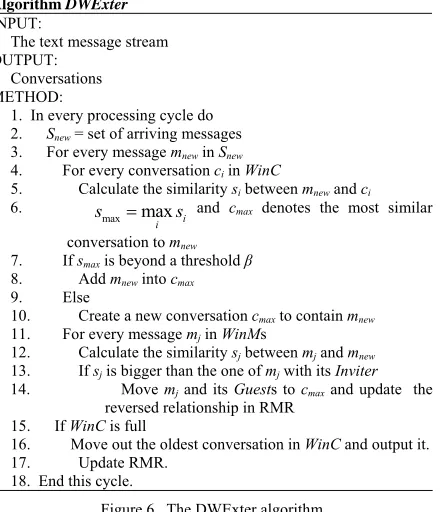
Firstly, DWExter assigns the new coming message to the most related conversation if this conversation exists, otherwise, creates a new conversation to contain this new message. Secondly, DWExter scans all the messages in candidate conversations and renew their assignments as well as the RMR structure on the condition that these messages are more similar to the new message than their original Inviters.
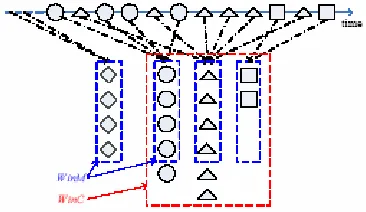
In this paper, we work on the conversation extraction task in on-line message stream in which the data is arriving continuously and endlessly with high rate. In order to adapt this situation on the condition of limited resources of memory and CPU, we design DWExter based on a double window mechanism. On this mechanism, we define two windows for DWExter. The first is conversation window WinC which contains the newer wc conversations. DWExter will consider only
conversations in WinC as candidates for grouping a new message to. The second is message window WinM which contains the newer wm messages in one conversation.
DWExter measures the similarity between new coming message and message only in WinM. This mechanism comes from the practice that people are conditioned to discuss a topic in a limited range of time, that is, the new coming message is mostly related to the recent wc
conversations. Furthermore, the topic of a conversation is usually discussed sequentially. The new coming message is mostly similar to the latest wm messages in a
conversation. wc is the window size for WinC as well as
wm for WinM. Figure 5 highlights the mechanism of
double windows.
The DWExter algorithm is illuminated in figure 6. The similarities between new message and every conversation in WinC window of RMR are calculated in steps 4 and 5 according formula (6). Step 6 selects the conversation which has the most similarity to new message. Only when the max similarity is beyond a specific threshold β, which is determined through experiments, the new message would be added into the most similar conversation. Otherwise, a new conversation will be created to contain the new message. This is achieved by steps 7~10. Steps 11~14 maintain the reversed message relationships as described in section 4.2. Conversations which expired are output in step 16. For simplicity, we use the relative time in stream other than absolute time for message as well as for conversation.
Algorithm DWExter INPUT:
The text message stream OUTPUT:
Conversations METHOD:
1. In every processing cycle do 2. Snew = set of arriving messages
3. For every message mnew in Snew
4. For every conversation ci in WinC
5. Calculate the similarity si between mnew and ci
6.
max maxi i
s = s and cmax denotes the most similar
conversation to mnew
7. If smax is beyond a threshold β
8. Add mnew into cmax
9. Else
10. Create a new conversation cmax to contain mnew
11. For every message mj in WinMs
12. Calculate the similarity sj between mj and mnew
13. If sj is bigger than the one of mj with its Inviter
14. Move mj and its Guests to cmax and update the
reversed relationship in RMR 15. If WinC is full
16. Move out the oldest conversation in WinC and output it. 17. Update RMR.
18. End this cycle.
Figure 6. The DWExter algorithm
0
1000 20003000 4000 5000600 0
70008000 9000 10000 0.0
0.5 1.0 1.5 2.0 2.5 3.0
lo
g of
f
req
uen
c
Word Index (a)
log of frequenc
0 5 10 15 20 25 30 35 40 45 50 55 60 65 70 75 80 85 0
100 200 300 400 500 600 700 800 900 1000
num
ber of
m
e
s
s
ag
e
length of message (b)
number of message
Figure 7. Statistical characteristics of dataset
TABLE I. STATISTICAL CHARACTERISTICS OF CONVERSATIONS
ID of sub stream D1 D2 D3 Number of messages 2603 2586 2591 Number of conversations 325 369 431 process. This is an improvement from Shen’s method
which fixes the relations of message to conversation even if the message should be regroup to another conversation.
D Analysis of the DWExter complexity
The similarity measure is based on the static lexical taxonomy and training corpus, both of which can be processed beforehand and stored for prospective access. Once it has been constructed, it would not be altered afterwards unless new information should be integrated. So we take this part out of our account when analyzing the DWExter complexity.
The main storage of DWExter exists in RMR and temporary variables, i.e. the similarity weight lists of new message to each of conversations and new message to each of messages in WinM windows. Both of them rely on the sizes of WinC and WinM. We assume that the size of WinC is wc and WinM is wm. and then the memory that
DWExter need can be estimated by O(wc·wm).
The complexity of similarity measuring between messages is determined by the message length and the scale of knowledge base of word relationship. The former is averagely below of 40 [2], and the latter is usually a static value once the base has been constructed. So, the time complexity of DWExter can be studied without regard to both of them. From figure 6, we can see that the main operations consist of two series-connected for-loops, the first is step 4 and the second is step 11. The former is related with wc and the latter can be quantized
by the production of wc and wm. Then the time complexity
of DWExter can be calculated by O(wc + wc·wm) =
O(wc·wm).
V. EXPERIMENTAL EVALUATION
We conduct a series of experiments to evaluate the performance of method proposed in this paper. These
experiments cover the parameter α, the threshold β and the comparison of the results among the baseline algorithms SPB, SPNN and DWExter. SPB and SPNN [10]
are based on the similar motivations with ours. We use HowNet system version 2000 as the lexical taxonomy. A The Dataset Analysis
A set of Chinese instant messages collected from our colleagues’ chatting group of Tencent QQ [22] is used as the dataset. The time range of these messages covers over one week. After preprocessing, such as tokenizing the dataset using a tool1, removing worthless symbols and deleting meaningless messages, there are still 7,780 messages and 10,215 disparate Chinese words and interpunctions. Figure 7 shows the dataset statistical characteristics: (a) word frequencies (b) message lengths. We can see from Figure 7(b) that the length of most messages, nearly 95%, is below 15. This dataset is a typically short text set.
The dynamic message stream is produced using this dataset based on their time stamps. The conversation information is provided by the authors of the messages. For DWExter, we need the training data to estimate conditional likelihood parameters. Therefore split the dataset into 3 folds, and we use two folds as training data and another fold as test data at each time. The two baseline algorithms are also tested on the same test data used by DWExter for comparison purposes. Table 1 shows the statistical information in these 3 sub datasets.
B Evaluation Criteria
The precision, recall and F measure [22] are used as evaluation metrics. Here, we explain these metrics in the context of the conversation extraction problem. For each detected conversation, we calculate its precision and recall against each real conversation. The F measure is defined by combining the precision and recall together. Specifically, for the extracted conversation j and the real conversation i, the metrics are calculated as follows:
( , ) ij
i
n Recall i j
n
= (7)
( , ) ij j n Precision i j
n
= (8)
Figure 8. F measure under Different Parameters
TABLE II. F MEASURE ON DATASET COMBINATIONS
Dataset (D1,D2) & (D3) (D1,D3) & (D2) (D2,D3) & (D1)
SPB 0.331 0.34 0.342
SPNN 0.527 0.532 0.54
DWExter 0.631 0.633 0.635
2 ( , ) ( , )
( , )
( , ) ( , ) Precision i j Recall i j F i j
Precision i j Recall i j
× ×
=
+ (9)
where nij is the number of messages of the real
conversation i in the detected conversation j, ni is the
number of messages in the real conversation i, nj is the
number of messages in the detected conversation j and F(i, j) is the F measure of the detected conversation j and the real conversation i. The whole F measure of the detection result in a stream is defined as follow:
max( ( , ))
i j i
n
F F i j
n
=
∑
(10)where the max is taken over all detected conversations and n is the total number of messages. The results we report in the next section are in terms of the average F value among all the sub test streams.
B Experimental Results B1 Parameters Tuning
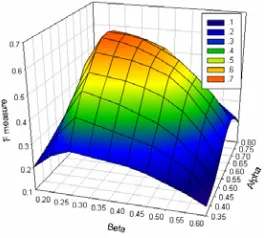
There are two parameters for DWExter to tune at the same time. That is the parameter α and β. We tune the two parameters orderly and repeatedly until the best combination is found. That is, we first fix α and then tune
β orderly to obtain a result list. After that, we change the value of α and tune β to get another list of results. We repeat this process until the performance of our algorithm achieves the better result. Figure 8 shows the results with regard to the different combinations of α and β. We found that DWExter achieves better result when α=0.65 and
β=0.25. The following results are on this condition.
α leverages the effect of text content and linguistic feature in messages when measuring their similarity. When α is assigned a small value, e.g. 0.35, the DWExter is degraded into none linguistic feature available and its F measure reaches nearly 0.4. β determines how much the similarity score between the new message a conversation should be at least to group the message into this conversation. When β gets close to 1, the DWExter would prefer small conversations, which would result in the low recall as well as low F measure. When α=0.65 and
β=0.25, DWExter achieves the better results (F = 0.637). In addition, the baseline methods employed in this paper need parameter tuning, too. We conducted a series of experiments on our dataset according to the instructions in their source paper. SPB get the best F
measure when tsim=0.479. SPNN achieves the best F
measure when tsim=0.551 and m=5. We set these
parameters based on table 2 in following experiments.
B2 F-feature on different dataset combination
In order to maximize the fairness of evaluation to algorithms, we describe the results produced by all algorithms on different dataset combinations. The indication of “(D1, D2) & (D3)” denotes that D1 and D2 are treated as training corpora and D3 as testing dataset.
From the results of table 2, we can see that DWExter has the bigger F measure than the other baseline algorithms, and the SPB algorithm is the poorest one,
which is an intuited method and make none use of temporal or linguistic feature in message stream. The SPNN algorithm got remarkable improvement from SPB
because of the employment of temporal features. Temporal features (by double time window) and linguistic features (by dynamic representation and linguistic rules) play an important role in DWExter.
From the different F measure of the same algorithm on different combination of datasets, we can conclude above assertion further. According to table 1, we found that the average length of conversation in D1 is the biggest among three datasets, and it is the smallest in D3. So, the traditional TF-IDF schema which is used by SPB and
SPNN could contributes to similarity measuring in D1. But
for D3, SPB and SPNN produced clearly lower F measure
than did in D1 because of sparse key words. But this kind of factor makes slightly interfere to DWExter, whose F measure has less difference on two different dataset than those of SPB and SPNN. It proves that DWExter can
process short text message stream commendably.
In summary, our method proposed in this paper can capture enriched temporal and linguistic features in text message stream and produce steady results concerning conversation extraction task. DWExter avoids the deviation of similarity because of the sparsity of key words and the unstability resulted from different lengths of conversations. When applied into conversation extraction task, our methods achieve better results than the baseline methods.
VI. CONCLUSION AND FUTURE WORK
We plan to study further the characteristic of instant message and HowNet to propose a specific approach for similarity measure between instant messages, such as the method of similarity measure between word based on HowNet and the schema of mixing taxonomy based and corpus based short text similarities. Besides, to evaluate the efficiency of our methods in this paper and propose solutions to improve it can still be a job when a public standard benchmark is available.
ACKNOWLEDGMENT
We thank Yan Wen, Panfeng Wang, Kai Du and Jiajia Miao for providing valuable comments on our paper. We also thank reviewers for their worthy suggestions. This paper is supported by the National High-Tech Research and Development Plan of China ("863" plan) under Grant No. 2006AA01Z451 and No. 2007AA01Z474, and Program for New Century Excellent Talents in University (NCET-06-0928).
REFERENCES
[1] http://www.instantmessagingplanet.com/
[2] D. Ma, F. Ichikawa, Y. Liu, and L. Jiang, "Use of Chinese Short Messages", In proceeding of HCII’07 Part II, Berlin, LNCS 4558, pp. 582–591, Aug 2007.
[3] http://www.itbusinessedge.com/blogs/exb/?p=148
[4] [4] http://news.xinhuanet.com/english/2007-04/06/ content_5940180.htm
[5] http://findarticles.com/p/articles/mi_qa5372/is_199812/ ai_n21431501
[6] http://www.washingtonpost.com/wp-dyn/content/article /2007/07/05/AR2007070501945_pf.html
[7] http://blog.wired.com/tableofmalcontents/2007/04/ does_your_sms_s.html
[8] T. Wu, F. M. Khan, T. A. Fisher, L. A. Shuler and W. M. Pottenger, "Error-Driven Boolean-Logic-Rule-Based Learning for Mining Chat-room Conversations", Lehigh University Technical Report LU-CSE-02-008, 2002 [9] J. Bengel, S. Gauch, E. Mittur, R. Vijayaraghavan,
“ChatTrack: Chat Room Topic Detection Using Classification”, In proceeding of 2nd Symposium on Intelligence and Security Informatics, Tucson, Arizona, pp. 266-277, Oct. 2004.
[10]D. Shen, Q. Yang,J. Sun, Z. Chen, "Thread Detection in Dynamic Text Message Streams", In proceedings of SIGIR’06, Washington, USA, pp. 35-42, Aug. 2006. [11]Allan, J. Carbonell, G. Doddington, J. Yamron, and Y.
Yang. “Topic detection and tracking pilot study”, In Proceedings of DARPA Broadcast News Transcription and Understanding Workshop, pp. 194–218, 1998.
[12]Y. Yang, T. Pierce, and J. Carbonell. “A study of retrospective and on-line event detection”. In Proceedings of SIGIR’98, Melbourne, Australia, pp. 28–36, Aug. 1998.
[13]Q. Zhao, P. Mitra, "Event Detection and Visualization for Social Text Streams", In proceedings of ICWSM’2007, Colorado, USA, pp. 26-28, Mar. 2007.
[14]G. Carenini, R. T. Ng, X. Zhou, "Summarizing Email Conversations with Clue Words", In proceeding of WWW’07, Alberta, Canada, pp. 91-100, May 2007.
[15]R. Cooper, S. Ali, "Extracting Data from Personal Text Messages", Technical Report, Computing Science, University of Glasgow, 2006.
[16]J. W. Kim, K. S. Candan, and M. E. D¨onderler. “Topic segmentation of message hierarchies for indexing and navigation support”. In Proceedings of WWW’05, Chiba, Japan, pp. 322–331, May, 2005.
[17]W. Xi, J. Lind, and E. Brill. “Learning effective ranking functions for newsgroup search”. In proceedings of SIGIR’04, Sheffield, UK, pp. 394–401, July 2004.
[18]Yi Guan, Xiaolong Wang, Xiangyong Kong, and Jian Zhao. “Quantifying Semantic Similarity of Chinese Words from Hownet”, In IEEE Proceedings of ICMLC’02, Beijing, China, IEEE Press, pp. 234-239, Nov. 2002. [19]http://www.keenage.com
[20]C.T. Meadow, B.R. Boyce, and D.H. Kraft, “Text Information Retrieval Systems”, second ed. Academic Press, 2000.
[21]http://download.tech.qq.com (in Chinese)
[22]K. G. Steinbach, M. and V. Kumar, “Acomparison of document clustering techniques”, Technical report 00-034, Department of Computer Science and Engineering, University of Minnesota, 2000.
Le Wang was born in Hebei province of China in 1978.
Wang is a PhD candidate majoring in computer application of the Computer College of National University of Defense Technology, Hunan province, China.
He is interested in data mining in text data, especially text clustering and TDT.
Yan Jia was born in Sichuan province of China in 1960. Jia
received the PhD (AI and database) degree from National University of Defense Technology in 2001.
She is a doctoral tutor at Computer College of National University of Defense Technology. Her research interests include middle ware technology, massive database system, information security and data mining.
Yingwen Chen was born in Hunan province of China in
1979. Chen received the PhD (sensor network) degree from National University of Defense Technology in 2008.
![Figure 1. An example for the message stream [10]](https://thumb-us.123doks.com/thumbv2/123dok_us/8355626.1668743/1.595.322.526.327.453/figure-example-message-stream.webp)