ISSN (e): 2250-3021, ISSN (p): 2278-8719
Vol. 09, Issue 1 (January. 2019), ||V (I) || PP 72-76
Design of Intelligent Drip Irrigation Method Using Wireless
Network
R.Aarthi
1, Dr. A. Shaik Abdul Khadir
2Research Scholar, P.G. and Research Department of Computer Science,
KhadirMohideen College, Adirampattinam, Bharthidasan University (Tiruchirappalli), Tamil Nadu, India. Associate Professor, P.G. and Research Department of Computer Science,
KhadirMohideen College, Adirampattinam, Bharthidasan University (Tiruchirappalli), Tamil Nadu, India2 Corresponding Author:R.Aarthi
Abstract: Agriculture is the largest livelihood provider in India. It also contributes a significant figure to the Gross Domestic Product (GDP).Irrigation plays an important role in agriculture. Nowadays World’s water resources are vanishing, use of proper method for irrigation is very much important and it is well known that irrigation by drip is very economical and efficient. In the conventional drip irrigation system, the farmer has to keep watch continuously on irrigation timetable, which is different for different crops. In Automatic microcontroller based drip irrigation system irrigation will take place only when there will be intense requirement of water. Irrigation system uses valves to turn switches ON and OFF. These valves may be easily automated by using controllers and solenoids. The developed irrigation method removes the need for workmanship for flooding irrigation as well as drip irrigation. In this intelligent drip irrigation automated system, I have used linear programming concept. Linear Programming helps us to distribute available water to the number of crops in order to get maximum profit with minimum cost. Also linear Programming helps us to do proper management of available water. Finally it helps to increase productivity and ultimately profit.
Keywords
:
Analog to digital converter, Controller, Drip, Linear program, Wireless sensor network.--- --- Date of Submission: 24-12-2018 Date of acceptance: 09-01-2019 --- ---
I.
INTRODUCTION
Today continuous increase in demand for food has lead to rapid improvement in food production technology. In India, Agriculture is the largest livelihood provider as the economy is mainly based on it and the climatic conditions are isotropic, still we are not able to make full use available of agricultural resources. The main reason is the lack of rains and water supply shortage of land reservoir water to agriculture fields. The continuous extraction of water from earth is reducing the ground water level due to which lot of land is coming slowly in the zones of UN-irrigated land. Another very important reason of this is due to unplanned use of water due to which a significant amount of water goes waste. At the present, the Agriculture sector heavily relies on human interaction with the physical space and entity. The farmers in India have been irrigating the land at the regular intervals manually. This process sometimes consumes more water or sometimes the water supply is delayed due to which the crops get dried. This problem can be perfectly rectified if we use intelligent drip system in which the irrigation will take place only when there will be intense requirement of water. Drip irrigation, also known as trickle irrigation or micro irrigation or localized irrigation, is an irrigation method allows water to drip slowly to the roots of plants, through a network of valves, pipes or emitter. Drip Irrigation prevents soil erosion, saves water and fertilizer can also be supplied by it. Using this technique in modern irrigation systems, the most significant advantage is that water is supplied near the root zone of the plants drip by drip due to which a large quantity of water is conserved. This sector consumes approximately 70 percent of the world water resources for irrigating farmlands and is liable to fulfill about 40 percent of the world’s food requirement. The efficiency of an irrigation management system is highly dependent on irrigation methods and schedules utilized such as surface irrigation or drip.
II.
OBJECTIVESFollowing are an objectives in an intelligent drip irrigation system using wireless system: Resource Optimization in Drip Irrigation System
To save water, energy and man power in the agriculture sector.
To Design such a system that will be efficient and reducing an effort of the farmer.
III.
USE
S
OFDRIP IRRIGATION
It is easy to install and simple to use. Fertilize the plants directly through drip system Save 20 -80% of water.
Control weed growth by watering only where it need. Each plant can be watered individually.
Protect the irrigated land from erosion. Have healthier, faster growing plants.
III.
SYSTEM ARCHITECTURE AND WORKING
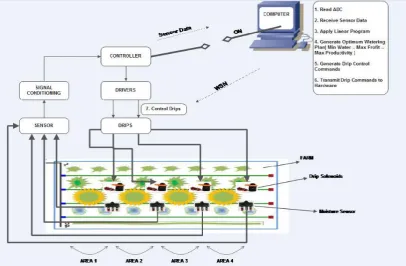
The aim is to design an intelligent drip irrigation system using wireless network system using Linear Programming. This system must be able to control the Valve timings of drips automatically based on pre-programmed timings. The time intervals for all the Valves can be fed into PC for an month or for particular days. Regional language based GUI must be developed so that novice users must be able to feed in the timings or program the hardware. An ADC connected to micro controller must gather the humidity values for soil at various points. These values must be visualized in software using 3D plots to assist the user in deciding valve timings. The computer can read the ADC values, also receives sensors data. Then whatever values have received from sensor and ADC all these values are taken into consideration before applying linear programming. When linear programming is get applied that need to refers some predefined constraints and then only we can generate maximum profit. So in order to apply linear programming to handle this system there is need to know that available water and energy power also need to know the ADC values that are recorded from the sensor and then apply the linear program. To generate maximum profit, determine the ways for the proper management of available water into number of crops in order to get maximum profit as well as productivity. So that integration of this system with conventional drip irrigation system becomes more and more efficient. Fig 1 shows the collection and transfer of data in drip system using wireless network.
Fig 1: control of drip system using signal in wireless network
through WSN.
a. Controller: It is heart of the whole system, means it controls the all activities of the system. It has memory in which control programs are saved.
b. Signal Conditioning: It is very essential. Generally the signal obtained from sensors are weak hence we uses signal conditioning in order to keep signal in to its original state.
c. Sensors: Sensor Sense the different physical parameters like light, ph_ value of soil, temperature and humidity and converts these sense data into electrical signals (either voltage or current).
d. Sensor Array: It is collection of various sensors basically it took input from sensor and fed that data as an input for the signal conditioning.
e. ADC (Analog to Digital Converter): It Converts analog signal into digital signal and fed that digital signal to the micro controller as an input.
f. Sensor Unit: The SU acquires data given by the ADC, and the data sent to BSU. Value of ADC input which comes from the sensor is stored in a 10-bit register.
g. wireless sensor network A wireless sensor network (WSN) consists of spatially distributed autonomous sensors to monitor physical or environmental conditions ,such as temperature, sound, vibration, pressure, motion or pollutants and to cooperatively pass their data through the network to a main location. The more modern networks are bi-directional, also enabling control of sensor activity. The development of wireless sensor networks was motivated by military applications such as battlefield surveillance, today such networks are used in many industrial and consumer applications, such as industrial process monitoring and control, machine health monitoring, and so on. Wireless sensor networks (WSN) have recently been proposed for a large range of applications in home and industrial automation. It consists of many tiny nodes, which have several sensors and a radio interface that depends on the IEEE 802.15.4 standard that supports large number of embedded devices in one network. WSN can be used for many applications such as environment monitoring, medical applications, robotic systems and home and industrial automation.
IV.
M ETHODOLOGY
Use of Linear Programming in System is a mathematical method for determining a way to achieve the best outcome (such as maximum profit or lowest cost) in a given mathematical model for some list of requirements represented as linear relationships. Linear programming is a specific case of mathematical programming (mathematical optimization).
.
• E.g. How to divide drip water timings in order to attain best possible throughput.
Consider 1000 liters of water
Profit: 6 Rs/Liter for Crop 1 7 Rs/Liter for Crop 2
Let ‖x‖ =liters for crop 1 ‖y‖ = liters for crop 2
Then PROFIT (P) = 6 x + 7 y (to maximize)
x + y ≤ 1000 − − − − − − − − − (1)
Power required sending 1 liter of water for crop 1 = 2 watts Power required sending 1 liter of water for crop 2 = 3 watts
Max power available = 2400 Watts
2x + 3y ≤ 2400 − − − − − − − −(2)
Solution:- Constraints x≥ 0, y ≥ 0
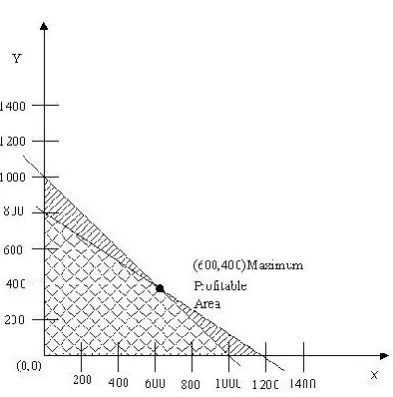
For Equation (1) put x=0 we get y=1000 and put y=0 we get x=1000 and for equation (2) put x=0 we get y=800 and put y=0 we get x=1200
maximum profit
2x + 3y = 2400——— (2)
-2x- 2y = -2000——– (1) multiplies by -2
Solve both Get y = 400
So put y=400 in equation (1) we get x=600
So now we have 4 points in graph i.e. (0,0), (1000,0), (0,800), (600,400).
Fig 2 shows proper distribution of water to get maximum profit. By using 4 points we get 2 lines. Interpretation of both lines gives the point which is maximum profitable area.
Now we have to calculate profit for that purpose we have to put these Values in equation (P = 6x + 7y)
For (0, 0) we get profit P = 0, For (1000,0) we get profit P = 6000 For (0,800) we get profit P = 56000
For (600,400) we get profit P = 3600 + 2800 = 6400 = maximum profit
Fig 2 Proper Distribution of Water to get maximum Profit Hence
600 liters of water for crop 1 And
400 liters of water for crop 2
VI EXPERIMENTAL RESULTS
Use of this system saves water, energy and manpower in the agriculture sector. Resource optimization technique is achieved in intelligent drip irrigation system. Provide the decision support for intelligent drip irrigation system. Automatically as well as manually system handling and detecting of water level. Increases the crop production and it uses the different. sensors like temperature, light, humidity, soil moisture is used in area where water resources are less. Complete elimination of manpower.
VII CONCLUSION
REFERENCES
[1]. Shiv Sutar, Swapnita-Jayesh, Komal-Priyanka MIT-COE, Pune, Mahrashtra. ‖Irrigation and Fertilizer control for Precision Agriculture usingWSN: Energy Efficient Approach‖, International Journal of Advances in Computing and InformationResearches, ISSN: 2277-4068, Volume 1 No.1, January 2012. [2]. Anurag D, Siuli Roy and Somprakash Bandyopad- hyay, Indian Insttute of Management Calcutta,
Kolkata, India ‖Agro-Sense Precision Agriculture using sensor based wireless mesh networks‖.
[3]. J.Panchard, P.R.S.Rao, M.S. Sheshshayee, P. Pa- padimitratos and J.-P. Hubaux ,‖Wireless Sensor Networking for Rain-fed Farming Decision Support‖.
[4]. Dnyaneshwar Wavhal and Manish giri ―Automated intelligent wireless drip irrigation using linear programming‖ International Journal of Advanced Research in Computer Engineering & Technology (IJARCET) Volume 2, Issue 1, January 2013, ISSN: 2278 – 1323,pp.1-5
[5]. S. R. Kumbhar, Arjun P. Ghatule, ―Microcontroller based Controlled Irrigation System for Plantation‖, Proceedings of the International MultiConference of Engineers and Computer Scientists 2013Volume II, March 2013.
[6]. Shiraz Pasha B.R., Dr. B Yogesha, ―Microcontroller Based AutomatedIrrigation System‖, The International Journal Of Engineering And Science (IJES), Volume3, Issue 7, pp 06-09, June 2014.