ISSN (e): 2250-3021, ISSN (p): 2278-8719
Vol. 08, Issue 8 (August. 2018), ||V (II) || 01-06
Realtime Wireless Smart Sensor System Using Raspberry Pi
K.Vijayanand Pg Scholar
Department Of Electronics And Communication Engineering St. Peters College Of Engineering, N. Viswanath Associate Professor,
Department Of Electronics And Communication Engineering St.Peters College Of Engineering, Corresponding Author: K.Vijayanand Pg Scholar
Abstract
— The constant growth of the digital enterprise has led a continuous growth of data sources and data that feeds into a potential big data eco system. With the advent of Internet of Things (IOT), multiple devices are getting connected with each of them being a big source of potential data. One such potential source of constant data feed are sensor devices which monitor wide variety of environmental data such as air pressure, temperate, humidity, orientation and further elements. We could easily envisage various ways of processing this data to suite various business and enterprise needs. The use of Bluetooth low energy (BLE) integrated in the Raspberry PI board along with the beacon technology for data transmissions helps serve the purse of a power and cost efficient solution. This paper present an approach to monitor the environmental data using commodity hardware like the Raspberry PI, sensor tag using BLE. This should help serve as a concept for building a power efficient economic and environmental monitoring solution that can be scaled based on the expanse over which environmental data monitoring is desired. This solution can be easily leveraged multiple other domains including industrial applications given the vast types of sensor hardware that integrate easily with the Pi board. The use of Bluetooth low energy (BLE) integrated in the Pi board along with Beacon technology for data transmissions helps serve the purse of a power efficient solution.Keywords
— Raspberry Pi, Bluetooth Lowe Energy, Web server, Senror devices, Wi-Fi, Sensor Tag,Wiced --- ---Date of Submission: 31-07-2018 Date of acceptance: 18-08-2018 ---
---I.
I
NTRODUCTIONBusiness cannot ignore growing importance of the constant digitization of data, and the eventual data explosion from the innumerable data sources connected over the internet. Now with the advent of Internet of Things (IoT), the growth of multiple connected devices is exponentially getting increased, adding to the possible sources of data and the data itself emanating from such sources. With an expected 21 billion devices possibly connected by the year 2020, used to produce this data in itself can become a huge cost to businesses. So it becomes important to explore cost-effective solutions build from commodity hardware and software using off-the-shelf products to satisfy the needs of business.
Today, a vast number of IoT devices related to healthcare and smart homes support Bluetooth or Wi-Fi connectivity. It means that tablets and smart mobile devices can act as hubs or gateways for such IoT devices. This paper presents and proposes a method for device control and performance monitoring of smart devices as gateway. BLE (version 4.0-4.2) also branded as Bluetooth Smart by Bluetooth Special Interest Group (SIG) is primarily focused for the growing smartphone markets and IOT solutions. The prime objective of this SIG is to minimize energy consumption by reducing functionality, complexity and throughputs.
It is also to be noted that the cost of the initial solution is just a fraction of the investment in general called capital expenditure (CAPEX). The cost of maintaining and upgrading the installed solution involves most of the Operating Expenditure (OPEX). A fine balance of CAPEX vx OPEX need to be maintained in designing and developing solutions for a product scalability
II.
RELATED
WORK
ON
MANAGEMENT
OF
I
OT
DEVICES
One or several of these connectivity solutions may constitute the communication infrastructure for enhanced assisted living environments. Operators and providers of care at home and related services need efficient and standardized methods to remotely operate, maintain and control their devices and services. There are several initiatives to enable end-to-end IP communication to gateways or multiple devices. Lightweight machine-to-machine (LWM2M) [9] from OMA (Open Mobile Alliance) is an integrated framework and protocol stack for remote management of cellular M2M appliances as well as devices from the IoT industry as a whole. LWM2M serves and clients (M2M or Iot devices) utilize the Constrained Application Protocol (CoAP) and DTLS/UDP which is an underlying protocol suite for transport of data. The CoAP protocol, is defined by IETF has RESTful Environment working group created an alternative to HTTP. The devices which has limited resources can still leverage standard web Methods like GET, PUT, POST and DELETE.
III.
TECHNOLOGIES
INVOLVED
A. Bluetooth Low Energy: Bluetooth Low Energy (Bluetooth LE, BLE, formerly referred as Bluetooth Smart) is a W-PAN (Wireless Personal Area Network) technology which is developed and marketed by the Bluetooth SIG (Special Interest Group). This technology is aimed at applications which includes multiple domains like home entertainment, fitness, medical and healthcare, security, and industrial applications. When Compared with classic Bluetooth technology, Bluetooth Low Energy is primarily designed to reduce power consumption and there by cost and providing extended communication range for low data rate applications. B. I Beacons: iBeacon is a protocol developed by Apple Inc. Multiple vendors have come up with
iBeacon-compatible hardware transmitters which are typically called as beacons. These beacons are class of Bluetooth low energy (BLE) devices which will periodically broadcast their unique identifier (UID) details to nearby portable electronic devices. This technology enables devices such as tablets, smart phones and other electronic devices to perform actions when they are in close proximity to an iBeacon network element. iBeacon is based on BLE sensing technology which will broadcast a universally unique identifier(UIID) on regular intervals and its get picked up by a similar application or operating system. The broadcast information contains information like device identifier and other sensor related parameters which can be used to determine the device's geographical location, track multiple such devices, or trigger an event based on its location.
C. Raspberry PI: The Raspberry Pi is a small form factor single-board computer designed and developed by Raspberry Pi Foundation. Several versions of of Raspberry Pi’s are available in the market. The system is powered by Broadcom System On Chip (SoC) which is an integrated variant of ARM compatible central processing unit (CPU) bundled with on-chip graphics processing unit (GPU) along with RAM and flash. The Raspberry Pi3 model was released in the year 2016 consisting of Broadcom 2837 ARMv8 CPU. The initial variant was having a clock frequency of 900MHz and a SDRAM of 1GB. The new Raspberry Pi 3 comes with a built in Wi-FI module for network connectivity along with 4 USB interfaces for connecting peripherals like keyboard/mouse along with onboard HDMI interface for connecting terminal devices. Raspberry Pi foundation provides an Operating System called Raspibian which is an open Source OS and is considered as the default OS for application development. Raspberry Pi comes with an 8 GPIO interfaces for interfacing multiple devices. The new Pi3 model also has a BLE support for developing applications using Bluetooth.
D. Web server: A Web server is an application program which uses standard HTTP (Hypertext Transfer Protocol) to serve the requests in the form of Web GUI pages to users, in response to their requests. The requests are created and forwarded by their computers web browsers which are designed on top of HTTP client protocol. The web browser creates a connection channel with the web server running on the computer. Data is further exchanged with an IP address and requests are served with the document on the host which name is hosted on a virtual path.
E. GATT commands:GATT Stands for General Attribute Profile and this is a way of communcation across two Bluetooth Low energy devices for data transfer. The data is exchanged using services and charecteristics. Once the Bluetooth device establishes a connection with the parnet devices, the data is then exchanged used this GATT protocol format. GATT connections are exclusive per device which means only one BLE device is connected to a centeral device at any given point in time.
WICED device can be further extended with the built-in GPIO interface which is used for extension of additional sensors or peripheral devices for control.
IV.
SYSTEM
DESIGN
1. The intent of this design is to have a scalable solution with sensors operating with BT/BLE and system connected to a centralized network using Wi-Fi network. Different sensors can be associated to the system without the need of physical wiring alike the case of a standard GPIO connection for which one set of wiring is dedicated to a given sensor.
2. WICED sense kit has multiple sensors like pressure, temperature, accelerometer and Gyroscope. This paper currently uses pressure and temperate sensors but the design is flexible so this framework can be extended to any sensor element.
3. The Raspberry Pi device is brought up with a Linux distribution Raspibian (Jessi) on a standard SD card. This will enable WLAN and other peripheral ports like USB. Further interfacing with BLE devices is achieved by installing BLE packages and tools which can be installed from Pi Repository or independently from different sources package lists. GATT framework is used for data exchange between BT/BLE devices and Raspberry PI. A proprietary communication protocol over is designed over GATT BT/BLE framework to interface with the WICED BLE enabled device. Multiple socket communication messages are exchanged between the two BLE enabled devices for protocol exchange along with the underlying data exchange which is required to be monitored by Raspberry Pi system.
4. A HTTP server is integrated to Raspberry Pi system to monitor the health of these sensors in real time. Further automation of the system can be made by implementing multiple scripts to connect to Pi devices and capture the data in real time and design a dash board for more meaningful design. The entire design, Development and programming is done in embedded C in Linux environment for ARM platform.
5. The hardware solution is a hand held device which can be installed in any premises as this doesn’t has any physical connections either to local network or to the sensor nodes and all of this is designed using Wi-Fi/BLE. The framework is scalable so this can be even extended to multiple such sensors nodes to monitor the data in real time using a standard web browser.
6. Alerts like alarms or LED alerts can be configured by mapping the GPIO ports for a desired functionality. A similar alert mechanism is incorporated in the web browser which can be configured based on the required thresholds for a given sensor parameter. Ex: If the temperate at any given point of time falls below 30 degree centigrade then a auto alert can be sent to the end user for further monitoring.
7. In order to ensure end to end connectivity across the devices, a periodic heartbeat message is exchanged between the Pi and WICED device and the health of the sensors will be presented in the Web GUI. If the communication between the sensor and the Pi fails then an alert is issued on the web GUI so that the end user can take necessary action.
8. The WICED sensor tag is powered by a coin cell of 3Volts and this battery condition is also collected periodically by Raspberry Pi as a part of BLE protocol exchange messages. This will help the end user to monitor the battery life of these devices and the end user can take a required action to change the battery based on the battery life.
V.
IMPLEMENTATION
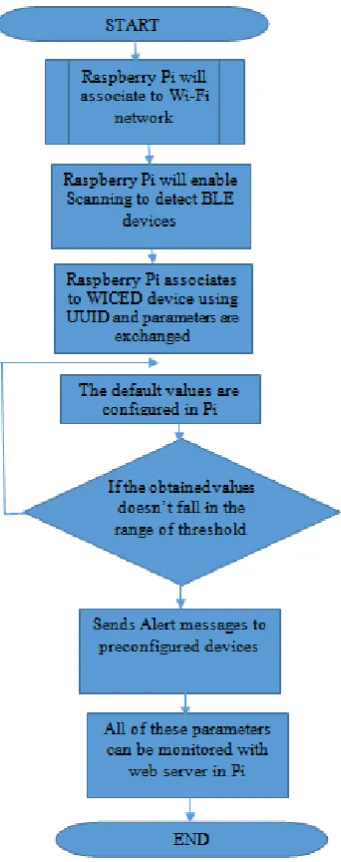
A. flow chartmaximum distance of 50 Meters. All of these results are periodically updated in the web server for constant monitoring of the vital elements. These parameters can also be viewed from a remote location as the Raspberry Pi is connected to internet using WLAN or Wi-Fi.
The below results in Figure 1 shows the values obtained from the sensor tag with a BLE client device. The BLE client device uses GATT commands in order to interface and exchange the data. Upon connection the data is exchanged between the BLE sensor tag and the BLE capable Raspberry Pi-
The below snap-shot in Figure 2 shows the web GUI interface showing the values of different sensor elements. The values will be changed based on the movement of the BT-BLE enabled sensor tag.
Figure 2: Web based access of sensor elements from a remote Wi-Fi server.
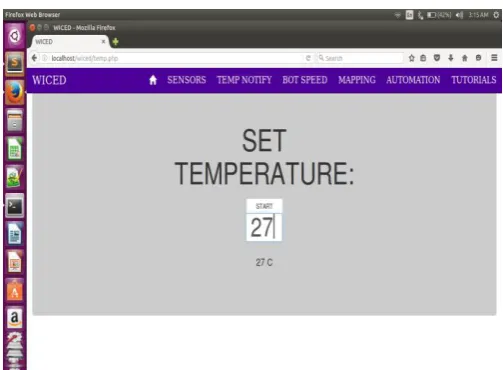
The below snap-shot in Figure 3 shows the Web GUI configuration page to set the required threshold for temperature. Once a specific threshold value is set, an alert is generated once the sensor crosses the set value. This event can be used by the administrator to take necessary action based. This also can be used to monitor a given sensor and this functionality can be extended to any sensor based on the event logic mechanism. Once the sensor is detected, the values are exchanged between sensor Tag and Raspberry Pi periodically.
Figure 3: Web GUI snap-shot to set the temperature alert of a given sensor device.
Scalability:- The current design can support up to 5 sensor parameters and they can be extended based on the need of the requirement. The extended elements in the sensor parameters can be added in the Bluetooth BLE tags as information elements for the Raspberry Pi and WICED device. This functionality can be extended to communicate with 8 such Bluetooth enabled devices so that all of the devices can exchange data with Raspberry Pi simultaneously to improve the scalability of the solution. The sensor elements on any WICED device can also be extended to 10 per device making the system to support multiple data monitoring elements.
VI.
APPLICATION
This proposal is a framework which can be used in many different domains based on the implementation proposed. The prime application areas of this approach include
1. Detect the levels of poisonous gases in an industrial environment that might prove detrimental to the health of the laborers, possibly evacuation of workspace or introducing neutralizing agents to nullify the toxic effects of such gases.
2. Using pressure and humidity sensors to know the weight and situation of the stock in a big warehouse there by monitoring the stock and triggering replenishments based on the report.
4. Another popular application area is to use this system for tracking a particular fixed asset. This can be achieved by taking the references of Gyro and compass values and fixing the location of the asset. Any change in the Gyro values will trigger an alert to the MCU (Raspberry Pi) which will start a camera to monitor the environment for location change.
VII.
CONCLUSSION
This work provides an approach to gather, compute and process multiple vital parameters required using a small and compact device like Raspberry Pi and a smart sensor gathering device like WICED. This approach provides a cost effect way of implementing a hardware and system software solution for collecting and monitoring environmental data in a wide variety of areas ranging from agriculture, grocery and manufacturing industry, including IT environments. An attempt is made here to implement the raspberry Pi Beacon, which allows an operator to monitor the sensor device readings connected to the Raspberry Pi from a remote location and also use beacons as a location system to help navigate towards the source of the environmental problem or location requiring attention. The raspberry Pi together with a BLE module like WICED can broadcast sensor readings with indoor positioning of Pi that can be read by any browser enabled device connected to Internet or in the same network of the Raspberry Pi.
VIII.
FUTURE
WORK
IBeacon payload: The iBeacon has a limitation of 20 bytes payload. This will limit the amount of environmental data that can be transmitted in each beacon payload. To overcome this limitation Altbeacons can be used in the design which has a bigger payloads of 28 bytes where 25 bytes are available for payload.
The current design can be improved by adapting different optimization techniques in the Pi and WICED device for supporting a cluster of devices and networks.
The existing system can be used to track the location of fixed assets along with GPS co-ordinates making device more scalable and adaptable for different environments.
A
CKNOWLEDGMENTThe work is carried out at Saint Peters College of engineering, Hyderabad. We thank all the individuals of this organization for their feedback and support for executing this project.
REFERENCES
[1]. https://www.raspberrypi.org/[2]. http://www.ibeacon.com/what-is-ibeacon-a-guide-to-beacons/
[3]. Je-sung Jeon; Youngsun Kong; Yunyoung Nam; Kangbin Yim, “An Indoor Positioning System Using Bluetooth RSSI with anAccelerometer and a Barometer on a Smartphone”, 2015 10th International Conference on Broadband and Wireless Computing, Communication and Applications (BWCCA), Year: 2015, Pages: 528 - 531, DOI: 10.1109/BWCCA.2015.142, IEEE Conference Publications.
[4]. Markus Koühne; Jürgen Sieck, “Location-Based Services with iBeacon Technology ”, Artificial Intelligence, Modelling and Simulation (AIMS), 2014 2nd International Conference on Year: 2014, Pages: 315 - 321, DOI: 10.1109/AIMS.2014.58, IEEE Conference Publications.
[5]. Sudhir G. Nikhade, “Wireless sensor network system using Raspberry Pi and zigbee for environmental monitoring applications”,Smart Technologies and Management for Computing, Communication, Controls, Energy and Materials (ICSTM), 2015 International Conference on Year: 2015, Pages: 376 - 381, DOI: 10.1109/ICDM.2015.7225445, IEEE Conference Publications.
[6]. Kittipong Kasantikul; Chundi Xiu; Dongkai Yang; Meng Yang, “An enhanced technique for indoor navigation system based on WIFI-RSSI”, 2015 Seventh International Conference on Ubiquitous and Future Networks Year: 2015, Pages: 513 - 518, DOI: 10.1109/ICUFN.2015.7182597, Cited by: Papers (1), IEEE Conference Publications.
[7]. Helmut H. Strey; Paul Richman; Russell Rozensky; Stephen Smith; Lisa Endee, “Bluetooth low energy technologies for applications in health care:proximity and physiological signals monitors”, Emerging Technologies for a Smarter World (CEWIT), 2013 10th International Conference and Expo on Year: 2013, Pages: 1 - 4, DOI: 10.1109/CEWIT.2013.6851347, Cited by: Papers (4), IEEE Conference Publications. [8]. Maria Varsamou; Theodore Antonakopoulos, “A bluetooth smart analyzer in iBeacon networks”, 2014
IEEE Fourth International Conference on Consumer Electronics Berlin (ICCE-Berlin), Year: 2014, Pages: 288 - 292, DOI: 10.1109/ICCE-Berlin.2014.7034291, Cited by: Papers (1) , IEEE Conference Publications.