Data Transfer System for Security Applications
Arun Prasad. M
Assistant Professor
Department of B.Sc. Electronics & Communication Systems KG College of Arts and Science, Coimbatore, India
Abstract
The research entitled data transfer system for security applications is employed to transfer data from one device to a different device with at most security. The transmitted data are browse solely by the suitable receiver. This novel is split into two sections. One is that the transmitter section and therefore the another one is that the receiver section. In the transmitter section we tend to send the information from laptop or computer to controller through RS-232 communication. The controller encrypts the information and send to the RF transmitter. Block cipher algorithmic rule is a good cryptography technique that is employed to code the information. The RF transmitter transmits the encrypted data. Within the receiver section the RF receiver receives the encrypted data then this data is distributed to the controller. The controller decrypts the information and send the information to laptop or computer through RS-232 communication.
Keywords: RS-232 Communication, Data Transfer System
________________________________________________________________________________________________________
I. INTRODUCTION
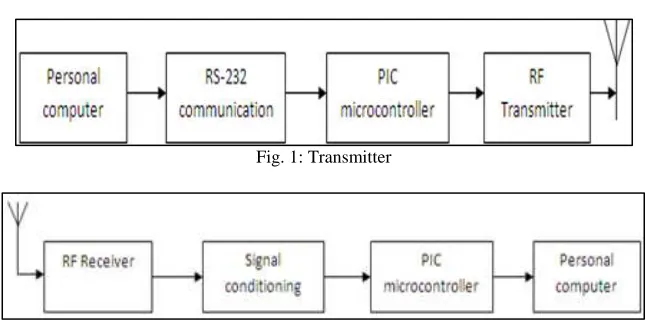
An embedded system could be a special purpose ADPS designed to perform one or a couple of dedicated functions, usually with period of time computing constraints. It's sometimes embedded as a part of an entire device as well as package and hardware elements. In distinction, a general laptop, like a private laptop, will do many various tasks in programming. Embedded devices have several common devices in use nowadays. Embedded system is devoted to try and do specific tasks, style engineers will optimize it, reducing the dimensions and value of the merchandise, or increasing the responsibleness and performance. Some embedded systems are factory made, making the most of economies of scale. Physically, embedded systems vary from moveable devices like digital watches and MP3 players, to giant stationary installations like traffic lights, industrial plant controllers, or the systems dominant nuclear energy plants. Complexness varies from low, with one microcontroller chip, to terribly high with multiple units, peripherals and networks mounted within an oversized chassis or enclosure. In general, "embedded system" isn't associate precisely outlined term, as several systems have some part of programmability. As an example, hand held computers share some components with embedded systems like the operative systems and microprocessors that power them don't seem to be really embedded systems, as a result they permit totally different applications to be loaded and peripherals to be connected. For all the safety applications there'll be the requirement to transfer data from one device to a different device. So the transmitted data has got to transmitted in an exceedingly most secured means so solely the suitable receiver will be able to open that data. This circuit has the transmitter and therefore the receiver sections. Within the transmitter section, the data that has got to be sent are encrypted by the PIC microcontroller then this encrypted data are transmitted through the RF transmitter. Within the receiver section, the RF receiver receives the encrypted data then the PIC Microcontroller can decode the data and therefore the original data are displayed within the receivers laptop. This circuit is built to transmit data up to the vary of fifty metres and it transmits data victimization FSK modulation within the vary of 433MHz.
II. THE STRUCTURE AND COMPOSITION OF THE SYSTEM
Fig. 1: Transmitter
RS 232 Communication
RS 232 (Recommended normal 232) is that the ancient name for a series of standards for serial binary single ended data and management signals connecting between a DTE (Data Terminal Equipment) and a DCE (Data Circuit-terminating Equipment). It's normally employed in laptop serial ports. The quality defines the electrical characteristics and temporal order of signals that means of signals, and therefore the physical size and pin out of connectors. Here RS-232 is employed for serial communication between the PIC microcontroller and GSM electronic equipment.
PIC Microcontroller
The PIC16F877A is that the heart of the system. It controls the operations of assorted blocks. It's associate 8-bit controller that processes 8-bit at a time. All blocks are interfaced with controller through its ports.
RF Transmitter
The sending system consists of two tuned circuits such the one containing the spark-gap could be a persistent oscillator; the opposite, containing the aerial structure. The oscillatory system, as well as the aerial structure with its associated inductance coils and condensers, is meant to be each a sufficiently persistent generator and a sufficiently active radiator. The sending system consists of two electrically coupled circuits, one among that, containing the air-gap, could be a powerful however not persistent generator, being given a tool for extinction the spark thus shortly because it has imparted enough energy to the opposite circuit containing the aerial structure, this second circuit then severally diverging the train of slightly damped waves at its own amount.
RF Receiver
A frequency receiver could be a radio set that's sometimes composed of many tuned frequency amplifiers followed by circuits to observe and amplify the audio signal. The RM 433 could be a frequency receiving device that operates at 433Mhz. It's designed to receive signals that are transmitted by RTI universal system controllers.
Signal Conditioning
In natural philosophy, signal learning suggests that manipulating associate analog signal in such how that it meets the wants of ensuing stage for more process. Common use is in analog to digital converters. Signal learning will embrace amplification, filtering, converting, vary matching, isolation and the other processes needed to create sensing element output appropriate for process once learning.
III. THEORY OF OPERATION
The Data transfer system for security application works on the principle of the block cipher algorithmic program that encrypts the information from the receiver facet in order that the transmitted data are within the encrypted kind. The initial data won't be offered to everybody within the receiver facet, as a result of this technique uses the word protection, in order that solely the acceptable one who is aware of the word are often ready to retrieve the data. The PIC Microcontroller plays a significant role during this system. Two PIC Microcontrollers area unit used, one for the transmitter and one for the receiver. Registers like TRISC, SPBRG, BRGH, RCSTA, TXSTA, GIE, all area unit set in step with the transmission or reception. TRISC register is employed to line whether or not it's input or output. SPBRG register is employed to line the baud for the system. BRGH register is employed to line the system speed, whether or not high speed or low speed. TXSTA register is employed to modify the transmitter section and therefore the register RCSTA is employed to modify the receiver section. RF Transmitter is employed to transmit the encrypted data so the RF Receiver can receive the data so the initial data are displayed solely once the receiver sides word confirmation. So the data area unit protected against the time of transmission and up to the receivers identity. This circuit is made with the RF 433. The RF 433 is right for device applications wherever low value and longer vary is needed. The transmitter operates from one 5 - 12V provide, creating it ideal for powered applications. The transmitter employs a SAW-stabilized generator, making certain correct frequency management for best vary performance. Electrical currents that are generated at radio frequencies have special properties not shared by electrical energy or AC current of lower frequencies. The energy in associate RF current will radiate off a conductor into area as magnetic attraction waves , this is often the premise of the technology of radio .The RF transmitter are often ready to transmit up to fifty metres, in order that this technique are often ready to transfer data up to the vary of fifty Metres.
Microcontroller
process unit. If a system is developed with the microcontroller, the designer has got to opt for the external memory like RAM, computer memory or ROM and peripherals and therefore the dimensions of the PCB are giant enough to carry all the desired peripherals. But, the digital computer possesses of these peripheral facilities on one chip thus development of an identical system with a microcontroller reduces PCB size and price of the planning.
PIC Microcontroller
PIC may be a family of Harvard design Microcontroller created by semiconductor unit Technology , derived from the PIC1640 originally developed by General Instrument's electronics Division. The name PIC at first noted Peripheral Interface Controller. PICs area unit fashionable each industrial developers and hobbyists alike because of their low value, wide handiness, giant user base, intensive assortment of application notes, handiness of low value or free development tools, and serial programming capability.
The PIC design is characterized by its multiple attributes:
Separate code and knowledge areas (Harvard architecture) for devices aside from PIC32, that encompasses a Neumann design. A little variety of mounted length directions.
Most directions area unit single cycle execution (Two clock cycles), with one delay cycle branches and skips. One accumulator (W0), the utilization of that (as supply operand) is silent (i.e. isn't encoded within the opcode). All RAM locations operate as registers as different functions.
A hardware stack for storing come back addresses.
A fairly touch of available knowledge area, extended through banking. Data area mapped mainframe, port, and peripheral registers.
The program counter is additionally mapped into the information area and writable.
There is no distinction between memory space and register space because the RAM serves the job of both memory and registers, and the RAM is usually just referred to as the register file or simply as the registers.
Universal Synchronous Asynchronous Receiver Transmitter (USART)
The Universal Synchronous Asynchronous Receiver Transmitter (USART) module is one in all the two serial I/O modules. (USART is additionally referred to as a Serial Communications Interface or SCI.) The USART are often organized as a full-duplex asynchronous system that may communicate with peripheral devices, such as CRT terminals and private computers, or it are often organized as a half-duplex synchronous system that may communicate with peripheral devices, like A/D or D/A integrated circuits, serial EEPROMs, etc.
USART Asynchronous Transmitter
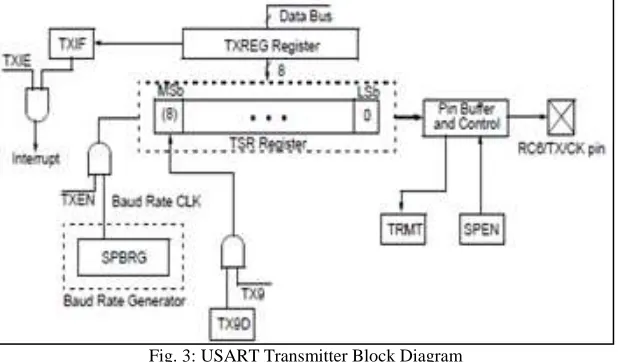
The USART transmitter diagram is shown in Figure. The center of the transmitter is that the Transmit (Serial) register (TSR). The register obtains its data from the Read/Write Transmit Buffer, TXREG. The TXREG register is loaded with data in software system. The TSR register isn't loaded till the Stop bit has been transmitted from the previous load. As before long because the Stop bit is transmitted, the TSR is loaded with new data from the TXREG register. Once the TXREG register transfers the information to the TSR register (occurs in one TCY), the TXREG register is empty and flag bit, TXIF (PIR1<4>), is set.
Fig. 3: USART Transmitter Block Diagram
the present bit that the user has got to poll this bit so as to see if the TSR register is empty. Transmission is modified by setting enable bit, TXEN (TXSTA<5>). The particular transmission won't occur till the TXREG register has been loaded with data and therefore the baud Generator (BRG) has created a shift clock.
USART Asynchronous Receiver
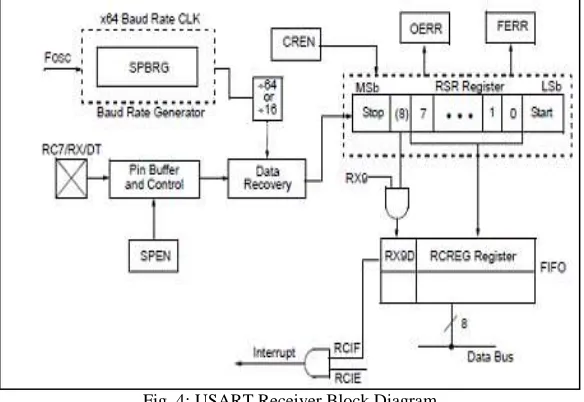
The receiver diagram is shown below. The information is received on the RC7/RX/DT pin and drives the information recovery block. The information recovery block is actually a high-speed shifter, operational at x16 times the information measure rate; whereas the most receive serial shifter operates at the bit rate or at FOSC. Once Asynchronous mode is chosen, reception is enabled by setting bit CREN (RCSTA<4>).
Fig. 4: USART Receiver Block Diagram
The heart of the receiver is that the Receive (Serial) register (RSR). Once sampling the Stop bit, the received data within the RSR is transferred to the RCREG register (if it's empty). If the transfer is complete, flag bit, RCIF (PIR1<5>), is set. The particular interrupt are often modified/ disabled by setting/clearing enable bit, RCIE (PIE1<5>). Flag bit RCIF may be a read-only bit that is cleared by the hardware. It’s cleared once the RCREG register has been scan and is empty. The RCREG may be a double-buffered register (i.e., it's a two-deep FIFO). It’s attainable for 2 computer memory units of data to be received and transferred to the RCREG inventory accounting and a 3rd byte to start shifting to the RSR register. On the detection of the Stop little bit of the third computer memory unit, if the RCREG register remains full, the Overrun Error bit, OERR (RCSTA<1>), are set. The word within the RSR are lost. The RCREG register are often scan doubly to retrieve the 2 bytes within the inventory accounting. Overrun bit OERR has got to be cleared in software system. This is often done by resetting the receive logic (CREN is cleared so set). If bit OERR is ready, transfers from the RSR register to the RCREG register area unit reserved and no more data are received. It is, therefore, essential to clear error bit OERR if it's set. Framing error bit, FERR (RCSTA<2>), is ready if a Stop bit is detected as clear. Bit FERR and therefore the ninth receive bit area unit buffered an equivalent approach because the receive data. Reading the RCREG can load bits RX9D and FERR with new values, therefore, it's essential for the user to scan the RCSTA register before reading the RCREG register so as to not lose the previous FERR and RX9D data.
IV. BLOCK CIPHER ALGORITHM
Block cipher may be a interchangeable key cipher operational on fixed-length teams of bits, known as blocks with associate unvarying transformation. A block cipher secret writing algorithmic program would possibly take (for example) a 128-bit block of plain text as input, and output a corresponding 128-bit block of cipher text. the precise transformation is controlled employing a second input — the key, secret writing is similar: the secret writing algorithmic program takes, during this example, a 128-bit block of cipher text at the side of the key, and yields the initial 128-bit block of plaintext. A message longer than the block size (128 bits within the on top of example) will still be encrypted with a block cipher by breaking the message into blocks and encrypting every block separately. However, during this methodology all blocks area unit encrypted with an equivalent key, that degrades security (because every repetition within the plaintext becomes a repetition within the cipher text) to beat this issue, modes of operation area unit accustomed build secret writing probabilistic. Some modes of operation, despite the very fact that their underlying implementation may be a block cipher, enable the secret writing of individual bits. The ensuing cipher is termed a stream cipher.
The block size, n, is usually sixty four or 128 bits, though some ciphers have a variable block size. Sixty four bits was the foremost common length till the mid-1990s, once new styles began to change to the longer 128-bit length. One in all many modes of operation is usually used at the side of a artifact theme to permit plaintexts of arbitrary lengths to be encrypted. Every mode has totally different characteristics in relevancy error propagation, easy random access and vulnerability to sure varieties of attack. Typical key sizes (k) embrace forty, 56, 64, 80, 128, 192 and 256 bits.
Data Encryption Standard (DES)
DES is one in all the foremost widespread secret writing standards for Block Cipher secret writing. DES stands for encryption Standards and was free in 1974 by IBM once the Department of Commerce requested a general purpose secret writing customary. DES works by calling it off the clear text into sixty four bit blocks, and needs a 56-bit key. The block is then rearranged before it's sent through the algorithmic program. DES then starts on the primary 64-bit input block and breaks it into two halves, a right and a left [*fr1]. The algorithmic program may be a series of sixteen transformations, that area unit known as rounds. Throughout the primary spherical, the algorithmic program can remodel the proper [*fr1] employing a sub key generated by a series of operations that generates a 48-bit key from the initial 56-bit key. Then it XORs the left half the block with the new remodeled block, and this becomes the new left half the block. Then the algorithmic program swaps the left and right sides of the block and sends it through ensuing spherical.
DES was revised so came Double-DES. Double-DES was found to be no more effective than DES, thus Double-DES was revised and have become Triple-DES.
Block Cipher algorithms area unit subject to an equivalent attacks that interchangeable key algorithms area unit. Interestingly enough, associate secret writing methodology is taken into account to be broken if it's attainable to derive the clear text in but time than a brute force attack would. There aren't any limitations on the number of storage that's needed, the amount of clear text and cipher text pairs you'd want, or the time needed, as long because it will complete the task quicker than brute Force, it'll be thought of to be broken.
Block Cipher algorithms area unit extraordinarily vital to Communication Security. Block Cipher algorithms area unit very simple to implement, relative to some uneven algorithms. Block Cipher algorithms even have the advantage that it isn’t tough to write in code and decipher messages, as a result of an equivalent key's accustomed write in code and decipher. this is often compared to uneven algorithms within which you've got to possess a separate public key for each person you want to take care of secure transmissions with. The convenience, easy use, and comparatively secure algorithms area unit what build Block Cipher algorithms a decent alternative for Communication Security.
V. FSK
Frequency Shift Keying (FSK) may be a FM theme within which digital data is transmitted through distinct frequency changes of a radio radiation. Frequency Shift Keying is additionally referred to as Frequency Shift Modulation and Frequency Shift sign. Frequency Shift Keying may be a data signal reborn into a particular frequency or tone so as to transmit it over wire, cable, glass fibre or wireless media to a destination purpose.
FSK is additionally referred to as frequency shift modulation and frequency shift sign. Frequency Shift Keying may be a data signal reborn into a particular frequency or tone so as to transmit it over wire, cable, glass fibre or wireless media to a destination purpose. In Frequency Shift Keying, the modulating signals shift the output frequency between planned levels. Technically FSK has 2 classifications, the non-coherent and coherent FSK. In non-coherent FSK, the fast frequency is shifted between two distinct values named mark and area frequency, severally. On the opposite hand, in coherent Frequency Shift Keying or binary FSK, there's no section separation within the sign. Frequency Shift Keying (FSK) reception is that the method of sick the initial signal by sleuthing the frequencies concerned within the original modulation. Typically, this is often through with a bandpass electronic equipment tuned to at least one of the two frequencies, followed by a amplitude rectifier. The output is that the original signal.
Radio Frequency
Radio frequency (RF) is a rate of oscillation within the vary of regarding thirty kHz to three hundred GHz, that corresponds to the frequency of radio waves , and therefore the alternating currents that carry radio signals. RF typically refers to electrical instead of mechanical oscillations, though mechanical RF systems do exist. Electric Currents that oscillate at radio frequencies have special properties not shared by electrical energy or AC current of lower frequencies. The energy in associate RF current will radiate off a conductor into area as magnetic attraction waves (radio waves), this is often the premise of the technology of radio . RF current cannot penetrate deeply into electrical conductors however flows on the surface of conductors; this is often referred to as the electrical phenomenon.
RF 433
creating Federal Communications Commission and ETSI compliance straight forward. The manufacturing-friendly SIP vogue package and low-priced build the RF-433 appropriate for top volume applications.
VI. CONCLUSION
In this new era, the information transfer between two devices is common. In order that the data has got to be sent by confirming that solely the acceptable person has got to scan that data. Our paper created exploitation the PIC Microcontroller is employed to transfer the data through the FSK modulation within the vary of 433 megacycle per second. In order that the data are often scan solely the priority one who is aware of the word, so in this novel, high security for the data is given. The created secured data transfer device works properly to transfer data from one device to the another one with none interaction. Once the data area unit transmitted from the transmitter, the receiver section is aware to receive the data. The receiving person has got to sort the proper word that has been set throughout the transmission method and if the receiving person enters the incorrect word, the transmitted messages are erased, in order that the receiving person has got to enter the proper word in order to receive the data. This data transfer system for security application is a very important device for the secured transfer of data between two systems. During this several developments are often done. Advancements within the field of wireless communication can add a lot of glitters to the present paper. Our Country is incredibly abundant developed within the field of science and technology, that the enhancements during this technique are often simply created. The scope for the longer term sweetening is wide. A number of the scopes area unit, transmission distance are often multiplied, system are often ready to add all weather conditions, graphical data are often transferred, audio and video data are often transferred.
REFERENCES
[1] http://www.microchip.com [2] http://www.murata.com
[3] http://www. interq.or.jp/japan/se-inoue/e_menu.html [4] http://www.electroschematics.com