Int. J. of Engg. Sci. & Mgmt. (IJESM), Vol. 2, Issue 3: July-Sep.: 2012, 292-296
INTERNATIONAL JOURNAL OF ENGINEERING SCIENCES
&
MANAGEMENT
STUDIES OF BEAM FORMING ALGORITHMS FOR SMART ANTENNA SYSTEMS IN WIRELESS COMMUNICATION APPLICATION
*Prof. G.R Prajapati, 1Prof. Nishant singh Rana *,1Alpine Institute of Technology, Ujjain (M.P), India
ABSTRACT
Adaptive antenna arrays are being developed to cope with the high capacity requirement of the 3G/4G wireless cellular communications systems Smart antenna is the most efficient leading innovation for maximum capacity and improved quality and coverage. A systematic comparison of the performance of different Adaptive Algorithms for beam forming for Smart Antenna System has been extensively studied in this research work. Simulation results revealed that training sequence algorithms like Recursive Least Squares (RLS) and Least Mean Squares (LMS) are best for beam forming (to form main lobes) towards desired user but they have limitations towards interference rejection .While Constant Modulus Algorithm (CMA) has satisfactory response towards beam forming and it gives better outcome for interference rejection, but Bit Error Rate (BER) is maximum in case of single antenna element in CMA. It is verified that convergence rate of RLS is faster than LMS so RLS is proved the best choice. The effect of changing step size for LMS algorithm has also been studied.
Key words: Smart Antenna System % Beam forming % Training sequence algorithms % Bit
error rate
INTRODUCTION
The demand for Wireless Mobile
Communication services are growing at an explosive rate, with the anticipation that communication to a mobile device anywhere on the globe at all times will be available in the near future. Smart antenna for mobile
communication has received capacity
enhancements without the need for
additional enormous interests worldwide in recent years. In the last power or spectrum, many practical algorithms for MIMO decade wireless cellular communication has
Corresponding Author* Email- [email protected]
Int. J. of Engg. Sci. & Mgmt. (IJESM), Vol. 2, Issue 3: July-Sep.: 2012, 292-296
and enhance system output (MIMO) system offers greater capacity than capacity. Several approaches have been studied to SISO counterparts. The multiple antennas can be used introduce smart antenna technology into GSM, IS-136 and to increase the communication reliability by diversity third generation systems. They have been considered or to increase the data rate by spatial multiplexing or a mostly for base stations so far. Recently, they have been combination of both. Smart antennas refer to a group of applied to mobile stations or handsets. Also, one of the antenna technologies that increase the system capacity third generation wireless personal communication by reducing the co-channel interference and increase the systems, 3GPP (third generation partnership project), quality by reducing the fading effects. Co-channel requires antenna diversity at base stations and optionally interference is the limiting factor to the communication at mobile stations but cost of fabrication increases with systems . Array containing M identical elements can the number of array elements .areas of radar, sonar, medical imaging location based application and communications. Smart antennas have the property of spatial filtering, which makes it possible to receive energy from a particular direction while simultaneously blocking it from another direction. This property makes smart antennas as a very effective tool in detecting and locating radiation from other sources. Smart antennas are characterized into switched beam system and adaptive arrays. In this paper adaptive arrays are investigated and used for smart antenna model. In adaptive beam forming, the goal is to adapt the beam by adjusting the gain and phase on each antenna element such that a desirable pattern is formed.
MATERIALS AND METHODS
The output response of the uniform linear array is given by LMS as follows:
y(n)= wH x(n) (1) where w is the complex weights vector and
x is the received signal vector Optimal weights are calculated as follows:
w(n+1)= w(n)- µ g(w(n)) (2)
where w(n+1) denotes new weights
computed at(n+1) iteration. ì is gradient step
size that controls the convergence
characteristics of the algorithm, that is how fast and close the estimated weights approach the optimal weights g(w(n)) is estimate of gradient of the Mean Square Error (MSE);
MSE(w(n))=E[3r(n+1)ï²]+ wH (n)R w(n)-2 wH(n)z (3) Errors between reference signal and array output have been calculated using standard methods. In RLS, from LMS is replaced by gain matrix, weight vector and error signal are calculated using standard methods.
RESULTS AND DISCUSSION
Int. J. of Engg. Sci. & Mgmt. (IJESM), Vol. 2, Issue 3: July-Sep.: 2012, 292-296
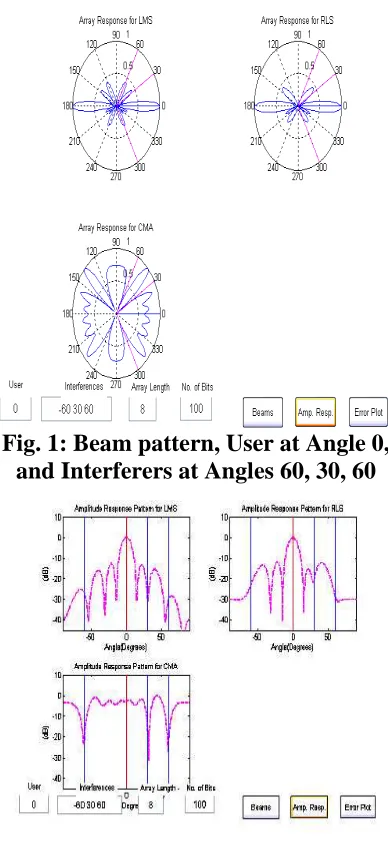
calculated for LMS, RLS and CMA. It is also revealed that by selecting larger array of antenna elements, element spacing increases. Major drawback of this approach lies in appearance of replicas of main lobe in undesired directions, referred to as grating lobes. Amplitude response is obtained by taking 20log10 of the values obtained during beam pattern (Figure 2). From Amplitude response it is also clear that main lobe is formed best from RLS and LMS Algorithms as it has maximum signal strength in user direction. While interference rejection is better in CMA as it can be seen that it is producing nulls towards interfering signals. By giving different angles to user signal and interference the amplitude response changes accordingly. The BER is obtained by first demodulating the output signal (that was modulated in Minimum Shifting Keying environment) to obtain the bits that were present in demodulated signal. Then these bits have been subtracted from the bits of original signal values. Modulus of this subtraction gives the BER values. The high error rate in single antenna element is due to the fact that it would have to provide coverage to enhanced number of users, which are much more than its capacity so error rate increases. CMA is Blind Sequence algorithm that does not require any training bits and it gives relatively less BER.LMS is training sequence Algorithm that requires reference signal to compare with input signal so it lessons BER. It has been
revealed from different simulation
measurements that RLS gives best results. It can be seen that BER is maximum for a single antenna element and BER reduces by using smart antenna system having Adaptive Algorithms.
Fig. 1: Beam pattern, User at Angle 0, and Interferers at Angles 60, 30, 60
Fig. 2: Amplitude Responses, User at Angle 0, Interferers at -60, 30, 60
The error plot is drawn by subtracting original signal from output signal. Its magnitude has been calculated to draw the plot. It has been observed that increasing the value of SNR error decreases. Minimum error has been noticed from RLS and
maximum error from CMA. Many
Int. J. of Engg. Sci. & Mgmt. (IJESM), Vol. 2, Issue 3: July-Sep.: 2012, 292-296
physics of the problem at hand. So it is further recommended for operators to verify performance in real life also. By increasing the number of elements in the Antenna Array (from 8 to 12 in this case) the Beams
become narrow. The most exciting
contribution of smart antennas in
communication technology lies in its narrow beam features that enhances directional gain and intensity and the user can be facilitated with maximum signal strength. On operator end it also saves power because a narrow beam consumes less power than a broad beam. By comparing amplitude responses from Figure 2, it is ascertained as well that beam size is reduced when we increase antenna array. The worst condition of SNR for performance comparison has been considered as well. The SNR has been reduced from 10 to 2 db, interference and user signals have been given angles quite close to each other that is a performance limiting factor for smart antenna system .The simulation results revealed that CMA and LMS give maximum BER when user and interference are quite close to each other which is not affordable in practical Base Station installations. In LMS algorithm weights are updated using a reference signal mostly and no knowledge of the direction of signal is utilized. Under certain conditions for example when the eigen value spread is large, convergence rate of LMS Algorithm slows down. This leads to development of RLS algorithm, which replaces the step size. CMA doesn’t use any reference signal but automatically selects one or several of the multi paths as the desired signal. When array vector is updated it does not need to know the arrival timings of the incident rays. It does not need to synchronously sample the received signal with the clock timing. RLS algorithm has been designed to cater with any change in environment and considering
all the other key parameters. Also
probability of this so close co channel interference is equally likely in real world. So on commercial scale it is not desirable to implement such problematic technique. It is evident as well that best performance
promise in all conditions is duly
accomplished by RLS only.
CONCLUSION
We have analyzed various types of primary array configurations such as linear, planar and circular arrays of isotropic sensors using array factor approach with the beam steering capabilities using MATLAB simulation. In a comprehensive comparison among adaptive algorithms, the parameters of beam pattern, amplitude response, error plot and BER have been studied. The system has also been analyzed in strict SNR environment. The significance of LMS algorithm cannot be ruled out in generating better main lobe in a specified direction of user but to nullify co channel interference it plays very unsatisfactory response. CMA bears maximum error but focusing on co channel interference it gives more reliable results than LMS and RLS. Results obtained from simulation assert that capability to reject the interfering signal by placing nulls
in undesirable direction is really
Int. J. of Engg. Sci. & Mgmt. (IJESM), Vol. 2, Issue 3: July-Sep.: 2012, 292-296 REFERENCES
1.S.F. Shaukat, 2Mukhtar ul Hassan, 3R. Farooq, 1H.U. Saeed and 1Z. Saleem.
Sequential Studies of Beamforming
Algorithms for Smart Antenna Systems “Department of Electrical Engineering, COMSATS, Abbottabad, Pakistan 2Brunel University, Uxbridge, United Kingdom (UK)
2. Baek, J.S. and J.S. Seo, 2008. Efficient design of block adaptive equalization and diversity combining for space-time
block-coded single-carrier systems, IEEE
Transactions on Wireless Communications, 7(7): 2603-2611.
3. Jensen, M. and J.W. Wallace, 2004. A review of antennas and propagation for MIMO wireless systems, IEEE Trans Antennas Propagation, 52: 2810-2824. 4. Gesbert, D., M. Shafi, D. Shiu, P.J. Smith and A. Najuib, 2003. An overview of MIMO space-time coded wireless systems, IEEE J. Sel. Areas Commun., 21: 281-302.
5.Chryssomallis, M., 2000. Smart antennas, IEEE Antennas and Propagation Magazine, 42(3): 129-136.