R E V I E W
Open Access
A systematic review of instruments for the
analysis of national-level physical activity
and sedentary behaviour policies
Bojana Klepac Pogrmilovic
1, Grant O
’
Sullivan
1, Karen Milton
2, Stuart J. H. Biddle
3and Zeljko Pedisic
1*Abstract
Background:This systematic review aimed to identify and critically assess available instruments for the analysis of national-level physical activity (PA) and sedentary behaviour (SB) policies and provide recommendations for their future use.
Methods:We conducted a systematic search of academic and grey literature through six bibliographic databases, Google and the websites of three international organisations for PA promotion to identify instruments that are used or that may be used for national-level PA/SB policy analysis. In order to describe and categorise the identified instruments, we used the Comprehensive Analysis of Policy on Physical Activity framework. This framework specifies the elements of a comprehensive analysis of PA/SB policies through the following categories: purpose, level, policy sector, type of policy, stages of policy cycle and scope of analysis.
Results:Out of 22,071 screened items, 26 publications describing 16 instruments met the selection criteria. All the instruments can be used for analysing PA policy, whilst only two include questions about SB policy. None of the instruments allow for the analysis of all the relevant components of national PA/SB policy. Some important elements of PA policy analysis, such as the tourism and research sectors, the agenda-setting and endorsement/ legitimisation stages, and the effects of policy, are addressed by only a few instruments. Moreover, none of the instruments address unwritten formal statements, informal policies, and the termination and succession stages of the policy cycle.
Conclusion:Designing new instruments or adapting existing ones is needed to allow for a more thorough analysis of national PA and SB policies. Given that policy analysis covering all important components of PA/SB policy may be extremely time-consuming, a way forward might be to develop a set of complementary instruments, with each tool collecting detailed information about a specific component.
Keywords:Physical activity, sedentary behaviour, national policy, policy analysis, instrument, tool, framework
Background
In 2008, it was estimated that 1 in 10 deaths worldwide were attributable to insufficient physical activity (PA) [1]. If rates of physical inactivity were to be reduced by just 10% to 20%, between half a million to more than a million lives could be saved each year [1]. It was estimated that, from 2002 to 2011, sedentary behaviour (SB) was respon-sible for 3.8% of all deaths [2]. Physical inactivity and SB
are not just key contributors to global mortality but there is also substantial economic burden to national healthcare systems worldwide associated with these behaviours. Esti-mates suggest that the lack of PA costs countries around the world over 50 billion dollars a year, of which almost 70% is paid by the public sector [3].
Both SB and insufficient PA are among the key risk factors for non-communicable diseases (NCDs) such as type 2 diabetes, cancer and cardiovascular disease. NCDs are responsible for the deaths of almost 40 million people per year, which is approximately 70% of the over-all global mortality [4]. Furthermore, low levels of PA
© The Author(s). 2019Open AccessThis article is distributed under the terms of the Creative Commons Attribution 4.0 International License (http://creativecommons.org/licenses/by/4.0/), which permits unrestricted use, distribution, and reproduction in any medium, provided you give appropriate credit to the original author(s) and the source, provide a link to the Creative Commons license, and indicate if changes were made. The Creative Commons Public Domain Dedication waiver (http://creativecommons.org/publicdomain/zero/1.0/) applies to the data made available in this article, unless otherwise stated. * Correspondence:[email protected]
1Institute for Health and Sport, Victoria University, Ballarat Road, Footscray, Melbourne, VIC 3001, Australia
and high levels of SB are also associated with negative mental health outcomes [5,6].
National governments are crucial players in achieving positive changes in population health [7]. Governments are, in cooperation with other public health stake-holders, responsible for creating environments that em-power individuals to make health-enhancing decisions [7]. One of the essential determinants of active living is the policy environment [8], and the development and implementation of national policies may contribute to the creation of supportive environments for people to engage in physically active lifestyles [9, 10]. The recent Global Action Plan on Physical Activity 2018–2030, issued by WHO, recommends 20 policy actions that produce multiple social, economic and health benefits, and are applicable to different national contexts [10]. Typical examples of standalone PA policies are national PA action plans (e.g.‘Get Ireland Active!’ –the national physical activity plan for Ireland [11]) and national PA strategies (e.g. ‘Everybody active, every day’ – an evidence-based approach to physical activity by Public Health England [12]). PA and SB policies are also often included in national obesity prevention strat-egies (e.g. the Mexican National Strategy for the Pre-vention and Control of Overweight, Obesity and Diabetes [13]), NCD prevention strategies (e.g. Na-tional Multisectoral Strategic Plan for Prevention and Control of Non-Communicable Diseases in Namibia 2017/18–2021/22 [14]), and public health strategies (e.g. ‘Healthy throughout Life’ – the targets and strat-egies for public health policy of the Government of Denmark, 2002–2010 [15]).
Progress regarding the development of national PA policies has been made in most countries [16]. How-ever, with policy implementation generally being poor, countries are urged to take bold initiatives to address this issue [16]. PA and SB policy analysis can help tackle these challenges through raising awareness of the current opportunities and gaps, promoting im-portant cross-sectoral and cross-level debates [17], providing a platform to improve public policy-making related to PA/SB, contributing to meeting various health objectives [18]. and assisting policy-makers in making better informed decisions [19].
Policy analysis, defined as“any form of policy-relevant research” [20], encompasses the use of various instru-ments, tools and techniques to study established pol-icies as well as their development and consequences [21]. It is a valuable practice for continuous improve-ment of policies, and it has been developing for almost 70 years [22, 23]. Health policy analysis has a central role in fostering successful health promotion reforms [24]. There is no consensus on how to perform a policy analysis and which method is best [25]. A plethora of
instruments, tools and techniques are available for pol-icy analysis in general [23, 26–29], health policy ana-lysis [21,24,30], and specific areas within health policy such as chronic illness [31] or obesity policies [32]. Given that contexts and research questions relevant for policy analysis in different areas may greatly differ, not all policy analysis instruments are universally applic-able. Several instruments have, therefore, been devel-oped specifically for the analysis of PA and SB policies [33, 34]. The Comprehensive Analysis of Policy on Physical Activity (CAPPA) framework [35] defines 38 elements of a comprehensive analysis of PA and SB pol-icies, through the following 6 categories: ‘purpose’, which includes 2 elements – auditing and assessment of policies; ‘level’, which includes 5 elements – inter-national, inter-national, subinter-national, local and institutional policies; ‘policy sector’, which includes 11 elements – health, sport, recreation and leisure, education, trans-port, environment, urban/rural planning and design, tourism, work and employment, public finance, and research; ‘type of policy’, which includes 5 elements – formal written policies, unwritten formal statements, written standards and guidelines, formal procedures and informal policies; ‘stage of the policy cycle’, which includes 8 elements – agenda-setting, formulation, endorsement/legitimisation, implementation, evalu-ation, maintenance, termination and succession of policy; and ‘scope of analysis’, which includes 7 elements–availability, context, processes, actors, polit-ical will, content and effects. The CAPPA framework also provides definitions and key rationales underpin-ning each category and element of the framework [35]. PA and SB are co-dependent behaviours [36] and the contexts of PA and SB policies are very similar [35]. Owing to these facts, PA and SB policies are very often studied within a single study. A recent review found only 1 study that analysed SB policies independently of PA policies [25]. It was therefore suggested that the CAPPA framework can be used to guide research on SB policies.
The scope and quality of policy analysis and compar-ability of findings across studies will largely be deter-mined by the quality, comprehensiveness and uniformity of instruments used to perform the analyses. No previ-ous systematic review has summarised information about the instruments used for the analysis of national policies related to PA and/or SB. Therefore, the aim of this systematic literature review was to identify and crit-ically assess available instruments for the analysis of national-level PA/SB policies and provide recommenda-tions for their future use. We aimed to assess the pur-pose and scope of each instrument, the sectors and stages of the policy cycle they refer to, and the types of policy that they cover.
Methods
Search strategy
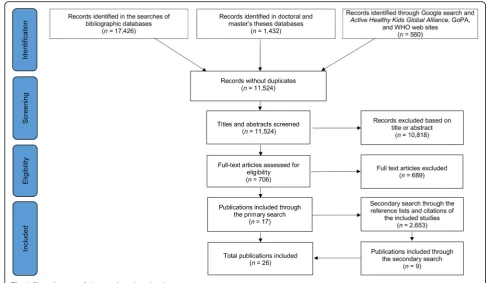
The primary search was conducted in six databases, namely Scopus, SPORTDiscus, PubMed/MEDLINE, Web of Science (including Science Citation Index Expanded, Arts & Humanities Citation Index, Conference Proceed-ings Citation Index – Science, Social Sciences Citation Index and Conference Proceedings Citation Index–Social Science & Humanities), Networked Digital Library of The-ses and Dissertations, and Open Access TheThe-ses and Dis-sertations. The search was conducted through titles, abstracts and keywords using the entries‘physical inactiv-ity’,‘physical activity‘,‘sitting’and‘sedentar*’, and combin-ing them with the terms ‘policy’ and ‘policies’. A full search syntax is available in Additional file1. The second-ary search was performed through (1) the reference lists of all included publications, (2) citations of the included pub-lications identified by Google Scholar and (3) the authors’ own archives. Additional searches were conducted in Google and on the websites of WHO and two large inter-national PA promotion networks – the Active Healthy Kids Global Alliance and the Global Observatory for Phys-ical Activity (GoPA!). We conducted a three-stage screen-ing process that included (1) automatic and manual exclusion of duplicates, (2) manual screening of titles and abstracts, and (3) assessment of eligibility based on full texts. The study selection was completed independently by two authors (BKP and GO) in July 2017. Discrepancies between the study selections were resolved in a discussion with the third author (ZP). If perfect agreement between the three authors had not been reached in the discussion, the final decision was made based on a majority vote. A flow diagram of the search and study selection process is available in Fig.1.
Study selection and inclusion criteria
In this review, we considered the term‘policy analysis’as a synonym for the terms‘assessment’,‘audit’,‘evaluation’ and ‘review’of policy. We relied on the definition of PA
policy analysis from the CAPPA framework, a concep-tual inventory of components for a comprehensive ana-lysis of PA policies, which can be used to guide the selection of existing instruments for policy analysis or the development of new ones [35]. It defines PA policy analysis as“any kind of policy-relevant research that au-dits or assesses one or more aspects of PA policy” [35]. Although developed primarily to guide the analysis of PA policies, the CAPPA framework can also be used in SB policy research [35].
By instruments, we considered sets of criteria and measurement tools that can be used for any aspect of PA/SB policy analysis. By a ‘set of criteria’, we consid-ered a collection of principles that may serve as a guide for policy analysis. These sets of criteria do not usually include specific questions that may directly be used for policy analysis. By contrast,‘measurement tools’contain specific questions that may be used in various types of research related to PA/SB policies.
To be included in the review, a publication had to meet the following two criteria:
1) The publication includes an original description of an instrument that has been used or that may be used for national-level PA/SB policy analysis; 2) The abstract and/or the full-text of the publication
is available in English.
Data extraction and coding
The following data were extracted for every identified PA/SB policy analysis instrument: (1) whether it ad-dresses PA policy, SB policy or both; (2) whether its pur-pose is auditing or assessment of policies; (3) what sectors of policy it covers; (4) what types of policies it covers; (5) what stages of the policy cycle it addresses; and (6) the scope of the policy analysis that can be done using the instrument.
To describe and categorise the identified instruments, we relied on the CAPPA framework [35]. We relied on all categories and elements presented in the CAPPA frame-work with the exception of a policy level category, because this review focused on national-level policies only.
The data extraction and coding were independently conducted by two authors (BKP and ZP). Disagreements between the authors were resolved by a discussion between all authors. Detailed data extraction is available in Table1.
Results
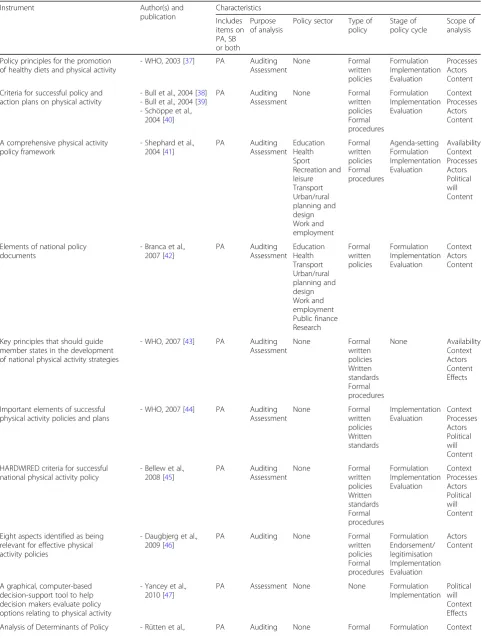
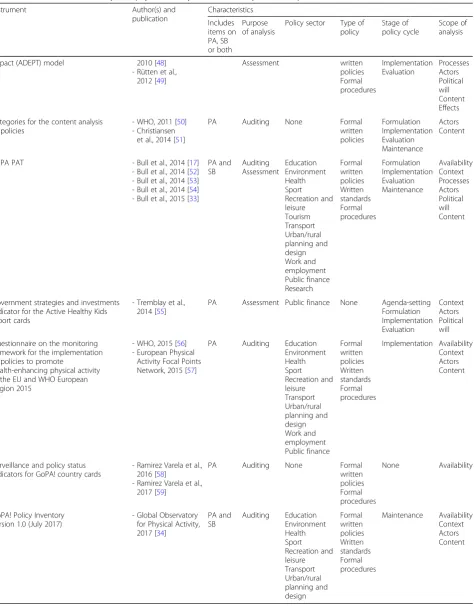
we identified a further 2653 documents, 9 of which met the inclusion criteria, providing a total of 26 publications for inclusion (Fig.1). These 26 documents (12 journal arti-cles [17,38,41,45–49,51,52,55,59], 11 reports [37,39, 40,42–44,50, 53, 54, 56,58], 2 published questionnaires [33,57] and 1 unpublished questionnaire [34]) describe 16 instruments. The identified instruments and their assess-ments against the CAPPA framework are presented in Table1. A description of included publications and all in-struments is available in Additional file 2. Ten included instruments (described in 13 documents) are sets of cri-teria [37–46,50,51,55]. To help readers understand how these sets of criteria may be used to collect data about PA/SB policy, we developed sample questions based on the items of 1 set of criteria [37] (Additional file3). Fur-thermore, the remaining 6 included instruments (de-scribed in 13 documents) are measurement tools [17,33, 34,47–49, 52–54,56–59]. All included publications were issued from 2003 to 2017. Eight studies were funded by the European Union (EU) and/or by WHO.
Only 2 included instruments refer to both SB and PA policies [33, 34]. All other instruments refer to PA pol-icies only. The number of items in the included instru-ments ranges from 2 to 28 (mode = 8). The included instruments differ greatly in terms of their content and structure. Nevertheless, items about some elements of PA policy emerge repeatedly across multiple instru-ments. Further, 81% (n= 13) of instruments contain
items about focus of policy on specific target groups, funding and available resources, and leadership and co-ordination, and 75% (n= 12) of instruments address the importance of integration of PA policy in different sec-tors and settings. Evaluation of policies and surveillance/ monitoring of PA/SB are addressed in 69% (n= 11) of the instruments. Setting specific goals for PA promotion is mentioned in 56% (n= 9) of the instruments, whilst the importance of involving different stakeholders in PA policy is addressed in 50% (n= 8) of the instruments. The significance of political support and the existence of PA guidelines as important parts of a successful PA policy are addressed in 44% (n= 7) of the instruments. Items about the timeframe for policy implementation and con-sultations in the policy development process are included in 38% (n= 6) of the instruments. Evidence-based PA pol-icy is addressed in 31% (n= 5) of the instruments.
Table 1Instruments for the analysis of physical activity and/or sedentary behaviour policies and their characteristics
Instrument Author(s) and
publication Characteristics Includes items on PA, SB or both Purpose of analysis
Policy sector Type of policy
Stage of policy cycle
Scope of analysis
Policy principles for the promotion of healthy diets and physical activity
- WHO, 2003 [37] PA Auditing Assessment None Formal written policies Formulation Implementation Evaluation Processes Actors Content
Criteria for successful policy and action plans on physical activity
- Bull et al., 2004 [38] - Bull et al., 2004 [39] - Schöppe et al.,
2004 [40]
PA Auditing Assessment None Formal written policies Formal procedures Formulation Implementation Evaluation Context Processes Actors Content
A comprehensive physical activity policy framework
- Shephard et al., 2004 [41]
PA Auditing Assessment Education Health Sport Recreation and leisure Transport Urban/rural planning and design Work and employment Formal written policies Formal procedures Agenda-setting Formulation Implementation Evaluation Availability Context Processes Actors Political will Content
Elements of national policy documents
- Branca et al., 2007 [42]
PA Auditing Assessment Education Health Transport Urban/rural planning and design Work and employment Public finance Research Formal written policies Formulation Implementation Evaluation Context Actors Content
Key principles that should guide member states in the development of national physical activity strategies
- WHO, 2007 [43] PA Auditing Assessment None Formal written policies Written standards Formal procedures None Availability Context Actors Content Effects
Important elements of successful physical activity policies and plans
- WHO, 2007 [44] PA Auditing Assessment None Formal written policies Written standards Implementation Evaluation Context Processes Actors Political will Content
HARDWIRED criteria for successful national physical activity policy
- Bellew et al., 2008 [45]
PA Auditing Assessment None Formal written policies Written standards Formal procedures Formulation Implementation Evaluation Context Processes Actors Political will Content
Eight aspects identified as being relevant for effective physical activity policies
- Daugbjerg et al., 2009 [46]
PA Auditing None Formal
written policies Formal procedures Formulation Endorsement/ legitimisation Implementation Evaluation Actors Content
A graphical, computer-based decision-support tool to help decision makers evaluate policy options relating to physical activity
- Yancey et al., 2010 [47]
PA Assessment None None Formulation Implementation
Political will Context Effects
Table 1Instruments for the analysis of physical activity and/or sedentary behaviour policies and their characteristics(Continued)
Instrument Author(s) and
publication Characteristics Includes items on PA, SB or both Purpose of analysis
Policy sector Type of policy
Stage of policy cycle
Scope of analysis
Impact (ADEPT) model 2010 [48] - Rütten et al.,
2012 [49]
Assessment written policies Formal procedures Implementation Evaluation Processes Actors Political will Content Effects
Categories for the content analysis of policies
- WHO, 2011 [50] - Christiansen
et al., 2014 [51]
PA Auditing None Formal
written policies Formulation Implementation Evaluation Maintenance Actors Content
HEPA PAT - Bull et al., 2014 [17] - Bull et al., 2014 [52] - Bull et al., 2014 [53] - Bull et al., 2014 [54] - Bull et al., 2015 [33]
PA and SB Auditing Assessment Education Environment Health Sport Recreation and leisure Tourism Transport Urban/rural planning and design Work and employment Public finance Research Formal written policies Written standards Formal procedures Formulation Implementation Evaluation Maintenance Availability Context Processes Actors Political will Content
Government strategies and investments indicator for the Active Healthy Kids report cards
- Tremblay et al., 2014 [55]
PA Assessment Public finance None Agenda-setting Formulation Implementation Evaluation Context Actors Political will
Questionnaire on the monitoring framework for the implementation of policies to promote
health-enhancing physical activity in the EU and WHO European Region 2015
- WHO, 2015 [56] - European Physical
Activity Focal Points Network, 2015 [57]
PA Auditing Education Environment Health Sport Recreation and leisure Transport Urban/rural planning and design Work and employment Public finance Formal written policies Written standards Formal procedures Implementation Availability Context Actors Content
Surveillance and policy status indicators for GoPA! country cards
- Ramirez Varela et al., 2016 [58]
- Ramirez Varela et al., 2017 [59]
PA Auditing None Formal
written policies Formal procedures
None Availability
GoPA! Policy Inventory version 1.0 (July 2017)
- Global Observatory for Physical Activity, 2017 [34]
PA and SB Auditing Education Environment Health Sport Recreation and leisure Transport Urban/rural planning and design Formal written policies Written standards Formal procedures Maintenance Availability Context Actors Content
institutional PA/SB policies, or (3) described and/or used an instrument for the analysis of health, sport, obesity, NCD or chronic disease-related policies only, without specific reference to PA/SB policies.
Purpose of analysis
The majority of instruments (56%; n= 9) were devel-oped for both policy auditing and assessment purposes [33,37,38,41–45,48]. Five instruments (31%) were de-signed only for auditing purposes [34, 46, 50, 57, 58] and 2 (12%) only for assessment purposes [47, 55]. In total, 88% (n= 14) of the instruments contain items for auditing and 70% (n= 11) contain items for assessment.
Policy sectors
Only 38% (n= 6) of the included instruments ask about specific sectors [33,34,41,42,55,57]. The number of sec-tors addressed by these 6 instruments ranges between 1 and 11. One instrument (6%) [33] asks about policies in all 11 sectors included in the CAPPA framework. The ‘education’, ‘health’, ‘transport’ and ‘urban/rural planning and design’ sectors are the most represented sectors. These are included in 5 instruments that ask about policy sectors [33, 34, 41, 42, 57]. The ‘sport’ [33, 34, 41, 57], ‘leisure and recreation’[33,34,41,57],‘work and employ-ment’[33,41,42,57], and‘public finance’[33,42,55,57] sectors are included in 25% (n= 4) of the instruments. The‘environment’sector is addressed in 19% (n= 3) of the instruments [33, 34, 57], the ‘research’ sector in 13% (n= 2) of the instruments [33, 42] and ‘tourism’is the least represented policy sector, included in only 1 instrument (6%) [33].
Type of policy
The reviewed instruments include items on between 1 and 3 (out of 5) different types of policy (mode = 2). Items about‘formal written policies’are included in 88% (n= 14) of the instruments [33, 34, 37,38,41–46,48,50, 57, 58], followed by items on‘formal procedures’ in 63% (n= 10) [33, 34, 38, 41, 43, 45, 46, 48, 57, 58] and‘written stan-dards and guidelines’in 38% (n= 6) [33,34,43–45,57] of the instruments. None of the instruments include items on ‘unwritten formal statements’ or ‘informal policies’. Finally, 13% (n= 2) of the instruments do not address any specific type of policy [47,55]; they refer to PA policy in general, without specifying the type of PA policy.
Stages of the policy cycle
The reviewed instruments include questions on 1–4 different stages of the policy cycle (modes = 3 and 4) out of 8 possible stages included in the CAPPA framework. The majority of instruments (81%, n = 13) include items about the policy ‘implementation’ stage [33, 37, 38, 41, 42, 44–48, 50, 55, 57]. In total, 69%
(n= 11) of the instruments include items about the ‘ for-mulation’ [33, 37, 38, 41, 42, 45–48, 50, 55] and ‘ evalu-ation’ [33, 37, 38, 41, 42, 44–46, 48, 50, 55] stages. The ‘maintenance’ stage is addressed in 3 (19%) instruments [33, 34, 50] and ‘agenda-setting’ in 2 (13%) instruments [41, 55]. Only 1 (6%) instrument includes items on the ‘endorsement/legitimisation’ stage [46]. None of the instruments include items about the ‘termination’ and ‘succession’stages of the policy cycle. Two (13%) instru-ments do not include items on any particular stage of the policy cycle [43,58].
Scope of analysis
The instruments include items on 1–6 elements that fall within the scope of analysis according to the CAPPA framework (mode = 3). The majority of instruments (88%, n = 14) include items about ‘actors’ in the policy process [33, 34, 37, 38, 41–46, 48, 50, 55, 57]. Policy ‘content’ is addressed in 81% (n= 13) of instruments [33,34,37,38,41–46,48,50,57] and policy‘context’in 75% (n= 12) [33, 34, 38, 41–45, 47, 48, 55, 57] of the instruments. Items about policy ‘processes’ [33, 37, 38, 41, 44, 45, 48] and items about ‘political will’ [33, 41, 44, 45, 47, 49, 55] are included in 44% (n= 7). Items about ‘availability’ of PA policies are included in 38% (n= 6) [33,34,41, 43,57,58] of the instruments. Items about ‘effects’ of PA policies are the least represented, as only 3 (19%) instruments include them [43,47,48].
Discussion
This is the first systematic review of instruments for the analysis of national PA and SB policies. Although a rela-tively large number of instruments was identified, none of them cover all elements needed for a comprehensive analysis of PA/SB policy according to the CAPPA frame-work. Moreover, data on some important aspects of PA/ SB policy, including ‘unwritten formal statements’, ‘informal policies’, the ‘termination’ stage and the ‘ suc-cession’ stage cannot be collected by any of the instruments.
All the instruments identified in the current review in-cluded items about PA policy, whilst only two asked about SB policy [33, 34]. Research on SB is a much younger field than PA research. Interest in SB as a health risk factor has been developing since 2000 [36]. While the body of evidence on determinants, prevalence, trends and health outcomes of SB is large and rapidly growing, the research on SB policies is still in its infancy [25]. Given the wide recognition of the importance of SB as a health risk factor, this area requires further develop-ment of instrudevelop-ments or modification of existing ones to allow for the analysis of SB policies.
prerequisite for policy assessment as it is important to find out which aspects of policy exist before they can be assessed [35]. Two included instruments contain only items for PA policy assessment, implying that, if they were to be used, policy auditing first needs to be done using some other instrument [47, 55]. In order to thoroughly understand PA/SB policies, it would be beneficial if they were first audited and then assessed. Therefore, having matching items for both these purposes in a single instru-ment would allow for an easier and more straightforward analysis and interpretation of results. This potentially use-ful feature has not been found in any of the included measurement tools.
A comprehensive approach that integrates policies across settings and sectors is considered essential to achieve substantial increases in PA at the population level [9]. Cross-sectoral approaches to policy-making may assist in positioning PA promotion on the agendas of different policy levels and policy sectors [60]. In the PA policy audit of seven European countries, performed using the Health-Enhancing Physical Activity Policy Audit Tool (HEPA PAT), one of the conclusions was that supportive PA-related policies were evident in the health, education and sport sectors, but that more opportunities should be created for supportive policies in other sectors [52]. Most included instruments in this review do not ask about specific sectors. Interestingly, tourism is the least represented sector, addressed in only one instrument [33]; although some authors suggest that this sector may have great potential to contribute to PA promotion [61], this has clearly not yet been sufficiently recognised in instruments for PA policy research.
Formal written policies are, by far, the most repre-sented type of policy in the available instruments. Ac-cordingly, a systematic review found that formal written policies were the most commonly analysed type of national PA/SB policy globally [25]. Items about written standards and guidelines and formal procedures are also well represented in the instruments. By con-trast, in the available instruments, no attention has been given to unwritten formal statements and informal policies. Including unwritten formal statements in the analysis of national PA/SB policy could bring additional insights into the comprehensive decision-making pro-cesses. As already recognised by Schmid et al. [62] in-formal policies are “considered to be part of culture rather than explicit policy and not a primary focus of initial physical activity policy research”. Rütten at al [49]. based their instrument on a broader definition of policy, stating that, besides formal statements and pro-cedures, policy also includes informal propro-cedures, ratio-nales for action and arrangements. However, this was not explicitly reflected in the instrument’s items.
In political science, usually, at least five stages are mentioned as crucial for understanding the full life circle of a policy and making sense of the policy process as a whole [63, 64]. Within most reviewed instruments, only a partial, three-stage policy cycle is inquired about, in-cluding the development of policy (formulation stage), policy implementation and the evaluation stage. We found only one instrument that includes an item on the endorsement/legitimisation stage of PA policies, which is not surprising given there does not seem to have been much interest in this particular aspect of policy in previ-ous research in this field [25]. It is also possible, how-ever, that the selection of research topics has been determined by the availability of measures. The agenda-setting and maintenance stages are addressed in only a few instruments, while none of the instruments address the termination and succession stages. Analysing PA/SB policy in the context of its full policy cycle, from agenda-setting to the termination or succession stage, is important to gain a more thorough understanding of the whole PA/SB policy-making process.
The majority of instruments are focused on policy content and the actors involved in policy processes. Some of the most common items on actors across the instruments are focused on leadership, coordination mechanisms and organisational structure for PA promo-tion. Some of the most common items related to policy content are about the target groups and policy’s specific goals and objectives. Only a few instruments ask about the availability of PA/SB policies, that is, analysis of whether a specific PA/SB policy exists or not [35]. With regards to the analysis of processes related to PA/SB policy, instruments that include relevant items are mainly focused on the processes of collaboration and/or consultation regarding PA policy. However, a detailed analysis of processes can be performed with very few in-struments. For example, little attention has been given to actions and interrelationships between various actors and to formal processes during the development and im-plementation of policy. Besides, none of the instruments ask about the power relationship in different processes.
may be missing the‘full picture’relevant to understand-ing how PA promotion in that country really works.
Analysing political, public health, social, economic and/or environmental impacts is one of the key aspects of policy analysis. However, we found only a few instru-ments that include items about the effects of PA policy. This aspect of PA policy analysis may have been neglected because the effects of PA policies can be com-plex and challenging to measure. In 2006, the Centers for Disease Control and Prevention highlighted that their “first priority” for future research was “to develop better tools to assess the effects of policies” [62]. Milton and Bauman [65] also noted that evaluating the effect-iveness of PA policy is important to inform future policy development. Such endeavours could be supported by the development of instruments specialised for analysing the effects of PA and SB policies.
Recommendations for the use of instruments for PA/SB policy analysis
We suggest to future users of the instruments, such as policy analysts, policy-makers and other stakeholders, to first use the CAPPA framework as a‘road map’to deter-mine a more specific ‘route’ to answer their research question [35]. This can help to inform decisions on which particular instrument best meets their needs. All instruments assessed in this review have advantages and disadvantages.
If a comprehensive PA policy analysis needs to be done, HEPA PAT would be the most suitable instru-ment. Using such a comprehensive instrument has advantages in that it can (1) provide a deeper under-standing of the current state of national PA/SB policies and (2) lead to a more detailed insight on what needs to be changed in order to improve policy development and/or implementation. On the other hand, using a comprehensive instrument usually means longer data collection, which may slow down the process of policy analysis, and once the analysis is finally completed, it may already be outdated. According to some experts who are currently using HEPA PAT, if undertaken by a single researcher, the process can take up to more than a year. Therefore, we believe this instrument is espe-cially suitable for an official governmental audit of na-tional PA/SB policy where a team of people is available to work on collecting and analysing the data.
While the HEPA PAT does have one assessment-type question, it is more suitable for an audit than for assess-ment. Therefore, for assessment purposes, we recom-mend using the Analysis of Determinants of Policy Impact (ADEPT) Model [48, 49]. This instrument is es-pecially suitable for researchers who wish to conduct in-terviews with policy-makers. However, the instrument does not mention SB policies, and it relies on a broad
definition of policy, which may not be suitable for some researchers who want to use a narrower definition.
It may not always be practical to conduct a compre-hensive analysis of PA policy. In such cases, a less com-prehensive instrument may need to be considered, albeit on account of gathering less detailed information about a PA/SB policy. If time or capacity is limited, we recom-mend using the GoPA! Policy Inventory [34]. It contains only 10 questions and is based on HEPA PAT–version 2 [33] and the Questionnaire on the monitoring frame-work for the implementation of policies to promote health-enhancing physical activity in the EU and WHO European Region 2015 [56].
Some of the instruments are not structured as ques-tionnaires. An example are the eight policy principles for the promotion of healthy diets and PA developed by WHO [37]. If needed for the purpose of data collection, such sets of principles can be easily transformed into questionnaire items. We provided sample questions de-rived from the WHO’s set of principles in Additional file 3. It should be noted, however, that these sample questions have not been developed by the authors of the original instrument and their measurement proper-ties have not been assessed. Rather, these sample ques-tions have been developed exclusively for the purpose of this review to help readers understand how a set of criteria can be transformed into a format suitable for data collection. Depending on their study design, re-searchers may prefer to develop different questions and use different types of response scales. In any case, it would be important to conduct a study of measurement properties of such newly developed questions before starting the data collection.
All these recommendations are an informed opinion of the authors of this review and should not be taken as an exclusive suggestion to use one instrument over an-other. The final decision should be left to users, who should independently asses all instruments and decide which is the most suitable for their needs. Table 1 and Additional file2can help to facilitate this process.
Towards standardisation of PA/SB policy analysis
specific target groups, political leadership and coord-ination, multi-sectoral approaches, evaluation, surveil-lance/monitoring, setting specific goals for PA promotion, and involvement of various stakeholders in PA policy, were found in most of them. This is promis-ing as it suggests a certain level of agreement between researchers about items that are critical for conducting a PA/SB policy analysis. However, there are several rea-sons for conducting policy analysis and different instru-ments have been developed for different purposes. Differences between questionnaire items and conceptua-lisations of PA/SB policy can negatively affect the com-parability of findings across studies. Nonetheless, diversity in methodological approaches may sometimes be considered desirable, particularly in younger fields like SB policy research, because it may serve as a catalyst for academic discussions and facilitate the search for op-timal solutions, whereas advancing to standardisation too soon might hinder the development of some novel and potentially valuable methods. Therefore, a balanced approach between heading towards standardisation and allowing for diversity in methodological approaches may be a good way to progress PA/SB policy research.
Strengths and limitations of the review
The main strengths of this systematic review are that (1) the search was performed through various biblio-graphic databases, search engines and websites as well as through the reference lists of all included publica-tions, which reduced the possibility of missing rele-vant studies; (2) we employed an inclusive search syntax and broad eligibility criteria, which allowed us to find and review various types of instruments that may be used for PA/SB policy analysis; (3) the assess-ment of eligibility of studies as well as the data ex-traction from the studies were done in duplicate, which reduced the likelihood of human error and subjectivity; and (4) we based our data extraction on a conceptual framework.
This systematic review is also subject to several lim-itations. Even though the search was done with no language restrictions, we included only publications with abstracts and/or full-texts in English, which may have led to the exclusion of relevant studies. We fo-cused only on national-level policies, yet we acknow-ledge that some instruments included in this review may also be used to analyse policies on other levels. We did not conduct a formal quality assessment of the studies and/or instruments given that the in-cluded studies varied in their aims and methods. Nevertheless, we provided a general assessment of the instruments and the strengths and limitations of vari-ous approaches employed in these.
Conclusions
There is a range of different instruments available that can be used for analysing PA policy, whilst only two instruments include questions about SB policy. None of the instruments allow for the analysis of all the relevant components of a national PA/SB policy. Some import-ant elements of PA policy analysis, such as the tourism and research sectors, the agenda-setting and endorse-ment/legitimisation stages, and the effects of policy, are addressed by only a few instruments. Moreover, none of the instruments address unwritten formal state-ments, informal policies, and the termination and suc-cession stages of the policy cycle. Thus, designing new instruments or adapting existing ones is needed to allow for a more thorough analysis of national PA and SB policies. Given that policy analysis covering all important components of PA/SB policy may be ex-tremely time-consuming, a way forward might be to de-velop a set of complementary instruments, with each tool collecting detailed information about a specific aspect of PA and SB policy.
Supplementary information
Supplementary information accompanies this paper athttps://doi.org/10. 1186/s12961-019-0492-4.
Additional file 1.Full search syntax used for each database.
Additional file 2.Instruments for the analysis of physical activity and/or sedentary behaviour policies and their description.
Additional file 3.Sample questions for physical activity policy auditing/ assessment.
Abbreviations
CAPPA:Comprehensive Analysis of Policy on Physical Activity; EU: European Union; GoPA!: Global Observatory for Physical Activity; HEPA PAT: Health-Enhancing Physical Activity Policy Audit Tool; NCD: non-communicable disease; PA: physical activity; SB: sedentary behaviour
Acknowledgments
This article is a part of the PhD project of the first author, BKP, supervised by KM, SJHB, and ZP (principal supervisor).
Authors’contributions
BKP and ZP conceived the idea for the review. BKP, ZP, SJHB and KM conceptualised the review. BKP took the lead in writing the study protocol. BKP and ZP designed the systematic search strategies. BKP and GOS conducted the study selection. BKP and ZP extracted, coded and tabulated the data. BKP and ZP developed the sample questions (Additional file3). BKP drafted the initial manuscript. ZP, KM, SJHB and GOS contributed to writing the manuscript. All authors read and approved the final manuscript.
Funding
Not applicable.
Availability of data and materials
Full search syntax used for each database is available in Additional file1. Full descriptions of the instruments and included publications are available in Additional file2. Sample questions for physical activity policy auditing/ assessment derived from one set of criteria are available in Additional file3.
Ethics approval and consent to participate
Consent for publication
Not applicable.
Competing interests
The authors declare that they have no competing interests.
Author details
1Institute for Health and Sport, Victoria University, Ballarat Road, Footscray, Melbourne, VIC 3001, Australia.2Norwich Medical School, University of East Anglia, Norwich Research Park, Norwich, United Kingdom.3Centre for Health, Informatics, and Economic Research, Institute for Resilient Regions, University of Southern Queensland, Springfield, Australia.
Received: 15 March 2019 Accepted: 23 September 2019
References
1. Lee I-M, Shiroma EJ, Lobelo F, Puska P, Blair SN, Katzmarzyk PT, Lancet Physical Activity Series Working Group. Effect of physical inactivity on major non-communicable diseases worldwide: an analysis of burden of disease and life expectancy. Lancet. 2012;380(9838):219–29.
2. de Rezende LFM, Sá TH, Mielke GI, Viscondi JYK, Rey-López JP, Garcia LMT. All-cause mortality attributable to sitting time: analysis of 54 countries worldwide. Am J Prev Med. 2016;51(2):253–63.
3. Ding D, Lawson KD, Kolbe-Alexander TL, Finkelstein EA, Katzmarzyk PT, van Mechelen W, Pratt M, Lancet Physical Activity Series 2 Executive Committee. The economic burden of physical inactivity: a global analysis of major non-communicable diseases. Lancet. 2016;388(10051): 1311–24.
4. World Health Organization. Noncommunicable Diseases.http://www.who. int/mediacentre/factsheets/fs355/en/. Accessed 2 Feb 2018.
5. Physical Activity Guidelines Advisory Committee. 2018 Physical Activity Guidelines Advisory Committee Scientific Report. Washington DC: Department of Health and Human Services; 2018.
6. de LFM R, Lopes MR, Rey-López JP, VKR M, do Carmo Luiz O. Sedentary behavior and health outcomes: an overview of systematic reviews. PloS One. 2014;9(8):e105620.
7. World Health Organization. WHO global strategy on diet, physical activity and health. Food Nutr Bull. 2004;25(3):292–302.
8. Sallis J, Cervero R, Ascher W, Henderson K, Kraft K, Kerr J. An ecological approach to creating active living communities. Annu Rev Public Health. 2006;27:297–322.
9. Bellew B, Bauman A, Martin B, Bull F, Matsudo V. Public policy actions needed to promote physical activity. Curr Cardiovasc Risk Rep. 2011;5(4): 340–9.
10. World Health Organization. Global Action Plan on Physical Activity 2018–2030: More Active People for a Healthier World. Geneva: World Health Organization; 2018.
11. Department of Health and Department of Transport, Tourism and Sport. Get Ireland Active. The National Physical Activity Plan for Ireland. Dublin: Department of Health and Department of Transport, Tourism and Sport; 2016.
12. Public Health England. Everybody Active, Every Day: An Evidence-Based Approach to Physical Activity. London: Public Health England; 2014. 13. Mexico - Gobierno de la Republica. Estrategia Nacional para la Prevención y
Control del Sobrepeso, la Obesidad y la Diabetes (National Strategy for the Prevention and Control of Overweight, Obeisity and Diabetes). Mexico: Secretaría de Salud; 2013.
14. Ministry of Health and Social Services. National Multisectoral Strategic Plan for Prevention and Control of Non-Communicable Diseases in Namibia 2017/18–2021/22. Windhoek: Ministry of Health and Social Services; 2017. 15. Government of Denmark. Healthy throughout Life–the Targets and
Strategies for Public Health Policy of the Government of Denmark, 2002–2010. Copenhagen: Ministry of the Interior and Health; 2002. 16. Sallis J, Bull F, Guthold R, Heath G, Inoue S, Kelly P, Oyeyemi A, Perez L,
Richards J, Halllal P. Progress in physical activity over the olympic quadrennium. Lancet. 2016;388(10051):1325–36.
17. Bull F, Milton K, Kahlmeier S. National policy on physical activity: the development of a policy audit tool. J Phys Act Health. 2014;11(2):233–40.
18. Buse K, Dickinson C, Gilson L, Murray S. How can the analysis of power and process in policy-making improve health outcomes? World Hosp Health Serv. 2009;45(1):4–8.
19. Quade ES, Carter GM. Analysis for Public Decisions. Cambridge: MIT Press; 1989. 20. Hird J. How effective is policy analysis? In: Friedman LS, editor. Does Policy
Analysis Matter?: Exploring Its Effectiveness in Theory and Practice. Oakland: University of California Press; 2017. p. 44–84.
21. Collins T. Health policy analysis: a simple tool for policy makers. J Royal Instit Public Health. 2005;119:192–6.
22. Lasswell HD, Lerner D, Fisher HH. The Policy Sciences: Recent Developments in Scope and Method. Palo Alto: Stanford University Press; 1951.
23. Bardach E, Patashnik EM. A Practical Guide for Policy Analysis: The Eightfold Path to More Effective Problem Solving. Washington: CQ press, SAGE Publications; 2015.
24. Walt G, Gilson L. Reforming the health sector in developing countries: the central role of policy analysis. Health Policy Plan. 1994;9(4):353–70. 25. Klepac Pogrmilovic B, O’Sullivan G, Milton K, Biddle S, Bauman A, Bull F,
Kahlmeier S, Pratt M, Pedišić Ž. A global systematic scoping review of studies analysing indicators, development, and content of national-level physical activity and sedentary behaviour policies. Int J Behav Nutr Phys Act. 2018;15:123.
26. Colebatch HK. Policy analysis, policy practice and political science. Aust J Public Adm. 2005;64(3):14–23.
27. Dunn WN. Public Policy Analysis. New York: Pearson Education; 2004. 28. Friedman LS. Public policy making and public policy analysis. In: Friedman
LS, editor. Does Policy Analysis Matter?: Exploring Its Effectiveness in Theory and Practice. Oakland: University of California Press; 2017. p. 1–34. 29. Geva-May I. An Operational Approach to Policy Analysis. The Craft:
Prescriptions for Better Analysis. New York: Springer Science & Business Media; 1997.
30. Walt G, Shiffman J, Schneider H, Murray S, Brugha R, Gilson L.‘Doing’health policy analysis: methodological and conceptual reflections and challenges. Health Policy Plan. 2008;23:308–17.
31. Cheung KK, Mirzaei M, Leeder S. Health policy analysis: a tool to evaluate in policy documents the alignment between policy statements and intended outcomes. Aust Health Rev. 2010;34(4):405–13.
32. Sacks G, Swinburn B, Lawrence M. Obesity policy action framework and analysis grids for a comprehensive policy approach to reducing obesity. Obes Rev. 2009;10:76–86.
33. Bull F, Milton K, Kahlmeier S. Health-Enhancing Physical Activity (HEPA) Policy Audit Tool (PAT) - Version 2. World Health Organization, Regional Office for Europe: Copenhagen; 2015.
34. Global Observatory for Physical Activity. The Global Observatory for Physical Activity-GoPA! Policy Inventory version 1.0. Adapted from the Health enhancing physical activity (HEPA) policy audit tool, version 2.0 and The European Monitoring Framework. 2017.
35. Klepac Pogrmilovic B, O’Sullivan G, Milton K, Biddle SJH, Pedisic Z. The development of the Comprehensive Analysis of Policy on Physical Activity (CAPPA) framework. Int J Behav Nutr Phys Act. 2019;16:60.
36. Pedišić Ž, Dumuid D, Olds T. Integrating sleep, sedentary behaviour, and physical activity research in the emerging field of time-use epidemiology: definitions, concepts, statistical methods, theoretical framework, and future directions. Kinesiology. 2017;49(2):135–45.
37. World Health Organization. Diet, nutrition and the prevention of chronic diseases, Report of a Joint WHO/FAO Expert Consultation. Geneva: WHO; 2003. 38. Bull F, Bellew B, Schoeppe S, Bauman A. Developments in national physical
activity policy: an international review and recommendations towards better practice. J Sci Med Sport. 2004;7(1):93–104.
39. Bull F, Bauman A, Bellew B, Brown W. Getting Australia Active II: An Update of Evidence on Physical Activity Melbourne. Melbourne: National Public Health Partnership; 2004.
40. Schöppe S, Bauman A, Bull F. International Review of National Physical Activity Policy - A Literature Review. NSW Centre for Physical Activity and Health: Sydney; 2004.
41. Shephard RJ, Lankenau B, Pratt M, Neiman A, Puska P, Benaziza H, Bauman A. Physical Activity Policy Development: a synopsis of the WHO/CDC Consultation, September 29 through October 2, 2002, Atlanta, Georgia. Public Health Rep. 2004;119(3):346–51.
43. World Health Organization. Steps to Health. A European Framework to Promote Physical Activity for Health. Copenhagen: WHO Regional Office for Europe; 2007.
44. World Health Organization. A Guide for Population-based Approaches to Increasing Levels of Physical Activity. Geneva: WHO; 2007.
45. Bellew B, Schöeppe S, Bull FC, Bauman A. The rise and fall of Australian physical activity policy 1996–2006: a national review framed in an international context. Aust N Z Health Policy. 2008;5:18.
46. Daugbjerg SB, Kahlmeier S, Racioppi F, Martin-Diener E, Martin B, Oja P, Bull F. Promotion of physical activity in the European region: content analysis of 27 national policy documents. J Phys Act Health. 2009;6(6):805–17. 47. Yancey AK, Cole BL, McCarthy WJ. A graphical, computer-based
decision-support tool to help decision makers evaluate policy options relating to physical activity. Am J Prev Med. 2010;39(3):273–9.
48. Rütten A, Gelius P, Abu-Omar K. Policy development and implementation in health promotion—from theory to practice: the ADEPT model. Health Promot Int. 2010;26(3):322–9.
49. Rütten A, Abu-Omar K, Gelius P, Dinan-Young S, Frändin K, Hopman-Rock M, Young A. Policy assessment and policy development for physical activity promotion: Results of an exploratory intervention study in 15 European Nations. Health Res Policy Syst. 2012;10:14.
50. World Health Organization. Promoting sport and enhancing health in European Union countries: a policy content analysis to support action. Copenhagen: WHO Regional Office for Europe; 2011.
51. Christiansen N, Kahlmeier S, Racioppi F. Sport promotion policies in the European Union: results of a contents analysis. Scand J Med Sci Sports. 2014;24(2):428–38.
52. Bull F, Milton K, Kahlmeier S, Arlotti A, Juričan A, Belander O, Martin B, Martin-Diener E, Marques A, Mota J. Turning the tide: national policy approaches to increasing physical activity in seven European countries. Br J Sports Med. 2014;49(11):749–56.
53. Bull F, Milton K, Kahlmeier S, Arlotti A, Backovic-Jurican A, Belander O, Berlic N, Colitti S, Martin B, Martin E, et al. National Policy Approaches to Promoting Physical Activity: Seven Case Studies from Europe. Final Technical Report. Perth: The School of Population Health, The University of Western Australia; 2014.
54. Bull F, Milton K, Kahlmeier S, Arlotti A, Backovic-Jurican A, Belander O, Berlic N, Colitti S, Martin B, Martin E, et al. National Policy Approaches to Promoting Physical Activity: Seven Case Studies from Europe. Final Technical Report 2: full country case studies. Perth: The School of Population Health, The University of Western Australia; 2014.
55. Tremblay M, Gray CE, Akinroye K, Harrington DM, Katzmarzyk PT, Lambert EV, Liukkonen J, Maddison R, Ocansey RT, Onywera VO, et al. Physical activity of children: a global matrix of grades comparing 15 countries. J Phys Act Health. 2014;11(Suppl 1):S113–25.
56. World Health Organization. Factsheets on Health-Enhanching Physical Activity in the 28 European Union Member States of the WHO European Region. Copenhagen: World Health Organization, Regional Office for Europe; 2015.
57. European Physical Activity Focal Points Network. Questionnaire on the Monitoring Framework for the Implementation of Policies to Promote Health-enhancing Physical Activity in the EU and WHO European Region European Physical Activity Focal Points Network; 2015.
58. Ramirez Varela A, Pratt M, Borges C, Hallal P. 1st Physical Activity Almanac: The Global Observatory for Physical Activity - GoPA: The Global Observatory for Physical Activity; 2016. https://indd.adobe.com/view/f8d2c921-4daf-4c96-9eaf-b8fb2c4de615. Accessed 10 Nov 2019.
59. Ramirez Varela A, Pratt M, Powell K, Lee IM, Bauman A, Heath G, Martins RC, Kohl H, Hallal PC. Worldwide Surveillance, Policy and Research on Physical Activity and Health: The Global Observatory for Physical Activity. J Phys Act Health. 2017;14(9):701–9.
60. Rütten A, Schow D, Breda J, Galea G, Kahlmeier S, Oppert J, Ploeg H, Mechelen W. Three types of scientific evidence to inform physical activity policy: results from a comparative scoping review. Int J Public Health. 2016; 61(5):553–63.
61. Szczechowicz B. The importance of attributes related to physical activity for the tourism product's utility. J Sport Tourism. 2012;17(3):225–49.
62. Schmid TL, Pratt M, Witmer L. A framework for physical activity policy research. J Phys Act Health. 2006;3(Suppl 1):S20–9.
63. Cairney P. Understanding Public Policy: Theories and Issues. Hampshire: Palgrave MacMillan; 2012.
64. World health Organization. Health Service Planing and Policy Making: A Toolkit for Nurses and Midwifes. Manila: WHO Regional Office for the Western Pacific; 2005.
65. Milton K, Bauman A. A critical analysis of the cycles of physical activity policy in England. Int J Behav Nutr Phys Act. 2015;12:8.
Publisher’s Note