R E S E A R C H
Open Access
Development of an item bank for the
EORTC Role Functioning Computer
Adaptive Test (EORTC RF-CAT)
Eva-Maria Gamper
1,9*, Morten Aa Petersen
2, Neil Aaronson
3, Anna Costantini
4, Johannes M. Giesinger
5,
Bernhard Holzner
5,9, Georg Kemmler
5,9, Anne Oberguggenberger
5,9, Susanne Singer
6, Teresa Young
7,
Mogens Groenvold
8,2and on behalf of the EORTC Quality of Life Group
Abstract
Background:Role functioning (RF) as a core construct of health-related quality of life (HRQOL) comprises aspects of occupational and social roles relevant for patients in all treatment phases as well as for survivors. The objective of the current study was to improve its assessment by developing a computer-adaptive test (CAT) for RF. This was part of a larger project whose objective is to develop a CAT version of the EORTC QLQ-C30 which is one of the most widely used HRQOL instruments in oncology.
Methods:In accordance with EORTC guidelines, the development of the RF-CAT comprised four phases. Phase I involved the conceptualization of RF. In Phase II, a provisional list of items was defined and revised by experts in the field. In phase III, feedback was obtained from cancer patients in various countries. Phase IV comprised field testing in an international sample, calibration of the item bank, and evaluation of the psychometric performance of the RF-CAT. Results:Phases I-III yielded a list of 12 items eligible for phase IV field-testing. The field-testing sample included 1,023 patients from Austria, Denmark, Italy, and the UK. Psychometric evaluation and item response theory analyses yielded 10 items with good psychometric properties. The resulting item bank exhibits excellent reliability (mean reliability = 0.85, median = 0.95). Using the RF-CAT may allow sample size savings from 11 % up to 50 % compared to using the QLQ-C30 RF scale.
Conclusions:The RF-CAT item bank improves the precision and efficiency with which RF can be assessed, promoting its integration into oncology research and clinical practice.
Keywords:Cancer, Oncology, Health related quality of life, Role functioning, QLQ-C30, Computer-adaptive test
Background
In health-related quality of life (HRQOL) research, there is increasing interest in generating computer-adaptive test (CAT) versions of HRQOL measures [1]. CAT facilitates greater measurement precision and may re-duce test length by tailoring the set of questions asked to the (estimated) level of functioning or symptom bur-den of each patient. This makes CAT attractive for
research as the increased measurement precision usually entails reductions in required sample sizes making HRQOL data collection more feasible. In addition, the use for HRQOL assessment in clinical practice for detec-tion and tracking of symptoms and as a communicadetec-tion aid has been proven [2]. Hence CAT is especially benefi-cial for use in clinical routine as it comes with a reduced measurement error in the individual assessment. This characteristic of CAT increases the practicability of HRQOL assessment for clinical use in general, such as for informing physicians and guiding interventions. CAT has already proved efficient for a range of HRQOL con-structs such as physical functioning [3] and fatigue [4]. * Correspondence:[email protected]
1Department for Psychiatry and Psychotherapy and Department for Nuclear
Medicine, Medical University of Innsbruck, Anichstraße 35, 6020 Innsbruck, Austria
9Department for Psychiatry, Psychotherapy and Psychosomatic Medicine,
Medical University of Innsbruck, Anichstraßé 35, 6020 Innsbruck, Austria Full list of author information is available at the end of the article
The present paper describes the development of a CAT for role functioning (RF) which is a construct in-corporated by all cancer-specific HRQOL instruments and comprises the ability of the individual to fulfil re-sponsibilities typical for a specific age and social setting. Its assessment is quite complex due to the plurality of roles different persons define as relevant and due to the natural fluctuation of such roles over time. However, in the context of health outcome research, it has been ar-gued that the focus needs to be on those aspects of role functioning which are influenced by health conditions and treatment [5]. These include being productive in work and capable of caring for oneself and having a role in immediate and extended social networks [6]. The operationalization of this definition differs across instru-ments but usually they separate occupational (e.g. work) from social aspects of functioning and assess them on distinct domains. This approach, for example, is applied by the two most widely used HRQOL questionnaires in oncology, the FACT-G (Functional Assessment of Cancer Therapy–General) [7] and the EORTC QLQ-C30 (European Organisation for Research and Treatment of Cancer Quality of Life Questionnaire-Core 30) [8] as well as by the widely used generic (i.e. non disease-specific) SF-36 (Short-Form 36) [9].
Despite agreement on the overall concept the issues that typically are covered in RF measures are quite di-verse, ranging from questions on work efficiency to questions on illness acceptance. This is also what poses a special challenge to the development of a CAT for RF as IRT-based measures mostly are based on unidimen-sional item banks. Although multidimenunidimen-sional CATs can be done, they are highly complex and hence unidimen-sional structures are usually preferred.
Concurrently, very restricted definitions of RF, for ex-ample focusing on physical limitations only or very spe-cific questions such as on reduction in working hours are considered a weakness of existing RF measures [5].
So far, three item banks measuring RF have been suc-cessfully developed. The National Institutes of Health-funded PROMIS (Patient Reported Outcomes Measure-ment Information System) initiative has developed two item banks for RF, one measuring the ability to partici-pate in social roles and one measuring the satisfaction with social roles [10]. Anatchkova et al. [11] developed an item bank for an RF-CAT which comprises occupa-tional, social and family issues and which showed a suffi-ciently unidimensional structure. All of these item banks are generic and designed to be applicable in a broad range of different health conditions.
The present paper describes the development of a cancer-specific CAT for RF and is part of a larger EORTC Quality of Life Group’s (QLG) project whose goal is to generate a CAT version of the QLQ-C30.
The original QLQ-C30 RF Scale consists of two items (“Were you limited in doing either your work or other daily activities?”and “Were you limited in pursuing your hobbies or other leisure time activities?”). These items concern the domains“work or other daily activities”and
“hobbies or other leisure time activities”, respectively, which are also described in the WHO International Classification of Functioning, Disability and Health (ICF) [12]. Thus, these are the domains the new item bank should cover.
The main aims of the study were to:
Develop a cross-culturally relevant and appropriate item list for the assessment of RF.
Develop of an item response theory (IRT) calibrated item bank for RF.
Evaluate the performance of the item bank in CAT simulations using real and simulated data.
Methods
EORTC item bank development is based on the EORTC guidelines for module development [13] and comprises four phases, namely defining the conceptual framework and conducting a literature search (phase I), operationali-zation (phase II), pre-testing (phase III) and field-testing and item bank calibration (phase IV). As with EORTC QLG modules these phases include pre-defined develop-ment steps and employ a multilingual and cross-cultural approach. The four development phases are summarised below. For further details on the general approach in phase I-III please refer to Petersen et al. 2010 [14], and for phase IV to Petersen et al. 2011 and 2012 [15, 16].
Conceptual framework and subdomains
In order to ensure that the new RF-item bank is comparable with data collected with the existing (static) version of the QLQ-C30, it needs to cover the same aspects as the QLQ-C30 RF Scale. The item bank should extend the measurement con-tinuum, i.e. allow for the assessment of a broader range of severity of impairment, and increase meas-urement precision. In addition, the items should fit a unidimensional model in order to be included in the final item bank. The WHO ICF differentiates be-tween limitations in activity and restrictions in par-ticipation. To reflect the RF construct as defined within the QLQ-C30 we decided to focus on limita-tions in activity and considered aspects of participa-tion to be assessed by the social funcparticipa-tioning domain of the QLQ-C30.
Phase I - Literature search
the following databases: PubMed, EORTC Item Bank (http://groups.eortc.be/qol/item-bank), ProQolid (https:// eprovide.mapi-trust.org/), Psyndex and PsyndexPlus. The search was conducted in September, 2008 applying combi-nations of the following free text and MeSH-terms: neo-plasm*, cancer, role, social, daily, function*, well-being, limitation.
Phase II - Operationalization
The item list compiled in phase I was refined according to pre-defined selection steps. In each selection step two independent reviewers performed the ratings, which were then compared and discussed in case of ment. A third reviewer was involved in case of disagree-ment, ratings were discussed and then a majority decision was made. Reviewers had expertise in HRQOL, CAT and/or clinical oncology. First, items that were re-dundant, not compatible with the QLQ-C30 item style, or that assessed issues outside of the scope of conceptual framework were eliminated (step 1). Based on the remaining items, new items in the style of the QLQ-C30 (i.e. a question with a one-week recall period, assessing severity of impairment on a 4-point Likert scale from 1-not at all to 4-very much), were developed (step 2). Step 3 comprised another redundancy rating and a rating of item relevance to the RF construct. In step 4, the remaining items were rated for difficulty (i.e., the level of RF being assessed). Subsequently, they were subjected to QLG internal expert reviews (step 5) before being sent out for international expert re-views (step 6) on the items’ relevance for the assess-ment of RF, redundancy, clarity, and appropriateness.
Phase III - Pre-testing
To ensure content validity and the appropriateness of the items for the target population the preliminary item list was pre-tested in an international sample of cancer pa-tients. Inclusion criteria were a cancer diagnosis, age
≥18 years, sufficient command of respective national lan-guage, no overt cognitive impairments, and informed con-sent. Translations were done according to published guidelines by the Translation Office of the EORTC Quality of Life Department [17]. Based on patient feedback, the content and wording of the item list was refined and a pre-liminary item list to be used in field testing was created.
Phase IV - Field testing and calibration of the item bank
Sample and procedure
The preliminary item list was field-tested in an inter-national sample of cancer patients. Inclusion criteria were the same as in phase III. We aimed at a heterogeneous sample of at least 1,000 patients, which is sufficiently large for the purposes of item calibration [18, 19]. Patients were approached in different oncology treatment settings (e.g.,
in-patient and outpatient; curative and palliative treatment) in order to cover a broad range of socio-demographic and clinical characteristics as well as different levels of RF impairment. In addition to the preliminary item list, patients completed the QLQ-C30 and answered questions on item relevance, clarity, and ap-propriateness, which were also presented paper-pencil based.
Evaluation of dimensionality and local dependence
The items were evaluated to determine if they met the requirements of unidimensionality and local independ-ence using exploratory and confirmatory factor analyses. We were also interested in the potential overlap between the constructs RF and physical functioning (PF). As all patients had completed the QLQ-C30 in phase IV data collection we were able to investigate the factor struc-ture of the new RF items and the physical functioning (PF) items of the QLQ-C30.
Eigenvalues, root mean square error of approximation (RMSEA) <0.10, the Tucker-Lewis Index (TLI) >0.90 and the Comparative Fit Index (CFI) >0.90 were used as criteria in the evaluation of factor structure and model fit [20, 21]. Residual correlations >0.20 served as indica-tors of local dependence (LD) [22].
Item bank calibration and evaluation of item fit
e.g. outside ±2.6 (99 %) as problematic, and outside 3.3 (99.9 % CI) as clearly problematic.
Differential item functioning
The items then were tested for differential item func-tioning (DIF), i.e. if items perform differently in cer-tain sociodemographic and clinical subgroups. This was done using ordinal logistic regression [28–30]. Group variables were age, gender, country, cancer site, cancer stage, current treatment, living with a partner/ alone, level of education, working/retired/other. Sub-sequently, for items with DIF it was tested if it affects parameter estimates. The method compares the RF scores obtained with the model which does not ac-count for DIF with a model which does. If the RF scores differ substantially, defined as a difference larger than the median standard error for the RF es-timates, this would indicate practically problematic DIF, also termed “salient scale-level differential func-tioning” [15, 28, 31].
Evaluation of measurement properties
Finally, the item bank’s performance for CAT measure-ment was assessed using real and simulated data. CAT simulations to evaluate measurement precision were done using Firestar and were based on the collected data (N= 1023). We simulated CATs asking an increasing number of items starting with one and ending with 9. We estimated the RF score based on these CATs, and compared these scores with the score based on all 10 items. As starting item we used the QLQ-C30 RF item with the highest average information. The Expected A Priori (EAP) method was applied for latent trait (theta/θ) estimation.
To evaluate possible savings in sample size, relative validity (RV) of the CATS compared to the QLQ-C30 RF scale in detecting expected group differences was cal-culated [32]. The RV is the ratio of two test statistics for comparing two (known) groups. We used the t-test statistic for each of the CATs as the numerator and the t-test for the QLQ-C30 RF scale as the denominator – hence an RV >1 indicates that the CAT has greater discriminating power than the QLQ-C30 scale. Known group variables (age, sex, stage, work, therapy, educa-tion) were tested if significant for either the CAT or the QLQ-C30 measures. If significant they were used for calculating RVs. This was done based on the col-lected data.
RV was also assessed on the basis of simulated data. We simulated responses to the items on the basis of RF scores sampled from normal distributions with different means. We compared groups of different sizes and dif-ferent true effect sizes. For each of the possible settings we ran 2000 simulations. For more details on methods
please refer to Petersen et al. 2011 [15] and Petersen et al. 2012 [16]. Statistical packages used were SAS, Pars-cale [33] and Mplus [34].
Results
Phase I: Literature search and item collection
The literature search described previously yielded 122 items on RF from 16 questionnaires.
Phase II: Operationalization - development of items and expert reviews
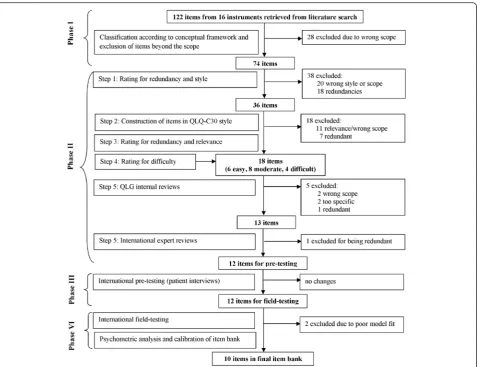
The flowchart in Fig. 1 shows details of the item de-velopment process, including numbers of items and reasons for exclusions at each step. In summary, across the selection steps one to four, 61 items were excluded due to incompatible style and lack of rele-vance for the EORTC RF concept (e.g. “I have diffi-culty talking to my boss about the cancer”), or overlap with other constructs (e.g. “…dealing with concerns about your family’s ability to cope with caring for you”) and 27 items were excluded due to redundancy (e.g. “Were you limited in the kind of work or other activities?” was considered redundant with the QLQ-C30 RF item on work and other daily activities).The resulting 18 candidate items were then rated for diffi-culty by three independent experts: six were classified as mainly relevant for patients with good RF, eight as relevant for moderate RF, and four as relevant for pa-tients with poor RF.
Reviewers disagreed on 11–25 % of the items across the developmental steps 1–4. Consensus choices were guided by the policy that patients at different ages and with different diagnoses and stages need to be able to re-late to the content of the items.
Phase III: Pre-testing
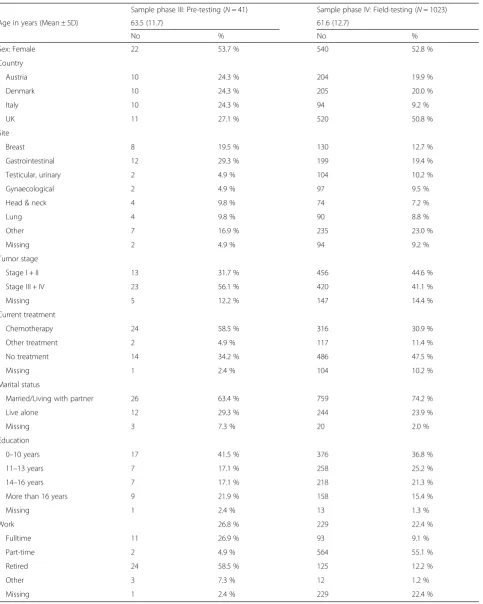
Patient interviews were conducted in four countries (Austria, Denmark, Italy, UK). The same sample has been used in the development of the emotional func-tioning CAT [35]. Forty-one patients were interviewed (mean age 63.5 + −11.7 years; 53.7 % female). The sam-ple included patients with a broad range of tumour types and stages. Sample characteristics are provided in Table 1. At this stage, no changes were prompted by pa-tient feedback.
Thus, the provisional item list consisted of 12 items, 9 items covering “work or other daily activities” and 3 items the domain “hobbies or other leisure time activ-ities” (difficulties: 4 easy, 5 moderate, 3 difficult) (see Table 1).
Phase IV: Field testing and calibration of item bank
Sample characteristics and descriptive analyses
In line with the guidelines [13] patients were recruited in the same countries as in phase III. Responses from 1,023 patients were obtained (mean age 61.6 ± 12.7;
52.8 % female) (details can be seen in Table 1). All 12 RF items were answered by 93.4 % of the sample, and only 3.2 % missed two or more items. The respondents gener-ally showed high levels of RF with a mean score of 1.7 (1 = not at all, 2 = a little, 3 = quite a bit, 4 = very much). There was a clear ceiling effect (23 % of patients an-swered“not at all” to all items), thus patients with poor RF were underrepresented in the sample. However for every item at least 10 patient responses for each re-sponse category were present and, thus, rere-sponse distri-butions were deemed adequate for analyses and calibration. Generally the patients had very few problems with answering these items (at most 0.4 % reported problems for each item).
Evaluation of dimensionality and local dependence
Table 1Patient characteristics
Sample phase III: Pre-testing (N= 41) Sample phase IV: Field-testing (N= 1023)
Age in years (Mean ± SD) 63.5 (11.7) 61.6 (12.7)
No % No %
Sex: Female 22 53.7 % 540 52.8 %
Country
Austria 10 24.3 % 204 19.9 %
Denmark 10 24.3 % 205 20.0 %
Italy 10 24.3 % 94 9.2 %
UK 11 27.1 % 520 50.8 %
Site
Breast 8 19.5 % 130 12.7 %
Gastrointestinal 12 29.3 % 199 19.4 %
Testicular, urinary 2 4.9 % 104 10.2 %
Gynaecological 2 4.9 % 97 9.5 %
Head & neck 4 9.8 % 74 7.2 %
Lung 4 9.8 % 90 8.8 %
Other 7 16.9 % 235 23.0 %
Missing 2 4.9 % 94 9.2 %
Tumor stage
Stage I + II 13 31.7 % 456 44.6 %
Stage III + IV 23 56.1 % 420 41.1 %
Missing 5 12.2 % 147 14.4 %
Current treatment
Chemotherapy 24 58.5 % 316 30.9 %
Other treatment 2 4.9 % 117 11.4 %
No treatment 14 34.2 % 486 47.5 %
Missing 1 2.4 % 104 10.2 %
Marital status
Married/Living with partner 26 63.4 % 759 74.2 %
Live alone 12 29.3 % 244 23.9 %
Missing 3 7.3 % 20 2.0 %
Education
0–10 years 17 41.5 % 376 36.8 %
11–13 years 7 17.1 % 258 25.2 %
14–16 years 7 17.1 % 218 21.3 %
More than 16 years 9 21.9 % 158 15.4 %
Missing 1 2.4 % 13 1.3 %
Work 26.8 % 229 22.4 %
Fulltime 11 26.9 % 93 9.1 %
Part-time 2 4.9 % 564 55.1 %
Retired 24 58.5 % 125 12.2 %
Other 3 7.3 % 12 1.2 %
and PF items supported a 2-factor solution. PROMAX rotations indicated that, although items generally loaded strongly on both factors, PF items clearly loaded higher on one factor while RF items loaded higher on the other. Confirmatory analyses showed that a one factor solution would be possible according to TLI and CFI, but RMSEA was not completely satisfying with a value of 0.118 in the one factor CFA and improving significantly to 0.085 in a two factor CFA.
Evaluation of item fit
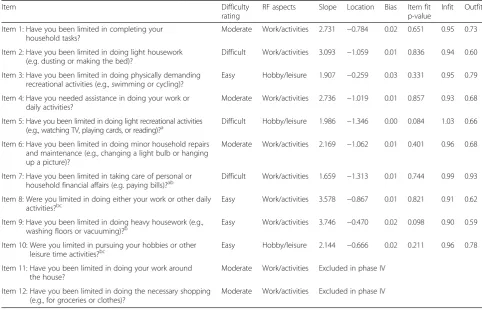
The 12 items were assessed for their fit to a GPCM and for the precision of predicting responses, as well as for redundancy. Two of the 12 items (items ID 7 and ID 12; item text see Table 2) showed a minor deviation from monotonicity of 0.06 corresponding to 2.0 on a 0–100 scale. Wilcoxon tests comparing the item scores in the two RF score groups where a drop occurred resulted in p= 0.28, i.e. drop is not significant. Hence, this does not seem to be a genuine deviation but likely random variation.
The GPCM converged for an 11-item model. RMSEs between 0.31 and 0.67 indicated some variation in the precision of predicting the item responses, but all
were < 1 (i.e. < 1 response category), so were not highly problematic. Furthermore, raw infit values ran-ging between 0.76 and 1.05 were acceptable. Likewise in the acceptable range were t-transformed infit values ranging between −1.5 and 0.8, except for item ID 12 (see Table 2), for which infit was −4.4 indicating clear problems with redundancy. Therefore it was deleted from the model. Items 5 and 7 (item text can be seen in Table 2) showed reversed thresholds. Although the GPCM would allow the ordering of thresholds to vary across items, reversed thresholds may give rise to counter-intuitive item characteristic (e.g. for some levels of RF an-swering ‘a little’or ‘very much’would then both be more likely than answering ‘quite a bit’). As most responses were in the category“not at all”and then frequencies were decreasing over the categories with the least in “very much”, the disorder may be an artefact caused by having too few responses in these categories. Therefore, response categories were collapsed to two categories (“not at all”vs. rest of categories). Our strategy for dealing with distorted thresholds is based on the approach suggested by Andrich [36] as opposed to the approach suggested by Adams et al. [37].
Table 2Items of phase III and phase IV including difficulties, subdomains, item parameters, and fit indices
Item Difficulty
rating
RF aspects Slope Location Bias Item fit p-value
Infit Outfit
Item 1: Have you been limited in completing your household tasks?
Moderate Work/activities 2.731 −0.784 0.02 0.651 0.95 0.73
Item 2: Have you been limited in doing light housework (e.g. dusting or making the bed)?
Difficult Work/activities 3.093 −1.059 0.01 0.836 0.94 0.60
Item 3: Have you been limited in doing physically demanding recreational activities (e.g., swimming or cycling)?
Easy Hobby/leisure 1.907 −0.259 0.03 0.331 0.95 0.79
Item 4: Have you needed assistance in doing your work or daily activities?
Moderate Work/activities 2.736 −1.019 0.01 0.857 0.93 0.68
Item 5: Have you been limited in doing light recreational activities (e.g., watching TV, playing cards, or reading)?a
Difficult Hobby/leisure 1.986 −1.346 0.00 0.084 1.03 0.66
Item 6: Have you been limited in doing minor household repairs and maintenance (e.g., changing a light bulb or hanging up a picture)?
Moderate Work/activities 2.169 −1.062 0.01 0.401 0.96 0.68
Item 7: Have you been limited in taking care of personal or household financial affairs (e.g. paying bills)?ab
Difficult Work/activities 1.659 −1.313 0.01 0.744 0.99 0.93
Item 8: Were you limited in doing either your work or other daily
activities?bc Easy Work/activities 3.578 −0.867 0.01 0.821 0.91 0.62
Item 9: Have you been limited in doing heavy housework (e.g., washing floors or vacuuming)?b
Easy Work/activities 3.746 −0.470 0.02 0.098 0.90 0.59
Item 10: Were you limited in pursuing your hobbies or other leisure time activities?bc
Easy Hobby/leisure 2.144 −0.666 0.02 0.211 0.96 0.78
Item 11: Have you been limited in doing your work around the house?
Moderate Work/activities Excluded in phase IV
Item 12: Have you been limited in doing the necessary shopping (e.g., for groceries or clothes)?
Moderate Work/activities Excluded in phase IV
a
four response categories collapsed to two b
significant DIF (item 7: age–higher RF >60 years,item 8: work–higher RF when retired; partner–higher RF if no partner,item 9: country–higher RF in UK + Austria, item 10: gender–higher RF in women,)
c
Finally, this yielded 10 items with good fit indices (S-X2 p> 0.05, infits between 0.90 and 1.03, outfits between 0.59 and 0.93, and bias ≤0.03 (which is about one point on 0–100 scale). Item texts and fit indices are shown in Table 2.
DIF analyses
DIF analyses showed that items 7–10 demonstrated sig-nificant DIF for different variables (details provided in Table 2). Detailed evaluations of the DIF effect indicated that it had only very minor impact on the estimation of RF-scores (all differences in RF scores were less than 0.1 and did not indicate salient scale-level differential func-tioning). Detailed evaluations of the DIF effect indicated that it had only very minor impact on the estimation of RF-scores; thus no items were deleted (results not shown).
Calibration and evaluation of final item bank
As no item had to be excluded due to DIF the final item bank contained 10 items which were calibrated within a GPCM.
The measurement precision of the item bank was high. The resulting item bank exhibits excellent reliability (mean reliability = 0.85, median = 0.95, ≥0.90 for 62 %). The score range covered by the item bank is θ= −2.43 (“very much” - lower extreme) to θ= 1.22 (“not at all” -upper extreme) (θ= the characteristic being measured, i.e. a person’s RF score). Particularly for patients answer-ing “a little” or “not at all” to all items, the item pool lacks relevant items at the high end of the role func-tioning scale continuum. The two QLQ-C30 RF items had total reliability <0.90 (total information ≤10) across the whole continuum (see Fig. 2). The item bank is
predominated by work/task related items, however, all available hobby items from the preliminary item list are included. Item parameters as well as different RF aspects covered are shown in Table 2.
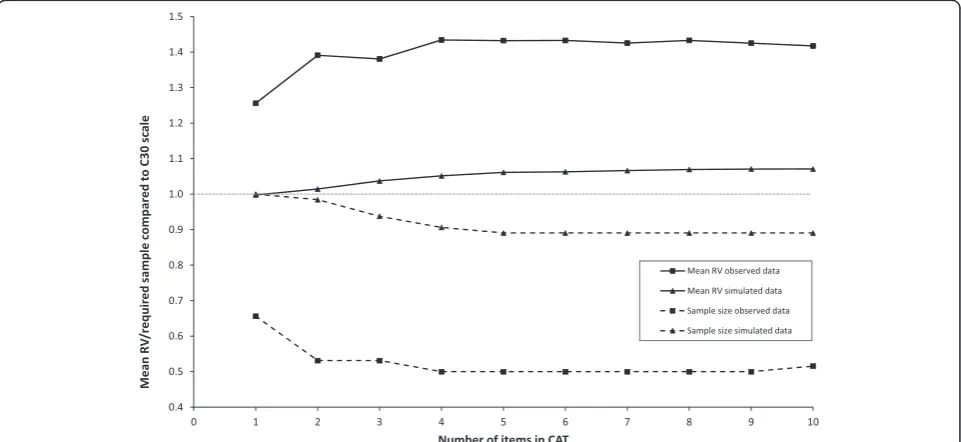
CAT simulations showed that median differences of RF estimates obtained from CAT versions with different lengths and the entire item bank were small (all <0.15 logits) (Fig. 3). As described previously, possible savings in sample size were determined by known group com-parisons based on observed and simulated data. Signifi-cant known groups were stage (I + II vs III + IV), work (working vs. not working), therapy (currently therapy vs. currently no therapy), and education (below vs. above A-level). Hence, these were used for RV analyses, showing that sample sizes may be reduced without loss of power by asking 2 or more CAT items compared to the static QLQ-C30 RF scale. However, the magnitude of sample size reduction was significantly different when based on observed versus simulated data. The simulated data indi-cated a maximum of 11 % reduction while the observed data indicated up to a 50 % reduction (see Fig. 4).
Discussion
Being able to maintain or rebuild ones usual life is an important aspect of coping with a chronic disease such as cancer. Thus, assessing the extent to which a person can fulfil his/her responsibilities is inevitable in the evaluation of oncologic treatments. Furthermore, issues of daily functioning are of utmost importance for cancer survivors, who as a result of rising incidence and de-creasing mortality rates are a growing population. For some sites this population even comprises increasingly younger age groups [38, 39].
In HRQOL research in general there is an interest in CAT measures due to their potential of a more effective and precise assessment compared to traditional instru-ments. Longitudinal studies and monitoring programs in clinical routine may especially benefit from the flexibility of a CAT as they allow repeated assessments with chan-ging sets of questions, supposedly reducing carelessness as well as the impression of redundancy when complet-ing the questions.
In this paper we have reported on the development and initial testing of a CAT for RF within the QLQ-C30
measurement framework. The project resulted in a suffi-ciently unidimensional item bank comprising 10 items including the two original QLQ-C30 items. We investi-gated the potential overlap between RF and PF and found that, as expected, they are closely related. How-ever, there is sufficient statistical support for the concep-tual separation of the two constructs.
The RF item bank showed high precision for patients with high and moderate RF impairments. A two-item CAT showed higher measurement precision than the original QLQ-C30 RF scale, which also consists of two Fig. 3Median and percentiles for differences between theta (θ) estimates based on fixed length CATs and full-lengthθ
items. When using CAT with five or more items, there are possible savings of required sample size between 11 and 50 %.
In a previous study [40] based on other data, we had stated that there may be little gain with IRT scoring com-pared to sum scoring of the QLQ-C30 domains. However, within the EORTC QLG CAT project, we found signifi-cant differences in the potential gain from using IRT/CAT across the different domains. Some of the most significant gains were found for the 1 and 2-item scales of the QLQ-C30 (the RF scale being one of those), while for emotional functioning and fatigue CATs with≤4 items, there was lit-tle difference between IRT scoring and sum scoring. Hence, our former conclusion, based on the physical func-tioning, the emotional funcfunc-tioning, and the fatigue do-mains only, may have been premature.
A major strength of RF-CAT is the standardized devel-opmental procedure involving international experts from different fields as well as patients themselves enabled the best possible balance between requirements from a psy-chometric and a practical perspective. This of special importance as the QLQC30 RF scale is designed to as-sess role impairments in all kinds of cancer patients, i.e. a heterogeneous group concerning sociodemographic and clinical characteristics. Furthermore, as the item bank also comprises the original QLQ-C30 RF items, even data collected prior to this project can be IRT scored now which makes information from earlier and future studies comparable.
As other functioning domains assessed by the QLQ-C30, RF comprises different aspects of the construct, namely work and daily activities and leisure time activ-ities. Within an assessment procedure, the CAT algo-rithm selects items based on the criterion of maximum information from a statistical perspective. However, to secure the RF construct of the QLQ-C30, content balan-cing can be included in the algorithm to ensure that the assessment includes both of these aspects of RF, i.e. item selection is based on statistical as well as on content-related reasoning.
A limitation of the item bank is the clear ceiling effect, i.e. it cannot discriminate well between patients with minor RF impairments, which might be of special inter-est when invinter-estigating survivor issues. Construction of well-fitting items relevant for these patients would clearly improve the item bank; however such a task may be difficult. There were no obvious candidate items from the 122 identified from 16 instruments in the original lit-erature search, and therefore, additional work is needed to identify ways to phrase such items.
Conclusion
Although 10 items form a small item bank, our results suggest that a 2-item CAT based on the item bank may
provide an improve measure of RF and enable sample size reductions compared to the static 2-item RF scale of the QLQ-C30. Considering that HRQOL assessments typic-ally cover multiple domains, there is clear benefit from more concise assessment of each single domain. Another advantage of the IRT calibrated item bank is that it will also be possible to create fixed ‘short-forms’ for certain purposes (e.g. screening in clinical routine) without losing comparability with other data collected with other items from the same bank. It should noted that significant dif-ferences in estimated required sample sizes were observed, depending on whether known group comparisons were based on simulated or observed data. Hence, the actual gain in terms of sample size reduction may vary across studies, and measurement properties need to be evaluated in independent data. This is currently being done within the ongoing EORTC CAT clinical validation study. The EORTC CAT versions have been integrated into software and will be made available on the EORTC QLG website after completion of the current validation exercise. This will also, hopefully, promote the use of HRQOL assess-ment in daily clinical practice.
Ethics, consent and permissions
The study was approved by the ethics committees of the participating centres/countries. All included patients provided informed consent.
Competing interests
The authors declare that they do not have any conflict of interest.
Authors’contributions
All Authors contributed to the item development process. EMG was responsible for Austrian data collection and writing of the manuscript. MAP contributed to conception and design, and performed analysis and interpretation of data. NA contributed to conception and design. AC performed Italian data collection. JMG, GK and AO contributed to Austrian data collection. BH contributed to conception and design and lead Austrian data collection. SS contributed to conception and design. TY contributed to conception and design and collected UK data. MG was responsible for conception and design, data acquisition in Denmark, and contributed to analysis and interpretation of data. All authors read, revised, and approved the final manuscript.
Acknowledgements
EORTC Quality of Life Group (grant number 0052007)
The work of Eva-Maria Gamper and Johannes Giesinger was partly funded by the Austrian Science fund (project numbers P26930-B24 and J3353).
Author details
1Department for Psychiatry and Psychotherapy and Department for Nuclear
Medicine, Medical University of Innsbruck, Anichstraße 35, 6020 Innsbruck, Austria.2The Research Unit, Department of Palliative Medicine, Bispebjerg
Hospital, Bispebjerg Bakke 23, 2400 Copenhagen, Denmark.3Netherlands Cancer
Institute, Psychosocial Research and Epidemiology, Plesmanlaan 121, 1066 CX Amsterdam, Netherlands.4Psychoncology Unit, Sant’Andrea Hospital Sapienza University of Rome, Via di Grottarossa 1035, 00189 Rome, Italy.5Department for
Psychiatry and Psychotherapy, Medical University of Innsbruck, Anichstraße 35, 6020 Innsbruck, Austria.6Department of Medical Biostatistics, Epidemiology, and
Informatics, University of Mainz, Saarstraße 21, 55122 Mainz, Germany.7Mount Vernon Cancer Centre, Lynda Jackson Macmillan Centre, Northwood, Middlesex HA6 2RN, UK.8Department of Public Health, Institute of Health Services Research,
9Department for Psychiatry, Psychotherapy and Psychosomatic Medicine, Medical
University of Innsbruck, Anichstraßé 35, 6020 Innsbruck, Austria.
Received: 9 June 2015 Accepted: 28 April 2016
References
1. Wainer H. Computerized adaptive testing: A primer. 2nd ed. Hillsdale: Lawrence Erlbaum Associates; 2000.
2. Howell D, Molloy S, Wilkinson K, Green E, Orchard K, Wang K, Liberty J. Patient-reported outcomes in routine cancer clinical practice: A scoping review of use, impact on health outcomes, and implementation factors. Ann Oncol. 2015;26:1846–58.
3. Oude Voshaar MA, Ten Klooster PM, Glas CA, Vonkeman HE, Krishnan E, van de Laar MA. Relative performance of commonly used physical function questionnaires in rheumatoid arthritis and a promis computerized adaptive test. Arthritis Rheumatol. 2014;66(10):2900–8.
4. Lai JS, Cella D, Choi S, Junghaenel DU, Christodoulou C, Gershon R, Stone A. How item banks and their application can influence measurement practice in rehabilitation medicine: A promis fatigue item bank example. Arch Phys Med Rehabil. 2011;92:S20–27.
5. Sherbourne CD, Stewart AL, Wells KB. Role functioning measures. In: Stewar AL, Ware Jr JE, editors. Measuring functioning and well-being: The medical outcomes study approach. Durham: Duke University Press; 1992. p. 205–19. 6. Goodman SH, Sewell DR, Cooley EL, Leavitt N. Assessing levels of adaptive
functioning: The role functioning scale. Community Ment Health J. 1993;29:119–31.
7. Cella DF, Tulsky DS, Gray G, Sarafian B, Linn E, Bonomi A, Silberman M, Yellen SB, Winicour P, Brannon J, et al. The functional assessment of cancer therapy scale: Development and validation of the general measure. J Clin Oncol. 1993;11:570–9.
8. Aaronson NK, Ahmedzai S, Bergman B, Bullinger M, Cull A, Duez NJ, Filiberti A, Flechtner H, Fleishman SB, de Haes JC. The european organization for research and treatment of cancer qlq-c30: A quality-of-life instrument for use in international clinical trials in oncology. J Natl Cancer Inst. 1993;85:365–76.
9. McHorney CA, Ware Jr JE, Lu JF, Sherbourne CD. The mos 36-item short-form health survey (sf-36): Iii. Tests of data quality, scaling assumptions, and reliability across diverse patient groups. Med Care. 1994;32:40–66. 10. Hahn EA, DeWalt DA, Bode RK, Garcia SF, DeVellis RF, Correia H, Cella D.
New english and spanish social health measures will facilitate evaluating health determinants. Health Psychol. 2014;33:490–9.
11. Anatchkova M, Rose M, Ware J, Bjorner JB. Evaluation of a role functioning computer adaptive test (rf-cat). Qual Life Res. 2013;22:1085–92.
12. WHO. Icf: International classification of functioning, disability and health/ world health organization. Geneva: Author; 2001.
13. Johnson C, Aaronson N, Blazeby J, Bottomly A, Fayers P, Koller M, Kulis D, Ramage J, Sprangers M, Velikova G, Young T. Guidelines for developing questionnaire modules. 2011. http://groups.eortc.be/qol/sites/default/files/ archives/guidelines_for_developing_questionnaire-_final.pdf. Accessed 13 June 2012.
14. Petersen MA, Groenvold M, Aaronson NK, Chie WC, Conroy T, Costantini A, Fayers P, Helbostad J, Holzner B, Kaasa S, Singer S, Velikova G, Young T. Development of computerised adaptive testing (cat) for the eortc qlq-c30 dimensions - general approach and initial results for physical functioning. Eur J Cancer. 2010;46:1352–8.
15. Petersen MA, Groenvold M, Aaronson NK, Chie WC, Conroy T, Costantini A, Fayers P, Helbostad J, Holzner B, Kaasa S, Singer S, Velikova G, Young T. Development of computerized adaptive testing (cat) for the eortc qlq-c30 physical functioning dimension. Qual Life Res. 2011;20:479–90.
16. Petersen MA, Aaronson Neil K, Arraras J, Chie WC, Conroy T, Costantini A, Giesinger J, Holzner B, King M, Singer S, Velikova G, Verdonck-de Leeuw IM, Young T, Groenvold M. The eortc computer-adaptive tests (cats) measuring physical functioning and fatigue exhibited high levels of measurement precision and efficiency. J Clin Epidemiol. 2013;66:330–9.
17. Koller M, Aaronson Neil K, Blazeby J, Bottomley A, Dewolf L, Fayers P, Johnson C, Ramage J, Scott N, West K. Translation procedures for standardised quality of life questionnaires: The european organisation for research and treatment of cancer (eortc) approach. Eur J Cancer. 2007;43:1810–20.
18. Muraki E, Bock RD. Parscale - irt based test scoring and item analysis for graded open-ended exercises and performance tasks. Chicago: Scientific Software International, Inc.; 1996.
19. Choi SW, Cook KF, Dodd BG. Parameter recovery for the partial credit model using multilog. J Outcome Meas. 1997;1:114–42.
20. Browne M, Cudeck R. Alternative ways of assessing model fit. Sociol Methods Res. 1992;21:230–58.
21. Kline R. Principles and practice of structural equation modeling. 2nd ed. New York: The Guilford Press; 2005.
22. Bjorner Jakob B, Kosinski M, Ware John Jr E. Calibration of an item pool for assessing the burden of headaches: An application of item response theory to the headache impact test (hit). Qual Life Res. 2003;12:913–33. 23. Muraki E. A generalized partial credit model. In: van der Linden WJH,
Hambleton RK, editors. Handbook of modern item response theory. Berlin: Springer; 1997. p. 153–68.
24. Orlando M, Thissen D. Likelihood-based item-fit indices for dichotomous item response theory models. Appl Psychol Meas. 2000;24:50–64. 25. Orlando M, Thissen D. Further examination of the performance of s-x2, an
item fit index for dichotomous item response theory models. Appl Psychol Meas. 2003;27:289–98.
26. Bond TG, Fox CM. Applying the rasch model: Fundamental measurement in the human sciences ed 2. New Jersey: Lawrence Erlbaum Associates, Inc; 2007.
27. Linacre JM. Sample size and item calibration stability. Rasch Measurement Transactions. 1994;7:328.
28. Petersen MA, Giesinger JM, Holzner B, Arraras JI, Conroy T, Gamper EM, King MT, Verdonck-de Leeuw IM, Young T, Groenvold M. Psychometric evaluation of the eortc computerized adaptive test (cat) fatigue item pool. Qual Life Res. 2013;22:2443–54.
29. French A, Miller TR. Logistic regression and its use in detecting differential item functioning in polytomous items. J Educ Meas. 1996;33:315–32. 30. Petersen Morten A, Groenvold M, Bjorner Jakob B, Aaronson N, Conroy T,
Cull A, Fayers P, Hjermstad M, Sprangers M, Sullivan M. Use of differential item functioning analysis to assess the equivalence of translations of a questionnaire. Qual Life Res. 2003;12:373–85.
31. Hart DL, Deutscher D, Crane PK, Wang YC. Differential item functioning was negligible in an adaptive test of functional status for patients with knee impairments who spoke english or hebrew. Qual Life Res. 2009;18:1067–83. 32. Fayers P, Machin D. Quality of life. The assessment, analyses and interpretation
of patient-reported outcomes. 2nd ed. Chichester: Wiley; 2007.
33. Muraki E. Irt based test scoring and item analysis for graded open-ended exercises and performance tasks. Chicago: Scientific Software, Inc.; 1996. 34. Muthén LK, Muthén BO. Mplus user’s guide. 5th ed. Los Angeles, CA:
Muthén & Muthén; 1998-2007.
35. Gamper EM, Groenvold M, Petersen MA, Young T, Costantini A, Aaronson N, Giesinger JM, Meraner V, Kemmler G, Holzner B. The eortc emotional functioning computerized adaptive test: Phases i-iii of a cross-cultural item bank development. Psychooncology. 2013;23(4):397-403.
36. Andrich D. An expanded derivation of the threshold structure of the polytomous rasch model that dispels any“threshold disorder controversy”. Educ Psychol Meas. 2013;73:78–124.
37. Adams RJ, Wu ML, Wilson M. The rasch rating model and the disordered threshold controversy. Educ Psychol Meas. 2012;72:547–73.
38. Siegel R, Desantis C, Jemal A. Colorectal cancer statistics, 2014. CA Cancer J Clin. 2014;64:104–17.
39. NCIN. Thyroid cancer trends by sex age and histological type. National Cancer Intelligence Network. 2014. http://www.ncin.org.uk/publications/ data_briefings/thyroid_cancer_trends_by_sex_age_and_histological_type. Accessed 2 May 2016.