Influence of Electrical Field Interation on Speech
Recognition Performance of Cochlear Implant
Users: Adults With Prelingual Deafness
Goutam Goyal, M. E., Dr. K. K. Dhawan, Dr. S. S. Tiwari,
ABSTRACT To examine the hypothesis that the newer generations of cochlear implants could provide considerable speech understanding to late-implanted, prelingually deaf adult patients. Cochlear implant (CI) user’s performance degrades significantly in noisy environments, especially in non-steady noisy conditions.Unlike normal hearing listeners. CI users generally perform better when listening to speech in non-steady-state noise than in fluctuating maskers, and the reasons for that are unclear. In this article, we propose a new hypothesis for the observed absence of release from masking by CI users. A new strategy is also developed and integrated into existing CI systems to improve speech recognition in noise for CI users.
1 INTRODUCTION
A pilot study was conducted to examine the influence of electrical-field interaction on speech recognition performance. Electrical-field interaction was measured with a psychophysical task, known as simultaneous masking (Section 1.1). Psychophysical thresholds were compared for patients with the Hi-Focus electrode array and the Electrode Positioning System (HF+EPS), patients with the Enhanced Bipolar Clarion electrode and electrode positioned (ENH+EPS), and patients with the Enhanced Bipolar Clarion electrode without an electrode positioned (ENH). A correlation analysis was then carried out to test whether less electrical-field interaction was associated with higher speech recognition scores. Several key findings have been consistently observed in the outcome measures of prelingually deafened CI users. Chief among them, age at implantation and duration of deafness were found to have the most significant impact on the post implant outcome measures. Adults with long-term prelingual deafness derived the poorest benefits from their implants. A few early studies showed that these latter groups of patients could achieve only limited post implant improvement in closed-set auditory perception, with some awareness of environmental sounds, but no open-set speech recognition ability.6,7 Consequently, few patients with long-term prelingual deafness were considered good CI candidates. As recent advances in CI technology continue to push the performance levels of most CI users to higher levels, interest in cochlear implantation for prelingually deafened adolescents and adults has been rekindled. Several recent studies have suggested that the latest implant technology could indeed provide some open-set speech perceptual abilities to these patients.
8–11 These conclusions, however, are based on analyses of results obtained with only a very small number of patients, and the data often showed enormous variability among individuals, making the true assessment of their effectiveness an exceedingly difficult task. Prelingually deafened adults consist of a very heterogeneous group of patients. A substantial number of individual factors, such as etiology of deafness, communication mode, residual hearing, and educational experience, could all affect the post implantation outcomes. Consequently, a valid assessment of the effectiveness of CIs would require a study with a large number of patients or a very well-controlled group of subjects. However, with no evidence proving their clinical efficacy, it is difficult to justify the cochlear implantation of a large number of such patients. In this article, we review all available published evidence in the CI literature on late-implanted prelingually deafened adults, and report new speech perception data obtained from an additional 103 patients from the recent CI clinical trials. The speech recognition scores of these patients were examined longitudinally over the 12-month clinical trial period to evaluate the effectiveness of cochlear implantation in providing auditory perceptual benefits.
1.1 Simultaneous Masking:
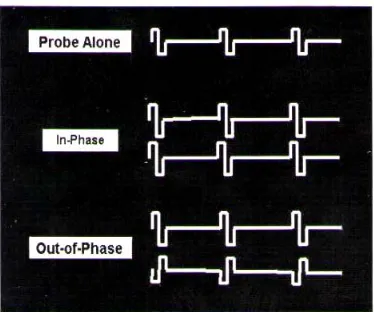
A psychophysical task, known as simultaneous masking, measures the degree of summation produced by two electrodes stimulated simultaneously. Several studies have used simultaneous masking to measure electrical-field interaction (Boëx et al., 1999; Shannon, In a simultaneous masking paradigm, thresholds are compared for biphasic pulses, comprised of one anodic and one cathode pulse, presented to a probe electrode alone and for pulses presented simultaneously to the probe electrode and a second electrode located some distance from the probe (i.e. the masker). The masker electrode either delivers biphasic pulses with the same phase first (Figure 1: middle panel) or is 180o out-of-phase with the pulses of the probe electrode (Figure 1: bottom panel).
1.2 Simultaneous Masking Conditions
If currents from the two electrical fields interact, then the listener’s loudness percept is altered. For the out-of-phase condition, pulses would cancel and the percept becomes softer. In this case, the thresholds are elevated relative to thresholds for stimuli presented to the probe electrode stimulated alone. The opposite occurs for the in-phase _________________________
• Goutam Goyal, M.E., Biomedical Engineering Research Group, Singhania University Rajasthan, India, Email [email protected]
• Dr. K. K. Dhawan, Ph.D., Director, Shekhawati Group Of College Shekhawati, Rajasthan, India,
Email [email protected]
• Dr. S. S. Tiwari , Ph.D., Managing Director, Sensors Technology Pvt. Ltd., Gwalior, India,
condition. Specifically, when same-phase current pulses overlap, they add electrically,
Figure 1: The top trace shows the biphasic pulse presented to a single electrode in the “probe alone” condition. The middle and lower traces show two pulses: one pulse is delivered to the probe electrode and the second is delivered to the masker electrode. The middle trace represents the “in-phase” condition, while the lower trace represents the “out-of-phase” condition.
Thereby increasing the loudness percept and lowering thresholds. The amount of electrical field overlap therefore determines how much current summation (in-phase) or cancellation (out-of-phase) occurs. The difference in thresholds for the in-phase and outof- phase conditions represents the degree of current pulse overlap, or electrical-field interaction. The degree of electrical-electrical-field interaction can be expressed by the following formula: Difference Threshold = THR(-) - THR(+) where, THR(-) = out-of-phase threshold THR(+) = in-phase threshold In situations where there is virtually no electrical-field interaction, the threshold patterns would appear like those found with acoustical hearing (Shannon, 1983b, 1985). In acoustical hearing, when two stimuli activate two critical bands (or, similarly, two electrodes stimulating separate neural populations), the percept is louder and thresholds are lower than when only one critical band (or electrode) is activated. Phase does not affect the simultaneous masked thresholds in acoustical hearing. Both out-of-phase and in-phase stimuli decrease thresholds, and roughly to the same degree. Therefore, the Difference Threshold would approach zero as the amount of electrical field overlap decreased. Simultaneous masking can be a useful measurement tool for evaluating the effectiveness of the EPS and Hi-Focus electrode array. If these new electrode designs serve their intended purpose, then it is predicted that the EPS combined with the Enhanced Bipolar Clarion electrode would generate less electrical-field interaction (or a smaller Difference Threshold) than the Enhanced Bipolar Clarion electrode without the EPS, and even less electrical-field interaction would occur when the EPS is combined with the Hi-Focus electrode array.Many researchers have claimed that cochlear implant users with poorer speech recognition abilities may be subject to the detrimental effects of
electrical-field interactions. Therefore, the relationship between electrical-field interaction and speech recognition performance was also evaluated in the pilot study. It was hypothesized that cochlear implant users with more electrical-field interaction would show lower speech perception scores than users with less electrical-field interaction.
2 Methods:
Simultaneous masking measures were collected from 5 subjects implanted with the Enhanced Bipolar Clarion electrode without the electrode positioning system (ENH), 5 subjects with the Enhanced Bipolar Clarion electrode with the electrode positioning system (ENH+EPS), and 4 subjects with the Hi-Focus electrode with the electrode positioning system (HF+EPS). Subject CS of the HF+EPS group has not returned to complete the vowel and consonant portion of the Subject areTable 1: Pilot Subject Demographics
performed in a sound-attenuated chamber. Speech stimuli were delivered through loudspeakers at a 0o azimuth and presented at 65 dB(A) in quiet and innoise at +5 and +10 dB signal-to-noise ratios. All speech testing was performed with the patient’s own speech processing strategy.
3 Results and Discussion
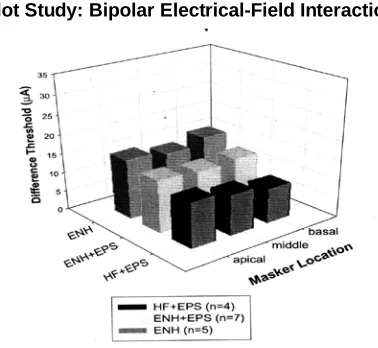
In addition, several patients with some residual hearing may have had some auditory experience through their hearing aids before cochlear implantation. Figures 3.1 and 3.2, the magnitude of electrical-field interaction, as measured by the Difference Threshold, is plotted for each electrode design and each masker electrode location (e.g. apical masker = electrode 2, middle masker = electrode 4, basal masker = electrode 6). In these two figures, the magnitude of electrical-field interaction for each masker electrode location was obtained by averaging the Difference Threshold for the two masker probe pairs with the same masker electrode. For example, the Difference Threshold value for the apical masker location was obtained by averaging the Difference Threshold for probe electrode 1 with masker electrode 2 and probe electrode 3 with masker electrode 2. Figure 3.1 shows the electrical-field interaction data for the monopolar design and Figure 3.2 shows the data for the bipolar design. These results indicate that, regardless of the electrode design, the HF+EPS subjects had the least electrical-field interaction, and the ENH group had the most electrical-field interaction. The results also show that the broad current distribution of monopolar stimulation produces relatively uniform levels of electrical-field interaction for each of the masker electrodes. With monopolar stimulation, a large portion of the modulus lies within the current field and, because of this, the nerve fibers along the entire length of the cochlea could be activated. Therefore, regardless of the masker probe pair, the same nerve populations contribute to the threshold measures in the simultaneous masking task. In contrast, with bipolar stimulation, the degree of electrical-field interaction varied depending on the location of the masker. Since only a 40 small region of auditory nerve fibers are activated with bipolar coupling, there was more variability in the magnitude of channel interaction for different masker+probe pairs.
Pilot Study: Monopolar Electrical-Field Interaction
figure 3.1: The magnitude of monopolar electrical-field interaction (represented by the Difference Threshold) is shown for each of the three electrode designs and thethree masker locations.
Pilot Study: Bipolar Electrical-Field Interaction
Figure 3.2: The magnitude of bipolar electrical-field interaction (represented by the Difference Threshold) is shown for each of the three electrode designs and the three masker locations.
4 Speech Recognition Results
Figure 4.1.1shows speech recognition performance in quiet and in noise for vowels, consonants, and sentences.
Pilot Data : Speech Recognition Performance
Figure 4.1.1 Mean Speech recognition performance in quiet is shown for five speech recognition tasks.
Pilot Study: Speech Recognition as a Function of Electrical-Field Interaction
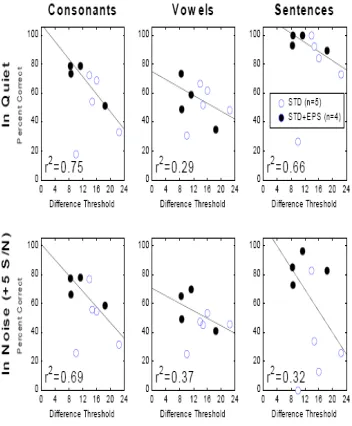
Figure 3.5: Scatterplots of the correlations are shown for the speech recognition tasks tested in quiet (top) and noise (bottom). The average difference threshold across all monopolar simultaneous masked conditions is plotted as a function of the percent of items correctly identified for each speech task with a monopolar CIS speech strategy. Filled circles represent the data for each of the four ENH+EPS subjects and unfilled circles represent the data for each of the four ENH subjects.
5 Conclusion
These preliminary experiments have examined the effects of electrical-field interaction on speech recognition. Speech recognition scores were strongly correlated with the magnitude of electrical-field interaction between adjacent
electrodes. It was also shown that the magnitude of electrical-field interaction varies as a function of electrode design. Electrical-field interaction was greatest for patients with the ENH electrode design and least for patients with the HF+EPS electrode design. In the experiments that follow, the extent of electrical-field interaction across the electrode array, instead of the magnitude of electrical-field interaction between adjacent electrodes, is investigated for the three electrode designs. The relationship between electrical-field interaction and speech processing strategy performance is also evaluated. Subjects were tested with 5 speech processing strategies varying in the number of simultaneous channels. Since simultaneous stimulation increases the likelihood for electrical-field interactions to occur, it was predicted that a high degree of electrical-field interaction should produce higher speech recognition scores for more sequential as opposed to simultaneous speech strategies. Specifically, it was predicted that subjects with lower levels of electrical-field interaction would be able to take advantage of the greater spectral and temporal resolution provided by simultaneous speech strategies, and would therefore show higher speech scores for simultaneous than sequential speech strategies. Even with the latest CI technology, a gradual lowering of the
performance plateau was observed as the age at implantation was delayed. If receiving implants after age 12, most profoundly deaf patients achieved only very limited closed-set speech perception and minimal to no open-set speech understanding, indicating the presence of a sensitive period for cochlear implantation. Second, prelingually deaf patients with long-term deafness reached their performance plateaus significantly earlier than patients receiving implants during their early childhood. Adult prelingual patients typically reach their performance plateau within 6 months to 1 year. Third, substantial performance variability was observed among individuals. A few CI users were able to score significantly above chance even in open-set speech perception tests. However, the number of such patients was very small, and they represent the exception rather than the rule. And finally, there were no significant differences noted in efficacy among the Nucleus, Clarion, and MedEl CIs at any of the postimplant intervals. Taken together, the pattern of results suggests that patient characteristics, rather than implant device properties, are likely to be the major contributing factors that are responsible for the observed outcome measures. In an effort to better understand the features that define the sensitive period of cochlear implantation, we will discuss in Part II of this series the possible anatomic and physiologic correlates of the observed performance limitations and outcome variabilities associated with long-term prelingual deafness.
REFERENCES
[1] Dorman MF. Speech perception by adults. Presented at the NIH Consensus Development Conference on Cochlear Implants in Adults and Children, Bethesda, Maryland, 1995;61–62.
[2] Waltzman SB, Cohen NL. Cochlear implantation in children younger than two years old. Am J Otol 1998;19:158–162.
[3] Fryauf-Bertschy H, Tyler RS, Kelsay DM, et al. Cochlear implant use by prelingually deafened children: the influences of age at implant and length of device use. J Speech Lang Hear Res 1997;40:183–199.
[4] Manrique M, Cervera-Paz FJ, Huarte A, et al. Cerebral auditory plasticity and cochlear implants. Int J Pediatr Otorhinolaryngol 1999;49(Suppl 1):S193– S197.
[5] Svirsky MA, Robbins AM, Kirk KI, et al. Language development in profoundly deaf children with cochlear implants. Psych Sci 2000;11:153–158.
[6] Waltzman SB, Cohen NL, Shapiro WH. Use of multichannel cochlear implant in the congenitally and prelingually deaf population. Laryngoscope 1992;102:395–399.
806.
[8] Sarant JZ, Cowan RS, Blamey PJ, et al. Cochlear implants for congenitally deaf adolescents: is open-set speech perception a realistic expectation? Ear Hear 1994;15:400–403.
[9] Waltzman SB, Cohen NL. Implantation of patients with prelingual long-term deafness. Ann Otol Rhinol Laryngol 1999;108:84–87.
[10] Waltzman SB, Roland JT, Cohen NL. Delayed implantation in congenitally deaf children and adults. Otol Neurotol 2002;23:333–340.
[11] Schramm D, Fitzpatrick E, Seguin C. Cochlear implantation for adolescents and adults with prelinguistic deafness. Otol Neurotol 2002;23:698– 703.
[12] Clark GM, Busby PA, Roberts SA, et al. Preliminary results for the cochlear corporation multielectrode intracochlear implant in six prelingually deaf patients. Am J Otol 1987; 8:234–239.
[13] Snik AF, Makhdoum MJ, Vermeulen AM, et al. The relation between age at the time of cochlear implantation and longterm speech perception abilities in congenitally deaf subjects. Int J Pediatr Otorhinolaryngol 1997;41:121–131.
[14] Snik AF, Vermeulen AM, Brokx JP, et al. Speech perception performance of children with a cochlear implant compared to that of children with conventional hearing aids. I. The “equivalent hearing loss” concept. Acta Otolaryngol (Stockh) 1997;117:750–754.
[15] Osberger MJ, Fisher L, Zimmerman-Phillips S, et al. Speech recognition performance of older children with cochlear implants. Am J Otol 1998;19:152–157.
[16] C. Wei, and K. Cao. Speech recognition with amplitude and frequency modula-tions. Proc. Nat. Acad. Sci. USA, 102:2293–2298, 2005.
[17] F-G. Zeng and C. W. Turner. Recognition of voiceless fricatives by normal and hearing-impaired subjects. J. Speech Hear. Res., 33:440–449, 1990.
[18] Aitkin, L (1990). The auditory cortex, (Chapman and Hall, London). Abbas, PJ (1993). “Electrophysiology,” in Cochlear Implants: Audiological foundations, edited by RS Tyler, (Singular Publishing, San Diego), pp. 317-355.
[19] Armstrong-Bednall, G, Goodrum-Clarke, K, Stollwerck, L, Nunn, T, Wei, J, Boyle, P (1999). “Clarion paired pulsatile sampler (PPS): User preference and performance,” Presented at the 1999 Conference on Implantable Auditory Prostheses, Pacific Grove, CA.
[20] Battmer, RD, Gnadeberg D, von Wallenberg E, (1993). “A study of monopolar and bipolar stimulation modes with a modified Nucleus mini-22 cochlear implant,” Adv Otorhinolaryngol 48, 9-16.
[21] Battmer, RD, Zilberman, Y, Haake, P, Lenarz, T (1999). “Simultaneous Analog Stimulation (SAS) – Continuous Interleaved Sampler (CIS) pilot comparison study in Europe,” Ann Otol Rhinol Laryngol 108, 69-73.
[22] Battmer, RD, Goldring, JE, Kuzma, J, Lenarz, T (2000a). “New CLARION Hi-Focus Intracochlear Electrode: Long-term clinical results,” Presented at The 6th International Cochlear Implant Conference. Miami Beach, FL.
[23] Battmer, RD, Goldring, JE, Kuzma, J,Lenarz, T (2000b). “Intraoperative measures and post-operative clinical results with new modiolus hugging electrodes and simultaneous analog stimulation (SAS) in young children,” Presented at The 6th International Cochlear Implant Conference. Miami Beach, FL.
[24] Berliner, KI and Eisenberg, LS (1987). “Our experience with cochlear implants: have we erred in our expectations?,” Am J Otol 8, 222-229.
[25] Berliner, KI, Tonokawa, LL, and Dye, LM, et al (1989a). “Open-set speech recognition in children with a single-channel cochlear implant.”, Ear Hear 10, 237-242.
[26] Berliner, KI, House, WF, Tonokawa, LL (1989b). “Open-set speech recognition by children with a single-channel cochlear implant,”, Trans Am Otol Soc, 50.
[27] Boex, C, de Balthasar, C, and Pelizzone, M (1999). “Electrode interactions in Clarion subjects,” Presented at the 1999 Conference on Implantable Auditory Prostheses, Pacific Grove, CA.
[28] Boex, C, Pelizzone, M, and Montandon, P (1996). “Speech recognition with a CIS strategy for the Ineraid multichannel cochlear implant,” Am. J. Otol. 17, 61-68.
[29] Boothroyd, A., Mulhearn, B., Gong., J., and Ostroff, J. (1996). “Effects of spectral smearing on phoneme and word recognition,” J. Acoust. Soc. Am. 100, 1807-1818.