Screening for Speech and Language
Delay in Children 5 Years Old and
Younger: A Systematic Review
Ina F. Wallace, PhDa, Nancy D. Berkman, PhDa, Linda R. Watson, EdDb, Tamera Coyne-Beasley, MD, MPHc,d, Charles T. Wood, MDc, Katherine Cullen, BAa, Kathleen N. Lohr, PhDa
abstract
BACKGROUND AND OBJECTIVES:No recommendation exists for or against routine use of brief, formalscreening instruments in primary care to detect speech and language delay in children through 5 years of age. This review aimed to update the evidence on screening and treating children for speech and language since the 2006 US Preventive Services Task Force systematic review.
METHODS:Medline, the Cochrane Library, PsycInfo, Cumulative Index to Nursing and Allied
Health Literature, ClinicalTrials.gov, and reference lists. We included studies reporting diagnostic accuracy of screening tools and randomized controlled trials reporting benefits and harms of treatment of speech and language. Two independent reviewers extracted data, checked accuracy, and assigned quality ratings using predefined criteria.
RESULTS:We found no evidence for the impact of screening on speech and language outcomes. In
23 studies evaluating the accuracy of screening tools, sensitivity ranged between 50% and 94%, and specificity ranged between 45% and 96%. Twelve treatment studies improved various outcomes in language, articulation, and stuttering; little evidence emerged for interventions improving other outcomes or for adverse effects of treatment. Risk factors associated with speech and language delay were male gender, family history, and low parental education. A limitation of this review is the lack of well-designed, well-conducted studies addressing whether screening for speech and language delay or disorders improves outcomes.
CONCLUSIONS:Several screening tools can accurately identify children for diagnostic evaluations
and interventions, but evidence is inadequate regarding applicability in primary care settings. Some treatments for young children identified with speech and language delays and disorders may be effective.
a
RTI International, Research Triangle Park, North Carolina; andbDivision of Speech and Hearing Sciences, and Departments ofcPediatrics, anddInternal Medicine, School of Medicine, University of North Carolina, Chapel Hill, North Carolina
Drs Wallace, Berkman, Watson, and Coyne-Beasley selected articles for inclusion; Drs Wallace, Berkman, Watson, Coyne-Beasley, and Wood extracted data; Drs Wallace, Berkman, Watson, and Wood and Ms Cullen drafted the manuscript; Drs Wallace, Berkman, Watson, Wood, and Lohr and Ms Cullen revised the manuscript; all authors reviewed the manuscript; and Dr Wallace gavefinal approval of the version to be published.
The staff at the Agency for Healthcare Research Quality and members of the US Preventive Services Task Force developed the scope of the work and reviewed draft manuscripts. Approval from the Agency for Healthcare Research Quality was required before the manuscript was submitted for publication, but the authors are solely responsible for the content and the decision to submit it for publication.
www.pediatrics.org/cgi/doi/10.1542/peds.2014-3889
DOI:10.1542/peds.2014-3889 Accepted for publication Feb 11, 2015
Address correspondence to Ina F. Wallace, Division for Health Services and Social Policy Research, RTI International, P.O. Box 12194, Research Triangle Park, NC 27709-2194. E-mail: [email protected]
Speech and language delays and disorders are common, with an estimated prevalence between 5% and 12% (median, 6%) in children 2 to 5 years of age.1A speech or
language delay implies that the child is developing speech or language in the correct sequence but at a slower rate than expected, whereas a speech or language disorder suggests that the child’s speech or language ability is qualitatively different from what is typical. In this review, we use speech and language“delay,” “disorder,” “impairment,”and“disability” interchangeably.
The American Speech-Language-Hearing Association guidelines describe a speech disorder as an impairment of the articulation of speech sounds,fluency, or voice and a language disorder as impaired comprehension or use of spoken, written, or other symbol systems. A disorder may involve the form of language (phonology, morphology, syntax), the content of language (semantics), and the function of language in communication (pragmatics) in any combination.2
Because prelinguistic communication behaviors (eg, gestures, babbling, joint attention) are associated with language delays,3–5this review
considers screening of both verbal and preverbal communication skills.
Young children with speech and language delay in the preschool years may be at increased risk for learning disabilities once they reach school age.6Children with both speech
sound disorders and language impairment are at greatest risk for language-based learning disabilities (eg, difficulties in reading and written language).7,8Estimates of the
increased risk for poor reading outcomes in grade school are 4 to 5 times greater for children with speech and language impairment than for children with appropriate
development9–12; risk persists into
adulthood.13Adults who had speech
and language disorders as children
may hold lower-skilled jobs and are more likely to experience
unemployment than other adults.14
Behavior problems and impaired psychosocial adjustment associated with speech and language may also persist into adulthood.15–17
Identifying speech and language problems before children enter school can foster initiation of early interventions before these problems interfere with formal education and behavioral adjustment. AAP clinical guidelines recommend that pediatric health care providers perform surveillance at every well-child visit for children,36 months of age; should concerns arise, screening should be administered using standardized developmental tools.18
Irrespective of concerns, the guidelines identify 9, 18, and 24 or 30 months as appropriate ages for developmental screening.
In 2006, the US Preventive Services Task Force (USPSTF) concluded that evidence was insufficient to
recommend for or against
(“I statement”) routine use of brief, formal screening instruments in primary care to detect speech and language delay in children up to 5 years of age. In 2013, the USPSTF commissioned a new systematic review of the current evidence on brief, formal screening for speech and language delays and disorders in children 5 years old and younger.19
The USPSTF used it to update its 2006 recommendations about screening in primary care settings.
METHODS
Following the USPSTF Procedure Manual,20we developed an analytic
framework (Supplemental Fig 2), list of key questions (KQs), and supporting contextual questions. We searched Medline (via PubMed), the Cochrane Library, PsycInfo, and Cumulative Index to Nursing and Allied Health Literature for English-language articles published from
January 1, 2004, through July 20, 2014. We conducted targeted searches for unpublished literature in ClinicalTrials.gov. Appendix A of the full report19documents the search
strategy. To supplement electronic searches, we reviewed reference lists of pertinent review articles and included studies
We used a PICOTS (populations, interventions, comparators,
outcomes, timing, settings, and study designs) approach to identify studies that met inclusion and exclusion criteria that we developed for each key question (see Appendices B and C of the full report).19Two reviewers
independently applied inclusion and exclusion criteria to all studies in the 2006 review and to all new studies from our update searches.
An investigator abstracted evidence from included full-text articles for each key question; a second investigator checked and confirmed each abstraction. We also checked for errors in the abstractions of studies in the 2006 review. Two reviewers independently rated the quality of each study based on USPSTF guidelines as good, fair, or poor (see Appendix D of the full report);19they
resolved discrepancies by discussion. We reassessed the quality rating of studies in the 2006 review to ensure that they met current criteria. If 1 reviewer disagreed with this earlier assessment, we rerated the quality of that study through dual review.
We abstracted accuracy statistics when available from screening studies. When investigators did not provide accuracy statistics, we calculated sensitivity, specificity, prevalence, positive and negative predictive values, positive and negative likelihood ratios (LRs), and 95% confidence intervals (CIs) for sensitivity and specificity (see Appendix E of the full report).19,21
representativeness of the population, study refusal rate, severity of the delay, and recruitment source and applicability of the intervention/ screening (ie, how well the clinical experience is liable to be reproduced in other settings).
This review was funded by the Agency for Healthcare Research and Quality (AHRQ). The USPSTF members and AHRQ Medical Officers helped develop the scope, KQs, and analytic framework that guided our literature search and review.
RESULTS
We document the impact of screening using evidence derived from included
studies identified through the 2006 report,22,23 our database and manual
searches,19,24and recommendations
from peer reviewers. We had evidence for 5 of 7 KQs
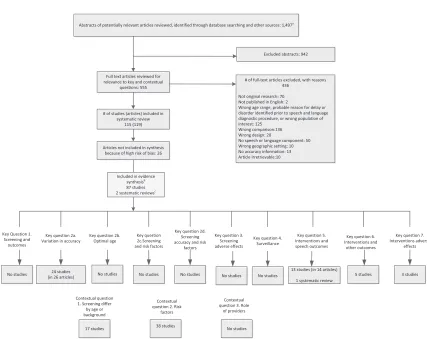
(Supplemental Fig 2); we had no evidence for KQ3 (adverse effects of screening) or KQ4 (surveillance by primary care clinicians). Figure 1 shows theflow of studies from initial identification of titles and abstracts to final inclusion or exclusion.
KQ1: Improvements in Outcomes
No study met the 2006 inclusion criteria to determine whether screening improved either speech and language or other outcomes. One randomized controlled trial (RCT)
met our inclusion criteria by randomizing a large national sample of children who received regularly scheduled care at child health centers to early screening and measuring outcomes at 8 years of age.25,26We
did not include evidence from this trial owing to a rating of poor quality caused by very high attrition.
KQ2: Accurate Identification of
Children for Diagnostic Evaluations and Interventions: Screening Accuracy
We examined the accuracy of screening techniques and whether accuracy varies by demographic and screening source. We included 24 good and fair studies (26 articles):
FIGURE 1
8 newly identified studies (9 articles27–35), and 16 studies (17
articles) from the 2006 review36–52
(Supplemental Table 3). Supplemental Table 4 describes relevant screening instruments.
Detailed Synthesis of Evidence on Screening Accuracy
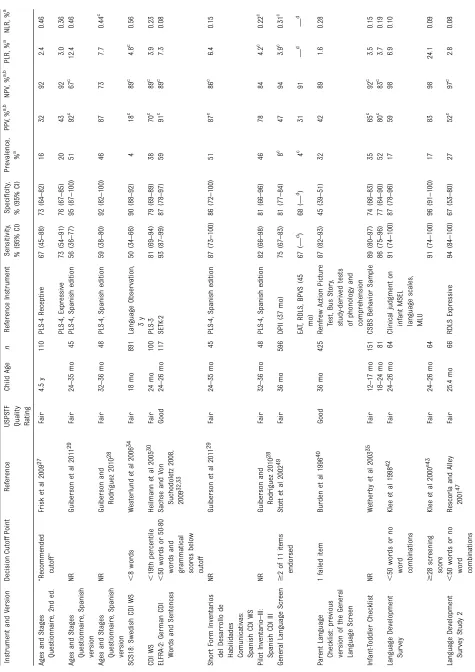
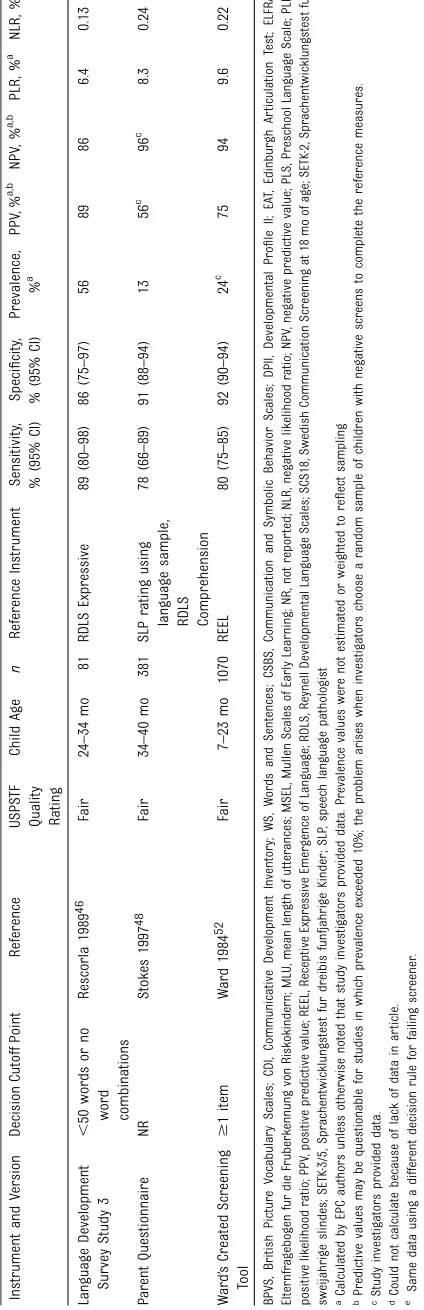
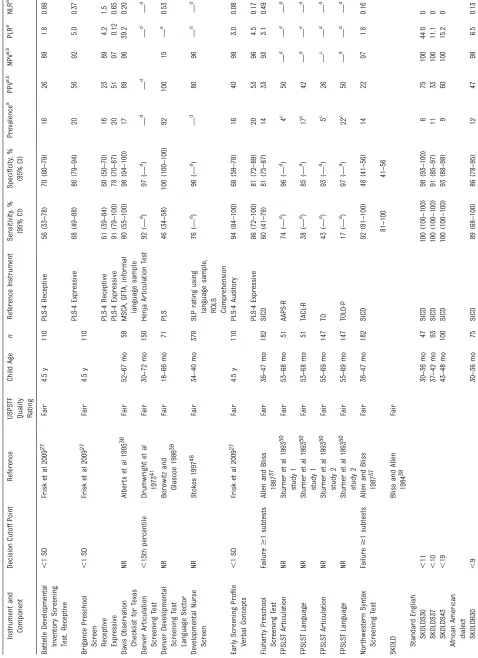
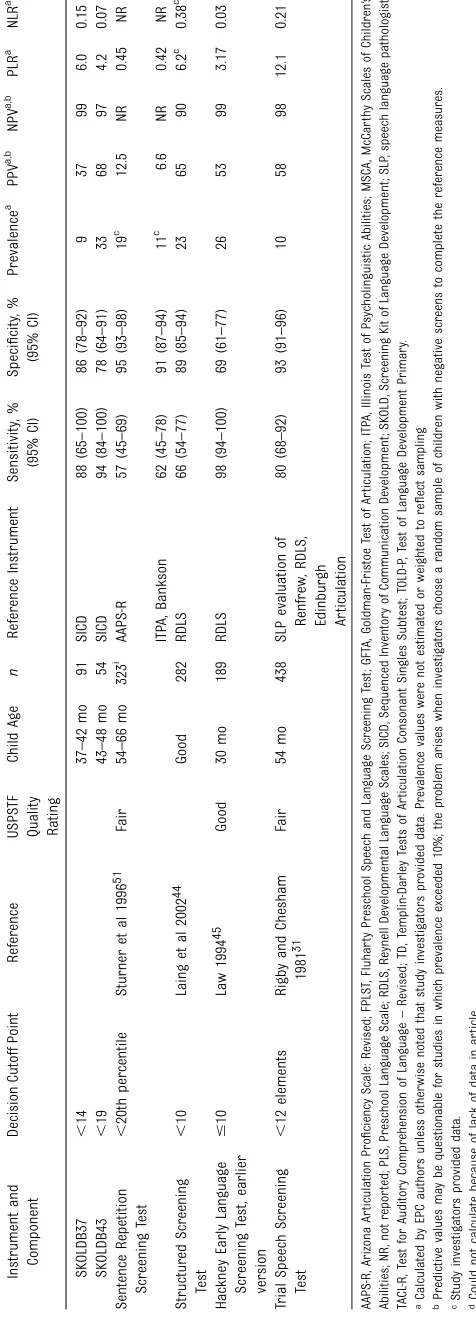
Tables 1 and 2 present accuracy statistics separately for parent and trained-examiner instruments, respectively. We report sensitivity and specificity (and 95% CIs), prevalence, positive and negative predictive values, and positive and negative LRs. We present median (not mean) values because accuracy statistics were skewed. We report the accuracy statistics by age group when possible.
Accuracy of Screening Instruments Used by Parents
Altogether, 14 studies (16 articles27–30,32–35,40,42,43,46–49,52)
examined the accuracy of screeners in which parents rated the speech and language skills of their young children (mostly 2 or 3 years of age) (Table 1). Cutoff scores for positive screening (ie, a speech or language problem), when provided, varied by instrument.
Sensitivity for detecting a true speech and language delay or disorder using parent-report screeners ranged between 50% and 94% (median, 81%); specificity for detecting a child without speech and language delays ranged between 45% and 96% (median, 87%). Children with positive screening results (ie, those who failed the screening test) had a moderately53higher likelihood of
language delay than children with negative screening results (ie, those who passed) in at least 1 study investigating the Ages and Stages Questionnaire (ASQ), the Communicative Development Inventory (CDI), the Language Development Survey (LDS), the Parent Questionnaire, and Ward’s screening tool. With respect to negative LRs, results from$1 studies
using the CDI, the Infant-Toddler Checklist (ITC), and LDS suggested a moderately lower likelihood of language delay for those children who passed the screening test relative to those who did not.
Accuracy by Age of Child
ASQ sensitivity was marginally higher for older children (4.5 years) in 1 study27than for younger children
(2 to 3 years) in 2 other studies.28,29
However, in the latter 2 studies, the positive LRs indicated at least a moderately higher likelihood of a language delay in children who screened positive relative to children who screened negative; we saw no such increase in the likelihood of delay in the study of older children. The negative LRs were small and equivalent for both younger and older samples.
Four of the 5 CDI studies examined the accuracy of the toddler version (18 to 36 months).29,30,32–34Thefifth
study used the preschool version with children 36 to 62 months of age.28
Accuracy of the 2 versions was similar. The 1 ITC study separately considered 2 age groups of toddlers (12 to 17 months; 18 to 24 months); accuracy was similar for younger and older toddlers.35
Accuracy of Longer-Term Prediction
Two studies examined the accuracy of parent-reported screeners for predicting long-term language delay.32,33,42,43Both studies
examined the accuracy of the screener at 2 years in relation to the reference standard (a diagnostic tool) at both 2 years and 3 years. In the LDS study,43sensitivity for detecting
a language delay at 3 years was 67% (91% at 2 years). Specificity for detecting typical language development at 3 years was 93% (96% at 2 years). In the ELFRA-2 (ie, German CDI) study,32,33sensitivity
and specificity at 3 years were 94% (93% at 2 years) and 61% (88% at 2 years), respectively.
Accuracy of Screening Instruments Used by Trained Examiners
Twelve studies examined the
accuracy of instruments administered by trained examiners, including nurses, primary care providers, teachers, and paraprofessionals (Table 2).27,31,36–39,41,44,45,48,50,51
These studies tended to focus on older preschool-age children: 3 studies included children 2 to 3 years of age44,45,48; 1 of children 3 to
4 years of age37; 5 of children 4 to
5 years of age27,31,36,50,51; and 3 of
children across different ages (18 to 72 months).38,39,41Several studies
included.1 screening instrument. All but 2 instruments require some direct testing of the child; the Developmental Nurse Screen48and
the Davis Observation Checklist for Texas (DOCT)36involve ratings made
after observing the child.
Sensitivity for detecting a true delay or disorder ranged between 17% and 100% (median, 74%); specificity for detecting typical speech and language ranged between 46% and 100% (median, 91%). In studies of the Battelle Developmental Inventory Screening Test,27DOCT,36Screening
Kit of Language Development (SKOLD),38Sentence Repetition
Screening Test,51Structured
Screening Test,44and the Trial
Speech Screening Test,31positive
LRs indicated at least a moderately higher likelihood of language delay for those who screened positive; the studies of the Brigance Preschool Screening Test,27DOCT,36Early Screening
Test,27Hackney Early Language
Screening Test,45 Northwestern
Syntax Screening Test,37and
SKOLD,38indicated at least
a moderately lower likelihood of language delay for those who screened negative.
Accuracy by Age of Children and Language Dialect
One study used the SKOLD to screen children ages 30 to 48 months.38For
to 36 months, 37 to 42 months, and 43 to 48 months, median sensitivity rates were 94%, 94%, and 97%, respectively; median specificity rates were 92%, 88%, and 85%. Across the 3 age levels, median sensitivity and specificity were 88% and 86% for the African American dialect versions and 100% and 93% for the Standard English versions.
KQ5: Treatment: Speech and Language Outcomes
Thirteen RCTs (6 newly identified)54–59in 14 articles
evaluating speech and language interventions and 1 systematic review met criteria for inclusion (Supplemental Table 5). Of these, 11 examined language outcomes and 8 measured speech outcomes. The systematic review of treatment of childhood apraxia of speech failed to find any studies that met our inclusion criteria, so we did not consider it further.60
Language
Of 11 studies measuring language outcomes (Supplemental Table 6), 4 used parents as the primary intervention agent.57,61–63In 2 trials
testing variations of the Hanen Parent Program57,62for toddlers with
language delays, 1 found significant effects on expressive language measures favoring the treatment group;62in contrast, another trial
found no significant differences in receptive or expressive language.57
Group training on language activities for parents of toddlers with limited expressive language found significant effects on expressive and receptive language.61Finally, 1 group of parents
learned activities to target speech sounds and a second group of parent shared storybooks with their
children63; neither treatment was
associated with gains in child expressive syntax or semantic knowledge compared with the control group.
Two trials tested treatments primarily or exclusively delivered in
a small group format by researcher-trained staff to toddlers64or
preschoolers;54the latter also
included individual treatment sessions after thefirst 10 weeks of the program.54Both trials reported
significant improvement on measures of language skills.
Four trials tested individual treatment to children by research staff or speech-language
pathologists.58,59,65,66One examined
the effects of providing young children (18 to 42 months) with language or phonological delays with access to usual speech-language therapy services in the community.65
With an average of only 6.2 hours of therapy over 12 months, children showed small but significant gains in receptive, but not expressive, language relative to controls. Another trial involving 4-year-olds with specific language impairments tested a manualized intervention that addressed individualized language goals, phonological and print awareness, and letter knowledge.59The intervention had
no significant effect on expressive, receptive, or pragmatic language. A third trial tested the effects of a strategy called recasting (repeating what is said by a child, with correct articulation or with a grammatical expansion of the child’s utterance).58
The intervention had no overall effect on children’s mean length of utterances but did produce improvements among children with the lowest baseline articulation skills. The fourth trial tested whether an individualized treatment of children with speech sound disorders affected mean length of utterance but found no significant language effect.66
Finally, preschoolers with language impairments who played with peers with age-appropriate language skills in the house play area of their classroom over a 3-week period improved significantly on activity-specific expressive language.64
Speech Sounds
Eight trials reported on various speech sounds54,58,59,63,65–68
(Supplemental Table 6). Of 2 trials of parent-mediated interventions, 1 found that a modified Hanen Parent Program had significant effects on consonant inventory and syllable structure.67In the other trial, parents
engaged the child in activities directed at discrimination of sounds.63Children in the control
condition improved more in auditory discrimination in the presence of background noise than experimental subjects.
A small group intervention for toddlers significantly improved the percentage of intelligible utterances for treated children.68
Two studies examined individual treatment by speech-language pathologists. One examined the effects of the“cycles”approach to phonological therapy (wherein rule-based errors in the child’s speech sound production are treated through recursive cycles of therapy) for preschoolers with severe phonological disorders; the intervention produced significant effects on standardized tests and percentage of correct consonants from a speech sample.66The other
study found no improvement in phonology error rate for children randomized to usual community speech-language pathology services for a year; however, treated children were 2.7 times less likely to exhibit the severity of speech sound problems used as a criterion for initial study eligibility.65
The recasting trial found no main effects on children’s intelligibility, but didfind improvements among children with the lowest baseline articulation skills.58
Two studies reported that their interventions significantly improved phonological awareness skills in preschoolers. In one, teaching assistants delivered small group
and individual lessons54; in the
other, language assistants provided individual home-based
interventions.59
Fluency
Two trials examined the Lidcombe Program of Early Stuttering intervention.69Both significantly
reduced stuttering in preschoolers, when delivered in a clinic setting55
and when using a telephone-based health delivery model.56
KQ6: Treatment: Outcomes Other Than Speech and Language
Two trials examined effects on socialization. One, among children receiving community-based speech-language services, produced no significant effect.65The other, among
language-delayed toddlers receiving small-group therapy, produced large and significant differences favoring the treated children.68
For reducing behavior problems, one trial tested the effectiveness of a low-intensity parent group program57and another an in-home
individualized program provided by a language assistant59; neither found
significant effects. Similarly, measures of well-being of toddlers65and
health-related quality of life of preschoolers59yielded nonsignificant
effects of treatment.
In 2 trials, toddlers randomized to speech-language services were no different from controls on attention level or play.65,68Parents of
language-delayed toddlers participating in small-group language therapy reported significantly greater improvements in parental stress.68
Two trials measuring emergent literacy skills among
preschoolers54,59found that letter
knowledge improved significantly, but one failed tofind a significant effect for a broader construct of literacy.54However, treatment did
significantly improve a measure of reading comprehension administered at 6-months of follow-up.
KQ7. Adverse Effects of Treatments
Three studies examined potential adverse effects of interventions but reported no negative impacts on children or parents.59,65,68
DISCUSSION
Screening Accuracy
Some screening instruments accurately identify children for language delays or disorders. As in the 2006 review, however, we observed wide ranges of reported sensitivity and specificity; no one instrument clearly demonstrated the best characteristics or 1 age as optimal for screening. We compared findings from the same instrument in different populations; specifically, accuracy of 3 parent-rated screeners (ASQ, CDI, and ITC) and 2 trained-examiner screeners (Fluharty Preschool Speech and Language Screening Test and SKOLD) across ages. CDI, ITC, and SKOLD displayed consistency and acceptable levels of sensitivity and specificity ($70%)70
at each age level; this suggests that they are more robust across different ages than ASQ and Fluharty Preschool Speech and Language Screening Test, which had generally low sensitivity across age levels.
Accuracy apparently drops over time. In the 2 studies32,33,42,43that
examined whether a parent-report screener administered at 2 years would be as accurate at 3 years, sensitivity was lower in 1 study and specificity was lower in the other. Decreasing specificity with time may mean some that some children with language delays will“catch up”and display more typical language skills as they age.71
offices and would require a dedicated, trained examiner to test the child directly. Three parent-rated screeners (CDI, ITC, and LDS) display
acceptable sensitivity and specificity. Moreover, because parents complete these screeners, adopting them in a screening program would not burden a primary care practice with training someone in test administration. The more extensive information that parents provide related specifically to their children’s language skills may help explain their greater accuracy in identifying children with speech and language delays than broad-based screeners that include other domains but fewer speech and language items. Moreover, staff in primary care settings could likely interpret results from parent screeners with little difficulty.
Treatment Outcomes
The majority of the 13 trials support the effectiveness of treating young children with language delays and disorders (6 of 11 trials reporting significant positive results) and those with problems with speech sounds (6 of 8 trials reporting significant positive results), and toddlers and preschoolers forfluency problems (2 of 2 trials reporting significant positive results). Individual and small-group service delivery models and various intervention agents, including parents supported or trained by professionals, speech-language pathologists, and trained teaching or therapy assistants, generally favored intervention groups.
Multiple factors limit the confident interpretation of this body of evidence on speech and language treatment. These factors involve (1) the small size of many trials, which constrains investigating moderators and mediators of treatment effectiveness; (2) the lack of replicated positivefindings for any treatment approach except the Lidcombe program for stuttering; (3) the wide variability across trials in the age of children treated,
intervention agents (eg, speech-language pathologists, teaching assistants, parents, research staff), intensity, content, and strategies; (4) the relatively small number of trials using manualized treatments or providing enough details of the treatment to permit replication; (5) a corresponding lack of data detailing treatmentfidelity in many trials; (6) a lack of common outcome measures; and (7) inconsistency in how results are reported. Because of this degree of heterogeneity, we could not do any meta-analysis. Overall, the evidence offers little guidance about specific factors associated with effective treatments for young children with speech and language delays.
Contextual Issues: Risk Factors
One contextual issue involved whether consistent, reliable, and valid risk factors exist that clinicians could use to identify children at highest risk for speech and language delay and disorders.19We examined 31 cohort
studies, 24 with multivariate analysis to control for other factors, and 1 review of studies on characteristics of late-talking toddlers; 20 cohort studies involved English-speaking children (Supplemental Tables 7 and 8). Potential risk factors for speech and language problems include male gender, family history of speech or language impairment, lower levels of parental education, and various perinatal risk factors (eg, prematurity, birth difficulties, and low birth weight).
Studies about risk factors varied in the type of delay or disorder being considered, used inconsistent measurement of risk factors, included heterogeneous patient populations, and inconsistently adjusted for confounders in multivariate models. Future research should account for the heterogeneity across populations of children, consider a multifactorial perspective of child development, examine social determinants of health as possible risk factors, and adopt more standardized outcome
measures over a longer-term period
of follow-up than has been customary to date.
Limitations of the Review
Numerous limitations of the literature base continue to plague thefield. Some date to the 2006 review, but additional limitations we encountered further reduce the applicability of thefindings.
Most serious is the lack of well-designed, well-conducted studies addressing the overarching question: does screening for speech and language delay or disorders improve outcomes? Moreover, neither the 2006 review nor our update found any studies that addressed the questions of adverse effects of screening or the role of enhanced surveillance by primary care clinicians in accurately identifying children for diagnostic evaluations and interventions, 2 important issues in screening.
We identified some instruments that can accurately screen children with speech and language delays. However, many studies included potentially inappropriate populations, such as “samples”of children identified (randomly or otherwise) on the basis of their language status. Using such “predetermined” samples hampers investigators from determining certain accuracy statistics (other than sensitivity and specificity) and may bias conclusions about screening accuracy and, thus, can limit
applicability to pediatric populations in general. Moreover, few studies examined how well screeners detected speech and language disorders over the long term. Such studies are critical in calculating the real benefit of early detection. In addition, few of the screening accuracy studies occurred in primary care settings, and none in the United States. The extent to which conclusions reached from screening in primary care settings in Sweden, Australia, and the United Kingdom are generalizable to the United States is not known.
Whether conclusions reached from trials in countries with different medical, health insurance, and educational systems apply in this country remains an open question. Additional limitations relate to interpreting treatment outcomes and replicating interventions. Much of the literature lacks information about important features of the intervention, such as whether children received community services for speech and language outside the study, and does not adequately document intervention models. Finally, control groups in numerous trials were children offered intervention on a delayed schedule. This condition likely would make parents more willing to consent to enrolling their children in a RCT, but it constrains our ability to look at long-range outcomes for treated versus untreated children.
Future Research Needs
To determine whether screening for speech and language delay or disorders improves speech, language, or other outcomes, studies need to be specifically designed and executed to examine these issues. Furthermore, they need to be implemented with little risk of bias. This research gap presents an opportunity for a large study in primary care settings to test the efficacy of systematic routine screening for speech and language delays and disorders in comparison with not implementing routine screening. In tandem with this, the field would benefit from a study to examine the feasibility of speech and language-specific screening as part of the more general developmental screening that is already recommended.18
Given federal mandates under the Individuals with Disabilities Education Act that all children with a documented speech or language delay receive early intervention, conducting RCTs to examine the efficacy of interventions may be difficult in future. Protocols may adopt rigorous quasi-experimental designs, such as regression discontinuity designs, to answer intervention questions. Well-designed and implemented regression
discontinuity designs meet standards for rigor for evaluations of evidence sponsored by the Institute of Education Sciences.
We recommend that stakeholders with an interest in screening develop research agendas and funding targeted to answer the important questions that we could not address. Future systematic reviews will benefit from an enhanced literature base.
CONCLUSIONS
We found no evidence to answer the overarching question of whether screening for speech and language delay or disorders improves speech and language outcomes. Studies from the 2006 review and our newly identified studies suggest that some screening instruments can accurately pinpoint these disorders. Although the parent-rated instruments require only that the primary care provider interpret thefindings, studies have not examined this in practice. As in the 2006 review, we found no studies that addressed the harms of
screening for speech and language delays. Neither did wefind any evidence about the role of enhanced
surveillance by a primary care clinician once a child elicits clinical concern for speech and language delay. Building on the 2006 review, we found evidence supporting the effectiveness of treating speech and language delays and disorders in children. Nevertheless, the whole body of evidence does not provide guidance regarding specific factors associated with effective treatments for young children with speech and language delays or disorders. Finally, we found no evidence relating to the harms of treating speech and language delays or disorders.
ACKNOWLEDGMENTS
This work was supported by the Agency for Healthcare Research and Quality, U.S. Department of Health and Human Services contract no. HHSA290201200015iTO2. The views expressed in this manuscript do not represent and should not be construed to represent a determination or policy of the Agency for Healthcare Research and Quality or the U.S. Department of Health and Human Services.
The authors gratefully acknowledge the following individuals for their contributions to this project and deeply appreciate their considerable support, commitment, and
contributions: our AHRQ Medical Officer, Karen C. Lee, MD, MPH; the USPSTF leads; Evidence-based Practice Center (EPC) Project Manager, Carol Woodell, BSPH; RTI-UNC EPC Director, Meera Viswanathan, PhD; our EPC Librarian, B Lynn Whitener, MSLS; and our EPC publications specialist, Loraine Monroe.
FINANCIAL DISCLOSURE:The authors have indicated they have nofinancial relationships relevant to this article to disclose.
FUNDING:Agency for Healthcare Research and Quality, U.S. Department of Health and Human Services Contract No. HHSA290201200015iTO2. The views expressed in this manuscript do not represent and should not be construed to represent a determination or policy of the Agency for Healthcare Research and Quality or the U.S. Department of Health and Human Services.
POTENTIAL CONFLICT OF INTEREST:The authors have indicated they have no potential conflicts of interest to disclose.
REFERENCES
1. Law J, Boyle J, Harris F, Harkness A, Nye C. Prevalence and natural history of primary speech and language delay:
findings from a systematic review of
the literature.Int J Lang Commun
Disord. 2000;35(2):165–188
2. American Speech-Language-Hearing
Association. Definitions of
Communication Disorders and Variations. Available at: http://www. asha.org/policy/RP1993-00208/. Accessed February 23, 2015
3. Whitehurst GJ, Smith M, Fischel JE, Arnold DS, Lonigan CJ. The continuity of babble and speech in children with
specific expressive language delay.
J Speech Hear Res. 1991;34(5):1121–1129
4. Thal DJ, Tobias S. Communicative gestures in children with delayed onset
of oral expressive vocabulary.J Speech
Hear Res. 1992;35(6):1281–1289
5. Crais ER, Watson LR, Baranek GT. Use of
gesture development in profiling
children’s prelinguistic communication
skills.Am J Speech Lang Pathol. 2009;
18(1):95–108
6. Bashir AS, Scavuzzo A. Children with language disorders: natural history and
academic success.J Learn Disabil.
1992;25(1):53–65, discussion 66–70
7. Raitano NA, Pennington BF, Tunick RA, Boada R, Shriberg LD. Pre-literacy skills of subgroups of children with speech
sound disorders.J Child Psychol
Psychiatry. 2004;45(4):821–835
8. Peterson RL, Pennington BF, Shriberg
LD, Boada R. What influences literacy
outcome in children with speech sound
disorder?J Speech Lang Hear Res.
2009;52(5):1175–1188
9. Catts HW, Fey ME, Tomblin JB, Zhang X. A longitudinal investigation of reading outcomes in children with language
impairments.J Speech Lang Hear Res.
2002;45(6):1142–1157
10. Catts H, Fey M, Zhang X, et al. Estimating
the risk of future reading difficulties in
kindergarten children: a research-based model and its clinical
implementation.Lang Speech Hear Serv
Sch. 2001;32(1):38–50
11. Tomblin JB, Zhang X, Buckwalter P, Catts H. The association of reading disability, behavioral disorders, and language impairment among second-grade
children.J Child Psychol Psychiatry.
2000;41(4):473–482
12. Glogowska M, Roulstone S, Peters TJ, Enderby P. Early speech- and language-impaired children: linguistic, literacy,
and social outcomes.Dev Med Child
Neurol. 2006;48(6):489–494
13. Young AR, Beitchman JH, Johnson C, et al. Young adult academic outcomes in a longitudinal sample of early
identified language impaired and
control children.J Child Psychol
Psychiatry. 2002;43(5):635–645
14. Felsenfeld S, Broen PA, McGue M. A 28-year follow-up of adults with a history of moderate phonological disorder: educational and occupational
results.J Speech Hear Res. 1994;37(6):
1341–1353
15. Law J, Rush R, Schoon I, Parsons S. Modeling developmental language
difficulties from school entry into
adulthood: literacy, mental health, and
employment outcomes.J Speech Lang
Hear Res. 2009;52(6):1401–1416
16. Cohen NJ, Barwick MA, Horodezky NB, Vallance DD, Im N. Language,
achievement, and cognitive processing in psychiatrically disturbed children
with previously identified and
unsuspected language impairments.
J Child Psychol Psychiatry. 1998;39(6):
865–877
17. Cohen NJ, Menna R, Vallance DD, Barwick MA, Im N, Horodezky NB. Language, social cognitive processing, and behavioral characteristics of psychiatrically disturbed children with
previously identified and unsuspected
language impairments.J Child Psychol
Psychiatry. 1998;39(6):853–864
18. Council on Children With Disabilities; Section on Developmental Behavioral Pediatrics; Bright Futures Steering Committee; Medical Home Initiatives for Children With Special Needs Project Advisory Committee. Identifying infants and young children with developmental disorders in the medical home: an algorithm for developmental
surveillance and screening.Pediatrics.
2006;118(1):405–420. Available at:
www.pediatrics.org/cgi/content/full/ 118/1/e405
19. Berkman ND, Wallace IF, Watson L, et al. Screening for Speech and Language
Delay and Disorders in Children Age 5 Years or Younger: A Systematic Evidence Review for the U.S. Preventive Services Task Force. Evidence Synthesis No. 120. AHRQ Publication No. 13-05197-EF-1. Rockville, MD: Agency for Healthcare Research and Quality; 2015.
20. U.S. Preventive Services Task Force. Procedure Manual. Rockville, MD:
USPSTF Program Office; 2011 August.
www.uspreventiveservicestaskforce. org/Page/Name/procedure-manual. Accessed October 2014
21. Hamm RM.Clinical Decision Making
Calculators. Oklahoma City: Department of Family and Preventive Medicine, The University of Oklahoma Health Sciences Center; 2004. Available at http://www.fammed.ouhsc.edu/ robhamm/cdmcalc.htm2014. Accessed at http://omerad.msu.edu/ebm/index. html2014. Accessed September 14, 2014
22. Nelson HD, Nygren P, Walker M, Panoscha R. Screening for speech and language delay in preschool children: systematic evidence review for the US Preventive Services Task Force.
Pediatrics. 2006;117(2):e298–e319. Available at: www.pediatrics.org/cgi/ content/full/117/2/e298
23. Nelson HD, Nygren P, Walker M, Penoscha R. Screening for speech and language delay in preschool children. Rockville, MD: Agency for Healthcare Research and Quality; February 2006
24. Law J, Boyle J, Harris F, Harkness A, Nye C. Screening for speech and language delay: a systematic review of the
literature.Health Technol Assess. 1998;
2(9):1–184
25. de Koning HJ, de Ridder-Sluiter JG, van Agt HME, et al. A cluster-randomised trial of screening for
language disorders in toddlers.J Med
Screen. 2004;11(3):109–116
26. van Agt HM, van der Stege HA, de Ridder-Sluiter H, Verhoeven LT, de Koning HJ. A cluster-randomized trial of screening for language delay in toddlers: effects on school performance and language development at age 8.
Pediatrics. 2007;120(6):1317–1325. Available at: www.pediatrics.org/cgi/ content/full/120/6/e1317
for language delays is more difficult
than it should be.Infants Young Child.
2009;22(4):290–308
28. Guiberson M, Rodríguez BL. Measurement properties and
classification accuracy of two spanish
parent surveys of language development for preschool-age
children.Am J Speech Lang Pathol.
2010;19(3):225–237
29. Guiberson M, Rodríguez BL, Dale PS.
Classification accuracy of brief parent
report measures of language development in Spanish-speaking
toddlers.Lang Speech Hear Serv Sch.
2011;42(4):536–549
30. Heilmann J, Ellis Weismer S, Evans J, Hollar C. Utility of the MacArthur-Bates communicative development inventory in identifying language abilities of late-talking and typically developing
toddlers.Am J Speech Lang Pathol.
2005;14(1):40–51
31. Rigby MJ, Chesham I. A trial speech screening test for school entrants.
Br Med J (Clin Res Ed). 1981;282(6262):
449–451
32. Sachse S, Von Suchodoletz W. Early
identification of language delay by
direct language assessment or parent
report?J Dev Behav Pediatr. 2008;29(1):
34–41
33. Sachse S, Von Suchodoletz W.
[Response].J Dev Behav Pediatr. 2009;
30(2):176
34. Westerlund M, Berglund E, Eriksson M. Can severely language delayed
3-year-olds be identified at 18 months?
Evaluation of a screening version of the MacArthur-Bates Communicative
Development Inventories.J Speech
Lang Hear Res. 2006;49(2):237–247
35. Wetherby AM, Goldstein H, Clearly J,
et al. Early identification of children
with communication disorders: Concurrent and predictive validity of
the CSBS Developmental Profile.Infants
Young Child. 2003;16(2):161–174
36. Alberts FM, Davis BL, Prentice L. Validity of an observation screening instrument
in a multicultural population.J Early
Interv. 1995;19(2):168–177
37. Allen DV, Bliss LS. Concurrent validity of two language screening tests.
J Commun Disord. 1987;20(4):305–317
38. Bliss LS, Allen DV. Screening Kit of Language Development: a preschool language screening instrument.
J Commun Disord. 1984;17(2):133–141
39. Borowitz KC, Glascoe FP. Sensitivity of the Denver Developmental Screening Test in speech and language screening.
Pediatrics. 1986;78(6):1075–1078. Available at: www.pediatrics.org/cgi/ content/full/78/6/e1075
40. Burden V, Stott CM, Forge J, Goodyer I. The Cambridge Language and Speech Project (CLASP). I. Detection of language
difficulties at 36 to 39 months.Dev Med
Child Neurol. 1996;38(7):613–631
41. Drumwright A, Van Natta P, Camp B, Frankenburg W, Drexler H. The Denver
articulation screening exam.J Speech
Hear Disord. 1973;38(1):3–14
42. Klee T, Carson DK, Gavin WJ, Hall L, Kent A, Reece S. Concurrent and predictive validity of an early language screening
program.J Speech Lang Hear Res.
1998;41(3):627–641
43. Klee T, Pearce K, Carson DK. Improving the positive predictive value of screening for developmental language
disorder.J Speech Lang Hear Res. 2000;
43(4):821–833
44. Laing GJ, Law J, Levin A, Logan S. Evaluation of a structured test and a parent led method for screening for speech and language problems: prospective population based study.
BMJ. 2002;325(7373):1152
45. Law J. Early language screening in city and Hackney: the concurrent validity of a measure designed for use with
2 1/2-year-olds.Child Care Health Dev.
1994;20(5):295–308
46. Rescorla L. The Language Development Survey: a screening tool for delayed
language in toddlers.J Speech Hear
Disord. 1989;54(4):587–599
47. Rescorla L, Alley A. Validation of the language development survey (LDS): a parent report tool for identifying
language delay in toddlers.J Speech
Lang Hear Res. 2001;44(2):434–445
48. Stokes SF. Secondary prevention of paediatric language disability: a comparison of parents and nurses
as screening agents.Eur J Disord
Commun. 1997;32(2 Spec No):139–158.
49. Stott CM, Merricks MJ, Bolton PF, Goodyer IM. Screening for speech and
language disorders: the reliability, validity and accuracy of the General
Language Screen.Int J Lang Commun
Disord. 2002;37(2):133–151
50. Sturner RA, Heller JH, Funk SG, Layton TL. The Fluharty Preschool Speech and Language Screening Test: a population-based validation study using
sample-independent decision rules.J Speech
Hear Res. 1993;36(4):738–745
51. Sturner RA, Funk SG, Green JA. Preschool speech and language screening: further validation of the sentence repetition screening test.
J Dev Behav Pediatr. 1996;17(6):
405–413
52. Ward S. Detecting abnormal auditory behaviours in infancy: the relationship between such behaviours and linguistic
development.Br J Disord Commun.
1984;19(3):237–251
53. Ebell M, Barry H.Likelihood Ratios Part
1: Introduction. Lansing, MI: Office of Medial Education Research and Development, College of Human Medicine, Michigan State University; 2008. Available at: http://omerad.msu. edu/ebm/index.html. Accessed September 18, 2014.
54. Fricke S, Bowyer-Crane C, Haley AJ,
Hulme C, Snowling MJ. Efficacy of
language intervention in the early
years.J Child Psychol Psychiatry. 2013;
54(3):280–290
55. Jones M, Onslow M, Packman A, et al. Randomised controlled trial of the Lidcombe programme of early
stuttering intervention.BMJ. 2005;
331(7518):659
56. Lewis C, Packman A, Onslow M, Simpson JM, Jones M. A phase II trial of telehealth delivery of the Lidcombe Program of Early Stuttering
Intervention.Am J Speech Lang Pathol.
2008;17(2):139–149
57. Wake M, Tobin S, Girolametto L, et al. Outcomes of population based language promotion for slow to talk
toddlers at ages 2 and 3 years: Let’s
Learn Language cluster randomised
controlled trial.BMJ. 2011;343:d4741
58. Yoder P, Camarata M, Gardner E. Treatment effects on speech intelligibility and length of utterance
in children with specific language and
intelligibility impairments.J Early
59. Wake M, Tobin S, Levickis P, et al. Randomized trial of a population-based, home-delivered intervention for
preschool language delay.Pediatrics.
2013;132(4):e895–e904. Available at:
www.pediatrics.org/cgi/content/full/ 132/4/e895
60. Morgan AT, Vogel AP. A Cochrane review of treatment for childhood apraxia of
speech.Eur J Phys Rehabil Med. 2009;
45(1):103–110
61. Gibbard D. Parental-based intervention with pre-school language-delayed
children.Eur J Disord Commun. 1994;
29(2):131–150
62. Girolametto L, Pearce PS, Weitzman E. Interactive focused stimulation for toddlers with expressive vocabulary
delays.J Speech Hear Res. 1996;39(6):
1274–1283
63. Shelton RL, Johnson AF, Ruscello DM, Arndt WB. Assessment of parent-administered listening training for preschool children with articulation
deficits.J Speech Hear Disord. 1978;
43(2):242–254
64. Robertson SB, Ellis Weismer S. The
influence of peer models on the play
scripts of children with specific
language impairment.J Speech Lang
Hear Res. 1997;40(1):49–61
65. Glogowska M, Roulstone S, Enderby P, Peters TJ. Randomised controlled trial of community based speech and language therapy in preschool children.
BMJ. 2000;321(7266):923–926
66. Almost D, Rosenbaum P. Effectiveness of speech intervention for phonological disorders: a randomized controlled
trial.Dev Med Child Neurol. 1998;40(5):
319–325
67. Girolametto L, Pearce PS, Weitzman E. Effects of lexical intervention on the
phonology of late talkers.J Speech
Lang Hear Res. 1997;40(2):338–348
68. Robertson SB, Ellis Weismer S. Effects of treatment on linguistic and social skills in toddlers with delayed language
development.J Speech Lang Hear Res.
1999;42(5):1234–1248
69. Onslow M, Packman A, Harrison E, eds.
The Lidcombe Program of Early Stuttering Intervention: A Clinician’s Guide. Austin, TX: Pro-Ed; 2003
70. Macias MM. Developmental Screening Tools, D-PIP Training Workshop. Elk
Grove Village, IL: American Academy of Pediatrics; 2006
71. Rescorla L. Late talkers: do good
predictors of outcome exist?Dev
Disabil Res Rev. 2011;17(2):141–150
72. Squires J, Potter L, Bricker D.Ages
and Stages Questionnaire user’s guide. Baltimore, MD: Brookes; 1999
73. Sturner RS, Layton TL, Evans AW, et al. Preschool speech and language screening: A review of currently
available tests.Am J Speech Lang
Pathol. 1994;3:25–36
74. Fenson L, Marchman VA, Thal DJ, et al.
MacArthur-Bates Communicative Development Inventories: Users guide and technical manual. Baltimore, MD: Brookes; 2007
75. Jackson-Maldonado D, Marchman VA, Fernald LCH. Short-form versions
of the Spanish MacArthur–Bates
Communicative Development
Inventories.Appl Psycholinguist. 2013;
34(4):837–868.
76. Sturner RA, Kunze L, Funk SG, Green JA. Elicited imitation: its effectiveness for
speech and language screening.Dev
Med Child Neurol. 1993;35(8):715–726
77. Adams-Chapman I, Bann CM, Vaucher YE, et al. Association between feeding
difficulties and language delay in
preterm infants using Bayley Scales of Infant Development-Third Edition.
J Pediatr. 2013;163(3):680–685
78. Alston E, James-Roberts IS. Home environments of 10-month-old infants selected by the WILSTAAR screen for
pre-language difficulties.Int J Lang
Commun Disord. 2005;40(2):123–136
79. Campbell TF, Dollaghan CA, Rockette HE, et al. Risk factors for speech delay of unknown origin in 3-year-old children.
Child Dev. 2003;74(2):346–357
80. Choudhury N, Benasich AA. A family
aggregation study: the influence of
family history and other risk factors on
language development.J Speech Lang
Hear Res. 2003;46(2):261–272
81. Desmarais C, Sylvestre A, Meyer F, Bairati I, Rouleau N. Systematic review of the literature on characteristics of
late-talking toddlers.Int J Lang
Commun Disord. 2008;43(4):361–389
82. Everitt A, Hannaford P, Conti-Ramsden G.
Markers for persistent specific
expressive language delay in
3-4-year-olds.Int J Lang Commun Disord. 2013;
48(5):534–553
83. Foster-Cohen SH, Friesen MD, Champion PR, Woodward LJ. High prevalence/low severity language delay in preschool children born very
preterm.J Dev Behav Pediatr. 2010;
31(8):658–667
84. Fox AV, Dodd B, Howard D. Risk factors
for speech disorders in children.Int J
Lang Commun Disord. 2002;37(2):
117–131
85. Glascoe FP, Leew S. Parenting behaviors, perceptions, and psychosocial risk: impacts on young
children’s development.Pediatrics.
2010;125(2):313–319. Available at: www.
pediatrics.org/cgi/content/full/125/2/ e313
86. Hammer CS, Farkas G, Maczuga S. The language and literacy development of Head Start children: a study using the Family and Child Experiences Survey
database.Lang Speech Hear Serv Sch.
2010;41(1):70–83
87. Harrison LJ, McLeod S. Risk and protective factors associated with speech and language impairment in a nationally representative sample of
4- to 5-year-old children.J Speech Lang
Hear Res. 2010;53(2):508–529
88. Henrichs J, Rescorla L, Schenk JJ, et al. Examining continuity of early expressive vocabulary development: the
generation R study.J Speech Lang Hear
Res. 2011;54(3):854–869
89. Kerstjens JM, de Winter AF, Bocca-Tjeertes IF, ten Vergert EM, Reijneveld SA, Bos AF. Developmental delay in moderately preterm-born children at
school entry.J Pediatr. 2011;159(1):
92–98
90. Kerstjens JM, Bos AF, ten Vergert EMJ, de Meer G, Butcher PR, Reijneveld SA. Support for the global feasibility of the Ages and Stages Questionnaire as
developmental screener.Early Hum Dev.
2009;85(7):443–447
91. Kerstjens JM, de Winter AF, Bocca-Tjeertes IF, Bos AF, Reijneveld SA. Risk of developmental delay increases exponentially as gestational age of preterm infants decreases: a cohort
study at age 4 years.Dev Med Child
92. Law J, Rush R, Anandan C, Cox M, Wood R. Predicting language change between 3 and 5 years and its implications
for early identification.Pediatrics. 2012;
130(1):e132–e137. Available at: www.
pediatrics.org/cgi/content/full/130/1/ e132
93. Mossabeb R, Wade KC, Finnegan K, Sivieri E, Abbasi S. Language development survey provides a useful screening tool for language delay in
preterm infants.Clin Pediatr (Phila).
2012;51(7):638–644
94. O’Leary C, Zubrick SR, Taylor CL, Dixon G,
Bower C. Prenatal alcohol exposure and language delay in 2-year-old children: the importance of dose and timing on
risk.Pediatrics. 2009;123(2):547–554.
Available at: www.pediatrics.org/cgi/ content/full/123/2/e547
95. Peña ED, Gillam RB, Bedore LM, Bohman TM. Risk for poor performance on a language screening measure for bilingual preschoolers and
kindergarteners.Am J Speech Lang
Pathol. 2011;20(4):302–314
96. Potijk MR, Kerstjens JM, Bos AF, Reijneveld SA, de Winter AF. Developmental delay in moderately preterm-born children with low socioeconomic status: risks multiply.
J Pediatr. 2013;163(5):1289–1295
97. Pruitt SL, Garrity AW, Oetting JB. Family history of speech and language impairment in African American children: implications for assessment.
Top Lang Disord. 2010;30(2):154–164
98. Reilly S, Wake M, Bavin EL, et al. Predicting language at 2 years of age: a prospective community study.
Pediatrics. 2007;120(6):e1441–e1449. Available at: www.pediatrics.org/cgi/ content/full/120/6/e1441
99. Reilly S, Onslow M, Packman A, et al. Predicting stuttering onset by the age of 3 years: a prospective, community
cohort study.Pediatrics. 2009;123(1):
270–277. Available at: www.pediatrics.
org/cgi/content/full/123/1/e270
100. Reilly S, Onslow M, Packman A, et al. Natural history of stuttering to 4 years of age: a prospective community-based
study.Pediatrics. 2013;132(3):460–467.
Available at: www.pediatrics.org/cgi/ content/full/132/3/e460
101. Roth C, Magnus P, Schjølberg S, et al. Folic acid supplements in pregnancy and severe language delay in children.
JAMA. 2011;306(14):1566–1573
102. Schjølberg S, Eadie P, Zachrisson HD, Oyen AS, Prior M. Predicting language development at age 18 months: data from the Norwegian Mother and Child
Cohort Study.J Dev Behav Pediatr. 2011;
32(5):375–383
103. Singer LT, Siegel AC, Lewis B, Hawkins S, Yamashita T, Baley J. Preschool language outcomes of children with history of bronchopulmonary dysplasia
and very low birth weight.J Dev Behav
Pediatr. 2001;22(1):19–26
104. Tallal P, Ross R, Curtiss S. Familial
aggregation in specific language
impairment.J Speech Hear Disord.
1989;54(2):167–173
105. Tomblin JB, Hardy JC, Hein HA. Predicting poor-communication status in preschool children using risk factors
present at birth.J Speech Hear Res.
1991;34(5):1096–1105
106. Tomblin JB, Smith E, Zhang X.
Epidemiology of specific language
impairment: prenatal and perinatal risk
factors.J Commun Disord. 1997;30(4):
325–343, quiz 343–344
107. van Batenburg-Eddes T, Henrichs J, Schenk JJ, et al. Early infant neuromotor assessment is associated with language and nonverbal cognitive function in toddlers: the Generation R
Study.J Dev Behav Pediatr. 2013;34(5):
326–334
108. Van Lierde KM, Roeyers H, Boerjan S, De Groote I. Expressive and receptive language characteristics in three-year-old preterm children with extremely
low birth weight.Folia Phoniatr Logop.
2009;61(5):296–299
109. Weindrich D, Jennen-Steinmetz C, Laucht M, Esser G, Schmidt MH.
Epidemiology and prognosis of specific
disorders of language and scholastic
skills.Eur Child Adolesc Psychiatry.
2000;9(3):186–194
110. Whitehurst GJ, Arnold DS, Smith M, Fischel JE, Lonigan CJ, Valdez-Menchaca MC. Family history in developmental expressive language
delay. J Speech Hear Res. 1991;34(5):
1150–1157
111. Yliherva A, Olsén P, Mäki-Torkko E, Koiranen M, Järvelin MR. Linguistic and motor abilities of
low-birthweight children as assessed by parents and teachers at 8 years of age.Acta Paediatr. 2001;90(12):
1440–1449
112. Zambrana IM, Pons F, Eadie P, Ystrom E. Trajectories of language delay from age 3 to 5: persistence, recovery and late
onset.Int J Lang Commun Disord. 2014;
49(3):304–316
113. Zubrick SR, Taylor CL, Rice ML, Slegers DW. Late language emergence at 24 months: an epidemiological study of prevalence, predictors, and covariates.
J Speech Lang Hear Res. 2007;50(6):
DOI: 10.1542/peds.2014-3889 originally published online July 7, 2015;
2015;136;e448
Pediatrics
Charles T. Wood, Katherine Cullen and Kathleen N. Lohr
Ina F. Wallace, Nancy D. Berkman, Linda R. Watson, Tamera Coyne-Beasley,
Younger: A Systematic Review
Screening for Speech and Language Delay in Children 5 Years Old and
Services
Updated Information &
http://pediatrics.aappublications.org/content/136/2/e448 including high resolution figures, can be found at:
References
http://pediatrics.aappublications.org/content/136/2/e448#BIBL This article cites 100 articles, 16 of which you can access for free at:
Subspecialty Collections
rning_disorders_sub
http://www.aappublications.org/cgi/collection/cognition:language:lea Cognition/Language/Learning Disorders
al_issues_sub
http://www.aappublications.org/cgi/collection/development:behavior Developmental/Behavioral Pediatrics
following collection(s):
This article, along with others on similar topics, appears in the
Permissions & Licensing
http://www.aappublications.org/site/misc/Permissions.xhtml in its entirety can be found online at:
Information about reproducing this article in parts (figures, tables) or
Reprints
DOI: 10.1542/peds.2014-3889 originally published online July 7, 2015;
2015;136;e448
Pediatrics
Charles T. Wood, Katherine Cullen and Kathleen N. Lohr
Ina F. Wallace, Nancy D. Berkman, Linda R. Watson, Tamera Coyne-Beasley,
Younger: A Systematic Review
Screening for Speech and Language Delay in Children 5 Years Old and
http://pediatrics.aappublications.org/content/136/2/e448
located on the World Wide Web at:
The online version of this article, along with updated information and services, is
http://pediatrics.aappublications.org/content/suppl/2015/07/02/peds.2014-3889.DCSupplemental Data Supplement at:
by the American Academy of Pediatrics. All rights reserved. Print ISSN: 1073-0397.