IJSRR, 8(3) July. – Sep., 2019 Page 88
Research article Available online www.ijsrr.org
ISSN: 2279–0543
International Journal of Scientific Research and Reviews
Study & Application of Electrical Resistivity in a Soil System
Narray Gurupal Yashpal
1*and Dr. S B Thakare
21
ME Civil Environmental Engineering, APCOER, Pune, 411009, India
2
Principal of ABMSP’s APCOER, Pune 411009, India. Email:[email protected], [email protected]
ABSTRACT
The electrical resistivity method is based on the well-established fact that the electrical resistivity of soils is much higher than the electrical resistivity of water, leachates or any liquid effluents. Hence, infiltration of even a small of amount of any of these permeates causes an alteration in the electrical properties of geo-materials which can easily be detected by the use of the electrical resistivity method. Investigation of the electrical resistivity behavior in such cases could assist in the detection and control of contamination (presence of seeping water in our case) in such systems.
Sustainability of Water Resources has now become a dominant issue for several reasons. The study & application of a system based on Theory of Electrical Resistivity Principle is an attempt to make use of modern technology & equipment for sustainability requirements. Study on a working prototype is conducted to evaluate the effects of contamination on the electrical resistivity of the SAMPLE soil by changing the fluid content with various combinations of PIPED water. The results obtained from this small range soil electrical resistivity meter have shown the workability of this prototype. It shows that resistivity readings vary for different, types & water contents, of soil.As this is an initial stage of the prototype, further investigations need to be formulated for authenticating & validating the data.
KEYWORDS:
Electrical resistivity, Water Content, Seeping Water, etc*
Corresponding Author
Mr. Narray Gurupal Yashpal
Research Scholar
Civil Environmental Engineering
Anantrao Pawar College of Engineering & Research, Pune 411009, Maharashtra, India.
IJSRR, 8(3) July. – Sep., 2019 Page 89
1. INTRODUCTION:
Electrical Resistivity Survey is performed by passing a known electric current into ground by means of two current electrodes and the potential differences between the other two potential electrodes is measured. The potential variations may changes due to size, shape and conducting capacity of the material in the subsurface and from the quantities of potential differences and the current applied the resistance is calculated.
Dry rocks whether Non-porous or Porous are almost non-conductors otherwise the resistivity and saturated clayey sediments have low resistivity; clay, sand and gravel deposits that are saturated with groundwater of low ionic strength have high resistivity. Porous geological formations, which are saturated with groundwater of high ionic strength, have very less resistivity.
Electrical resistivity methods of geophysical prospecting are well established and the most important method for groundwater investigations. The electrical resistivity method is one that has been widely used because of the theoretical, operational and interpretational ease. The advantages of electrical methods also include control over depth of investigation, portability of the equipment, availability of wide range of simple and elegant interpretation techniques, and the related software etc.
1.1 Objective of Study
Electrical Resistivity Survey is performed by passing a known electric current into ground by means
of two current electrodes and the potential differences between the other two potential electrodes is measured.
Because soil quality may vary greatly with depth and over a wide lateral area, estimation of soil resistivity
based on soil classification, provide only a rough approximation. Actual resistivity measurements are required
to fully qualify the resistivity and its effects on the overall transmission system. Hence, a study of electrical
resistivity in soil system will help us to apply the usage of same, through a Working Model, to investigate
presence of moisture due to leakages in underground pipelines.
1.2 Limitations of the Study
Some of the limitations of this Study are;
We cannot utilize this Service in Rainy Season
We cannot utilize this Service for MS / GI make of water Conveying Pipelines.
IJSRR, 8(3) July. – Sep., 2019 Page 90
2
. LITERATURE REVIEW
Correlation between Electrical Resistivity and Water Content of Sand
1The usual practice is to apply direct or alternating current between two electrodes and measure the difference of potential between two other electrodes implanted in the ground that do not carry current.
The theory and field methods used for resistivity surveys are based on the use of Direct Current, because it allows greater depth of investigation than Alternating Current (AC) and it avoids the complexities caused by effects of ground inductance and capacitance and resulting frequency dependence of resistivity.
The clean, oven dried fine sand passing through a 425 micron IS sieve and bore-well water is taken for preparing all the specimens. The specific gravity of oven dried sand is determined by pyconometer method and pH of water was measured in the pH meter in the laboratory. The pre-defined quantity of water is added in sand and is kept in plastic bags for 24 hours for maturing. This wet sand of known water content is used for filling in the P.V.C. mould in three layers for performing electrical resistivity tests.
Electrical Resistivity of Sandy Soil with Water, Leachates & Seawater
2It can be observed that the electrical resistivity of distilled water is greater than that of tap-water at the same gravimetric tap-water content and diffusion coefficient for same ionic species of clays.
This disparity is because the tap water contains more ions and hence is more conductive than distilled water. The greater presence of ions also accounts for the observation that the changes in electrical resistivity produced by a gradual increase in tap water content are more pronounced than the changes due to increases in distilled water content.
It can thus be inferred that the type of permeate has quite a significant impact on the electrical resistivity of sandy soil.
The Influence of Changes in Water Content on the Electrical Resistivity of a
Natural Unsaturated Loess
3Non-destructive methods of measuring water content in soils have been extensively developed in the last decades, especially in soil science.
Among these methods, the measurements based on the electrical resistivity are simple and reliable thanks to the clear relationship between the water content and the electrical resistivity of soils.
IJSRR, 8(3) July. – Sep., 2019 Page 91
electrical current is induced through the soil at the vicinity of the contact between the probe and the specimen.
Soil Water Retention and Electrical Resistivity
4The electrical resistivity or conductivity of the soil-water system is related with the mobility of electrical charges in water and with the mobility of soil water itself. Yet it can be a measure of solute retention in soil. In addition, the electrical properties of soil-water system such as electrical resistivity, conductivity, and electrical potential are easily measured in both field and laboratory conditions. The objectives of the study are to discuss the influence of soil water retention on electrical properties of soil water based on the thermodynamic theories and to show experimentally the different mechanisms of electrical conductivity and water retention at different soil water content ranges. Theories of soil water retention and electrical conductivity as well as experimental data are combined to develop the relationships between electrical resistivity and water content for the different water content conditions from air-dry to saturated soil.
Prediction of Soil Engineering Properties using Electrical Resistivity Values at
Controlled Moisture Content
5The main purpose of conducting the electrical resistivity survey is to know the soil resistivity distribution of the soil sounding volume. Falsely produced electric streams are supplied to the dirt and the subsequent potential contrasts are measured. Potential contrast examples give data on the type of subsurface heterogeneities and of their electrical properties. Electrical resistivity is defined as the material property which demonstrates the propensity of a material to oppose stream of current through it. The physical standard behind electrical resistivity sensation is the Ohm's law.
3. MATERIAL AND METHODS
a) Black Cotton Soil b) Yellow Soil
c) An AC to DC Adaptor (range 12V to 24V)
d) Acrylic Resistivity Boxes (24 cm x 24 x 24 cm) 4 no + Water Bucket 1 no e) 20 mm diameter PVC pipes with Tees, Sockets, Valves, Plugs, etc.
f) Aluminum & Copper Conductors / Probes g) Digital Multi-meters 2 no
IJSRR, 8(3) July. – Sep., 2019 Page 92
The soil resistivity value is subject to great variation, due to moisture, temperature and chemical content.
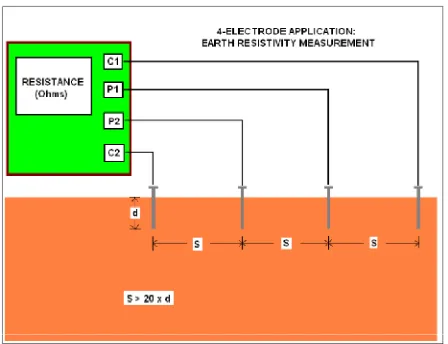
In this process a known value of electric current (I) is passed into the ground by two outer metals stakes (C1 & C2) that are buried in the ground. The potential variation (V) is measured between two inner electrodes termed potential electrodes (P1and P2).
The ratio of V/I provides the resistance (R) and by multiplying R with the geo-electrical factor (K) of the electrode separation, the resistivity ‘ρ’, and it is inverse of conductivity of the ground may be described.
The basic instruments proposed to be used are based on simple circuit diagram, as shown below, based on Wenner 4 pole method.
Fig 1- Wenner 4 Pole Method Circuit Diagram
For Direct Current (DC) resistivity survey, energy source is a generator in which current is injected into the specimen soil –a two layered system of Black Cotton & Yellow soils, filled in Acrylic Box of size 24 cm x 24 cm, inserted with a 20 mm diameter PVC pipe, at approximately mid-level of the Box, replicating underground water supply pipeline – using two outer electrodes (C1 & C2).
Additionally, two inner electrodes (P1 & P2) are used to measure the potential difference (voltage) due to injected current electrodes (C1 & C2). These measurements of Current & Voltage are done by using Digital Multi-meters.
These 4 probes are spaced at equal distances between each other.
In this Project, an adjustable AC to DC Adaptor is used to step up the voltage supplied from 12 V to 24 V. Based on Ohm’s Law, by increasing the Voltage, Current can also be increased.
IJSRR, 8(3) July. – Sep., 2019 Page 93
Whereas, the Inner Two probes are the receiver electrodes, which measure the potential difference of voltage, as current is injected into the specimen soil.
In this case, the specimen soil – two layered Black Cotton + Yellow soils - acts as the Resistor. Hence, the application of Resistivity Survey Principle is attained.
4. RESULTS AND ANALYSIS
The specimen soil is a mixture (of Yellow & Black Cotton Soil) to match the existing site conditions under study.
Initially, Resistivity readings are recorded when the specimen soil is totally dry.
Post recording of these observations, the inserted PVC pipelines are made to progressively leak by puncturing them with holes of increasing diameters.
This results in a separate sheet of observations, when the specimen soil is made moist, due to leaking and seeping water (as in the case of leaking underground pipeline).
The results of this study will effectively showcase the workability of the use of Electrical Resistivity Principle in detecting the seepages of Shallow Ground.
Study of this working model shall be helpful to evaluate the effects of contamination on the electrical resistivity of the sample soil by changing the fluid content with various combinations of piped water.
The study undertaken will assess whether due to leakage of piped water, the resistivity decreases appreciably with increasing fluid content.
IJSRR, 8(3) July. – Sep., 2019 Page 94
5. CONCLUSIONS
Table 1 below Lists the Resistivity Readings When the Model is Run in Dry State.
Battery Voltage - 12.34 mV + 15.23 mV + 18.43 mV
Electrode spacing S (meter) - 0.08
2 Layered Soil nature - Dry (Black Cotton Soil + Yellow Cotton Soil; 0.125 mm thick each)
Traverse Coordinates
Voltage without Battery V0 (mV)
Voltage with Battery V1 (mV)
Battery current I
(mA)
R = (V1-V0)/I rho = 2πSR
Resistance (ohm) Resistivity (ohm-m)
V = 12.34 V -19 116 0.05 2700 1356
-26 111 0.05 2740 1377
-23 113 0.05 2720 1367
V = 15.23 V -32 103 0.06 2250 1130
-37 101 0.06 2300 1156
-33 104 0.06 2283 1147
V = 18.43 V -41 94 0.07 1929 969
-42 92 0.07 1914 962
-44 93 0.07 1957 983
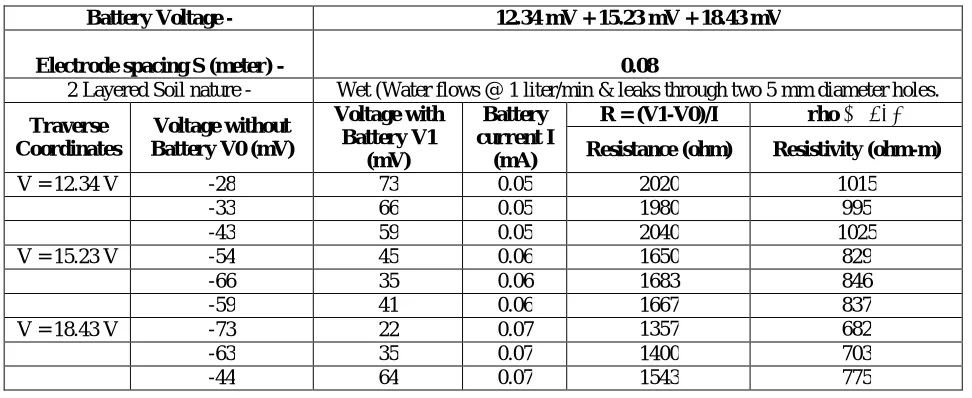
Table 2 below Lists the Resistivity Readings when the Model is Fed with Water & Leakage Occurs.
Battery Voltage - 12.34 mV + 15.23 mV + 18.43 mV
Electrode spacing S (meter) - 0.08
2 Layered Soil nature - Wet (Water flows @ 1 liter/min & leaks through two 5 mm diameter holes.
Traverse Coordinates
Voltage without Battery V0 (mV)
Voltage with Battery V1 (mV) Battery current I (mA)
R = (V1-V0)/I rho = 2πSR
Resistance (ohm) Resistivity (ohm-m)
V = 12.34 V -28 73 0.05 2020 1015
-33 66 0.05 1980 995
-43 59 0.05 2040 1025
V = 15.23 V -54 45 0.06 1650 829
-66 35 0.06 1683 846
-59 41 0.06 1667 837
V = 18.43 V -73 22 0.07 1357 682
-63 35 0.07 1400 703
-44 64 0.07 1543 775
IJSRR, 8(3) July. – Sep., 2019 Page 95
6. REFERENCES
1. Bhatt S, Jain P K; Correlation between electrical resistivity and water content of sand; AIJRSTEM (Online) 2014; 2-3
2. Pandey L M; Electrical Resistivity of Sandy Soil with Water, Leachetes & Seawater; Theses No 1724; Edith Cowan University 2015; 51
3. Munoz-Castelblanco J A, Pereira J M, Delage P and Cui Y J;The influence of changes in water content on the electrical resistivity of a natural unsaturated loess; ASTM Geotechnical Testing Journal 2012; 35(1): 11-17
4. Pozdnyakova L, Zhang R, and Pozdnyakov A; Soil Water Retention and Electrical Resistivity; Department of Renewable Resources, University of Wyoming, Laramie, USA & Central Peat Bog Research Station; Moscow; Urban Water 2001; 205-216
5. Qazi W H, Osman S B A B S, Memon M B; Prediction of Soil Engineering Properties using Electrical Resistivity values at controlled moisture content; ISSN 1819-6608; ARPN Journal of Engineering & Applied Sciences; 2006; 3