R E S E A R C H
Open Access
Multiple kernels learning-based biological
entity relationship extraction method
Xu Dongliang
1, Pan Jingchang
1*and Wang Bailing
2FromBiological Ontologies and Knowledge bases workshop on IEEE BIBM 2016 Shenzhen, China. 16 December 2016
Abstract
Background: Automatic extracting protein entity interaction information from biomedical literature can help to build protein relation network and design new drugs. There are more than 20 million literature abstracts included in MEDLINE, which is the most authoritative textual database in the field of biomedicine, and follow an exponential growth over time. This frantic expansion of the biomedical literature can often be difficult to absorb or manually analyze. Thus efficient and automated search engines are necessary to efficiently explore the biomedical literature using text mining techniques.
Results: The P, R, and F value of tag graph method in Aimed corpus are 50.82, 69.76, and 58.61%, respectively. The P, R, and F value of tag graph kernel method in other four evaluation corpuses are 2–5% higher than that of all-paths graph kernel. And The P, R and F value of feature kernel and tag graph kernel fuse methods is 53.43, 71.62 and 61.30%, respectively. The P, R and F value of feature kernel and tag graph kernel fuse methods is 55.47, 70.29 and 60.37%, respectively. It indicated that the performance of the two kinds of kernel fusion methods is better than that of simple kernel.
Conclusion: In comparison with the all-paths graph kernel method, the tag graph kernel method is superior in terms of overall performance. Experiments show that the performance of the multi-kernels method is better than that of the three separate single-kernel method and the dual-mutually fused kernel method used hereof in five corpus sets.
Keywords: Tag-graph kernel, Entity relationship extraction, Multi-kernels learing
Background
There are more than 20 million literature abstracts included in MEDLINE, which is the most authoritative textual database in the field of biomedicine.The biomed-ical literature is difficult to detect manually because of growing number of papers. Thus biomedical entity rela-tionship extraction is necessary to analysis biomedical literature.Biomedical entity relationship extraction is the extraction of inter-entity specific semantic relationships in text [1, 2]. Besides, it is benefit for semantic similarity [3], biological network construction [4, 5] and ontology term prediction [6, 7].
*Correspondence: [email protected]
1School of Mechanical, Electrical and Information Engineering, ShanDong
University, WenHua West Road, 264209 WeiHai, China Full list of author information is available at the end of the article
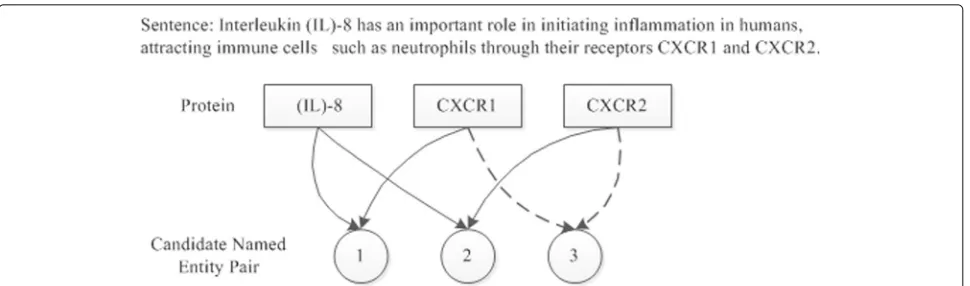
In the biomedical texts, the entity relationships contain gene-disease association [8–10], drug-drug interaction [11–13], protein-protein interaction. Biomedical relation extraction aiming to automatically discover relations from these biomedical articles with high efficiency and accu-racy, is becoming an increasingly well understood alterna-tive to manual knowledge discovery. In this article, entity relationship extraction refers to the extraction of entity relationship that appears in the same sentence. Consider-ing the extraction of protein interaction relationships as an example, as shown in Fig. 1. “Sentence” is a sentence comprising a natural language in the biological literature, i.e., an object to be extracted; “Protein” means a biologi-cal entity named protein, which is present in the sentence to be extracted, and three proteins coexist in the sen-tence in the figure, namely,“IL-8”,“CXCR1” and “CXCR2”, respectively. “Candidate Named Entity Pair” refers to the
Fig. 1Sampling example of protein interaction (The PMID of the literature where the sentence is found is 23041326, and PMID refers to the retrieval number biological literature coded by PubMed)
candidate relationship pairs comprising two proteins and three candidate entity relationship pairs contained in the sentence, as shown in the figure, two of which are cor-rect protein relationship pairs. These relationship pairs are marked by two actual performance arrows in the figures. The entity relationship extraction is the accurate extraction of the two correct entity relationship pairs.
A knowledge network of biological entity can be pre-dicted and established by extracting biological entity rela-tionship [14]. A heavily studied area in biological text mining concerns the relationships known as protein-protein interactions (PPI). Massive PPI have accumulated continuously with the exponential growth of biomedical literature.
The remainder of the paper is organized as fol-lows: Section II reviews the related work. Section III is overview of our approach, which contains introduction of our approach (A type of tag graph kernel method), Characteristics-based kernels, extension dependency path tree kernel and fused kernel method. In section IV, we construct an experiment to evaluate our approach and fused kernel method. Section V is our conclusion.
Biological entity relationship extraction methods can be categorized into three categories statistical machine learning method [15, 16], co-occurrence-based [17, 18] and pattern-based method [19, 20].
The co-occurrence-based method is a graphical repre-sentation of relationships between terms [21, 22]. Antono et al. [23] proposed new method known as WeMine-P2P based on WeMine Aligned Pattern Clustering algo-rithm which discovers and identifies the localized and co-occurring conserved patterns and regions allowing variable length and pattern variations.
Although the co-occurrence-based method is simple and easy to use, the hypothesis depended on by this method fails to completely reflect the actual situation of massive and complicated biological texts, therefore leading to a relatively poor accuracy. Therefore, the
co-occurrence-based method is usually applied to the “crude extraction” stage, indicating that all candidate relationship pairs are extracted. The more accurate extraction of entity relationships requires fusing other information to filter the extracted candidate relationship pairs.
The patterns defined are used to match the labeled sequence in the based methods.The pattern-based method contains two methods: the method pattern-based on extraction-pattern [24] and the method based on tem-plate [25]. The extraction-pattern-based method summa-rizes entity relationship to obtain several extraction rules in the texts by using the natural language processing tool. The template-base method explores the entity relation-ships from the aspect of syntax or part of speech to summarize a series of templates by utilizing the natural language processing. Peng et al. [26] proposed a pattern-based biomedical relation extraction system with a new framework. There are three characteristics: 1) generating patterns by adjusting syntactic variations, 2) improving the coverage of patterns by using sentence simplification, 3) the referential relations can be identified. Some sys-tems which are implemented by the pattern-base method depend on pre-defined patterns at the surface textual level [27–29].Other parsers are used with hand-crafted patterns [30–32].
Compared with the above two methods, machine learning-based approaches which are driven by data and set of annotated corpora are effective [33–36]. But the quality and the number of annotated corpora are signifi-cant effort to the performance of systems.
proposed a method to predict strengths of PPIs by employing protein domain information. Jiang et al. [38] proposed a multi-label correlated semi-supervised machine learning method. It can effectively solve the problem of labeled data by exploring the intrinsic relationship between related classes.
The semi-supervised-machine-learning-based method includes the method based on characteristic [40, 41] and the method based on kernel [42, 43].
In this paper, a type of tag graph kernel method for extracting protein relationship was proposed and com-bined with feature-based kernel and extension path graph kernel into a fused kernel learning method.
Methods
In this article, the kernel method is used as a function to calculate the similarity between two objects. We used three kernels to calculate the inter-entity relationships from three aspects, which can avoid losing important features and strengthen similarity measurement.
Characteristics-based kernels
Characteristic selection is the main work of using characteristic-based kernel function for extracting the protein interaction relationships, where lexical item fea-ture, entity distance and keyword are regarded to features.
1) Item feature
In this work, we used the following three types of key-word item features: the keykey-word items included in the two protein entity names, the keyword items between the two protein entity names, and the keyword items around the two protein entity names.
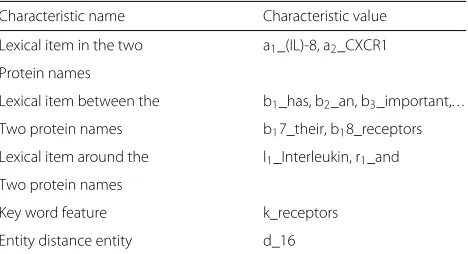
One protein name may contain multiple words, such as the sentence in Fig. 1, where the bold part indicates a pro-tein entity name, and its characteristic value in the char-acteristic vector can be denoted as a1_(IL)-8, a2_CXCR1, and a3_CXCR2.
In case that lexical item between two protein entity names is absent, then the characteristics are considered dull. Such as, in the sentence in Fig. 1, the word “and" between protein CXCR1 and protein CXCR2 is expressed as b1_and in the characteristic value in the characteristic vector.
Given the two proteins, CXCR1 and CXCR2, in the sen-tence in Fig. 1, the three words at the left side of CXCR1 are “through,” “their” and “receptors” and their character-istic values in the charactercharacter-istic vector can be expressed as l1_through, l2_their, l3_receptors. Lexical item is absent at the right side of CXCR2, and this feature item is set to dull.
2) Keyword feture
Many words (keywords) around or between two protein entities can designate the protein relationship, includ-ing “has” and “receptors”. In this paper, when a keyword emerges around or between two proteins, the keyword
is inserted to the keyword form (there are about 600 keywords in the keyword form). As for the sentence in Fig. 1, the corresponding key word, “receptors” are found in the key word form, and its characteristic value in the characteristic vector is expressed as k_receptors.
3) Entity distance entity
The number of interval words between two proteins is called distance. The shorter the distance, the closer the relationship. Therefore, a shorter distance between two proteins demonstrates a higher possibility of their inter-action. If the inter-entity distance is equal to or less than three words, then the corresponding characteristic value is expressed as d_3; if the inter-entity distance is greater than three words but equal to or less than eight words, then the corresponding characteristic value is expressed as d_8; if the inter-entity distance is greater than eight words but equal to or less than 15 words, then the corre-sponding characteristic value is expressed as d_15; if the inter-entity distance is greater than 15 words, then the corresponding characteristic value is expressed as d_16.
The characteristics of two protein entities (IL)-8 and CXCR1 extraction characteristics in the sentence in Fig. 1 are expressed in Table 1.
In this work, we employed the radial-based function as the kernel function for calculating the feature vector (Formula (4)), in which s indicates the covariance matrix.
K(x,y)=exp
−||x−y||2
2s2
(1)
Extension dependency path tree kernel
Formula (5) is the definition of extension path dependency path tree kernel which is one of convolution tree kernel (“c” which is in the lower right corner is convolution). For-mula (5) shows that the tree structure is the representation of the protein entity. And the similarity of semanteme between syntax analysis tree T1and T2is calculated by the same number of structural subtree. Calculation process is as follows: first, the big tree is broken down into many different sub-trees; second, calculating the similarities of these sub-trees; third, the similarity of the big tree is got by
Table 1(IL)-8 and CXCR1 characteristics
Characteristic name Characteristic value
Lexical item in the two a1_(IL)-8, a2_CXCR1
Protein names
Lexical item between the b1_has, b2_an, b3_important,. . .
Two protein names b17_their, b18_receptors
Lexical item around the l1_Interleukin, r1_and
Two protein names
Key word feature k_receptors
summing the similarity of the sub-trees. The dependence path tree kernel [44] and the shortest path tree kernel [45] is two of classical convolution tree.
Kc(T1,T2)=
n1∈N1
n2∈N2
(n1,n2) (2)
In this article, original dependency path tree ker-nels are selected for the extension to form the tension dependency path tree kernels. A dependence relationship analysis is conducted (the analysis process is shown in Fig. 2) using “The expression of rsfA is under the con-trol of both ENTITY1 and ENTITY2.” as example. The path tree between ENTITY1 and ENTITY2 is “(DEPEN-DENCY(CONJ(ENTITY1,ENTITY2))).” Apparently, the information of this tree is insufficient for the judgment of the inter-entity relationship. The solution provided hereby is used to extend the length of the dependency path when the path length is less than three. The path between ENTITY1 and ENTITY2 in the above example can be extended into “(DEPENDENCY(PREP(control, of )) POBJ((of, ENTITY1)) (CONJ(ENTITY1, ENTITY2))).” The algorithm is shown in Algorithm 1.
Algorithm 1Ext_Dep_Path_Sim(n1,n2) Input: n1,n2
Output: Similarity of T1and T2
1: if (the generator between n1 and n2 is defferent)
2: (n1, n2)=0
3: else if(n1and n2is marked as pre-terminal) 4: (n1,n2)=1×λ
5: else recursively calculate the following formula
6: (n1,n2) =λ Nl(n1)
k=1
(1+(cl(n1,k),cl(n2,k)))
7: End if
Where, n1and n2is root node of T1and T2;λ(0< λ <1) is the attenuation factor;Nl(n1) at line 06 is the number of child nodes of n1; n1 and n2 have the same genera-tive, so Nl(n1) = Nl(n2); In which cl(n,k) is the kth child node of node n; (cl(n1,k),cl(n2,k)) represents calculat-ing the number of same subtrees between tree T1and T2 by a recursive algorithm. Hence, the time complexity of algorithm is O(n1log(min(n1,n2))).
The function value between the same trees is much larger than that of different trees when the scale of the tree is very large. We adopted two ways to stop the func-tion value become too much large: a) The funcfunc-tion value is normalized by formula(6); b) In order to reducing the impact of subtree scale, we imported the attenuation fac-torλto multiple the similarity contribution of the subtree on its father node.
K(T1,T2)= K(T1 ,T2)
√
K(T1,T1)K(T2,T2)
(3)
Tag Graph kernel
Definition 1Graph kernel: set G as a finite or infinite graph set, and functionκ : G×G →R is called one graph kernel. In the presence of one Hilbert space (which is prob-ably infinitely dimensional) F and one mappingφ : G→F thus, all the points g, g ∈G,κ(g,g)=< φ(g),φ(g)>and <·,·>represents the dot product of Hilbert space F.
The current graph kernel methods are mainly divided into three categories: diffuse graph kernel, volume graph kernel, and path graph kernel. The authors of this article propose the tag graph kernel method. The core is used to compare the quantity of public channels of the two graphs through hashtag to measure their similarity.
Definition 2Directed tag graph: given v is one node set, εis one directed edge set andε⊂ν×ν,κis a tag set, and m ⊂ν×κis a mapping fromνtoκ, then graph G = (ν,ε,m) is a directed tag graph.
Definition 3Adjacency matrix: given [E]ij= 1⇔(νi,νj)
∈ ε, and [E]ij = 1 ⇔ (νi,νj) ∈/ ε, then matrix E is an
adjacency matrix of directed tag graph G.
Definition 4Tag matrix: given tag setκ= {κ1,κ2,· · ·}, if
[L]ri = 1⇔κr= label(νi), and [L]ri = 0⇔ κr=label(νi),
then matrix L is the tag matrix of directed tag graph G.
Definition 5Matrix inner product: matrix A and matrix B are the matrices of two m×n, and the inner product of matrix A and matrix B is defined as A,B=
m
i=0 n
j=0 AijBij.
Given G and Gas two directed tag graphs, on the basis of hashtag, the all-paths hashtag graph kernel function is shown as Formula (7):
K(G,G)
= r r=0 βr Lr ∞ i=0 ξiEi LT
r,Lr
∞
i=0
ξiEi LT r = r r=0 |k|
m=0 |k| n=0 βr Lr ∞ i=0 ξiEi LT
r
mn
Lr
∞
i=0
ξiEi LT r
mn (4)
where, E and E are the adjacency matrices of G and G, respectively, and L0,L1,· · ·,Lr, and L0, L1,· · ·, Lr are the hashtags of G and G, respectively. Matrix [ En]ij repre-sents the number of all paths in directed tag graph G with
a length of n from nodeνito nodeνj. ∞
i=0λ
iEican fuse all
paths with different lengths between different nodes into graph G. K is the set consisting of all hashtags, ris the upper limit of hashtag top class, andξ(0< ξ <1) is the path weight parameter of adjacency matrix.βr(βr >0)is the top class of hashtags, and the setting ofβ0,β1,· · ·,βr can effectively distinguish the effects of the hashtag at different top classes on the different categories of tasks.
Kernel fusion
The three kernel methods used in this article have their own advantages and disadvantages. The feature-based kernel is simple and effective but cannot obtain the sen-tence structural information. Extension dependency path can obtain the sentence structural information but ignores the deep grammar information. Tag graph kernels can utilize both the results of the grammar analysis and the characteristics of words but ignores the words with a rel-atively long distance and the path similarity of over three words. To sum up, the authors of this article propose a method based on the multi-kernel fusion to extract bio-logical entity relationships. For each kernel, the similarity is measured according to its field, as shown in Formula (8).
K(x,y)=
m
i=1
Ki(x,y) (5)
where i represents the quantity of kernels, m=3. To achieve the kernel fusion of different analysis structures,
the feature weightηis imported, andηi > 0, i ηi =
1.
However, the kernel weighted sum is used to replace the simple multi-kernel summing, as shown in Formula (9):
K(x,y)=
m
i=1
ηiKi(x,y) (6)
At this point, the single-kernel target function is turned into as follows:
Ld=
t
αt−1 2
t
s
αtαsrtrs i
ηiKi
xt,xs (7)
The multi-kernel combination also appears in Discrim-inant (11):
g(x)=
t
αtrt i
ηiKi
xt,xs (8)
The value ofηiis used through training, and the value determines the role of the corresponding kernels in the discriminant.
Results and discussion
To evaluate the multiple-kernel-learning-based method proposed herein, we conducted computational experi-ments and compared with the existing method.
Experimental evaluation index
In the biomedical entity relationship extraction research, there are three evaluation indices which are the following: (Precision, P), (Recall, R) and (F-score, F).
P= TP
TP+FP (9)
R= TP
TP+EN (10)
F= 2∗P∗R
P+R (11)
Where TP represents the number of correctly catego-rized positive examples, TN represents the number of correctly categorized negative examples, FP represents the number of wrongly categorized positive examples, and FN represents the number of wrongly categorized nega-tive examples. P refers to the precision of the algorithm, and R refers to the integrity of reaction algorithm. F value
Table 2Statistical form of corpus information
Corpus set Number of texts Number of sentences Number of positive examples Number of negative examples Total number of examples
Aimed 225 1955 1000 4834 5834
IEPA 50 145 335 482 817
BioInfer 863 1100 2534 7132 9666
HPRD50 200 486 163 270 433
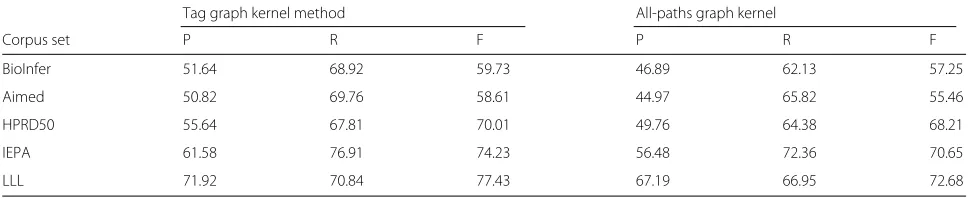
Table 3Comparison between tag graph kernel and all-paths graph kernel in terms of their performance
Tag graph kernel method All-paths graph kernel
Corpus set P R F P R F
BioInfer 51.64 68.92 59.73 46.89 62.13 57.25
Aimed 50.82 69.76 58.61 44.97 65.82 55.46
HPRD50 55.64 67.81 70.01 49.76 64.38 68.21
IEPA 61.58 76.91 74.23 56.48 72.36 70.65
LLL 71.92 70.84 77.43 67.19 66.95 72.68
is the harmonic mean of the two evaluation indices of P and R and is currently the main evaluation index for the current biomedical entity relationship extraction study.
Experimental corpus
In this section, we used five evaluation corpuses [46] which are authoritative evaluation corpuses in the biomedical entity relationship extraction research. Sta-tistical information on the five experimental corpuses, Aimed, IEPA, BioInfer, HPRD50, and LLL, are shown in Table 2.
Experimental results
All-paths graph kernel method [43] is one of the most typ-ical methods in the protein relationship extraction study. Table 3 shows the comparison of tag graph kernel method and all-paths graph kernel method in terms of their per-formance in the five corpus sets. Evidently, the perfor-mance of the tag graph kernel method in five corpus sets is superior to that of the all-paths graph kernel method. The P, R, and F value of tag graph method in Aimed corpus are 50.82, 69.76, and 58.61%, respectively. The cor-responding values of all-paths graph kernel method are 44.97, 65.82, and 55.46%, respectively. The P, R, and F value of tag graph kernel method in other four evaluation corpuses are 2-5% higher than that of all-paths graph ker-nel. The results indicate that the overallperformance of tag graph kernel method is superior to that of all-paths graph kernel.
In order to compare two kinds of kernel fusion meth-ods with the three simple kernel methmeth-ods, we conducted experiments on the BioInfer corpus which is moderate scale. The results are shown in Table 4. In the three separate kernel methods, the tag graph kernel method proposed herein has the best performance followed by the extension dependency path tree kernel. The three kernel methods have a better performance than the single kernel methods. Furthermore, two kernels fuse methods which one is tag graph kernel method obtained the better per-formance. The P, R and F value of feature kernel and tag graph kernel fuse methods is 53.43, 71.62 and 61.30%, respectively. The P, R and F value of feature kernel and tag graph kernel fuse methods is 55.47, 70.29 and 60.37%,
respectively. Experiment results have indicated that the performance of the two kinds of kernel fusion methods is better than that of simple kernel. Hence, the fussed ker-nel methods indeed improve the performance of protein relationship extraction method.
As shown in Table 5, the three-kernel-fused methods and fused kernel methods remain relatively stable in the five kinds of corpus sets. The fused kernel method has the best performance in all aspects, and the proposed tag graph kernel method has the second best performance. The parameters in the tag graph are the parameters with the best results after rand Brhave gone through a large amount of training. Compared with P and R, the F value in the five corpuses sets changes greatly. For example, the F value of the four methods in the BioInfer corpus ranges from 52 to 62%, whereas the F-value in the LLL corpus ranges from 68 to 91%. Such result is mainly due to the changes in the distribution of positive and nega-tive changes of corpus, which greatly affect the F value, whereas other evaluation parameters are insensitive to the changes in the positive and negative example ratio in corpus. The negative examples in Aimed and Bioinfer cor-puses far outnumber the positive examples. Thus, the F value of the two corpuses is significantly lower than that of other corpuses, such as LLL.
Conclusion
In this paper, a tag graph kernel method used hashtag was proposed, which is combined with extension-path-tree-kernel-based method and characteristic-kernel-based method, a fused kernel learning method was further
Table 4Performance of different kernel methods in BioInfer corpus
Method P R F
Characteristics-based kernels 45.61 63.57 56.24
Extension dependency path tree kernel 41.32 69.76 52.58
Tag graph kernel 51.64 68.92 59.73
Feature kernel + path tree kernel 49.86 70.12 60.25
Feature kernel + tag graph kernel 55.43 71.62 61.30
Table 5Performance of different kernel methods in five types of corpuses
Corpus set Evaluation parameters Characteristics- based kernels Extension path dependency kernel Tag graph kernel Kernels from three-kernel fusion
Aimed P 45.34 42.31 50.82 57.45
R 61.25 68.54 69.76 72.31
F 55.36 52.63 58.61 60.98
IEPA P 56.84 52.48 61.58 73.82
R 72.92 69.35 76.91 81.06
F 87.15 63.79 74.23 79.57
BioInfer P 45.61 41.32 51.64 91.69
R 63.57 69.76 68.92 71.62
F 56.24 52.58 59.73 62.35
HPRD P 50.26 49.96 55.64 61.87
R 67.59 66.31 67.81 72.35
F 75.38 69.78 70.01 85.48
LLL P 53.59 83.34 71.92 75.69
R 70.12 69.78 70.84 78.37
F 68.43 88.03 77.43 90.12
proposed. Experimental results indicate that the P, R and F value of the tag graph kernel method is higher on five evaluation corpuses in comparison with the all-paths-graph kernel method. And the performance of multi-kernel fusion methods proposed herein is the best of all of methods used in this article. Obviously, multi-kernel fusion methods can make up for the defect in simple ker-nel and improve the performance of protein relationship extraction method.
Acknowledgements
This research was partially supported by the National Natural Science of China under grant No. 61371177,No. U1431102, Science and Technology Major Project in ShanDong under grant 2015ZDXX0201B04, Science and technology development Program in Shandong Province under grant 2014GGX101053, Science and technology development Program in Weihai Province under grant 2014GGX101053.
Funding
The publication costs for this article were funded by Shandong University.
Availability of data and materials
If you need data and material in the paper,please contact with xudongliang. Email: [email protected]
About this supplement
This article has been published as part ofJournal of Biomedical Semantics
Volume 8 Supplement 1, 2017: Selected articles from the Biological Ontologies and Knowledge bases workshop. The full contents of the supplement are available online at https://jbiomedsem.biomedcentral.com/articles/ supplements/volume-8-supplement-1.
Authors’ contributions
XD and PJ designed and implemented the tag graph kernel method. WB and XZ combine the tag graph kernel methods with Characteristics-based kernel and extension path graph kernel into a fused kernel learning method. All authors read and approved the final manuscript.
Ethics approval and consent to participate
Not applicable.
Consent for publication
Not applicable.
Competing interests
The authors declare that they have no competing interests.
Author details
1School of Mechanical, Electrical and Information Engineering, ShanDong
University, WenHua West Road, 264209 WeiHai, China.2School of Computer
Science and Technology, Harbin Institute of Technology, WenHua West Road, 264209 WeiHai, China.
Published: 20 September 2017
References
1. Spasi´c I, Zhao B, Jones CB, et al. KneeTex: an ontology-driven system for information extraction from MRI reports. J Biomed Semant. 2015;6(1):1. 2. Alm R, Waltemath D, Wolfien M, et al. Annotation-based feature
extraction from sets of SBML models. J Biomed Semant. 2015;6(1):1. 3. Peng J, Li H, Liu Y, et al. InteGO2: a web tool for measuring and
visualizing gene semantic similarities using Gene Ontology. BMC genomics. 2016;17(5):553.
4. Hu Y, Zhang Y, Ren J, Wang Y, Wang Z, Zhang J. Statistical Approaches for the Construction of Human Protein-Protein Interaction Network. Biomed Res Int. 2016;2016:5313050.
5. Peng J, Bai K, Shang X, Wang G, Xue H, Jin S, Cheng L, Wang Y, Chen J. Predicting Disease-related Genes using Integrated Biomedical Networks. BMC Genomics. 2017;18(1):1043.
6. Peng J, Tao W, Wang J, Wang Y, Jin C. Extending gene ontology with gene association networks. Bioinformatics. 2015;32(8):1185-94. 7. Peng J, Wang T, Hu J, Wang Y, Chen J. Constructing Networks of
Organelle Functional Modules in Arabidopsis. Current Genomics. 2016;17(5):427-38.
9. Cheng L, Wang G, Li J, Zhang T, Xu P, Wang Y. SIDD: A Semantically Integrated Database towards a Global View of Human Disease. PLOS ONE. 2013;8(10):e75504.
10. Ananiadou S, Thompson P, Nawaz R, et al. Event-based text mining for biology and functional genomics. Brief Funct Genom. 2014;14(3):213–30. 11. Park JC, Lee HJ. Augmenting Biological Text Mining with Symbolic
Inference. Biol Knowl Discov Handb Preprocessing Min Postprocessing Biol Data. 2014:901–18.
12. Cheng L, Jiang Y, Wang Z, Shi H, Sun J, Yang H, Zhang S, Hu Y, Zhou M. DisSim: an online system for exploring significant similar diseases and exhibiting potential therapeutic drugs. Sci Rep. 2016;6:30024.
13. Blaschke C, Valencia A. The functional genomics network in the evolution of biological text mining over the past decade. New Biotech. 2013;30(3):278-85. 14. Pavlopoulos GA, Promponas VJ, Ouzounis CA, et al. Biological information
extraction and co-occurrence analysis. Biomed Lit Min. 2014;77-92. 15. Valenzuelaescarcega MA, Hahnpowell G, Bell D, et al. SnapToGrid: From
Statistical to Interpretable Models for Biomedical Information Extraction. In: Proceeding of the 15th Workshop on Biomedical Natural Language Processing. Berlin; 2016. p. 56–5.
16. Li B, Yang Y, Ma L, et al. Metagenomic and network analysis reveal wide distribution and co-occurrence of environmental antibiotic resistance genes. ISME J. 2015;9(11):2490-502.
17. Sætre R, Yoshida K, Miwa M, et al. Extracting protein interactions from text with the unified AkaneRE event extraction system. IEEE/ACM Trans Comput Biol Bioinforma (TCBB). 2010;7(3):442-53.
18. Torii M, Arighi CN, Li G, et al. RLIMS-P 2.0: a generalizable rule-based information extraction system for literature mining of protein phosphorylation information. IEEE/ACM Trans Comput Biol Bioinforma (TCBB). 2015;12(1):17-29.
19. Torii M, Arighi CN, Wang Q, et al. Text mining of protein phosphorylation information using a generalizable rule-based approach. In: Proceedings of the International Conference on Bioinformatics, Computational Biology and Biomedical Informatics. Washington: ACM; 2013. p. 201.
20. Li L, Zhang P, Zheng T, et al. Integrating Semantic Information into Multiple Kernels for Protein-Protein Interaction Extraction from Biomedical Literatures. PloS ONE. 2014;9(3):e91898.
21. Zheng S, Jayasumana S, Romera-Paredes B, et al. Conditional random fields as recurrent neural networks. In: Proceedings of the IEEE International Conference on Computer Vision. 2015. p. 1529-37. 22. Honig B, Petrey D, Califano A, et al. Systems And Methods For Predicting
Protein-Protein Interactions. Pat Appl. 2013;3(7):13/789,255. 23. Sze-To A, Fung S, Lee ESA, et al. Predicting Protein-protein interaction
using co-occurring Aligned Pattern Clusters. In: Bioinformatics and Biomedicine (BIBM). Washington: IEEE; 2015. p. 55–60.
24. Zhou D, Zhong D, He Y. Biomedical relation extraction: from binary to complex. Comput Math Methods Med. 2014;2014.
25. Szilagyi A, Zhang Y. Template-based structure modeling of protein-protein interactions. Curr Opin Struct Biol. 2014;24(24C):10-23. 26. Peng Y, Torii M, Wu CH, et al. A generalizable NLP framework for fast
development of pattern-based biomedical relation extraction systems. BMC Bioinform. 2014;15(1):1.
27. Tudor CO, Vijay-Shanker K. RankPref: Ranking sentences describing relations between biomedical entities with an application. In: Proceedings of the 2012 Workshop on Biomedical Natural Language Processing. Montreal: Association for Computational Linguistic; 2012. p. 163-71. 28. Cohen KB, Verspoor K, Johnson HL, Roeder C, Ogren PV, Baumgartner WA,
White E, Tipney H, Hunter L. High-precision biological event extraction: effects of system and of data. Comput Intell. 2011;27(4):681-701. doi:10.1111/j.1467-8640.2011.00405.x.
29. Hakenberg J, Leaman R, Ha Vo N, Jonnalagadda S, Sullivan R, Miller C, Tari L, Baral C, Gonzalez G. Efficient extraction of protein-protein interactions from full-text articles. IEEE/ACM Trans Comput Biol Bioinform (TCBB). 2010;7(3):481-94.
30. Kilicoglu H, Bergler S. Adapting a general semantic interpretation approach to biological event extraction. In: Proceedings of the BioNLP Shared Task 2011 Workshop. Portland: Association for Computational Linguistics; 2011. p. 173-82.
31. Quirk C, Choudhury P, Gamon M, Vanderwende L. MSR-NLP entry in BioNLP shared task 2011. In: Proceedings of the BioNLP Shared Task 2011 Workshop. Portland: Association for Computational Linguistics; 2011. p. 155-63.
32. Kim J, Rebholz-Schuhmann D. Improving the extraction of complex regulatory events from scientific text by using ontology-based inference. J Biomed Semantics. 2011;2(Suppl 5). doi:S3-10.1186/2041-1480-2-S5-S3. 33. Vlachos A, Craven M. Biomedical event extraction from abstracts and full
papers using search-based structured prediction. BMC Bioinforma. 2012;13(Suppl 11). doi:S5-10.1186/1471-2105-13-S11-S5.
34. Riedel S, McClosky D, Surdeanu M, McCallum A, Manning CD. Model combination for event extraction in BioNLP 2011. In: Proceedings of the BioNLP Shared Task 2011 Workshop. Portland: Association for Computational Linguistics; 2011. p. 51-55.
35. Björne J, Salakoski T. Generalizing biomedical event extraction. Proceedings of the BioNLP Shared Task 2011 Workshop. Portland: Association for Computational Linguistics; 2011. p. 183-91. 36. Bui QC, Katrenko S, Sloot PM. A hybrid approach to extract
protein-protein interactions. Bioinformatics. 2011;27(2):259-65. doi:10.1093/bioinformatics/btq620.
37. Kamada M, Sakuma Y, Hayashida M, et al. Prediction of Protein-Protein Interaction Strength Using Domain Features with Supervised Regression. Sci World J. 2014;2014(1):240673.
38. Jiang JQ, McQuay LJ. Predicting protein function by multi-label correlated semi-supervised learning. IEEE/ACM Trans Comput Biol Bioinforma (TCBB). 2012;9(4):1059-69.
39. Nguyen TP, Ho TB. Detecting disease genes based on semi-supervised learning and protein-protein interaction networks. Artif Intell Med. 2012;54(1):63-71.
40. Hu J, Zhang X, Liu X, et al. Prediction of hot regions in protein-protein interaction by combining density-based incremental clustering with feature-based classification. Comput Biol Med. 2015;61:127-37. 41. Buchan DWA, Minneci F, Nugent TCO, et al. Scalable web services for the
PSIPRED Protein Analysis Workbench. Nucleic Acids Res. 2013;41(W1): W349-W357.
42. Li L, Guo R, Jiang Z, et al. An approach to improve kernel-based Protein-Protein Interaction extraction by learning from large-scale network data. Methods. 2015;83:44-50.
43. Airola A, Pyysalo S, Björne J, et al. All-paths graph kernel for protein-protein interaction extraction with evaluation of cross-corpus learning. BMC Bioinforma. 2008;9(11):1.
44. Chowdhury MFM, Lavelli A. Combining tree structures, flat features and patterns for biomedical relation extraction. In: Conference of the European Chapter of the Association for Computational Linguistics. Avigno 2012. p. 420–9.
45. Ruan P, Hayashida M, Maruyama O, et al. Prediction of heterodimeric protein complexes from weighted protein-protein interaction networks using novel features and kernel functions. PloS ONE. 2013;8(6):e65265. 46. Pyysalo S, Airola A, Heimonen J, et al. Comparative analysis of five
protein-protein interaction corpora. BMC Bioinforma. 2008;9(3):1.
• We accept pre-submission inquiries
• Our selector tool helps you to find the most relevant journal • We provide round the clock customer support
• Convenient online submission • Thorough peer review
• Inclusion in PubMed and all major indexing services • Maximum visibility for your research
Submit your manuscript at www.biomedcentral.com/submit