Themed Section: Science and Technology
An Effective QoS based Route Optimization Model in MANET using Machine
Learning
M. Janardhan, Prof. S. Pallam Shetty, Prof. Prasad Reddy P.V.G.D
Department of Computer Science & Systems Engineering, Andhra University, Visakhapatnam, India
ABSTRACT
Mobile Ad hoc network is a network which is dynamic where the mobile nodes form a temporary network in the deficiency of centralized administration, i.e. A MANET is an autonomous group of dis tributed mobile nodes. Due to the absence of centralized administrator in a network, routing in mobile ad hoc network (MANET) becomes the primary issue which reduces the selection of an optimal path for routing. Specific performance parameters such as latency, overhead, and packet delivery ratio (PDR) are affected unfavorably for which various techniques such as Machine Learning approach are encouraged that enhances the selection of the efficient and stable path. In our, Proposed Research works our attempt is made to select the optimal route i.e. which supports to identify the pattern for Link failure in communication and Optimized routing path for better communication to achieve the QoS for MANET environment using knowledge-based learning algorithm. The optimal path will possess the highest average sum of relay nodes and will be considered as the most optimal and reliable path. We also anticipated that analysis of throughput and PDR is better as compared to the traditional methods.
Keywords : Routing Protocols, Internal Attacks, External Attacks, Manets
I.
INTRODUCTIONThere are research contribution exist in routing mechanisms of MANETS by considering the QoS parameters.
Ant Colony Based QoS Routing Algorithm for Mobile AdHoc Networks is an on-demand QoS routing algorithm [1] proposed by P.Deepalakshmi. This algorithm is adaptive in nature and reduces the end to end delay in high mobility cases. But the other QoS constraints i.e. other network layer or link layer metrics like energy, jitter, link stability etc. are not considered here. Furthermore, here link failure is not handled properly.
Metrics in Mobile Ad Hoc Networks proposed by R. Asokan [2] and it performs well in route discovery phase with dynamically changing
topology and produces better throughput and low delay variance. Again flooding of route request may potentially reach all nodes in the network, so bandwidth wastage increases and efficiency degrades. Besides this, it is a collision and contention prone routing protocol. Thus, packet delivery ratio decreases, congestion increases and throughput also become very poor in case of multimedia. The routing overhead is also increased.
the last round following a failure. More energy is consumed because of this routing process.
S.Kannan has projected a multi agent ant based routing algorithm for MANET [4]. It is a hybrid algorithm which combines the concepts of multi agents and ant algorithm. This technique increases node connectivity and decreases average end to end delay and increase packet delivery ratio. But complex optimization problems are not considered in algorithm.
B. R. Sujatha has proposed a PBANT algorithm [5] which optimizes the route discovery process by considering the position of the nodes which can be obtained by GPS receiver but here energy parameter is not taken into account.
Routing Protocols:
Initially, the optimization property of ACO algorithms has attracted much attention. Inspired by it, researchers have been motivated to apply ACO algorithms to find optimized routes for network communications. There are many approaches that belong to this category. He we presents the most famous ones in chronological order.
AntNet
Di Caro and Dorigo [30] have proposed AntNet, which is the rst representative ACO-based algorithm for solving the problem of internet routing. In AntNet, each node proactively sends out Forward ANTs (FANTs) to discover a path to a randomly chosen destination node. Once FANTs reach the destination, Backward ANTs (BANTs) are sent back to the source node following the reverse path. BANTs update the local models of the network status and the local routing table at each intermediate node. The performance of AntNet is evaluated in three different wired network scenarios.
ARA
Another representative ACO-based routing protocol for MANETs, ARA was proposed by Günes et al. [31].ARA is an on-demand routing algorithm, which is based on a simple ant colony optimization meta-heuristic algorithm. The whole routing algorithm consists of three phases: a route discovery phase, a route maintenance and a route failure handling. The route discovery phase in ARA is designed in a similar way to AntNet. FANTs and BANTs are used in the route discovery phase. FANTs are broadcasted by the sender. Duplicate FANTs are identied by their sequence numbers and are deleted by intermediate nodes. Once FANTs reach their destination nodes, BANTs are created and sent back to the source nodes. Different from AntNet [30], ARA uses data packets to maintain the route to avoid the overhead caused by using periodic ants. If a node recognizes a link failure, it First sets the pheromone value of this link to zero to deactivate it. Then it searches for an alternative link. If this fails, it informs its neighbors. This process is repeated until an alternative route has been found or the source node receives a route error message. In the latter case, the source node will initiate a new route discovery phase if there are still packets to be sent.
PERA
authors have compared PERA with AODV [2]. The results indicate that PERA has lower delay in all cases. However, the throughput of PERA at the higher speed is slightly less than AODV and the goodput of PERA is lower than AODV in high mobility scenarios.
AntHocNet
Di Caro et al. [33] have presented a hybrid multi-path routing algorithm, AntHocNet. In AntHocNet there are 6 different kinds of ants: Proactive FANTs (PFANTs), Proactive BANTs (PBANTs), Reactive FANTs (RFANTs), Reactive BANTs (RBANTs), RePair FANTs (RPFANTs) and RePair BANTs (RPBANTs). In the reactive route setup process,if a source node has no routing information about the requested destination node, it broadcasts RFANTs. Otherwise,it unicasts. When this RFANT reaches the destination,a RBANT is sent back to the source. Along its journey, the RBANT collects quality information about each link in the path and updates the pheromone table at each intermediate node. Once the First route is constructed, AntHocNet starts the proactive route maintenance process. Here, source nodes send out PFANTs to their destination nodes. PFANTs consider both regular and virtual pheromone for choosing the next hop node at each intermediate node. Once a PFANTreaches the destination node, it is converted to a PBANT. PBANTs update the regular pheromone table on their way back to the source node. In case of a link failure, RPFANTs and RPBANTs are used to handle the problem. The authors have implemented the protocol in QualNet [34] and investigated its performance using various simulations and comparing the results to AODV [2].
PACONET
Osagie et al. [35] have proposed an improved ACO algorithm for routing called PACONET. In PACONET, a source node reactively broadcasts FANTs in a restricted manner to explore the network. Each FANT records the total time it has traveled and maintains a list of all visited nodes. At each intermediate node the
FANT updates the pheromone value. Once a FANT arrives at the destination, a corresponding BANT is generated.The BANT uses the list of visited nodes recorded by the FANT to travel back to the source node. Along the way,the BANT also updates the pheromone value in the reverse direction. Different from the AntNet, PACONET let both FANTs and BANTs update the pheromone. The performance of PACONET has been compared with AODV [2].The results show that PACONET has less end to end delay and routing control overhead than AODV, but the packet delivery ratio is nearly the same.
ACO-AHR
Yu et al. [36] have proposed a hybrid routing algorithm ACO-AHR, which includes reactive routing setup and proactive routing probe and maintenance. There are two kinds of agents: ant agents and service agents. The ant agents are FANTs and BANTs as in other ACO based routing algorithms. In the reactive routing setup process, a source node broadcasts FANTs. Along the trip, each FANT records all the nodes it has visited in order to avoid cycles in the path. Each BANT carries all the information collected by the corresponding FANT. It calculates the delay from one intermediate node to the destination node. Once a BANT ant reaches the source node, a service agent is created. The service agent updates the routing table at intermediate nodes by using the information gathered by the BANT. In the proactive routing maintenance process, proactive FANTs are sent out while the data session is ongoing. The proactive FANTs are normally unicasted, but they could be broadcasted with a small probability. In the latter case, the FANTs may be able to find new paths.
HOPENT
HOPENT is simulated on GlomoSim [38] and the authors have compared HOPNET with several famous routing protocols, such as AODV [2], AntHocNet [33], and ZRP [39]. The results indicate that HOPNET is highly scalable for large networks in comparison with AntHocNet [33].Moreover, the author also varied the zone radius in the experiments and results indicate that the selection of the zone radius has considerable effect on the performance.
ANT-E
Sethi and Udgata [40] have proposed an ACO-based on-demand routing protocol Ant-E. Ant-E uses Blocking Expanding Ring Search (Blocking-ERS) [41] to limit overhead and controls local retransmission to improve the Packet Delivery Ratio (PDR). The authors compared Ant-E with
AODV [2] and DSR [3]. The results show that Ant-E performs better.
OUTLINE :
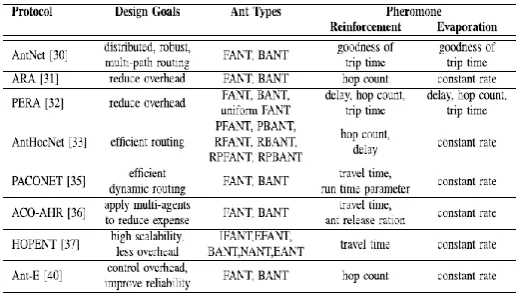
Here we have introduced some of the representative protocols which were proposed in the early stage of ACO based routing protocols. The First ACO based routing protocol, AntNet, proposed in 1998, gave a good example of howto apply theACO algorithm in communication networks.In the following ten years, many subsequent researchers proposed various ACO based routing protocols for MANETs based on this idea. Protocols in this category aimed for Finding the optimal routes in dynamically changing networks and their performance indicated that ACO is a promising solution for routing problems in MANETs. This further encouraged researchers to design novel ACO based routing protocols which consider other issues, such as Quality of Service (QoS), energy consumption and so on.
Table 1. Design parameter overview of basic ACO routing protocols.
TABLE 2. Pheromone parameter overview of basic ACO routing protocols.
QoS AWARE ACO ROUTING PROTOCOLS
QoS has always been a focus of attention in mobile ad hoc networks.It is a challenging problem when transmitting packets via multiple paths in a dynamic network. At the same time, the pheromone concept from ant colony algorithms also inspires many authors to use QoS parameters for selecting routes.
1) ARAMA
2) SAMP-DSR
SAMP-DSR is proposed by Khosrowshahi-Asl et al. [43], which aims to solve the shortcomings of both ACO and DSR [3] algorithms. In SAMP-DSR, each node can operate in two modes, called ``local mode''• and ``global mode’ ‘Depending on the rate of network topology change, nodes switch between the two modes, in order to help the ants converge efficiently.
3) QAMR
QAMR is a QoS-enabled ant colony based multipath routing protocol for MANETs which is proposed by Krishna et al. [44]. It selects paths based on Next Hop Availability (NHA) and the path preference probability. The NHA is defined as the availability of nodes and links for routing on a path, considering both mobility and the energy factors. In order to find the best path that satisfying the QoS constraints, QAMR uses a path preference probability which measures different parameters such as delay, bandwidth and hop count. However, there are many extra control messages for estimating the quality of outgoing links.
4) QoRA
Al-Ani and Seitz [45] have introduced a QoS Routing protocol for multi-rate ad hoc networks based on Ant colony optimization (QoRA). In order to reduce the overhead when collecting information from multiple paths and to avoid congestion during data transmission, this paper uses the Simple Network Management Protocol (SNMP) [46] to estimate QoS parameters locally. The proposed mechanism consists of two components: the QoRA entity and the SNMP entity.The QoRA entity runs on every node to identify a suitable route that meets the specified QoS requirements, while the SNMP entity collects detailed information about the characteristics of the outgoing links such as bandwidth, delay and packet loss. More specifically, the QoRA entity consists of ve components: the neighbor table, the routing table, the
by Finding an alternative path using EANTs.The QoRA protocol does not require either exchanging additional control packets or synchronizing nodes with the help of the SNMP entity. It computes QoS parameters locally to reduce overhead. The computation of QoS parameters is all loaded to the SNMP entity which allows the QoRA protocol to reduce end-to-end delay. Although it is clear that the QoRA entity requires less overhead, the communication between the QoRA entity and SNMP entities consumes more energy and bandwidth.
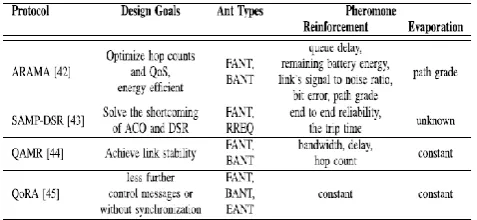
OUTLINE : Here we discussed five representative protocols which focus on QoS fulfillment. QoS has always been a vital task for data transmission in MANETs. The approaches focus mainly on the parameters: link stability and hop count. Other common QoS related improvements are a reduction in overhead produced by control messages and the ability to eschew the requirement of time synchronization. Many other QoS parameters such as link delay, remaining battery energy, end to end reliability and bandwidth are treated as pheromone reinforce factors in above protocols.
Quality of Service is the primary mission for data transmission and communication in MANETs.
TABLE 1.Design parameter overview of QOS aware ACO routing protocols.
TABLE 2. Pheromone parameter overview of QOS aware ACO routing protocols.
TABLE 3. Pheromone parameter overview of energy aware ACO routing protocols.
SECURITY AWARE ACO ROUTING PROTOCOLS
Other than QoS and energy efficiency, security is another hot topic in routing protocols which attracts many researchers' attention. As is well-known there exist many security threats in the network layer, such as black hole attacks, wormhole attacks, Flooding attacks and so on. When these attacks are launched during the routing process, this usually leads to strong harmful effects on the network. In the worst cases, an attacker might even make the communication in the network impossible. Therefore, mechanisms that help participants in a network to defend against the potential attacks are necessary. However, the scope of security is wide. Different researchers have their own ideas about how to best build defense systems. In this section, an overview about existing security aware ACO based routing protocols is presented.
1) SAR-ECC
This approach makes use of two basic processes: one is estimating the trust value between neighbor nodes. The other uses the AntNet routing mechanism for route discovery and ECC for mutual authentication between the source and destination. In the network, each node in the cluster keeps trust values for all its neighbors. A trust value is calculated based on a measurement of uncertainty and is an increasing function that correlates with the probability of successfully transmitting each packet. During route establishment, the source node tries to nd multiple routes using AntNet [30]. Then it gathers the trust values of all nodes in the paths. Based on the trustworthiness of nodes, it selects a trustworthy route for data transmission. The novelty of the protocol is using a trust value based on a measurement of uncertainty instead of the conventional pheromone. However, the updating mechanism for the trust value is not described and the benefits of combining a cluster structure with an ACO algorithm are not clearly described.
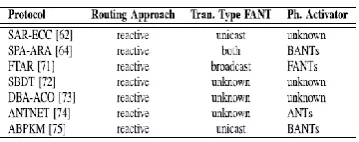
Due to the prevalence of security threats in the networks, security is also a hot topic that attracts many researchers ‘attention. Common attack types are, for example, black hole and wormhole attacks. Different researchers have proposed various ideas about how to ensure security in their routing protocols. In this section, we compare a selection of security aware ACO based routing protocols. These protocols use several methods to ensure secure routing. From Table 4,we observe that all surveyed protocols in this subsection use reactive approaches, thus avoiding the higher overhead commonly associated with proactive methods. For example, besides the regular proactive routing table maintenance, if a malicious node is detected in proactive approaches, all nodes in the network need to put the malicious node into black lists and update their routing tables to avoid routes including the reported malicious node. Table 5 shows that most of the security aware ACO routing protocols aim to ensure Finding secure and reliable
routes. Some of them such as DBA-ACO [73] and ANTNET [74] focus on defending against certain attack types, while others are interested in detecting malicious or anomalous nodes in the network. All the listed protocols use the basic ant types, except ABPKM [75] which has two other special ant types, namely Repair ANTs (RANTs) and Update ANTs (UANTs). Although some of the proposed protocols have not described their pheromone related parameters clearly, we can still observe that there are various pheromone reinforcement factors, which are applied in this subsection. Besides a trust value, which is the most common parameter, there are also other parameters used for reinforcing the pheromone values, such as traveling time, distance, trails and attractiveness. In contrast to the reinforcement factors, most of the protocols use a constant rate to evaporate the pheromone over time.From these research contributions it is clearly evident that still the scope exists for proposing a routing mechanism by achieving the QoS parameter such as delay, jitter, scalability, performance, through put, energy consumption etc.
TABLE 4. Design parameter overview of security aware ACO routing protocols.
Table 6. Simulation parameter overview of ACO based routing protocols.
Routing Protocols:
Some of the representative protocols which were proposed in the early stage of ACO based routing protocols. The First ACO based routing protocol, AntNet, proposed in 1998, gave a good example of howto apply theACO algorithm in communication networks.In the following ten years, many subsequent researchers proposed various ACO based routing protocols for MANETs based on this idea. Protocols in this category aimed for Finding the optimal routes in dynamically changing networks and their performance indicated that ACO is a promising solution for routing problems in MANETs. This further encouraged researcher to design novel ACO based routing Protocols which consider other issues,
such as Quality of Service (QoS), energy consumption and so on.
QoS AWARE ACO ROUTING PROTOCOLS :
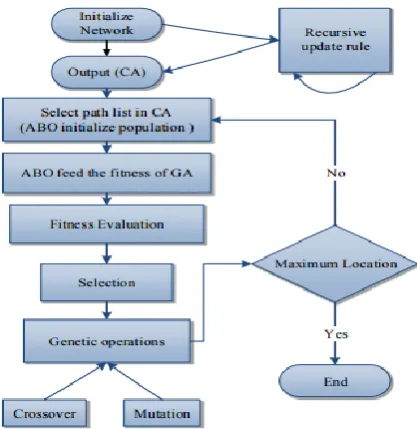
QoS has always been a vital task for dat transmission in MANETs .The proposed method was a new energy and delay-aware routing protocol that combines cellular automata (CA) with the hybrid genetic algorithm (GA) and African Buffalo Optimization (ABO) to optimize the path selection in the ad-hoc on-demand distance vector (AODV) routing protocol.
AN EFFICIENT ENERGY AND DELAY ROUTING PROTOCOL :
Our proposed research attempt to establish a robust path and get fulfill the QoS requirement as energy and delay. Our research comprised two stages to achieve our objective,
The proposed method was a new energy and delay-aware routing protocol that combines cellular automata (CA) with the hybrid genetic algorithm (GA) and African Buffalo Optimization (ABO) to optimize the path selection in the ad-hoc on-demand distance vector (AODV) routing protocol.
Discovering Routes by CA
To find out a path with delay as the QoS constraint. There exists no hierarchy among the nodes, and the network plane is found to be fully homogeneous (i.e. all nodes consist of the same characteristics). Our approach involves the broadcasting of the RREQ message that constitutes the delay requirement of the connection request [maximum delay (Dmax)] by the source node to its communicating neighbors. All the nodes at the right, left, top, and down side are involved in this, as depicted in Figure 2.
The message re-broadcast by the intermediate nodes to their neighbors, which also establish a reverse path to the sender. Certain nodes, when given a delay constraint, turn into a wave, take in a wave node to their neighbors, re-broadcast the message, and establish a reverse path to the nodes from which they had obtained the message. This activity continues till the message is collected by the destination node or the delay faced by the packet outstrips the limit Dmax. The destination obtains many RREQ messages for the same sender when there are more paths from the sender to the destination. Consequently, reply to some of the RREQ messages is done by the destination through sending an RREP message through the reverse path that is established when the RREQ messages are passed on. The entire set of nodes observed along these routes amidst the source and the destination constitute the path nodes. Each and every communication between the source and the
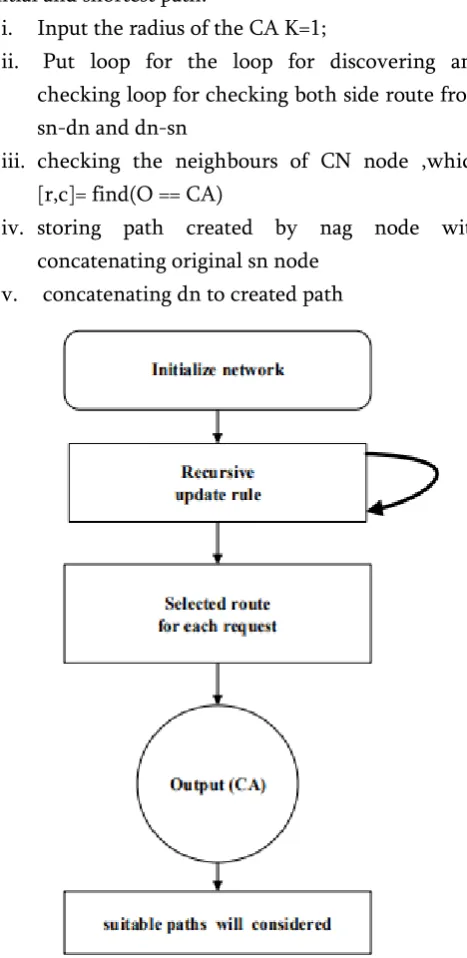
destination from this juncture happens through this path till the topology of the network gets modified.. Algorithm for two-way dimensional of CA for the initial and shortest path.
i. Input the radius of the CA K=1;
ii. Put loop for the loop for discovering and checking loop for checking both side route from sn-dn and dn-sn
iii. checking the neighbours of CN node ,which [r,c]= find(O == CA)
iv. storing path created by nag node with concatenating original sn node
v. concatenating dn to created path
Figure The Process rule for short path selection
Fig : The process of CA with hybrid algorithm
Backbone Based Quick Link Failure Recovery Multicast Routing Protocol :
An Efficient Backbone Based Quick Link Failure Recovery Multicast Routing Protocol is a hybrid protocol with the features of tree based and mesh based routing protocols. The proposed protocol overcomes the limitations of existing protocols. It has four phases: Group Formation, Backbone Construction, On-Demand Route Discovery and Route Maintenance. At the inception every node exchange HELLO packets with the neighbour nodes and compute 1- hop neighbouring count, the node which possess the highest count of 1-hop neighbor nodes will be elected as the core node and send core request to 1-hop neighbouring cores. Upon receiving reply from neighbouring cores backbone will be formed. When a source intends to transmit data packets firstly it checks its route cache if route found directly transmits data packets to destination. Else initiate the route discovery process and once route is found multicast data packets. In the transmission path of data packets if any link failure is encountered, upstream node initiates route discovery to generate an alternate path towards destination.
The main aim of the proposed protocol is to construct an efficient robust backbone to overcome the limitations of existing protocols and to provide a mechanism for the quick recovery of link failures by generating an alternate path from the point of failure to the destination, which can be adoptable in any sort of environment.
Energy Efficient Routing based on Route Segmentation :
The proposed energy efficient routing based on
route segmentation (EER-RS) provides a scalable
and energy saving routing model for MANETs.
This maintains small route segments for the
active routes. The functionality of route discovery
of EER-RS is comparable to DSR where multiple
routes are discovered to reach the target node,
and the shortest and optimal route is used for
routing. In the case of longer routing, the shortest
route might have a few hops to reach the target
node. These hops, when segmented into w node,
make v route segments. The process of
construction segmentation is described below.
Route Segmentation Mechanism:
The intention of segmenting route is to make
EER-RS scale for the bigger network. The
distribution of network in MANET is into regions
based on the node ranges as shown in Fig.1. The
two highlighted node in the figure makes a 2-hop
segment. One can decide the number of hops
based on the route hops length.
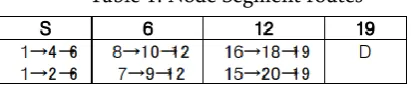
Let's consider a route discovery process of node S, identifies two prominent routes to reach D as shown below.
Route1: S→1→4→6→8→10→12→16→18→19→D Route2: S→1→2→6→7→9→12→15→20→19→D If the segment length, w=2, then each route will be divided w segments having a segment head which maintain the segment path to reach segment end node as shown in Table-1.
Table 1: Node Segment routes
The advantage of these route segment supports in low energy utilization in maintenance in case of broken links. It can be present locally at the stage of a segment. Fixing a failure route within a segment broadens the life span of the route and accumulate energy through minimizing frequent route discoveries process. Thus, this mechanism will substantially help in reducing the routing overhead and energy consumption and improve the performance. Even varying segment length, w can support the adaptive routing scheme, which will be important for MANETs. Utilizing these segments we compute the minimum energy required to route data over it which will save the energy further.
Energy Saving Mechanism:
Even though segmenting route save quite an amount of energy through minimizing routing overhead, but is essential to route data in an energy efficient route. As mention in Table-1 that each node in a route maintains its own segment path, eventually identifying the best energy sufficient path for routing can make the segment life longer and throughput efficiency can be achieved. To compute the energy level of each segment path we enhance the algorithm
CMMBCR [24] ("Conditional Min-max Battery Capacity Routing") which recognize the routes that have an adequate left over energy of a battery and then choose the routes with lowest total transmission power .
Let’s represent a routing structure by a graph V = (N, E), where, N is "the set of nodes" and E is "the set of communication edges".
Figure 2: A graph model of node S to reach Node-6 Based on fig.2, the node S has to send a packet to N6, which has two paths to reach and the energy needed to send a message to each hopping node is directly comparative to the square of its distance. If the first path distance, p1 have a distance is, p1=(d1+d2+d3) then the energy required for transmitting is, e1= (p1)2. Since, node S also have another path for transmitting and its distance is, p2 = (d1+d4+d5), and its energy required is, e2 = (p2)2. In this case, if e1 ≥ e2 then, S transmit data through p2 instead of p1 to save energy.
The minimum energy, B required between nodes S to next node n to send the message can be computed using the equation-1 as follows,
EER-RS Based Routing Mechanism :
routes the data packets in energy efficient route as described in Alogorithm-1 below.
SECURITY ATTACKS IN MOBILE AD-HOC NETWORK :
MANET’s has lots of security problems. Links are
open and actively movable here thus bad-natured
intruder can easily intrusion this network.
Attacks matching to specific layer are displayed
in table 1. The particular attacks are usually of
two types i.e. internal and external attacks [4].
Attacks Matching to MANET Layers
Internal Attacks Timing Attack Modification Attack Dropping Attack Fabrication Attack
External Attacks
Active Attacks: -It harms or alters the computer resources and involves modification of the information stream.
Denial of Service Attack Spoofing
Man-in-the-Middle ARP poisoning Ping Flood Smurf Attack Buffer Overflow Heap Overflow
Formatting String Attack
Passive Attacks: -This type of attacks does not affect the system resource; they only observe or monitor the communication. The aim of this type of attack is to obtain information that is being transmitted [5]. These can be following
Wiretapping Port Scan Idle Scan
Layer Attacks
Gray Hole Attack Byzantine Attack Rushing Attack Partitioning Attack
Black Hole Attack Worm Hole Attack Link Withholding Attack
Sybil Attack
Location Disclosure Attack Replay Attack
SOLUTIONS FOR SECURING MANET ROUTING PROTOCOLS :
To secure routing protocols from attacks lots of solutions are proposed by researchers like AODV, DSDV, DSR, OLSR and FSR etc. As routing is a significant task for Ad-hoc network, thus this should be more secure as viable.A protocol might be enough to please security problems and working terms. Below are few solutions .
SAR (Security Aware Ad-hoc Routing)
SAODV (Secure Ad-hoc on Demand Distance Vector)
ARAN (Authenticated Routing for Ad-hoc Network)
ARIADNE
SRP (Secure Routing Protocol)
SEAD (Secure Efficient Ad-hoc Distance Vector) SLSP (Secure Link State Routing Protocol) DSDV (Destination-Sequenced Distance Vector
Protocol)
DSR (Dynamic Secure Routing)
II.
REFERENCES
1. P. Deepalakshmi and Dr.S.Radhakrishnan, ‘Ant colony based QoS routing algorithm for mobile ad hoc networks,’ International Journal of Recent Trends in Engineering, vol. 1, no. 1, May 2009, pp. 459-462.
2. Asokan, R. Natarajan, A. Nivetha, ‘ A swarm based distance vector routing to support multiple quality of service (QoS) metrics in MANETs,’ J. Comput. Sci., vol. 3, 2007, pp. 700-707.
3. S. Sethi and S. Udgata, ‘The efficient ant routing protocol for MANET,’ International Journal on Computer Science and Engineering, vol. 02, no. 07, 2010, pp. 2414-2420.
4. S. Kannan, T. Kalaikumaran, S. Karthik and V. Arunachalam, ‘Ant colony optimization for routing in mobile ad hoc networks,’ International
Journal of Soft Computing, vol. 5, Iss. 6, 2010, pp. 223-228.
5. B.R.Sujatha and Dr. M.V. Sathyanarayana, ‘PBANT Optimized ant colony routing algorithm for manets,’ Global Journal of Computer Science and Technology, vol. 10, Iss. 2, April 2010, pp. 29- 34.
6. P Venkata Krishna, V. Saritha, G. Vedha, A. Bhiwal and A. Bhiwal, Quality of service enabled ant colony based multipath routing for mobile ad hoc networks, IET Commun., vol. 6, Iss. 1, 2012, pp. 76-83.
7. E. Bonabeau, M. Dorigo, and G. Theraulaz, Swarm Intelligence: From Natural to Arti_cial Systems. Oxford, U.K.: Oxford Univ. Press, 1999. 8. J Bishop, "Stochastic searching networks,'' in
Proc. 1st IEE Int. Conf.Artif. Neural Netw. (Conf.), 1989, pp. 329_331.
9. R Poli, J. Kennedy, and T. Blackwell, "Particle swarm optimization,''Swarm Intell., vol. 1, no. 1,
pp. 33_57, Jun. 2007, doi:
https://doi.org/10.1007/s11721-007-0002-0. 10. M. Dorigo, "Optimization, learning and natural
algorithms,'' Ph.D. dissertation,Politecnico di Milano, Milan, Italy, 1992.
11. H. Zhang, X. Wang, and D. Hogrefe, "A survey of location aware ant colony optimization routing protocols in MANETs,'' in Proc. 10th EAI Int.Conf. Bio-Inspired Inf. Commun. Technol. (BIONETICS), 2017. [Online].Available: http://bionetics.org/2017/show/accepted-papers 12. C. S. Moreau, C. D. Bell, R. Vila, S. B. Archibald,
and N. E. Pierce, "Phylogeny of the ants: Diversi_cation in the age of angiosperms,'' Science,vol. 312, no. 5770, pp. 101_104, 2006. 13. B. Hlldobler and E. O. Wilson, The ANTS.
Cambridge, MA, USA: Harvard Univ. Press, 1990. 14. G. F. Oster and E. O. Wilson, Caste and Ecology in the Social Insects. Princeton, NJ, USA: Princeton Univ. Press, 1978.
16. C. Anderson, G. Theraulaz, and J.-L. Deneubourg, "Self-assemblages in insect societies,'' Insectes Sociaux, vol. 49, no. 2, pp. 99_110, 2002.
17. N. J. Mlot, C. A. Tovey, and D. L. Hu, "Fire ants self-assemble into waterproof rafts to survive _oods,'' Proc. Nat. Acad. Sci. USA, vol. 108, no. 19, pp. 7669_7673, 2011.
18. P. C. Foster, N. J. Mlot, A. Lin, and D. L. Hu, "Fire ants actively control spacing and orientation within self-assemblages,'' J. Experim. Biol., vol. 217, no. 12, pp. 2089_2100, 2014. 19. N. Fujiwara-Tsujii, N. Yamagata, T. Takeda, M.
Mizunami, and R. Yamaoka, "Behavioral responses to the alarm pheromone of the ant camponotus obscuripes (hymenoptera: Formicidae),'' Zool. Sci., vol. 23, no. 4, pp. 353_358, 2006.
20. H. Ahmed and J. Glasgow, "Swarm intelligence: Concepts, models and applications,'' School Comput., Queens Univ., Kingston, ON, Canada, Tech. Rep. 2012-585, 2012.
21. F.Moyson and B. Manderick, The Collective Behavior of Ants: An Example of Self-organization in Massive Parallelism, Vrije Univ. Brussel, Ixelles, Belgium, 1988.
22. S. Goss, S. Aron, J.-L. Deneubourg, and J. M. Pasteels, "Self-organized shortcuts in the Argentine ant,'' Naturwissenschaften, vol. 76, no. 12, pp. 579_581, 1989.
23. M. Dorigo and L. M. Gambardella, "Ant colony system: A cooperative learning approach to the traveling salesman problem,'' IEEE Trans. Evol. Comput., vol. 1, no. 1, pp. 53_66, Apr. 1997. 24. B. Bullnheimer, R. F. Hartl, and C. Strau, "A new
rank based version of the ant system_A computational study,'' Central Eur. J. Oper. Res. Econ., vol. 7, pp. 25_38, 1997. Accessed: Oct. 26,
2017. [Online]. Available:
http://citeseerx.ist.psu.edu/viewdoc/summary?doi =10.1.1.49.4735
25. V. Maniezzo, "Exact and approximate nondeterministic tree-search procedures for the quadratic assignment problem,'' INFORMS J. Comput., vol. 11, no. 4, pp. 358_369, 1999. 26. T. Sttzle and H. H. Hoos, "MAX_MIN ant
system,'' Future Generat. Comput. Syst., vol. 16, no. 8, pp. 889_914, 2000.
27. C. Blum and M. Dorigo, "The hyper-cube framework for ant colony optimization,'' IEEE Trans. Syst., Man, Cybern. B, Cybern., vol. 34, no. 2, pp. 1161_1172, Apr. 2004.
28. M. Dorigo and T. Sttzle, Ant Colony Optimization. Cambridge, MA, USA:MIT Press, 2004.
29. D. W. Corne, A. Reynolds, and E. Bonabeau, "Swarm intelligence,'' in Handbook Natural Computing. Berlin, Germany: Springer, 2012, pp. 1599_1622, doi: 10.1007/978-3-540-92910-9_48. 30. G. Di Caro and M. Dorigo, "AntNet: Distributed
stigmergetic control for communications networks,'' J. Artif. Intell. Res., vol. 9, pp. 317_365,Dec. 1998.
31. M. Gunes, U. Sorges, and I. Bouazizi, "ARA-the ant-colony based routing algorithm for MANETs,'' in Proc. Int. Conf. Parallel Process. Workshops, 2002, pp. 79_85.
32. J. S. Baras and H. Mehta, "A probabilistic emergent routing algorithm for mobile ad hoc networks,'' in Proc. Modeling Optim. Mobile, Ad Hoc Wireless Netw. (WiOpt), 2003, p. 10.
33. G. Di Caro, F. Ducatelle, and L. M. Gambardella, "AntHocNet: An adaptive nature-inspired algorithm for routing in mobile ad hoc networks,'' Eur. Trans. Telecommun., vol. 16, no. 5, pp. 443_455, 2005.
34. QualNet 5.2.0 Programmer's Guide, SCALABLE Netw. Technol., Inc, Culver, CA, USA, 2011. 35. E. Osagie, P. Thulasiraman, and R. K. Thulasiram,
36. W.-J. Yu, G.-M. Zuo, and Q.-Q. Li, "Ant colony optimization for routing in mobile ad hoc networks,'' in Proc. Int. Conf. Mach. Learn., vol. 2. 2008,pp. 1147_1151.
37. J. Wang, E. Osagie, P. Thulasiraman, and R. K. Thulasiram, "HOPNET: A hybrid ant colony optimization routing algorithm for mobile ad hoc network,'' Ad Hoc Netw., vol. 7, no. 4, pp. 690_705, 2009.
38. A. Kathirvel, Introduction to GloMoSim. Saarbrcken, Germany: LAP Lambert Academic Publishing, 2011.
39. Z. J. Haas, M. R. Pearlman, and P. Samar, "The zone routing protocol (ZRP) for ad hoc networks,'' IETF, Fremont, CA, USA, Tech. Rep. draftietf-manet-zone-zrp-04, 2002. Accessed: Oct. 26, 2017. [Online]. Available: https://tools.ietf.org/html/draft-ietf-manet-zone-zrp-04
40. S. Sethi and S. K. Udgata, "The ef_cient ant routing protocol for MANET,'' Int. J. Comput. Sci. Eng., vol. 2, no. 7, pp. 2414_2420, 2010. 41. I. Park, J. Kim, and I. Pu, "Blocking expanding
ring search algorithm for ef_cient energy consumption in mobile ad hoc networks,'' in Proc. 3rd Annu. Conf. Wireless On-Demand Netw. Syst. Services (WONS), 2006, pp. 191_195. 42. O. Hussein and T. Saadawi, "Ant routing
algorithm for mobile ad-hoc networks (ARAMA),'' in Proc. IEEE Int. Perform., Comput., Commun. Conf., Apr. 2003, pp. 281_290.
43. E. Khosrowshahi-Asl, M. Noorhosseini, and A. S. Pirouz, "A dynamic ant colony based routing algorithm for mobile ad-hoc networks,'' J. Inf. Sci. Eng., vol. 27, no. 5, pp. 1581_1596, 2011. 44. P.V. Krishna,V. Saritha, G.Vedha, A. Bhiwal, and
A. S. Chawla, "Qualityof- service-enabled ant colony-based multipath routing for mobile ad hoc networks,'' IET Commun., vol. 6, no. 1, pp. 76_83, 2012.
45. A. D. Al-Ani and J. Seitz, "QoS-aware routing in multi-rate ad hoc networks based on ant colony optimization,'' Netw. Protocols Algorithms, vol. 7, no. 4, pp. 1_25, 2016.
46. J. D. Case, M. Fedor, M. L. Schoffstall, and J. Davin, "Simple network management protocol (SNMP),'' IETF, Fremont, CA, USA, Tech. Rep. rfc1157, 1990. [Online]. Available: http://www.rfceditor. org/info/rfc1157
47. T. Back, Evolutionary Algorithms in Theory and Practice: Evolution Strategies, Evolutionary Programming, Genetic Algorithms. Oxford, U.K.: Oxford Univ. Press, 1996.
48. I.Woungang, M. S. Obaidat, S. K. Dhurandher, A. Ferworn, and W. Shah, "An ant-swarm inspired energy-ef_cient ad hoc on-demand routing protocol for mobile ad hoc networks,'' in Proc. IEEE Int. Conf. Commun. (ICC), Jul. 2013, pp. 3645_3649.
49. S. Misra, S. K. Dhurandher, M. S. Obaidat, P. Gupta, K. Verma, and P. Narula, "An ant swarm-inspired energy-aware routing protocol for wireless ad-hoc networks,'' J. Syst. Softw., vol. 83, no. 11, pp. 2188_2199, 2010.
50. P. Vijayalakshmi, S. A. J. Francis, and J. A. Dinakaran, "A robust energy ef_cient ant colony optimization routing algorithm for multi-hop ad hoc networks in MANETs,'' Wireless Netw., vol. 22, no. 6, pp. 1_20, 2015.
51. J. Zhou, H. Tan, Y. Deng, L. Cui, and D. D. Liu, "Ant colony-based energy control routing protocol for mobile ad hoc networks under different node mobility models,'' EURASIP J. Wireless Commun. Netw., vol. 2016, no. 1, p.
105, Dec. 2016, doi:
https://doi.org/10.1186/s13638-016-0600-x. 52. S. B. Prabaharan and R. Ponnusamy, "Secure and
53. P. Misra and P. Enge, Global Positioning System: Signals, Measurements and Performance, 2nd ed. Lincoln, MA, USA: Ganga-Jamuna Press, 2006. 54. S. Kamali and J. Opatrny, "POSANT: A position
based ant colony routing algorithm for mobile ad-hoc networks,'' in Proc. 3rd Int. Conf. Wireless Mobile Commun. (ICWMC), 2007, p. 21.
55. D. Kadono, T. Izumi, F. Ooshita, H. Kakugawa, and T. Masuzawa, "An ant colony optimization routing based on robustness for ad hoc networks with GPSs,'' Ad Hoc Netw., vol. 8, no. 1, pp. 63_76, 2010.
56. S. L. O. B. Correia, J. Celestino, and O. Cherkaoui, "Mobility-aware ant colony optimization routing for vehicular ad hoc networks,'' in Proc. IEEE Wireless Commun. Netw. Conf., Mar. 2011, pp. 1125_1130.
57. M. Killat and H. Hartenstein, "An empirical model for probability of packet reception in vehicular ad hoc networks,'' EURASIP J. Wire- less Commun. Netw., vol. 2009, no. 1, p. 721301,
Dec. 2009, doi:
https://doi.org/10.1155/2009/721301.
58. J. Herri, C. Bonnet, and F. Filali, "Kinetic mobility management applied to vehicular ad hoc network protocols,'' Comput. Commun., vol. 31, no. 12, pp. 2907_2924, 2008.
59. H. Rana, P. Thulasiraman, and R. K. Thulasiram, "MAZACORNET: Mobility aware zone based ant colony optimization routing for VANET,'' in Proc. IEEE Congr. Evol. Comput., Jun. 2013, pp. 2948_2955.
60. S. Balaji, S. Sureshkumar, and G. Saravanan, "Cluster based ant colony optimization routing for vehicular ad hoc networks,'' Int. J. Sci. Eng. Res., vol. 4, no. 6, pp. 26_30, Jun. 2013.
61. M. H. Eiza, T. Owens, and Q. Ni, "Secure and robust multi-constrained QoS aware routing algorithm for VANETs,'' IEEE Trans. Depend. Sec. Comput., vol. 13, no. 1, pp. 32_45, Jan. 2016.
62. V. Vijayalakshmi and T. Palanivelu, "Secure antnet routing algorithm for scalable adhoc networks using elliptic curve cryptography,'' J. Comput. Sci., vol. 3, no. 12, pp. 939_943, 2007. 63. V. Kapoor, V. S. Abraham, and R. Singh, "Elliptic
curve cryptography,'' Ubiquity, vol. 2008, no. 5, pp. 7:1_7:8, May 2008, doi: 10.1145/1378355.1378356.
64. S. Mehfuz and M. N. Doja, "Swarm intelligent power-aware detection of unauthorized and compromised nodes in MANETs,'' J. Artif. Evolu- tion Appl., vol. 2008, Nov. 2008, Art. no. 236803.
[Online]. Available:
http://dx.doi.org/10.1155/2008/236803
65. H. Krawczyk, R. Canetti, and M. Bellare, "HMAC: Keyed-hashing for message authentication,'' IETF, Fremont, CA, USA, Tech. Rep. rfc2104, 1997. [Online]. Available: https://tools.ietf.org/html/rfc2104
66. P. Papadimitratos and Z. J. Haas, "Secure routing for mobile ad hoc networks,'' in Proc. SCS Commun. Netw. Distrib. Syst. Model- ing Simulation Conf. (CNDS), San Antonio, TX, USA, Jan. 2002, pp. 193_204.
67. S. J. Mirabedini and M. Teshnehlab, "FuzzyAntNet: A novel multiagent routing algorithm for communications networks,'' Comput. Sci. Telecommun., vol. 12, no. 1, pp. 45_49, 2007.
68. S. J. Mirabedini, M. Teshnehlab, and A. Rahmani, "FLAR: An adaptive fuzzy routing algorithm for communications networks using mobile ants,'' in Proc. Int. Conf. Converg. Inf. Technol., 2007, pp. 1308_1315.
69. S. J. Mirabedini, M. Teshnehlab, M. Shenasa, A. Movaghar, and A. M. Rahmani, "AFAR: Adaptive fuzzy ant-based routing for communication networks,'' J. Zhejiang Univ. Sci. A, vol. 9, no. 12, pp. 1666_1675, 2008.
Comput. Eng. Technol. (ICCET), vol. 2. 2009, pp. 438_444.
71. S. Sethi and S. K. Udgata, "Fuzzy-based trusted ant routing (FTAR) protocol in mobile ad hoc networks,'' in Proc. Int. Workshop Multi-Disciplinary Trends Artif. Intell., 2011, pp. 112_123.
72. G. Indirani and K. Selvakumar, "Swarm based detection and defense technique for malicious attacks in mobile ad hoc networks,'' Int. J. Comput. Appl., vol. 50, no. 19, pp. 1_6, 2012. 73. K. Sowmya, T. Rakesh, and D. P. Hudedagaddi,
"Detection and prevention of blackhole attack in MANET using ACO,'' Int. J. Comput. Sci. Netw. Secur., vol. 12, no. 5, p. 21, 2012.
74. S. Pal, K. Ramachandran, I. D. Paul, and S. Dhanasekaran, "A review on anomaly detection in manet using antnet algorithm,'' Middle-East J. Sci. Res., vol. 22, no. 5, pp. 690_697, 2014.