University of Pennsylvania
ScholarlyCommons
Publicly Accessible Penn Dissertations
1-1-2014
Causal Modeling Under Complex Dependency in
Clustered and Longitudinal Observations
Jiwei He
University of Pennsylvania, [email protected]
Follow this and additional works at:
http://repository.upenn.edu/edissertations
Part of the
Biostatistics Commons
This paper is posted at ScholarlyCommons.http://repository.upenn.edu/edissertations/1311
Recommended Citation
He, Jiwei, "Causal Modeling Under Complex Dependency in Clustered and Longitudinal Observations" (2014).Publicly Accessible
Penn Dissertations. 1311.
Causal Modeling Under Complex Dependency in Clustered and
Longitudinal Observations
Abstract
In assessing the efficacy of a time-varying treatment Marginal Structural Models (MSMs) and Structural
Nested Mean Models (SNMMs) are useful in dealing with confounding by variables affected by earlier
treatments. MSMs model the joint effect of treatments on the marginal mean of the potential outcome,
whereas SNMMs model the joint effect of treatments on the mean of the potential outcome conditional on
the treatment and covariate history. These models often consider independent subjects with noninformative
time of observation.
The first two chapters extend the two classes of models to clustered observations with time-varying treatments
in the presence of time-varying confounding. We formulate models with both cluster- and unit-level
treatments and derive semiparametric estimators of parameters in such models. For unit-level treatments, we
consider both the presence and absence of interference, namely the effect of treatment on outcomes in other
units of the same cluster. For MSMs, we show that the use of unit-specific inverse probability weights and
certain working correlation structures can improve the efficiency of estimators under specified conditions.
The properties of the estimators are evaluated through simulations and compared with the conventional GEE
regression method for clustered outcomes. To illustrate our methods, we use data from the treatment arm of a
glaucoma clinical trial to compare the effectiveness of two commonly used ocular hypertension medications.
The third chapter extends SNMMs to situations with intermittent missing observations. In observational
longitudinal studies, subjects often miss prescheduled visits intermittently. Previous literature has mainly
focused on dealing with monotone censoring due to early dropout. Here we focus on intermittent missingness
that can depend on the subjects' covariate and treatment history. We show that under certain assumptions the
standard SNMMs can be used for situations where non-outcome covariates are missing intermittently. In
situations where outcomes are also missing intermittently, we use a method that does not require artificially
censoring the data, but requires a strict missing at random assumption. The estimators are shown to be
consistent and achieve reasonable efficiency. We illustrate the method by estimating the effect of non-steroidal
anti-inflammatory drugs (NSAIDs) on genitourinary pain using data from a study of chronic pelvic pain.
Degree Type
Dissertation
Degree Name
Doctor of Philosophy (PhD)
Graduate Group
Epidemiology & Biostatistics
Keywords
Causal Inference, Clustered data, Longitudinal data, Structural models
CAUSAL MODELING UNDER COMPLEX DEPENDENCY IN CLUSTERED AND LONGITUDINAL OBSERVATIONS
Jiwei He
A DISSERTATION
in
Epidemiology and Biostatistics
Presented to the Faculties of the University of Pennsylvania
in
Partial Fulfillment of the Requirements for the
Degree of Doctor of Philosophy
2014
Supervisor of Dissertation
Alisa J. Stephens
Assistant Professor of Biostatistics
Graduate Group Chairperson
John H. Holmes, Associate Professor of Medical Informatics in Epidemiology
Dissertation Committee
Russell Taki Shinohara, Assistant Professor of Biostatistics
John H. Kempen, Professor of Ophthalmology
CAUSAL MODELING UNDER COMPLEX DEPENDENCY IN CLUSTERED AND
LONGITUDINAL OBSERVATIONS
c
COPYRIGHT
2014
Jiwei He
This work is licensed under the
Creative Commons Attribution
NonCommercial-ShareAlike 3.0
License
To view a copy of this license, visit
ACKNOWLEDGEMENT
I would like to thank my advisor, Dr. Marshall Joffe, for his mentorship, guidance and support
throughout my dissertation. He is a knowledgeable, patient and inspiring mentor. He introduced
me to the area of causal inference and helped me make progress in my dissertation until he was
forced to take medical leave. I really appreciate his efforts to offer suggestions to my work and
presentations at a challenging time. I would also like to thank my co-advisor Dr. Alisa Stephens,
who kindly agreed to supervise me when Marshall was on leave. She helped me frame the last
chapter of my dissertation and dedicated a lot of time revising my entire dissertation. This work
would not have been possible without them. I am grateful to other members of my committee,
Drs. Taki Shinohara, John Kempen and Linda Zhao for their feedback and encouragement in my
dissertation work, and Dr John Kempen for also providing expertise in ophthalmology. I would also
llike to thank Dr. Jason Roy for checking on my progress and offering valuable suggestions and Dr.
Justine shults for her guidance in my master’s thesis and encouragement throughout my time in the
program.
I would like to thank our graduate group chairs, Drs. Mary Putt and Daniel Heitjan, for assigning
me with interesting research assistant projects. I am grateful that I had the opportunity to explore a
variety of research topics outside my dissertation area and also gain some consulting experience.
I would also like to thank Drs. Wei-Ting Hwang, Pamela Shaw, Richard Entsuah for supervising me
on these projects as well as clinical collaborators Drs. John Christoduleas and Brian Baumann for
their expertise and guidance in medical research.
I further need to thank all of the faculty and staff of the Department of Biostatistics and
Epidemi-ology. I have learned a lot from their classes, and I would not have been able to complete my
dissertation without those skills. I also need to thank my parents for their love and support for
many years. I would like to thank Drs. Minghong Ma and Johnathan Raper in the Department of
Neuroscience for their support when I changed my major to biostatistics. I would also like to thank
my fellow students in the program especially those from the same cohort as well as my roommates
ABSTRACT
CAUSAL MODELING UNDER COMPLEX DEPENDENCY IN CLUSTERED AND
LONGITUDINAL OBSERVATIONS
Jiwei He
Alisa J. Stephens
In assessing the efficacy of a time-varying treatment Marginal Structural Models (MSMs) and
Struc-tural Nested Mean Models (SNMMs) are useful in dealing with confounding by variables affected by
earlier treatments. MSMs model the joint effect of treatments on the marginal mean of the potential
outcome, whereas SNMMs model the joint effect of treatments on the mean of the potential
out-come conditional on the treatment and covariate history. These models often consider independent
subjects with noninformative time of observation.
The first two chapters extend the two classes of models to clustered observations with time-varying
treatments in the presence of time-varying confounding. We formulate models with both
cluster-and unit-level treatments cluster-and derive semiparametric estimators of parameters in such models. For
unit-level treatments, we consider both the presence and absence of interference, namely the effect
of treatment on outcomes in other units of the same cluster. For MSMs, we show that the use of
unit-specific inverse probability weights and certain working correlation structures can improve the
efficiency of estimators under specified conditions. The properties of the estimators are evaluated
through simulations and compared with the conventional GEE regression method for clustered
outcomes. To illustrate our methods, we use data from the treatment arm of a glaucoma clinical
trial to compare the effectiveness of two commonly used ocular hypertension medications.
The third chapter extends SNMMs to situations with intermittent missing observations. In
observa-tional longitudinal studies, subjects often miss prescheduled visits intermittently. Previous literature
has mainly focused on dealing with monotone censoring due to early dropout. Here we focus on
in-termittent missingness that can depend on the subjects’ covariate and treatment history. We show
that under certain assumptions the standard SNMMs can be used for situations where non-outcome
covariates are missing intermittently. In situations where outcomes are also missing intermittently,
random assumption. The estimators are shown to be consistent and achieve reasonable efficiency.
We illustrate the method by estimating the effect of non-steroidal anti-inflammatory drugs (NSAIDs)
TABLE OF CONTENTS
ACKNOWLEDGEMENT . . . iii
ABSTRACT . . . iv
LIST OF TABLES . . . ix
LIST OF ILLUSTRATIONS . . . x
CHAPTER 1 : INTRODUCTION . . . 1
1.1 Background . . . 1
1.2 Novel Developments . . . 2
CHAPTER 2 : STRUCTURAL NESTED MEAN MODELS TO ESTIMATE THE EFFECTS OF TIME -VARYING TREATMENTS ON CLUSTERED OUTCOMES . . . 4
2.1 Introduction . . . 4
2.2 Notation for clustered observations . . . 5
2.3 Structural models and estimation for point treatments in clustered observations . . . 6
2.4 Structural models and estimation for time-varying treatments in clustered observations 12 2.5 Simulation study . . . 16
2.6 Analysis of glaucoma data . . . 20
2.7 Discussion . . . 22
CHAPTER 3 : MARGINAL STRUCTURAL MEAN MODELS TO ESTIMATE THE EFFECTS OF TIME -VARYING TREATMENTS ON CLUSTERED OUTCOMES . . . 26
3.1 Introduction . . . 26
3.2 Notation for clustered observations . . . 27
3.3 Marginal structural models and estimation for a point treatment in clustered observa-tions . . . 28
3.4 Marginal structural models and estimation for time-varying treatments in clustered observations . . . 32
3.6 Analysis of glaucoma study . . . 40
3.7 Discussion . . . 42
CHAPTER 4 : ESTIMATION OF STRUCTURAL NESTED MEAN MODELS IN LONGITUDINAL STUD -IES WITH INTERMITTENT MISSING OBSERVATIONS . . . 46
4.1 Introduction . . . 46
4.2 Longitudinal data with intermittent missing observations . . . 47
4.3 Intermittent missingness in non-outcome covariates . . . 48
4.4 Intermittent missingness in outcomes . . . 53
4.5 Analysis of MAPP data . . . 57
4.6 Discussion . . . 60
CHAPTER 5 : DISCUSSION. . . 62
5.1 Future directions . . . 63
APPENDICES . . . 66
LIST OF TABLES
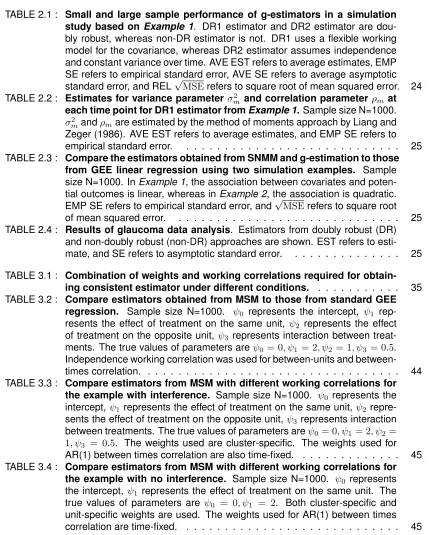
TABLE 2.1 : Small and large sample performance of g-estimators in a simulation study based onExample 1. DR1 estimator and DR2 estimator are dou-bly robust, whereas non-DR estimator is not. DR1 uses a flexible working model for the covariance, whereas DR2 estimator assumes independence and constant variance over time. AVE EST refers to average estimates, EMP SE refers to empirical standard error, AVE SE refers to average asymptotic standard error, and REL√MSErefers to square root of mean squared error. 24 TABLE 2.2 : Estimates for variance parameterσ2
m and correlation parameterρm at
each time point for DR1 estimator fromExample 1.Sample size N=1000.
σ2
mandρmare estimated by the method of moments approach by Liang and Zeger (1986). AVE EST refers to average estimates, and EMP SE refers to empirical standard error. . . 25 TABLE 2.3 : Compare the estimators obtained from SNMM and g-estimation to those
from GEE linear regression using two simulation examples. Sample size N=1000. InExample 1, the association between covariates and poten-tial outcomes is linear, whereas inExample 2, the association is quadratic. EMP SE refers to empirical standard error, and√MSErefers to square root of mean squared error. . . 25 TABLE 2.4 : Results of glaucoma data analysis. Estimators from doubly robust (DR)
and non-doubly robust (non-DR) approaches are shown. EST refers to esti-mate, and SE refers to asymptotic standard error. . . 25
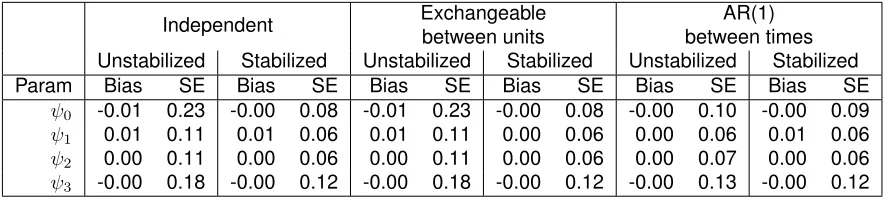
TABLE 3.1 : Combination of weights and working correlations required for obtain-ing consistent estimator under different conditions. . . . 35 TABLE 3.2 : Compare estimators obtained from MSM to those from standard GEE
regression. Sample size N=1000. ψ0 represents the intercept, ψ1 rep-resents the effect of treatment on the same unit, ψ2 represents the effect of treatment on the opposite unit,ψ3 represents interaction between treat-ments. The true values of parameters areψ0= 0, ψ1= 2, ψ2 = 1, ψ3= 0.5. Independence working correlation was used for units and between-times correlation. . . 44 TABLE 3.3 : Compare estimators from MSM with different working correlations for
the example with interference. Sample size N=1000. ψ0 represents the intercept,ψ1represents the effect of treatment on the same unit,ψ2 repre-sents the effect of treatment on the opposite unit,ψ3represents interaction between treatments. The true values of parameters areψ0= 0, ψ1= 2, ψ2=
1, ψ3 = 0.5. The weights used are cluster-specific. The weights used for AR(1) between times correlation are also time-fixed. . . 45 TABLE 3.4 : Compare estimators from MSM with different working correlations for
TABLE 3.5 : Analysis of results from glaucoma study using GEE, MSM with un-stabilized and un-stabilized IPW respectively. ψ0 represents the intercept,
ψ1 represents the effect of beta-blocker only on the same unit, ψ2 repre-sents the difference between prostaglandin analogue and beta blocker on the same unit, ψ3 represents the difference between combined treatment and beta blocker on the same unit. The weights used are time-specific and unit-specific. . . 45
TABLE 4.1 : Results for the example with intermittent missingness in non-outcome covariates. Average estimates (EST), empirical standard errors (SE), av-erage asymptotic standard errors (ASE) and95% coverage probability are listed for the correctly specified treatment as well as the mis-specified treat-ment model that omitsCm−1. . . 53 TABLE 4.2 : Results for the example with intermittent missingness in covariates
and outcome. Average estimates (EST), empirical standard errors (SE), average asymptotic standard errors (ASE) and95%coverage probability are listed for unweighted estimating equation (No IPW), our approach with un-stabilized (IPW) or un-stabilized (Stabilized IPW) weights, monotone censoring approach with unstabilized (Monotone IPW) or stabilized (Monotone stabi-lized IPW) weights withK= 5orK= 7. . . 58 TABLE 4.3 : Results for the example with intermittent missingness in covariates
and outcome, in which if weights are greater than 200, they are trun-cated at 200. . . . 58 TABLE 4.4 : Results from analyzing MAPP data . . . 60
TABLE B.1 : Compare estimators from MSM with different working correlations for the example with interference. Sample size N=1000. ψ0 represents the intercept,ψ1represents the effect of treatment on the same unit,ψ2 repre-sents the effect of treatment on the opposite unit,ψ3represents interaction between treatments. The true values of parameters areψ0= 0, ψ1= 2, ψ2=
1, ψ3 = 0.5. The weights used are cluster-specific. The weights used for AR(1) between times correlation are also time-fixed. . . 74 TABLE B.2 : Compare estimators from MSM with different working correlations for
LIST OF ILLUSTRATIONS
FIGURE 2.1 : DAG for an example with single time point . . . 7
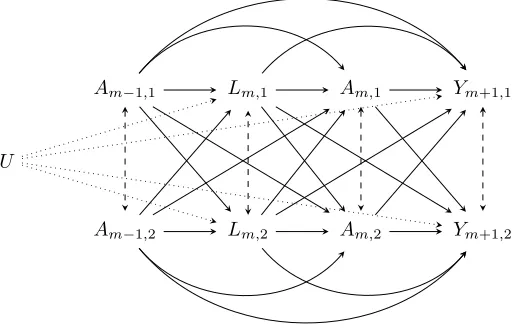
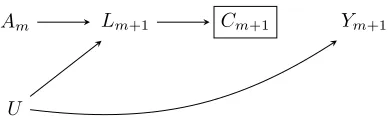
FIGURE 2.2 : Partial DAG for an example with time-varying treatments . . . 12
FIGURE 3.1 : Directed acyclic graph (DAG) for a single time point example. . . 28
FIGURE 3.2 : Partial DAG for an example with time-varying treatments. . . 32
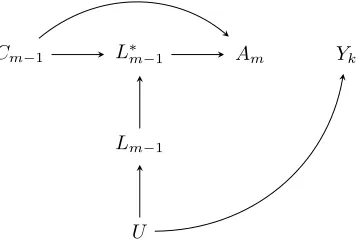
FIGURE 4.1 : Confounding due to missing indicator Scenario 1 . . . 50
FIGURE 4.2 : Confounding due to missing indicator Scenario 2 . . . 50
CHAPTER 1
I
NTRODUCTION1.1. Background
In assessing the efficacy of a time-varying treatment Marginal Structural Models (MSMs) and
Struc-tural Nested Models (SNMs) are useful in dealing with confounding by variables affected by earlier
treatments. MSMs model the joint effects of treatment on the marginal mean of the potential
out-come. There are two types of SNMs: (1) structural nested mean models (SNMMs) model the joint
effect of treatment on the mean of the outcome conditional on the treatment and covariate history,
and (2) structural nested distribution models (SNDMs) model the joint effect of treatment on the
entire distribution of the outcome conditional on the treatment and covariate history. Compared to
MSMs, SNMs have the advantage of being able to model effect modification by time-varying
co-variates, whereas MSMs can only model effect modification by baseline covariates. SNMs are also
useful for modeling the effect of dynamic treatment regimes, in which the treatment plan changes
according to observed patient characteristics during the treatment course, in contrast to static
treat-ment regimes, in which the entire treattreat-ment schedule is known at the time of initiation. Another
advantage of SNMs is that they can work under conditions where certain assumptions fail. For
ex-ample, SNMs may be fit under instrumental variable assumptions when there is unmeasured
con-founding. Despite these advantages of SNMs, MSMs are more widely used compared to SNMs,
partly because the models are easier to understand and can be implemented with standard
soft-ware.
SNMs and MSMs often consider treatment allocation and repeated measures at the individual
level. These models have seldom been used for clustered observations. A common example for
clustered outcomes is eye disease treatment, where two eyes of a given subject form a cluster.
Other examples include infectious diseases among members of the same household etc. Rubin
(1986) calls a situation where “the observation on one unit is unaffected by the particular treatment
assignment to the other units” the “stable unit-treatment value assumption (SUTVA)” [19]. If we
consider each eye as a separate unit for treatment, the SUTVA assumption may be violated. Under
the same subject. If the treatments are binary, each eye will have not only two but four possible
treatments, depending on the treatment received by both eyes. VanderWeele (2008) has discussed
SUTVA in the context of neighborhood effects [26]. To our knowledge, the only published work in
this category is from Brumback et al. (2014), where SNMs and an instrumental variable approach
were used to estimate the effect of cluster-level treatment on unit-level outcomes in the presence
of unmeasured confounding [1].
In observational longitudinal studies, subjects are often observed at random times with
subject-specific intervals between consecutive visits. A conventional approach is to convert continuous
time to discrete time points. This will result in intermittent missing observations for many subjects.
In other cases, subjects may miss prescheduled visits intermittently depending on their condition
throughout the study. Most of the previous literature focuses on dealing with monotone censoring.
One approach to analyzing intermittent missing data is to artificially censor the data as
mono-tone and use methods appropriate for monomono-tone data [10]. However, this approach will result in
significant loss of information, especially if many subjects miss an early visit but later return. Time
varying treatments and dynamic observation schedules have been considered with regard to MSMs
by Hern´an et al. (2009) [6]. Most of their work is based on the assumption that treatment changes only occur at observed times. They used inverse probability weighting to adjust for selection bias
due to the missing outcomes. We consider the implications of dynamic treatment schedules for
es-timating parameters in SNMMs. Like Herna´n et al. (2009), we will focus on the setting of dynamic observation plan, where a subject’s observation times depend on his treatment and covariate
his-tory.
1.2. Novel Developments
In this dissertation, we develop statistical methods for the design and analysis of longitudinal
ob-servational data with clustered observations or intermittent missing observations. The dissertation
consists of three parts. In Chapter 2, we extend SNMMs to clustered observations with time-varying
confounding and treatments. This is a generalization of Brumback et al. (2014)’s method [1]. We
demonstrate how to formulate models with both cluster- and unit-level treatments and show how
to derive semiparametric estimators of parameters in such models. For unit-level treatments, we
The properties of the estimators are evaluated through simulations and compared with the
conven-tional GEE regression method for clustered outcomes. To illustrate our methods, we use data from
the treatment arm of a glaucoma clinical trial to compare the effectiveness of two commonly used
ocular hypertension medications.
In Chapter 3, we extend MSMs to clustered observations with time-varying confounding and
treat-ments. Again we demonstrate how to formulate models with both cluster- and unit-level treatments
and show how to derive semiparametric estimators of parameters in such models. We consider
cases where there is presence or absence of interference. We also consider using unit-specific
inverse probability weights (IPWs) and certain working correlation structures to improve the
effi-ciency of estimators under specified conditions. We use the same glaucoma clinical trial data for
illustration and compare the results from the SNMM approach.
In Chapter 4, we extend SNMMs to situations with intermittent missing observations. We show
that under assumptions of last observation carried forward treatment and ignorable treatment the
regular SNMMs can be used for situations where non-outcome covariates are missing intermittently.
We further consider intermittently missing outcomes and use an inverse probability of weighting
approach. Whereas missing data methods often censor subjects after the first missed visit, we
used a method that does not require artificially censoring the data, but requires a stricter MAR
assumption. Results from our simulation studies show that the estimators are consistent and show
some advantage in efficiency in comparison to the monotone censoring approach. To illustrate our
method, we use data from a study of chronic pelvic pain to estimate the effect of non-steroidal
CHAPTER 2
S
TRUCTURAL NESTED MEAN MODELS TO ESTIMATE THE EFFECTS OFTIME
-
VARYING TREATMENTS ON CLUSTERED OUTCOMES2.1. Introduction
Structural nested models (SNMs) are a class of models that is useful for estimating the causal
ef-fect of a time-varying treatment in the presence of time-varying confounding [12]. In some studies,
treatments are affected by covariates at earlier time points and subsequently affect covariates at
later time points. Confounding that arises in such situations cannot be properly controlled for by
conventional regression methods. However, such problems can be solved by several other
meth-ods, including marginal structural models (MSMs) and SNMs. Compared to MSMs, SNMs have the
advantage of being able to model effect modification by time-varying covariates, whereas MSMs
can only model effect modification by baseline covariates. SNMs are also useful for modeling the
effect of dynamic treatment regimes, in which the treatment plan changes according to observed
patient characteristics during the treatment course, in addition to static treatment regimes, in which
the entire treatment schedule is known at the time of initiation. Another advantage of SNMs is that
they can work under conditions where certain assumptions fail. For example, SNMs may be fit
un-der instrumental variable assumptions when there is no unmeasured confounding. There are two
types of SNMs: (1) structural nested mean models (SNMMs) model the joint effect of treatments
on the mean of the outcome conditional on the treatment and covariate history, and (2) structural
nested distribution models (SNDMs) model the joint effect of treatments on the entire distribution of
the outcome conditional on the treatment and covariate history. So far, SNMs have seldom been
used for clustered observations. Brumback et al. (2014) used SNMs and an instrumental variable
approach to estimate the effect of cluster-level treatment on unit-level outcomes in the presence
of unmeasured confounding [1]. This paper generalizes previous work by formulating SNMMs for
clustered observations with time-varying confounding and treatments. The formulation applies to
both unit-level and cluster-level treatments.
A motivating example is the study of eye disease treatment, where two eyes of a given subject form
subject-specific characteristics. Rubin (1986) calls a situation where “the observation on one unit
is unaffected by the particular treatment assignment to the other units” the “stable unit-treatment
value assumption (SUTVA)” [19]. If we consider each eye as a separate unit for treatment, the
SUTVA assumption may be violated. Under eye-specific treatment, treatment received by one
eye may affect outcomes in the other eye of the same subject. If the treatments are binary, each
eye will have not only two but four possible treatments, depending on the treatment received by
both eyes. VanderWeele (2008) has discussed the SUTVA in the context of neighborhood effects
[26]. In the ophthalmology study, treatments are eye-specific drops. Treatments, clinical covariates,
and outcomes are measured repeatedly over an extended period of time; treatments are therefore
subject to time-dependent confounding. We are interested in modeling the joint effect of a series
of treatments on a series of clustered outcomes. Other examples of clustered observations include
repeated measurements of disease symptoms on the same individual or an infectious disease
among people in the same household.
The structure of the paper is as the following: we first describe the setup for exploring causal effects
among clustered observations. We then formulate SNMMs for clustered observations in a single
time point setting and describe an efficient estimating equation. We then extend the model and
estimation to time-varying treatments and repeatedly measured outcomes. Last, the method is
evaluated using simulation studies and applied to an ophthalmology dataset.
2.2. Notation for clustered observations
We first describe the general structure of data with repeatedly measured treatments and repeatedly
measured clustered outcomes and the definition of a causal effect in such a context. The notation
is based on Robins (1994) with extension for clustered data [12]. Suppose that data is collected on
N clusters,i= 1,2, ..., N atK+ 1time points,k= 0,1, ..., K. At each time pointk, outcomes are measured fromJ units in each cluster,j= 1,2, ..., J. LetAimjdenote unit-specific treatment in the
jth unit at timemfor clusteri, andA†imdenote systemic treatment received at timemfor clusteri. LetLijmdenote unit-specific covariates in thejth unit, andL†imdenote cluster-specific covariates measured at timemfor clusteri.Yimjdenotes the observed outcome injth unit measured at time
clusteri.Yim={Yim1, ..., YimJ}is all observed outcomes measured at timemin clusteri. We use overbars to denote the history of a variable; thus, A¯im ={Ai0,Ai1, ...,Aim} is treatment history through timem in cluster i, and L¯im = {Li0,Li1, ...,Lim} is covariate history through time min clusteri. We use underbars to denote the future of a variable; thus,Yi,m={Yi,m,Yi,m+1, ...,Yi,K} is outcomes observed since timemin clusteri. If unstated, the notation in formulation and figures is for one cluster and therefore omits the subscriptifor cluster. The subscriptmfor time is omitted in examples with single time point. UnboldAim, Lim, Yimrepresent scalar treatment, covariate and outcome, respectively for subjecti at timem in situations without clustered outcomes, which we use to reference previous literature on SNMMs.
To define causal effects and structural models, we will use potential or counterfactual outcomes
that are outcomes that would be observed were the subject to receive a certain treatment [20]. We
presume that treatments at timemdo not affect outcomes prior to timem. Potential outcomes are considered under a regime, which is defined as a sequential set of treatments¯aK ={a1, ...,aK}. In formulating SNMs, the regime(¯am,0), the counterfactual treatment regime that agrees witha¯m through timemand is0thereafter, is of particular interest. LetY¯am,0
i,k =
n
Ya¯m,0
ik1 , ..., Y ¯ am,0
ikJ
o
denote
the potential outcome in clusterithat would be observed at timekwherek > mwere the cluster to receive treatment historya¯mthrough timemand0thereafter. LetY¯ai,m+1m,0 ={Y
¯ am,0
i,m+1, ...,Y ¯ am,0
i,K }
denote the series of potential outcomes in clusterithat would be observed after timem. Causal effects can be defined as contrasts of potential outcomes for the same group of subjects under
different treatment regimes. For instance,Y¯aK
i,m−Y ¯ a0
K
i,m, where¯aK 6= ¯a0K, denotes the causal effect of treatment¯aK versus¯a0K on a subject’s outcome at timem.
2.3. Structural models and estimation for point treatments in clustered
observa-tions
Prior to describing the formulation of SNMMs for clustered observations, we review the general
concepts of SNMMs for nonclustered outcomes. SNMMs model the contrast between conditional
means of potential outcomesγm∗(¯lm,¯am) =g
EY¯am,0
m+1|L¯m= ¯lm,A¯m= ¯am
−
gEYa¯m−1,0
m+1 |L¯m= ¯lm,A¯m= ¯am
the means of subsequent potential outcomes after having removed the effect of all later treatments,
a process called “blipping down” [12]. A functionγ∗
m(¯lm,¯am)that defines such a contrast is called a blip function. It can be parameterized with finite dimensional parameterψ.
We first formulate SNMMs for clustered outcomes in a single time point example, where treatments,
covariates and outcomes are measured at one time point only. In this example, we assume that
each cluster consists of two units, and consider unit-level treatment only. The results can be easily
generalized to situations with more than two units or with cluster-level treatment. A directed acyclic
graph (DAG) is shown in Figure 2.1. The subscript here refers to unit number. L={L1, L2, L†}is the set of cluster- and unit-level measured confounder for the effect of joint treatmentA={A1, A2} on clustered outcomesY = {Y1, Y2}. We assume that there is no unmeasured confounding be-tweenAandY. Dashed double arrows represent possible unmeasured confounding withinL,Aor
Ybetween units.Uand dotted arrows represent possible unmeasured confounding betweenLand
Y. LetYa
j =Y
aj,aj0
j denote the potential outcome injth unit, whereaj andaj0 refer to unit-specific
treatment to the same unit and the other within-cluster unit respectively,{j, j0}={1,2},{2,1}.
L†
L1
L2
A1
A2
Y1
Y2
U
Figure 2.1: DAG for an example with single time point
2.3.1. Structural nested mean models
a contrast between means of potential outcomes under joint treatment versus means of potential
outcomes under no treatment as seen in (1). If there is an additional binary systemic treatmentA†,
the combined treatment{A†, A1, A2}will contain8levels.
E
Ya1,a2
1
Ya2,a1
2
L=l,A=a
−E
Y10,0 Y20,0
L=l,A=a
=
γ1∗(a1, a2,l)
γ2∗(a2, a1,l)
. (2.1)
The vector-valued blip functionγ∗(.)models the effect of removing joint treatmentafrom both unit-level outcomes within the cluster. It can be parameterized with the finite dimensional parameterψ
to form
γ∗1(a1, a2,l;ψ)
γ∗2(a2, a1,l;ψ)
. (2.2)
As an example, let
γ1∗(a1, a2, l;ψ)
γ2∗(a2, a1, l;ψ)
=
ψ1a1+ψ2a2+ψ3a1a2
ψ10a2+ψ20a1+ψ30a2a1
. (2.3)
In (2.3), ψ ∈ R6; ψ
1 andψ10 represent the effect of unit-specific treatment on the outcome in the
same unit, ψ2 andψ20 represent the effect of treatment on the outcome in the opposite unit, ψ3
andψ30 represent the interaction between treatments in different units. This example imposes the
assumption that effect modification by covariates is absent.
The dimension of causal parameters will increase sharply with increase in the number of units per
cluster. Some additional model assumptions are considered to reduce the dimension of causal
parameters. For the ophthalmology example, it is reasonable to assume symmetry between two
eyes, namely the effect of the joint treatment is the same for each unit. In (2.3), the symmetry
assumption implies ψ1 = ψ10, ψ2 = ψ20, ψ3 = ψ30. In some cases, we may want to assume no
interference, namely unit-specific treatment on one unit has no effect on outcomes in the other
units of the same cluster. With two units per cluster, it refers to
Yaj,aj0
j =Y
aj,0
In (2.3), the no interference assumption impliesψ2=ψ3=ψ20 =ψ30 = 0.
2.3.2. Identifiability
A1-A3 below are sufficient assumptions to identify the causal effect of joint treatmentarelative to
no treatment from observed data and therefore the causal parameterψ. A1. Consistency. IfA=afor a given cluster, thenYa=Yfor that cluster.
A2. Conditional exchangeability. Y0,0⊥A|L=l.
A3. Positivity. IffL(l)>0, thenfA|L(a|l)>0for all treatmentsa.
In the presence of interference between units, potential outcomes like Yaj
j are not well-defined.
However, under no interference, it is reasonable to relax A1 and define consistency under the
standard assumption for non-clustered data: ifAj = aj for a given unit j, thenY aj
j = Yj for that unit. A3 can be relaxed in SNMMs such that the assumption does not need to hold for allLwith
fL(l)>0.
2.3.3. Alternative modeling
An alternative way of modeling the joint effect of{a1, a2} is to use the concepts in SNMMs with time-varying treatments and sequentially remove the effect of each unit-specific treatment. In the
following example, the effect of treatment on the opposite unit is removed first, followed by the effect
of treatment on the same unit.
1. Remove the effect of treatment on the opposite unitaj0:
EYaj,aj0
j |L=l,A=a
−EYaj,0
j |L=l,A=a
=γ1,j∗ (aj0,l, aj) (2.4a)
2. Remove the effect of treatment on the same unitaj:
EYaj,0
j |L=l, Aj=aj
−EYj0,0|L=l, Aj=aj
For example, the blip functions in (2.4a) and (2.4b) can be parameterized as γ∗1,j(aj0, l, aj;ψ) =
ψ2aj0+ψ3aj0ajandγ2,j∗ (aj,l;ψ) =ψ1aj respectively.
Assumptions A1 and A3 plus a sequential ignorability assumption are sufficient to identify the
causal effect in (2.4a) and (2.4b). Specifically, the sequential ignorability assumption states that
Yaj,0
j ⊥ Aj0|L, Aj andYj0,0 ⊥ Aj|L. Testing for no interference under this model is equivalent to
testing whether the blip function in (2.4a) equals 0. Since the entire covariate history for the
clus-ter is conditioned on in the sequential blipping down, this approach will not cause any additional
collapsibility problem under logit link, if the sequential ignorability assumption holds; otherwise
re-peated averaging overAj0 is required. However, sinceajandaj0 are simultaneous treatments, the
order of blipping down is arbitrary. Parameters from different orders of blipping down have different
interpretations. For this reason, the approach in (2.1) is used for the rest of the paper.
2.3.4. Estimation
Robins (1994) has derived a class of estimating equations for parameters of SNMMs based on
semiparametric theory [12]. He defined Hk(ψ) = Yk −Pkl=0−1γl,k∗ L¯l,A¯l;ψ as the fully blipped down outcome at timek, and H(m) = [H
m+1(ψ), Hm+2(ψ), ...., HK(ψ)]T as the vector of blipped down outcomes after timem, wherem= 0, ..., K−1. Under the sequential ignorability assumption,
E H(m)|L¯m,A¯m
=E H(m)|L¯m,A¯m−1
.H˙(m)is defined asH˙(m)=H(m)−E H(m)|L¯m,A¯m−1
.
The efficient estimating function, known as the efficient score [25], under general settings involves
complex recursive expressions, but under the assumption that
E HkHj|L¯m,A¯m
=E HkHj|L¯m,A¯m−1
, (2.5)
fork > m, j > m, m= 0, ..., K−1, the efficient score can be simplified as:
Sψef f =
N
X
i=1 K−1
X
m=0
"
E
(
∂H˙i(m) ∂ψT
¯
Lim,A¯im
)
−E
(
∂H˙i(m) ∂ψT
¯
Lim,A¯i,m−1
)#
·V arH˙i(m)|L¯im,A¯i,m−1
−1
·H˙i(m)
(2.6)
By setting (2.6) to 0 and solving the estimating equation, one can obtain an efficient estimator for
(2.6)in terms of the partially blipped down outcomeUmwith removal of the effect of treatments from time monwards [27]. Specifically, Um is a vector with elementsUm,k = Yk −P
k−1
l=mγl,k∗ L¯l,A¯l
,
for k = m+ 1, ..., K. Um mimics the potential outcomes in the sense that E Um|Lm, Am
=
EYam−1,0
m+1 |Lm, Am
. The alternative expression is:
Sψef f =
N
X
i=1 K−1
X m=0 E ∂Uim ∂ψT ¯
Lim,A¯im
−E ∂Uim ∂ψT ¯
Lim,A¯i,m−1
·V ar Uim|L¯im,A¯i,m−1)
−1
·
Uim−E Uim|L¯im,A¯i,m−1 (2.7)
The theory for SNMMs can be directly applied to situations with clustered observations. We first
construct blipped down outcomesU. For a single time point example with bivariate outcomes, they
can be written as
U= Y1 Y2 −
γ1∗(A1, A2,L;ψ)
γ2∗(A2, A1,L;ψ)
.
The following is a parameterized example for blip function under the symmetry assumption:
γ1∗(a1, a2,l;ψ)
γ2∗(a2, a1,l;ψ)
=
ψ1a1+ψ2a2+ψ3a1a2
ψ1a2+ψ2a1+ψ3a2a1
(2.8)
Based on (2.7), the efficient score for a single time point example can be written as
Sψef f =
N
X
i=1
∂U
i
∂ψT −E
∂U i ∂ψT Li
·V ar(Ui|Li)−1· {Ui−E(Ui|Li)}. (2.9)
For the example in (2.8), ∂U
∂ψT has the following expression:
∂U
∂ψT =
A1 A2
A2 A1
A1A2 A2A1
.
E∂ψ∂UT|L
is based on a model for treatment. If treatment probabilities are unknown, a multinomial
joint treatment. The estimating equation in (2.9) is doubly robust, because the estimator forψwill be consistent if either the model forE∂U
∂ψT|L
or the model forE(U|L)is correctly specified. When both are correctly specified and the conditional varianceV ar(U|L)is also correctly specified, the estimator achieves the semiparametric efficiency bound for model (2.2) if assumption (2.5) is true.
2.4. Structural models and estimation for time-varying treatments in clustered
ob-servations
We next extend the method to time-varying treatments. Suppose that treatments and covariates
are measured repeatedly at timesm = 0, ..., K−1, and outcomes are measured only at the last time pointK. Figure 2.2 is a partial DAG that shows the effect of a joint treatment from two arbitrary time pointsm−1andmon the clustered outcomes at timem+ 1. The cluster-specific covariate
L†m is omitted from the graph for simplicity. In this example,Lm = {Lm,1, Lm,2}is a time-varying confounder for the effect of Am = {Am,1, Am,2} on Y = {Y1, Y2}. Therefore, they need to be controlled for in analysis. Lm, however, also mediates the effect of earlier treatmentsAm−1onY,
which suggests that analysis should not control forLm. In addition,Lmis a collider on the pathway
fromAm−1toY. Controlling forLmwill thus induce bias in estimating the causal effect. For these
reasons, conventional regression methods will fail in the presence of time-varying confounding [14].
Lm,1
Lm,2
Am,1
Am,2
Ym+1,1
Ym+1,2
Am−1,1
Am−1,2
U
2.4.1. Structural nested mean models
In the SNMM below, the blip function vectorγm∗(.)models the effect of removing joint treatmentam at timemfrom both outcomes, after having removed the effect of all subsequent treatments.
E
Y¯am,0
1
Y¯am,0
2
¯
Lm= ¯lm,A¯m= ¯am
−E
Y¯am−1,0
1
Y¯am−1,0
2
¯
Lm= ¯lm,A¯m= ¯am
= γ∗
m,1(¯am,¯lm;ψ)
γm,2∗ (¯am,¯lm;ψ)
.
(2.10)
For repeatedly measured outcomes, (2.10) can be further generalized to
EYa¯m,0
m+1|L¯m= ¯lm,A¯m= ¯am
−EYa¯m−1,0
m+1 |L¯m= ¯lm,A¯m= ¯am
=γ∗
m(¯am,
¯l
m;ψ), (2.11)
where γ∗
m is a vector with components γ ∗
m,k(¯am,¯lm;ψ) that models the effect of removing joint treatment at timem from both outcomes at timek, fork = m+ 1, ..., K. The sequential ignora-bility assumption is required to identify the contrast in (2.10) and (2.11). It is a generalization of
assumption A2 to sequential treatments as shown below:
Y¯am−1,0
m+1 ⊥Am|A¯m−1= ¯am−1,L¯m= ¯lm. A parameterized example for (2.10) is shown below:
γ∗m,1(¯am,¯lm;ψ)
γ∗m,2(¯am,¯lm;ψ)
=
ψm,1am,1+ψm,2am,2+ψm,3am,1am,2
ψm,10am,2+ψm,20am,1+ψm,30am,2am,1
. (2.12)
Theψparameters in (2.12) have similar interpretation as those in example (2.3), except that they contain subscript m to indicate the effect of joint treatment at time m is time-specific. A more parsimonious example is shown below:
γ∗m,1(¯am,¯lm;ψ)
γ∗m,2(¯am,¯lm;ψ)
=
ψ1am,1+ψ2am,2+ψ3am,1am,2
ψ1am,2+ψ2am,1+ψ3am,2am,1
. (2.13)
Model (2.13) makes the symmetry assumption and also assumes the effect of treatments is the
interpreted as effect of treatment per unit time.
2.4.2. Estimation
Similar to the single time point case, we first construct a series of partially blipped down outcomes
Umfor each timem:
Um=
Y1 Y2 −
K−1
X
l=m
γl,1∗ (¯al,¯ll;ψ)
γl,2∗ (¯al,¯ll;ψ)
.
The partially blipped down outcomes mimic the potential outcomes Ya¯m−1,0 in the sense that
E Um|L¯m,A¯m = E Y¯am−1,0|L¯m,A¯m. For repeatedly measured outcomes, Um is a vector with components
Um,k=
Yk,1 Yk,2 −
k−1
X
l=m
γl,k,1∗ (¯al,¯ll;ψ)
γl,k,2∗ (¯al,¯ll;ψ)
,
fork=m+ 1, ..., K.
For time-varying treatments, we suggest using the following score:
Sψ= N
X
i=1 K−1
X
m=0
"
∂γm∗ L¯im,A¯im;ψ
∂ψT −E
(
∂γm∗ L¯im,A¯im;ψ
∂ψT ¯
Lim,A¯i,m−1
)#
·V arUim
¯
Lim,A¯i,m−1
−1
·
Uim−E Uim|L¯im,A¯i,m−1 . (2.14)
The efficient score in (2.6) is usually too complicated to be used for situations with time-varying
treatments. The estimator from the score in (2.14) is not optimal but is reasonably efficient and
dou-bly robust. It is straightforward to show that the estimator is consistent, if for each timem, either the model for treatment,E
∂γm∗(L¯m,A¯m;ψ) ∂ψT
¯
Lm,A¯m−1
, or the model for outcome,E Um|L¯m,A¯m−1, is correctly specified. A simpler non-doubly robust estimating equation is
Sψ= N
X
i=1 K−1
X
m=0
"
∂γm∗ L¯im,A¯im;ψ
∂ψT −E
(
∂γm∗ L¯im,A¯im;ψ
∂ψT ¯
Lim,A¯i,m−1
)#
·Uim. (2.15)
For the parameterized example in (2.13), we have the following expression for ∂γ
∗
m(L¯m,A¯m;ψ)
∂ψT :
∂γ∗
m L¯m,A¯m;ψ
∂ψT =
Am,1 Am,2
Am,2 Am,1
Am,1Am,2 Am,2Am,1
. Similarly, E
∂γ∗m(L¯m,A¯m;ψ)
∂ψT
¯
Lm,A¯m−1
is based on a model for treatment. If treatment
proba-bilities are unknown, a multinomial logistic regression model can be used to estimate treatment
probability in each category of the combined treatment{Am,1, Am,2} received at timem. We can either fit a separate model for each time m, or fit a single model to pooled data from all person times. For the pooled treatment model, we may allow intercepts to be time-varying with the use of
a spline.
2.4.3. Closed form estimator
IfV ar Um|L¯m,A¯m−1
is given, and a linear working modelDmδ=dm L¯m,A¯m−1
δis assumed forE Um|L¯m,A¯m−1
, whereδ is the q−dimensional nuisance parameter in the outcome model anddmis aJ ×q matrix-valued function of
¯
Lm,A¯m−1 , and the blip function is linear inψwith
γ∗
m L¯m,A¯m
=Rmψ=rm L¯m,A¯m
, whereψisp−dimensional andrmis aJ×pmatrix-valued function of¯
Lm,A¯m , the estimator forψwill have the following closed form (based on Robins and Hern´an, 2009):
ˆ ψ ˆ δ = N X i=1 K−1
X m=0 Cim Dim T
·V arUim
¯
Lim,A¯i,m−1
−1
·
PK−1
l=mRil Dim
−1 · N X i=1 K−1
X m=0 Cim Dim T
·V arUim
¯
Lim,A¯i,m−1
−1
·Yi
, (2.16)
whereCm=P K−1 l=m
Rl−E
Rl
L¯m,A¯m−1 . A simple working model forV ar Um|L¯m,A¯m−1
isσ2I
section will examine the impact of such mis-specification on the efficiency of ψˆ. If one assumes a working model other than independence structure and constant variance, estimation will then
require iterative procedures similar to those in generalized estimating equations (GEEs). We can
start by assuming working modelσ2I
J×Jto obtain an initial estimate forψ, and then iterate between estimating parameters inV arUm
¯
Lm,A¯m−1
and estimatingψ until convergence is achieved. We adapted the method of moments approach by Liang and Zeger (1986) in estimating variance
parameters [9]. An asymptotic variance estimator forψˆmay be derived using the sandwich method, with the exact form found in Appendix A.1.
2.5. Simulation study
2.5.1. Algorithm
The data generating process is based on the likelihood for SNMMs described in Robins, Rotnitzky
and Scharfstein (2000) [17]. Details about the likelihood can be found in Appendix A.2. A simulation
study is conducted based on the setting where treatments and covariates are measured repeatedly
at timesm= 0, ..., K−1, and outcomes are measured at the last time pointKonly. The number of time points is K = 5, and the cluster size isJ = 2. The total number of clusters is varied as
N = 100or 1000. The algorithm for generating data for one cluster is shown below. It includes two examples with different covariate effects in the conditional mean of outcomes. Variables with
subscriptm=−1assume value 0.
Form= 0, ..., K−1, we generated covariatesLmfrom a multivariate normal distribution:
Lm,1 Lm,2
L†m
|L¯m−1,A¯m−1∼N3
0.3Lm−1,1+ 0.2Am−1,1
0.3Lm−1,2+ 0.2Am−1,2
0.3Lm−1+ 0.1Am−1,1+ 0.1Am−1,2
,
1 0.3 0.2 0.3 1 0.2 0.2 0.2 1
.
We generated joint treatmentAm from a multinomial logistic regression model with probabilities
pm,00,pm,10,pm,01,pm,11:
Am,1 Am,2 | ¯
where
pm,10=mlogit−1(0.5Lm,1−0.5L†m+ 0.2Am−1,1),
pm,01=mlogit−1(0.5Lm,2−0.5L†m+ 0.2Am−1,2),
pm,11=mlogit−1(0.5Lm,1+ 0.5Lm,2−L†1+ 0.2Am−1,1+ 0.2Am−1,2),
pm,00= 1−pm,01−pm,10−pm,11.
Last, observed outcomes YK were generated. We first generated the conditional mean of YK
under the sequential ignorability assumption:
E(YK|¯lK−1,¯aK−1) = K−1
X
m=0
γm∗(¯lm,¯am) + K−1
X
m=1
h
E(Yam−1,0
K |¯lm,a¯m−1)−E(Y am−1,0
K |¯lm−1,a¯m−1)
i
+E(YK0|l0).
For both simulation examples,
K−1
X
m=0
γ∗m(¯lm,¯am) = K−1
X
m=0
ψ1am,1+ψ2am,2+ψ3am,1am,2+ψ4am,1lm,1+ψ5am,1l†m
ψ1am,2+ψ2am,1+ψ3am,2am,1+ψ4am,2lm,2+ψ5am,2l†m
,
whereψ1= 2, ψ2= 0.5, ψ3= 0.2, ψ4= 0.5, ψ5=−0.2, and
E(Y0K|l0) =
2l0,1−l†0
2l0,2−l†0
.
The two examples differ in the association between covariates and the potential outcomes. In
Example 1, the association is linear:
K−1
X
m=1
h
E(Yam−1,0
K |¯lm,a¯m−1)−E(Y am−1,0
K |¯lm−1,a¯m−1)
i
=
K−1
X m=1
lm,1−lm†
lm,2−lm†
−E
lm,1−l†m
lm,2−l†m
|
¯lm−1,¯am−1
In Example 2, the association is quadratic:
K−1
X
m=1
h
E(Yam−1,0
K |¯lm,¯am−1)−E(Y am−1,0
K |¯lm−1,a¯m−1)
i
=
K−1
X m=1
(lm,1−l†m) 2
(lm,2−l†m)2
−E
(lm,1−lm† ) 2
(lm,2−lm† )2
|
¯lm−1,a¯m−1
. (2.18)
YK was generated from its conditional mean plus a bivariate normal error term:
YK=E(YK|¯lK−1,¯aK−1) +,
where the error term also follows multivariate normal distribution:
|L¯K−1,A¯K−1∼N2
0,
1 0.2 0.2 1
. 2.5.2. Results
Two doubly robust (DR) estimators (2.14) and one without the doubly robust property (2.15) were
computed using the simulated data (Example 1). For both DR estimators, we assume a linear
work-ing model forE Um|L¯m,A¯m−1
. ForV arUm
¯
Lm,A¯m−1
, we either assume an exchangeable
working modelΣm=σ2m
1 ρm
ρm 1
for each timemand denote the estimator asDR1, or a
work-ing model with independence structure and constant varianceΣ = σ2
1 0 0 1
for all time points
and denote the estimator asDR2. TheDR2estimator has the closed form described in (2.16), but not theDR1estimator. The non-DR estimator is based on the score in (2.15).
To estimate treatment probabilities, a multinomial logistic regression model is fit to pooled data
from all time points. Simulation and estimation procedures were repeated for 1000 replicates. The
results are shown in Table 1. Averaged estimates (Ave EST), empirical standard errors (Emp SE),
and averaged asymptotic standard errors (Ave SE) are provided. The square root of mean squared
Coverage of all95%confidence intervals (CI) atN = 1000show the expected range of93%−96%. At N = 100, all 95% CIs show under-coverage, likely due to the small sample size. The DR1 estimator has the worst coverage probabilities at N = 100, but it is the most efficient among the three estimators. The relative √MSE of DR2 and non-DR estimators relative to DR1 estimator ranges from1.3−1.4 and 2.4−3.4 respectively. As seen in Table 2, for the DR1 estimator, the estimates of the variance parameterσ2
mand correlation parameterρmin the conditional variance of Umdecrease over time, since more of the variance is accounted for by the increased treatment and
covariate history in the conditioning. Therefore, a flexible working model forV arUm
¯
Lm,A¯m−1
used in DR1 estimator tends to improve efficiency.
We did a comparison between g-estimation of SNMMs and standard GEE regression, a
conven-tional method to deal with clustered outcomes. We considered two simulation examples with
differ-ent covariate effects as shown in (2.17) and (2.18). Both SNMM and GEE regression approaches
were applied to the simulated data. Predictors in restricted mean models for GEE include all factors
in the blip functions as well as all covariates used in generating the conditional mean of outcomes.
An exchangeable working model is assumed for the correlation structure. The conditional mean
models used in the GEE approach in the two examples are
Yj ∼ K−1
X
m=0
Amj+ K−1
X
m=0
Amj0+
K−1
X
m=0
AmjAmj0+
K−1
X
m=0
AmjLmj+ K−1
X
m=0
AmjLm+ K−1
X
m=0
Lmj+ K−1
X
m=0
Lm,
and
Yj∼ K−1
X
m=0
Amj+ K−1
X
m=0
Amj0
K−1
X
m=0
AmjAmj0+
K−1
X
m=0
AmjLmj+ K−1
X
m=0
AmjLm+
L0j+L0+ K−1
X
m=1
L2mj+ K−1
X
m=1
L2m+ K−1
X
m=1
Lmj·Lm
respectively. The models included correctly specified predictors, but did not properly control for
time-varying confounding. The coefficients corresponding to treatment and effect modification are
shown in Table 3. As expected, the DR1 estimators from SNMMs and g-estimation are unbiased,
whereas bias is induced in GEE estimators by controlling for covariates affected by earlier
treat-ments. In the first example, the GEE estimators are in fact more efficient than the DR1 estimators.
larger standard errors compared to the DR1 estimators, and all of them are biased.
2.6. Analysis of glaucoma data
The Ocular Hypertension Treatment Study (OHTS) is a multi-center randomized trial designed to
evaluate the safety and efficacy of topical ocular hypertensive medication in delaying or preventing
primary open-angle glaucoma in subjects with elevated intra-ocular pressure (IOP) [7]. In the first
part of the study, a total of 1636 subjects with an IOP between 24 mm and 32 mm in one eye and
between 21 mm and 32 mm in the other eye were randomized to either observation or treatment
with commercially available topical ocular hypertension medication. In the second part of the study,
both the observation arm and the treatment arm received medication. The subjects were followed
up every 6 months up to 7.5 years median time in the first part of the study and up to 13 years
median time in the second part.
We use data from 817 subjects in the treatment arm to illustrate our method. In the treatment
arm, the subjects received several classes of topical ocular hypertension medications, including
beta blockers, prostaglandin analogues, topical carbonic anhydrase inhibitors and alpha 2 agonists.
Sometimes more than one type of medication was prescribed for one eye. We are interested
in comparing the effectiveness of the two most common classes, beta blockers and prostaglandin
analogues in lowering IOP. The treatment is eye-specific drops, and the outcome is IOP in each eye.
Within the treatment arm, different medications were not randomized. At each visit, clinicians made
decisions about the type and dose of medication given to each subject, although dose information
is not available in the data provided. Treatment decisions at each time may be influenced by the
subject’s treatment and covariate history. Therefore, the treatment received by these subjects is
time-varying. The subject’s IOPs at each visit are affected by earlier treatment and IOPs, and in
turn affect later treatment and IOPs. Therefore, they are likely to be time-varying confounders.
We created a categorical treatment variable containing 3 categories: beta blocker only (BB), prostaglandin
analogue only (PROST) and beta blocker plus prostaglandin analogue (BB+PROST). Since almost
all subjects received medication only to one eye at baseline, we did not model baseline treatment
but still included relevant baseline covariates in our analysis. In the follow-up visits, once a subject
received no medication or medications other than a beta blocker and prostaglandin analogue in
subjects received a beta blocker at the first follow-up visit, treatment at the first follow-up visit was
also not modeled. In this study, most subjects did not receive different treatments in each eye.
Therefore, we decide not to model the effect of treatment on the opposite eye. For each eye, we
pooled all subject-visits and fit a pooled multinomial logistic model after performing model selection
based on AIC. The resulting treatment model was
mlogit Pr[Atj =a|A¯t−1,L¯t] =α0t+α1At−1,j+α2At−1,j0 +α3IOPt,j+α4IOPt,j0+α5IOPt−1,j+
α6At−1,j·IOPt−1,j +α7RACE +α8AGE +α9IOP0,j,
wherea= 1or2refers to ‘PROST’ or ‘BB+PROST’ versus the reference category ‘BB’. The signif-icant predictors include IOP in the current time in each eye, IOP in the previous time in the same
eye, treatment in the previous time in each eye, interaction between IOP and treatment in the
pre-vious time in the same eye, as well as baseline covariates race, age and baseline IOP in the same
eye. The time-varying intercept is modeled by a spline to allow more flexibility. The causal effect is
modeled with a blip function with two parameters
EYa¯m,0
k,j |L¯m= ¯lm,A¯m= ¯am
−EY¯am−1,0
k,j |L¯m= ¯lm,A¯m
=γm,k,j∗ (¯am,¯lm;ψ)
=ψ1I(am,j = 1) +ψ2I(am,j = 2),
whereψ1 represents the effect of ‘Prost’ versus ‘BB’, and ψ2 represents the effect of ‘BB+Prost’ versus ‘BB’. Negative values refer to lowering IOP more and therefore indicate that a treatment
is beneficial relative to ‘BB’. This model makes the symmetry assumption and also assumes the
effect of treatment at each time is the same on each of the later outcomes. Both non-doubly robust
(non-DR) and doubly robust (DR) estimators were computed forψ, and the results are shown in Table 2.4.
The DR estimators have smaller standard errors compared to the non-DR estimators. Results from
the DR approach show thatψˆ1= -0.15 with p-value= 0.22, suggesting the effect of ‘PROST’ is not significantly different from that of ‘BB’, andψˆ2= 0.19 with p-value= 0.047, suggesting the combined treatment ‘BB+PROST’ is significantly worse than ‘BB’ in lowering IOP. The fact thatψˆ2is positive is counterintuitive, since we would expect a combined treatment to work better than any of the single
model.
2.7. Discussion
In this work, we have extended SNMMs to settings with clustered observations and time-varying
confounding. We formulate models that are generalized to both cluster- and unit-level treatments,
with consideration of the effect of interference. We also derive semiparametric estimators of
param-eters in those models. Our simulation study demonstrated that the estimators are consistent and
achieve reasonable efficiency in contrast to those from the conventional GEE regression approach.
We have applied the method to compare the effectiveness of two commonly used topical ocular
hypertension medication in lowering IOP using data from the treatment arm of OHTS. In the
glau-coma study, two eyes of a given subject form a cluster. At each visit, different medications were
not randomized in the treatment arm. Therefore, it is a setting with clustered observations and
time-varying confounding. The effect of prostaglandin relative to beta-blocker is not shown to be
statistically significant. The fact that the effect of the combined treatment is shown to be worse
than that of the single treatments is counterintuitive. One likely explanation is residual
confound-ing in the analysis, since clinicians usually prescribe combined treatment if the sconfound-ingle ones do not
work. Some of the residual confounding may also be due to the lack of dose information, which
limits the capacity to fairly compare the three treatment categories. The analysis can potentially be
improved by adjusting for loss to follow-up and exclusion of patients on other medications through
inverse probability weighting (IPW). In this particular dataset, the treatment did not differ between
two eyes in most subjects. Simulation study suggests it is not suitable to model interference under
such situations because of the multicollinearity problem (results not shown). However, the method
introduced can potentially be used to model interference among units within the same cluster when
treatment assignments within the cluster are more variable.
We have demonstrated and implemented our method with continuous outcomes and an identity
link in SNMMs. Our method can potentially be generalized to discrete outcomes and other link
functions. For binary outcomes and the logit link, the causal parameter in SNMMs cannot be
estimated with G-estimation [13]. Vansteelandt and Goetghebeur (2003) proposed the generalized
structural mean model to overcome this limitation [28]. The two-stage model includes a structural
outcome in the treatment arm. They also proposed an estimator that is robust to misspecification of
the nuisance association model. The causal model in their approach can be extended to clustered
observations in a similar way described in our method. Extensions of the association model to
T ab le 2.1: Small and lar g e sample perf ormance of g-estimator s in a sim ulation stud y based on Example 1 . DR1 estimator and DR2 estimator are doub ly rob ust, whereas no n-DR estimator is not. DR1 uses a fle xib le w or king model for the co v ar iance , whereas DR2 estimator assumes independence and constant v ar iance o v er time . A VE EST ref ers to a v er age estimates , EMP SE ref ers to empir ical st andard error , A VE SE ref ers to a v er age asymptotic standard error , and REL √ MSE ref ers to square root of mean squared error . DR1 Estimator DR2 Estimator non-DR estimator N P ar am T rue A v e EST Emp SE A v e SE 95% CO V √ MSE A v e EST Emp SE A v e SE 95% CO V
REL √ MSE
A v e EST Emp SE A v e SE 95% CO V
REL √ MSE
Table 2.2: Estimates for variance parameterσ2
m and correlation parameterρmat each time
point for DR1 estimator fromExample 1. Sample size N=1000.σ2
mandρmare estimated by the method of moments approach by Liang and Zeger (1986). AVE EST refers to average estimates, and EMP SE refers to empirical standard error.
ˆ
σ2m ρˆm Time (m) Ave
EST Emp
SE
Ave EST
Emp SE 0 7.76 0.38 0.51 0.03 1 6.06 0.29 0.50 0.03 2 4.37 0.19 0.47 0.03 3 2.69 0.11 0.42 0.03 4 1.03 0.03 0.19 0.03
Table 2.3: Compare the estimators obtained from SNMM and g-estimation to those from GEE linear regression using two simulation examples. Sample size N=1000. InExample 1, the association between covariates and potential outcomes is linear, whereas inExample 2, the association is quadratic. EMP SE refers to empirical standard error, and√MSE refers to square root of mean squared error.
DR1 estimator GEE estimator
Example Param True Bias Emp
SE Bias Emp
SE
REL
√
MSE
1
ψ1 2.0 -0.00 0.05 -0.08 0.03 1.69
ψ2 0.5 -0.00 0.05 0.08 0.03 1.71
ψ3 0.2 0.00 0.07 0.00 0.04 0.61
ψ4 0.5 0.00 0.03 0.00 0.02 0.56
ψ5 -0.2 -0.00 0.03 0.00 0.02 0.62
2
ψ1 2.0 -0.00 0.06 -0.17 0.10 3.07
ψ2 0.5 -0.00 0.07 -0.02 0.09 1.46
ψ3 0.2 0.00 0.09 0.07 0.13 1.58
ψ4 0.5 0.00 0.04 0.14 0.06 3.56
ψ5 -0.2 0.00 0.04 -0.31 0.06 7.25
Table 2.4: Results of glaucoma data analysis. Estimators from doubly robust (DR) and non-doubly robust (non-DR) approaches are shown. EST refers to estimate, and SE refers to asymptotic standard error.
Non-DR estimator DR estimator EST SE P-Value EST SE P-Value
ψ1 -0.27 0.34 0.21 -0.15 0.20 0.22
CHAPTER 3
M
ARGINAL STRUCTURAL MEAN MODELS TO ESTIMATE THE EFFECTS OFTIME
-
VARYING TREATMENTS ON CLUSTERED OUTCOMES3.1. Introduction
Marginal structural models (MSMs) are a class of causal models useful for estimating the effect
of time-varying treatments in the presence of time-varying confounding [15]. An MSM is structural
because it is a model for counterfactual outcomes, defined as outcomes that would be observed
were the subject to receive a certain treatment [20]. It is marginal because it describes the effect of
pre-specified treatment regimes on the marginal distribution of their corresponding counterfactual
outcomes. The parameters of an MSM can be consistently estimated by the use of inverse
proba-bility weights (IPW) that create a pseudo-population in which the distribution of confounders is the
same in the treated and the untreated. Therefore, the pseudo-population is free from confounding.
Structural nested models (SNMs) are another major class of causal models that can be used to
deal with time-varying confounding. MSMs are more widely used than SNMs, partly because the
models are easier to understand and can be implemented with standard software. However, both
methods have their respective advantages. Brumback et al. (2014) and He and Marshall (2014)
introduced SNMs for clustered observations [1] [3]. This paper focuses on formulating MSMs for
clustered observations.
A motivating example of eye disease treatment was introduced by Heitjan and Sharma (1997), He
and Joffe (2014), where two eyes of a given subject form a cluster [4] [3]. Eye-specific outcomes
from a given subject tend to be correlated because they share subject-specific characteristics.
Rubin (1986) calls a situation where “the observation on one unit is unaffected by the particular
treatment assignment to the other units the “stable unit-treatment value assumption (SUTVA)” [19].
If we consider each eye as a separate unit for treatment, the SUTVA assumption may be violated.
Under eye-specific treatment, treatment received by one eye may affect the outcome in the other
eye of the same subject. If the treatments are binary, each eye will have not only two but four
potential outcomes, depending on the treatment received by both eyes. In the ophthalmology study,