Tanya N. Beran
University of CalgaryA Construct Validity Study of Bullying
The construct validity of the Bully/Victim Questionnaire (Olweus, 1996a) as a measure of bullying was examined. Although researchers have defined bullying and reactive
aggression as two distinct types of aggression, this study examined how closely related they are using empirical data. Reports from students and teachers on measures of bullying and reactive aggression were compared for evidence of convergent validity (degree of similarity) and divergent validity (degree of difference). Comparisons of correlation coefficients indicate that convergent validity coefficients (.26 to .85) are not higher than divergent validity coefficients (.21 to .74). In addition, correlations between teachers and students differ. It is concluded that measuring bullying is problematic and that bullying and reactive aggression are highly correlated whereas teacher and student reports are not.
Cet article porte sur l’évaluation de la validité conceptuelle du questionnaire Bully/Victim (Olweus, 1996a) comme mesure de l’intimidation. Les chercheurs distinguent
l’intimidation de l’agressivité réactionnelle et les considèrent comme étant deux formes distinctes d’agressivité. Toutefois, cette étude puise dans des données empiriques pour démontrer à quel point les deux comportements sont liés. Nous avons analysé des rapports d’élèves et d’enseignants portant sur l’évaluation de l’intimidation et de l’agressivité réactionnelle pour en noter la validité concourante (degré de similarité) et la validité divergente (degré de différence). La comparaison des coefficients de corrélation a indiqué que les coefficients de validité concourante (de 0,26 à 0,85) ne sont pas plus élevés que les coefficients de validité divergente (de 0,21 à 0,74). De plus, les corrélations des enseignants diffèrent de celles des élèves. Nous concluons qu’il est difficile de mesurer l’intimidation, que l’intimidation et l’agressivité réactionnelle sont fortement corrélées, mais que les rapports des enseignants et des élèves ne le sont pas.
Concern about children’s aggression has increased dramatically in the general public (Limber & Small, 2003). Aggressive behaviors such as hitting, kicking, slapping, and name-calling are a persistent problem in schools as they interfere with the development of healthy relationships and classroom learning (Pel-legrini & Long, 2002). In the 1930s researchers identified reactive aggression as aggression exhibited as a reaction to frustration (Dollard, Doob, Miller, Mowrer, & Sears, 1939). Beginning in the 1970s, another type of aggression was identified called mobbing or bullying. It is described as repetitive negative be-haviors against another child who is unable to defend himself or herself. Researchers around the world have examined the nature of bullying based on its conceptualization as a construct that is distinct from reactive aggression. Because the aggressive behaviors studied in the domain of bullying are the same as those studied in the context of reactive aggression, it is important to determine whether the measurement of bullying is specific and not quantifying
general acts of aggression. It is the purpose of this study to examine the extent to which a frequently used measure of bullying, Olweus’ Bully/Victim Ques-tionnaire, measures bullying specifically rather than aggression more general-ly.
Aggression
Aggression includes a variety of harmful behaviors exerted either directly or indirectly against someone. They include slapping, punching, pushing, name-calling, and excluding (Day, Bream, & Pal, 1992). From the early aggression theories of Berkowitz (1963), and Dollard et al. (1939), the classification of reactive and proactive aggression was developed to study these various ag-gressive behaviors. Reactive aggression is a hostile reaction to frustration, anger, or some other negative emotion that may result from a perceived threat or provocation (Bandura, 1983; Berkowitz, 1983). For example, a student may hit another student when angry as a result of being blocked from entering a room. Dodge and colleagues have reported that children who exhibit high levels of reactive aggression are likely to experience attention problems and impulsivity, physical abuse in early childhood, general behavior problems at an early age, and peer rejection (Dodge, Lochman, Harnish, & Bates, 1997). In addition, they are likely to be diagnosed with somatization, depression, sleep disorders and personality disorders, and have social information-processing deficits such as difficulty attending to and interpreting social cues (Dodge & Coie, 1987; Dodge et al., 1997). These problems occur significantly less often among people who use proactive aggression, which is the controlled use of aggression to obtain a goal (e.g., someone stealing a car).
Bullying
Although proactive aggression was defined in the 1930s, it was not until the 1970s when a distinct form of proactive aggression was identified as mobbing, now called bullying (Olweus, 1972, 2001). Whereas reactive aggression is ex-erted in response to negative emotions such as frustration and anger, and proactive aggression is exerted as a means of gaining a goal, bullying is a type of proactive aggression whereby unprovoked aggressive behavior is used to obtain a social goal. Indeed, dominance theory has been used to explain bully-ing whereby a student shows aggression toward another student as a means of establishing leadership and dominance in the peer hierarchy (Pellegrini & Long, 2002).
both included, the time frame for measuring bullying varies, and some aggres-sive behaviors may be considered socially acceptable in the context of competi-tion (Beran, in press; Besag, 1989; Siann & Callaghan, 1993). Thus inconsistent uses of the term bullying lead to differences in how it is measured.
Another difficulty in measuring bullying is the identification of a power differential. A child targeted by a peer is placed in a subservient role as a victim; however, identifying an act of aggression as bullying or reactive aggres-sion based on the identification of a victim is problematic. Although children who are bullied by their peers are reportedly negatively affected (e.g., depressed, anxious, and lonely), these negative characteristics may have ex-isted before the onset of bullying (Hawker & Boulton, 2000; Kochenderfer-Ladd, & Kochenderfer-Ladd, 2001; Kumpulainen, Rasanen, & Puura, 2001; Sharp, Thompson, & Arora, 2000). Indeed, some studies show that children who have low self-es-teem are more likely to be targeted by aggressive peers (Egan & Perry, 1998; Matsui, Tsuzuki, KakuyaMa, & OnglatCo, 1996). Thus children cannot be identified as victims on the basis that they experience functioning difficulties, making it difficult to determine if the aggressive act was a form of bullying.
To summarize, although the purpose and definition of reactive aggression and bullying are theoretically distinct, it is unlikely that measures of aggression are able to specify them. Inconsistency in the types of bullying behaviors measured and the difficulty of identifying a victim make identification of bullying versus reactive aggression problematic.
Measuring Aggression
There are many reporting sources and approaches for quantifying or measur-ing aggression. Sources include students, teachers, researchers, parents, and peers using approaches such as naturalistic observations, interviews, question-naires, and diaries (Espelage & Swearer, 2003; Pellegrini & Bartini, 2000). One of the most often used measures of bullying is the self-report form of Olweus’ Bully/Victim Questionnaire (Schafer, Werner, & Crick, 2002). It has been used in Norway, Canada, the United States, the United Kingdom, France, Italy, and Australia to estimate the prevalence of bullying and evaluate the effectiveness of anti-bullying programs (Smith et al., 1999).
Teachers are often asked to document rates of bullying; however, they may disagree about particular aggressive behaviors they regard as bullying. Boul-ton (1997) found that half of the teachers sampled indicated that laughing at people constitutes a form of bullying and the other half did not. Moreover, Hazler, Miller, Carney, and Green (2001) found that school personnel tend mistakenly to identify bullying in situations where aggression is not repetitive (a criterion of Olweus’ definition of bullying). In the present study, I examine consistency among teachers in identifying bullying.
Teacher reports of student behaviors “traditionally … have been the most important sources of data on children’s behavioral, emotional, and social functioning” (Pepler & Craig, 1998, p. 178). The primary advantage of using teachers to rate behaviors is that they can make comparisons of individual students’ behaviors with a large number of students, and they may be less biased than parents as they will not have preexisting judgments about the students from previous years. Despite these advantages, teacher reports have limitations. From observations of children’s behaviors on the playground, Pepler and Craig (Craig & Pepler, 1995, 1997; Pepler & Craig, 1998) found that teachers are rarely present during episodes of bullying and thus may be un-aware of their occurrence. Thus teachers may underreport bullying. In the present study, their reports are compared with students’ reports to determine their relative accuracy.
In sum, the objective of the present study was to examine the construct validity of bullying. To address this objective, the convergent and divergent validity of the Bully/Victim Questionnaire as a measure of bullying versus reactive aggression was examined. Its similarity to other measures of bullying (i.e., convergent validity) was determined, followed by an examination of its distinction from other measures of reactive aggression (i.e., discriminant validity). These comparisons were then examined between teacher and student report sources. In addition, the reliability of all the measures used in the study was calculated. All this information was summarized to demonstrate how well a frequently used measure of bullying is able to measure bullying.
Method Participants
A total of 120 students (59 male, 61 female) in grades 4-6 from four public elementary schools were included in the sample. The schools are predomi-nantly Caucasian and urban and in middle-income communities. These stu-dents and their teachers completed questionnaires. Teachers were given a restaurant certificate to participate in the study.
Procedure
female students in each class up to a maximum of 10 students per class. This limit was established to manage the amount of time required from teachers because they were asked to complete two behavior rating scales for each selected student in their homeroom class. Five boys and five girls in all classes participated except for one class where six girls and four boys were selected. Their homeroom teachers were asked to complete several questionnaires for each of these students because they would have spent more time with these students than any other adults in the school.
Measures
Olweus’ Bully/Victim Questionnaire (BVQ, Olweus, 1996a). This scale consists of 10 bullying items such as “How often have you threatened or forced another student to do something he or she didn’t want to do.” Responses are listed on a Likert scale from never to several times a week. The sum of the 10 items was used as a measure of bullying. Its reliability and validity as a measure of bullying were examined in this study. It was administered to students and modified so that the same questions were administered to teachers.
Proactive/Reactive Aggression Questionnaire (PRAQ, Dodge & Coie, 1987). This questionnaire consists of the proactive (PA) and reactive scales (RA). Each scale consists of three items that are rated on a Likert scale ranging from Never to Almost Always. The sum of each set of three items is calculated to obtain proactive and reactive aggression scores, and a high score indicates a high level of aggression. The proactive scale asks, for example, “[Name of child] uses physical force to dominate,” and the reactive scale asks, “When teased [name of child] angers easily and strikes back.” Its internal consistency is adequate according to Cronbach’s Alpha coefficients of .69 to .91. Although Dodge and Coie obtained only moderate evidence of validity according to higher within-factor items than between-within-factor items, Day et al. (1992) provided stronger evidence whereby 47% of the variance was explained by the proactive aggres-sion factor, and 23% of the variance was measured by the reactive aggresaggres-sion factor. This questionnaire was developed as a rating instrument for teachers. In my study it was administered to teachers and modified for students.
Results
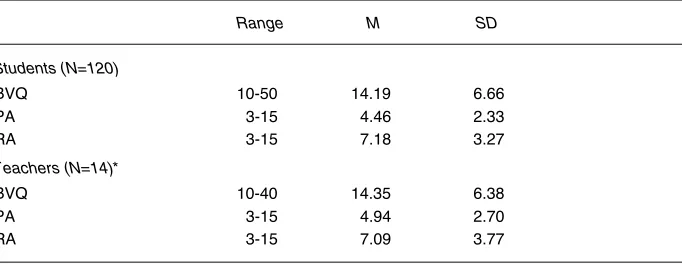
To determine whether bullying as measured by the BVQ measures bullying in contrast to reactive aggression, evidence of convergent and discriminant validity, followed by a comparison between teachers and students are presented in turn. Also, the reliability of the scales is reported. As shown in Table 1, students and teachers reported a range of scores on the bullying and reactive aggression questionnaires.
Because each teacher completed questionnaires for about 10 students, re-sponses across questionnaires for each teacher are likely to be similar. This clustering creates the problem of dependence of observations. To account for the similarity in responses for each teacher, their variance was removed by calculating partial correlation coefficients of bullying and reactive aggression. These coefficients are presented in a matrix format (see Table 2).
scale of the PRAQ are .26, .47, .66, and .85. With the exception of the .26 correlation, these correlations are moderate to high, thus providing evidence of convergent validity.
Also, if the BVQ measures bullying rather than reactive aggression, it should be more highly correlated with measures of bullying than with measures of reactive aggression. According to Table 2, this type of validity (divergent validity) was not found. The four correlations of the BVQ and the reactive scale of the PRAQ are .21, .39, .62, and .74. Because these correlations are in the moderate to high range, similar to the correlations between the BVQ and reactive aggression items, it seems that the BVQ does not measure bullying specifically, but rather general acts of aggression. Thus evidence of dis-criminant validity was not found.
Comparisons between teachers and students are examined below. The cor-relations between the two bullying measures completed by teachers are high (.85), and the two correlations between the bullying and reactive aggression scores obtained by teachers are high (.74 and .84). Similarly, the correlation between the bullying scores according to students is high (.66), and the correla-tion between bullying and reactive aggression from students is high (.62). In contrast, the nine correlations between student and teacher reports on the bullying and reactive aggression questionnaires are lower (.20 to .47). Thus when considering convergent and discriminant validity as well as the source of the reports, there is greater similarity between the two traits (bullying and reactive aggression) than between the two report sources (students and teach-ers).
Discussion
In a special issue of School Psychology Review on school bullying, Espelage and Swearer (2003) noted the problem of specifying bullying. They concluded, “This definitional issue is fundamentally related to accurate assessment of bullying and to conclusions researchers make about this complex dynamic” (p. 369). In this vein, the present study examined the distinction between bullying and reactive aggression by comparing a frequently used measure of bullying,
Table 1
Descriptive Statistics for Measures of Bullying
Range M SD
Students (N=120)
BVQ 10-50 14.19 6.66
PA 3-15 4.46 2.33
RA 3-15 7.18 3.27
Teachers (N=14)*
BVQ 10-40 14.35 6.38
PA 3-15 4.94 2.70
RA 3-15 7.09 3.77
the Bully/Victim Questionnaire (Olweus, 1996a), with other measures of bully-ing and reactive aggression.
The comparisons of correlations across traits and report sources of bullying and reactive aggression indicate that bullying and reactive aggression do not emerge as separate traits. Rather, students’ ratings of their reactive aggression and bullying were highly related. Similarly, teachers’ ratings of reactive aggres-sion and bullying were highly related. These results suggest that teachers and students do not differentiate these behaviors to a large degree. In other words, students rated as likely to react with aggression when provoked are also rated as likely to bully others (Hazler et al., 2001).
Despite earlier research that suggests disagreement among teachers about the types of aggressive behaviors that constitute bullying (Boulton, 1997; Haz-ler et al., 2001), teachers in the present study were consistent in reporting bullying. Students were also consistent in their reports. Perhaps with the in-creased attention in the media on bullying behaviors, adults and children are becoming more aware of acts that constitute bullying.
This study confirms earlier findings that measuring bullying is problematic (Smith & Levan, 1995). The constructs bullying and reactive aggression vary according to the situation in which the aggressive behaviors are demonstrated: bullying establishes leadership or dominance in the peer group, and reactive aggression is a reaction to negative emotions that probably occur in an un-pleasant situation. Although the introduction to the Bully/Victim Question-naire specifies the context for bullying, results suggest that students and teachers do not contextualize the definition of bullying when reporting aggres-sive behaviors.
Table 2
Partial Correlations Between Bullying and Aggression Across Two Measurement Sources (N=120)
Source 1 Source 2
Teacher Student
Bullying Aggression Bullying Aggression
BVQ PA RA BVQ PA RA
Source 1 Bullying
Teacher BVQ (.90)
PA .85a (.84)
Aggression
RA .74b .84b (.92)
Source 2 Bullying
Student BVQ .44a .47a .39b (.91)
PA .26a .30a .21b .66a (.81)
Aggression
RA .21b .24b .20a .62b .62b (.68)
Note. The reliability of questionnaires is shown in parentheses. The reliability coefficients, as measured by Cronbach’s Alpha, range from .68 to .92. With the exception of the reactive aggression items measured by student reports on the reactive scale of the PRAQ, the internal consistency of the measures is high.
Given the lack of measurement specificity found for the Bully/Victim Ques-tionnaire, the following suggestions are offered. The definition of bullying can be respecified to improve operationalization for measurement. Also, more training for teachers on the definition of bullying can be offered (Hazler et al., 2001). However, the question of the usefulness of the term bullying must also be considered. If teachers and students consider bullying and reactive aggression as general acts of aggression, and teachers and students rate aggressive be-haviors differently, then perhaps interventions should focus on teacher and student perspectives about aggression. For example, students may consider some acts of aggression such as dirty looks as benign, whereas teachers may regard them as a mild form of bullying.
Although this study examined one of the most often used measures of bullying in the published research, construct validity of bullying should be further examined with additional questionnaires on bullying. Although the reliability of the two questionnaires used in this study was high, it is recom-mended that longer questionnaires be developed with more items and used to test construct validity of bullying. Also, although teachers are the most likely adults to be aware that bullying is occurring based on their everyday proximity to students and bullying, other school professionals and parents should be included in future research, and their consistency in reporting bullying in comparison with teachers should be compared for evidence of interrater reliability. Considering that teachers may not witness most bullying incidents, other sources of information such as researcher observations should be used in further research. Thus although children’s own reports of bullying were in-cluded in the present study, the results must be considered as tentative as teacher reports may not be as accurate. Another limitation of this study is that motivation for aggression was not systematically examined. The Bully/Victim Questionnaire specified the function of aggression as instrumental, but the function of the aggressive behaviors in the other questionnaires was not men-tioned. By including questions about why the aggression was exerted, an empirical distinction between bullying and reactive aggression may be found (Little, Brauner, Jones, Nock, & Hawley, 2003; Little, Jones, Henrich, & Hawley, 2003).
Although the measurement of bullying in the research is fraught with difficulties, school personnel who spend considerable time attempting to iden-tify and manage children’s aggressive behaviors often use the term bullying. Considering that several scales identified as measures of bullying have been developed without definitional criteria (Bosworth, Espelage, & Simon, 1999), confusion about the meaning of bullying will continue. However, for scientific advancement, a standard definition and accurate measures of bullying are needed.
References
Bandura, A. (1983). Psychological mechanisms of aggression. In R.G. Green & E. Donnerstein (Eds.), Aggression: Theoretical and empirical views (vol. 1, pp. 11-40). New York: Academic Press. Bentley, K.M., & Li, A.K.F. (1995). Bully and victim problems in elementary schools and students’
beliefs about aggression. Canadian Journal of School Psychology, 11, 153-165.
Beran, T. (in press). Characteristics of victims of bullying: Implications for research. In F. Columbus (Ed.), New research on social perception.
Berkowitz, L. (1983). The experience of anger as a parallel process in the display of impulsive, “angry” aggression. In R.G. Green & E.I. Donnerstein (Eds.), Aggression: Theoretical and empirical views (vol. 1, pp. 103-134). New York: Academic Press.
Besag, V.E. (1989). Bullies and victims in schools. Philadelphia, PA: Open University Press. Bjorkvist, K., Lagerspetz, K.M.J., & Kaukiainen, A. (1992). Do girls manipulate and boys fight?
Developmental trends in regard to direct and indirect aggression. Aggressive Behavior, 18, 117-127.
Bosworth, K., Espelage, D.L., & Simon, T. (1999). Factors associated with bullying behavior in middle school students. Journal of Early Adolescence, 19, 341-362.
Boulton, M.J. (1995). Patterns of bully/victim problems in mixed race groups of children. Social Development, 4, 277-293.
Boulton, M.J. (1997). Teachers’ views on bullying: Definitions, attitudes and ability to cope. British Journal of Educational Psychology, 67, 223-233.
Craig, W.M., & Pepler, D.J. (1995). Peer processes in bullying and victimization: A naturalistic study. Exceptionality Education in Canada, 4, 81-95.
Craig, W.M., & Pepler, D.J. (1997). Observations of bullying and victimization on the schoolyard. Canadian Journal of School Psychology, 13, 41-59.
Day, D.M., Bream, L.A., & Pal, A. (1992). Proactive and reactive aggression: An analysis of subtypes based on teacher perceptions. Journal of Clinical Child Psychology, 21, 210-217. Dodge, K.A., & Coie, J.D. (1987). Social-information-processing factors in reactive and proactive
aggression in children’s peer groups. Journal of Personality and Social Psychology, 53, 1146-1158. Dodge, K.A., Lochman, J.E., Harnish, J.D., & Bates, J.E. (1997). Reactive and proactive aggression
in school children and psychiatrically impaired chronically assaultive youth. Journal of Abnormal Psychology, 106(1), 37-51.
Dollard, J., Doob, C.W., Miller, N.E., Mowrer, O.H., & Sears, R.R. (1939). Frustration and aggression. New Haven, CT: Yale University Press.
Egan, S.K., & Perry, D.G. (1998). Does low self-regard invite victimization? Developmental Psychology, 34, 299-309.
Espelage, D.L., & Swearer, S.M. (2003). Research on school bullying and victimization: What have we learned and where do we go from here? School Psychology Review, 32, 365-383.
Farrington, D.P. (1993). Understanding and preventing bullying. In M. Tonry & N. Morris (Eds.), Crime and justice (vol 17, pp. 381-458). Chicago, IL: University of Chicago Press.
Hawker, D.S.J., & Boulton, M.J. (2000). Twenty years’ research on peer victimization and psychosocial maladjustment: A meta-analytic review of cross-sectional studies. Journal of Child Psychology and Psychiatry and Allied Disciplines, 41, 441-455.
Hazler, R.J., Miller, D.L., Carney, J.V., & Green, S. (2001). Adult recognition of school bullying situations. Educational Research, 43, 133-146.
Kochenderfer-Ladd, B., & Ladd, G.W. (2001). Variations in peer victimization: Relations to children’s maladjustment. In J. Juvonen & S. Graham (Eds.), Peer harassment in school: The plight of the vulnerable and victimized (pp. 25-48). New York: Guilford Press.
Kumpulainen, K., Rasanen, E., & Puura, K. (2001). Psychiatric disorders and the use of mental health services among children involved in bullying. Aggressive Behavior, 27, 102-110. Limber, S.P., & Small, M.A. (2003). State laws and policies to address bullying in schools. School
Psychology Review, 32, 445-455.
Little, T.D., Brauner, J., Jones, S.M., Nock, M.K., & Hawley, P.H. (2003). Rethinking aggression: A typological examination of the functions of aggression. Merrill-Palmer Quarterly, 49, 343-369. Little, T.D., Jones, S.M., Henrich, C.C., & Hawley, P.H. (2003). Disentangling the “whys” from the
“whats” of aggressive behaviour. International Journal of Behavioural Development, 27(2), 122-133.
Matsui, T., Tsuzuki, Y.Y., Kakuyama, T., & Onglatco, M.L. (1996). Long term outcomes of early victimization by peers among Japanese male university students: Model of a vicious cycle. Psychological Reports, 79, 711-720.
Olweus, D. (1972). Personality and aggression. In J.K. Cole & D.D. Jensen (Eds.), Nebraska symposium on motivation (pp. 261-321). Lincoln, NE: University of Nebraska Press. Olweus, D. (1991). Bully/victim problems among schoolchildren: Basic facts and effects of a
school based intervention program. In D. Pepler & K. Rubin (Eds.), The development and treatment of childhood aggression (pp. 411-448). Hillsdale, NJ: Erlbaum.
Olweus, D. (1993). Bullying at school. Cambridge, MA: Blackwell.
Olweus, D. (1996b). Bullying at school: Knowledge base and an effective intervention program. In C.F. Ferris & T. Grisso (Eds.), Understanding aggressive behavior in children. Annals of the New York Academy of Sciences (vol. 794, pp. 265-276). New York: New York Academy of Sciences. Olweus, D. (2001). Peer harassment: A critical analysis and some important issues. In J. Juvonen & S. Graham (Eds.), Peer harassment in school: The plight of the vulnerable and victimized (pp. 3-48). New York: Guilford Press.
Pellegrini, A.D., & Bartini, M. (2000). An empirical comparison of methods of sampling aggression and victimization in school settings. Journal of Educational Psychology, 92, 360-366. Pellegrini, A.D., Bartini, M., & Brooks, F. (1999). School bullies, victims, and aggressive victims:
Factors relating top group affiliation and victimization in early adolescence. Journal of Educational Psychology, 9, 216-224.
Pellegrini, A.D., & Long, J.D. (2002). A longitudinal study of bullying, dominance, and victimization during the transition from primary school through secondary school. British Journal of Developmental Psychology, 20, 259-280.
Pepler, D.J., & Craig, W.M. (1998). Assessing children’s peer relationships. Child Psychology and Psychiatry Review, 3(4), 175-182.
Schafer, M., Werner, N.E., & Crick, N.R. (2002). A comparison of two approaches to the study of negative peer treatment: General victimization and bully/victim problems among German schoolchildren. British Journal of Developmental Psychology, 20, 281-306.
Sharp, S., Thompson, D., & Arora, T. (2000). How long before it hurts? An investigation into long-term bullying. School Psychology International, 21(1), 37-46.
Siann, G., & Callaghan, M. (1993). Bullying: Teachers’ views and school effects. Educational Studies, 19, 307-321.
Siann, G., Callaghan, M., Glissov, P., Lockhart, R., & Rawson, L. (1994). Who gets bullied: The effect of school, gender and ethnic group. Educational Research, 36, 123-134.
Smith, P.K., & Levan, S. (1995). Perceptions and experiences of bullying in younger pupils. British Journal of Educational Psychology, 65, 489-500.
Smith, P.K., Morita, Y., Junger-Tas, J., Olweus, D., Catalano, R., & Slee, P. (Eds.) (1999). The nature of school bullying: A cross-national perspective. London: Routledge.