Volume 11, Issue 04 (April 2015), PP.34-53
Best Fit and Selection of Probability Distribution Models for
Frequency Analysis of Extreme Mean Annual Rainfall Events
EM Masereka
1,
FAO Otieno
2, GM Ochieng
3J Snyman
4 1D.Tech. student Civil Engineering Department, Tshwane University of Technology,Pretoria, South Africa
2Prof and Vice Chancellor, Durban University of Technology, Durban, South Africa 3Prof and Head of Dept; Civil Engineering and Building, Vaal University of Technology,
Vanderbijlpark, South Africa
4Dr, J. Snyman; Senior Lecturer Dept; Civil Engineering and Building Tshwane
University of Technology; Pretoria South Africa
Abstract:- Frequency analysis of extreme low mean annual rainfall events is important to water resource planners at catchment level because mean annual rainfall is an important parameter in determining mean annual runoff. Mean annual runoff is an important input in determining surface water available for water resource infrastructure development. In order to carry out frequency analysis of extreme low mean annual rainfall events, it is necessary to identify the best fit probability distribution models (PDMs) for the frequency analysis. The primary objective of the study was to develop two model identification criteria. The first criterion was developed to identify candidate probability distribution models from which the best fit probability distribution models were identified. The second criterion was applied to select the best fit probability distribution models from the candidate models. The secondary objectives were: to apply the developed criteria to identify the candidate and best fit probability distribution models and carry out frequency analysis of extreme low mean annual rainfall events in the Sabie river catchment which is one of water deficit catchments in South Africa. Although not directly correlated, mean annual rainfall determines mean annual runoff at catchment level. Therefore frequency analysis of mean annual rainfall events is important part of estimating mean annual runoff events at catchment level. From estimated annual runoff figures water resource available at catchment level can be estimated. This makes mean annual rainfall modeling important for water resource planning and management at catchment level.
The two model identification criteria which were developed are: Candidate Model Identification Criterion (CMIC) and Least Sum of Statistics Model Identification Criterion (LSSMIC).
CMIC and LSSMIC were applied to identify candidate models and best fit models for frequency analysis of distribution of extreme low mean annual rainfall events of the 8 rainfall zones in the Sabie river catchment. The mean annual rainfall data for the period 1920-2004 obtained from the Water Research Commission of South Africa was used in this study. Points below threshold method (PBTM) was applied to obtain the samples of extreme low mean annual rainfall events from each of the 8 rainfall zones. The long term mean of 85 years of each of the 8 rainfall zones was chosen as the threshold.
The identification of the best-fit models for frequency analysis of extreme low mean annual rainfall events in each of the 8 rainfall zones was carried out in 2 stages. Stage 1 was the application of CMIC to identify candidate models. Stage 2 was the application of LSSMIC to identify the best fit models from the candidate models. The performance of CMIC and LSSMIC was assessed by application of Probability-Probability (P-P) plots.
Although P-P plot results cannot be considered completely conclusive, CMIC and LSSMIC criteria make useful tools as model selection method for frequency analysis of extreme mean annual rainfall events.
The results from the application of CMIC and LSSMIC showed that the best fit models for frequency analysis of extreme low mean annual rainfall events in the Sabie river catchment are; Log Pearson 3, Generalised Logistic and Extreme Generalised Value.
Keywords:- Best-fit probability distribution function, Candidate probability distribution functions, candidate model identification criterion (CMIC) Least sum of statistics model selection criterion (LSSMIC)
I. INTRODUCTION
A. Water resources situation in South Africa35
Management Areas will experience water deficit situation (IWMI, 1998). Although only 11 out of 19 water management areas are in situation of water resource deficit, on average the whole country can be classified as water stressed (IWMI, 1998). The annual fresh water availability is estimated to be less than 1700m³ per capita. The 1700m³ per capita is taken as the threshold or index for water stress. Prolonged periods of low rainfall periods result into low production agricultural products.
South Africa depends on surface water resources for most of its domestic, industrial and irrigation requirements (NWRS, 2003). There are no big rivers in South Africa, so the surface water resources are mainly in form of runoff. The estimated mean annual runoff under natural condition is 49,000 M m³/a and the mean annual rainfall is 465 mm (NWRS, 2003). The utilizable groundwater exploitation potential is estimated at 7500Mm3/a (NWRS, 2003). Although not directly correlated the amount of mean annual runoff depends on the amount of mean annual rainfall. Mean annual run off and mean annual rainfall are important variables for water resource planning at catchment level. In planning water resource systems at catchment level, it is necessary to consider the impacts of extreme scenarios of both mean annual rainfall and mean annual runoff.
B. Modeling the distribution of extreme mean annual rainfall events
Modeling of the distribution of extreme mean annual rainfall events is based on the assumption that these events are independent and identically distributed random events. This process is called stochastic modeling. Stochastic modeling therefore involves developing mathematical models that are applied to extrapolate and generate events based on sample data of those specific events. Numerous Stochastic models have been developed to extrapolate different aspects of hydro-meteorological events including mean annual run-off, mean annual rainfall, temperature, stream flow, groundwater, soil moisture and wind. Shamir, et al (2007) developed stochastic techniques to generate input data for modeling small to medium catchments. Furrer and Katz (2008) studied generation of extreme, stochastic rainfall events. The general practice in stochastic analysis of hydro-meteorological events including extreme mean annual rainfall has been to assume a probability distribution function that is then applied in the analysis. The focus of this study was to develop model identification criteria for selecting the best fit probability distribution functions for frequency analysis of extreme annual rainfall events and apply the developed criteria to identify the best fit models. The identified best fit models were applied in modeling the distribution of extreme mean annual rainfall events in Sabie river catchment which is one of water deficit catchments in South Africa.
C. Methods of identifying best fit probability distribution functions for extreme mean annual rainfall events. In developing magnitude – return period models for frequency analysis of extreme mean annual rainfall events like other extreme hydro meteorological events, it is necessary to identify probability distribution functions that best fit the extreme event data. The methods for identifying best fit probability distribution functions that have been applied include: maximum likelihood method (Merz and Bloschl, 2005, Willems et al., 2007), L-moments based method (Hosking et al,. 1985, Hosking 1990), Akaike information criteria (Akaike,1973) and Bayesian information criteria.(Schwarz,1978). The reliability of identifying the best fit models for hydro-meteorological frequency analysis has had some criticisms. Schulze (1989), points out that because of general short data, non homogeneity and non stationary of sample data, extrapolation beyond the record length of the sample data may give unreliable results.
Boven (2000) has outlined the below listed limitations of applying probability distribution functions in modeling extreme of hydro-meteorological events e.g. floods:-
The best fit probability distribution function of the parent events is unknown. And different probability distribution functions may give acceptable fits to the available data. Yet extrapolation based on these probability distribution functions may result in significantly different estimates of the design events. The fitted probability distribution function does not explicitly take into account any changes in the
runoff generation processes for higher magnitude event
Apart from the above criticisms a gap still remains in that a specific criteria to identify best-fit PDFs for extreme hydro-meteorological events that is universally accepted in South Africa has not been developed ( Smither and Schulze, 2003).
This gap is addressed in this study by developing two model identification criteria based on data from Sabie river catchment. Sabie river catchment is water deficit catchment.
D. Probability Distribution functions for frequency analysis of extreme hydro- meteorological events in South Africa.
of extreme hydro meteorological events in South Africa. However, Mkhandi et al. (2000) found that the Pearson Type 3 probability distribution function fitted with parameter by method of PWM to be the most appropriate distribution to use in 12 of the 15 relatively homogenous regions identified in South Africa (Smithers-J.C, 2002). Cullis et al, (2007) and Gericke (2010) have specifically recommended for further research in developing the methodologies of determining best fit PDFs for frequency analysis of extreme hydro-meteorological events in South Africa (Smithers, J.C, 2002). In this study two model identification criteria were developed to address the problem of identifying best fit probability distribution functions for frequency analysis of extreme hydro meteorological events specifically extreme mean annual rainfall events in water deficit catchments in South Africa.
E. Uncertainty associated with modeling of extreme mean annual rainfall events.
There is inherent uncertainty in modeling extreme mean annual rainfall like other extreme hydro-meteorological events. Yen et al. (1986) identified 5 classes of uncertainties. The classes are:-
Natural uncertainty due to inherent randomness of natural process
Model uncertainty due to inability of the identified model to present accurately the system’s true physical behavior
Parameter uncertainty resulting from inability to quantify accurately the model inputs and parameters Data uncertainty including measurement errors and instrument malfunctioning
Operational uncertainty that includes human factors that are not accounted for in modeling or design procedure.
Yue-Ping (2010) quotes Van Asselt (2000) to have classified uncertainty based on the modeler’s and decision makers’ views. In this case, the two classes are model outcome uncertainty and decision uncertainty. The aim of statistical modeling of extreme hydro-meteorological events is to reduce the degree of uncertainty and the risks associated to acceptable levels.
F. Limitations inherent in presently applied model selection criteria
The common practice in frequency analysis of extreme hydro meteorological events like extreme mean annual rainfall has been that the modeler chooses a model for frequency analysis or chooses a set of models from which he identifies the best-fit model to be applied for the frequency analysis (Laio etal., 2009). The following limitations have been identified in this approach which include among others the following:
Subjectivity: - This limitation arises from the fact that there is no consistent universally accepted method of choosing a model to be applied or a set of candidate models from which the best fit can be identified for frequency analysis. In other words the choice depends on the experience of the modeler, and therefore subjective;
Ambiguity: - The limitation arises from the fact that two or more models may pass the goodness-of-fit test. Which one to choose for analysis then leads to ambiguity (Burnham and Anderson, 2002); and Parsimony: - The case of parsimony is when the identified model mimics the sample data applied as
frequency analysis rather than the trend of the variable under consideration.
Jiang (2014) has further outlined limitations of presently applied model selection criteria as:
Effective sample size: This arises from the fact that the size of the sample n may not be equal to data points because of correlation.
The dimension of the model: This limitation is due to the fact that the number of parameters can affect the model fitting process.
The finite-sample performance and effectiveness of the penalty: These limitations are due to the fact that the penalty chosen may be subjective: and
The criterion of Optimality: This limitation is due to the fact that in the present criteria, practical considerations for instance economic or social factors are hardly included.
The limitation of parameter under and over fitting to models has also been cited in the current model selection criteria. An attempt was made to address the above outlined limitations in developing the two model selection criteria.
II. METHODS
Developing two model identification criteria and applying the developed criteria for frequency analysis of extreme low mean annual rainfall events in 8 rainfall zones in Sabie secondary catchment was carried out in 4 stages
37
2. Developing LSSMSC for identifying the best fit models from the candidate models. 3. Developing frequency analysis models based on the identified best fit models. 4. Developing QT-T models for each extreme low mean rainfall event sample.
A. Development process of CMIC
The development of CMIC was made in two steps. Step 1 was based on classification of PDFs and bound characteristics of upper and lower tail events of the distributions of the sample data of the extreme low mean annual rainfall. The step 2 was based on set significance levels in hypothesis testing as explained below.
1) Bounds classification and tail events characteristics of PDFs: The step 1 of development of CMIC criterion
was based on the classification of continuous probability distribution functions and bound characteristics of upper and lower tail events of the distributions of sample data. Continuous probability distribution functions can be divided into four classes: Bounded, Unbounded, Non-Negative and Advanced (MathWave, 2011). This division is based on their upper and lower tail events characteristics and their functionality. The lower and the upper tail events of the samples were applied to develop CMIC because the extreme characteristics of a sample are expressed in the spread of tail events. Probability distribution function of events in any sample of any variable has two bounds; upper and lower tail events. MathWave (2011) has proposed three possible characteristics of any tail events bound. These are; - unknown, open and closed. These characteristics were adopted.
The rationale behind the three characteristics can be illustrated as follows: Let sample M of variable X be made of events X1, X2………..Xn-1, Xn arranged in ascending order and the sample size is n. If the sample
events X1 and Xn are defined and known, then the sample comes from a parent population of frequency
distribution functions with both lower and upper tails bounded and the tails are closed. These distributions are called bounded with closed tails (MathWave, 2011). If X1 and Xn events of M are undefined with unknown
value, then the sample belongs to a parent population of frequency distribution which is unbounded with unknown or open tails. If X1 and Xn of the sample are positive, then the sample belongs to a population of
frequency distribution with end tails which can be non-negative, unknown, open or closed. The sample data that does not belong to any of the above groups, belongs to populations with advanced distribution functions (MathWave, 2011). Summary of distribution bounds is given in Table I.
Table I: Bound Classifications and Tail Characteristics of Distribution Functions Upper
Lower
Unknown Open Closed
Unknown Bounded Unbounded Non-Negative advanced
Unbounded Non-Negative Advanced
Bounded Advanced
Open Unbounded
Advanced
Unbounded Advanced
Advanced
Closed Bounded
Non-Negative Advanced
Non-Negative Advanced
Bounded Advanced
Source: (MathWave, 2011)
The CMIC criterion for identifying sample specific candidate models for frequency analysis was based on Table 1. The development of CMIC involved the following basics:
Let the sample M of variable X be made of events:
2.1
If events are arranged in ascending order, then
2.2
and if is the smallest numerical value event and forms the last event of lower tail of frequency distribution of
and is the largest numerical value event and forms the last event of upper tail of frequency distribution
of , then in this case, both upper and lower tails of are bounded, defined and closed, therefore the
candidate models for frequency analysis of are bounded and advanced with closed tails. (Table1). There are
two extreme scenarios in this method. Scenario one arises when numerical values X1 and Xn of a specific sample
candidate models. These models are bounded, unbounded, non- negative and advanced (Table I). The other scenario is when the numerical values of X1 and X n are identified and defined numerical values. In this case
bounded and advanced continuous probability distribution functions are the candidate models. The step 1 procedure led to identification of the initial candidate models for frequency analysis of low and high extreme mean rainfall sample data events.
2) Hypothesis testing and significance levels:This was step 2 of development of CMIC. For initial candidate
models identified in Step 1 for each sample data, hypothesis testing at significance levels 0.2. 0.1, 0.05, 0.02 and 0.01was carried out.
The goodness of fit tests adopted for this study were: Kolomogrov-Smirnov, Anderson-Darling and Chi-Square. The reasons for applying the 3 specific goodness of fit tests are outlined in section C.
The null and the alternative hypothesis for each test were: -
HO. The sample data was best described by the specific probability distribution function
HA. The sample data was not best described by the specific probability distribution function.
The hypothesis testing was applied to fence-off the final candidate models from the initial candidate models identified by bounds method. Models from initial candidate models that were rejected in hypothesis testing at any significance levels of 0.2, 0.1, 0.05, 0.02 and 0.01 by any of the three goodness-of-fit tests were dropped from the candidate models.
B. Development of Least Sum of the Statistic Model Identification Criterion (LSSMIC).
1) Introduction: The Least Sum of the Statistic Model Selection Criterion (LSSMSC) was developed by determining the Least Sum of Statistics of goodness of fit of the tests: - Kolmogorov-Smirnov, Anderson-Darling, and Chi-Square. The mathematical principle of each of the tests on which development of LSSMSC was based is briefly discussed below:
2) Kolmogorov-Smirnov statistic : Kolmogorov-Smirnov statistic is based on uniform law of large
numbers which is expressed in Glivenko-Cantelli Theorem (Wellener, 1977). The theorem can be summarized as:
2.3
In this case is the cumulative distribution function, is the empirical cumulative distribution function
defined by:
2.4
where are i.i.d. with distribution and
The uniformity of this law for large numbers can be explained as:
2.5
2.6
where is the empirical distribution that assigns to each .
The law of large numbers indicates that for all
According to GLivenko–Cantelli theorem (Wellner 1977), this happens uniformly over . Applications of Kolmogorov-Smirnov statistic as an index in determining the best-fit model among the candidate models was based on this theorem. The model with the Least Kolmogorov-Smirnov statistic was taken as the best fit model
for this test since as in equation 2.6.
3) Anderson-Darling statistic : Anderson-Darling statistic is an index of goodness-of–fit test. In this
case the Anderson-Darling goodness-of–fit test is the comparison of empirical distribution function assumed to be the parent distribution that is the distribution being fitted to sample data.
The hypothesis is
Ho: 2.7
39
The difference between and is defined by:-
2.8
where is a weight function
For a given variable and a distribution to be fitted to samples of events of , the random variable
has a binomial distribution with probability . (Anderson,1952). The expected value of
is and the variance is
Since the objective was to identify best fit models for frequency analysis of extreme events, the emphasis was put into upper and lower tails of the models in this case
, 2.9 (a)
then specifically for extreme mean rainfall events
= 2.9 (b)
In equation 2.8 if the mean is 0 and the variance 1, then and this leads to the
Anderson-Darling statistic:-
2.10
Equation 2.10 can be re-arranged and be written as
2.11
where and
is the ordered sample
From equation 2.10 and 2.11, it can be concluded that the model with the least value of among the candidate
models is the best fit.
4) Chi-Squared statistic : Applying as an index in determining the best-fit-model of extreme low
mean annual rainfall events from candidate models was based on the interpretation of as described in the
section that follows.
The value of indicates that the discrepancy between the empirical distribution function and
the model being fitted to sample data is in accord with the error of variance. Therefore the best fit
model among the candidate models is the one with the least discrepancy. Absolute (abs was
adopted in the study abs was defined as:
2.12(a)
2.12(b)
where number of degrees of freedom given by
is the expected frequency in the corresponding bin
is the observed frequency in each bin, Number of observations
Number of fitted observations , Number of candidate models
C. Elements of LSSMSC
To develop an alternative but simple model selection criterion, advantages of , and were
2.13
where Kolomogrov-Smirnov statistic
Anderson-Darling statistic
Absolute reduced Chi-Square
= number of models
D. Application of CMIC and LSSMIC
The developed CMIC and LSSMSC criteria were applied in Easy fit v5.5 software to identify candidate and best fit models for the frequency analysis of the extreme mean annual events. Mean annual rainfall data for the period 1920-2004 for each of the 8 rainfall zones was obtained from Water Research Commission Pretoria. Easy fit V5.5 was chosen for this study because of the following features (mathwave,2011):
1) It supports more than 50 continuous and discrete probability distribution functions. 2) It has powerful automated fitting model combined with flexible manual fitting capabilities. 3) It carries out goodness of fit tests
4) It has capability of generating random numbers 5) It is easily applied to user interface
6) There is comprehensive technical assistance from the developers (Mathwave,2011) Other scientific features which make Easy Fit V.5.5 include
o It can be applied to analyze large data sets (up to 250,000 data points)
o It includes application of advanced distributions to improve the validity of probability distribution functions
o It can be applied to calculate descriptive statistics
o It organizes data and analyzes results into project files.
1) Application of points below threshold (PBT) Model: Points below threshold (PBT) model was applied to
identify extreme low mean annual rainfall events for each of the 8 rainfall zones. For each of the 8 rainfall zones, the mean of mean annual rainfall values for the period 1920-2004 was chosen as the threshold for that particular rainfall zone. The mean rainfall events less than the threshold formed the extreme low mean annual rainfall events. The mean of mean annual rainfall values of each rainfall zone was chosen as the threshold because annual rainfall less than the mean leads to agricultural drought.
E. Development of QT-T models
Based on the identified best fit model for frequency analysis extreme low mean annual rainfall events for each of the 8 rainfall zones, QT-T models were developed. The developed QT-T models were applied to
extrapolate and estimate extreme low mean annual rainfall events for return periods of 5, 10, 25, 50, 100 and 200 years for each of the 8 rainfall zones. The methods of parameter estimations applied were: methods of moments, and maximum likelihood.
F. Assessment of performance of CMIC and LSSMIC
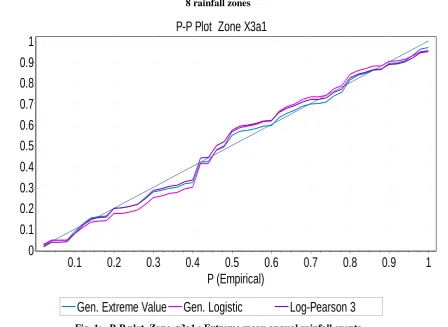
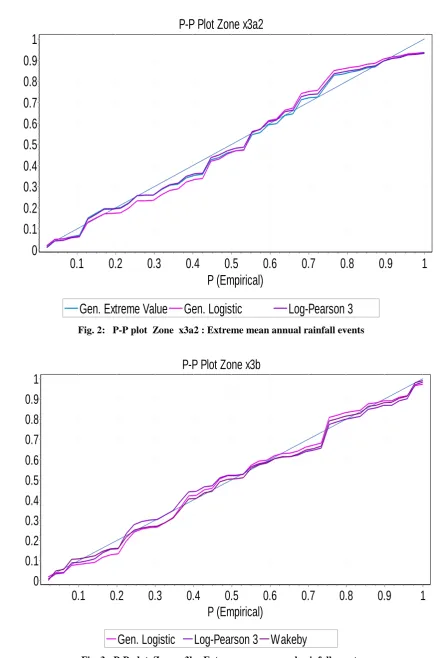
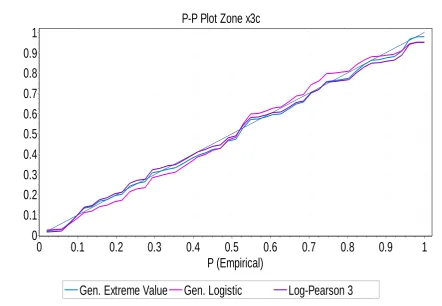
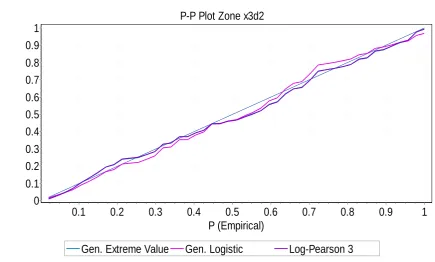
The performance of CMIC and LSSMIC as candidate and best fit models for frequency analysis of extreme mean annual rainfall events was carried out by applying probability-probability (P-P) in EasyFit 5.5 software. EasyFit 5,5 software displays reference graphic plots. The closeness of the candidate model plot to the reference graphic plots was the mode of the assessment applied. This was visual assessment.
III. RESULTS
A. Descriptive statistics of extreme low mean annual rainfall for 8 rainfall zones.
The descriptive statistics of events of the 8 samples of extreme low mean annual rainfall are presented in table II. The descriptive statistics were applied in developing QT-T models for frequency analysis of the
41
Table II: Descriptive statistics
Rainfall zones X3a1 X3a2 X3b X3c X3d1 X3d2 X3e X3f Statistic Value Value Value Value Value Value Value Value
Sample Size 50 47 49 51 51 47 52 50
Range 38.88 41.03 50.2 52.63 59.39 55.28 49.26 50.01
Mean 85.49 83.36 82.96 82.65 82.89 80.9 80.9 82.06
Variance 96.92 107.6 126.1 173.3 156.2 149.3 165.5 162.4
Std. Deviation 9.845 10.37 11.23 13.16 12.5 12.22 12.86 12.74
Coef. of Variation 0.1152 0.1245 0.1354 0.1593 0.1508 0.151 0.159 0.1553
Std. Error 1.392 1.513 1.604 1.843 1.75 1.782 1.784 1.802
Skewness -0.549 -0.460 -0.923 -1.043 -1.14 -0.865 -0.764 -0.694
Excess Kurtosis -0.454 -0.428 0.569 0.784 1.944 0.738 -0.230 -0.200
The skewness value of each of the 8 samples of extreme mean annual rainfall is less than zero ie negative. This means that the frequency distribution of events in each of these samples is left skewed. Most of the events are concentrated on the right of the mean with extreme events to the left. The excess kurtosis value of each of the 8 samples is less than 3. This means that the frequency distribution of each sample is platykurtic with peak flatter and wider than that of normal distribution.
B. Initial candidate models
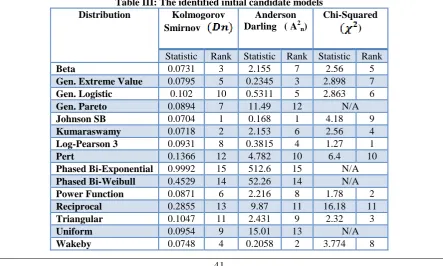
The results of applying CMIC to each of the 8 data samples of extreme low mean annual rainfall are presented in table II. To obtain these results, method described in section B was applied. The results showed that all the 8 samples had similar candidate models presented in table II.These candidate models are: Beta, Generalised Extreme Value, Generalised Logistic, Generalised Pareto, Johson SB, Kamaraswany, Log-Pearson 3, Piet, Phased Bi- Webull, Power function, Recipricol, Triangular, Uniform and Wakeby.
C. Final candidate models
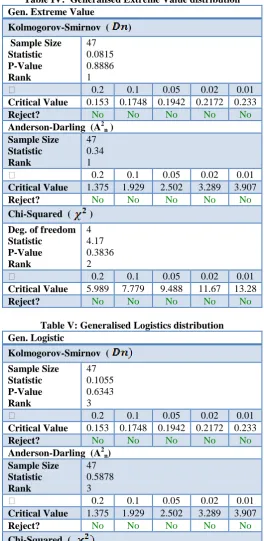
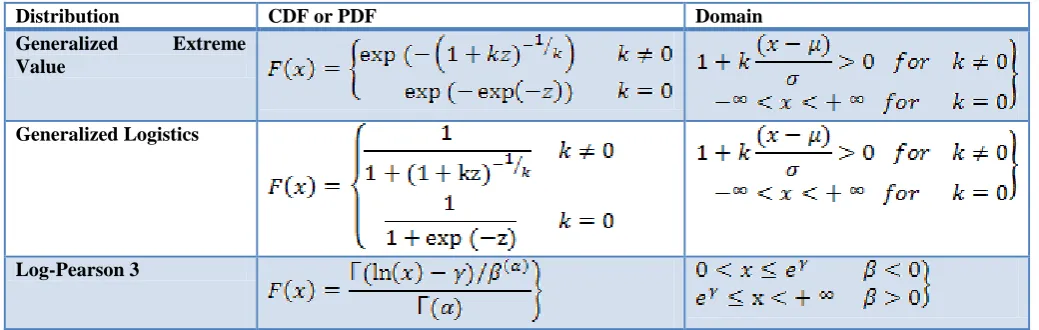
Step 2 of the CMIC described in section B was applied to sets of the initial identified candidate models given in table II. The results are presented in tables 3.3-3.5. The results showed that the final candidate models for frequency analysis of extreme low mean annual rainfall events in each of the 8 rainfall zones were: Generalised Logistic (GL), Log-Pearson 3 (LP3), and Generalised Extreme Value (GEV). The CDFs and PDFs of the identified candidate models are presented in table VII.
Generalised Logistic, Log-Pearson 3 and Generalised Extreme Value frequency analysis models were identified as the final candidate models because none of these models was rejected at significance levels; 0.2,0.1, 0.02 and 0.01 in the three goodness of fit test in any of the 8 samples of extreme low mean rainfall events. The results of goodness of fit tests are presented in tables IV-VI
Table III: The identified initial candidate models Distribution Kolmogorov
Smirnov
Anderson Darling ( A2n)
Chi-Squared )
Statistic Rank Statistic Rank Statistic Rank
Beta 0.0731 3 2.155 7 2.56 5
Gen. Extreme Value 0.0795 5 0.2345 3 2.898 7
Gen. Logistic 0.102 10 0.5311 5 2.863 6
Gen. Pareto 0.0894 7 11.49 12 N/A
Johnson SB 0.0704 1 0.168 1 4.18 9
Kumaraswamy 0.0718 2 2.153 6 2.56 4
Log-Pearson 3 0.0931 8 0.3815 4 1.27 1
Pert 0.1366 12 4.782 10 6.4 10
Phased Bi-Exponential 0.9992 15 512.6 15 N/A
Phased Bi-Weibull 0.4529 14 52.26 14 N/A
Power Function 0.0871 6 2.216 8 1.78 2
Reciprocal 0.2855 13 9.87 11 16.18 11
Triangular 0.1047 11 2.431 9 2.32 3
Uniform 0.0954 9 15.01 13 N/A
Tables IV-VI Identified final candidate models Table IV: Generalised Extreme Value distribution Gen. Extreme Value
Kolmogorov-Smirnov ( ) Sample Size
Statistic P-Value Rank
47 0.0815 0.8886 1
0.2 0.1 0.05 0.02 0.01
Critical Value 0.153 0.1748 0.1942 0.2172 0.233
Reject? No No No No No
Anderson-Darling (A2n ) Sample Size
Statistic Rank
47 0.34 1
0.2 0.1 0.05 0.02 0.01
Critical Value 1.375 1.929 2.502 3.289 3.907
Reject? No No No No No
Chi-Squared ( ) Deg. of freedom Statistic
P-Value Rank
4 4.17 0.3836 2
0.2 0.1 0.05 0.02 0.01
Critical Value 5.989 7.779 9.488 11.67 13.28
Reject? No No No No No
Table V: Generalised Logistics distribution Gen. Logistic
Kolmogorov-Smirnov ( Sample Size
Statistic P-Value Rank
47 0.1055 0.6343 3
0.2 0.1 0.05 0.02 0.01
Critical Value 0.153 0.1748 0.1942 0.2172 0.233
Reject? No No No No No
Anderson-Darling (A2n) Sample Size
Statistic Rank
47 0.5878 3
0.2 0.1 0.05 0.02 0.01
Critical Value 1.375 1.929 2.502 3.289 3.907
Reject? No No No No No
Chi-Squared ( Deg. of freedom Statistic
P-Value Rank
4 3.292 0.5102 1
0.2 0.1 0.05 0.02 0.01
Critical Value 5.989 7.779 9.488 11.67 13.28
43
Table VI: Log-Pearson distribution Log-Pearson 3
Kolmogorov-Smirnov ( ) Sample Size
Statistic P-Value Rank
47 0.0899 0.8093 2
0.2 0.1 0.05 0.02 0.01
Critical Value 0.153 0.1748 0.1942 0.2172 0.233
Reject? No No No No No
Anderson-Darling ( A2n) Sample Size
Statistic Rank
47 0.3954 2
0.2 0.1 0.05 0.02 0.01
Critical Value 1.375 1.929 2.502 3.289 3.907
Reject? No No No No No
Chi-Squared ( Deg. of freedom Statistic
P-Value Rank
5 4.33 0.5029 3
0.2 0.1 0.05 0.02 0.01
Critical Value 7.289 9.236 11.07 13.39 15.09
Reject? No No No No No
Table VII: Candidate models for modeling the distribution of extreme low mean annual rainfall events in 8 rainfall zones in Sabie river catchment
Distribution CDF or PDF Domain
Generalized Extreme Value
Generalized Logistics
Log-Pearson 3
D. Results of identification of best-fit models for frequency analysis of extreme low mean annual rainfall events in Sabie river catchment
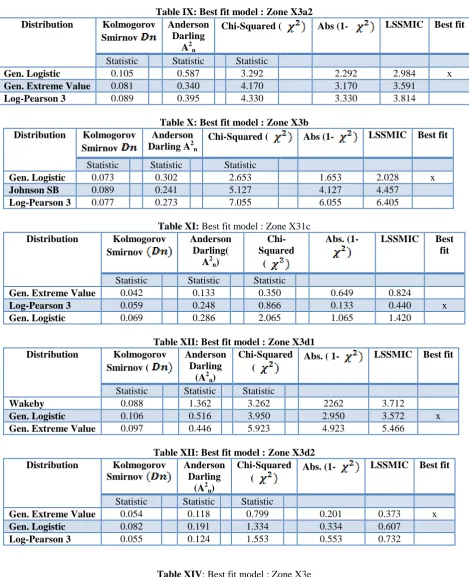
The best fit models for frequency analysis of extreme low mean annual rainfall events in 8 rainfall zones in Sabie river catchment are presented in tables VII-XV. The summary of the results of the best fit model identification is presented in table XVI.
Table VIII: Best fit model : Zone X3 a1
Distribution Kolmogorov Smirnov
Anderson Darling
A2n
Chi-Squared Abs(1- LSSMIC Best fit
Statistic Statistic Statistic
Gen. Extreme Value 0.079 0.234 2.898 1.898 2.211
Gen. Logistic 0.102 0.531 2.863 1.863 2.496
Table IX: Best fit model : Zone X3a2 Distribution Kolmogorov
Smirnov
Anderson Darling
A2n
Chi-Squared ( Abs (1- LSSMIC Best fit
Statistic Statistic Statistic
Gen. Logistic 0.105 0.587 3.292 2.292 2.984 x
Gen. Extreme Value 0.081 0.340 4.170 3.170 3.591
Log-Pearson 3 0.089 0.395 4.330 3.330 3.814
Table X: Best fit model : Zone X3b Distribution Kolmogorov
Smirnov
Anderson Darling A2n
Chi-Squared ( Abs (1- LSSMIC Best fit
Statistic Statistic Statistic
Gen. Logistic 0.073 0.302 2.653 1.653 2.028 x
Johnson SB 0.089 0.241 5.127 4.127 4.457
Log-Pearson 3 0.077 0.273 7.055 6.055 6.405
Table XI: Best fit model : Zone X31c
Distribution Kolmogorov Smirnov
Anderson Darling(
A2n)
Chi-Squared
(
Abs. (1- LSSMIC Best fit
Statistic Statistic Statistic
Gen. Extreme Value 0.042 0.133 0.350 0.649 0.824
Log-Pearson 3 0.059 0.248 0.866 0.133 0.440 x
Gen. Logistic 0.069 0.286 2.065 1.065 1.420
Table XII: Best fit model : Zone X3d1 Distribution Kolmogorov
Smirnov (
Anderson Darling
(A2n)
Chi-Squared (
Abs. ( 1- LSSMIC Best fit
Statistic Statistic Statistic
Wakeby 0.088 1.362 3.262 2262 3.712
Gen. Logistic 0.106 0.516 3.950 2.950 3.572 x
Gen. Extreme Value 0.097 0.446 5.923 4.923 5.466
Table XII: Best fit model : Zone X3d2 Distribution Kolmogorov
Smirnov
Anderson Darling
(A2n)
Chi-Squared (
Abs. (1- LSSMIC Best fit
Statistic Statistic Statistic
Gen. Extreme Value 0.054 0.118 0.799 0.201 0.373 x
Gen. Logistic 0.082 0.191 1.334 0.334 0.607
Log-Pearson 3 0.055 0.124 1.553 0.553 0.732
Table XIV: Best fit model : Zone X3e
Distribution Kolmogorov Smirnov
Anderson Darling
A2n
Chi-Squared (
Abs.(1- LSSMIC Best fit
Statistic Statistic Statistic
Gen. Extreme Value 0.088 0.461 2.029 1.029 1.578 X
Gen. Logistic 0.107 0.771 3.415 2.415 3.293
45
Table XV: Best fit model : Zone X3f Distribution Kolmogorov
Smirnov
Anderson Darling (
A2n)
Chi-Squared
(
Abs. ( 1- LSSMIC Best fit
Statistic Statistic Statistic
Log-Pearson 3 0.072 0.401 1.244 0.244 0.717 X
Gen. Extreme Value 0.057 0.265 1.843 0.843 1.165
Gen. Logistic 0.092 0.560 4.527 3.527 4.179
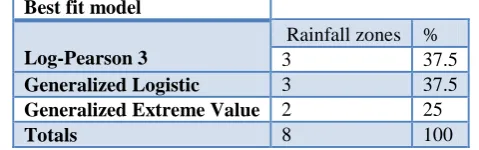
Table XVI: Summary of best fit model identification results. Best fit model
Log-Pearson 3
Rainfall zones %
3 37.5
Generalized Logistic 3 37.5
Generalized Extreme Value 2 25
Totals 8 100
Log- Pearson 3 and Generalised Logistic models each was the best fit models for frequency analysis of extreme low mean annual rainfall events in 3 rainfall zones. Generalised extreme value model was the best fit in 2 rainfall zones. The results shows that there no single model which is the best fit for frequency analysis of all low mean annual rainfall events in Sabie river catchment.
Table XVII: Best fit and QT-T models for frequency analysis of extreme low mean annual rainfall events
Rainfall zone
Best fit model
QT-T model
X3a1 LP 3
X3a2 GL
X3b GL
X3c LP 3
X3d1 GL
X3d2 GEV
X3e GEV
X3f LP 3
E. Results of frequency analysis of extreme low mean annual rainfall events in 8 rainfall zones in water deficit catchments in South Africa
Table XVIII: Recurrence intervals in years of extreme low mean annual rainfall events
F. How CMIC and LSSMIC address common limitations of model identification criteria General Information Criteria (GIC) can be expressed as:
3.1
where is the measure lack of fit by model
is the dimension of , defined as the number of free parameter under model
is the penalty for complexity of the model (Parsimony)
may depend on effective sample size and dimension of (free parameters)
Addressing of limitations cited by Jiang (2014) by developing CMIC and LSSMIC was based on Equation 3.1. Emanating from this work and based on the results obtained thereof, following can be considered with respect to the previous cited limitations with the current model selection criteria:
Limitation of effective sample size
In the case where the sample size is not equal to sample points, this limitation is addressed by identifying
candidate models and best models based on characteristic of sample probability tail events and hypothesis significance levels. Sample distribution tail shape and not size is applied. In so doing, the effect of sample size is eliminated. Kolomogrov-Smirnov goodness-of-fit index is a component of LSSMIC. This index is generally not influenced by the possible inequality of sample size against the sample points especially in case of correlations.
Limitation due to dimension of the model (parameters)
For practical purposes as illustrated in previous sections, the Anderson-Darling goodness-of-fit index has been adjusted to address the complexity of the problem (Refer to Equation 2.11). Chi-Squared goodness-of-fit was also adjusted to absolute index to address the limitation of dimension of the model (Refer to Equation 2.12(a).). Over and under parameter fitting limitation was also addressed in developing of absolute Chi-Squared index (Refer to Equation 2.12(b). In this procedure parsimony was also addressed. Both Anderson-Darling and Chi-Squared indices are elements in LSSMIC.
Limitation of ambiguity
Determination of LSSMIC index results into specific numbers which in turn reduces ambiguity. A special case is when parameters shape or scale of Wakeby model is equal to zero. In that case Wakeby and Generalized Pareto statistics are equal and if are the least, then the two models are taken as the best fit.
Rainfall zone
Best-fit
Mathematical model
Recurrence interval in years
5 10 25 50 100 200
X3a1 LP3 77.06 73.18 69.84 67.76 66.24 64.7 6
X3a2 GL 99.12 98.55 97.90 97.49 97.08 96.71
X3b GL 93.62 90.30 86.91 84.84 83.06 81.52
X3c LP3 71.67 68.23 66.78 64.15 62.90 61.54
X3d1 GL 92.60 88.91 84.59 82.00 79.73 77.72
X3d2 GEV 87.51 84.17 81.60 80.44 79.68 78.99
X3e GEV 86.27 83.17 80.93 79.99 79.40 79.03
47
Limitation of Criterion of Optimality
CMIC and LSSMIC have been developed in such a way that other parameters can be included. This approach ensures that technical and social parameters or variables can be included when needed. In this particular case peaks under threshold models have been included. This could practically be assigned to the demand for water resources needed at catchment level.
Limitation of small sample and extreme events
This limitation is deemed to be solved by including Anderson-Darling and Kolomogrov-Smirnov in LSSMIC as both cater for small sample and extreme events scenarios.
IV. CONCLUSION
The main objective of this study was to develop two model identification criteria for frequency analysis of extreme low mean rainfall events in water deficit catchments in South Africa. The two model selection criteria which were developed are:
1. Candidate Model Identification Criterion (CM1C) for identifying candidate models.
2. Least Sum of Statistics Model Identification Criterion ( LSSM1C) for identifying the best fit models for frequency analysis of the extreme low mean annual rainfall events from the identified candidate models. The two developed criteria were applied to identify candidate models and best fit models for frequency analyses of the extreme low mean annual rainfall events in 8 rainfall zones in Sabie river catchment. Results obtained showed that there no single probability distribution function is the best fit for all the 8 rainfall zones (table XVI).
Log-Pearson 3 (LP3) probability distribution function has been recommended for design hydro-meteorological events mostly flood and drought in South Africa (Alexander, 1990, 2001). From the results of this study, Log-Pearson 3 may not be the only best fit model for frequency analyses of extreme hydro-meteorological events in South Africa. It is therefore important to carry out model identification processes to identify best fit model for the specific required frequency analysis.
Probability-Probability (P-P) plots were applied to evaluate the performance of CMIC and LSSMISC. The plots showed that CMIC and LSSMIC performed fairly well. Although the Probability-Probability (P-P) plot results cannot be considered completely conclusive, CMIC and LSSMSC criteria make useful tools as model selection method for frequency analysis of extreme mean annual rainfall events.
ACKNOWLEDGEMENT
The study has been supported by the Provincial Dept. of Agriculture, Rural Development, Land and Environmental Affairs: Mpumalanga Provincial Government, South Africa.
REFERENCES
[1]. Akaike, H., 1974.`` A new look at the statistical model identification.’’IEEE Transaction on automatic control vol. 6 pp 716-725.
[2]. Alexander, W.J.R., 1990. Flood Hydrology for Southern Africa. SANCOLD, Pretoria, RSA. [3]. Alexander, W.J.R., 2001. Flood Risk Reduction Measures. University of Pretoria, Pretoria, RSA. [4]. Alexander, W.J.R., 2002a. The standard design flood. Journal of the South Africa Institution of Civil [5]. Engineers, 44 (1):26-31.
[6]. Anderson, T.W., Darling, D.A., 1952. Asymptotic theory of certain goodness-of-fit criteria based on [7]. stochastic processes. Ann.Mat.Stat. 23, 193-212.
[8]. Anderson,D., R., and Burnham, K., P., 2002: Avoiding pitfalls when using information-theoretic methods: Journal of wildlife management 66(3): 912-918.
[9]. Beven, K., J., 2000 Rain-Run-off modeling: The Primer. John Wiley and sons. Chichester, UK, 360, 360pp
[10]. Bobee, B., and Rasmussen, P., F., 1995 Recent advances in flood frequency analysis. : Reviews of Geophysics, supplement, July 1111-1116.
[11]. Bodini, A., and Cossu, Q., A., 2010 Vulnerability assessment of Central-East Sardinia ( Italy) to extreme rainfall events. Journal of Natural hazards and Earth systems sciences. 10. Pp 61-77
[12]. Claeskens, G., Hjort, N.L., 2003. The focused Information Criterion: Journal of the American statistical [13]. Association. 98, 900-916.
[14]. Feyen,H.M.J., 1970 . Identification of run-off processes in catchments with a small scale topograph. [15]. Furrer, E., M., and Katz, R., W., 2008: ``Improving the simulation of extreme precipitation events by
stochastic weather generators’’. Water Resources Research 44, W 12439doi. 1029/2008 WR 007316, 2008.
[17]. Gorgens, A., H., M., Joint Peak- Volume ( JPV) Design Flood Hydrographs for South Africa. WRC Report 1420/3/07 Water Research Commission, Pretoria, South Africa.
[18]. Gorgens, A., H., M., Lysons,S., Hayes, L., Makhabana, M., and Maluleke, D., 2007 Modernised South African Design Floo Pro actce in the context of Dam safety, WRC Report 1420 / 2 / 07, Water Research omission, Pretoria, South Africa.
[19]. Goswani, P., and Ramesh, K.., V., 2007. Extreme rainfall events: Vulnerability Analysis for Disaster Management and Observation Systems Design. Research Report CSIR PP21.
[20]. Hernandez, A., R., P., Balling R., C., Jr. and Barber-Matinez 2009. Comparative analysis of indices of extreme rainfall events: Variation and trend from Southern Mexico. Journal de Atmosfera 2 pages 219-228
[21]. Hosking, J.R.M., 1990. L-moments: Analysis and estimation of distribution using Linear combinations of
[22]. order statistics: Journal of the Royal statistics society Series B. 52, 105-124.
[23]. Hosking, J.R.M., Wallis, J.R., Wood, E.F. 1985. Estimation of the generalized extreme-value distribution
[24]. by the method of probability-weighted moments, Technimetrics. 27 (3) pp, 251-261. [25]. Hjort, N.L., Claeskens, G., 2003. Rejoinder to the focused.
[26]. Jiang, J., 2014. The fence method: Advances in statistics. Volume 2014 Article ID, 38081. [27]. Kidson, R., Richards, K.S., Carling, P.A., 2005. Reconstructing the Ca-100 year flood in Northern [28]. Thailand. Geomorphology 70 (2-4), 279-595
[29]. Kottegoda, N.T., Rosso, R, 1998. Statistics Probability and Reliability for Civil and Environmental [30]. Engineers. McGrawHill, New York.
[31]. Laio, et.al., 2009. Model selection techniques for the frequency analysis of hydrological extremes water
[32]. Research. Vol.45, W07416.
[33]. Laio, F., 2004. Cramer-Von Mises and Anderson-Darling goodness-of-fit tests for extreme value [34]. distributions with unknown parameters Water Resources Research. 40, W09308,
[35]. doi:10.1029/2004WR003204
[36]. Mathwave(2011), http://www.mathwave.com.
[37]. Mallows, C.L., 1995. Some comments on Cp: Technimetrics. 37, 362-372. [38]. Mallows, C.L., 1973. Some comments on Cp: Technimetrics. 15, 661-675.
[39]. Meiz, R., and Bloschl, G., 2004 Regionaliisation of catchment model parameters. J. Hydrol. 287 pp 95-123.
[40]. Mkhandi, S.H., Kachroo, R.K., Gunasekara, T.A.G., 2000. Flood frequency analysis of Southern Africa:
[41]. II. Identification of regional distributions. Hydrological Sciences Journal, 45(3):449-464.
[42]. Mutua, F.M., 1994. The use of the Akaike Information Criterion in the identification of an optimum flood
[43]. frequency model. Hydro. Sci.J.39 (3), 235-244.
[44]. Salami, A., W., ( 2004) Prediction of the annual flow regime along Asa River using probability distribution models. AMSE periodicals, Lyon, France. Modeling c-2004 65 (2), 41-56. ( http://amse-modeling.org/content.amse 2004. htm)
[45]. Schwarz, G., 1978. Estimating the dimension of a model. Annals stat. 6, 461-464.
[46]. Schulze, R.,E., 1989, Non-stationary catchment responses and other problems in determing flood series: A case for a simulation modeling approach: In: Kienzle, S., W., Maaren, H., (Eds); Proceedings of the Fourth South African National Hyrological Symposium SANCIAHS, Pretoria, RSA pp 135-157. [47]. Shamir,E., 2005 2004,,Application of temporal streamflow descriptors in hydrologic model parameter
estimation.Water Resource Research 41 doi: 10 : 1029/2004 WR 003409 SSN 0043-1397
[48]. Shao, J., Sitter, R.R., 1996. Bootstrip for imprinted Survey data. Journal of the American statistical [49]. Association, 93, 819-831.
[50]. Smithers, J.C., Schulze, R.E., 2001. Design runoff estimation: A review with reference to practices in [51]. South Africa, Proceedings of Tenth South Africa National Hydrology Symposium: 26-28 September, [52]. 2001. School of BEEH, University of Natal, Pietermaritzburg, RSA.
[53]. Smithers, J.C., Schulze, R.E., 2003. Design rainfall and flood estimation in South Africa.WRC Report No.
[54]. 1060/01/03, Water Research Commission, Pretoria, RSA.
[55]. Stedinger, J.R., Vogel, R.M., Foufoula, E., 1993. Frequency analysis of extreme events, in Handbook of
49
[57]. Stedinger, J.R., 1980. Fitting log normal distribution to hydrologic data. Water Resource research. 16(3)
[58]. pp, 481-490.
[59]. Stephens, M.A., 1976. Asymptotic results for goodness-of-fit statistics with unknown parameters. Ann. [60]. Stat. Vol. 4, 357-369.
[61]. Van der Linde, A., 2005. DIC in variable selection statistical Neerlandica. 59, 45-56.
[62]. Van der Linde, A., 2004. DIC in variable selection Technical report, Institute of statistics, University of [63]. Bremen, http://www.math.uni-bremen.de/$\simsard1/download\papers\varse12.pdf.
[64]. Wellner J.A., 1977. Aglirenko-Cantelli. Theorem and strong laws of large numbers for function of order
[65]. statistics: The annual of statistics vol.5 number 3. 1977, 473-480.
[66]. Wilks, D.,S., 1998 Multi-site generalization of daily stochastic precipitation model, J. Hydro 210 178-191.
[67]. Willens, P., Olsson, J., Ambjerg_Nielsen, Beecham,S., Pathirana, A., BulowGregersen, Madsen,H. and Nguyen, V.,T.,V. 2007 Impact of climate change on rainfall extreme and urban drainage systems pp19-20.
[68]. WMO- World Meteorological organization. 1988. Analysing long Time Series of Hydrological data with respect of climat variability WCAP-No. 3 WMO-TD No. 224.
[69]. WMO- World Meteorological organization. 2009 Guidelines on Analysis of extremes in a changing climate in support of informed decisions for adaptations. WCDMP-No. 72 WMO-TD No. 1500. [70]. Yua-Ping, Xu, Booij, Martin, J., Tong, Yang_Bin 2010 Uncertainity analysis in statistical modeling of
extreme hydrological events
[71]. Yue, S., and Wang, 2004. The Mann-Kendall test modified by effective sample size to detect trend in serially correlated hydrological series.: Journal of Water Resources Management 18 Pages 201-218.
Appendix A: Probability-Probability (P-P) plots for extreme low mean rainfall events for the 8 rainfall zones
P-P Plot Zone X3a1
Gen. Extreme Value
Gen. Logistic
Log-Pearson 3
P (Empirical)
1
0.9
0.8
0.7
0.6
0.5
0.4
0.3
0.2
0.1
P
(M
odel)
1
0.9
0.8
0.7
0.6
0.5
0.4
0.3
0.2
0.1
0
Fig. 1: P-P plot Zone x3a1 : Extreme mean annual rainfall events
P-P Plot Zone x3a2
Gen. Extreme Value
Gen. Logistic
Log-Pearson 3
P (Empirical)
1
0.9
0.8
0.7
0.6
0.5
0.4
0.3
0.2
0.1
P
(M
odel)
1
0.9
0.8
0.7
0.6
0.5
0.4
0.3
0.2
0.1
0
Fig. 2: P-P plot Zone x3a2 : Extreme mean annual rainfall events
P-P Plot Zone x3b
Gen. Logistic
Log-Pearson 3
Wakeby
P (Empirical)
1
0.9
0.8
0.7
0.6
0.5
0.4
0.3
0.2
0.1
P
(M
odel)
1
0.9
0.8
0.7
0.6
0.5
0.4
0.3
0.2
0.1
0
51
P-P Plot Zone x3c
Gen. Extreme Value
Gen. Logistic
Log-Pearson 3
P (Empirical)
1
0.9
0.8
0.7
0.6
0.5
0.4
0.3
0.2
0.1
0
P
(M
odel)
1
0.9
0.8
0.7
0.6
0.5
0.4
0.3
0.2
0.1
0
Fig.4: P-P plot Zone x3c : Extreme mean annual rainfall events
P-P Plot Zone x3d1
Gen. Extreme Value
Gen. Logistic
Wakeby
P (Empirical)
1
0.9
0.8
0.7
0.6
0.5
0.4
0.3
0.2
0.1
0
P
(M
odel)
1
0.9
0.8
0.7
0.6
0.5
0.4
0.3
0.2
0.1
0
P-P Plot Zone x3d2
Gen. Extreme Value
Gen. Logistic
Log-Pearson 3
P (Empirical)
1
0.9
0.8
0.7
0.6
0.5
0.4
0.3
0.2
0.1
P
(M
odel)
1
0.9
0.8
0.7
0.6
0.5
0.4
0.3
0.2
0.1
0
FIG. 6: P-P plot Zone x3d2 : Extreme mean annual rainfall events
P-P Plot Zone x3e
Gen. Extreme Value
Gen. Logistic
Log-Pearson 3
P (Empirical)
1
0.8
0.6
0.4
0.2
0
P
(M
odel)
1
0.9
0.8
0.7
0.6
0.5
0.4
0.3
0.2
0.1
0
Fig. 7: P-P plot Zone x3e: Extreme mean annual rainfall events
53
P-P Plot Zone x3f
Gen. Extreme Value
Gen. Logistic
Log-Pearson 3
P (Empirical)
1
0.9
0.8
0.7
0.6
0.5
0.4
0.3
0.2
0.1
P
(M
odel)