Auto Assist Physio Arm
Ms.K.Kiruba1, B.Kamalini2, C.Anu3, B.Arunkumar4 and J.Sathyaraj5
1Assistant Professor, Department of ECE, K.S.R.College of Engineering, Tiruchengode, Tamilnadu.
2,3,4,5Student, Dept. of ECE, K.S.R.College of Engineering, Tiruchengode, Tamilnadu. Email Id: [email protected]
Article Received: 01 March 2018 Article Accepted: 09 April 2018 Article Published: 28 April 2018
1. INTRODUCTION
One in every 75 people suffer from Paralysis. Paralysis is a disorder where the loss of muscle function occurs in one
or more muscles. It is a complete loss of strength in an affected limb or muscle group [1]. The paralysis most often
occur as a result of nervous system damage, trauma cases involving severe nerve injury and most often it is a
by-product of stroke. There are cases were paralysis occurs even in new-borns as a result of Spina bifida [2].
Paralysis usually affects various parts of body, it may be a localised one or generalised one. The types of paralysis
include Monoplegia (affecting only one arm), Diplegia (affecting the same body region on both the sides),
Hemiplegia (affecting one side of the body), Paraplegia (affecting both legs), Quadriplegia (affecting all limbs and
trunk) [3]. There is no instant cure for paralysis as of now. The paralysed patients are being approached with some
medications and physiotherapy [4]. Physiotherapy seems to be a widely adopted solution for muscle arrest as it
enhances blood circulation to a particular organ and relax those muscles. These therapy treatment not only recovers
the damaged muscles but also hampers the progress of paralysis to a great extent. In order to undergo this
therapeutical treatment, the patient needing physical rehabilitation have to make a regular visit to the hospital, to
get the treatment done by the therapist. This regular visit to the hospital causes inconvenience to the patients, as
they have got to travel a distance. Moreover the existing shortage of therapists and caregivers assisting physically
disabled individuals at home is expected to increase and would become serious problem in the near future. The
patient population needing physical rehabilitation of the upper extremity is also constantly increasing. Robotic
devices have the potential to address this problem as noted by the results of recent research studies. However, the
availability of these devices in clinical settings is limited, leaving plenty of room for improvement. In order to
rectify this issue, an Auto Assist Physio model for therapeutical purpose have been proposed. In this system, two
arms are being employed. The paralyzed patient will be provided with an arm for therapy purpose and another arm
will be with the doctor for assisting the therapy. This model provides therapy only to the upper extremities. The
patient arm will be attached to the patient by having a grip at neck and shoulder of the patient. On the other side the
doctor will be giving therapy to these patients via commands that is being executed on the doctor arm model. In
A B S T R A C T
Each and every human being in this world have their desire and right to lead a healthy life. But unfortunately accidents, diseases, elder-ship make their desire into disability. Moreover the number of handicaps and paralyzed patients are increasing day by day. They always need someone to help them in moving and undergoing some physical therapies for recuperating their strain back. In this paper the proposed system helps them to undergo the therapy activities of physiotherapist in a cost effective manner. In this project, paralyzed patient have inbuilt arm for their daily exercise. This arm can be activated through another arm by the doctor. The doctor can give command to the patient through arm. This arm helps to fold, straight and rotate the patient arm as per doctor arm. The aim of the research is to design a robotic arm for the paralyzed patient in order to help them undergo treatment at the place they are located, rather than making a regular visit to the hospital.
response to the doctor arm command, the patient arm executes the therapy. The command operations includes
folding, straightening, rotating to particular degree, massaging and so on. The implemented work is actually a
combination of two parts i.e. controlling part and therapy part.
2. METHODOLOGY
2.1. Controlling portion
The Doctor arm frames the controlling part of the model. A block diagram representing all the elements used in the
controlling portion is shown in Fig 01. Here rotary sensors are being used for measuring the angle between the knee
joints and this is provided with a supply voltage of 5V. Rotary sensor of high sensitive passive design is used.PIC
microcontroller is used for the controlling operation. PIC16F877 belongs to a class of 8-bit microcontrollers of
RISC architecture. It has 8kb flash memory for storing a written program. It is usually used for storing important
data that must not be lost if power supply suddenly stops. MPLAB IDE is the software program that runs on a PC to
develop applications for Microchip Microcontrollers. The doctor codes the therapy to be done into the controlling
portion of the device and the code is being transmitted through the RF transmitter. HT12A with a 38 kHz carrier for
infrared transmission medium is being employed.
Fig 01: Block Diagram of Doctor arm
2.2. Therapy portion
The Patient arm frames the therapy part of the model. A block diagram representing all the elements used in the
therapy portion is shown in Fig 2. Here DC motors are being used for bending and straightening the patient’s knee
joints and this is provided with a supply voltage of 12v with current rating at about 1amp. The motor has torque
ranging about 500 N/m.sq and its RPM is 12. Relay is used to turn on/off the motor. The transmitted signal from the
data which is send by the transmitting antenna. The antenna receives the desired signal and sends the data to the
decoder circuit. The 2^12 decoders are a series of CMOS LSIs for remote control system applications. They are
paired with Holtek’s 2^12 series of encoders. Once encoding is completed, the therapy is performed to the patient.
Fig 02: Block Diagram of Patient arm.
In this system, the Deep learning technique is used for getting better data transmission and reception. In Deep
learning, a computer model learns to perform classification tasks directly from image, text, or sound [5]. Deep
learning models can achieve state of the art accuracy, sometimes exceeding human-level performance. Most deep
learning methods use Neural network architecture, which has about 150 hidden layers, while the typical design
have only about 2-3 hidden layers.
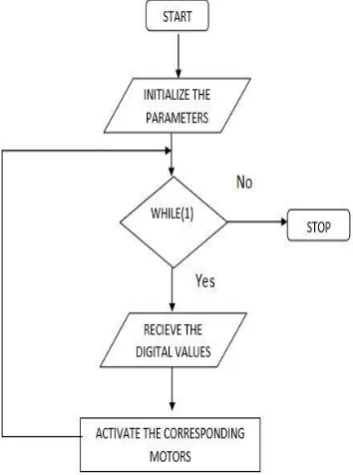
3. SYSTEM FLOWCHART
Fig 04: Flow Chart of Doctor Arm Software
In Fig.04 flowchart of the doctor arm software and in Fig.05 flowchart of the patient arm software are shown which
gives the perception of system software.
4. RESULTS AND DISCUSSION
4.1. Outcomes
In the test run, it is found that the patient arm is bended to about 45° in response to the movement of the doctor arm,
which is bended to an angle of 45°. In a similar manner, therapy movements such as rotation, streching and
massaging can be performed with further advancements.
4.2. System application
1. A paralyzed person needs some important therapies regularly and for long period of time. To avail these
therapies a therapist or a doctor or a specialist is essential. But with this system the disable person can accomplish
some basic therapies without help of another person or only with the help of family members.
2. Moreover, a therapist or a specialist demands a large amount of fee which is a burden for a person of middle or
lower class family. In that case this system can save their money, by fulfilling their demand.
4.3. System advantages
This system has the following advantages
1. Simple operation
2. Wide control
3. One doctor can give exercise to more patients
4.4. System limitation
This system has some limitations also. These includes
1. The proposed system can provide therapy treatment one for upper extremity issues.
4.5. Future development
The improvement of the system can be done as given below:
1. Redesigning and rebuilding as per patient’s requirements.
2. Development could made for providing treatment for lower extremity issues.
5. CONCLUSION
In this project, Microcontroller based arm was developed in order to provide therapy for paralysis case with upper
extremity. This method of therapeutical approach is more efficient and cost effective compared to the making
regular visit to the therapist. However with the advancement in the proposed system, therapy can be provided to all
types of paralysis patients in same manner and thereby ensuring the rehabilitation of the defective parts. With the
REFERENCES
[1] https://www.encylopedia.com/medicine/diseases-and-conditions/pathology/paralysis
[2] https://en.m.wikipedia.org/wiki/paralysis
[3] https://www.heaalthline.com/health/paraly sis
[4] https://ww.portea.com/physiotherapy/paral ysistreatment-at-home/
[5] https://www.athworks.com/discover/deep-learning.html
[6] Md.Mamunur Rahman, Swarup Chakraborty, Avradip Paul, Ali Mohammed Jobayer, Md. Azad Hossain,
Feb (2017), “Wheel Therapy Chair: A smart system for disabled person with therapy facility”, IEEE
transaction on robotic and automation, Vol.2, No.10, pp.630 – 635.
[7] Emerson, J.Potgieter, W.L.Xu, Apr(2016), “Control Implementation for an integrated robotic and virtual
mirror therapy system for stroke rehabilitation”, IEEE advanced motion control.
[8] Sarah J. Housman, Kelly M. Scott, David J. Reinkensmeyer, Jun (2009), “A Randomized Controlled Trial
of Gravity-Supported, Computer-Enhanced Arm Exercise for Individuals with Severe Hemiparesis”,