IJIRT 101500
INTERNATIONAL JOURNAL OF INNOVATIVE RESEARCH IN TECHNOLOGY103
Development of rapid analytical methods to select
suitable rice varieties for cracker production
Thejani M. Gunaratne, Nadeesha M. Gunaratne, S. B. Navaratne
Department of Food Science and Technology, University of Sri Jayewardenepura
Abstract - This study was conducted to develop rapid analytical methods to select suitable rice varieties with high stickiness for cracker production. Rice with low amylose is stickier than rice with high amylose. The study was designed to determine the two most important factors amylose and amylopectin. It was conducted to locally bred rice varieties AT 306, AT 405 and Samba. Amylose content was quantitatively determined using Juliano method. The amylopectin content was determined using a color card. It was developed by the reaction of several concentrations of pure amylopectin with 0.2% iodine to form respective colors. The particle size distribution of rice flour was analyzed. For this purpose, 100g of milled rice flour was placed on the sieve shaker and was operated for 12 minutes. The weight of flour retained on each sieve was weighed to identify passing through and retained on percentages. The results revealed that the amylose percentage of AT 306, AT 405 and samba were 19.6%, 12.2% and 25.87% respectively. The percentage of rice flour with larger particle size (>300µm) for Samba was above 95%, and for AT 306 and AT 405 it was 77%.
Index terms - Amylopectin, Amylose, Particle size distribution, Rice crackers, Rice varieties, Stickiness
I. INTRODUCTION
Rice is a monocot and one of the most important cereals in the world. More than half of the world’s population consumes rice. Because of Asia’s favorable hot and humid climate, about 90% of the world’s rice is grown and consumed in Asia, where it contributes about 50 to 80% of dietary energy (Juliano, 1993) [2]. There are two major rice varieties as Japonica and Indica rice varieties. Japonica rice is generally known to be stickier, short and roundish than the Indica type as it contains low amylose content of 0-20%. Indica rice on the other hand has higher amylose content which makes the cooked rice harder and less sticky. They are long, slender, and flat and have an amylose content of 23-31%.
Rice is the staple food of Sri Lankans. Sri Lanka is self sufficient in rice. But there is a major fluctuation of the rice utilization pattern. So it is important if rice can be diversified into other fields, mainly because the Sri Lankan population likes the taste of rice. A good example is production of rice crackers. Normally biscuits are produced using wheat flour. They contain gluten which helps to maintain the consistency and the integrity of the product. But rice lacks gluten. So the major problem faced when producing rice crackers is the loss of integrity and formation of cracks on the product.
Stickiness becomes a major parameter when producing rice crackers with high quality. The major rice variety in Sri Lanka is Indica variety. They are high in amylose and low in stickiness. So specially bred rice is used for rice cracker production. But the stickiness of these rice varieties varies depending on the batch. So the major objective of this study is to develop rapid analytical methods to select suitable rice varieties for rice cracker production and minimize the wastage of rice.
II. METHODOLOGY
2.1 Quantitative determination of amylose:
IJIRT 101500
INTERNATIONAL JOURNAL OF INNOVATIVE RESEARCH IN TECHNOLOGY104
standard curve was drawn against the absorbance and amylose concentration. The same procedure was carried out for the sample by using 100mg of rice flour instead of standard amylose. Also instead of preparing a series of solutions, 5ml of starch solution was reacted with 1ml of 1N acetic and 2ml of 0.2% iodine. Absorbance was measured at 620nm. The amylose percentage of sample was determined as described by Juliano, 1971 [3].
2.2 Particle size distribution:
Initially 150g of the rice sample was ground in a grinder for 3 minutes. The sieve tester was arranged by keeping the sieve with highest micron (300µm) to the lowest micron (106µm) from top to bottom. Then 100g of the ground rice flour was weighed and transferred into the sieve tester. The sieve tester was operated for 12 minutes and the weight of the rice flour retained on each sieve was weighed using the analytical balance. Finally the particle size distribution was developed in terms of the weight of flour retained on and passing through.
2.3 Development of color card to determine amylopectin concentration:
A series of pure amylopectin samples were prepared using Juliano method by substituting standard amylopectin instead of standard potato amylose. The color was developed using 0.2% iodine. The color variation was captured using a digital camera and was included in a color card. The amylopectin concentration of incoming rice sample can be determined by using this color card. Rice starches were isolated using the alkali steeping method developed by Yamamoto et al (1973) [11]. The amylose of starch was precipitated using amyl alcohol. It was centrifuged and the supernatant, which is amylopectin, was reacted with iodine and the color was compared with the color card to determine the concentration of amylopectin of the rice sample qualitatively.
III. RESULTS AND DISCUSSION
3.1 Quantitative determination of amylose
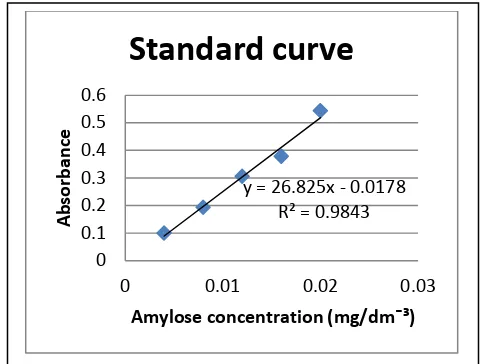
The standard curve developed (fig 1) for the quantitative determination of amylose content under Juliano method had an R2 (coefficient of determination) value of 0.984. The gradient of the graph was 26.82. The gradient along with the
absorbance values of samples were used to determine the amylose content. The amylose content of AT 306, AT 405 and Samba were 19.6%, 12.2%, 25.87% respectively. According to these values, samples AT 306 and AT 405 are low amylose rice varieties as amylose content is < 20%. They have high stickiness. Samba is a high amylose rice variety as amylose content is > 25%. It has a low stickiness. When compared to AT 306, AT 405 is stickier.
3.2 Particle size distribution
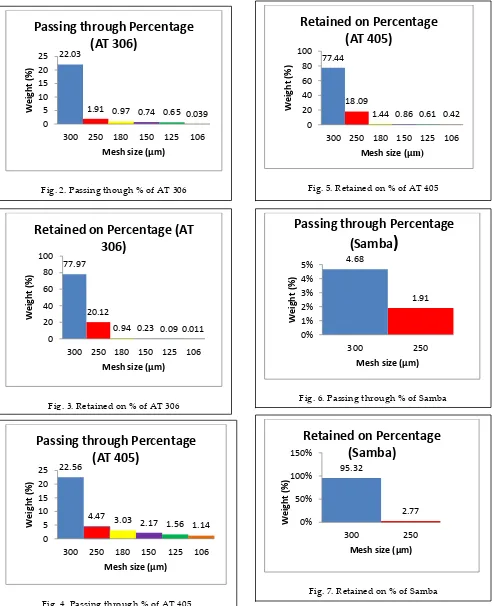
The Samba had above 95% of larger particle size flour (>300 µm). AT 306 and AT 405 had 77% higher particle size flour. Based on the results of Juliano method [3] Samba is a high amylose rice variety, low in stickiness. It confirms that high particle size is lower in stickiness. So samba has a lower stickiness than AT 306 and AT 405. The particle size distribution profiles drawn are shown in fig 2 – fig 7.
Fig. 1. Standard curve for amylose determination y = 26.825x - 0.0178
R² = 0.9843
0 0.1 0.2 0.3 0.4 0.5 0.6
0 0.01 0.02 0.03
A
b
sor
b
an
ce
Amylose concentration (mg/dm¯³)
IJIRT 101500
INTERNATIONAL JOURNAL OF INNOVATIVE RESEARCH IN TECHNOLOGY105
Fig. 2. Passing though % of AT 306 22.03
1.91 0.97 0.74 0.65 0.039 0 5 10 15 20 25
300 250 180 150 125 106
W ei gh t (% )
Mesh size (µm)
Passing through Percentage
(AT 306)
Fig. 3. Retained on % of AT 306 77.97
20.12
0.94 0.23 0.09 0.011 0 20 40 60 80 100
300 250 180 150 125 106
W ei gh t (% )
Mesh size (µm)
Retained on Percentage (AT
306)
Fig. 4. Passing through % of AT 405 22.56
4.47 3.03 2.17 1.56 1.14 0 5 10 15 20 25
300 250 180 150 125 106
W ei gh t (% )
Mesh size (µm)
Passing through Percentage
(AT 405)
Fig. 5. Retained on % of AT 405 77.44
18.09
1.44 0.86 0.61 0.42 0 20 40 60 80 100
300 250 180 150 125 106
Wei
gh
t
(%
)
Mesh size (µm)
Retained on Percentage
(AT 405)
Fig. 6. Passing through % of Samba 4.68 1.91 0% 1% 2% 3% 4% 5%
300 250
Wei
gh
t
(%
)
Mesh size (µm)
Passing through Percentage
(Samba
)
Fig. 7. Retained on % of Samba 95.32 2.77 0% 50% 100% 150%
300 250
Wei
gh
t
(%
)
Mesh size (µm)
IJIRT 101500
INTERNATIONAL JOURNAL OF INNOVATIVE RESEARCH IN TECHNOLOGY106
3.3 Development of color card
The color card developed (fig 8) using standard amylopectin had concentrations from 0.016 – 0.160 ppm. The reaction between amylopectin and iodine gives a brown – red color. When the amylopectin concentration increases the intensity of the color also increase. This card can be used to check the amylopectin concentration of samples. For this
purpose the amylopectin of the rice sample can be isolated and reacted with iodine to develop respective colors. This color developed can be cross checked with the color card to identify the amylopectin concentration available in the rice sample. Rice samples with higher amylopectin concentration are suitable for rice cracker production.
Fig 8: Color card for different amylopectin concentrations
IV. CONCLUSION
According to Juliano method, AT 306 and AT 405 are low amylose rice varieties and samba is a high amylose rice variety. AT 306 and AT 405 have high breakability as they contain lower particle sizes after grinding. But samba does not have a high breakability. It only contains larger particles sizes. So AT 306 and AT 405 have a high stickiness and they require less energy for size reduction process, where samba requires high energy for size reduction, and it has a low stickiness. Based on the tests conducted all these methods developed can be used to select suitable rice varieties for rice cracker production and AT 306 and AT 405 are suitable for rice cracker production, where samba is not suitable.
ACKNOWLEDGMENT
The authors wish to thank the academic and non academic staff of the Department of Food Science and Technology, University of Sri Jayewardenepura, Sri Lanka.
REFERENCES
[1] A.Jain, S. M. Rao, S. Sethi, A. Ramesh, S. Tiwari, K. S. Mandal, and N. K. Singh, Effect of cooking on amylose content of rice, European Journal of Experimental Biology, 2(2): pp 385-388, 2012.
[2] B.O. Juliano and C.G. Pascual, Quality characteristics of milled rice grown in different countries, International Rice research Institute, Los Banos: Laguna, Philippines, 1993.
[3] B. O. Juliano, “Simplified assay for milled rice amylose,” Cereal Science Today, vol. 16, pp. 334-338, 1971.
[4] F. Zhong, W. Yokoyama, and Q. Wang, “Rice Starch, Amylopectin, and Amylose: Molecular Weight and Solubility in Dimethyl Sulfoxide Based Solvents,” Journal of Agricultural and Food Chemistry, vol. 54, pp. 2320 – 2326, 2006.
IJIRT 101500
INTERNATIONAL JOURNAL OF INNOVATIVE RESEARCH IN TECHNOLOGY107
of Food and Agriculture, vol. 24, pp. 1589-1594, 1973.
[6] International Rice research Institute. Grain Quality Evaluation of World Rices. Los Banos, Laguna, Philippines, 1993.
[7] International Rice Research Institute, Proceedings of the workshop on Chemical aspects of rice grain quality. Los Banos, Laguna, Phillippines, 1979. [8] J. Patindol, Y. J. Wang, “Fine Structures and Physicochemical Properties of Starches from Chalky and Translucent Rice Kernels,” Journal of Agricultural and Food Chemistry, vol. 51, pp. 2777 - 2784, 2003.
[9] K. Reddy, M. G. Bhotmange, “Isolation of Starch from Rice (Oryza Sativa L.) and its Morphological Study using Scanning Electron Microscopy,”
International Journal of Agriculture and Food Science Technology, vol. 4, no. 9, pp. 859 -866, 2003. [10] K. Wuttisela, S. Shobsngob, W. Triampo, and D. Triampo, “Amylose/ amylopectin simple determination in acid hydrolyzed tapioca starch,” J. Chil. Chem, vol. 53, no. 3, pp. 1565-1567, 2008. [11] K. Yamamoto, S. Sawada, and T. Onkai, “Properties of rice starch prepared by alkali method with various conditions,” Japanese J. Soc Starch Sci,
vol. 20, pp. 99-104, 1973.
[12] L. J. Zhu, Q. Q. Liu, J. D. Wilson, M. H. Gu, and Y. C. Shi, “Digestibility and physicochemical properties of rice (Oryza sativa L.) flours and starches differing in amylose content,” Carbohydrate
Polymers, vol. 86, no. 4, pp. 1751– 1759, 2011. [13] M. H. Chen and C. J. Bergman, “Method for determining the amylose content, molecular weights, and weight- and molar-based distributions of degree of polymerization of amylose and fine-structure of amylopectin,” Carbohydrate Polymers, vol. 69, pp. 562–578, 2007.
[14] M. H. Ong and J.M. Blanshard, “Texture determinants in cooked, parboiled rice. I: Rice starch amylose and the fine stucture of amylopectin,”
Journal of Cereal Science, vol. 21, pp. 251–260, 1995.
[15] P. C. Williams, F. D. Kuzina, and I. Klyinka, “A rapid colorimetric procedure for estimating the amylose content of starches and flours,” vol. 47, pp. 411 – 420, 1970.
[16] R. Chinnaswamy and M. A. Hanna, “Relationship between amylose content and extrusion – expansion properties of corn starches,” Cereal Chemistry, vol. 65, no. 2, pp. 138 – 143, 1988. [17] R. L. Whistler, and W. M. Doane, “Characterization of intermediary fractions of high amylose corn starches,” Purdue University Agricultural experiment station, vol. 38, pp. 251 – 255, 1960.
[18] R. R. Little, G. B. Hilder, and E. H. Dawson, “Differential effect of dilute alkali on 25 varieties of milled white rice,” Cereal Chemistry, vol. 35, pp. 111-126, 1958.
[19] S. Y. Sonaye and R. N. Baxi, “Particle size measurement and analysis of flour,” International Journal of Engineering Research and Applications,
vol. 2, no. 3, pp. 1839 – 1842, 2012.
[20] T. Mahmood, M. A. Turner and F. L. Stoddard, “Comparison of Methods for Colorimetric Amylose Determination in Cereal Grains,” Starch journal, vol. 59, no. 8, pp. 357–365, 2007.
[21] T. Zhu, D. S. Jackson, R. L. Wehling, and B. Geera, “Comparison of Amylose Determination Methods and the Development of a Dual Wavelength Iodine Binding Technique,” Cereal Chemistry, vol. 85, no. 1, pp. 51-58, 2008.
[22] W. Karntarat, S. Sujin, T. Wannapong, T. Darapond, “Amylose/ amylopectin simple determination in acid hydrolyzed tapioca starch,”
Journal of the Chilean Chemical Society, vol. 53, no. 3, pp. 1565-1567, 2008.
[23] W. Z. Hassid and R. M. Mc Cready, “The molecular constitution of amylose and amylopectin of potato starch,” J. Am. Chem. Soc., vol. 65, pp. 1157, 1943.
IJIRT 101500
INTERNATIONAL JOURNAL OF INNOVATIVE RESEARCH IN TECHNOLOGY108
Journal of Cereal Science, vol. 34, pp. 279–284, 2011.