184 Abstract— Distillery spentwash contains all nutrients and organic matter and used in agriculture as a source of plant nutrients and irrigation water. Besides all the nutrients, spentwash contains appreciable amount of nitrogen also. The effect of different levels and methods of spentwash application on soil nitrogen dynamics was examined through a field experiment. The field experiment was conducted using Groundnut (Arachis hypogea L.) as a test crop. At all stages of groundnut growth, the amounts of NH4-N and NO3-N were greater in soil that received 120 m3 of spentwash with the recommended dose of NP fertilizers. Results shown that the spentwash not only adds mineral N (NH4-N and NO3-N) to soil, but also promotes the mineralization of soil organic N, thus resulting in large amounts of NH4-N and NO3-N in soil. The present study was, therefore, undertaken to study the nitrogen dynamics in soil under spentwash application and its impact on soil, crop and environmental quality.
Index Terms—Levels of spentwash, Mineralization, Nitrogen, Nitrogen dynamics.
I. INTRODUCTION
Nitrogen plays an important role in increasing the agricultural production and as a constituent of protein, it increases the food value. It also influences the quality of environment. Available N includes NH4+, NO3- and NO2- forms. Since, NO2 is highly unstable in soil, it is either immediately oxidized to NO3- form or reduced to NH4+ form. The dynamic of these two forms is influenced by the aeration status of the soil. The predominant form present is NO3-. The NO3- accumulated in the soil is either taken up by the crop or leaches down to the lower soil horizon as it is readily soluble in water. Some amount of NO3-N is also immobilized by soil microbes during the process of mineralization of organic matter.
The spentwash, being loaded with organic and inorganic compounds could bring remarkable changes on the physical, chemical and biological properties of soils and thus influences the fertility of soil significantly. However, indiscriminate disposal results adverse impact on soil and environmental health [1]. Most studies investigating effluent irrigation and leaching losses have focused on NO3-N [2], but
Manuscript received May, 2010. P. Kalaiselvi thanks the Salem Cooperative Sugar mills Ltd., Mohanur in Namakkal District, Tamil Nadu, India. for their financial assistance.
P. Kalaiselvi , Corresponding author and Assistant Professor, Tapioca and Castor Research Station, Tamil Nadu Agricultural University, Yethapur, Salem, Tamil Nadu, India-636119. (Email - [email protected]) Mobile P.No. 9003303070
S. Mahimairaja, Professor, Department of Environmental Sciences, Tamil Nadu Agricultural University, Coimbatore, Tamil Nadu, India- 641 003. ([email protected])
in certain situations NH4-N or organic N may be the dominant form of N to be leached. Information are scarce on nitrogen dynamics in soil under spentwash application and its environmental significance. Such information are needed for developing guidelines or strategies for effective utilization of distillery spentwash without any environmental hazards.
II. MATERIALS AND METHODS
A. Collection and characterization of spentwash
The biomethanated distillery spentwash sample was collected from the Salem Co-operative Sugar Mills Ltd, Mohanur, Namakkal District, Tamil Nadu, India. and characterized for its nutritive value and pollution potential by following standard methods [3], and used in the experiment (Table 1).
B. Experimental details
A field experiment was conducted at Research and Development Cane Farm, The Salem Co-operative Sugar Mills Ltd., Mohanur, Namakkal, District Tamil Nadu, India using Groundnut (Arachis hypogea L.) variety TMV 7 @ 125 kg/ha during the rabi season (August 31, 2007 to December 11, 2007). The experimental soil was taxonomically belongs to the family Typic Rhodustalfs. The soil was medium in mineral-N, high in NaHCO3-P and high in NH4OAc-K status (201.6, 18.1 and 278.0 kg /ha, respectively). A representative soil sample, at 0-15 cm depth, was collected from the experimental plot to determine the initial properties of the soil.
Design of the experiment: Split plot design; Replication: 3; Plot size: 13.5 m2 size; Spacing: 30 cm x 10 cm
Main plots: M1 - One time application; M2 - Continuous split doses of application
Sub plots: T1 – Control; T2 - RD of NP; T3 - Spentwash @ 40 m3/ha; T4 - Spentwash @ 40 m3/ha+ RD of NP; T5 -
Spentwash @ 80 m3/ha; T6 - Spentwash @ 80 m3/ha+ RD of NP; T7 - Spentwash @ 120 m3/ha; T8 - Spentwash @ 120 m3/ha+ RD of NP. (RD – Recommended Dose)
The different levels of spentwash was applied to the field uniformly by spraying manually to each plot 15 days before sowing for first main plot treatment (M1). In the second main plot treatment (M2), the spentwash was applied in three equal splits along with irrigation water. The first split dose of spentwash was applied 15 days after sowing. The crop was supplied with N and P fertilizers, as per the treatments at the recommended dose of 17 and 34 kg/ha, respectively. The K was entirely supplied through the spentwash. All other routine cultural operations until the harvest of the crop were followed as per the recommendations of crop production
Effect of Spentwash Application on Nitrogen
Dynamics in Soil
185 guide of Tamil Nadu Agricultural University.
C. Chemical analysis
KMnO4 –N
The KMnO4– N content of the soil was determined by the alkaline permanganate method [4].
Nitrogen fractions
The fractionation of soil nitrogen was carried out by the procedure given by [5] and [6]. The individual fractions were estimated according to the procedure given by [7].
• Preparation of Equilibrium extract: A quantity of 10 g
of soil (0.2 mm) treated with 100 ml of 2 M KCl solution was shaken for one hour and filtered through Whatman No.1 filterpaper.
• Ammonical nitrogen (NH4-N): An aliquot of 20 ml of the
above filterate was distilled with freshly ignited MgO in distillation apparatus and the distillate collected in 2 % boric acid containing mixed indicator was titrated with standard H2SO4.
• Nitrate nitrogen (NO3-N): On removal of NH4 from the
sample, added a pinch of devarda’s alloy and continued the steam distillation. The amount of NO3-N was determined as described for NH4-N.
Statistical analysis
The data on various characters studied during the investigation were statistically analysed by the method given by [8]. The critical difference was worked out at 5 per cent (0.05) probability levels.
III. RESULTS
Application of different levels of spentwash had remarkable impact on both NH4-N and NO3-N in soil (Tables 2 and 3). Before sowing NH4-N content was only 72 mg/kg in the control; whereas, it ranged from 138 to 282 mg/kg under one time application of spentwash (M1). Increase in the levels of spentwash significantly increased the NH4-N and such increase was more due to NP fertilizers application. Soil that received 120 m3 of spentwash plus NP fertilizers had the highest concentration of NH4-N (282 mg/kg).
During the crop growth, the concentration of the NH4-N was decreased both at pod formation and at harvest. At pod formation stage, the NH4-N content ranged between 39 and 120 mg/kg due to one time application of spentwash; whereas, it was between 46 and 136 mg/kg under continuous application of split doses of spentwash. Significant difference was observed between treatments and also between the two methods of spentwash application. Further reduction in the concentration was observed in soils collected after the harvest of crop.
Initially, 15 days after one time application of spentwash (before sowing) the concentration of NO3-N varied from 276 to 564 mg/kg, as against only 96 mg/kg in the control and 106 mg/ kg in soil that received only NP fertilizers. The highest concentration was observed in T8 (spentwash at a rate of 120 m3/ha plus NP fertilizers). During the crop growth, the NO3-N
was found decreased drastically which ranged from 56 to 226 mg/kg at pod formation, and 28 to 86 mg/kg at harvest. Continuous application (split application) of spentwash also significantly increased the NO3-N content. The concentration was higher at pod formation stage, ranged between 124 and 240 mg/kg as against 40 mg/kg in the control. Marked reduction was observed after harvest. Increase in the rate of spentwash application had increased the NO3-N significantly; however, such difference was narrow down in the post harvest soil. In general, continuous application of split doses of spentwash resulted in relatively higher amount of NO3-N in soil.
Table 1. Characteristics of biomethanated distillery spentwash
S.
No Characters
Biomethanate d spentwash*
1. Colour Dark brown
2. Odour Unpleasant burnt sugar
3. pH 7.1
4. EC (dS/m) 38
5. Total dissolved solids 50000 6. Total suspended solids 3300
7. Total solids 53300
8. Biological oxygen demand 12800
9. Chemical oxygen demand 35000
10. Carbon (g/L) 24
11. Nitrogen 420
12. Phosphorus 40
13. Potassium 9097
14. Sodium 357
15. Calcium 4600
16. Magnesium 1752
17. Chloride 13471
18. Bicarbonates 195
19. Sulphate 947
20. Oil and grease 19.6 21. Total sugars (%) 3.49 22. Reducing sugars (%) 1.77
23. Total phenols 84
24. Zinc 7.20
25. Iron 78
26. Manganese 5.3
27. Copper 5.5
29. Bacteria (x 10of effluent) 6 CFU/ml 12
30. Fungi (x 10effluent) 4 CFU/ml of 19
31. Actinomycetes (x 10CFU/ml of effluent) 3 Nil
186 IV. DISCUSSION
A. Dynamics of nitrogen
The results of field experiment have shown that the transformation and the plant availability of N in soil was greatly influenced by the spentwash application. The two methods of spentwash application differed significantly in affecting the N dynamics. Before sowing (15 days after spentwash application), both NH4-N and NO3-N were significantly higher in soil with one time application, whereas, at later stages (pod formation and harvest stages), continuous application recorded higher values (Table 2 and 3). One time application (M1) of single dose of spentwash added large amount of N and increased the ammonification and nitrification, resulting in higher concentration of NH4-N and NO3-N in soil. Similar results were also observed in the incubation experiment. At later stages crop removal and losses due to NH3 volatilization and NO3 leaching might have reduced the NH4 and NO3 contents in soil. In continuous application (M2), nutrients were added to soil in split doses continuously which gradually increased the concentration of NH4-N and NO3-N. One time application or continuous application of different levels of spentwash had remarkably increased the NH4-N and NO3-N in soil. Increase in the N availability in soil due to spentwash application was reported by [9]-[11].
As expected the addition of inorganic N and P fertilizers had significantly improved the NH4-N and NO3-N concentration. Irrespective of methods of application, at all stages of crop growth, the amounts of both NH4-N and NO3-N were greater in soil that received spentwash at a rate of 120 m3/ha plus recommended dose of NP fertilizers. The lowest concentration were registered in control followed by NP alone treatment (T2). Incorporation of N through spentwash and inorganic N fertilizer (urea) added large amounts of N which have increased the NH4-N and NO3-N in soil. As the spentwash contains plant based proteinaceous substances the ammonification of organic N followed by nitrification of NH4 might have occurred and increased the mineral N content in soil. The data on NH4-N and NO3-N have indicated that the spentwash not only adds N to the soil, but also enhances the mineralization of N from organic N pool in soil.
The spentwash used in the study contained about 420 mg N /L. At a rate of 40, 80 and 120 m3 of spentwash,
approximately 16.8, 33.6 and 50.4 kg of total N/ha, respectively, might have added to the soil. This corresponds to 25.8, 51.6 and 77.4 mg/kg, respectively. However, the results have shown that within 15 days of spentwash application, several fold increase in both NH4-N and NO3-N in soil. Such increase in the concentration of mineral N incorporated through spentwash application. It is likely that the spentwash application facilitated the mineralization of native (soil) organic N, which also increased the NH4-N in soil. Whereas, microbial oxidation of NH4-N, derived from spentwash as well as soil, had increased the NO3-N in soil. The results from the incubation experiment also provide evidence for these findings.
The biological oxidation of NH4 to NO2 and NO3 is believed to be carried out almost entirely by specialised
bacteria, although oxidation by unspecialised bacteria has been observed in some environment. This may be one of the reasons for the reduction in NH4-N at later stages. Besides, crop removal, part of NH4-N is also adsorbed on clay particles, and/or lost through NH3 volatilization. The high pH (> 8.2) and hot environment may have favored these processes in this soil under field condition. In control soil that has not received spentwash, the entire amount of NH4-N was derived mostly from the decomposition of organic N which includes the soil humus N and recently added plant residues. Soil organic N decomposes relatively slowly. Under condition where organic N is accelerating or decreasing very slowly only a small portions of the total supply is converted into plant available N.
The net mineralization of N (Nm) for the spentwash application at the rate of 40 m3 (T3), 80 m3 (T5) and 120 m3 (T7) was calculated as in (1) [12].
Nm = ∆ Ni swt - ∆Ni c (1)
∆Ni = Ni tx - Ni to
Where,
Nm = Net mineralization of N (mg N/kg soil)
Ni = inorganic N or mineral N
Ni swt = inorganic N in spentwash treatment
Ni c = inorganic N in control treatment
t = time
The data are presented below
Net mineralization of N (mg N/kgsoil) at different levels of spentwash application in soil
S.
No. Treatments
Before sowing
Pod formation stage
Post harvest stage
M1 M2 M1 M2 M1 M2
1. Spentwash @ 40 m3/ha 246 10.0 86.6 118.6 1.0 32.0
2. Spentwash @ 80 m3/ha 510 -2.0 176.0 212.0 53.6 77.0
3.
Spentwash @ 120 m3
/ha
594 0.0 222.0 243.0 66.7 93.0
187 mineral N might have also been immobilized microbially in soil.
TABLE2.EFFECT OF DIFFERENT LEVELS OF SPENTWASH APPLICATION ON NH4-N(MG/KG) CONTENT OF SOIL
Treatments Stage I Stage II Stage III
M1 M2 Mean M1 M2 Mean M1 M2 Mean
T1- Control 72 76 74 39 46 43 33 32 33
T2 - NP alone 82 80 81 55 62 59 48 41 45
T3 - Spentwash @ 40 m3 ha-1 138 84 111 72 98 85 65 86 76
T4- Spentwash @ 40 m3 ha-1+ NP 186 78 132 90 102 96 81 94 88
T5- Spentwash @ 80 m3 ha-1 210 72 141 108 114 111 92 105 99
T6- Spentwash @ 80 m3 ha-1 + NP 228 76 152 114 129 122 108 115 112
T7- Spentwash @ 120 m3 ha-1 252 78 165 112 120 116 98 112 105
T8- Spentwash @ 120 m3 ha-1+ NP 282 72 177 120 136 128 114 118 116
Mean 181 77 129 89 101 95 80 88 84
SEd CD (0.05) SEd CD (0.05) SEd CD (0.05)
T 4.19 8.99 1.89 3.88 2.46 5.28
M 2.24 4.75 0.60 1.22 1.38 2.93
T x M 6.13 13.07 2.24 4.59 3.70 7.88
M x T 6.33 13.42 1.70 3.46 3.91 8.28
M1 - One time application; M2 - Continuous application Stage I – Before sowing; Stage II - Pod formation; Stage III - Post harvest
With continuous application of split doses of spentwash, the net mineralization was very slow initially probably due to relatively low input of N. The negative value indicates that immobilization (microbial and/or chemical) exceeded the mineralization, resulting in less net mineralization of N. However, the continuous application resulted in the build-up of N pool and facilitated higher rate of mineralization at pod formation stage. Crop removal and N losses (volatilization, leaching) further had decreased the mineral N concentration.
It could be attributed to microbial immobilization of NO3 and NH4, adsorption of NH4+ and leaching of NO3. Both mineralization and immobilization of N are carried out by large numbers and many types of microorganisms. Hence the rate of mineral N production or depletion in soils is a net value of these two oppositive processes. Numerous experiments have shown that mineralization and immobilization occurs simultaneously in most soil. Furthermore, since the soil pH was > 8.2, it might also have favoured the volatilization loss of NH3. According to [13], the microbial consumption of NO3-N can be significant under high C availability and is strongly influenced by microbial substrate use efficiency. As the spentwash incorporates large amounts of easily oxidizable organic carbon, microbial immobilization of NO3-N in the soil also could be responsible for the decrease in NO3-N at pod formation and harvest stages.
It is also likely that some of the N appearing as NO3-N was directly added as ammonium and nitrified (rather than mineralized from organic N) when conditions for microbial activity were appropriate for this transformation. In control plots lower soil NO3-N concentration may be attributed to low availability of a substrate (organic matter) for N mineralization. A lag time of mineralization and nitrification
rates is expected after application of spentwash [14]. The average annual rainfall at the field experimental site was 815.6 mm. The pattern of the monthly rainfall and predicted amount of net drainage for the experimental period are shown in Fig. 1. A total rainfall of 332 mm and a cumulative drainage of 460.4 mm were calculated from the sowing of groundnut (31.8.2007) to the harvesting (11.12.2007) which may have had a significant effect on leaching and the movement of nutrients in the soil profile. With crops grown during rainy season there is a possibility of leaching of large amount of NO3 which could contaminate the groundwater. Thus, a high rate of net drainage predicted during the crop period may have resulted in significant leaching of mineral N. The rapid accumulation of NO3 in plots receiving spentwash application implied the need for proper management of N to avoid environmental impact associated with N losses and leaching.
-400 -300 -200 -100 0 100 200 300 400
September October November December
D
ra
in
age
(mm)
R
ain
fa
ll
(m
m
)
Rainfall Drainage
Fig.1. Monthly rainfall and predicted net drainage for the experimental period (Sep to Dec 2007)
TABLE3.EFFECT OF DIFFERENT LEVELS OF SPENTWASH APPLICATION ON NO3-N(MG/KG) CONTENT OF SOIL
188
M1 M2 Mean M1 M2 Mean M1 M2 Mean
T1- Control 96 92 94 56 40 48 28 26 27
T2 - NP alone 106 102 104 66 78 72 35 40 38
T3 - Spentwash @ 40 m3 ha-1 276 94 185 118 124 121 38 49 44
T4- Spentwash @ 40 m3 ha-1+ NP 330 90 210 134 166 150 49 63 56
T5- Spentwash @ 80 m3 ha-1 468 94 281 172 202 187 65 75 70
T6- Spentwash @ 80 m3 ha-1 + NP 492 103 298 208 236 222 79 91 85
T7- Spentwash @ 120 m3 ha-1 510 90 300 214 227 221 72 84 78
T8- Spentwash @ 120 m3 ha-1+ NP 564 101 333 226 240 233 86 91 89
Mean 355 96 226 149 164 157 57 65 61
SEd CD (0.05) SEd CD (0.05) SEd CD (0.05)
T 8.21 17.60 4.54 9.73 1.77 3.80
M 4.28 9.08 2.65 5.62 0.99 2.11
T x M 11.86 25.29 6.98 14.87 2.66 5.67
M x T 12.12 25.68 7.50 15.91 2.81 5.96
M1 - One time application ; M2 - Continuous application Stage I - Before
sowing ; Stage II- Pod formation Stage; III - Post harvest
It is also possible that an over estimation of NO3 may also have occurred as a result of methodological biases associated with soil sampling in the field. Of particular concern is the large and variable NO3 pools in these spentwash amended soil, and probable uneven distribution of microbial activities. It is likely that the ‘hot-spots’ of mineralization-nitrification may be formed due to uneven distribution of spentwash. These hot-spots would have had higher NO3 concentration and more rapid nitrification than the rest of the soil.
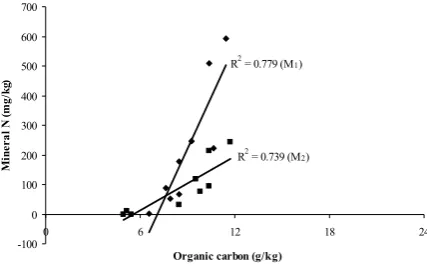
It has been reported that organic manure with C/N ratio below 15:1 are more likely to give positive N mineralization after application in soil. In general a C/N ratio of 20:1 or narrower is assumed to have significant N to supply the decomposing microbes and release some N as well [15]. As has already been mentioned, the spentwash not only added nutrients and C, but also enhanced the microbial activity in soil which is evident from organic C content and enzyme activity. A strong correlation (R2 = 0.78) observed between organic C and net mineralization of N (Fig. 2) demonstrates the role of C in controlling the N dynamics in soil [16].
R2 = 0.779 (M1)
R2 = 0.739 (M2)
-100 0 100 200 300 400 500 600 700
0 6 12 18 24
Organic carbon (g/kg)
M
in
era
l N
(m
g/
kg
)
Fig. 2. Relationship between organic C and net mineralization of N
V.CONCLUSION
The results of the experiments have shown that the transformation and the plant availability of N in soil was greatly influenced by the spentwash application. The levels and methods of spentwash application differed significantly in affecting the N dynamics. Continuous application of split doses of spentwash at a rate of 120 m3/ha with or without the recommended dose of NP fertilizers was found better in improving the nutrients status of soil. The spentwash not only
adds nitrogen to soil, but also promotes the mineralization and/or solubilization of nitrogen in soil.
ACKNOWLEDGMENT
“P. Kalaiselvi thanks The Salem Cooperative Sugar mills Ltd., Mohanur in Namakkal District, Tamil Nadu, India. for their financial assistance”.
REFERENCES
[1] S. Mahimairaja and N. S. Bolan, “Problems and Prospects of agricultural use of distillery spentwash in India.” In:Proceedings of Supersoil 2004: 3rd
Australian New Zealand Soils Conference, University of Sydney, 2004, Australia. pp.1-6.
[2] P. L. Singleton, C. D. A. McLay and G. F. Barkle, “Nitrogen leaching from soil lysimeters irrigated with dairy shed effluent and having managed drainage.” Australian Journal of Soil Research, 39, 2001, pp. 385-396.
[3] APHA, Standard methods for the examination of water and wastewater, 16th ed. American Public Health Association, Washington, DC, 1989, p.
83.
[4] B. V. Subbiah and G. L. Asija, “A rapid procedure for estimation of available nitrogen in soils.” Current Science, 25, 1956, pp.259-260. [5] H. H. Cheng and D. R. Kurtz, “Chemical distribution of added nitrogen
in soils.” Soil Science Society of America Proceedings, 27, 1983, pp. 313-316.
[6] D.R. Keeney and J.M. Bremner, Effect of cultivation on the nitrogen distribution in soil. Soil Science Society of America Proceedings, 28, 1964, pp.653-656
[7] J. M. Bremner, Inorganic and organic forms of nitrogen. In:Methods of Soil Analysis, Part II, Black CA, (ed), Madison, Wisconsin: American Society Agronomy, 1965, pp. 1179-1255.
[8] K. A. Gomez and A. A. Gomez, Statistical Procedures for Agricultural Research. New Delhi: John Wiley and Sons, 1984, pp.680.
[9] M. Baskar, H. Gopal, C. Kayalvizhi, M. Sheik Dawood, M. Subash Chandra Bose and K. Rajukkannu, Influence of pre-plant application of distillery effluent and fertilizers on soil properties and yield of sugarcane. In:Proceedings of national seminar on use of poor quality water and sugar industrial effluents in agriculture, held at ADAC & RI, Tamil Nadu Agricultural University, Tiruchirapalli: 2001, pp. 76-82. [10] M. Subash Chandra Bose, H. Gopal, M. Baskar, C. Kayalvizhi and M.
Sivanandham, Utilization of distillery effluent in costal sandy soil to improve soil fertility and yield of sugarcane. In: Symposium No. 30, 17th WCSS, Aug. 14-21, Thailand: 2002, pp. 1980-1988.
[11] L. Devarajan and G. Oblisami, “Effect of distillery effluent on soil properties, yield and quality of sugarcane.” Madras Agricultural Journal, 82, 1995, pp. 397-399.
[12] J.T. Sims, “Nitrogen transformation in a poultry manure amended soil: temperature and moisture effects.”Journal of Environmental Quality, 15, 1986, pp. 59-63.
[13] M. Burger and L. E. Jackson, “Microbial immobilization of ammonium and nitrate in relation to ammonification and nitrification rates in organic and conventional cropping systems.” Soil Biology and Biochemistry, 35, 2003, pp. 29-36.
189
[15] R. W. Miller, R. C. Donahue and J. C. Skickluna,.Soils: An Introduction to Soils and Plant Growth. New York: 5th (ed) Prentice
Hall, Inc, 1983, pp.350.
[16] N. C. Brady and R. R. Weil, The Nature and Properties of Soils. New York: Prentice Hall, Inc, 1999, pp. 960.
NAME - P. KALAISELVI, Place – Salem, Date of Birth - 19.05.1975, Educational Background- Doctoral Degree (Ph.D)-Environmental Science, Tamil Nadu Agricultural University, Coimbatore, Tamil Nadu, India, Year of passing - 2008, Field of study - waste water recycling, study of nutrient dynamics in soil and environmental impact assessment. Master degree (M.Sc.)-Agriculture, in Agricultural Microbiology, Tamil Nadu Agricultural University, Coimbatore, Tamil Nadu, India, Year of passing - 1999, Field of study- Silicate and Potassium Solubilization in Rice Soils. Bachelor Degree (B.Sc) – Agriculture, Tamil Nadu Agricultural University, Coimbatore, Tamil Nadu, India, Year of passing – 1996.
She worked as JUNIOR RESEARCH FELLOW during the master degree programme in the ASPEE Research Foundation, Mumbai, India sponsored fellowship, worked as GUEST LECTURER for Applied Botany (Medicinal plants) in the Periyar University, Salem, Tamil Nadu, India, worked as SENIOR RESEARCH FELLOW during the doctoral degree programme in a private firm (The Salem Cooperative Sugar mills Ltd., Mohanur in Namakkal District, Tamil Nadu, India.) sponsored fellowship, after finishing doctoral degree worked as SENIOR RESEARCH FELLOW in the Government of India – Ministry of Environment and Forest, New Delhi, India sponsored scheme in the Department of Environmental Science, Tamil Nadu Agricutural University, Ciombatore, India and also worked as RESEARCH ASSOCIATE inGovernment of India – Central Pollution Control Board, New Delhi, India sponsored net work project in the Department of Environmental Science, Tamil Nadu Agricutural University, Ciombatore, India. Currently working as Assistant Professor (Environmental Science), Tamil Nadu Agricutural University, Tapioca and Castor Research Station, Yethapur, P.G.Palayam, Attur, Salem, Tamil Nadu, India. Published article- i) P. Kalaiselvi, S. Shenbagavalli, S. Mahimairaja and P. Srimathi.
Impact of Post Biomethanated Distillery Spentwash on Seed Germination
and Seedling Growth of Dryland Crops. Madras Agricultural Journal, 96
(7-12), 2009, pp. 331-334. ii) P. Kalaiselvi and S. Mahimairaja. Effect of Biomethanated Spent Wash on Soil Enzymatic Activities. Botany Research International, 2 (4), 2009, pp. 267-272. iii) P. Kalaiselvi and S. Mahimairaja. Influence of distillery spentwash on nutrient content and uptake of groundnut crop. Journal of Environmental Research and Development. 4(2), 2009, pp. 341-358. Current research interests-Developing technology in compost making, bioremediation and environmental impact assessment studies, previous research interests-Waste water recycling and nutrient dynamic studies in soil.