Problems and Prospects:
Universal Networking Language
on Bangla Sentence Structure Perspective
Md. Ahsan Arif
Assistant Professor, Department of Computer Science and Engineering, Asian University of Bangladesh Uttara Model Town, Dhaka 1230, Bangladesh
Abstract
—
The World Wide Web (WWW) is most effective communication media now a day. The WWW represents a revolutionary tool to communicate and access information. It enables us to access innumerable documents about a huge variety of topics, from any place around the world. However, despite the abundance of information, languages very often cause problems. When most of the web pages today are written in few most commonly used languages as like English, French, Chinese etc, it becomes difficult for a person with insufficient knowledge of these languages to access and use this tool of communication and information. This has prompted the need to devise means of automatically converting the information from one natural language to another natural language, called Machine Translation. This process needs syntactic and semantic analysis of both source and target languages. Interlingua based machine translation has received a considerable attention because of economy of translation of effort and also additional attraction of the Interlingua providing a knowledge representation scheme. In this paper we present the computational analysis of the complex case structure of Bengali with a view toward Interlingua based MT.Index Term— Universal Networking Language, Machine Translation, En-Converter, De-Converter, Bangla Sentence Conversion.
I. INTRODUCTION
About 189 Million people speak Bengali and is ranked 4th
in the world in terms of the number of
people speaking the language [1]. Like most languages in the Indo Aryan family, descended from Sanskrit, Bengali has the Subject-Object-Verb (SOV) structure with some typical characteristics. A motivating factor for creating a system for processing Bengali is the possibility of laying the framework for processing many other languages too.
Although, there is an immense proliferation of information through Internet, it is not accessible to vast multitude of people across nations as most of the resources are in English. To overcome this problem, United Nations launched Universal Networking Language project in 1996 [2]. The result of the project is universal networking language (UNL), a language
neutral specification, and a universal parserspecification. The
goal is to eliminate the massive task of translation between two languages and reduce language to language translation to a one time conversion to UNL. For example, Bangla corpora, once converted to UNL, can be translated to any other
language given UNL system built for that language. The UNL
system does this by representing only the semantics of a native
language sentence in a hyper graph. En-converter (parser)
converts each native language sentence to a UNL hyper graph and de-converter translates from hyper graph to any native language [3].
In order to overcome the language barrier, many attempts have been made in the past. Professional translators have been bridging such a communication gap. The quantity of translation by human however is rather small as compared to the required communication needed for the different languages. The main reason for such a limitation is high cost involved in the translation work. In addition, the number of translators for minor language is rather small. Translation made by human being, thus has its limitation in terms of cost and human resources.
Computer translation systems have made significant progress. Some of them are now being incorporated in network browsers. The demand for these systems indicates how large the language problem is among Internet users. Computer translation systems are useful under limited conditions. For instance, the user can evaluate and modify a translated document in his own language, but seldom in the other language. However, after translating with a computer, the user has to work to edit the output document. In addition it would require language knowledge to edit the translation of the document in the other language. In sending information throughout the world, the sender normally does not know the language of the recipient. In this case, the sender is bound to use a computer translation system blindly, because he can‘t check whether the translated results are correct or not. This is a serious limitation in current computer translation system, and explains in parts, their limited acceptance.
II. UNLPROJECT
represent knowledge. With this characteristic in mind, Universal Networking Language (UNL) is developed. UNL
intermediates understanding among different natural
languages [4]. UNL represent sentences in the form of logical expression without ambiguity. It is an intermediate language, which allows communication among people of different language using their mother tongue. The UNL is a language specification for the exchange of information over the Internet. The motivation behind UNL is to develop an Interlingua representation such that semantically equivalent sentences of all language have the same Interlingua representation. UNL plays the role of an interface between different languages to exchange information. UNL represent each sentence in the given text as set of relation.
The UNL vocabulary consists of Universal Word: represent the word meaning, Relation Label: represent the relation between UW‘s, Attribute Label: represent the further definition or additional information, which appears in the sentence.
Word Knowledge is expressed by Universal Words (UW‘s), which are language independent. These UW‘s are tagged using restrictions describing the sense of the word in the
current context. For example, drink (icl > liquor) denotes the
noun sense of drink restricting the sense to a type of liquor.
Here, icl stands for inclusion and forms an is-a relationship
like in semantic nets.
Conceptual Knowledge is captured by relating UW‘s through a set of UNL relations [14]. For example, Humans affect the environment is described in the UNL as
agt means the agent and obj the object. Affect (icl > do),
human (icl >animal) and environment (icl > abstract thing)
are the UW‘s denotingconcepts.
Speaker‘s view, aspect, time of event, etc. are captured by UNL attributes. For instance, in the above example, the
attribute @entry denotes the main predicate of the sentence,
@present the present tense and @pl the plural number.
The above discussion can be summarized using the example below
John, who is the chairman of the company, has arranged a meeting at his residence
The UNL for the sentence is
In the expressions above, agt denotes the agent relation, obj
the object relation, plc the place relation, pos is the possessor
relation, mod is the modifier relation and aoj is the
attribute-of-the-object (used to express constructs like A is B) relation.
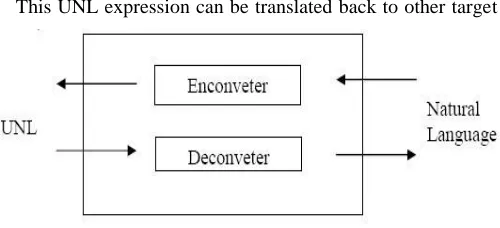
This UNL expression can be translated back to other target
language. Thus, UNL is an intermediate language, which allows communication among people of different languages, using their mother tongue. The UNL system will transform natural languages to UNL expression (using En-converter) and UNL expression to natural language (using De-converter).
Figure 1.1: UNL Systems
Our work is based on an authoritative treatise on Bengali grammar. The strategies of analysis and generation of linguistic phenomena have been guided by rigorous grammatical principles. Universal Networking Language Based Analysis and Generation for Bengali.
III.NATURAL LANGUAGE GENERATION
Natural Language Generation (NLG) is a sub field of artificial intelligence and computational linguistics that is concerned with the construction of computer system that can produce understandable texts in English or other human language from some underlying nonlinguistic representation of information [5]. NLG systems combine knowledge about language and the application of domain to automatically produce documents, reports, explanation, help message and other kinds of texts. The most common use of natural generation technology is to create computer system that present information to people in a representation that they find
agt(affect(icl>do).@present.@entry, human(icl>animal).@pl)
obj(affect(icl>do).@present.@entry, environment(icl>abstract thing).@pl)
mod(chairman(icl>post).@present.@def,company(icl>institution). @def)
aoj(chairman(icl>post).@present.@def, John(icl>person))
agt(arrange(icl>do).@entry.@present.@complete, John(icl>person))
pos(residence(icl>shelter), John(icl>person))
obj(arrange(icl>do).@entry.@present.@complete, meeting(icl>event).@indef)
easy to comprehend. Internally, Computer systems use representation, which are straightforward for them to manipulate, such as databases, accounting, spreadsheets, expert system‘s knowledge bases, simulations of physical systems etc. These representations of information require a considerable amount of expertise to interpret. This means there is often a need for systems that can present data in an understandable form to non-expert users. The important domains for the application of natural language generation are
To generate textual weather forecast from
representations of graphical weather maps
To automatically generate documents
To summarize statistical data extracted from a database
or spreadsheet
To explain medical information in a patient friendly
manner
Machine translation between natural languages
Translation from a source representation to multiple
natural languages.
A. Machine Translation
Machine translation (MT), also known as ―automatic translation‖ or ―mechanical translation,‖ is the name for computerized methods that automate all or part of the process of translating from one human language to another. MT is a multi-disciplinary field of research as it incorporates ideas from linguistics, computer science, artificial intelligence, statistics, mathematics, philosophy and many other fields [6].
B. Need for Machine Translation
Today the need of translation is much more as in past. Here are some important requirements for the Machine translation system.
The Internet changes the world very fast. Now we can find vast amount of knowledge on Internet. In spite of all the progress that is being made in the field of Information
Technology, rural masses remain deprived of the
technological advancements. The one of the primary reasons for this is the incapability in information distribution and language barrier is one of the biggest hurdles in this information distribution. There is a great demand to translate Web pages and electronic mail messages [7].
There is also a demand of Internet-based online
translation services. In this direction, the pioneer was the service offered in France by Systran.
Demand of online versions of electronic dictionaries as
‗translation systems‘ to help human translators for translation.
The Internet also suggests other roles for MT. Searching
data and information in languages unknown or poorly known by the user is a formidable obstacle. ―Cross
Language Information Retrieval‘ (CLIR) systems are designed in this direction, which enable queries expressed as keywords in one language to be translated into keywords of another language and for searches to be conducted on databases in multiple foreign languages [8].
The results of MT research could impact major aspects
of life, including politics, culture, science, philosophy, and business. If MT can become accurate and efficient enough, it can break down cultural barriers and make communication between speakers of different languages much easier.
Commercially, MT can allow companies to translate
product manuals more quickly into the target language or languages. Thus, MT systems can expand a company‘s market, save translators time and companies money in the process of translation. So we can easily conclude that there is a huge market for translation from one language to another or multi-lingual translation systems.
C. Challenges for Machine Translation
Languages are challenging to translate for several reasons, and some of the obstacles are presented here. Major issues in MT involve ambiguity, structural differences between languages, and multiword units like idioms [9].
D. Ambiguity
Languages can present ambiguity on several levels. If a word can have more than one meaning, it is classified as lexically ambiguous. An approach to solve this problem is syntactic parsing or statistical analysis. For Example:
(a) I am drinking water. (b) Do not water the plants.
In this case water word is interpreted as a noun in (a) and in (b) it is interpreted as verb. When a phrase or sentence can be interpreted in more than one way, it is called structurally ambiguous. It is especially challenging because it requires a deep understanding of the speaker‘s intention, and we can often not be certain of what exactly the speaker meant. For Example:
(c) We killed that team last night
This sentence can be interpreted in two ways: first, ―we ended the lives of that team‖ and second, ―we beat that team in quite a resounding manner.‖
E. Structural and lexical differences between languages
English language whereas there are no articles in Bangla Language.
Idioms, Articles and Phrases
A group of words or collocations such as Idioms or Phrases cannot be translated with the normal rules used for MT. An idiom like ―To kill two birds with one stone‖ in English translated literally would make absolutely no sense in Bangla language. Articles may be used in a language in one context, but in the target language, articles might not be used. Lexical holes exist where the target language has to represent a word in the source language with a phrase because there is no exact translation.
F. Tense Generation
Tense generation is another structural difference problem. Tenses may exist in one language but not another. For example: a language like English has explicit present progressive and present structure, whereas Arabic has one tense that encompasses both of those English structures.
IV.UNL‘S REPRESENTATION OF INFORMATION
The UNL represents information sentence by sentence. Each sentence is converted into a directed hyper graph having concepts as nodes and relations as arcs [11]. The knowledge within document is expressed in three dimensions:
Word knowledge is expressed by Universal Words
(UW‘s).
Concept Knowledge is captured by relating UW‘s
through a set of UNL relations.
Speakers view, aspect, time of event, etc. are captured
by UNL attributes.
A. Universal Word
Universal Words (UW‘s) are character-strings used to represent simple or compound concepts It is made up of a character string followed by a list of constraints.
B. Head Word
Head Word is an English word/compound
word/phrase/sentence that is interpreted as a label for a set of
concepts. UW‘s are used to index the UNL knowledge base (UNLKB).
For example: drink, eat, dog etc.
C. Constraints or Restrictions
The Constraint List restricts the range of the concept that a Basic UW represents. Each restricted UW represents a more specific concept, or subset of concepts.
For example:
state(equ>nation) : denotes nation.
state(icl>situation) : kind of situation
state(icl>government) : kind of government
D. Relations
Binary relations are the building blocks of UNL sentences. They are made up of a relation and two UW‘s. The relations between UW‘s in binary relations have different labels according to the different roles they play. There are many factors to be considered in choosing an inventory of relations.
For example:
Relation Description
Agt Agent A thing which initiates an action Bas Basis A thing used as the basis Con Condition A non-focused event which
conditioned a focused event Dur Duration A period of time during an event
occurs or a state exists Fmt Range A range between two things Icl A kind of A more general concept man Manner The way to carry out event or
characteristics of a state Nam Name A name of a thing Obj Affected
thing
A thing in focus which is directly affected by an event or state
Opl Affected place
A place in focus where an event affects
qua Quantity A quantity of a thing or unit Rsn Reason A reason that an event or a state
happens
―Dog barks‖ is represented as:
agt (do, thing): agt(bark(icl>do), dog(icl>animal)
E. Attributes
Attributes of UW‘s are used to describe subjectivity of sentences. They show what is said from the speaker‘s point of view. Relations and UW‘s are used to describe the objectivity information of sentences. Attributes modify UW‘s to indicate subjectivity information such as about how the speaker views these states-of-affairs and his attitudes toward them and to indicate the property of the concepts [12].
For example:
<UW> ::= <Head Word> [<Constraint List>]
<Head Word> ::= <character>
Time with respect to the speaker @past, @present, @future
Speaker‘s view of Aspect @begin, @complete, @continue
Speaker's view of Reference @generic, @def, @indef
Speaker‘s Focus @emphasis, @entry, @qfocus
Speaker‘s attitudes @confirmation, @exclamation, @interrogative
Speaker's view point @ability, @although, @conclusion, @doubt
Describing speaker's attitudes @polite, @request
―It began to work again‖ has attributes:
work.@begin.@past
―I have done it‖ has attributes: do.@end.@present
F. UNL Knowledge Base
UNL Knowledge Base (UNLKB) defines every possible relation between concepts. The possible relations are defined based on a hierarchy of UW‘s. The UW System is built up by inclusive relations between concepts according to property inference mechanism of concepts. The architecture of the UW System allows introducing and defining any concept no matter how particular or specific it is. UNLKB not only provides linguistic knowledge in the form that computer can understand but also provides the semantic background of UNL expressions, that is the UNLKB ensures the meanings of UNL expression [13].
V. BANGLA SENTENCE STRUCTURE AND REPRESENTATION
One of the main motivations towards the generation system is the SOV structure of Bengali as against SOV structure of English. Examples are shown below.
(i) Rahim saw Poly (Subject – verb – object)
(ii) Rahim poly ke dekhechilo (Subject - object – verb)
A. Simple UNL Representations
Simple sentences in UNL are represented through node-net by taking into consideration all the relation it has in the UNL expression.
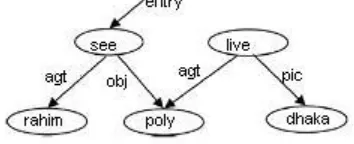
Consider the example in Figure 1 : Rahim lives in Dhaka.
Fig. 1. Simple UNL Representations
B. Multiple UNL Representations
Clausal sentences can be represented in more than one ways in UNL viz. either using a scope node (Compound-UW), or using multiple parents on some of the nodes. Consider the same example, "Rahim saw Poly who lives in Dhaka" in Figure 2.
This is the first representation: It is called the hyper-graph representation:
Fig. 2. Multiple UNL Representations (part 1)
The second way to represent this sentence is using multiple parents in Figure 3:
Fig. 3. Multiple UNL Representations (part 2)
Both are valid UNL representations for the same sentence. In the representation, the node "live" has no parents. And starting from the node marked "entry", we cannot reach this node (live) by following only child pointers. Such nodes are called "Orphans". However this is not the case with Compound Sentences.
Fig. 4. Multiple UNL Representations (part 3)
Based on this observation the UNL representation of a sentence can be classified in the following way:
Fig. 5. Multiple UNL Representations (part 4)
C. The Case of aoj-Parents
Multiple parents can also be encountered in case of aoj-relation like in the following example: "American novelist won Noble Prize". It‘s UNL-representation shown in Figure 6.
Fig. 6. Case of aoj-parents
Here even if we don't have a clausal or compound sentence we see a case of multiple parents. This is a sort of exceptional behavior and is not shown by any other relation.
D. Bangla – English Dictionary
Bangla to English dictionary is the source to build Bangla to UNL dictionary as universal words are English words mandated by UNL [16]. Such dictionaries also provide all attributes along with meaning of a word. Any entry in the dictionary is put in the following format:
[HW] {ID} ―UW‖ (ATTRIBUTE1, ATTRIBUTE2 . . .) <FLG, FRE, PRI>
Here,
HW <- Head Word (Bangla word)
ID <- Identification of Head Word (omitable) UW <- Universal Word
ATTRIBUTE <- Attribute of the HW FLG <- Language Flag
FRE <- Frequency of Head Word PRI <- Priority of Head Word
Some example entries of dictionary for Bangla are given below:
Here the attributes, N stands for Noun PLACE stands for place ADJ stands for Adjective
FLG field entry is B which stands for Bangla
E. Bangla to UNL En-Conversion:
An En-Converter is a software that automatically or interactively en-converts natural language text into UNL. As it generates UNL from natural languages, enables peoples to make UNL documents without any knowledge about UNL. It means that users of the UNL system do not need to learn UNL.
En-Converter is a language independent parser that provides synchronously a framework for morphological, syntactic and semantic analysis. It would be impossible to solve an ambiguity in morphological analysis without the use of syntactic or semantic information. Also, it would be impossible to solve an ambiguity in syntactic analysis without the use of semantic information.
En-Converter generates UNL expressions from sentences (or lists of words of sentences) of a Bengali language by applying en-conversion rules. In addition to the fundamental function of en-conversion, it checks the formats of rules, and outputs the messages for any errors. It also outputs the information required for each stage of en-conversion in different levels. With these facilities, a rule developer can easily develop and improve rules by using Converter. En-Converter loads the en-conversion rules and the rule checker works while converting rules. Once the rules are made, they are stored automatically and can be used directly the next time without rule conversion.
shahor {} ―city(icl>region)‖ (N, PLACE) <B,0.0>
prochur {} ―huge(icl>big)‖ (ADJ) <B,0,0>
Convert or load the rules.
Secondly, it inputs a string or a list of
morphemes/words of a sentence of Bengali language.
Input a Bengali sentence.
Then, it starts to apply rules to the Node-list from the initial state. En-Converter applies en-conversion rules to the Node-list. The process of rule application is to find a suitable rule and to take actions or operate on the Node-list in order to create a syntactic functionalities and UNL network using the nodes in the Analysis Windows. If a string appears in a window, the system will retrieve the Word Dictionary and apply the rule to the candidates of word entries. In this case, if a word satisfies the conditions required for the window of a rule, this word is selected and the rule application succeeds. This process will be continued until the syntactic functions and UNL network are completed and only the entry node remains in the Node-list [17].
Apply the rules and retrieve the Word Dictionary
Finally, it outputs the UNL network (Node-net) to the output file in the binary relation format of UNL expression.
Output the UNL expressions with the exception of the
first process of rule conversion and loading, once En-Converter starts to work, it will repeat the other
processes for all input sentences
.
Fig. 4.3. References between each process and the dictionary and the rule files
En-Converter analyses a sentence using the Word Dictionary, Knowledge Base, and En-conversion Rules. It retrieves relevant dictionary entries from the Word Dictionary, operates on nodes in the Node-list by applying En-conversion Rules, and generates semantic networks of UNL by consulting the Knowledge Base. The word entries of Bengali language are stored in the Word Dictionary. Each entry of the Word Dictionary is composed of three kinds of elements: the Headword, the Universal Word (UW) and the Grammatical Attributes. A headword is a notation/surface of a word of a Bengali language that composes the input sentence, and it is to be used as a Bengali En-conversion Rules.
Apply the rules and Retrieve the Word Dictionary
F. Bengali Input Sentence
Bangla Word
Dictionary
Knowledge Base
G. Output the UNL expressions
Trigger for obtaining equivalent UW‘s from the Word Dictionary in en-conversion. An UW expresses the meaning of the word and it is to be used in creating UNL networks (UNL expressions) of output. Grammatical Attributes are the information on how the word behaves in a sentence and they are to be used in en-conversion rules [18].
H. Bengali Language Specific and Language Independent Information
En-Converter analyses a sentence using the Word Dictionary, Knowledge Base, and En-conversion Rules. It retrieves relevant dictionary entries from the Word Dictionary, operates on nodes in the Node-list by applying En-conversion Rules, and generates semantic networks of UNL by consulting the Knowledge Base.
The word entries of Bengali language are stored in the Word Dictionary. Each entry of the Word Dictionary is composed of three kinds of elements: the Headword, the Universal Word (UW) and the Grammatical Attributes. A headword is a notation/surface of a word of a Bengali language that composes the input sentence, and it is to be used as a trigger for obtaining equivalent UW‘s from the Word Dictionary in en-conversion. An UW expresses the meaning of the word and it is to be used in creating UNL networks (UNL expressions) of output. Grammatical Attributes are the information on how the word behaves in a sentence and they are to be used in en-conversion rules.
For example binary relation
agt
in Knowledge base
UW1 – should be a action (do) and
UW2 – should be a thing
E.g. ‗sha douray‘ (he run)
‗sha‘ - a thing
‗douray‘ – do (action)
An En-conversion Rule is composed of Conditions for the nodes placed on the Analysis and Actions and/or Operations for the nodes placed on the Analysis Windows. Such en-conversion rules describe the kind of actions and/or operations that should be carried out for all phenomena of a language, and under what conditions. En-Converter will find the most suitable rule every time, and create a UNL expression. A set of UNL expressions of a sentence will finally be completed after having applied a set of all the necessary rules.
Basically the En-converter needs certain information from the input sentences. The information is available at various linguistic levels either the morphological, syntactic or semantic levels. The amount and type of information available at each level is largely dependent on the characteristics of the language. This means the design of the En-converter is decided by what information is needed by UNL and the nature of the language, which decides on the type of information that can be extracted from the various linguistic levels. UNL has separate concepts for noun, verb, adjective and adverb in other words there is a need to syntactically categorize the words of the sentence. For a noun the attributes to be included in the concept definition in UNL is number. For the verb the concept definition tense marker is required. The next important part of UNL is the definition of relations. These include case relations of noun concepts with the corresponding verbs, association of adverbial components with verb definitions and the association of adjectival components with the noun definitions.
In this paper the extraction of the information needed in building the UNL structures from the various linguistic levels of Bengali language has been discussed.
VI. SCOPE OF FUTURE WORK (RESEARCH) FUTURE WORK IN THIS PROJECT INCLUDES THE FOLLOWING
INSTRUCTIONS, WHICH ARE:
To establish a Bangla Language Server, this will contain
a comprehensive Bangla UNL Dictionary.
To build up an En-Conversion and De-Conversion
system applying the analysis rules to convert Bangla to UNL Document and generation rules to convert UNL document to Bangla.
To remove ambiguity of words and to provide strong
ambiguity handling rules by applying word net.
To establish of an UNL Center for Bangla like the
sixteen other official languages of the UNL project to perform effective research and to develop and
co-ordinate activities among researchers, developers, and the Universal Networking Digital Language (UNDL) Foundation.
VII. CONCLUSION
In this research document, I have described the various issues in details that involved in Bangla to UNL generation and the ways we improvised to approach them. I have presented simple and multiple Bangla sentence structure/ syntax for converting the natural Bangla sentences to UNL documents and vice versa. After that I have clearly mentioned
the ambiguity problems and some other future
recommendations to fix those issues.
VIII. REFERENCES
[1] The Summer Institute for Linguistics (SIL) Ethnologue Survey, 1999. [2] H. Uchida, M. Zhu, ―The Universal Networking Language (UNL)
Specification Version 3.0‖, Technical Report, United Nations University, Tokyo, 1998
[3] H. Uchida , M. Zhu , T.G. D. Senta ―Universal Networking Language‖, 2005/6-UNDL Foundation, International Environment House. [4] A Gift for a Millennium, Hiroshi Uchida, Meiying Zhu, Tarcisio Della
Senta.
[5] UNL 2005 Specifications, Chapter 2, UNL Center of UNDL Foundation.
[6] James Allen, Natural Language Understanding, Pearson Education, 2004.
[7] R..M.K.Sinha UNL: Beyond MT: An Indian Press ,Proceeding of LEC‘02.
[8] Jitender Singh and Gajendra Agrawal: Information Need and Dissemination: Indian Rural Context,Indo European Systems Usability Partnership Conference, ICHI 2004 on Human Computer Interface, Bangalore, December, 2004.
[9] Zhu, Meiying., Uchida, Hiroshi., UNL Center, UNDL Foundation – Universal Word and UNL Knowledge Base -invited presentation at ICUKL-2002 at 25-29 Nov. 2002, Goa of India.
[10] T.Dhanabalan, T.V. Geetha : UNL Deconverter for Tamil : International Conference on the Convergence of Knowledge, Culture, Language and Information Technologies, December2-6, 2003. [11] Kuntal Deyl and Pushpak Bha1racharyya, ―Universal Networking
Language Based Analysis and Generation for Bengali Case Structure Constructs‖, Page 2.
[12] Sinha, R.M.K. and Jain, A.: Angla Hindi: An English to Hindi Machine- Aided Translation System, Machine Translation Summit IX, New Orleans, Louisiana, USA, September 23-27, 2003.
[13] P. Bhattacharyya: Multilingual Information Processing Using Universal Networking Language, Indo UK Workshop on Language Engineering for South Asian Languages (LESAL), Mumbai, India, April, 2001. [14] Uchida, Hiroshi, ―The Universal Networking Language Beyond
Machine Translation‖, ―International Symposium on Language in Cyberspace‖ held at 26-27 September 2001, Seoul of Korea, Dave.
[15] UNL Wiki,
―http://www.unlweb.net/wiki/index.php/Dictionary_Specs‖.
[16] UNL Wiki,
―http://www.unlweb.net/wiki/index.php/FAQ#What_is_a_node_list.3F ‖.
[17] Md. Zakir Hossain, Shahid Al Noor, Muhammad Firoz Mridha , ―Some Proposed Standard Models for Bangla Dictionary Entries of Bangla Morphemes for Universal Networking Language‖, Sec-4.
[18] Md. Musfique Anwar, Nasrin Sultana Shume and Md. Al-Amin Bhuiyan, ―Structural Analysis of Bangla Sentences of Different Tenses for Automatic Bangla Machine Translator‖