Volume 1, Issue 3 (September 2012) PP: 27-31
A Dynamic Approach to Multicast Communications
Using Decentralized Key Management
D.Chalapathirao
1, K.Rajendra Prasad
2, S.Venkata Rao
3 1Department of CSE, Chaithanya Engg.College, Visakhapatnam, A.P., India
2Assoc. Professor, Department of CSE, Chaithanya Engg College, Visakhapatnam, A.P., India. 3Assist. Professor, Department of CSE, Kaushik College of Engg, Visakhapatnam, A.P., India.
Abstract–– The security in the multicast communication in the large groups is the major obstacles for effectively controlling access to the transmitting data. The IP Multicast itself does not provide any specific mechanisms to control the intruders in the group communication. Group key management is mainly addresses upon the trust model developed by Group Key Management Protocol (GKMP). There are several group key management protocols that are proposed, this paper will however elaborate mainly on Group key management which has a sound scalability when compared with other central key management systems. This paper emphases protocol which provides a scope for the dynamic group operations like join the group, leave the group, merge without the need of central mechanisms. An important component for protecting group secrecy is re-keying. With the combination of strong public and private key algorithms this would become a better serve to the multicast security.
Index Terms––Group key management, multicast security, scalability.
I.
INTRODUCTION
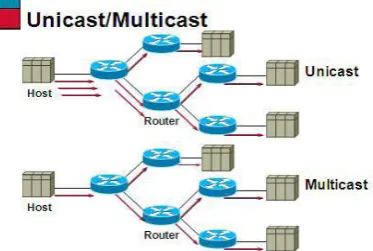
1.1 Unicast - Broadcast Multicast
The multicast group can be identified with the class D IP address so that the members can enter or leave the group with the management of Internet group management protocol. The trusted model gives a scope between the entities in a multicast security system. For secure group communication in the multicast network, a group key shared by all group members is required. This group key should be updated when there are membership changes in the group, such as when a new member joins or a current member leaves. Along with these considerations, we take the help relatively prime numbers and their enhancements that play a vital role in the construction of keys that enhances the strength for the security.
Multicast cryptosystems are preferably for sending the messages to a specific group of members in the multicast group. Unicast is for one recipient to transfer the message and „Broadcast‟ is to send the message to all the members in the network. Multicast applications have a vital role in enlarging and inflating of the Internet. The Internet has experienced explosive growth in last two decades. The number of the Internet users, hosts and networks triples approximately every two years. Also Internet traffic is doubling every three months partly because of the increased users, but also because of the introduction of new multicast applications in the real world such as video conferencing, games, ATM applications etc..broad casting such as www, multimedia conference and e-commerce, VOD (Video on Demand), Internet
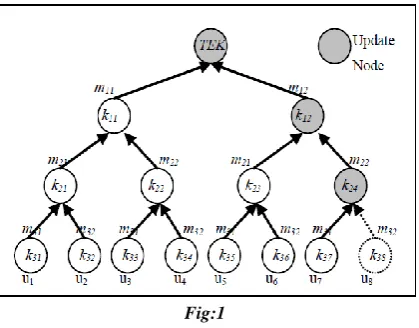
Fig:1
Figure 1 depicts the key and modulus graph, where TEK is a traffic encryption key, kij is a key encryption key, and
mij is a modulus. Moduli Maintenance: The key server needs to store 2log2n moduli and each member needs to store log2n
moduli but they do not need to keep the moduli secret. The sibling nodes in the tree graph are assigned with two different moduli (i.e., mi1 and mi2 where i is the depth of the tree) and the nodes in the different level of the tree are assigned with the different moduli but each a pair of siblings at the same tree depth are assigned with the same two moduli under the different parents (see Figure 1). This means there are only 2log2n different moduli in the tree graph, i.e. mij (1≤i≤log2n, j=1, 2) where
i is the depth of the node in the tree, and the nodes (except the root) on a path from a leaf to the root and its direct children exactly cover all moduli. For instance, in Figure 1, for a path from u1 to the root, the moduli on the path include m11, m21, and m31, and the moduli on its direct children include m12, m22, and m32. In addition, all different moduli in the tree graph should be pair wise relatively prime (i.e., gcd (mij, mst)=1 for i_=s or j_=t), and each modulus should be bigger than the key encryption value, i.e., mij>Ekil (kst) where mij and kil belong to the same node and kst belongs to its parent node. Key Maintenance: The key server needs to store 2n-1 keys,i.e., TEK and kij(1≤i≤log2n, 1≤j≤2i) where i is the depth of the node in the tree and j is the ordinal number of the node in the ith depth of the tree, and each member needs to store log2n+1 keys. The key server shares the keys with each member on the path from its leaf to the root. The keys on its path from the leaf to the root need to be updated in the protocol when a member joins or leaves the group but all moduli must be kept fixed. To update the keys on the tree graph, the key server generates a new key for each update node and encrypts it with its children keys on its path from the leaf to the root. For instance, the key server needs to generate new keys {TEK_, k_il} to update
{TEK, kil} for the arrival of member ud (its leaf key is kwd, w=log2n) to the group, where 1≤i≤log2n-1 and l=_d/2log2n−i_ which is the upper limit integer of d/2log2n−i, and encrypts the updated keys using the following formula, where
e=_d/2log2n−i−1_ and v=_d/2log2n−1_:
Each member decrypts the updated traffic encryption key and related key encryption keys based on their own moduli and keys. For the departure of member ud from the group, the process is as same as the above except calculating Kwd
(i.e., Kwd=0).
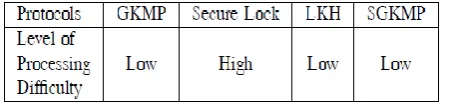
TABLE I : A COMPARISON ON LEVEL OF PROCESSING DIFFICULTY
As an illustration, we give the following example for the re-key process in Figure 1, where the member u8 requests to join the group. The key server generates new keys {TEK_,k_12, k_24} to update {TEK, k12, k24} and does the following encryption: K38=Ek38 (k_24), K37=Ek37 (k_24), K24=Ek_24 (k_12),K23=Ek23 (k_12), K12=Ek_12 (TEK_), K11=Ek11 (TEK_). The key server then calculates a lock as L=K38M32y32+K37M31y31+K24M22y22+K23M21y21+K12M12y12 +
K11M11y11 mod M, where M=m11m12m21m22m31m32, Mij=M/mij , yij=M−1ij mod mij .
In the protocol, we can see that the key server uses the same modulus (M) and parameters (Mij, yij ) to calculate the lock for any re-key process but the key encryption value (i.e., Kst) for calculating the lock are changed based on the re-key requested by the different members. This means the re-key server can pre-calculate the modulus (M) and parameters (Mij, yij ) to be used for later re-key processing steps and only needs to calculate them once for a fixed tree graph.
III.
SCALABILITY OF GROUP KEY MANAGEMENT PROTOCOLS
In order to measure the scalability of group key management protocols more accurately, we propose the following scalability metrics: „computational complexity‟, „bandwidth usage‟, „storage‟, „number of re-key messages‟, and „level of processing difficulty‟. Computational complexity measures the processing time in the central key server. Bandwidth usage accounts for the size of total messages sent out by the key server for a re-key process. Storage measures the total size of keys maintained by the key server. The number of rekey messages is the number of such messages needed to be processed by the key server. The level of processing difficulty indicates applicability for small mobile devices. Table I gives a comparison on the level of processing difficulty. Table II gives a comparison of the new protocol with the GKMP, Secure Lock, and LKH protocols without signature protection. Table III gives a comparison with signature protection, where storage and number of re-key messages are the same as in Table II.The signature technique for GKMP and LKH is based upon a single digital signature scheme proposed by Merkle, which has been the most efficient method so far for signing a set of messages destined to different receivers. From Tables II and III, we see that the LKH and SGKMP reduce the encryption operation and bandwidth usage from O(n) to O(log n) when compared to the Secure Lock and GKMP protocols, and the length of the lock from O(n) to O(log n) when compared to the Secure Lock. In addition, SGKMP has better performance when compared to the LKH protocols. The detailed processing time performance according.
• N is the length of the encrypted secret key (default is 128 bits for a symmetric cryptograph) or the length of a hash value (default is 128 bits)
• L is the length of the signature
• n is the number of members
• H is a hash operation
• E is a symmetric key encryption operation
• S is a signature operation
• A is an Big Integer addition operation
• M is a Big Integer multiplication operation
• MD is a Big Integer modulus operation
• MR is a Big Integer modulus reverse operation to computational complexity is tested in the next section for both with and without the signature operation.
IV.
PERFORMANCE OF THE NEW PROTOCOL
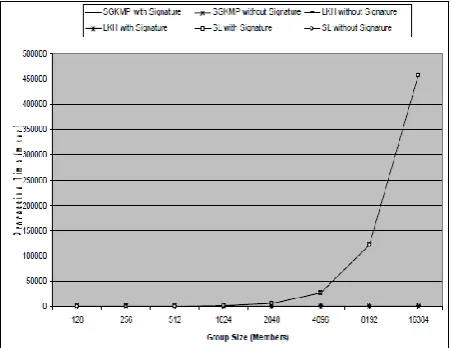
The performance of the SGKMP, LKH, and Secure Lock protocols were tested in order to compare their scalability. The testing was done on a PC (Intel Pentium 4 CPU 3.00GHz and 1 GB RAM). The software used for the testing was Java JDK 1.6. The main classes included Java Big Integer, security, and crypto. The encryption algorithm was AES with a 128 bit encryption key, and the signature algorithm was 512 bit RSA. The testing determined the processing time performance according to group size (see Figure 2 and 3) both with and without signature protection. From the testing results, we can see that the Secure Lock has very poor scalability when compared to SGKMP and LKH (Figure 2, where the SGKMP and LKH are in the bottom), and the SGKMP has very good scalability for both with and without signature protection when compared to LKH (Figure 3). The processing time of SGKMP with signature for a rekey request corresponding to a group size of up to a million members is less than 10 milliseconds.
Fig.3. Performance of the SGKMP and LKH protocols.
V.
CONCLUSION & FUTURE SCOPE
To improve the scalability of group key management, we propose a scalable group key management protocol and demonstrate that it has better scalability in terms of computational complexity (from testing) and bandwidth usage (from calculations in Tables II and III). The security of PGKMP is mainly based on neighborhood authentication of the nodes, as well as on security associations, while the use of public key cryptography is minimized. PGKMP finds disjoint paths only, so the route discovery cost will be less as compared to LKH where all possible paths exist and a key server has to be maintained. Also due to the double encryption scheme provided to the protocol, the network is more secured. There is a scope to further decrease the overheads and increase more security with this Protocol (PGKMP) and a positive hope for the enhancement of this protocol.
REFERENCES
1. C. K. Wong, M. Gouda, and S. S. Lam, “Secure group communications using key graphs,” IEEE/ACM Trans. Networking, vol.8, no.1, pp.16–30, Feb. 2000.
2. D. Wallner, E. Harder, and R. Agee, “Key management for multicast: issues and architecture,” National Security
Agency, RFC 2627, June 1999.
3. H. Harney and C. Muckenhirn, “Group Key Management Protocol (GKMP) architecture,” RFC 2093, July 1997.
4. H. Harney and C. Muckenhirn, “Group Key Management Protocol (GKMP) specification,” RFC 2094, July 1997.
5. G. H. Chiou and W. T. Chen, “Secure broadcast using secure lock,” IEEE Trans. Software Engineering, vol. 15, no. 8, pp. 929–934, Aug. 1989.
Mr. D.CHALAPATHI RAO has received Post Graduation MSc (Maths) from the Department of Mathematics, Andhra University in 2008. He is pursuing Master of Technology in the Dept of Computer Science Engineering, Chaithanya Engineering College, Vishakhapatnam, and JNT University. His research interests are Computer Networking.