Volume 7, Issue 2 Ver. II [February 2018] PP: 21-28
The Intensity Pattern of Nasals in Disyllabic Words in Madurese
Maolin Wang
College of Chinese Language and Culture / Institute of Applied Linguistics, Jinan University, Guangzhou, China,
Corresponding Author: Maolin Wang
Abstract: In this study, the intensity pattern of nasals of disyllabic words in Madurese is investigated, and the effect of position and syllable structure is examined. It is found that due to the effect of initial strengthening, in the CV syllable and the onset position of the CVC syllable, the intensity values of nasals are much larger in the second syllable than in the first syllable. At the edges of words, initial consonants show more linguopalatal contact than word-medial or word-final consonants, which are called articulatory strengthening. When the nasals are at the initial position of words, their articulation is strengthened, being more consonant-like, so the intensity is weak. Because of the intervocalic weakening effect, in the VC syllable and the coda position of the CVC syllable, the intensity values of nasals in the first syllable are larger than those of the second syllable. Keywords: Intensity, syllable, nasal, strengthening
--- ---Date of Submission 27-02-2018 ---Date of acceptance: 14-03-2018 --- ---
I.
INTRODUCTIONNasals are phonetic sounds in the production of which air escapes through the nose but not through the mouth, as it is blocked by the lips or tongue. The oral cavity still acts as a resonance chamber for the sound in the articulation. During the articulation of the nasal, the oral tract is closed at the place of articulation. This is the start of the stop occlusion. Only the oral cavity is occluded. Air is free to flow through the nasal cavity. During the oral occlusion air continues to be expelled from the lungs. Usually the vocal folds are together and are vibrating, and both the airflow and the majority of the voiced sound energy pass through the nasal cavity. Some sound energy also passes into the part of the oral cavity posterior to the occlusion. This posterior part of the oral cavity modifies the quality of the sound to create the distinctive sound qualities of each of the nasal stops [1, 2]. When the nasal phoneme is finished, the oral closure may be released, unless this is prevented by the requirements of the next phoneme. Because air pressure is released through the nose, there is usually not an audible burst when the oral occlusion is released. The active articulator continues to move towards its target for the next phoneme. The velum is free to close now, unless this is prevented by the requirements of the next phoneme.
Most nasals are voiced, and in fact, the nasal sounds [n] and [m] are among the most common sounds cross-linguistically. Voiceless nasals occur in a few languages such as Burmese, Welsh, Icelandic and Guarani. Nasals are different from oral, which block off the air completely, and different from fricatives, which obstruct the air with a narrow channel. Both stops and fricatives are more commonly voiceless than voiced, and are known as obstruents. In terms of acoustics, nasals are sonorants, which mean that they do not significantly restrict the escape of air, as it can freely escape out the nose. However, nasals are also obstruents in their articulation because the flow of air through the mouth is blocked. This duality, with sonorant airflow through the nose along with an obstruction in the mouth, means that nasal occlusives behave both like sonorants and like obstruents. For example, nasals tend to pattern with other sonorants such as [r] and [l], but in many languages, they may develop from or into stops.
the sonagram: for [m] compared to [n] there is a clear decrease in the acoustic energy around 1000Hz and again at around 3000Hz.
The decrease in energy around 1000Hz means that now not only F3 but also F2 is more or less cancelled out. For the anti-resonances related to the mouth cavity it is also much easier to work out a rough estimate of their expected frequencies than it is for the side-tubes formed by the nasal sinuses. The mouth cavity can be considered as a tube closed at one end at the lips and open at one end at the opening into the pharynx near the uvular. The resonances of this tube system will appear as anti-resonances in the output signal. The formula for calculating the resonances is exactly the same as that used for calculating the resonances of a neutral tube as for schwa. Assuming a length of the mouth tube of about 8cm, this gives about 1000Hz and 3000Hz for the first two resonance frequencies. Thus we expect very little energy in the output signal at these frequencies [4, 5]. These are indeed the frequencies at which we observed the major differences between [n] and [m]. An important further consequence of this basic principle is that the location of these anti-resonances will move upwards in frequency as the place of articulation of the nasal moves back in the mouth from bilabial to alveolar or palatal.
The spectral structure of nasal consonants is formed by the resonances of the pharyngeal, nasal, and oral cavities. Production of a nasal consonant requires coordinating the lowering of the velum, thereby opening the velo-pharyngeal port, with the closing of the oral cavity to allow sound to be propagated through the nasal cavity, followed by coordinating the raising of the velum in conjunction with the release of the oral closure. The acoustic consequence of having sound pass through the nasal cavity is the occurrence of a nasal murmur prior to the release of the oral closure. The nasal murmur which contains spectral information for both manner and place of articulation is the definitive attribute the nasals. The manner cues for nasals include the presence of a low-frequency resonance due to the nasal cavity, and the rapid fall and rise in energy as the nasal is made and released. The place cues to nasals mostly arise from the second and third formant transitions, as for plosives [6]. In addition, the spectral shape of the nasal itself varies slightly with the place of the obstruction in the vocal tract. This seems to be due to the size of the cavity trapped behind the obstruction which modifies the filter characteristic of the branched tube.
A nasal consonant is a consonant whose production involves a lowered velum and a closure in the oral cavity, so that air flows out through the nose. Nasalized sounds are sounds whose production involves a lowered velum and an open oral cavity, with simultaneous nasal and oral airflow. The most common nasalized sounds are nasalized vowels, as in French ‗vin‘ (wine), although some consonants can also be nasalized. Almost all known languages have nasal phonemes, which are among the first sounds acquired by children. On the other hand, nasalized phonemes are much rarer, although nasalized allophones often occur as the result of phonological and phonetic processes of nasalization. Processes of nasalization have informed phonological theory, in particular, nonlinear approaches. In nasalized speech, the coupling of the nasal side chain to the phonetic tract results in additional peaks and valleys in the voice spectrum. An extra pole-zero pair between the first two formants was found in the speech of nasalized vowels of adults with normal-hearing.
When the velum is sufficiently lowered during the production of a vowel, the nasal tract becomes acoustically coupled to the main vocal tract, and the resulting sound is perceived by listeners as nasalized or nasal. Certain languages use velopharyngeal aperture to achieve a phonemic contrast between oral and nasal vowels. Over the years, many researchers have attempted to determine which acoustic cues signal vowel nasality. The behavior of oral and nasal formants and antiformants is constrained by the laws of physics. When the velopharyngeal port opening area increases from zero to the maximum—with concomitant decrease of the oral passage cross-sectional area from the original value to zero—the oral vowel formants and nasal formants will shift upward or downward in the frequency domain. However, no formant can meet or overtake another.
The nasal cavity and its related structures make significant contributions to mechanisms of human phonation. The resonance of voice spectra is closely related to the characteristics of the nasal cavity. A common voice change related to nasal cavities is hyponasality, which usually occurs with nasal obstruction during the episodes of acute rhinitis or nasal allergy. Moreover, hypernasality that results from cleft palate or velopharyngeal insufficiency interferes with speech intelligibility as well [7, 8]. These changes in the voice can be promptly identified by experienced experts using only their ears. The acoustic mechanisms coupled to human ears are basically derivations of Fourier transformation. Knowing this, power spectrum analysis of a voice may potentially provide a possible and objective way of evaluating hyponasality and nasal airway obstruction. Spectral characteristics of nasalized speech, such as a reduction of the intensity of the first formant, the increased bandwidth of formants, and the presence of pole-zero pairs, have been reported in the literature [9, 10]. Significant voice changes are observed when the nasal cavities and the related structures are changed, either medically or surgically [11].
time interval that the velum is closing. The same holds true for the final portion of a vowel preceding a nasal consonant. The amount of co-articulated nasalization depends upon the particular language and dialect. Coarticulatory nasalization of the vowel preceding a nasal consonant is a regular phenomenon in all languages of the world. The coarticulation can, however, be so large that the nasal murmur is completely deleted and the cue for the nasal consonant is only present as nasalization in the preceding vowel.
Phonetic descriptions indicate that vowel nasalization occurs more often and for a longer duration in anticipatory contexts than in carryover contexts [12]. In an articulatory study on nasalization, velic motion was measured and it was found a greater degree of velum lowering in stressed and high-speaking-rate conditions [13]. It was also shown that the velum is lowered during vowels preceded by nasal consonants. This closing velic movement rate is approximately up to 1.6 times more rapid than the opening movement in vowels followed by nasal consonants, implying that vowels may be more nasalized in pre-nasal positions [14]. Though these articulatory and phonetic studies suggest that nasalization exists in vowels preceded by nasal consonants, some language pedagogy books claim there is no vowel nasalization at all in such phonetic contexts.
In order to characterize acoustic properties of nasal and nasalized vowels, these sounds can be considered as a dynamic trend from an oral configuration toward a nasal-like configuration. The latter can be viewed as a target for vowel nasalization. This target corresponds to the pharyngonasal tract and it can be modeled, with some simplifications, by a single tract without any parallel paths. Thus the first two resonance frequencies characterize this target well. A series of measurements has been carried out in order to describe the acoustic characteristics of the target. Measured transfer functions confirm the resonator nature of the low-frequency peak [15]. The introduction of such a target allows the conception of the nasal vowels as a trend beginning with a simple configuration, which is terminated in the same manner, so allowing the complex nasal phenomena to be bounded. It allows the proposition of a common strategy for the nasalization of all vowels, so a true nasal vowel can be placed in this nasalization frame.
A nasal vowel is produced, in articulatory terms, by the gesture of lowering the velum, which establishes an acoustic coupling between the oral cavity and the nasal cavities. Traditionally, simulations using transmission line models have often been carried out, since they give reasonably satisfactory results in the case of oral vowels. When using this simulation for nasal vowels, the nasal tract is connected to the oral tract with a certain degree of coupling. This connection introduces several zeros and supplementary peaks in the speech spectra. However, these simulations have not permitted a satisfactory extraction of nasal acoustic cues since there are too many poles/zeros; they vary as a function of the degree of coupling, which is a very difficult parameter to control. In addition, these simulations seem to be incapable of producing high quality synthetic nasal sounds.
Sound energy is conveyed to our ears by means of a wave motion through some medium. At any given point in the medium the energy content of the wave disturbance varies as the square of the amplitude of the wave motion. That is, if the amplitude of the oscillation is doubled the energy of the wave motion is quadrupled. The common method in gauging this energy transport is to measure the rate at which energy is passing a certain point. This concept involves sound intensity. Consider an area that is normal to the direction of the sound waves. If the area is a unit, namely one square meter, the quantity of sound energy expressed in Joules that passes through the unit area in one second defines the sound intensity. Normally, sound intensity is measured as a relative ratio to some standard intensity. The response of the human ear to sound waves closely follows a logarithmic function of the form.
Intensity is the way that the human ear perceives sound. At its simplest, when the amplitude is increased, sound gets louder, and when it is decreased, sound gets quieter. There are two things that contribute to our perception of sound. The first is the amplitude of the sound and the second is the frequency of the sound. Both of these things are precise measurements of sound rather than a perception. This change in loudness brought on by an increase in amplitude is not proportionate. It all comes down to waveforms and how they vibrate. It is these vibrations that make sound. Amplitude affects the size of the vibration, while the frequency affects the speed of the vibration. This is what gives sound its pitch. So, a sound with the same level of amplitude but a different frequency will have a different loudness to the human ear. For example, a bass sound will sound quieter than a mid-range sound even when both have the same amplitude. If the amplitude of the bass sound is increased, its volume will increase and it will become louder.
The present study will investigate the intensity pattern of nasals under the effect of position and syllable structure in Madurese. It is aimed to present the variation of nasal intensity in the first and the second syllables of the word, and the effect of syllable structure on nasal intensity.
II.
METHODOLOGY 2.1. Studying materialsCV: mate (to go out) mateh (death of animals); VC: anteng (earring) anyar (new)
CVC (onset): massak (cook food) messak (tough) CVC (coda): bangbong (hoodlum) bangku (bench)
The intensity of nasal is variable in Madurese. Within a word, the nasal may in the first syllable, or in the second syllable, and its syllable may be of various types, like CV, or CVC. In this study, only nasal intensities of two-syllable words are investigated. The variables of syllable position, i.e., first syllable and second syllable, and syllable types, like CV or CVC, will be taken into consideration.
2.2. Procedure and measurements
This study aims to investigate the intensity pattern of nasals of two-syllable words in Madurese, so intensity values of nasals of various syllable position and various syllable types are investigated. The intensity value of each nasal is extracted using the software of Praat [16]. The intensity values of nasals at different word positions and different syllable structures are compared.
III.
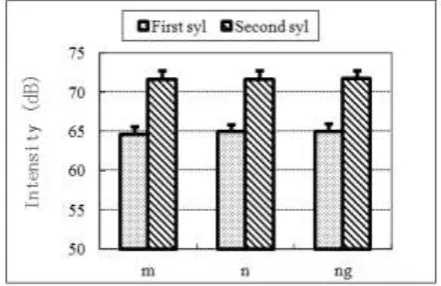
RESULT 3.1 CV syllableFigure 1 displays the intensity values nasals in the CV syllables, and it is show that the intensity value is much larger in the second syllable than in the first syllable. Nasal intensity of the second syllable is about 72 dB, while that of the first syllable is about 65 dB. No matter occurring in the first syllable or the second syllable, the intensity value of the velar nasal is a little less than those of labial and alveolar.
Fig. 1 Nasal intensity of the CV syllable
3.2 VC syllable
In Figure 2, the intensity pattern of nasals in the VC syllable is displayed. It is shown that for the alveolar and velar nasals, the intensity values in the first syllable is much larger than those in the second syllable, while for the labial nasal, that of the second syllable is larger. When occurring in the first syllable, the intensity of the velar nasal is the strongest, and that of the labial nasal is the weakest, while when occurring in the second syllable, the of the labial nasal is the strongest, and that of alveolar nasal is the weakest.
3.3 CVC syllable 1) At the onset position
As for the CVC syllable, Figure 3 displays the intensity values of nasals in this condition. It is shown that, at the onset position of CVC syllable, the intensity pattern is quite similar to that of the CV syllable. For all the three nasals, the intensity values of the second syllable are much larger than those of the first syllable, and the intensity values of the three nasals are quite close to each other. In the second syllable, the values are about 72 dB, while in the first syllable, they are about 65 dB.
Fig. 3 Intensity of nasals at the onset of the CVC syllable
2) At the coda position
When occurring at the coda position of the CVC syllable, the intensity pattern is to some extent similar to that of the VC syllable, as is shown in Figure 4. In the figure, it is shown that for all the three nasals, the intensity values of nasals in the first syllable are larger than those of the second syllable. In the first syllable position, the intensity value of velar nasal is comparatively large, while in the second syllable position, its value is relatively small.
Fig. 4 Intensity of nasals at the coda of the CVC syllable
IV.
DISCUSSIONResults from the previous section show that there is strong effect of syllable position on the intensity of nasals. In the CV syllable and the onset position of the CVC syllable, the intensity value is much larger in the second syllable than in the first syllable. We suppose this is due to the effect of initial strengthening. In the first syllable, the nasal is right at the initial position of the word. Its articulation is strengthened, being more consonant-like, so the intensity is weak. Researchers have found in previous work that consonants at beginnings of phrases are more constricted than consonants in the middles of phrases, and furthermore, consonants at the beginnings of larger phrases are more constricted than consonants at the beginnings of smaller phrases, or of words. Such a pattern has been interpreted as a kind of strengthening of a consonant‘s oral articulation according to the strength of its prosodic position, i.e., the stronger the position, the stronger the articulation, and referred to as ‗domain-initial strengthening‘.
contact than domain-medial or domain-final consonants, at three prosodic levels. Most vowels show less linguopalatal contact in domain-final syllables compared to domain-initial and domain-medial. As a result, the articulatory difference between segments is greater around a prosodic boundary, increasing the articulatory contrast between consonant and vowels, and prosodic domains are marked at both edges. Furthermore, the consonant initial strengthening is generally cumulative, i.e., the higher the prosodic domain, the more linguopalatal contact the consonant has. It is suggested that this initial strengthening could provide an alternative account for previously observed supralaryngeal declination of consonants. Acoustic duration of the consonants is also affected by prosodic position, and this lengthening is cumulative like linguopalatal contact.
For domain-initial strengthening, the lingual articulations appeared to be stronger for consonants at the beginning of each prosodic domain. It has been discussed that there are some possible mechanisms, including articulatory undershoot of shorter segments, overshoot of consonants after lengthened domain-final vowels, coarticulatory resistance by segments in initial positions, and overall greater articulatory effort for initial segments. The idea that longer durations allow articulatory targets to be more closely approximated, while shorter durations result in undershoot of those targets can readily be related to initial strengthening. If initial segments are longer, then they would have more time to achieve more extreme articulations.
It is also shown from the results that, in the VC syllable and the coda position of the CVC syllable, the intensity values of nasals in the first syllable are larger than those of the second syllable. This is due to the intervocalic weakening effect. When the nasal is in the first syllable of the VC syllable, it is right in the intervocalic position. The phonetic weakening of intervocalic consonants may be considered within a larger phenomenon affecting other voiceless consonants. A number of acoustic studies have shown that, especially in casual speech, the intervocalic voiceless stops /p t k/ have a tendency to voice and further weaken to approximants. This lenition is an incipient, optional phenomenon, much more common in spontaneous speech than in reading style and subject to substantial individual variation.
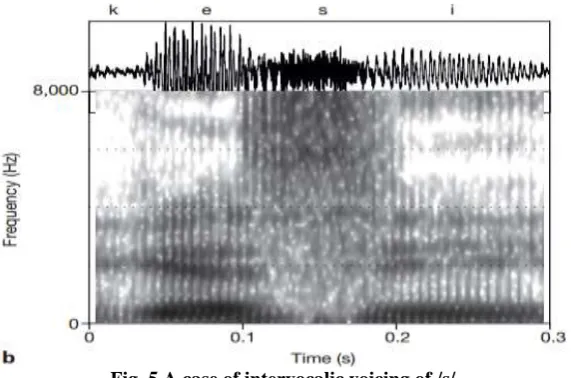
Research shows that when the fricative /s/ is in the intervocalic position, it will get weak. It is indicated that voicing is interrupted for around 80 ms, which is shown by the lack of a voicing bar and periodic energy in the time region of the spectrogram corresponding to the fricative consonant, as in Figure 5. In that time region, energy drops in the lower part of the spectrum, reflecting the formation of a front oral constriction, and sharply increases above 3.5 kHz, reflecting the creation of turbulence at the constriction.
It is the prominent concentration of aperiodic energy in mid-high regions of the spectrum that gives [s] its characteristic sibilant quality. In Figure 6, voicing is present throughout much of the realization of the fricative and gradually disappears towards its mid- point, before picking up as the transition into the upcoming vowel approaches.
Fig. 6 Another case of intervocalic voicing of /s/
It can be seen that there is a less sharp decrease in low-frequency energy, resulting perhaps from a less narrow oral constriction and the presence of voicing. Frication noise in the mid-high frequencies is less prominent, and in both cases voicing continues uninterrupted throughout the [s] consonants with no visible signs of decay. Moreover, the duration of the consonants, as estimated informally from the amplitude envelope in the waveforms and the occurrence of aperiodic energy in the spectrograms, appears to be significantly shorter than that of the examples in Figure 5. The examples in figure 7 illustrate cases of extreme weakening. Frication noise in the example is considerably weaker than in the previous ones, to the point that it is hardly visible.
As in the examples in Figure 6, voicing continues uninterruptedly throughout the vowel-/s/-vowel sequences. These examples make it apparent that the familiar correlates of a voiceless fricative, aperiodic energy in the high frequencies and lack of periodicity throughout the consonant, are not always present, and that, if present, they may be very weak.
Fig. 7 An extreme case of intervocalic voicing of /s/
V.
CONCLUSIONat both edges. The idea that longer durations allow articulatory targets to be more closely approximated, while shorter durations result in undershoot of those targets can readily be related to initial strengthening.
ACKNOWLEDGEMENTS
The research reported here is partially supported by China National Social Science Fund, No. 16ZDA211.
REFERENCES
[1]. Dalston R. M, Warren D. W, Dalston E. T. A preliminary investigation concerning the use of nasometry in identifying patients with hyponasality and/or nasal airway impairment. J. Speech Hear Res. 1991;34:11–18.
[2]. Younger R, Dickson R. I. Adult pharyngoplasty for velopharyngeal insufficiency. J. Otolaryngol. 1985;14: 158–162. [3]. Curtis J. F. The acoustics of nasalized speech. Cleft Palate J. 1970; 7: 480–496.
[4]. Lindqvist-Gauffin J, Sundberg J. Acoustic properties of the nasal tract. Phonetica. 1976;33:161–168.
[5]. Williams R. G, Eccles R, Hutchings H. The relationship between nasalance and nasal resistance to airflow. Acta Otolaryngol. 1990;110:443–449.
[6]. Soneghet R, Santos R. P, Behlau M, Habermann W, Friedrich G, Stammberger H. Nasalance changes after functional endoscopic sinus surgery. J. Voice. 2002;16: 392–397.
[7]. Hong K. H, Kwon S. H, Jung S. S. The assessment of nasality with a nasometer and sound spectrography in patients with nasal polyposis. Otolaryngol Head Neck Surg. 1997;117: 343–348.
[8]. Chuma A. V, Cacace A. T, Rosen R, Feustel P, Koltaii P. J. Effects of tonsillectomy and/or adenoidectomy on vocal function: laryngeal, supralaryngeal and perceptual characteristics. Int. J. Pediatr Otorhinolaryngol. 1999;47:1–9.
[9]. Chen M. Y. Acoustic parameters of nasalized vowels in hearing-impaired and normal-hearing speakers. J. Acoust Soc. Am. 1995;98:2443–2453.
[10]. Kataoka R, Warren D. W, Zajac D. J, Mayo R, Lutz R. W. The relationship between spectral characteristics and perceived hypernasality in children. J. Acoust Soc. Am. 2001;109: 2181–2189.
[11]. Chen MY, Metson R. Effects of sinus surgery on speech. Arch Otolarygol Head Neck Surg. 1997;123: 845–852.
[12]. Dang J, Honda K. Acoustic characteristics of the human paranasal sinuses derived from transmission characteristic measurement and morphological observation. J. Acoust Soc. Am. 1996;100: 3374–3383.
[13]. Lee G-S, Yang CCH, Kuo TBJ. Voice low tone to high tone ratio - a new index for nasal airway assessment. Chin. J. Physiol. 2003;46:123–127.
[14]. Feng G, Castelli E. Some acoustic features of nasal and nasalized vowels: a target for vowel nasalization. J. Acoust. Soc. Am. 1996;99:3694–3706.
[15]. Masuda S. Role of the maxillary sinus as a resonant cavity. Nippon Jibiinkoka Gakkai Kaiho. 1992; 95: 71–80. [16]. Boersma P. Praat, a system doing phonetics by computer, Glot International, 2001, 5:9/10, pp. 341–345.