E-ISSN 2308-9830 (Online) / ISSN 2410-0595 (Print)
Contribution to Improving the Treatment of CDR in Development
Countries
SAMBA NDIAYE1, LANDRY T. YELOME2, NGARTABE KAG-TEUBE3, ABDOURAHMANE RAIMY4, SIDI M. FARSSI5, SAMUEL OUYA6
1, 2, 3, 4, 5, 6 Cheikh Anta Diop University, Polytechnic High School, Dakar, Senegal
E-mail: [email protected], [email protected], [email protected],
4
[email protected], [email protected], [email protected]
ABSTRACT
Traffic is one of the most important values in the telecommunication‟s sector. Unfortunately, most of the part of that value is beyond the control of the International Telecommunication Union (ITU) and the countries in development while on its mastery depend the accuracy and the relevance of the sector development policies. Today, it is clear that States, through the regulatory bodies, are focused on the statements made by telecommunication operators to issue invoices at the end of each month. The regulator has no visibility on incoming calls or calls made by the rest of the world to a particular country. For better management of this situation, we propose through this article a control system for regulators to have visibility on the incoming traffic. The system allows then, the State to be able to collect its share that‟s paid by the foreign operators and not by the local one.
Keywords:Call Details record (CDR), Pricing, Traffic, Visibility, Volumetry.
1 INTRODUCTION
The world today has become a global village where exchanges have no borders. The Information and Communication Technologies (ICT) allow the convergence of Computers, Audiovisual, and Telecommunications [1], participating in the dynamics of an automatic information processing in real time. Each country receives a considerable number of traffic per day, week, month and year. In many countries, particularly countries in development, there are large emigrant populations, which contribute significantly, through remittances and phone calls to the turnover achieved by financial companies and Telecommunication operators. However, most of the countries do not properly collect royalties on international incoming traffic, as they do not have appropriate technical tools to control traffic and to face operator‟s statements. Controlling traffic is a source of revenue that will allow States/countries to finance structural projects in the field of Research, Education etc. The aim of our work is to provide a web platform that calculates for a given CDR, the
number of calls, the number of seconds, the minutes and the billed or charged traffic. To do so, we will create accounts on an Asterisk [2] server and will use softphones to make calls in order to generate CDR. The other way is to test the platform using an already made CDR file (obtained from a real Telecommunication operator).
In the continuation of this paper, we will present in section 2, the context or research. In section 3,
we will speak about regulation of
telecommunications. As in point 4, we will speak about pricing in a convergent network of telecommunications. As in point 5, we present results resulting from simulation. Lastly, the sixth and last section will be booked with the conclusion and the prospects.
2 CONTEXT OF RESEARCH
2.1 Problem
the volume of the international incoming traffic to a Telecommunication operator by the regulator as well as the high rate of fraudulent traffic, are a major lost for local industry actors. That situation is also true for States/countries. This fraudulent traffic benefits to individuals. International traffic control is part of the International Telecommunications Regulations (ITR) [3] clearly stating, "The sovereign right to regulate its telecommunications is fully recognized for each country." The control will allow States, via the regulators to know the total volume of the incoming and legally established operator‟s traffic.
2.2 Issues
Traditionally, the telephone traffic was exchanged between operators on a bilateral base defined according to the D-150 recommendation of the ITU-T [4]. The exchanged traffic had for origin the country of residence of the two operators (for the greater part in monopoly position of State) who established between them a distribution tax intended to pay for the use of their respective networks. This exchange was made via a center of transit after an agreement on the rates to be distributed between origin, transit and destination. In the 90s, the transit market has become very competitive and strategic and we have seen the abandonment of ITU rules for the adoption of the so-called “Hubbing” which consists in providing or ending complete traffic to third-party networks according to beforehand negotiated conditions. From a bilateral system defined by ITU with secure rules guaranteeing the exchange of international traffic between hundreds of operators, we moved to a system governed by the market of routing at a lower cost (Least Cost Routing) where the involved actors (several thousand of operators and intermediaries) are using every mean to capture the maximum possible traffic going to all destinations, optimizing the cost and routing at the expense of quality. This widespread practice of “Hubbing” led to the creation of an international stock market of traffic around a wholesale market. This market is dominated by a number of carriers that escapes to the control from governments, regulatory bodies and international organizations such as the ITU. Indeed, we notice that the volume of traffic received from developed countries is greater than the volume of traffic emitted by countries in development. Hence the interest to exploit the call detail records (CDR) [5] generated by the equipment of operators of Telecommunications.
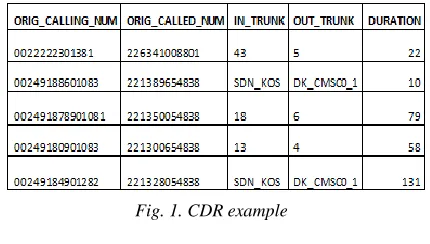
Below is an excerpt from a CDR which provides information, on the caller, the called/callee and the call duration.
Fig. 1. CDR example
3 REGULATION OF
TELECOMMUNICATIONS
The sector of Telecommunications is regulated
worldwide by the International
Telecommunications Union (ITU). Taking into account the sovereignty and security of States, it is left to each country the latitude to regulate their telecommunications at their will. The interest for a sovereign country is indeed to achieve the control of the international incoming traffic by establishing the resources and data collection procedures. Telecommunications are a set of activities convenient to the analysis of economic and legal phenomenon of regulation. The regulation is a concept that was born at the end of the monopoly, according to the fact that originally, each country has an incumbent operator. With the opening/beginning of the competition, States have issued licenses to other alternative operators that have entered the sector. Thus, it was necessary to set up other texts/laws and regulations which allow all stakeholders (government, incumbent operators, new incomers, consumers...) to meet their interests. It is from there that was the regulation born.
3.1 Position of authorities of regulation
more money on VAT (Value Added Tax) compared to what it perceived from operators unreliable statements.
3.2 Legal legitimacy for a State to control incoming traffic
The first legal argument on the control of incoming calls holds a general principle of international law which states that: "States are free to organize sovereignly Telecommunications on their own territory as they wish in order to fit and submit to the law of their choice, to the legal traditions of the country, to the dominant political doctrine or to the national economic development requirements." [6]. This principle which underlies the sovereign right of the State to intervene in the control of the incoming traffic is due to the fact that Telecommunications regulation was eminently technical and protector of the interests of operators who exercised under a regime of State monopoly. This regulation faded to make way for the Telecommunications law (or right) whose the purpose is to seek a balance between the requirements of the proper functioning of the market and the necessity of the presence of the State. This right is based on three layers of rules governing the Telecommunication‟s sector:
The main principles such as the guarantee of secrecy of private correspondences which supply all the material (subject);
A set of measures defining the regime of the access to markets, Telecommunications activities (networks and services), interconnection, consumer protection, competition (price regulation) between actors; Technical rules for the use of the frequency
spectrum or the evaluation of equipment... This shows that the control of traffic and pricing pull their substance from the material of the three layers so indicated and that its object can not break these rules.
4 PRICING IN A CONVERGENT
NETWORK OF
TELECOMMUNICATIONS
Pricing is the mechanism by which a service determines the amount of the minimal counterparty amount of the due for a service provided or to offer. In the area of pricing, countries are sovereign. No rules of the World Trade Organization (WTO), any international agreement, no community legal act of the West African Economic and Monetary Union
(UEMOA) or no rules of the Economic Commission of the States of the West Africa (ECOWAS) can oppose it. No regulations or no international convention impose on States any rules to match to practice pricing of international calls which are of three types: voice, data and video
routed to a convergent network of
Telecommunications [7]. In the few countries that do traffic control, the focus is mainly placed on voice traffic while the volume of data traffic is increasing compared to the voice traffic. The purpose is to have a perfect control of the pricing process of the share of the State on the incoming international traffic, following the following phases:
• CDR collection
• CDR processing
• Calculation of charged traffic (share of the State).
The exercise is to confirm or to refute the results (minutes) from the CDR by demonstrating it in an objective and rigorous way of processing. At this level, the processing focuses mainly on the voice traffic and actual calls with durations. The volumetry on CDR is obtained, based on the number of calls, by adding the number of seconds and the number of minutes. The share of the State will be equal to the number of minutes multiplied by a ratio. For example a State may decide to take off 25 AFC Francs (African Financial Communities: an African currency) per minute on each direct, transit or bypassing incoming call. The main part is that, the call must be an international forwarded call to a third party country and recorded on a CDR that can serve validly as a proof [8].
5 SIMULATION
Fig. 2. Information collection form HTML code
The user is prompted for the location of the CDR file.
Fig. 3. CDR file import
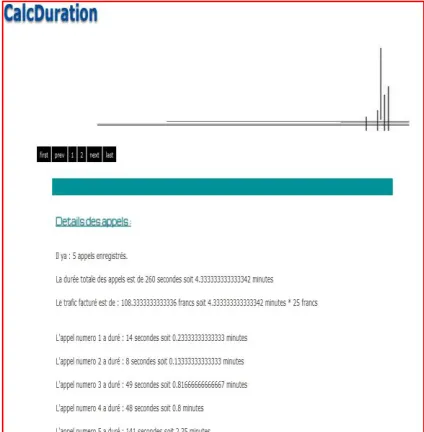
Clicking on the “Voir les details” button, after submitting a 5 records file, the system returns the following results:
Fig. 4. Results
108.33 AFC Francs (African Financial Communities: an African currency) represents the amount obtained by accumulation of all of the call durations.
5.1 Description
The script collects the information submitted by the user from the CDR file and returns the results. Among the expected results, there are: the number of calls, the global duration of all the calls in seconds and minutes, and the billed or charged traffic before displaying the duration of each call in seconds and minutes.
5.2 Comments
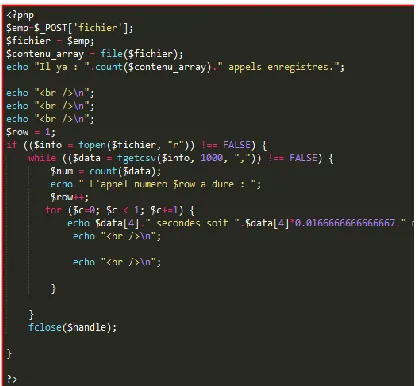
A ratio of 25 AFC Francs (African Financial Communities: an African currency) is applied to the result of the obtained accumulation to calculate the invoiced traffic from a CDR. To browse the entire file and view the details of each call, we used the “for” and the “while” loops. But before using that loops, we have put a conditional structure (“if”) to check if the specified CSV (Comma Separated Value) file exists.
The following script enables the CDR processing:
Fig. 5. Script processing
6 CONCLUSION AND PERSPECTIVES
The proposed CDR processing system will allow the State to dissuade swindlers (operators). Also, the State will no longer relied solely on the data reported by operators but on the actual data generated by the CDR. Thus, the State will generate more revenues to finance various projects in the field of Education, Health, Research, etc. Finally, the regulator will be able to manage potential disputes opposing operators relying on CDR as evidence. Given the number of CDR and the size of each, the regulatory body can use big data for better organization of the information collected from the operators. This will ensure a sustainable and secure storage.
7 REFERENCES
[1] Laurent Ouakil, Guy Pujolle, “Téléphonie sur IP” 2e edition, ISBN: 978-2-212-12359-3, page 89, Groupe Eyrolles 2008.
[2] Mohammad Masudur Rahman1, Nafish Sarwar Islam (2014), „‟ VoIP Implementation Using
Asterisk PBX‟‟, IOSR Journal of Business and Management (IOSR-JBM), Volume 15, Issue 6 (Jan. 2014), PP 47-53
[3] International Telecommunication Regulation, Preamble P.3
[4] ITU D156 recommendation
[5] Uzma Anwar, Ghulam Shabbir, Malik Ahsan Ali, „‟ Data Analysis and Summarization to Detect Illegal VOIP Traffic with Call Detail Records‟‟, International Journal, of Computer Applications (0975 – 8887), Volume 89 – No 8, March 2014
[6] LAMY (Droit de l‟Informatique et des réseaux 2002)
[7] J. Sanchez, M. Thioume, « UMTS, services, architecture, et WCDMA», Hermès science, 2001
[8] Steenbruggen, John, Emmanouil Tranos, and Peter Nijkamp. "Data from mobile phone operators: A tool for smarter cities?" Telecommunications Policy 39.3 (2015): 335-346.