Vehicle Counting and Automated Toll Collection
System using Image Processing
1
Swati Sagar, 2 Jayshri Jori, 3 Aishwarya Kale , 4 Kalyani Khodade , 5 Payal Mali
1
Professor at Department of Information technology, Bharati Vidyapeeth College of Engineering for Women,Pune-43.
2,3,4,5
Dept. of Information Technology,
Bharati Vidyapeeth College of Engineering for Women,Pune-43
Abstract - Now a days there is a huge rush at the toll plazas in order to pay the toll tax. On any toll plaza the vehicle has to stop for paying the toll amount. Hence we are trying to develop a system that would pay the toll amount automatically and reduce the rush at the toll plaza. In our system user registration is done with information like name, address, mobile number, vehicle plate number, vehicle type, etc. Camera is used to capture number plate of vehicle. System will check the database, if match is found then toll amount will be deducted from the user’s account and then gate will be open. Notification will be sent to the user via message. Our system is able to count the total number of vehicles that are passing through the toll plazas. By doing automation of toll plaza we can have the solution over money loss at toll plaza by reducing the man power required for collection of money and also can reduce the traffic at toll plazas which indirectly resulting in the reduction of time at toll plaza.
Keywords - Number Plate Recognition, Optical Character Recognition, SMS, Vehicle Counting, Image Processing.
1.
Introduction
We are proposing a new approach for toll payment at the toll plazas. As we all know that development of any country depends upon its infrastructure like an express highway, for physical movement. But we experience a long queue or large rush at each toll plazas on expressway which wastes a lot of journey time, fuel. Initial toll collection system being manual in nature and time consuming, it leads to traffic congestion, pollution. Quite obviously, this process makes it necessary for the manual services to be worked continuously through the day and night. Ever increasing need for efficient, reliable and safe toll tax payment along with image processing resulted in the development of different kinds of solutions. In our project “Vehicle counting and automated toll collection system using image processing” as the name describe
”Automated Toll Collection” the main aim of our project is the automation. So here we will just take over look of what is mean by automation. The word Automation indicate that replace the human being from the process with the machine. It means what presently the human is doing on the process now onwards the same work machines are going to do. Automatic Toll Collection System using image processing aims at successfully removing unnecessary traffic delays, faster and reliable processing etc. In this paper we present a system which is based on image processing which can be work for real time automatic vehicle toll collection system. A High Definition (HD) camera is used to capture the number plate of an incoming vehicles. Verification is done and deduction process is carried out hence allowing the vehicles to pass.
2.
Literature Survey
“Receiver Autonomous Integrity Monitoring of GNSS Signals for Electronic Toll Collection”, Daniel Salós, Anaïs Martineau, Christophe Macabiau, Bernard Bonhoure, and Damien Kubrak with, ieee transactions on intelligent transportation systems, vol. 15, no. 1, february 2014.
infrastructure. The main advantage of such system is that it can work in all weather and relatively simple setup for GNSS receiver. The disadvantage of this system is increase number of sensor require power and communication.
“Automated Toll Collection System Using RFID”, Pranoti Salunke, Poonam Malle, Kirti Datir, Jayshree Dukale with IOSR Journal of Computer Engineering (IOSR-JCE) e-ISSN: 0661, p- ISSN: 2278-8727Volume 9, Issue 2 (Jan. - Feb. 2013), PP 61-66.
In this paper, they developed the system using RFID technique in which vehicle is identified with the help of radio frequency. Each vehicle has the RFID tag. And this RFID tag has an unique identification number which is assigned by the RTO or traffic governing authority. System will store all the basic information of the owner, and the amount that has to be paid for the toll tax along with this number.
The RFID reader will be placed strategically at the toll plaza. When the vehicle crosses the toll plaza, the toll amount based on vehicle type will be deduced from user’s account balance and new account balance will be updated. If the user has insufficient balance, they uses the alarm which will alert the authority that the vehicle have insufficient balance and that particular vehicle can be trapped. The advantage of this system is RFID tag can not be cloned so can not be cheated and it is less costly. The disadvantage of this system is RFID tag are vulnerable to electro static discharge damage.
“Electronic toll collection system using barcode laser technology”, Sanchit Agarwal, Shachi Gupta, Nidheesh Sharma with International Journal of Emerging Trends & Technology in Computer Science (IJETTCS) Volume 3, Issue 2, March – April 2014
They developed the electronic toll collection system using barcode laser technology. This system uses barcode. Initially user information embedded on barcodes which are mounted on the number plate of vehicle. When the vehicle passed through the toll booth, information is read by barcode reader and toll is deducted from the user’s account. This system make the payment without using the cash manually and save time. The disadvantage of this system is that it takes more time for sending the signal to barcode and retrieving the information from Barcode.
3. Objective and Aim
To transform manual transaction to automated toll collection. Reduce longer waiting time in a toll queue. To provide traveler ease of toll payment.
The main aim of our project is to create automation in traffic management at toll plazas without much change in current system and it should be less expensive. Using this system, we can control human intervention which will decrease the chances of corruption, can provide faster and more efficient service that is no exchanging toll fee by hand, notification provide via message instead of receipts.
4. Future Scope
In our system, the toll payment is done automatically means that toll amount is deducted from the user’s account. The same idea can be used to improve car parking and security system. In future perspective, the police department should be involved in this system to deduct various fine including chalan, alcoholic motorist, non-helmate wearer, no seat belt put, high speed motors etc.
5.
Need
Existing method for toll collection is manual. It takes time to collect the toll amount hence time consuming. As this system is time consuming, hence it leads to environment pollution and wasting fuel and money.
6. Architecture
Fig .1 Automated toll collection and vehicle counting system
6.1 User Registration
In our system first user registration is done with the information like user name, address, mobile number, vehicle number plate, vehicle type, chassis number, email-id, owner name etc.
Fig . 2 Vehicle registration
6.2 Number Plate Recognition
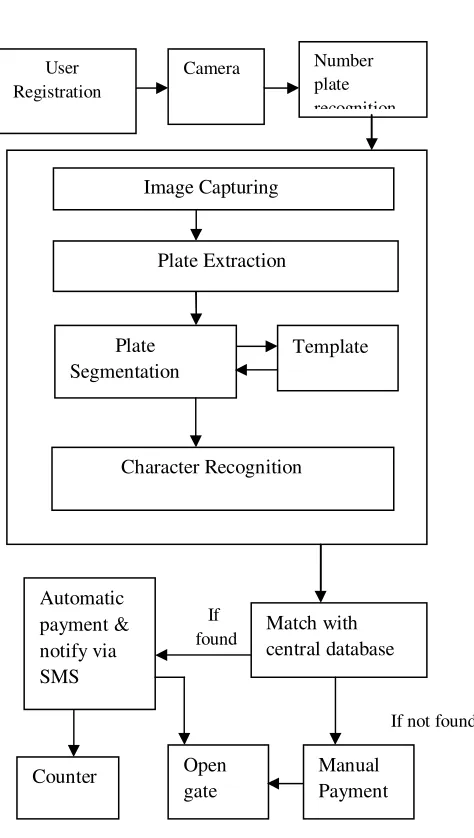
Number plate recognition is used to recognize number plate of vehicle captured by camera as well as text from number plate. It uses optical character recognition (OCR) on image taken by camera. There are three primary algorithm that the system requires for identifying a number plate :
1. Plate Localization : It is responsible for finding and isolating the plate on image.
2. Character Segmentation : It is used to find the individual characters on the plate.
3. Optical Character Recognition : The characters are recognized by using template matching.
If found
If not found User
Registration
Camera Number
plate recognition
Image Capturing
Plate Extraction
Plate Segmentation
Template
Character Recognition
Match with central database Automatic
payment & notify via SMS
Counter Open gate
Fig. 3 Numer plate recognition
6.3 Database
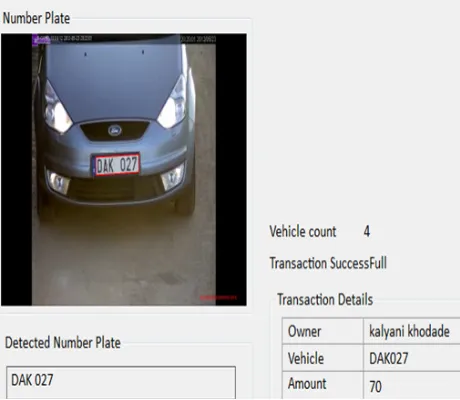
The central database is the main part of the database system. This database contains all registered vehicles with details of owner. When the registered vehicle passes through toll plaza then automatically toll amount is deducted from user’s account. Database is updated with this information at a same time and the system notify user via SMS.
7. Conclusion
Automated toll collection system is user friendly. It can reduce traffic congestion at toll plazas which leads to avoid fuel loss. It can be removed all disadvantages of current manual toll collection system like time and human efforts. It does not required any tag only required best quality camera.
8. Future Scope
In our system toll payment is done automatically that is toll amount will be deducted from the user’s account. The same idea can be used to improve car parking and security system. In future perspective, the police department should be involved in this system to deduct various fine including chalan, alcoholic motorist, non-helmate wearer, no seat belt put, high speed motors etc.
Acknowledgment
Authors are thankful to the Department of Information Technology, Bharati Vidyapeeth’s College Of Engineering for Women, Pune, Maharashtra, India, for providing necessary facilities for carrying out this work. Authors
gratefully acknowledge the support given by Savitribai Phule Pune University, Maharashtra, India, for carrying out this research work. Authors also grateful to Prof. Ms. Swati.A.Sagar, Bharati Vidyapeeth’s College of Engineering for Women, Pune, Maharashtra for their time to time guidance and support towards carrying out the research work. For influencing us to take forth this research concept and work towards its implementation and also the anonymous reviewers for their valuable suggestions towards improving the paper.
References
[1] Automatic toll collection using RFID functioning. 1.Pranoti Salunke, 2. Poonam Malle, 3.
Kirti Datir, 4. Jayshree Dukale. IOSR Journal of Computer Engineering (IOSR-JCE), e-ISSN: 2278-0661, p- ISSN: 2278-8727Volume 9, Issue 2 (Jan. - Feb. 2013), PP 61-66.
[2] Receiver Autonomous Integrity Monitoring of GNSS Signals for Electronic Toll Collection. 1. Daniel Salós, 2. Anaïs Martineau, 3. Christophe Macabiau, 4. Bernard Bonhoure, 5. Damien Kubrak, 2014. IEEE
TRANSACTIONS ON INTELLIGENT
TRANSPORTATION SYSTEMS, VOL. 15, NO. 1, FEBRUARY 2014.
[3] Electronic toll collection system using barcode laser technology. 1. Sanchit Agarwal, 2. Shachi Gupta, 3. Nidheesh Sharma.International Journal of Emerging Trends & Technology in Computer Science (IJETTCS), Volume 3, Issue 2, March – April 2014. [4] Automated Toll Collection Using Satellite Navigation.
1.Ms.Kirti A.Lonkar, 2. Ms. Pratibha P. Kulkarni, 3. Ms Monalisha Dash, 4. Mr.Abhishek Dhawan, 5. Mr.Hemant R.Kumbhar, 6. Mr.Monika P.Gagtap. [5] Smart highway electronic toll collection system. 1.
Ganesh K. Andurkar, 2. Vidya R. Ramteke.
[6] Image Processing based Toll Automation using ANPR. 1 Kavya.S, 2 Mutturaj Hubballi, 3 Priyanka.B.N (IASIR).
[7] Automatic License Plate Recognition (ALPR) : A State-of-the-Art Review. 1. Shan Du, Member, IEEE, 2. Mahmoud Ibrahim, 3. Mohamed Shehata, Senior Member, IEEE, 4. WaelBadawy, Senior Member, IEEE. IEEE TRANSACTIONS ON CIRCUITS AND SYSTEMS FOR VIDEO TECHNOLOGY, VOL. 23, NO. 2, FEBRUARY 2013.
[8] Automatic Detection and Counting of Vehicles Based on Image Processing R. Rajamunipriya1, S.Dinesh2. International Journal of Science and Research (IJSR).
Author Profile
Prof. Ms. Swati A . Sagar,
Bachelor of Engineering (Computer Engineering), Master of Engineering (Computer Engineering),Bharati Vidyapeeth’s College of Engineering for Women, Pune-43.
Ms. Jayshri Shrikant Jori,
Savitribai Phule Pune University,
Bharati Vidyapeeth’s College Of Engineering for Women , Pune-43.
Ms. Aishwarya Shankar Kale,
Bachelor of Engineering (Information Technology), Savitribai Phule Pune University,
Bharati Vidyapeeth’s College Of Engineering for Women , Pune-43.
Ms. Kalyani Ashok Khodade,
Bachelor of Engineering (Information Technology), Savitribai Phule Pune University,
Bharati Vidyapeeth College Of Engineering for Women , Pune-43.
Ms. Payal Rajendra Mali,
Bachelor of Engineering (Information Technology), Savitribai Phule Pune University,