A Survey on Different Image Processing Techniques for
Pest Identification and Plant Disease Detection
1
Preetha Rajan, 2 Radhakrishnan B
1
PG Student, Department of Computer Science and Engineering, Baselios Mathews II College of Engineering Sasthamcotta, Kollam, Kerala, India
2
Assistant Professor, Department of Computer Science and Engineering, Baselios Mathews II College of Engineering Sasthamcotta, Kollam, Kerala, India
Abstract - Pest detection and identification of diseases in agricultural crops is essential to ensure good productivity. The productivity of plants will reduce due to diseases and presence of pests. Image processing can be used to identify the pests and thereby can reduce the use of pesticides. Image processing involves capturing the image and applying various preprocessing techniques and detect the pest in the image. By using the classifier we can classify the pests and plant diseases. This paper presents the study of various image processing techniques and applications for pest identification and plant disease detection.
Keywords - Image Processing, Segmentation, Feature Extraction, Classification, Pest Identification, Disease Detection.
1. Introduction
Agriculture plays key role in the development of human civilization. Research in agriculture focuses on increasing the productivity and food quality. The quality and quantity of agriculture production is affected by environmental parameters and biological parameters. The major biological parameters are pests and plant diseases. Diseases and insect pest are the major problems in the agriculture. These require careful diagnosis and timely handling to protect the crops from heavy losses. The naked eye observation is the commonly used method for detection of pest and identification of plant diseases. This needs continuous monitoring. But it is not practical in the case of large farm. Also it is not accurate, expensive and time consuming. Integrated pest management (IPM) method used to control pests with minimal environmental impacts. Detection, identification and application of correct management are the steps of IPM.
Machine vision systems are widely used for inspection of growing plants to recognize their diseases. The image processing can be used in various agriculture applications such as to detect diseased leaf and stem, to identify the
affected area, to determine color of affected area etc. Automatic detection of plant diseases with the help of image processing technique provides more accurate pest detection and guidance for disease management. Various papers have been published which explain different techniques used, including image processing for detection of objects, extraction of features and identification of pests based on various parameters such as color, boundary, background color, foreground color, intensity of pixels etc. We have reviewed papers that have been researched on pest identification with the intention of getting a fair idea about the methods which are efficient and useful.
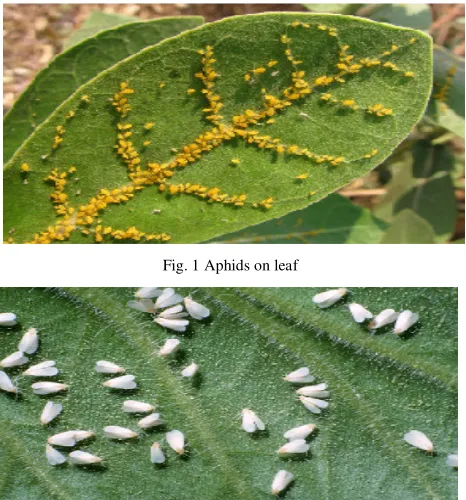
Fig. 1 Aphids on leaf
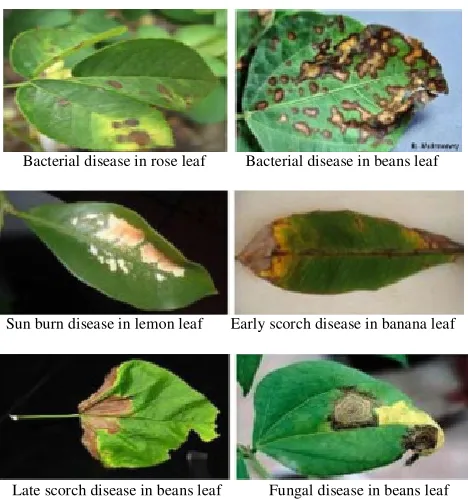
Bacterial disease in rose leaf Bacterial disease in beans leaf
Sun burn disease in lemon leaf Early scorch disease in banana leaf
Late scorch disease in beans leaf Fungal disease in beans leaf
Fig. 3 Sample images of leaf diseases
Basic steps of plant disease detection algorithm are,
1. Image Acquisition 2. Image Preprocessing 3. Feature Extraction 4. Classification 5. Diagnosis
2. Literature Review
2.1 Pest Identification
Rupesh G. Mundada et.al [1] proposed a system for early pest detection. In this, feature extraction was done with the help of Support Vector Machines (SVM's). SVM is a supervised learning method. SVM classification first finds a hyper plane which separates the d-dimensional data perfectly into two classes. This is done by maximizing the margin from the hyper plane. Hyper plane is defined as,
Yi = <w. x> + c (1)
Where w is n-dim vector and c is a constant or scalar. By adding a scalar value c it increases the margin between hyper planes and in the absence of c, hyper plane is forced to pass through the origin. Multiclass classification is also recommended and used two class SVMs to solve the problem 1) one-versus-all or one 2) kernel function. A common disadvantage of non-parametric techniques such as SVMs is the lack of transparency of results.
Ganesh Bhadane et.al [2] describes a software prototype system for pest detection on the infected images of different leaves. Images of the infected leaf are captured by digital camera and processed using image growing, image segmentation techniques to detect infected parts of the particular plants. Then the detected part is been processed for further feature extraction which gives general idea about pests. Object extraction is done by background subtraction. Thresholding is used for background subtraction. Then segmentation is used to partition the image in to multiple regions. For these particular type of edge detection sobel operator is used. The drawback of this system is that if the color of pest and leaf is almost similar then the background subtraction method cannot identify the pest. The color change on the leaf is also identifying as pest. The accuracy of pest identification depends on the selection of threshold value.
Gaurav Kandalkar et.al [3] developed a decision support system which identify various agricultural pests and gives preventive or control measures to farmers leading to increase in crop production. The proposed decision support system constitutes of image segmentation, feature extraction, training and testing neural network. The segmentation will be carried out for extraction of pest from the image. Thresholding techniques are used for segmentation. After segmentation the feature extraction is done. Classification is performed to identify the pest. Classification process done by RBF neural network. RBF neural network is an artificial neural network that uses radial basis function as activation function. The RBF is easy to train but is slower in identifying the real time images.
Johnny et.al [4] developed a pest identification system using neural network. In this system for object detection uses background subtraction method is used. Then the feature extraction and segmentation performed. To identify the insect Kohonen Self Organizing Maps neural network is used. Kohonen Self Organizing Maps neural network requires necessary and sufficient data in order to develop meaningful clusters. The weight vectors must be based on data that can successfully group and distinguish inputs. Lack of data or extraneous data in the weight vectors will add randomness to the groupings.
Relative difference in pixel intensities is calculated with pixels located ϕ locations to the left and top of α. These differences are represented by β1 and β2 respectively.
= , − , − ) (2)
= , − − , ) (3)
If β1 or β2 is found to be greater than the threshold value θ, then the resultant pixel ψ (i, j) is identified to be belonging to the foreground. Otherwise it is identified to constitute the background. This has been represented as follows.
, = 255 ; 1 2 ≥ 0 ; 1 2 < (4)
Vincent Martin et.al [17] developed a system named DIViNe for early pest detection. In this system pest detection will perform based on video analysis. The detection of objects in video sequences is usually based on back ground subtraction technique. This system adopt cognitive vision approach. Cognitive vision approach [18] combines image processing, learning and knowledge based techniques. Finally the classification and counting of pests will perform.
Johnny et.al [6] presented an automatic detection and extraction system to detect and extract the pests in the captured image. In this background modeling is used to detect the presence of insect pests in the captured image. For this the input image compared with reference image. If the pixel value of the input image is equal to the reference image then the background will be white. The difference of the reference and input image should have to be determined next and the input image will now be used as the reference image. Based on this comparison, the output image will be
, = 255 ; !, = ",
", ; !, ≠ ", (5)
Then the output image is served as the input to the next phase.
2.2 Plant Disease Detection
S. Arivazhagan et.al [7] proposed a system to identify the unhealthy region of plant leaves and classify plant leaf diseases using texture features. The color images are converted into HSI color space representation. Then the system will mask the green pixel by thresholding and then remove the masked cells. The infected region will be segmented into number of regions. The color occurrence
texture analysis method is developed through SGDM. Finally the classification done by using minimum distance criterion and SVM classifier. The texture features will calculated by the equations,
Contrast = ∑%&',()*, +, (6)
Energy = ∑%&',()*+, (7)
Local Homogeneity = ∑%&',()*+, /1 + − (8)
Cluster shade = ∑%&',()*. − /0+ + /12+, (9)
SabahBashir et.al [8] used an effective image segmentation algorithm for color and texture analysis. The algorithm used for texture analysis is co-occurrence matrix method. CCM method is selected for image analysis technique. In texture analysis K-means clustering technique is used. A bayes classifier is used to classify various plant diseases.
Sonal P. Patil et.al [9] developed a system for diagnosing cotton leaf spot diseases. Segmentation is performed to find the actual segments of the leaf in the image. In this research they have applied global threshold, variable threshold and Otsu method for obtaining an automatic threshold value. Feature extraction for the infected part of the leaf is completed based on specific properties among pixels in the image or their texture. After this certain statistical analysis tasks are completed to choose the best features that represent the given image, thus minimizing feature redundancy. Finally, classification is completed using support vector machine. SVM’s generalization performance is based on the principle of Structural Risk Minimization (SRM).
Santanu Phadikar et.al [10] proposed a software prototype system for rice disease detection based on the infected images of various rice plants. In this both image processing and soft computing techniques are applied. The feature extraction method includes region segmentation, boundary detection and spot detection. Self organizing map (SOM) neural network has been employed for classification. The zooming algorithm extracts features of the images using simple computationally efficient technique, which results satisfactory classification for test images.
Pawan P. Warne et.al [12] presented an approach for careful detection of diseases, diagnosis and timely handling to prevent the crops from heavy loss. In low contrast images during preprocessing, histogram equalization is applied, K-means clustering algorithm is used for segmentation which classifies objects based on a set of features into K number of classes and finally classification is performed using Neural-network.
Kamaljot Singh Kailey et al[13] presented a method to identify plant disease based on color, edge detection and histogram matching. In the training process, first separate the layers of RGB image into Red, Green and Blue layers and then apply the CANNY’s edge detection technique to detect the edges of layered images. The histogram is generated for both healthy leaf sample and diseased leaf sample, and the comparison techniques are applied The edge detection technique can not apply directly on the RGB image. Firstly, the image have to be converted into grayscale image, then the CANNY’s edge detection technique is applied.
Prasad Babu et.al [14] developed a software model, to suggest remedial measures for pest or disease management in agricultural crops. Using this software, the user can scan an infected leaf to identify the pest or disease affected on it and can obtain solutions to control it. Prewitt edge detection produces an image where higher grey level values indicate the presence of an edge between two objects. Back propagation Neural Network is used for classification. The training set contains minimum five spices for each type of leaf in each data file. Using more number of species in training set and number of output nodes can enhance the recognition ability.
Anand.H.Kulkarni et.al [15] proposes a methodology for detecting plant diseases early and accurately, using diverse image processing techniques and artificial neural network. The image is filtered and segmented using Gabor filter. Then, texture and color features are extracted from the segmented image. The recognition process consists of two phases, training and classification. Artificial neural network (ANN ) is then trained by choosing the feature values that could distinguish the healthy and diseased samples appropriately. Classification of image is done by ANN . An ANN based classifier is adopted which uses the combination of color and texture features to recognize and classify different plant diseases.
Ajay A. Gurjar et al [16] present an approach for cotton leaf image pest identification using Eigen feature regularization extraction. Image space spanned by the eigenvectors of the within class scatter matrix is decomposed into subspaces. Eigen features are regularized differently in these subspaces. Feature extraction and
classification will be performed. Set of images are recognized using the classifier.
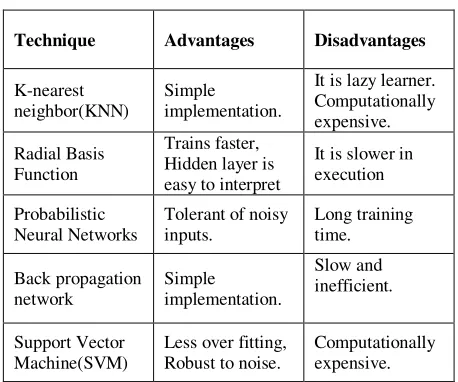
Table. 1 Comparison of Classification Techniques
Technique Advantages Disadvantages
K-nearest neighbor(KNN)
Simple implementation.
It is lazy learner. Computationally expensive.
Radial Basis Function
Trains faster, Hidden layer is easy to interpret
It is slower in execution
Probabilistic Neural Networks
Tolerant of noisy inputs.
Long training time.
Back propagation network
Simple implementation.
Slow and inefficient.
Support Vector Machine(SVM)
Less over fitting, Robust to noise.
Computationally expensive.
3. Challenges
In a greenhouse major difficulty is to deliver accurate detection results with respect to lighting changes. Lighting changes may be due to change in weather conditions or due to the rotation of earth. Due to weather change image features such as color, intensity, contrast will vary. There are number of plant species, number of pests. Thus, many large image-bases (database of images) exist in plant database. High-speed image processing on image classification is really challenging and complex.
4. Conclusion
This paper addresses how the disease analysis and pest detection is possible in agriculture field. In this review different image processing techniques for pest detection and plant disease detection are studied. The image processing technique proved as an effective machine vision system for agriculture domain. In this paper various feature extraction techniques and classification techniques are compared. The SVM classification provides better result in the detection of pests in almost all the cases. It yields better result and execution time.
References
[2] Ganesh Bhadane, Sapana Sharma and Vijay B. Nerkar, "Early Pest Identification in Agricultural Crops using Image Processing Techniques", International Journal of Electrical, Electronics and Computer Engineering 2(2), 2013, pp. 77-82.
[3] Gaurav Kandalkar, A.V.Deorankar and P.N.Chatur, "Identification of Agricultural Pests Using Radial Basis Function Neural Networks ", International Journal of Engineering Research and Applications, April 2014, pp.52-56.
[4] Johnny L. Miranda, Bobby D. Gerardo and Bartolome T. Tanguilig III, "Pest Identification using Image Processing Techniques in Detecting Image Pattern through Neural Network", Advances in Computer and Electronics Technology, 2014.
[5] Sushma R. Huddar, Swarna Gowri, Keerthana K., Vasanthi S. and Sudhir Rao Rupanagudi "Novel Algorithm for Segmentation and Automatic Identification of Pests on Plants using Image Processing ", Third International Conference Computing Communication & Networking Technologies(ICCCNT) , July 2012, pp. 26-28. [6] Johnny L. Miranda, Bobby D. Gerardo, and Bartolome
T. Tanguilig III," Pest Detection and Extraction Using Image Processing Techniques", International Journal of Computer and Communication Engineering, Vol. 3, May 2014, pp. 189-192
[7] S. Arivazhagan, R. Newlin Shebiah, S. Ananthi and S. Vishnu Varthini, “Detection of unhealthy region of plant leaves and classification of plant leaf disease using texture features”, Agric Eng Int: CIGR Journal, Vol 15, March 2013, pp. 211-217
[8] Sabah Bashir and Navdeep Sharma, "Remote Area Plant Disease Detection Using Image Processing", IOSR Journal of Electronics and Communication Engineering,Vol 2, Issue 6 (Sep - Oct) 2013, pp. 31-34. [9] Prof. Sonal P. Patil and Ms. Rupali S.Zambre, "Classification of Cotton Leaf Spot Disease Using Support Vector Machine ", International Journal of Engineering Research and Applications, Vol. 4, Issue 5 ( Version 1), May 2014, pp.92-97
[10] Santanu Phadikar and Jaya Sil, “Rice disease identification using pattern recognition techniques” Proceedings of 11th International Conference On Computer and Information Technology, 2008, pp. 25-27
[11] Alexander A. Doudkin, Alexander V. Inyutin, Albert I. Petrovsky, Maxim E. Vatkin "Three level neural network for data clusterization on images of infected crop field", Journal of research and applications in Agriculture Engineering , Vol.52(1),2007
[12] Pawan P. Warne and Dr. S. R. Ganorkar," Detection of Diseases on Cotton Leaves Using K-Mean Clustering Method", International Research Journal of Engineering and Technology, Vol 2, July 2015, pp. 425 - 431.
[13] Kamaljot Singh Kailey and Gurjinder Singh Sahdra, "Content-Based Image Retrieval (CBIR) For Identifying Image Based Plant Disease ", International Journal of Computer Technology and Application, Vol 3 (3), pp. 1099-1104.
[14] M. S. Prasad Babu and B. Srinivasa Rao, "Leaves Recognition Using Back propagation neural network - advice for pest and disease control on crops", India Kisan.Net:Expert Advisory System,2007.
[15] Anand.H.Kulkarni and Ashwin Patil R.K."Applying image processing technique to detect plant diseases", International Journal of Modern Engineering Research, Vol.2, Issue.5, Sep-Oct. 2012 pp. 3661-3664.
[16] Ajay A. Gurjar and Viraj A. Gulhane, "Disease Detection On Cotton Leaves by Eigenfeature Regularization and Extraction Technique " International Journal of Electronics, Communication & Soft Computing Science and Engineering, Volume 1, Issue 1.
[17] Vincent Martin and Sabine Moisan, "Early Pest Detection in Greenhouses", Computer and Electronics in Agriculture journal, 2009.
[18] P. Boissard, V. Martin and S. Mosain, "A Cognitive Vision Approach to Early Pest Detection in greenhouse crops", Computer and Electronics in Agriculture Journal, April 2008, pp. 83 -93.
Preetha Rajan received her B. Tech (Computer Science & Engineering) from University of Kerala in 2009. She is currently pursuing her Masters in Computer Science & Engineering from University of Kerala. Her research interests include image processing.