Distributed power steering by Beamforming Approach for Wireless
Cognitive Radio Networks Using Cuckoo Algorithm
Pouya Derakhshan-Barjoei
Department of Telecommunication Engineering, Naein Branch, Islamic Azad University, Naein, Isfahan, Iran
Abstract: Distributed power steering by beamforming
approach in cognitive radio networks requires a precise analysis of the impacts of the transmission parameters, tolerable interference and guarantees the quality of service of both the primary users and secondary users. In this paper, our proposed method provides improved performance to solve the constrained nonlinear multi-object optimization and joint power steering and beamforming problem using bio inspired algorithm, cuckoo optimization. Our scheme considers a secondary usage of spectrum scenario where a secondary network coexists and/or shares the radio spectrum in an Ad Hoc scenario with a primary network to which the spectrum is licensed in an infrastructure scenario. In addition, the received interferences at primary users remain below a specific threshold level as well as the secondary users are guaranteed with their quality of service. A bioinspired optimization behaves a good performance and technique with a dynamic cost function.Keywords: cognitive radio, cuckoo algorithm, power steering, beamforming.
1. INTRODUCTION
Cognitive radio is a new approach which is introduced to cope with the spectral limitations and improve spectral efficiency. Due to the accelerated deployment of broad band communication systems and current fixed frequency allocation schemes spectrum is becoming a major bottleneck. Therefore, there is an increasing interest on this technology among the researchers in both academia and industry and power and spectrum policy makers. In [1, 2 and 3], the power control and spectrum sharing limitations have been studied. According to the descriptions in [4], the power control has an effective impact on the probability of bit error rate. In [5] joint beamforming and power control using weighted least square algorithm have been performed. Beamforming can be implemented either at the transmitter or at the receiver. Transmitter beamforming concentrated the transmission signal on a certaing direction in order to minimize interference to other users. Receiver bemforming is usually useful
for signal localization or to take advantage of spatial diversity. In addition, as mentioned in [6] the distances between base stations and users have an impressive rule in the topology of the systems. Because of dynamic feature of the environment the transmit power control requires a precise study by employing an intelligent algorithm. In [7], a genetic power control algorithm, driven for cognitive radio decision engine, is presented. the issues of transmit power control in cognitive radio networks and propagation channels have been studied in [8, 9,10,and12]. In[13]cooperative communications networks for cognitive radios have been studied. While, the population adaptation for genetic algorithm based cognitive radio and bio-inspired algorithm for dynamic resource allocation and parameter adaptation have been studied. In [8] and [14] respectively. In addition, dynamic spectrum sensing and spectrum management have been studied in [15,16,17 and 18]. The adaptation algorithm using particle swarm optimization and genetic algorithm have been compared and some optimizations for transmission parameter have been studied, also the performance of the power control algorithm considering the distance has been studied in [19]. These researches make it possible for a secondary or cognitive radio network to opportunistically utilize a frequency band initially allocated to a primary network. In [10,15,20,and 21] common spectrum sensing methods and adaptive power allocation have been considered. However, evolutionary power control for cognitive users has not been previously investigated
in non-stationary environments considering
modulation adaptation and constrained multi-objective problem. In this paper, we proposed an intelligent method to meet the challenges of the cognitive radio network. To achieve these goals our cognitive radio network employs the bird bioinspired intelligence algorithm based on cuckoo optimization.
2. SYSTEM MODEL
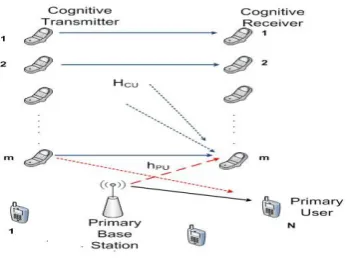
transmission power. In our scenario, the downlink of the primary network is considered. In the secondary network, cognitive radio users are considered to work in the same frequency band as the primary system. The secondary network has an Ad Hoc scenario with deployment of k antennas at each cognitive transmitter, an efficient transmit beamforming technique is proposed to maximize the sum throughput. The transmit powers of cognitive users are limited to a maximum value prescribed by primary users. This network coexists in the same area with secondary users which are cognitive users. The system model of our scenario is illustrated in figure 1. The secondary network included M secondary users so it has an Ad Hoc scenario. The secondary user including K antenna is based on beamforming at both the transmitter and the receiver.
Fig 1: Conceptual scenario.
3. Mathematical Formulation and Analysis
All secondary users are working intelligently in an Ad Hoc scenario, considering our previous system model simulation and formulation [27,28,30], herewith a cuckoo bioinspired algorithm adaptation to the proposed scenario is being used. The nth primary user’s received signal is obtained as follow:
m j j p u M j p u p u
n x x
y
j
n h b n
h
. . . 1 (1)Where
x
pu andx
jare the transmitted signals of theprimary base station and secondary users, respectively.
j
b
is the pre-beamforming for user j and The power ofassociated signals are as below:
2 0 2
} |
{|n N
E m (2)
su
j
p
x
E
{|
|
2}
j=1,2,3……m
pu
pu
p
x
E
{|
|
2}
pu
h andHsu are vectors in size of k ×1 and k× k, the
fading path gains from primary base station to the nth
primary users and
n
denotes zero mean additive withGaussian noise with variance 2
0
N . Define
p
pu andsu
p
as the transmitted power of primary base stationand secondary users, respectively. Also power
p
suisconstrained by a maximum transmit power limit
p
max.Here we present the pre and post beamforming vectors, also we design the transmit and receive beamvectors. Infact, beamvector associated with each secondary user is determined by optimizing a certain criterion to reach a specific purpose such as maximizing the throughput or minimizing the interference.Assuming that the secondary users signal are uncorrelated with zero mean, in downlink mode. So we can express the mth secondary user received signal as: m H m pu pu H m j j su M m j j H m m m su H m
m x x x
y
m mj
mmb a H b a h a n
H
a . . . .
, 1 (3)
where
a
mis the post-beamforming vector at thereceive secondary users.
The per-user sum capacity is:
) . | | . | . | . | . . | . | . . | 1 ( log 2 0 2 2 2 , 1 2 2
1 p p N
p C H m pu pu H m j j su M m j j H m su m su H m M m su m mj mm a h a b H a b H a (4)
For beamforming, the transmitted power through all the secondary users for the mth secondary user is
proportional to
||
b
m||
2 .The purpose of this letter is todetermine optimal transmit power for all possible fading channel status in a non-stationary conditions using bio inspired cuckoo algorithm so as to maximize the channel capacity under peak interference temperature constraints. With considering a penalty function, we can convert the constrained optimization process into an unconstrained one to meet problem constraints simultaneously [22, 23]. The cost function is defined as :
) || . .(|| ) || || .( ) . ) || || .( ) . ). ( 1 ( log int 2 3 max 2 2 max 2 1 1 max 2 1 J p p M m
F j j pu j
M j m H m M m j b h b b b
b
(5)
Where Jint is the maximum tolerable received power at
the primary receiver. Bio-inspired distributed
non-stationary environment and modified spectrum sensing have been done in our previous work [27-30].
4. NUMERICAL AND SIMULATIONS STUDY
We consider some simulation results to approach and evaluate performance of the proposed scenario. A secondary network coexists and/or shares the radio spectrum with a primary network to which the spectrum is licensed, in an infrastructure scenario. The channels between the transmitters and receivers are assumed to be Rayleigh faded; the channel gains are independent across sub channels. The maximum transmit power for secondary users are assumed to be
3×10⁻³. Interference from primary users to base station
is ignored. Interference constraint of all primary users is 10-4. It was found that the more repetition of the
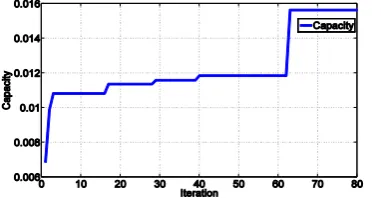
algorithm in each iteration has the much accuracy. In figure 2 the behavior of the cost function is shown. we can see the behavior of the cost function and its convergence attributes of cuckoo algorithm, it is clear that the all constraints are fulfilled. This algorithm is one of the newest and most powerful evolutionary optimization methods ever introduced. Cuckoo's algorithm is inspired by the bird's way of life called Cuckoo, developed by Xin-she Yang and Suash Deb in 2009[24-26]. Cuckoo algorithm is based on the life of the species of cuckoo. It was inspired by the obligate brood parasitism of some cuckoo species by laying their eggs in the nests of other host birds. Some host birds can engage direct conflict with the intruding cuckoos. This algorithm is based on three idealized rules: Each cuckoo lays one egg at a time, and dumps its egg in a randomly chosen nest; The best nests with high quality of eggs will carry over to the next generation; The number of available hosts nests is fixed, and the egg laid by a cuckoo is discovered by the host bird with a determined probability.. Discovering operate on some set of worst nests, and discovered solutions dumped from farther calculations.
Table 1: Cuckoo parameters
Cuckoo population 10
Minimum number of eggs 3 Maximum number of eggs 7
Alive cuckoo 100
Population variance 7-9
The concept of mutual information was introduced for the first time to detect the relationship between these features of a data set. The speed and accuracy of the algorithm behaved good as figure 2,3 and 4 show related convergence. Our proposed algorithm, involves the following steps.
Step 1: get and set the given parameters, and check the constraint
Step 2: Apply system model to evaluate.
Step 3: match the parameters using cuckoo algorithm. Step 5: Repeat process.
Step 6: Detect the best parameters using Cuckoo algorithm to optimize the cost function
Step 7: Repeat for the best result.
Step 8: Continue to optimize and update the parameters of Cuckoo algorithm.
Step 9: Repeat.
Fig 2: Behavior of the cost function.
Fig 3: Convergence of transmission power for secondary users.
From figure 4, it can be seen that the transmission capacity arises with increasing the amount of transmission power; however the power will be limited by our simulations constraints and primary user interference.
Also, in figure 5 and 6, the effect of number of antennas in transceivers on fitness convergence and the effect of number of secondary users on fitness convergence are shown, respectively.
Fig 5: Effect of number of antennas in transceivers on fitness convergence
Fig 6: Effect of number of secondary user on fitness convergence
Furthermore, the fitness functions steer the evolution of the cuckoo algorithm in the correct direction to optimize the given multi-objective functions for the secondary users with the defined constraints in a non stationary environment.
5. CONCLUSIONS
We have proposed a bird bioinspired, cuckoo algorithm, assisted minimum transmission power design in cognitive or secondary radio network in a non stationary environment. The scenario is formulated in the downlink mode of the secondary user network to maximize the transmission capacity of secondary users. However, the minimum transmission power of each cognitive or secondary user is considered. We have developed transmission power control approach which cuckoo adjust the parameters, while maintaining a quality of service for the primary user. The proposed cuckoo algorithm provides improved performance by using appropriate pre and post beamforming. Proposed scheme shows the performance of a heuristic improvement in cognitive radio performance in a dynamic environment.
REFERENCES
[1] Grandhi, SA., Zander, J. (1994). Constrained power
control in cellular radio systems. In Proc. 44th
IEEE Veh. Technol. Conf. Stockholm, Sweden, pp. 824-828.
[2] Ghasemi, A., Sousa, ES. (2007). Fundamental limits
of spectrum-sharing in fading environments. IEEE Trans. Wireless Commun. Mag. pp. 10-11.
[3] Grandhi, S., Zander, J., Yates, R. (1995).
Constrained Power Control. International Journal
of Wireless Personal Communications, Vol. 1, No. 4.
[4] Park, CS., Lee, KB. (2004). Transmit power
allocation for BER performance improvement in
multicarrioer systems. In IEEE Trans. On
Communications, pp. 1658-1663.
[5] Islam, MH., Liang, YC., Hoang, AT. (2008). Joint
power control and beamforming for cognitive
radio networks. In IEEE Trans. On Wireless
Communications, Vol. 7, No. 7.
[6] Ren, W., Zhao, Q., Swami, A. (2009). Power control
in cognitive radio networks: How to cross a
multi-lane highway. IEEE Journal on Selected Areas in
communications,Vol. 27, No. 7.
[7] Newman, TR., Barker, BA., Wyglinski, AM., Aghah,
A., Evans, JB., Minden, GJ. (2007). Cognitive engine
implementation for wireless multicarrier
transceivers. Wiley Journal on Wireless
Communications and Mobile Computing, pp.1129-1142.
[8] Renk, T., kloeck, C., Burgkhardt, D., Jondral, FK.,
Grandblaise, D., Gault, S., Dunat, JC. (2008). Bio-inspired algorithms for dynamic resource
allocation in cognitive wireless networks. Mobile
Netw. Appl. pp. 431-441.
[9] Rondeau, T., Le, B., Rieser, C., Bostian, C. (2004).
Cognitive radio with genetic algorithms:
untelligent control of software defined radios. In Software Defined forum technical Conference. pp. C3-C8.
[10] Haykin, S. (2005). Cognitive
radio:brain-empowered wireless communications. IEEE Journal on Selected Areas in Communications. pp. 201-220.
[11] Newman, TR., Rajbanshi, R., Wyglinski, AM.,
radios. Mobile Netw. Appl. pp.442-451.
[12] Molisch, AF., Greenstein, LJ, Shafi, M. (2009).
Propagation issues for cognitive radio. In Proceedings of IEEE, Vol. 97, No. 5.
[13] Letaief, KB., Zhang, W. (2009). Cooperative
communications for cognitive radio networks. In Proceedings of IEEE, Vol. 97, No. 5.
[14] Zhao, Z., Xu, S., Zheng, S., Shang, J. (2008).
Cognitive radio adaptation using particle swarm
optimization. Wiley Journal on Wireless
Communications and Mobile Computing.
[15] Akyildiz, IF., Lee, WY., Vuran, MC., Shantidev, M.
(2006). Next generation/dynamic spectrum access/cognitive radio wireless networks: a survey. Computer Networks Journal(Elsevier), pp. 2127-2159.
[16] Eghbali, A., Johansson, H., Löwenborg, P., Göckler,
HG.(2009). Dynamic frequency-band reallocation
and allocation: from satellite-based
communication systems to cognitive radios. J. Sign. Process. Syst.
[17] Budiarjo, I., Lakshmanan, MK., Nikookar, H.
(2008). Cognitive radio dynamic access
techniques. International Journal of Wireless Personal Communications, pp.293-324.
[18] Derakhshan, P., Dadashzadeh, G., Razzazi, F.,
Razavizadeh, SM. (2010). A Comparison of Radiometry and Modified Periodogram Spectrum Detection in Wireless Radio Networks. In Proceedings of IEEE International Conference on Computer and Automation Engineering. Tianjin, China.
[19] Qian, L., Li, X., Attia, J., Gajic, Z. (2007). Power control for cognitive radio ad hoc networks. In Proceedings of IEEE, 15th Workshop on local and Metropolitan Area Networks.
[20] Ma, J., Li, GY., Juang, BH(Fred). (2009). Signal
Processing in cognitive radio. In Proceedings of
IEEE, Vol. 97, No. 5.
[21] Akyildiz, IF., Lee, WY., Chowdhury, KR. (2009).
CRAHNs:Cognitive radio ad hoc networks. Ad Hoc Networks Journal(Elsevier), pp.810-836.
[22] Boyd, SP., Vandenberghe, L. (2004). Convex
Optimization. Cambridge University Press.
[23] Luenberger, DG. (1984). Linear and Nonlinear
Programming (2nd edn). Addison-Wesley
Publishing Company.
[24] X.-S. Yang; S. Deb. “Cuckoo search via Lévy
flights”. World Congress on Nature & Biologically Inspired Computing, IEEE Publications. pp. 210– 214, 2009.
[25] R. B. Payne, M. D. Sorenson, K. Klitz, “The
Cuckoos”, Oxford University Press, 2005.
[26] R. Rajabioun, “Cuckoo Optimization Algorithm”,
Applied Soft Computing Journal, Vol. 11, pp. 5508, 2011.
[27] P. Derakhshan B., G. Dadashzadeh, F. Razzazi, S. M.
Razavizadeh, (2011) “Minimum power transmission design for cognitive radio networks in non-stationary environment,” IEICE Electronic Exp., Vol. 8, no. 3, pp.136-142, Feb.
[28] P. Derakhshan, G.R. Dadashzadeh, F. Razzazi, S.M.
Razavizadeh,(2011) “Bio-inspired distributed
beamforming for cognitive radio networks in non-stationary environment.” IEICE Electronic Exp. Vol. 8, No. 6.
[29] P. Derakhshan, (2011)“Modified Spectrum
Sensing and Awareness in Wireless Radio Networks,” Int. Review on Modeling and Simulations, I.RE.MO.S. Journal, pp. 718-722, Vol. 4. No. 2.
[30] P. Derakhshan, G. Dadashzadeh, F. Razzazi,S. M.