Design and Analysis of Comparators using
180nm CMOS Technology
1
Neha,
2Amana Yadav,
3Ila Chaudhary
1,2,3Dept. of Electronics and Communication, FET, Manav Rachna International University,
Faridabad, Haryana, India
Abstract
The real world signals are mostly analog in nature and hence, an analog to digital converter is needed to transmit effectively the analog signals to digital signals. This paper describes the comparator circuits used in most of the analog circuits now-a-days. Comparators play a vital role in most of the analog circuits like Flash ADC’s and the performance of these circuits is greatly
influenced by the choice of comparators. In this paper, first a “ Open
loop comparator” is designed and its analysis is done followed by
a “TIQ comparator”, “Quantized Differential Comparator”, “Two stage CMOS amplifier with an output inverter” and “CMOS-LTE
Comparator” and all of these circuits are used for implementing a lot low power analog circuits. After implementing all the comparator circuits, power and delay analysis has been done on the basis of which Power-Delay-Product (PDP) has been calculated. All the
above circuits are implemented using 180nm CMOS technology using a supply voltage of 1.8v. TANNER EDA environment is
used for design and simulation of these circuits.
Keywords
CMOS comparator, TIQ comparator, low power, differential comparator, CMOS-LTE, Tanner EDA.
I. Introduction
The comparator is a circuit which compares one analog signal with another analog signal or a reference signal and produces binary signal as the output based on the comparison. Comparators are also known as 1-bit analog-to-digital converter. Fig. 1 shows symbol of comparator.
Fig. 1: Symbol of a Comparator
In Analog-to-Digital converters (ADC), comparators play an
important role. The performance of the target application is
significantly influenced by the type and architecture of the
comparator. The comparators, the delay, input offset voltage and input signal range directly affects the speed and resolution
of an ADC. Some fundamental applications of comparators are
analog-to-digital conversion, signal detection, neural networks and function generation etc.
Fig. 2: The Block Diagram of a Comparator
This paper is organized into six sections. Section 1explaines all about comparators in general. Section II discusses the design of a “Two stage open loop comparator using 180nm Cmos technology”. Section III discusses “TIQ Comparator” and its disadvantages. Section IV gives the Quantized differential Comparator followed by the explanation of two stage CMOS amplifier with an output inverter section V. Section VI deals with CMOS-LTE Comparator and Section VII deals with implementation and results of the above circuits using CMOS technology in TANNER EDA
environment.
II. Two Stage Open Loop Comparator
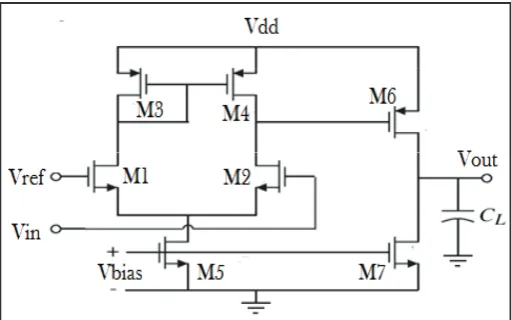
Two stage open loop comparator circuits consist of two differential
inputs. This comparator consists ofdifferential amplifier, input stage, and output stage as shown in Fig. 3. One of the advantages
of this circuit is that the circuit consumes minimum number of transistor and thus the circuit area is small.
Fig. 3: Two Stage Open Loop Comparator
In order to implement a high gain, open-loop comparator, the two-stage op-amp without compensation will be an excellent implementation. In order to achieve the desired resolution Comparator requires differential input and sufficient gain. So, two stage op-amps make an excellent implementation of the comparator. Hence a simplification occurs because it is not
necessary to compensate the comparator as it will generally be
used in an open loop mode. In fact, the comparator has the largest
bandwidth possible if it is not compensated and hence the large bandwidth gives a faster response.
The two stage open loop comparator can be designed by using the following formulas:
(W6/L6) = (2I6)/ (Kp’*(VSD6 (sat))2); (i)
(W7/L7) = (2I7)/ (KN’*(VDS7 (sat))2); (ii)
(W3/L3) = (W4/L4) = (I5)/ (Kp’*(VSG3-|VTP|)2); (iii)
(W1/L1) =(W2/L2) = gm12/(KN*I5); (iv)
(W5/L5) = (2I5)/(KN’*(VDS5(sat))2); (v)
Where, I6=I7= (|Pll|*Cll)/(λn + λp); (vi)
|Pll| = 1/(tp*(mk) 1/2); (vii)
III. TIQ (Threshold Inverter Quantization) COMPARATOR
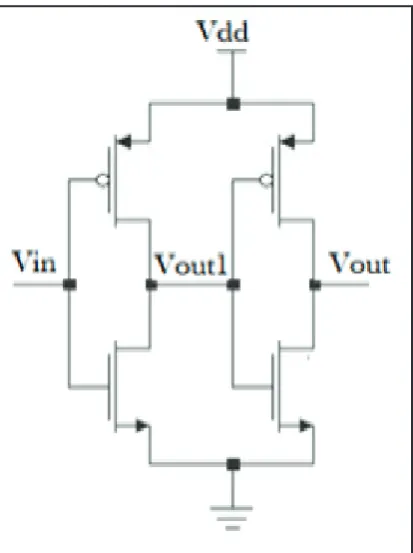
The technique’s name is so due to the use of two cascading inverters as a voltage comparator. The voltage comparators compare theinternal reference voltages with input voltage, which
are determined by the transistor sizes of the inverters. Hence, the
resistor ladder circuit used is not required as in a conventional
flash ADC. The Comparator’s role is to convert an input voltage (VIN) into logic `1’ or `0’ by comparing a reference voltage (Vref) with the VIN. If VINis greater than Vref, the comparator produces an output which is `1’, otherwise `0’. The TIQ comparator uses two cascading CMOS inverters as a comparator for low power consumption and high speed as shown in fig. 4.
Fig. 4: TIQ Comparator
The use of second inverter is to increase voltage gain and to
prevent an unbalanced propagation delay. Keeping the length of the PMOS and NMOS devices fixed, we can get desired values by changing only the width of the PMOS and NMOS transistors. We
take the assumption that both transistors are in the active region,
the gate oxide thickness (Cox) for both transistors are same, and the lengths (Lp and Ln) of both transistors are also the same. So, Vm is shifted depending upon the transistor width ratio (Wp/Wn). Hence, increasing Wp makes Vm larger and increasing Wn results in Vm being smaller on the VTC.
However, in order to use the CMOS inverter which acts as a voltage comparator, we should check the sensitivity of Vm to other
parameters, which are not taken into consideration, for correct
operation of the TIQ comparator. In a mixed-signal design, the
ignored parameters like threshold voltages of both transistors, electron and hole mobility, and power supply voltage are not
fixed at a constant value.
There are some distinct disadvantages of the TIQ approach:
The structure is single-ended. 1.
Due to poor power supply rejection ratioit requires a separate 2.
reference power supply voltage for analog part only. Due to process parameter variations,it has slight changes in 3.
linearity measures (DNL, INL) and the maximum analog
input signal range. However, these problems can easily be
handled by front end signal conditioning circuitry.
In order to reduce the power consumption and increase the 4.
performance during metastable stage it requires an S/H at
the analog input.
IV. Quantized Differential Comparator
Quantized Differential Comparator technique is basically used
for low voltage applications of Flash ADC’s. The internal
reference voltages, which are calculated by the transistor sizes of the Quantized Differential Comparator, are then compared
with the input voltage. The comparator produces an output ‘1’
or ‘0’ depending on applied input voltage. If we take the case of conventional differential comparator, the transistor sizes are matched and the input Vb is taken from Reference Voltage (Vref)
generated by resistor ladder circuit. Thus all the comparators of
n-bit flash ADC are identical. On the other hand, to create an offset voltage in Quantized Differential Comparator, we use different transistor sizes of the transistor M2 of the differential pair. And also, input voltage is applied to the V1 terminal and the voltages at V2 and Vb are constants (Figure 5). With this intentional mismatch
in the differential pair,the desired internal reference voltage is
generated. On this basis, 2n-1different sizes of comparators are needed for the flash ADC implementation. The inverter is used at the output of the differential amplifier to get sharp Voltage Transfer Characteristic (VTC) curves.
Fig. 5: Quantized Differential Comparator
In order to design n-bit flash ADC, one needs 2n-1 equal quantization voltages, and those many numberof Quantized Differential Comparators. In order to generate the different sizes
of transistors for different reference voltages of the comparators,
a PERL code has been developed and the device sizes have been picked up from the data generated to match the requirements. Once
the comparators produce a thermometer code, the thermometer
decoder is used, which generates 1-out-of-n code, using XOR
logic.
V. Two Stage CMOS Amplifier with an Output Inverter This comparator circuit is a two–stage CMOS amplifier with an output inverter consisting a total of three stages. The first is a differential pair, the second stage is a common source amplifier
current is mirrored to the first two gain stages. Both the analog
inputs are connected to the differential pair. The refernce voltage
is set as ‘Vim’ in this circuit. The transistors length is chosen to
be 180nm as speed is more important than gain in this circuit
design. Since NMOS transistors have higher mobility than PMOS transistors, an NMOS differential pair is used.
In order to improve gain of the first stage and lower the input offset voltage , the widths of the input differential pair NMOS1-NMOS2 were increased to get better matching. A commomsource amplifier is usec to get overall agin of the amplifier.The area covered by the common source transistorPMOS2 is increasedwith the goal of reducing the high parasitic capacitance ofPMOS2 which causes delay in the first stage. This causes decrease in the propagation
delay of the circuit. The thirdstage is an inverter buffer which increases slew rate of the circuit and adds modest gain. The
circuit designed in fig. 6 gives the length, width and multiplier
values for each transistor.
Fig. 6: Two Stage CMOS Amplifier With an Output Inverter
Comparator
VI. CMOS-LTE Comparator
CMOS inverter is the well-knownsimplest voltage-to-current transducer (VCT) implemented in CMOS technology. The inverter
has very low distortionand very good frequency response,as shown
by experiment and simulation howeverthe linear behavior depends
severely on the matching between p-channel and the n-channel
transistors; i.e., the parameter μμeffCoxW/L must be the same for both the transistors and its power supply rejection (PSR) is also poor. The MOS parameters in the above expression have their usual meaning. Perfect matching is difficult to achieve in practice because the effective mobilities μeffof electrons and holes depend
on doping, bias voltages and temperature.
The solution to this problem is the four transistor CMOS Trans
conductance element, whose operation resembles in most respect
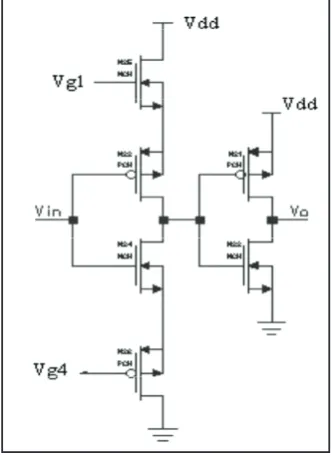
that of the CMOS inverter but without having PSR problems. Fig.7 shows the CMOS Linear Tunable Transconductance Element.The CMOS-LTE Comparator consists Linear Tunable Transconductance Element and an inverter. By systematically varying the transistor sizes of the CMOS linear tunable Trans
conductance element,the internal reference voltages are generated.
The transistor sizes of CMOS Transconductance are identical in this design, with Vg1 and Vg4 as fixed voltages. The output of this component is connected to CMOS inverter in order to increase
the voltage gain of the comparator.
Fig. 7: CMOS-LTE Comparator
VII. Implementation and Results
A. Two Stage Open Loop Comparator (IN TANNER EDA Using 180NM Technology)
Fig. 8: Two Stage Open Loop Comparator
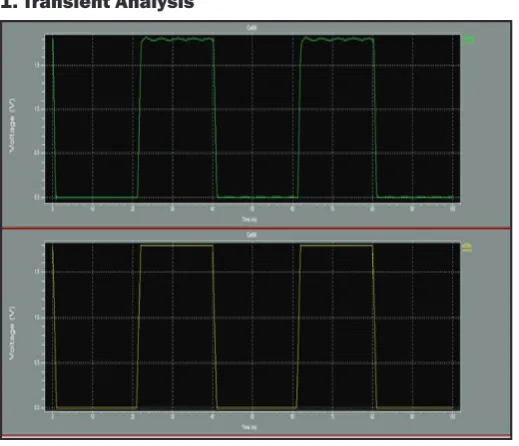
1. Transient Analysis
2. Power Results (Open Loop Comparator) VVoltageSource_2 from time 1e-008 to 1e-007 Average power consumed -> 2.370059e-005 watts Max power 7.570612e-005 at time 4.1e-008 Min power 5.441084e-006 at time 2.1375e-008
3. Delay Analysis tdlay = -1.8463e-008 Trigger = 4.0250e-008 Target = 2.1787e-008
B. Implementation of TIQ (Threshold Inverter Quantiz-ation using 180nm Technology)
Fig. 10: Schematic of TIQ Comparator
1. Transient Analysis
Fig. 11: Transient Analysis of TIQ
2. Power Results (TIQ comparator) VVoltageSource_1 from time 1e-008 to 1e-007 Average power consumed -> 1.694443e-006 watts Max power 6.135738e-005 at time 2.2e-008 Min power 1.548471e-007 at time 1e-008
3. Delay Analysis tdlay = 2.0173e-010 Trigger = 4.0278e-008 Target = 4.0480e-008
4. Transistor Count = 4
C. Implementation of Quantized Differential Comparator
Fig. 12: Schematic of Quantized Differential
1. Transient Analysis
Fig. 13: Transient analysis of QDC Comparator
2. Power Results
VVoltageSource_1 from time 1e-008 to 1e-007
Average power consumed-> 1.594352e-004 watts Max power 3.089151e-004 at time 8.1e-008
Min power 2.372884e-007 at time 4.025e-00
3. Delay Analysis tdlay = 2.7083e-010 Trigger = 4.0278e-008 Target = 4.0549e-008
4. Transistor Count = 7
D. Implementation of Two Stage CMOS Amplifier with an Output Inverter
1. Transient Analysis
Fig. 15: Output waveform Inverter
2. Power Results
VVoltageSource_1 from time 1e-008 to 1e-007 Average power consumed -> 5.214885e-005 watts Max power 9.352080e-005 at time 8.18344e-008 Min power 1.542141e-006 at time 7.27415e-008
3. Delay Analysis tdlay = -1.7849e-008 Trigger = 4.0278e-008 Target = 2.2429e-008
4. Transistor Count = 10
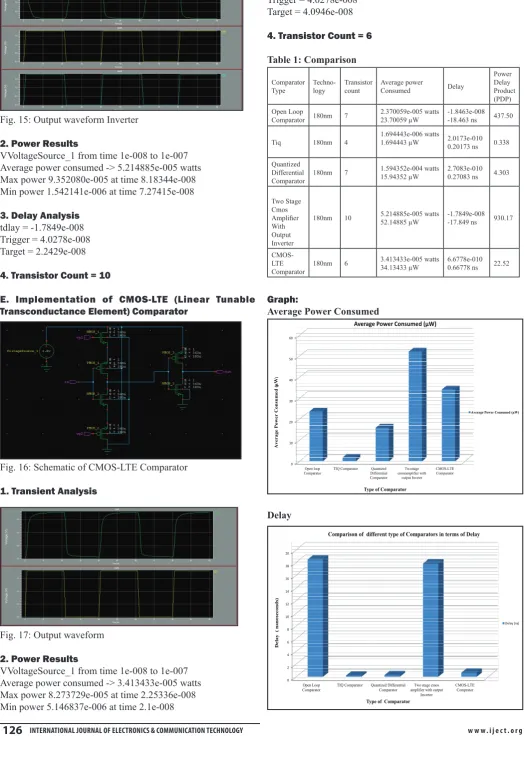
E. Implementation of CMOS-LTE (Linear Tunable Transconductance Element) Comparator
Fig. 16: Schematic of CMOS-LTE Comparator
1. Transient Analysis
Fig. 17: Output waveform
2. Power Results
VVoltageSource_1 from time 1e-008 to 1e-007 Average power consumed -> 3.413433e-005 watts Max power 8.273729e-005 at time 2.25336e-008 Min power 5.146837e-006 at time 2.1e-008
3. Delay Analysis tdlay = 6.6778e-010
Trigger = 4.0278e-008 Target = 4.0946e-008
4. Transistor Count = 6
Table 1: Comparison
Comparator
Type Techno-logy Transistor count Average powerConsumed Delay
Power Delay Product (PDP)
Open Loop
Comparator 180nm 7 2.370059e-005 watts23.70059 µW -1.8463e-008-18.463 ns 437.50
Tiq 180nm 4 1.694443e-006 watts1.694443 µW 2.0173e-0100.20173 ns 0.338
Quantized
Differential
Comparator 180nm 7
1.594352e-004 watts
15.94352 µW 2.7083e-0100.27083 ns 4.303
Two Stage
Cmos
Amplifier
With
Output Inverter
180nm 10 5.214885e-005 watts52.14885 µW -1.7849e-008-17.849 ns 930.17
CMOS-LTE
Comparator 180nm 6
3.413433e-005 watts
34.13433 µW 6.6778e-0100.66778 ns 22.52
Graph:
Average Power Consumed
0 10 20 30 40 50 60
Open loop
Comparator TIQ Comparator DifferentialQuantized Comparator
Twostage cmosamplifier with
output Inveter CMOS-LTE Comparator
Average Power Consumed (
μW
)
Type of Comparator
Average Power Consumed (μW)
Average Power Consumed (μW)
Delay
0 2 4 6 8 10 12 14 16 18 20
Open Loop
Comparator TIQ Comparator Quantized DifferentialComparator amplifier with outputTwo stage cmos Inverter
CMOS-LTE Comprator
Delay ( nanoseconds)
Type of Comparator
Comparison of different type of Comparators in terms of Delay
Average Power Consumed (µw) & DELAY (ns) 0 10 20 30 40 50 60 Open Loop
Comparator TIQ Comparator DifferentialQuantized comparator
Two stage CMOS Amplifier with Output Inverter
CMOS-LTE Comparator
Power (
μW) & Delay (ns)
Type of Comparator
Comparison of different Comparators in terms of Power and Delay
Average Power consumed (μW)
Delay (ns)
VIII. Conclusion
In this paper, five comparator circuits have been designed. There are some disadvantages of TIQ comparator in some applications
as stated in section 3. Two stage open loop comparator is presented
using 180nm CMOS technology. After this a Quantized Differential
Comparator has been implemented followed by a two stage
Amplifier with Output Inverter and a CMOS-LTE Comparator. All these architecture can be extended from medium to high resolution
applications because of the simplicity of the circuits. Comparators are a main part of analog circuits. As we can see in the power
results that the average power consumed by TIQ comparator is
less than that consumed by the open loop comparator and so is by
quantized differential comparator. This is due to the reason that the TIQ comparator generates the reference voltage internally and
hence the resistor ladder network is not required when designing a
FLASH ADC. Quantized Differential Comparator can also be used
for designing low power high speed Flash ADC’s. The two stage
CMOS amplifier with output inverter has also been implemented
and the average power consumed by the circuit is calculated. Delay for all these circuits has been calculated and PDP has been
defined which makes the comparison of all these circuits easier. As future work, we can design low power flash ADC using these comparator designs and a Priority Encoder.
Refrences
[1] Abhishek Rai, B Ananda Venkatesan,“Analysis and design of High Speed and Low Power Comparator in ADC”, International Journal of Engineering Development and Research (IJEDR), 2014.
[2] Anand Kumar Singh, Anuradha, Dr. Vijay Nath, “Design and Performance analysis of Low power CMOS Op-Amp.”, INTERNATIONAL JOURNAL OF ENGINEERING SCIENCES & RESEARCH TECHNOLOGY. 2014 [3] Dharmendra B. Mavani, Arun B.Nandurbarkar,“Study and
Implementation of comparator in CMOS 50nm Technology”, International Journal Of research and engineering Technology (IJRET), Vol. 3, Feb. 2014.
[4] T.Maneesha, T.S Ghouse Basha,“Design of Low Voltage low Power Inverter based comparator using CMOS technology”, International Journal of emerging Engineering Research and technology(IJEERT), Vol. 2, September 2014.
[5] Sujeet Mishra, Balchand Nagar,“Design of a TIQ comparator for high speed and low power 4-bit Flash ADC”, International Journal of Emerging Technologies in Computational and Applied science (IJETCAS), 2013.
[6] Marcel Siadjine Njinowa,“Design of low power 4-bit flash
ADC based on standard cells”, New Circuits and Systems Conference (NEWCAS), 2013, IEEE.
[7] M Subba Reddy, S. Tipu Rahaman,“An effective 6-bit flash ADC using low power CMOS technology”, Advanced Computing Technologies (ICACT), 2013, IEEE.
[8] Smriti Subhanad, Dr. H.P Shukla, A.G Rao,“Design and Simulation of a high speed CMOS Comparator”, International Journal Electronics and Communication Engineering, Vol.
6, 2013.
[9] Pradeep Kumar, Amit Kolhe,“Design & Implementation of Low Power 3-bit Flash ADC in 0.18μm CMOS”, International Journal of Soft Computing and Engineering (IJSCE), Vol. 1, Issue 5, November, 2011.
[10] A. Mahesh Kumar, Venkat Tumamala,“Design of a Low Power, Variable-Resolution Flash ADC”, 22nd International Conference on VLSI Design, 2009, IEEE
[11] Phillip E. Allen, Douglas R. Holberg,"CMOS Analog Circuit Design", Oxford University Press, Inc. 2002.
[12] Sung-mo Kang, Yusuf Leblebici,“CMOS Digital Integrated Circuits: Analysis and Design”, third edition, Tata
McGraw-Hill edition 2003.
Neha received B.Tech degree in
Electronics and Communication Engineering from Punjab Technical University (PTU), Punjab in 2014 and M.Tech scholar degree in VLSI & Embedded Systems from Manav Rachna International University, Faculty of Engineering and
Technology, Faridabad in 2016. Her current research interests include
low power VLSI design, Embedded Systems, Nanoscale and CMOS devices.
Amana is currently working as
an Assistant Professor in ECE Department of FET-MRIU, Faridabad. She is pursuing her Ph.D from Manav Rachna Internatioal University. She did M.Tech in VLSI Design from Mody Institute of Technology and Science, Lakshmangarh in the year 2008 and B.E (Honors) in ECE from Sri Balaji College of Engineering and technology, Rajasthan University in the year 2006. She did her thesis during M.Tech under the guidance of Dr. S.C Bose Scientist E2, CEERI, Pilani. Her Research interests include VLSI Designing.
Ila has done M.Tech from Kurukshetra University in VLSI Design and Microelectronics She has teaching and research experience of eight years and
is currently working in electronics and Communication department at Manav
Rachna International University, Faridabad. She is specialized in circuit
simulations as well as Front-end Design