Lossless Image Compression Technique
Comparing Haar Wavelet and Vector
Transform With Integer To Integer
Compression
Neha Sikka1 and Sanjay Singla2
I.INTRODUCTION
Image processing field produce many challenges in front of computer vision researchers. The challenges may cover different phases like Image acquisition, Pre-processing, Segmentation, Restoration, Compression etc. Image Compression is also one of the hot topic. Image compression is a field where an original image is reduced to a smaller sized image and then for the purpose of remote communication this minimize image is used [1,2]. At the destination site, this minimize image is again converted to original image by the execution of some algorithms. The result of these algorithms produces another image which may be very close to the original one .All the operations in reverse order again provide the initial data means data in decompressed form .During the process of decompression to get the original image back some of the finer details in the image sometime have to be surrender for saving a little more bandwidth or storage space etc. This also means that lossy compression techniques can be used in this area. During lossy compression the resultant image produced by the decompression stage may be slightly different from the input image. This minor variation is acceptable during some of the applications like the images transferred through social networking applications such as Whatsapp, Facebook etc Lossless compression is used to reproduce the input image after the decompression
1Department of Computer Science Engineering IET Bhaddal, Ropar, Punjab,India 2Department of Computer Science Engineering IET Bhaddal, Ropar, Punjab,India
DOI: http://dx.doi.org/10.21172/1.73.507 e-ISSN:2278-621X
Abstract- The area of Image processing make a high effect in the age of fast growing technology to fulfil the human comfort level. A single image may contain thousand times more information than a written text on piece of paper. But due to the advent of technology, number of image formats exists to provide strength to the image data like JPEG, Tiff, BMP, Gif etc. Even when we wants to communicate on the base of these images through Internet for some purpose then the issue arises and affect the communication. To deal with this issue some compression mechanism is required. Compression is technique which is used to represent a particular thing by giving its shorter version to save some space for storage. In this paper a lossless technique of Image processing is proposed by considering Haar wavelet and Vector transform techniques. 97% compression percentage is achieved with the help to proposed method and when the results are compared with other techniques like Integer-to-Integer transform low SNR (Signal to Noise Ratio) values and high RMSE values are achieved for the proposed system which shows its accurate behavior.
process without the loss of any information from it. Lossless techniques are required where sensitive information such as legal documents, executable documents, medical images etc.[3,4]. Most compression schemes worked on the data present in the image in the form of repetitions. For example, alphanumeric characters are normally represented by a 7-bit ASCII code, but when we apply a compression process then only 3-bit code is required to represent the eight most common letters [5]. Here the main concept is to replace a particular thing in the image which repeatedly occurs with the number of its appearances. For example, in case of compression of audio recording the silence can be replaced by some value which indicates how long that silence was present in the audio. Similarly, the number of white spaces can replace different white spaces present in the image [6,7]. Data compression process is mostly used to decreases the size of the data to deal with less storage and low bandwidth requirement issues. To increase the overall throughput various communications equipment like modems, bridges, and routers use different compression techniques which was not there previously in case of standard phone lines or leased lines. Compression is also used to compress voice telephone calls transmitted over leased lines so that more calls can be placed on those lines. In case of video conferencing applications compression is the main weapon to deal with the issues like lesser bandwidth networks and high speed networks [8].
Compression techniques show promising results in the application where voice and data are combined to form data packets. Compression techniques have been developed that reduce the data requirements for a voice channel down to 8 Kbits/sec. This is a significant improvement over non compressed voice (64 Kbits/sec) and older compression techniques yielding 32 Kbits/sec [9,10]. During image compression process a digital image is considered as a matrix containing intensity values of different image pixels as the data stored inside the matrix. The intensity values in case of Gray scale images is in the range of 0-255 means the stored inside the matrix can have minimum value as 0 and maximum value as 0-255. All the mathematical methods for the sake of compression only consider this intensity data as raw data. [11,12]. To give strength to compression process linear algebra techniques are used. These techniques also helps to maintain a suitable level of detail present in the image. The field of Medical image processing involves in the task of processing finer details hidden in the medical images. These details may affect the treatment process of any medical person and may provide a specific direction to work [13,14]. But again when different medical persons present at remote locations, wants to share some information in the form of medical images my face the difficulty due to the size of image. The size of image may become a barrier in front of limited bandwidth channels. Here, to deal with this issue, a hybrid lossless image compression algorithm is presented in this paper. This algorithm is the combination of Haar wavelet technique and Vector transform technique. The proposed system of compression and decompression is also compared with the existing algorithms such as Integer to Integer compression techniques. The system produces better results than existing algorithms. The next part of the paper will give a highlight to the work already done by other researchers in this field and after that there is a discussion about the existing techniques used for the purpose of comparison. Then the proposed technique is explained in detail. At the end results obtained from the proposed system are explained with the help of tables and charts.
II. RELATEDWORK
inspection proves that HWT show upper edge to DCT compression but as compared to BWT it showed low performance..
Yu Shen, Xieping Gao found that during image compression process using integer transform image entropy decreases and the overall process was recognized as lossless image compression. The decrease in the value of entropy happened because of the increase of transform layer. They achieved higher compression rate but consume more time. But their proposed method gave good results in case of lossy compression but poor during lossless compression.
Merav Huberoterner et al. proposed a new hyper spectral compression method. The authors focused on the extraction of background from the image data and compression of individual pixel. The method did not make any assumption about the image and did not require target attraction. The method show low computational complexity and high compression ratio (CP). The band decimation compression was presented as a baseline of the simple 1-D spectral compression. Their proposed method gave satisfactory results.
Adnan Khashman and KamilDimililer worked on medical images. They worked on the concept that very minute details stored under medical images may affect the overall disease treatment process. They focused on Wavelet transform technique as it helps to retrace the images as it is. Authors elaborate a method to select wavelet for compression of medical images. They had done quality analysis on reconstructed image and on the basis of MSE and PSNR results they conclude that bi-orthogonal 4.4 wavelet produced better results.
Yu Yanxin, Song Xue, found that overlapping block algorithm estimates the blocking effect that blocking brings. Their proposed system produced better results than direct blocking technique. They worked on the overlap blocking algorithm to save space and increase calculation speed. Hardware parallel mode was also achievable from the algorithm proposed by them.
Olfa Kanoun, Kachouri, presented that for Angiography images, degradation of the images were more visible on the reconstruct images after compression using JPEG quantification. They proposed that mathematical tools in medical imagery aim at gathering information about properties which are more complex to seen with naked eyes.
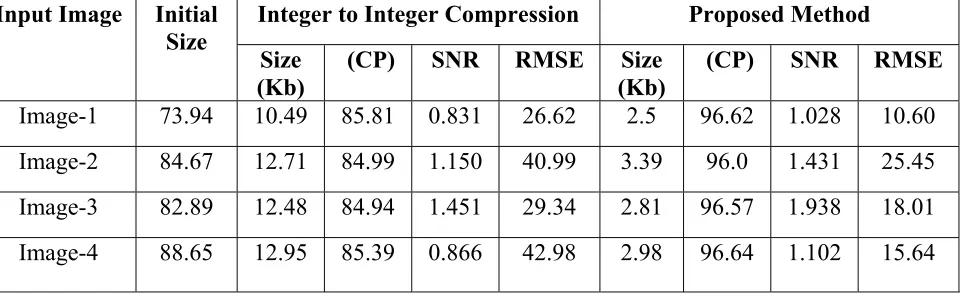
Table 1. Results of parameters
Input Image Initial Size
Integer to Integer Compression Proposed Method Size
(Kb) (CP) SNR RMSE (Kb) Size (CP) SNR RMSE
Image-1 73.94 10.49 85.81 0.831 26.62 2.5 96.62 1.028 10.60
Image-2 84.67 12.71 84.99 1.150 40.99 3.39 96.0 1.431 25.45
Image-3 82.89 12.48 84.94 1.451 29.34 2.81 96.57 1.938 18.01
Paul W.Gorley, Nicolas, compare two compression methods, symmetric and asymmetric encoding and concluded that symmetric compression produces better results. It was assumed by them that uncompressed image was a perfect and ideal stereo image.
for JPEG stereoscopic image encoding, symmetric compression should be used for all image types.
Adnan Khashman and KamilDimililer focused on the concept to transmission and storage of medical images. The main concern of an efficient image compression system is to achieve high compression ration and wavelet transform provides a direction in this problem. Authors trained a neural network in their study for the purpose of compression. Their neural network then made a choice for optimum CP for different radiographs with the help of intensity values of image pixels and weights of neural network.
Marta mrak,SonjaGrgic and MislavGrgic, concluded that the major problem during the compression and decompression process is the degradation of the reconstructed image. All this happed because of the noise which may produced during the compression process. In their paper correlation of subjective with objective measures had been highlighted. Picture quality is measured using 9 different objective measures and subjective measures using mean opinion score. The effect of different compression algorithm, picture content and CR are accessed. Their system show good results for some objective measures as compared to original image but the system was not reliable to compare the effect of different other algorithms.
Matthew C. Stamm, proposed a set of anti-forensic operations. These operations were used to remove compression fingerprints. They proposed a new framework to remove quantized fingerprints. Authors estimated the distribution o transform coefficient before compression, they added anti-forensic dither to the compressed image’s transform coefficients.
III. EXISTING TECHNIQUES
Integer to Integer Compression: It is a lossless compression technique where data is handled in the form of integers [15,16]. The entire input data is denoted as integers as the common wavelet is a float number. The lossless transform is performed using the obtained data in the form of floating point numbers. The process is used to handle boundary error and precision error. This technique firstly divide the data into two parts and not converting the data from integer to float form. then the next steps are Prediction and P(x) and Update U(y) [17,18]. The following are the equations used for these two steps:
here xi and yi are the coordinates of the pixel under consideration.
IV. PROPOSED SYSTEM
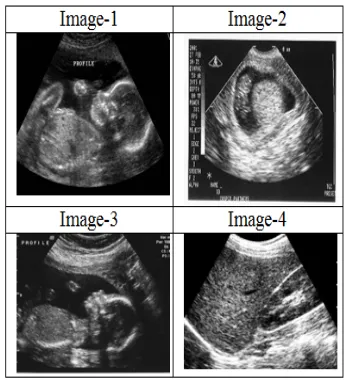
Figure1. Test Images
1) Make four different pairs of the entries of set r as (220,180),(248,108),(126,142),(160,160).
2) Form the average of each pair as (220+180)/2= 200 and at the end get the set of four values as [200, 178, 134, 160]. This new set is denoted by r1 and it is a new vector formed.
3) In this step, subtract each average value obtained in the previous step from the first entry of the pair which was used to form this value. As for the pair (220,180), average value is 200 and the new value is (220-200=20). So, for r1 vector its next values are (20,70,-8,0). After this step vector r1 is (200,178,134,160,20,70,-8,0). The first four values of r1 are called approximation coefficients and the last four are called detailed coefficients.
4) Similarly the same steps are followed in the same order by making the pairs of approximation coefficients and generate detailed coefficients from it up to the possible level.
5) Reverse steps will provide the decompressed image.
V.RESULTS & DISCUSSIONS
The implemented system shows the process involved in the proposed system. One technique Integer-to-Integer (ITI) Compression are compared with the proposed hybrid combination of Haar wavelet and Vector transform techniques. Figure 1. shows the test images used for the purpose of experiment. The results are compared by considering the parameters such as SNR (Signal to Noise Ratio), RMSE (Root Mean Square Error), CP (Compression Percentage) and Size of the output image.
0 10 20 30 40 50
Ima
ge
1
Ima
ge
2
Ima
ge
3
Ima
ge
4
Ima
ge
5
Propose d Compre ssion method
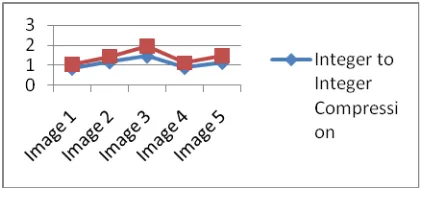
Figure 3. SNR results
Table 1. shows the comparison of these parameters for considered techniques. From this table it is cleared that the performance of proposed system is better as compared to considered existing systems as we obtain smaller values of RMSE, large values of SNR, High CP and small size for the proposed system all the times.
VI. CONCLUSION
In this research a lossless image compression method using the hybrid combination of Haar wavelet and vector transform technique is implemented. The values of different parameter like SNR, RMSE, CP, CR etc. shows the best performance of the proposed system as compared to existing systems like Integer to Integer techniques.
Further this work may be extended on implement some of the optimization algorithms like Genetic Algorithms (GA), Ant Colony Optimization (ACO) etc. for the purpose of lossless compression. These algorithms must proven to be effective because these are meant for the situations where the solution domain is very large.
VII. REFERENCES
[1] P. Seuntiens, L. Meesters, and W. Ijsselsteijn, "Perceived quality of compressed stereoscopic images: Effects of symmetric and asymmetric JPEG coding and camera separation," ACMTrans. Appl. Percept., vol. 3, no. 2, pp. 95-109, 2009.
[2] W. J. M. Levelt, “On binocular rivalry”, Levelt, W. J. M., Ed., 2005.
[3] M. G. Perkins, "Data compression of stereopairs," IEEE Transactions on communications, no. 40, pp. 684-696, 2009.
[4] D. V. Meegan, L. B. Stelmach, and W. J. Tam, "Unequal weighting of monocular inputs in binocular combination: Implications for the compression of stereoscopic
imagery," Journal ofExperimental Psychology: Applied, vol. 7(2), pp. 143-153, 2012.
[5] L. Stelmach, W. Tam, D. Meegan, A. Vincent, and P. Corriveau, "Human perception of mismatched stereoscopic 3D input," in Image Processing, 2010. Proceedings. 2010 International Conference on, vol. 1, 2010, pp. 5-8.
[6] D. A. Leopold, J. C. Fitzgibbons, and N. K. Logothetis, "The role of attention in binocular rivalry as revealed through optokinetic nystagmus," Cambridge, MA, USA, Tech. Rep., 2011. [7] L. Kaufman, Ed., Sight and Mind: An Introduction to Visual Perception. University of Illinois
Press, 2011.
[9] L. L. Kontsevich, "Pairwise comparison technique: a simple solution for depth reconstruction," J. Opt. Soc. Am. A, vol. 10, no. 6, pp. 1129-1135, 2003.
[10] B. Julesz, "Foundations of cyclopean perception," 2002.
[11] I. Dinstein, "Compression of stereo images and the evaluation of its effects on 3D perception," in SPIE Applications of Digital Image Processing XII, 1153,522-30, 2010.
[12] S. Sethuraman, M. Siegel, and A. Jordan, "A multiresolution framework for stereoscopic image sequence compression," in Proc. ICIP-08, vol. 2, November 2008, pp. 361 - 365.
[13] I. Dinstein, G. Guy, J. Rabany, J. Tzelgov, and A. Henik, "On stereo image coding," in In the International Conference on Pattern Recognition, 2007, pp. 357-359
[14] L. Stelmach, W. J. Tam, D. Meegan, and A. Vincent, "Stereo image quality: effects of mixed spatio-temporal resolution," Circuits and Systems for Video Technology, IEEE Transactions on, vol. 10, no. 2, pp. 188-193, Mar 2010.
[15] M. W. Siegel, P. Gunatilake, and S. Sethuraman, "Compression of stereo image pairs and streams," in In Stereoscopic Displays and Applications V, 2010, pp. 258-268.
[16] M. Siegel, S. Sethuraman, J. S. McVeigh, and A. Jordan, "Compression and interpolation of 3D-Stereoscopic and multi-view video," in 3D-Stereoscopic Displays and Virtual Reality Systems IV, vol. 3012, February 2007, pp. 227 - 238.
[17] H. M. Al-Otum, "Qualitative and quantitative image quality assessment of vector quantization, JPEG, and JPEG2000 compressed images," Journal of Electronic Imaging, vol. 12, no. 3, pp. 511-521, 2008.
[18] P. W. Gorley and N. S. Holliman, "Stereoscopic image quality metrics and compression," ser. Stereoscopic Displays and Applications XIX, SPIE Proceedings, vol. 6803, 2008.
[19] Adnan Khashman and KamilDimililer “Medical radiographs compression using neural networks and Haar wavelet”, Eurocon IEEE, 2009.