Abstract— The Nigerian construction industry produces nearly 70% of the nation’s fixed capital formation yet its performance within the economy has been, and continues to be, very poor. For example, the Nigerian construction industry’s contribution to employment has remained consistently at 1.0% over the last decade against the World Bank’s average observation of about 3.2% in developing countries. The last decade however exposed the declining level of clients’ satisfaction from the built facilities as a result of poor quality performance in addition to the perennial problems of time and cost overruns in the Nigerian construction industry. This has necessitated a radical change in industry practice in order to improve the quality of construction processes and the level of clients’ satisfaction arising there from by devising methodology for evaluating the quality performance of the contractors in order to assist construction clients in selecting quality-oriented organizations that will provide higher quality services and products within budget and on schedule. Therefore, the principal aim of this paper is to provide a methodology that will improve the quality of the design and construction processes and the level of customer satisfaction derived there from. This paper identified quality attributes relevant to the construction process and proposed a quality performance evaluation model that covers both the corporate and operational levels of a construction project. The paper also implemented the framework in the form of an investigative survey into the quality performance of building contractors in Nigeria as perceived by client organizations. The assessment was based on clients’ perception of the contractor quality practices based on the identified quality attributes.
Index Term— Client satisfaction, Construction industry, Quality attributes, Quality Performance,
I. INT RODUCT ION
The Nigerian construction industry produces nearly 70% of the nation‘s fixed capital formation [ 1 ] . Yet its performance within the economy has been, and continues to be, very poor. For example, the Nigerian construction industry‘s contribution to employment has remained consistently at 1.0% over the last decade against the World Bank‘s average observation of about 3.2% in developing countries. The construction industry tends to define quality as the ability of products and processes to conform to the established requirements. These requirements are established
Assoc. Prof. DR Arazi Idrus is with the Department of Civil Engineering, Universiti Teknologi Petronas, Seri Iskandar, T ronoh, Perak, Malaysia. E
-mail: ([email protected]. )
Mahmoud Sodangi is a PhD research student under the supervision of DR Arazi Idrus at Universiti Teknologi Petronas, Seri Iskandar, T ronoh, Perak,
Malaysia. (E-mail: [email protected] )
characteristics of a product, process or service as specified in the contractual agreement. Quality is a persuasive concern throughout the entire project process, as the performance of each phase in the process will affect the performance of subsequent phases [2]. Both [3] and [4] have suggested the consideration of quality as a major criterion in construction procurement systems in order to enhance the level of competitiveness and facilitate the production of higher quality construction,. Yet, quality remains an elusive attribute that has been defined in many different ways. [6] consider quality as a subset of performance, in conjunction with productivity, safety and timeliness, while others seem to think of it in terms of ―conformity to established requirements‖ or ―fitness for purpose‖ [7] and [8]. ISO 8402 defined quality as the degree of excellence in a competitive sense, such as reliability, serviceability, maintainability or even individual characteristics. Similarly, the term ‗performance‘ can also take on different meanings depending on the context in which it is being used. Traditionally, it has been used to measure the effectiveness (doing the right thing) and efficiency (doing the right thing right). Various researchers have attributed numerous dimensions to performance, such as quality, productivity, profitability, safety, timeliness, growth, satisfaction, etc [9].
Therefore, in order for construction clients and end-users of completed facilities to realize best value, the concept of quality culture must be stressed in the industry to improve the quality of services (design and construction processes) and products (facilities constructed) offered by various organizations. Accordingly, there is a need for a framework for evaluating quality performance to assist construction clients in selecting quality-oriented organizations that will provide higher quality services and products within budget and on schedule. Therefore, the principal aim of this paper is to provide a methodology that will improve the quality of the design and construction processes and the level of customer satisfaction derived there from. The main objectives include investigating project quality attributes in the design and construction process; developing a quality performance evaluation model that will encompass both the corporate and project levels of a construction; and demonstrate the application of the framework by investigating the client‘s perspectives of the quality performance of their contractors at operational level.
Framework for Evaluating Quality Performance
of Contractors in Nigeria.
109301-4747 IJCEE-IJENS © February 2010 IJENS
I J E N S
a
[ 1 1 ] ;
b
[ 1 2 ] ;
c
[ 1 3 ] ;
d
[ 1 4 ] ;
e
[ 1 5 ]
a
[11]; b[12]; c[13]; d[14]; e[15] 2. CONST RUCT ION QUALIT Y
PERFORMANCE
In a paper on assessing contractor quality performance, [10] stated that quality performance in construction is results oriented, and seeks evidence of quality awareness within the operations and output of a project organization. For example, cost overruns and time delays of construction activities are often used to measure the impact of rework occurring during the process. They added also that quality performance is defined over a long term for the effects to be permanent, and its improvement are expected to increase the productivity and profitability of contractors as well as increasing client and end-user satisfaction.
Quality performance in the context of this paper is defined in terms level of satisfaction derived by owners and end-users of completed facilities as a result of the performance of
the consulting and contracting organizations. The proposed methodology for evaluating quality performance, shown in Fig. 1, diagnoses construction from both corporate level (where corporate strategies concerning how to perform the construction operations are formulated) and project level (where the design and construction systems produce a physical facility and provide contracting and consulting services). Although prescriptive in nature, this dissection would facilitate the development of strategies to define, operationalize, measure and
improve construction quality at both corporate- and site- levels.
2.1 Quality Performance at Project-level
The quality performance of a construction project at the site-level includes the quality of the constructed facility as well as the quality of services. A mix of product and service quality dimensions would therefore be very instrumental to the achievement of site-level quality performance. Table I contains some of the product and service quality dimensions (attributes) from literature, and their interpretations.
TABLE I
PRODUCT AND SERVICE QUALITY DIMENSIONS AT PROJECT-LEVEL
Dimension Definitions
Product Quality
Performancea Basic function of the facility meets the end-user‘s needs and intents
Featuresa Characteristics that supplement basic functions of the facility
Reliabilitya, c The level of confidence with which the end-user may use the facility, to the end of its design life, without failure.
Conformancea The degree to which construction operations meet the design standards and specifications
Durabilitya The amount of use end-users get from the facility before replacement is preferred to continued repair a
Serviceability Speed, courtesy, competence with which maintenance on facility can be carried out
Aestheticsa The level of satisfaction the end-user experiences with the facility‘s look, feel, sound, taste, or smell. Perceived
a quality
The level of satisfaction the end-user experiences with the facility‘s image and publicity
S ervice Quality
Timeb The duration of the contract, including the wait for mobilization on site
Timelinessb Completion of the contract on the scheduled date b
Completeness The amount of items on the punch list upon completion of the project
Courtesyb, c The degree of respect, politeness, friendliness and kindness of the site and other personnel
Consistencyb The ability to repetitively provide the same level of service to all clients
Accessibility & b, c convenience
The ease with which the contracting service is obtained
Accuracyb The ability to provide the right service the first time with minimum amount of rework
Responsivenessb,
c, d The ability to react to the unexpected problems encountered during the contract. Willingness and
readiness to provide prompt service c, d
Reliability Ability to perform the promised service dependably and accurately
Communicationc Keeping customers informed in a language they can understand and listening to the customer when necessary
Credibilityc Honesty; trustworthiness
Securityc Physical, financial and confidentiality
Competencec Possession of required skills and knowledge of all employees
Tangiblesc, d The physical facilities and equipment, and appearance of employees
Understandingc The ability to comprehend the client‘s needs and requirements
Assuranced Knowledge and courtesy of employees and their ability to inspire trust and confidence
Empathyd The degree of caring, individualized attention the firm provides its customers
Factor 1
People and customer management
♦ Human resource management in line with company performance plans
♦ Employee recognition/ movement to support quality performance plans
♦ Management of customer relations. Factor
2
Supplier partnership
♦ Assurance of supplier quality
♦ Action to assist and improve the quality and expensiveness of suppliers
Factor 3
Communication of improvement information ♦ Determination of quality costs
♦ Assessment of needs for quality trailing and subsequent delivery and review
♦ Benchmarking of processes in non-competing organizations ♦ Promotion of quality improvement with outside groups.
Factor 4
Customer satisfaction orientation
♦ Commitments to customers through strengthening of warranties/policies, etc.
♦ Comparisons of customers‘ satisfaction with competitors and internal indicators.
♦ Determination of improvements in customer satisfaction. ♦ Benchmarking of direct competitors‘ products and policies
Factor 5
External Interface Management
♦ Recognition of responsibilities for public health and safety, and the environment.
♦ Determination of customers‘ requirements.
♦ Integration of the design process with customer and operational requirements.
Factor
6 Strategic Quality Management ♦ Process control and improvement of core process in accordance with design
♦ Active leadership by managers in quality issues.
♦ Inclusion of employee well-being considerations in improvement activities.
♦ Senior executive commitment to quality through involvement and communications.
♦ Development/implementation o f short-term plans/strategies focused on quality.
♦ Analysis of performance and cost data to support improvement priorities.
Factor 7
T eam work structures form improvement
♦ Use of specific organizational structures to support quality improvement.
♦ Use of techniques to identity key process, customers and suppliers.
Factor 8
Operational Quality Planning
♦ Development/implementation of short-term plans/strategies focused on quality.
♦ Consideration of performance requirements in developing short terms goals.
Factor 9
Quality improvement measurement system.
♦ Assessment and improvement of processes, practices and products/services.
♦ Management of data/information to support quality improvement efforts.
♦ Procedures to ensure reliability and improvement of data gathering.
Factor 10
Corporate quality culture.
♦ Consideration of performance requirements in developing long-terms goals. ♦ Encouragement of a company wide culture committed to quality improvement.
To sum it up, the project level is where the project process is carried out in order to produce a physical facility and provide a contracting service. This level may be part of the corporate organization [16].
2.2 Quality Performance at Corporate-level
The foundations of the quality orientation of a company are defined at the corporate level. Quality orientation is recognized
by an organizational commitment to developing and maintaining core competence based upon a quality focus [17]. Core competence is what a company does better than anyone else. It should be noted that core competence should be enhanced in line with the business environment, to provide more value to the customer, otherwise it risks becoming obsolete [18] Other factors contributing to quality orientation include the business performance and social responsiveness of the organizations. [19] assert that quality-conscious companies adopt quality management systems that focus on creating and/or sustaining performance improvement in the areas of management involvement and leadership, product and process design, product control, customer and supplier communications,
quality improvement programmes, employee
participation, education and training, and quality information.
The corporate-level quality of a contractor can be experienced through the corporate quality culture, which comprise of the organizational value system that encourages a quality-conscious work environment. It establishes and promotes quality and continuous improvement through values, traditions and procedures [20]. [21] provides reliable and tested critical success factors for Total Quality management. Table II shows the quality performance indicators at corporate level of an organization.
TABLE II
109301-4747 IJCEE-IJENS © February 2010 IJENS
I J E N S The evaluation of project quality performance are based on the
availability and implementation of certain quality improvement tools and techniques that will help in the assessment of the quality attributes identified at both
corporate and project levels.
Fig. 1. Framework for evaluating c o nstruction Quality Performance
(Adopted from [23]).
The following definitions constitute the key quality dimensions of the above proposed framework.
• Design Quality Practices – consist of a framework for guiding quality-related actions by all employees of the consulting organisations and a means of assessing how well these actions are carried out. These are reflected in the quality practices of the consulting organisations.
• Total Quality Systems - consist of a framework for guiding quality-related actions by all employees and a means of assessing how well these actions are carried out. These are reflected in the quality management systems of the organisations.
• Product design performance – the degree to which the features of the facility conform to the client‘s needs as expressed in the client‘s brief.
• Product quality performance - the degree of conformance of built facility to the drawings and specifications.
• Design service performance - the competence, integrity and promptness with which the design and construction planning activities are carried out by consultants.
• Construction service performance - the
technical/managerial competence, integrity and
promptness demonstrated by contractors during the construction process.
3. CLIENT S‘ PERSPECT IVES OF PROJECT-LEVEL
QUALIT Y PERFORMANCE OF CONT RACT ORS
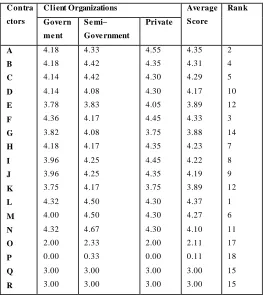
The proposed framework was partially implemented in the context of clients‘ perceptions of the quality performance of contractors a t t h e p r o j e c t l e v e l . The evaluation w a s restricted to the project level because construction is a project-oriented industry and many construction researchers have emphasized closer focus on the project level more than the organizational level [24] and [25]. Eighteen (18) out of thirty (30) randomly selected medium sized contractors responded to the request to identify one each from the following client groups that they worked with recently; Government, Semi-government and Private clients. Each of the client organizations were requested to assess the quality performance of the specific contractor that identified them. The assessment was along the product and service dimensions identified in Table II using a scale of 1 to 5 where 1 is poor performance and 5 is best performance. The average means of the scores for each contractor and their rankings are given in Table III. The contractors were labeled A to R to maintain the confidentiality of their identities assured during the survey.
TABLE III
EVALUATION RESULTS OF ASSESSMENT OF CONTRACTORS BY
CLIENT ORGANIZATIONS
C ontra
ctors
C lient Organizations Ave rage
4. ANALYSIS OF VARIANCE (ANOVA)
An analysis of variances (ANOVA) test was carried out at 95% confidence level to determine whether the three groups of clients have different perceptions on the quality performance of the contractors. The null hypothesis, H0, was that the three groups of clients have the
same perception about the quality performance of the contractors. The decision was to accept H1 if the critical
value of F is less than F-table, otherwise H0 will be
accepted. In other words, to accept H1 is to say that the
three groups have different perceptions of the quality performance of the contractors.
Since the F-ratio calculated from the ANOVA table has a value of 0.52, which is less than the critical value of F at 5% significant level of 3.19, it can be concluded that H0 is
accepted and implying that the mean quality performance of the three categories of clients is the same. Thus, by way of inference, a contractor can be selected based on the assessment of any of the three
groups of client organizations as far as quality performance of construction product and service is
concerned at the project level.
5. CONCLUSION
A quality performance evaluation model that covers both the company and site levels of a construction project was proposed in this paper. The paper also identified quality attributes relevant to the construction process and implemented the framework in the form of an investigative survey into the quality performance of building contractors in Nigeria as perceived by client organisations. The measurement was based on clients‘ perception of the quality performance of contractors based
on identified quality practices at both organisational and operational levels. The results revealed that the three categories of clients generally agree on their assessment, indicating a general consistency in the quality performances amongst the contractors. The paper, while acknowledging the dynamics and continuous change in the construction sector especially the shortcomings of the lowest cost competitive bidding, further stressed that quality be considered as a major criterion in contractor evaluation and selection systems. It is also recommended that Government, being the major client of the building industry, should establish specialist Construction Quality Council that will serve as regulatory body to ensure conformance to quality standards required in various areas (materials, labour skills, equipment, methods, etc) of the construction industry.
REFERENCES
[1] Federal Office of Statistics (FOS) (2004), Annual Abstract of Statistics, FOS, Abuja.
[2] Willis, T .H. and Willis, W.D. (1996). A quality performance management system for industrial construction engineering projects. International Journal of quality & Reliability Management. Vol 23, No. 9, pp. 38-48.
[3] Marr, B. (2001) Scored f or lif e , Fin a n c ia l Ma n a g e m e n t, April, 30.
[4] Latham, M. (1994) Constructing the Team , HMSO, London. Love, P.E.D. and Holt, G.D. (2000) Construction business
performance measurement: T he SPM alternative, Business Process Managem ent, 6(5), 408-416.
[5] Egan, J. (1998) Rethinking Construction, CIB, London.
[6] Oglesby, C.H., Parker, H.W. and
Howell, G.A. (1989) Productivity Im provem ent in Construction, McGraw- Hill, New York.
[7] Kaydos, W. (1991) Measuring, Managing and Maxim ising Perform ance, Productivity Press, Cambridge.
[8] Milakovich, M.E. (1995) Im proving Service Quality: Achieving H ig h P e r f o r m a n c e i n t h e P u b l i c a n d P r i v a t e Sector., St. Lucie Press, Delray Beach, FL.
[9] Szilagyi, Jr., A.D. (1988) Managem ent and Perform ance, 3rd edn., Scott, Foresman, Glenview, IL. [10] Yasamis, F., Arditi, D., and Mohammadi, J. (2002). Assessing
contractor quality performance. Construction Management and Economics. Vol. 20, No. 3, pp. 211-223.
[11] Garvin, D.A. (1988) Managing Quality, T he Free Press, New York.
[12] Evans, J.R. and Lindsay, W.M. (2005) The Managem ent and Control of Quality, 6th Edn., South-Western, T hompson corporation.
[13] Parasuraman, A., Zeithaml, V.A. and Berry, L.L. (1985) A conceptual model of service quality and its implications for future research, Journal of Marketing, 49, 41 – 50. [14] Parasuraman, A., Zeithaml, V.A. and Berry, L.L. (1988)
SERVQUAL: A multiple item scale for measuring consumer perceptions of service quality, Journal of Retailing, 64(1), 14 – 40.
[15] Gronroos, C. (1988) Service quality; the six criteria of good perceived service quality, Review of Business, 9(3), 10 – 13. [16] ISO10006:2003, International Standard: Quality management
systems – guidelines for quality management in projects. Second Edition, Geneva.
[17] Miles, P., Russell, G.R. and Arnold, D.R. (1995) the quality orientation: an emerging business philosophy? Review of Business, Jam aica, 17(1), 7.
[18] Russell, R . S . and T a y l o r , B . W . (1998) Operations Management: Focusing on Quality and Competitiveness, Prentice-Hall, Englewood Cliffs, NJ.
[19] Evans, J.R. and Lindsay, W.M. (2005) The Managem ent and Control of Quality, 6th Edn., South-Western, T hompson corporation.
[20] Goetsch, D.L. and Davis, S.B. (2000) Introduction to Total Quality: Quality Management for Production, Processing and Services, Prentice-Hall, Englewood Cliffs, NJ.
[21] Saraph, G.V.P., Benson, G. and Schroeder, R.G. (1989). An i n s t r u m e n t f o r measuring the critical f a c t o r s of quality management, Decision Sciences, 20, 810 – 829. [22] Zlack, S.A. and Porter, L.J. (1996) Identification of the
critical factors of T QM, Decision Sciences, 27(1), 1 – 21. [23] Ibrahim, A.D. and Sodangi, M. (2007). An Assessment of
Quality Performance in construction using Clients‘ Project- level quality Performance, T he Information Manager Journal, Published by the Department of Library and Information Science (ABU, Zaria), Vol. 7 no. 1, pp.22-31, ISSN: 1596-5422.
[24] Kagioglou, M., Cooper, R. and Aouad, G. (2001) Performance management in construction: A conceptual framework, Construction Managem ent and Econom ics, 19(1), 85-95.
[25] Love, P.E.D. and Holt, G.D. (2000) Construction business performance measurement: T he SPM alternative, Business Process Managem ent, 6(5), 408-416.
CURRICULUMVITAE C orre sponding author
Surname : Idrus
First Name: Arazi
O ccupation: Lecturing
C urre nt Position: Associate Professor
O rganiz ation: University T eknologi Petronas, Bandar Seri Iskandar, T ronoh, Perak, Malaysia.
109301-4747 IJCEE-IJENS © February 2010 IJENS
I J E N S Acade mic Q ualifications
Doctor of Philosophy, Imperial College, University of London. Masters of Science, Cranfield University, United Kingdom.
Bachelor of Engineering (Hons) in Civil and Structural Engineering, Sheffield University, United Kingdom.
Are as of spe cializ ation
Construction Management: Site productivity
Construction IT Pre-cast construction.
Se cond author Surname : Sodangi
First Name: Mahmoud
O ccupation: Student
C urre nt Position: PhD research student
O rganiz ation: University T eknologi Petronas, Bandar Seri Iskandar, T ronoh, Perak, Malaysia.
E-mail:[email protected]
Acade mic Q ualifications:
Masters of Science, University of T echnology Malaysia, Malaysia. Bachelor of Science (Hons) in Quantity Surveying, Ahmadu Bello University Zaria, Nigeria.
Re se arch Are a