Volume 5, Issue 3 [February 2016] PP: 01-05
Path Optimization of Tube Sheet Welding Robot based on
improved Genetic Algorithm
Yuan Tian
1, Xueliang Ping
1, Jiawei He
1, Yi Jiang
1, Fanghong Yao
21Jangsu Province Key Laboratory ofAdvanced Food Manufacturing Equipment and Technology,School of
Mechanical Engineering, Jiangnan University, Wuxi, China.
2Wuxi Lima Chemical Machinery Co., LTD, Wuxi, China.
Abstract: To improve the efficiency of robot tube sheet welding, an effective genetic algorithm is proposed to solve the path optimization problem which can be summarized as a traveling salesman problem. The initial population is constructed by natural number encoding, and the fitness function is established by the quality of arc welding path of the torch. The partially mapped crossover (PMX), 2-opt mutation and elite selection
operator are appliedto evolve the individuals. Calculation results show that the proposed algorithm is better
than the basic genetic algorithm, the machining path of robot tube sheet welding is shorten and the efficiency is improved.
Keywords: tube sheet welding, genetic algorithm, traveling salesman problem
I.
INTRODUCTION
Heat exchangers, reactors, storages and other pressure vessels are widely used in petroleum, chemical, electric power, metallurgy, light industry, nuclear power and other industries. In order to effectively improve the flexibility and versatility of the pressure vessel manufacturing equipment, the authors proposed a robot tube sheet automatic welding method which can supersede the duplication of skilled workers and increase the productivity and quality [1].
Current researches to tube sheet welding are mostly on welding sequences. Linghua Zhou determined the optimal order of tube welding by analyzing welding processes and the scope of welding [2]. Although studies about the tube sheet welding sequence are maturing, there is not yet an intelligent algorithm which can establish the connection of such welding process with welding process efficiency.
To solving this problem, a novel genetic algorithm with tournament selection, partially mapped crossover (PMX) and 2-opt mutation is addressed in this paper. In the interest of avoiding premature convergence and evolutionary stagnation, the strategy of elitist is applied to the algorithm. In order to evaluate and analyze the performance of the improved genetic algorithm, two experiments (gk41 and pr81) are carried out to verify the feasibility and effectiveness of the algorithm.
II.
RELATED
WORK
2.1 Tube Sheet Automatic Welding Robot System
PLC main control unit
robot system
water vapor system welding torch
wire feed system welding power welding robot
Fig.1 Structure of tube sheet automatic welding robot Fig.2.Diagram of tube sheet automatic welding robot system
The implementation procedures of tube sheet automatic welding robot are summarized as follows: first, write a welding locator program according to the requirements, efficiency and quality of tube sheet welding process. Then drive the welding gun at the end of robot to complete seam positioning of the first tube hole by welding locator program. After seam positioning is completed, the arc welder starts welding this tube hole. In this process, the PLC control unit regulates the start, stop and speed of torch rotary motor and wire motor by its I/O extension modules, and provides arc welder high frequency pulse welding current by its analog modules. Then move the arc welder to the next tube hole and weld it until all the tube hole’s welding are completed.
2.2 Traveling Salesman Problem
Traveling Salesman Problem (TSP) is known to be NP-complete [4]. It was first considered mathematically in the 1930s by Merrill Flood [5]. TSP can be formulated as an integer linear program [6].
In its simplest form, TSP involves finding an optimal route for visiting n cities and returning to the point of origin, where the intercity distances are known. Namely, finding a round-trip tour T ( ,t1 t2,,tn) to make the follow quantity minimized:
1
1 1
1
( ) ( , ) ( , )
n
i i n
i
f T d t t d t t
(1)This quantity is referred to the tour length ti is the number of the city and d t t( .i j) represents the distance from city i to city j.
2.3 Idle Stroke Path Optimization Analysis of Tube Sheet Welding Robot
Tube sheet automation welding device is developed on the basis of tube sheet automatic welder. It retains the advantages of the tube sheet automatic welder: flexible and reliable, anti-interference ability and reliable welding quality. Using welding robot instead of skilled workers to complete hole positioning work which can highly improve the efficiency of the tube sheet welding. Comparing the implementation procedures of tube sheet automatic robot welding with TSP, it’s not difficult to find out that the idle stroke path optimization problem of tube sheet welding robot is quite familiar with TSP. They both concern how to arrange the path reasonable. So the idle stroke path optimization problem of tube sheet welding robot can be concluded as the TSP problem.
Robot tube sheet welding process can be described as following steps: (1) The welding robot drives the torch to the initial position (safety position). (2) The torch moves fast to the center position of a tube hole.
(3) The robot starts to weld the tube hole.
III.
PROPOSED
ALGORITHM
The Genetic Algorithm (GA) is an adaptive global optimization algorithm that is modeled after the simulation of biological heredity and evolution in the natural environment [7]. Since it has a good global search capability, it is the most effective method to solve various optimization problems. The simple genetic algorithm (SGA) is a classical form of genetic algorithm. In the algorithms the roulette wheel selection, single point crossover and insertion mutation are applied to evolve the individuals [8].
To solving this idle stroke path optimization problem the author put forward a new algorithm, called Improved GA [9], based on Genetic Algorithm. The tournament selection of Improved GA, partially mapped crossover, 2-opt mutation and elitist are applied to evolve the individuals. The framework of the improved genetic algorithm consists of the following steps:
(1) Initialization: Generate the population of M individuals randomly. (2) Evaluate the fitness of each chromosome in the population
(3) Selection: First copy the best individual (or a few best individuals) to new population, then find N individuals randomly and copy the highest fitness one to new population.
(4) Crossover by partially mapped crossover: Choose M*Pc/100 pairs of individuals randomly and produce an offspring from each pair of individuals.
(5) Mutation by 2-opt mutation: Choose Pm% of individuals randomly and improve them by 2-opt mutation. (6) If the end condition is satisfied, stop, and return the best solution in current population, if not, go to step 2.
IV.
EXPERIMENTAL
RESULTS
AND
PERFORMANCE
COMPARISONS
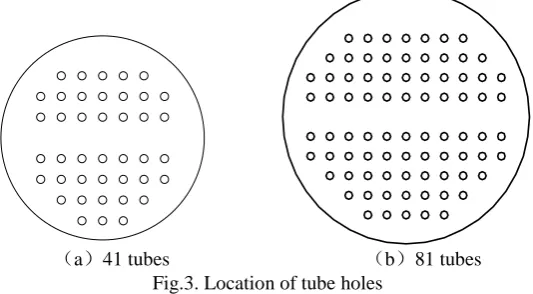
Both methods, simple genetic algorithm (SGA) and the proposed algorithm, are implemented using matlab programs. Two experiments (gk41 and gk81) are carried out to verify the feasibility and effectiveness of the algorithm. Fig. 3 shows the position of the tube holes.
(a)41 tubes (b)81 tubes Fig.3. Location of tube holes
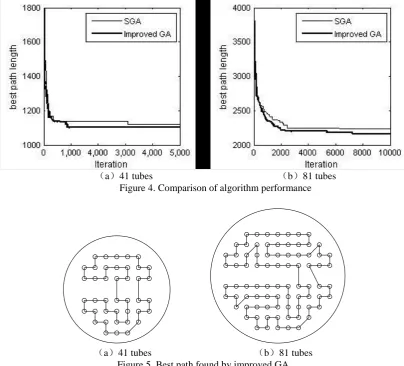
The simple genetic algorithm and the proposed algorithm were run with the same settings: 86.9% crossover, the population size of 500, 15% elitism, 0.7% mutation. TABLE 1 and the Fig. 4 shows the experimental results of the proposed approach and simple genetic algorithm. Fig. 5 shows the best path found by improved GA.
TABLE 1. Comparison of algorithm performance
examples random path /mm parameters SGA Improved GA
gk41 1253.8725
Best path length /mm 1119.2382 1102.7201 Iteration when achieve
the Best path 3026 928
time/s 10 7
gk81 3481.8608
Best path length /mm 2232.6472 2156.2082 Iteration when achieve
the Best path 6292 7245
(a)41 tubes (b)81 tubes Figure 4. Comparison of algorithm performance
(a)41 tubes (b)81 tubes Figure 5. Best path found by improved GA
The experimental results of the texts in TABLE 1 and Figure 3 & 4 show that the proposed improved GA performs preferably for the tested problems. The experimental results of the proposed algorithm are superior to simple genetic algorithm, which indicates that the combination of partially mapped crossover with 2-opt greatly enhance the ability to find the global optimum. Compared with simple genetic algorithm, the best path length and time consuming are both significantly improved.
V.
CONCLUSION
In order to further increase the flexibility and versatility of the pressure vessel manufacturing equipment, the author carried out the mathematical description of idle stroke path optimization of robot tube sheet welding by comparing idle stroke path optimization problem with traveling salesman problem. And then used an improved genetic algorithm to solve this problem. The experimental results shows that the combination of partially mapped crossover (PMX) and the 2-opt heuristic operator reduces runtime without destroying the basic power of the algorithm, which greatly enhance the ability to find the global optimum. It has some practical value.
REFERENCES
[1] Yuan, Tian, Xue-Liang, Ping, Liang-Liang, Bai, et al. 2015. A tube sheet automation welding method by robot. [P]. Jiangsu:CN104384763A.
[2] Linghua Zhou. 2010. welding technology research of tube plate and tube in tubular reactor. east China university of science and technology.
[6] Papadimitriou C H, Steiglitz K. 1998. Combinatorial optimization: algorithms and complexity[M]. Courier Corporation.
[7] Li L, Zhang Y. 2007. An improved genetic algorithm for the traveling salesman problem//Advanced Intelligent Computing Theories and Applications. With Aspects of Contemporary Intelligent Computing Techniques. Springer Berlin Heidelberg.208-216.
[8] Vose M D. 1999. The simple genetic algorithm: foundations and theory. MIT press.