e-ISSN: 2278-7461, p-ISSN: 2319-6491
Volume 7, Issue 4 [April 2018] PP: 10-15
Performance Analysis of Paraboloid Solar Collector
T.Rama Rao
*1; Piyush Ranjan Ojha
21. Professor Mechanical Engineering Deptt.,Bhilai Institute of Technology Raipur, C.G., India, 496331 2. UG Scholar 8th Sem. Mechanical Engineering Deptt., Bhilai Institute of Technology Raipur, C.G., India,
496331
Corresponding Author:T.Rama Rao
Abstract:
This paper is aimed for collecting low density solar energy and converts it into high density energy by Paraboloid solar collector which can be further developed efficiently for commercial utilization. As energy proves out to be the basic requirement of civilization. The history of energy development shows that ancient man used the fire lit with stone & obtained by burning wood. When man started developing himself the main requirement that he felt was energy. With the development of civilization he has started exploring new sources of energy. During the 20th century the industrial development was at its peak and man started using the conventional sources of energy which are still used today. But the conventional or non- renewable sources are supposed to get exhausted in the near future. In the mid-20th century people therefore started thinking of renewable sources of energy. One of them is solar energy. Solar energy is considered as replacement of fossil fuel and nuclear energy. It is believed that solar energy has potential to replace all energy needs such as electrical, thermal, chemical and even transportation fuel also. But for that to happen it needs system and components that can gather and concentrate it effectively.Keywords:
Solar paraboloid collector, Efficiency, Design & Modeling of collector--- --- Date of Submission: 28-04-2018 Date of acceptance: 14-05-2018 --- ---
I INTRODUCTION
This paper focuses on the solar energy which is the result of nuclear fusion reactions deep in the Sun‟s core. This travels to the earth in the form of discrete packets „photons‟ through radiation. Thousands of kilowatts are being collected either directly or indirectly.Indirect collection ranging from collection in the form of wind, hydrological cycle, oceans or fossil fuels and direct collections from solar collectors like flat plate collectors, concentrating collectors which can be cylindrical parabolic systems and power tower systems and paraboloid concentrating collector.As Solar energy is very diffused form of energy and due to earth‟s rotation, it suffers atmospheric interference from clouds, particulate matter, gases etc. So these flat plates, cylindrical collectors or parabolic collectors used cannot produce any heat energy sufficientto convert water into high temperature water or steam.[1] Therefore, necessity is felt for generating a system which can further intensify the solar energy incident. The experiments carried out on various setups and the solution found is Paraboloid dish collector, which can concentrate the incident solar radiations through a point where large heat can be absorbed. So this paper is aimed for further research towards effective generation of heat at the focus of parabolic collector and utilizing this heat either at the focus or transporting it to some place and utilizing it.[5-6,8,15-19]
II MATERIALS AND METHODS The basic elements making up a conventional Paraboloid Collector are
1) The absorber tube located at the focal axis through which the liquid to heated flows
2) Circulating liquid
3) The Parabolic concentrator
Absorber tube / Surface
The observer tube is usually made of mild steel or copper and has a diameter of 2.5 to 5 cm. It is coated with a heat resistant black paint and is generally surrounded by a concentric glass cover with an annular gap of 1 to 2 cm [12]. In the case of high performance collectors, the absorber tube is coated with a selective surface like black chrome and space between the tube and glass cover is evacuated. In some collectors, the concentric cover is replaced by glass or plastic sheet covering the whole aperture area of the collector which helps in protecting the reflecting surface from the weather.[16]
Liquid
The liquid heated in the collector depends upon the temperature required [10]. Usually organic heat transfer liquids are used. Because of their low thermal conductivity, these liquids yield low heat transfer coefficients. Augmentive devices in the form of twisted tapes or central plugs are therefore used to increase the value of the heat transfer coefficient.[14]
Paraboloid Concentrator
The Paraboloid Reflector has the following two elements
1) Reflecting Surface: The reflecting surface is generally curved black silvered glass. Thin electro
polished anodized aluminum sheets and silver coated acrylic films have also been used. The reflecting surface in this project will be made up of silvered glass.[9,15]
2) Aperture area / frame: The reflector is fixed on a light-weight aluminum sections. Its design includes
considerations that it should not distort significantly due to its own weight and should be able to withstand wind loads. Aperture area is the area on which the sunlight falls. These usually ranges from 1 to 6 sq meters and Concentration ratios range from 10 to 80. Here we use Satellite Dish Antenna to obtain Aperture area.[11]
Fig. 2 Types of Concentrating Collectors
Experiments Performed
S.NO. Start Time End Time Water Temperature
1 9 am 10 am 48
2 10 am 11 am 50
3 11 am 12 56
4 12 1 pm 58
5 1 pm 2 pm 62
6 2 pm 3 pm 58
7 3 pm 4 pm 52
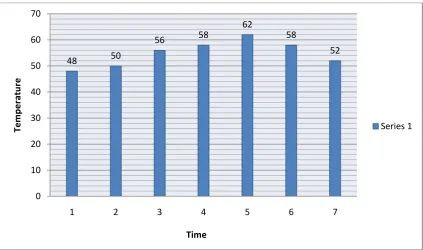
Table 1: Depicting Temperature Observed On 9th April Between 9am To 4pm.
Therefore average temperature of water was about 54.86 °C Therefore average temperature rise was = 31 °C
Fig.5 Graph showing Temperature Rise Calculations
The overall Aperture Area of the collector is calculated as follows: There are Flat Mirror Panels having dimensions
8 × 3, 15 × 4, 14 × 4, 12 × 3, 11 × 2.5, 9.5 × 4, 6.5 × 4 (in inches)
All are 18 in numbers. Therefore calculating the total aperture area of the collector we get
Total Aperture / Surface Area = 267.5 × 18 𝑖𝑛𝑐ℎ𝑒𝑠2
= 3.1064 𝑚2====================== (1)
Now assuming that the daily global radiation at Durg is same as that in Nagpur. The average radiation falling in the month of April per day will be
Total Radiation at Durg = 22718 𝑘𝐽
𝑚2.𝑑𝑎𝑦 ========================(2)
Therefore the radiation falling per hour on the collector will be
=3.1064 × 22718
24 kW ==================(3)
Now for heating a litre of water by above energy and taking a overall efficiency of 30%, also, considering that only one fourth of aperture area is engaged in concentrating the temperature rise will be
= 2940.46 × 0.3 ×0.25
4.18 ==================(4)
= 52.75 °C
48 50 56 58 62 58 52 0 10 20 30 40 50 60 70
1 2 3 4 5 6 7
On performing the Experiment the total rise in temperature was obtained to be 31 °C, which was 73.445 % of calculated value.
And for the rise of 31 °C of the heat absorbed will be = 4.18 × 1 × 31
= 129.58 𝑘𝑊 ℎ𝑟
Therefore Efficiency of heat collection of radiation received will be
Efficiency = 129.58
2940 .46 ×0.3===================(5)
= 14.69 %
Therefore efficiency of heat collection for this Paraboloid collector is close to 15 % of the radiation received.
= 2940.466 kW
III RESULTS AND DISCUSSION
For the model of Paraboloid collector various components were separately procured which were as follows:
Frame:The frame which mounted all the other components as well as serve the basic purpose of providing the Paraboloid shape was obtained by actually utilizing the Dish antenna. The antenna had a size of 8 feet diameter and had the overall surface area of about 40 square feet.
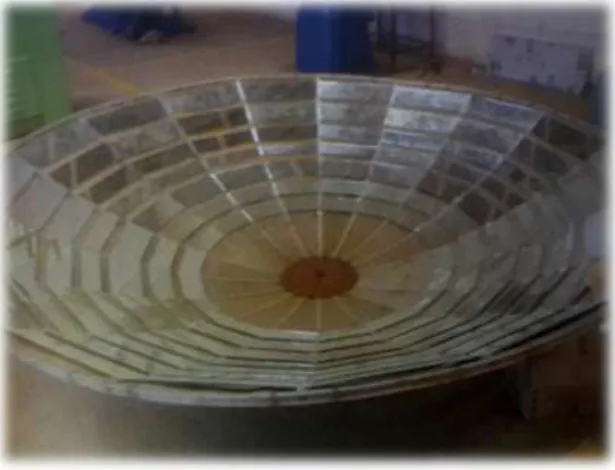
Reflecting Surface:The reflecting surface was obtained by sticking high quality mirror on the frame with the help of silicon gel which is generally used for joining Glass to Glass or Glass to Metal. In order to avoid complications, mirrors were cut into pieces and then was affixed around the Frame [13]. There was a space leftbetween the Circumferential lining so that mirror pieces do not get broken while deflection of frame structure the frame deflects while lifting or moving it.[4,19]
Fig. 2 Reflecting Surface
Fig. 3 Copper Receiver
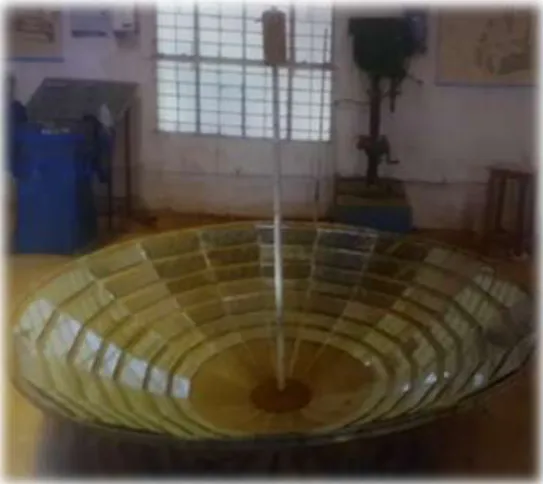
Fabrication: The various components were purchased from various market places. The majority of fabrication was done in the workshop itself.
Fig. 4 Model of completed project
IV CONCLUSION At the end of this paper we conclude that:
1. Fabrication & installation of a Paraboloid dish collector & effective utilization of solar radiation. 2. Obtained a temperature rise of about 31 °C which is about 73% of calculated value.
REFERENCES
[1]. Kreith F, Kreider JF.(1981),“Principles of Thermodynamics and Heat Transfer Applied to Solar Energy”. Solar Energy Handbook, McGraw-Hill: New York, 1981
[2]. Grald EW, Kuehn TH.(1989),”Performance Analysis of a Parabolic Trough Solar Collector with a Porous Absorber Receiver.” Solar Energy; 42(4):281–292.
[3]. Bakos G.C., Ioannidis I., Tsagas N.F. and Seftelis I. (2001),“Examination of Design, optimisation and conversion efficiency determination of a line-focus parabolic-trough solar collector.”,Vol-68, page 43-50, Greece
[4]. KalogirouS.A. (2004), “Solar thermal collectors and applications”, Prog. Energy Combust. Sci. 30 (3) 231–295.
[5]. Burkholder F, Kutscher C.(2008),“Heat-Loss testing of Schott‟s 2008 PTR70 parabolic trough receiver”, NREL TP-550-42394. 2008.
[6]. Garcıa A. F., Zarza E., Valenzuela L. and Perez M. (2010),”Examination of Parabolic-trough solar collectors and their applications.” Vol-14, page 1665-1721, Spain
[7]. Fernandez-Garcia, A., Zarza, E., Valenzuela, L., Perez, M., (2010).”Parabolic-trough solar collectors and their applications.” Renewable Sustainable Energy Rev. 14, 1695–1721.
[8]. Medrano,M.,Gil,A.,Martorell,I.,Potau,X.,Cabeza,L.,(2010).”Stateofthearton high-temperature thermal energy storage for power generation, case studies.” Renewable Sustainable Energy Rev.14,56–72.
[9]. Bergman and Theodore L (2011), “Introduction to Heat Transfer”, 6th ed. Hoboken: Wiley, 2011. Print.
[10]. Powell Kody M and Thomas F Edgar (2011), “Modeling and Control of a Solar Thermal Power Plant with Thermal Energy Storage”, Chemical Engineering Science, Vol. 71, pp. 138-45.
[11]. Javier Muñoz, Alberto Abánades(2011), “Analysis of internal helically finned tubes for parabolic trough design by CFD tools” Applied Energy 88, 4139–4149.
[12]. Dan Nchelatebe Nkwetta, Mervyn Smyth(2012), “Performance analysis and comparison of concentrated evacuated tube heat pipe solar collectors” Applied Energy 98, 22–32
[13]. M.I. Roldán , L. Valenzuela , E. Zarza (2013), “Thermal analysis of solar receiver pipes with superheated steam”, Applied Energy 103, 73–84
[14]. A. de Risi, M. Milanese, D. Laforgia (2013), “Modelling and optimization of transparent parabolic trough collector based on gas-phase nanofluids” Renewable Energy 58, 134-139
[15]. A. Mohamad, J. Orfi and H. Alansary (2013), “Heat losses from parabolic trough solar collectors”, Int. J. Energy Res. 2014; 38:20-28, published online, Feb 2013 in Wiley online library.
[16]. Alok Kumar (2013), “Improvements in efficiency of solar parabolic trough, “IOSR Journal of Mechanical and Civil Engineering,” Vol. 7, Issue 6, Jul- Aug 2013, PP 63-75.
[17]. Ayush Khare, Sachin Saxena, C H Tyagi and Sangeev Kumar (2014), “International Journal of Mechanical Engineering and Robotics Research,Vol. 3, No. 4, October 2014.
[18]. V K Jebasingh and G M Joselin Herbert (2015), ”Performance Study of latest Technology in Parabolic Trough Collector for Maximum Energy Utilization from the Solar Energy.”, International Journal of Engineering Research & Technology, Vol-4, Issue-01, Jan 2015.
[19]. Gang Xiao (2015), “Manual making of a parabolic solar collector”, Laboratoire J.A. Dieudonne, Universite de Nice, Nice, France, October 2015.