Page 162 www.ijiras.com | Email: [email protected]
Influence Of Top Management Support On Completion Of
Construction Projects In Public Secondary Schools In Bungoma
County, Kenya
Josephine N. Ojiambo
PhD Candidate, University of Nairobi, Kenya Prof Charles M. Rambo
University of Nairobi, Kenya
Stephen Wekesa Masinde PhD student, UNICAF, USA
I. INTRODUCTION
Studies conducted by researchers on a global view like one in the United Kingdom (UK) in 2010 statistics showed that 52% of projects had cost overruns in excess of 10% while 45% of projects had time overruns of over 25% Mbathi (1986), as cited in Atkinson (1999). Mbathi (1986) further
indicated that similar studies carried out in India showed that 56% of projects had cost overruns in excess of 20% while 49% had time overruns in excess of between 1 and 160 months. Delay in construction projects has been reported globally as noted by Njuguna (2008) whose findings revealed that there exists similarities and differences as to the causes of the delays.
Abstract: The central basis of this study was to establish influence of top management support on completion of construction projects in public secondary schools in Bungoma County, Kenya. The study was informed by construction management and soft value management theories. The study employed purposive sampling technique in choosing 461study respondents (Principals and Chairpersons of Parents Teachers Association) who were purposively sampled to ensure homogeneity of the selected sample in ensuring that samples are drawn from each region encompassed in the target population, then followed by simple random sampling technique from each region. Questionnaires and interview schedules were the main data collection instruments. Data analysis too involved use of statistical package for social sciences, SPSS version 21 software where both descriptive and inferential statistics were used. Cronbach Alpha of coefficient of 0.949 was attained on all constructs of top management support, which was above the recommended 0.7 as recommended by Cronbach (1951) implying the research instruments were reliable. The correlation coefficient (R) or the beta value β1 of 0.652≠0 at p=0.00 indicated that the hypothesis was accepted. The coefficient of determination, R-square
of 0.425 implied that 42.5% of the variance in completion of construction projects was attributed to top management support. The findings reveal importance of top management support on completion of construction projects. The study recommends top management to timely approve project plans, allocate sufficient resources and fully be involved in project work. The results show a statistically significant positive influence of top management support on completion of construction projects in public secondary schools. The current study was done in public secondary schools in Bungoma County. Future studies are encouraged to be done in both private and public secondary schools in the whole country and compare the results. In addition, the research concentrated on education sector. Future research is encouraged to cover other sectors and compare the findings. It is hoped that the findings are of importance to the Ministry of Education in Kenya and other interested parties in future. Future research have the basis of reference from this study.
Keywords: Top management support, Completion of construction projects, Public Secondary schools.
Page 163 www.ijiras.com | Email: [email protected] Projects in developing countries have over years been
faced with poor implementation. In Africa, the challenge of timely project delivery can take multiple dimensions depending on the project’s environment. In Ghana, Frimpong, Oluwoye and Crawford, (2003) identified five factors as the major causes of delays to projects. These include monthly payment difficulties to contractors, poor contract management, material procurement difficulties, poor technical performance and material price escalations. Poor professional management, fluctuation of prices, rising cost of materials and poor site management have also been identified as factors causing a delay in project completion time. In order to forestall the challenge of timely project delivery, Samuel (2008) recommends that project time management be a key priority for the contractors and that the appointment of a registered project manager for each contract should be a mandatory condition of tender.
Top management support is considered an area that has high impact on project success. However, previous studies have also stated that effective top management support practices may vary across industries. Top management influences the process and progress of a project and lack of executive input can put a project at a severe disadvantage. According to Kerzner (2001), the most important issue is top and senior management support .The lack of top management involvement is the primary challenge project managers feel most deserving of their attention (Simonsen, 2007).Management's support of the project may involve aspects such as allocation of sufficient resources (financial, manpower, time, excreta) as well as the project managers’ confidence in their support in the event of crises. Majority of studies done as showcased in the literature have examined Top Management Support in the context of large organizations other than schools. This justifies the choice of this variable in schools’ context.
STATEMENT OF THE PROBLEM
According to a Citizen bulletin on Constituency Development Fund (CDF) for Kanduyi Constituency in Bungoma County for the financial year 2007/08 released in 2011, most of the projects with a funding allocation of a total of Kshs. 128, 652, 18 had been poorly implemented projects. Subsequently, an audit report for the financial year 2009/10 released in 2012 by the National Taxpayers Association for Bungoma County Council on the performance of the Citizens’ Local Authority Transfer Fund (LATF) found that Kshs. 11,466,000 of taxpayers’ money had been wasted due to poorly completed projects while Kshs. 1,850,000 of taxpayers’ money had been wasted on abandoned project (National Tax Payers Association, 2011).
Further, completion of a project is hinged on the need to have support of top management. If top management does not support a project, chances of failing would be high. Equally, resources are required for completion of any project. Availability of funds on time greatly influence project completion. Different socio-economic factors such as prices of raw materials and community involvement in construction projects have implication. When top management do not approve sufficient funds, the quality of the project will be
sacrificed. Funds that are not allocated on time will delay the entire project and hence its quality. Time to allocate funds for the project should be within the work plan. Top management must be fully involved in project for ownership and accountability. Top management should be involved entirely to have quality projects. They can help in resource mobilization, monitoring and evaluation for proper completion of project. t is on the basis of these that this study sought to establish how top management support influence project completion in public secondary schools Bungoma County with an intention of making recommendations to enhance project completion. The review of related literature reveal that studies on completion of construction projects have been undertaken in other parts of the world with little evidence of similar study as far as Bungoma County public secondary schools is concerned yet school construction contributes significantly to learners performance and development of the county in general.
STUDY OBJECTIVE
To establish how top management support influence completion of construction projects in public secondary schools in Bungoma County, Kenya.
RESEARCH QUESTION
How does top management support influence completion of construction projects in public secondary schools in Bungoma County?
RESEARCH HYPOTHESIS
H1: Top management support significantly influence completion of construction projects in public secondary schools in Bungoma County.
II. LITERATURE REVIEW
The theory of construction management whose proponents are Radosavljevic and Bennett (2012) focuses on efficiency of construction projects. It involves creating a model of construction management (CM), which utilizes the differentiated methods in order to ensure completion of building and construction projects. They present the Japanese construction industry as the most advanced in terms of their theory (, and that Lean Construction is founded on the Toyota production system and the development of lean production in Japan. The authors aim is to provide a “rigorous theory” based on a “tool kit of concepts and relationships” that will improve the efficiency and quality of “construction products”.
Page 164 www.ijiras.com | Email: [email protected] applies to the proposed study in regard to the study’s purpose
to examine the influence of project critical success factors on completion of construction projects with a view of making recommendations for improving project performance within the schools, hence connects with the theory of SVM whose aim is in attempting to minimize negative impacts in a project and enhance project completion.
TOP MANAGEMENT SUPPORT AND COMPLETION OF CONSTRUCTION PROJECTS
The success of a project is hinged on the need to have the support of the management. If the top management does not support a certain idea or project, chances of failing would be high. This is because it was crucial in terms of releasing the funding and offering a set of administrative support that was crucial for the development of the project. On the other hand, it was important to know that if the management supports the project, there was an easy way to ensure to be confident that the implementation took place successfully. This was because issues like delays would not be experienced if the project is being supported by the top management (Adan et al; 1995).
Kerzner (2001), demonstrates that there is need to have the support of the management. This was because the quality of the work that needs to be done needed to be reviewed on time and plans that need to be changed required the approval of the management. In this case, there was need to ensure the project is getting on without delays due to lack of support. Simonsen (2007), and Young and Jordan (2008), have also argued that there is need to ensure the project is carried out in the right way while it is being supported by the top management. The project manager would have a hard time trying to review the decisions or make authorizations because it was hard for the manager to get the attention of the managers. The project also needed to be at the heart of the top management in terms of making it a priority and thus the execution of the project became easy (Doll, 1985).
On the other hand, Alijaz (2011), carried out a study on the project organization and the correlations in terms of culture and performance. The study was closely linked to the top management attitude towards the support of a certain project. In this case, the kind of top management support would directly influence the attitude of the manager while making decision about a project. If the top management had shown full support towards the project, there was a high spirit linked to the kind of decisions the manager would make. If the manager knew the top management was not in support of the idea, the decisions made would have a huge difference with the kind of decisions that would be made if the manager knew the top management was fully in support of the project. Kuen and Yudi, (2008), explains that the success of the project was hinged on the mission of the project and the top management decision to support the idea. In a research that involved respondents from the Penang, which is a manufacturing plant in Malaysia, the participants clearly indicated that top management was crucial in the process of undertaking any project. The respondents who supported the claim that the top management support was critical was 36.7%. On the other hand, Kerzner (2001), argues that the top management was highly required to show commitment to a project in order to
even inspire the employees that they were being supported. According to Young (2000); Andersen, Grude and Hang (2004); White, (2006). Although there are different causes of failure of a project, still top management support was in the lead. Other factors include poor communication, poor coordination, unclear roles and lack of resources.
Zwikael and Globerson (2006), have also pointed that apart from supporting the specific programs and projects, there is need to ensure that other activities related to the project implementation. One of such activities that require the support of the top management is the training programs that was used to enhance the skills of the experts were involved in the implementation process. Zwikael, (2008), indicted that the support of the top management was also critical in the software development process. This is because projects such as software development would impact how an organization would carry out transactions and even change how the top management would relate with the client and the junior employees. As such, their support was important because they need to give an assurance to the team developing the software that they are on their back. On the hand, they required to be available for consultations if changes needed to be made. In this case, there was need to argue that the support the management offered helped in successful completion (Project Management Institute – PMI, 2003).
Besner and Hobbs (2008) also emphasizes that the top management was highly required to offer maximum support to ensure projects were going on smoothly. The study involved different sets of 17 processes that would ultimately require the support of the management. In this case, the project success was measured after 213 project managers were interviewed together with their supervisors. The research was being carried out in Japan, Israel and New Zealand. The study involved a comparison of the critical and non-critical issues that did not have an impact on the success of a project. The study revealed that it was crucial for the management to support the projects because they were required to show unity in different ways. Again, their support was a way of ensuring that the employee felt encouraged to continue with the project because they could definitely know they would be appreciated by the management in the end. However, presently, top management in different organizations are not aware of the impact the have on projects and the kind of support they are required to offer (Zwikael, 2008).
Page 165 www.ijiras.com | Email: [email protected] needed support to the project implementation process. In the
process of offering the needed support, the contractors will need financial support in order to keep everything running. The managers also needed administrative support in terms of making decisions. When the support is weak or completely withdrawn, there is a risk that delays will be experienced (Tawil et al; 2013; Aftab, Ismael and Kartam, 2012).
CONCEPTUAL FRAMEWORK
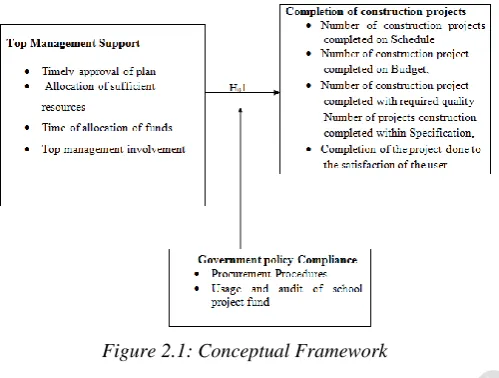
Figure 2.1 shows the interaction between top management support and completion of construction projects in public secondary schools in Bungoma County Kenya.
Figure 2.1: Conceptual Framework
III. RESEARCH METHODOLOGY
The study adopted a descriptive survey due to its ability to consider diverse aspects of the research problem and helps the researcher to describe precisely what is being seen (Saunders et al., 2007). A descriptive research design also enables generation of factual information about the study. A descriptive research design is concerned with describing characteristics of a problem. A descriptive research design is deemed appropriate for this research proposal because it helped to portray accurate profile of events and how they are. It also allowed for in-depth analysis of variables and elements of the study population as well as collection of large amounts of data in a highly efficient way. This was carried out using the combination of both qualitative and quantitative data through interviews and questionnaires.
The County has 296 public secondary schools and 12 private schools. The literacy level is 60.5% with those attending school (15 yrs-18 yrs.) at 87.4% with secondary school enrolment of 130,907 students. The target population from which the study sample was drawn was 296 Principals and 296 PTA Chairpersons of public secondary schools and 9 Quality Assurance and Standards Officers giving a total of 601,as the target population.
Purposive sampling was adopted in choice of study respondents who were subjected to Stratified sampling to ensure homogeneity of the selected sample in ensuring that samples are drawn from each region encompassed in the target population, then followed by simple random sampling
technique from each region. The sample size for this study was 461 drawn from a target population of 601 using Yamane (1967) theory of sampling.
Primary data was obtained from the questionnaires and interview schedules as research instruments. Questionnaires were used to capture data from the respondents. This instrument was used in the study because it is confidential, saves on time, has no bias and covers wide area (Mugenda and Mugenda, 2003). The questionnaire as an instrument used both closed ended and open ended questions in its structure.
The study used both descriptive and inferential statistics during data analysis. Numerical scores were awarded to closed ended questions. Descriptive statistics employed the use of means, frequencies and percentages and for inferential statistics. Quantitative data collected from respondents was coded and analyzed using Statistical Package for Social Sciences (SPSS version 20). Simple regression was used to determine the influence of project characteristics on completion of construction projects.
IV. STUDYRESULTS
A total of 452 questionnaires were issued to the respondents out of which 320 questionnaires were correctly filled and returned. This constituted 70.8% of which was considered adequate and in line with Kothari (2004) who recommended that a return rate of more than 50% was acceptable in social science research. From the results, 16 (5%) of the respondents came from Cheptais sub county, 36(11.3%) from Kimilili sub county, 28(8.8%) were from Bungoma central sub county, 58 (18.1%) from Bungoma East sub county, 48(15%) from Bungoma South sub county, 42 (13.1%) from Bumula sub county, 50 (15.6%) were from Bungoma North sub county, 32 (10%) from Bungoma West sub county while the remaining 10 (3.1%) were from Mt Elgon sub county. The results showed that 18 (5.6%) of the respondents were aged between 25-34 years, 39 (12.2%) were aged between 35- 44 years, 191 (59.7%) were aged between 45-54 years, 35 (10.9%) were aged between 55 – 64 years while the remaining 37(11.6%) were 65 years and above.
The age of the majority of respondents is important because it is an active age that is quite productive in determining the success of any given task (Sin, 2010).Out of 320 respondents who participated in the study 246 (76.9%) were male while 74 (23.1) were female. This finding goes against gender parity as articulated in Kenyan constitution. The results shows that out of 320 respondents who participated in the study 55 (17.2%) had tertiary education, while 265 (82.8%) had university education. This shows that the level of education of the people involved in the management of projects is adequate for completion of construction projects.
Page 166 www.ijiras.com | Email: [email protected] with the statement provided in a Likert scale of 1- 5 where:
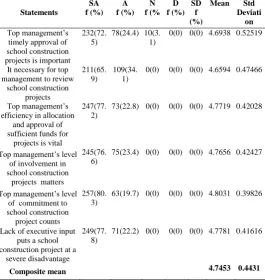
Strongly agree (SA)=5, Agree(A)= 4, Neutral or not sure (N)= 3, Disagree (D)= 2 and strongly disagree (SD) = 1. The results were as shown in Table 4.1.
Statements SA f (%) A f (%) N f (% D f (%) SD f (%)
Mean Std Deviati
on Top management’s
timely approval of school construction projects is important
232(72. 5)
78(24.4) 10(3. 1)
0(0) 0(0) 4.6938 0.52519
It necessary for top management to review
school construction projects 211(65. 9) 109(34. 1)
0(0) 0(0) 0(0) 4.6594 0.47466
Top management’s efficiency in allocation
and approval of sufficient funds for
projects is vital
247(77. 2)
73(22.8) 0(0) 0(0) 0(0) 4.7719 0.42028
Top management’s level of involvement in school construction
projects matters
245(76. 6)
75(23.4) 0(0) 0(0) 0(0) 4.7656 0.42427
Top management’s level of commitment to school construction
project counts
257(80. 3)
63(19.7) 0(0) 0(0) 0(0) 4.8031 0.39826
Lack of executive input puts a school construction project at a
severe disadvantage
249(77. 8)
71(22.2) 0(0) 0(0) 0(0) 4.7781 0.41616
Composite mean 4.7453 0.4431
Table 4.1: Top Management Support and Completion of Construction Projects
Statement one; top management’s timely approval of school construction projects is important. Out of 320 who responded, 232 (72.5%) strongly agreed, 78(24.4%) agreed, 10 (3.1%) were not sure while none disagreed and strongly disagreed respectively. Majority of the respondents 310(96.9%) agreed with the statement. The statement mean 4.6938 was below the composite mean 4.7453 which meant, top management’s timely approval of school construction projects is not important for completion of construction projects. Statement two; It is necessary for top management to review school construction projects. Out of 320 who responded, 211 (65.9%) strongly agreed, 109(34.1%) agreed while 0(0%) disagreed and strongly disagreed respectively. The statement mean 4.6594 was below the composite mean 4.7453 implying top management reviewing of school construction projects does not support completion of construction projects.
Third statement; top management’s efficiency in allocation and approval of sufficient funds for projects is vital. Out of 320 respondents, 247 (77.2%) strongly agreed, 73 (22.8%) agreed while 0(0%) disagreed and strongly disagreed respectively. The statement mean 4.7719 was above the composite mean 4.7453 implying top management’s efficiency in allocation and approval of sufficient funds for projects is vital for completion of construction projects. Statement four; top management’s level of involvement in school construction projects matters. Out of 320 who participated in the study, 245 (76.6%) strongly agreed while the remaining 75 (23.4%) agreed. None of the respondents was not sure, disagreed or strongly disagreed respectively. The
statement mean 4.7656 was above the composite mean 4.7453 which implies top management’s level of involvement in school construction projects matters for completion of construction projects.
Statement number five, top management’s level of commitment to school construction project counts. Out of 320 who responded, 257 (80.3%) strongly agreed, 63 (19.7%) agreed while 0(0%) were not sure, disagreed and strongly disagreed respectively. The statement mean 4.8031 was above the composite mean 4.7453 implies top management’s level of commitment to school construction project supports completion of construction projects. Statement six; lack of executive input puts a school construction project at a severe disadvantage. Out of 320 who responded, 249 (77.8%) strongly agreed, 71(22.2%) agreed while none was not sure, disagreed and strongly disagreed respectively. The statement mean 4.7781 was above the composite mean 4.7453 implying lack of executive input puts a school construction project at a severe disadvantage and has influence on completion of construction projects.
HYPOTHESIS H1
H1: Top management support significantly influence completion of construction projects in public secondary schools in Bungoma County. The mean of top management support (TM) and completion of construction project (Ycp) was regressed. The purpose of this analysis was to find the relationship between composite index of top management support and completion of construction project in Bungoma County. This was tested using significance of R square, regression coefficient (B) and correlation coefficient (Beta) at 95.0% confidence level. The results are presented in Table 4.2.
Model's Goodness of Fit Statistics
R R
Square
Adjusted R
Square Df F Sig.
0.652 0.425 0.425 (318,319) 234.984 0.000b
Regression Coefficients Model Unstandardize d Coefficients Standardi zed Coefficie
nts T Sig.
B
Std.
Error Beta
(Constant) 10.
686
.989 10.8
07
.000
TM .85
9
.056 .652 15.3
29
.000
a. Dependent Variable: Completion of construction projects Table 4.2: Regression of Top Management Support and
Completion of Construction Projects
Page 167 www.ijiras.com | Email: [email protected] accepted and thus there is statistically significant relationship
between top management support and completion of construction projects in public secondary schools in Bungoma County. Hence the equation;
Completion of construction projects = 10.686+0.652* top management support +3.76.
The hypothesis was confirmed and accepted.
The findings of the current study are in line with those of Alijaz (2011), who carried out a study on the project organization and the correlations in terms of culture and performance. The study found out that the kind of top management support would directly influence the attitude of the manager while making decision about a project. If the top management had shown full support towards the project, there was a high spirit linked to the kind of decisions the manager would make. If the manager knew the top management was not in support of the idea, the decisions made would have a huge difference with the kind of decisions that would be made if the manager knew the top management was fully in support of the project.
Similar findings were noted in a study by Kuen and Yudi, (2008) who explains that the success of the project was hinged on the mission of the project and the top management decision to support the idea. On the other hand, Kerzner (1998), argues that the top management was highly required to show commitment to a project in order to even inspire the employees that they were being supported. In addition, Besner and Hobbs (2008) also emphasizes that the top management was highly required to offer maximum support to ensure projects were going on smoothly. The study revealed that it was crucial for the management to support the projects because they were required to show unity in different ways. Again, their support was a way of ensuring that the employee felt encouraged to continue with the project because they could definitely know they would be appreciated by the management in the end. In addition, the current study findings are in line with the findings of Amponsah (2012), who was interested to know why projects would fail in Ghana and how the culture affected the project management. The study established that projects undertaken in the private sector were given more support by the top management.
The same voice was echoed from the interview schedules carried out;
“When top management do not approve sufficient funds, the quality of the project will be sacrificed. Funds that are not allocated on time will delay the entire project and hence its quality. Time to allocate funds for the project should be within the work plan Top management must be fully involved in project for ownership and accountability. Top management should be involved entirely to have quality projects. They can help in resource mobilization, monitoring and evaluation”.
V. CONCLUSION
The results show a statistically significant positive influence of top management support on completion of construction projects in public secondary schools. When top management do not approve sufficient funds, the quality of the project will be sacrificed. Funds that are not allocated on time
will delay the entire project and hence its quality. Time to allocate funds for the project should be within the work plan. Top management must be fully involved in project for ownership and accountability. Top management should be involved entirely to have quality projects. They can help in resource mobilization, monitoring and evaluation for proper completion of project.
VI. RECOMMENDATION
From the findings of this study, top management timely approval of project plan, allocation of sufficient resources and full involvement in project work is important for project completion. Plans for projects should be availed and approved on time to ensure timely completion of construction projects.
VII. LIMITATIONS
The major limitations of this study were: the high cost implications of the study area. Bungoma County measures 2,206.9 square Km, therefore schools are many kilometers away from each other, and hence this caused challenges to the researcher who visited them. This was overcome by using motor cycles as means of transport to access schools located in the interior of the county. This helped to reduce cost. The researcher anticipated experiencing financial constraints due to wide area the County covers and the spread of schools. This was mitigated by securing funds in good time from a Sacco to avoid delaying the study due to lack of funds. The funds were used to facilitate travel, subsistence and materials required for the research. Laxity by respondents to willingly and freely share information with the researcher for not knowing what the information was to be used for was guarded by the researcher stating and introductory letters were crucial in order to assure the respondents of their safety and the confidentiality of the information. Respondents who participated in the study were given an assurance that the information sought was regarded as confidential and that the findings of the study analysis were for academic purposes only. PTA Chairpersons are not school employees and so may not be readily found in schools when required to fill questionnaires. The researcher made appointments with them through the school principals. The researcher facilitated their travel to school to be able to fill questionnaires and even carry out telephone interviews where necessary for practical reasons. Given the busy schedule of school Principals, the researcher made appointments with them to allow the use of some of their time out of their busy schedule in filling the questionnaires. This hastened their response to filling the research questionnaire.
REFERENCES
Page 168 www.ijiras.com | Email: [email protected] [2] Ada P.L Chan (2004). “Key performance indicators for
measuring construction success.” Journal, International issue 2 pp 203Volume 11, -221.
[3] Adan M., Theodre D., Jennifer L., and Key P., (1995). Bringing order out of chaos. Psychometric characteristics of the confusion, hubbub and order scale. Journal of applied Developmental Psychology. Volume 16, issue 3, pp 429-444
[4] Aketch, J., &Karanja, P. (2013). Factors Influencing Procurement Performance in Constituency Development Fund (CDF): Case of CDF Use in Makadara Constituency. International Journal of Social Science & Entrepreneurship, 1(2), 41-55.
[5] Alijaz, S. (2011) The impact of the organizational structure and project organizational culture on project performance in solvent enterprises. Journal of Management Vol 16(2) pp1-22.
[6] Al-Momani, A.H. (2000). Examining service quality within construction Processes Technovation. 20, pp. 643-651.
[7] Amponsah. R. (2012) The real project failure and effects of culture on project management in Ghana- ICBE research report.
[8] Besner, C. and Hobbs, B. (2008), “Project management practice, generic or contextual: a reality check”, Project Management Journal, Vol. 39 No. 1, pp. 16-33.
[9] Boyatzis, R. E. (2008). Competencies in the 21st Century. Journal of Management Development
[10] Chua D.K.H, Kog T.C and Loh P.K (1999), Critical success factors for different projects objectives, Journal Construction Engineering management, Vol 125(3), PP.142-150.
[11] Crawford L., Hobbs, B. and Turner, J.R. (2005). Project Categorization Systems, Project management Institute, Newton Square, PA, USA
[12] Crawford, L. H. (2003). Assessing and developing the project management competence of individuals. In J.R. Turner (Ed.), People in Project Management. Aldershot, UK: Gower
[13] Doll, J. W. (1985). Avenues for Top Management Involvement in Successful MIS Development. MIS Quarterly.9 (1), pp. 17-35.
[14] Dolfi, J. and Andrews, E. J. (2006) The Submittal Characteristics of Project Managers: An Exploratory Study of Optimism Overcoming Challenge in the Project Management Work Environment. L. Ou, R. Turner (eds), Proceedings of the IRNOP VII Project Research Conference, October 11–13, 2006, Xi’an, China.
[15] Dulewicz, V., & Higgs, M. J. (2003). Design of a new instrument to assess leadership dimensions and styles Henley Working Paper Series HWP 0311 Henley-on-Thames, UK: Henley Management College
[16] Emmit, S, (3003). Construction Communication. Technology and Engineering.
[17] Frimpong,Y., Oluwoye, J. and Crawford, L.(2003). Causes of delay and cost overruns in construction of groundwater projects in developing countries; Ghana as a case study. International Journal of Project Management21 (5): 321-326.
[18] Kalinova, G. (2007). Project Manager and his Competencies (Knowledge, Skills and Attitude
[19] Kariungi SM. (2014). Determinants of Timely Completion of Projects in Kenya: A Case of Kenya Power and Lighting Company, ThikaABC Journal of Advanced Research, 3, 9-19.
[20] Kerzner, H., (2001). Project management: A systems approach to planning, scheduling, and controlling (7thed.). New York: John Wiley & Sons, Inc.
[21] Kibebe L.W &Mwirigi P.W (2014). Selected factors influencing effective implementation of Constituency Development Fund (CDF) projects in Kimilili Constituency, Bungoma County. International Journal of science and research (IJSR) Vol 3.Issue I
[22] Kuen C.W Suhaiza&Yudi F (2008). “Critical success factors influencing the project success amongst manufacturing Companies in Malaysia”-African Journal of Business Management Vol.3 (1), PP.016-127, January 2009
[23] Lee-Kelley L. and Leong. Loong K. (2003). Turner’s five-functions of project-based management and situational leadership in IT services projects. International Journal of Project Management 21(8), 583–591.
[24] MacInnis, P. (2003), “Skill test question”, Computing Canada, Vol. 29 No. 18, p. 10.
[25] Maslej, M. (2006). Communication in the Construction Industry. [online]. Available from: http://liad.gbrownc.on.ca/Ejournal/thesis%20pdf/final%2 0pdf/marcin_maslej.pdf. Acessed 15 August 2017. [26] Mbathi C.M, (1986), Building Contract Performance: A
Case Study of Government Projects in Kenya, MA Thesis, unpublished, University of Nairobi
[27] Mugenda M .O and Mugenda, G.A (2003).Research methods: Quantitative and Qualitative Approaches, Nairobi: AC TS Press.
[28] Muller R, Turner JR. (2003) .On the nature of the project as a temporary organization. Int. J. Project Management, 21(1): 1.
[29] National Taxpayers Association (2011). Citizen’s constituency Development Fund Report for Kanduyi Constituency Bungoma County.
[30] Njuguna, B (2008), The Construction Industry in Kenya and Tanzania; Understanding Mechanism that Promote Performance, ESAM DBA assignment
[31] Pinto J K. (1987). Project Implementation: A determination of its critical success factors, moderators, and their relative importance across the Project life cycle (Doctorate dissertation: University of Pittsburgh.
[32] Pinto J.K. &Slevin P.(1987).”Critical Success Factors across the Project Lifecycle” Project Management Journal, 19(3), 67-75.
[33] Prabhakar, G.P. (2005). Switch leadership in projects: an empirical study reflecting the importance of transformational leadership on project success across twenty-eight nations. Project Management Journal36 (4), 53–60.
Page 169 www.ijiras.com | Email: [email protected] [35] Salleh, R. (2009). Critical success factors for project
management for Burundi Construction projects;
improving project performance, Athesis submitted in partial fulfillment of the requirement for the degree of Doctor of philosophy, school of urban development & faculty of built Environment and engineering, Queensland University of Technology
[36] Samuel, R. (2008). Effective and Efficient Project Management on Government Projects. Available on: www.cib2007. com/papers.CIDB2008%2520F.Accessed: 14th November2017.
[37] Saunders, M., Lewis P. and Thornhill A. (2009) Research Methods for business students4th edition Pearson education limited
[38] Shehu, Z. and Akintoye, A. (2009).The Critical success factors for effective programme management: a pragmatic approach. The Built & Human Environment Review2: 1-24.
[39] Simonsen, J. (2007). Involving top management in IT projects. Communications of the ACM.50 (8), pp. 53-58. 31.
[40] Toor S.R and Ogunlana S.O (2007), critical COMs of success in large scale construction projects: Evidence from Thailand Construction industry, International Journal of Project management 132 (6) PP.636-649. [41] Turner, J.R. and Mu¨ller, R. (2006) Choosing Appropriate
Project Managers: Matching their leadership style to the type of project. Project Management Institute, Newton Square, PA, USA.
[42] Yahya Aliabadizadeh (2009). Evaluation of ways to recover late construction projects.
[43] Yamane, (1967). Determining sample size. edis.ifas.ufl.edu/pd006. Accessed, December 2013. [44] Zwikael, O. (2008), “Top management involvement in
project management – exclusive support practices for different project scenarios”, International Journal of Managing Projects in Business, Vol. 1 No. 3