RESEARCH ARTICLE
ON SOLVING STOCK PORTFOLIO PROBLEM THROUGH INTERVAL-VALUED FUZZY LINEAR
PROGRAMMING
1
Khalifa, H. A. and
2, *Al- Shabi, M.
1Department of Mathematics, College of Arts and Science, Al- Badaya, Qassim University, Saudi Arabia
2Department of Management Information System, College of Business Administration, Taibah University, Saudi Arabia
ARTICLE INFO
ABSTRACT
In this paper, a stock portfolio problem is studied under uncertainty. The problem is considered by incorporating interval- valued fuzzy numbers. A solution method transform the problem into triple- objective problem is proposed. Then the weighting method is used to obtain the optimal fuzzy solution. The advantages of the method are: The investors able to reachthe maximum of expected returns, and hence determinetheir own strategy portfolio selection. Finally, a numerical example is taken tothe utility of the proposed method.
Copyright©2018, Khalifa and Al- Shabi. This is an open access article distributed under the Creative Commons Attribution License, which permits unrestricted use, distribution, and reproduction in any medium, provided the original work is properly cited.
1. INTRODUCTION
Portfolio investment is quoted securities investment, a narrow sense of investment. It refers to the behavior that an enterprise or individual buys negotiable profits. Securities such as stocks and bonds with accumulated money to earn profits (Yin, 2018). Portfolio selection problem (PSP) is a well- know problem in the field of economics, which aims to allocate the capital to a pre- given set of securities and mean-while obtain the maximum return (Fang et al., 2017). In the real- world applications, there exists two types of uncertainties in the decision- making process one is randomness; the other is fuzziness. In general, if enough sample data are available, we can use the statistic methods to estimate the probability distribution of the involved uncertain parameters, and the probability theory can be used as an effective tool to deal with them. On the other hand when there are not enough sample data or even no sample data, a common method is to treat the parameters as fuzzy variables by using professional judgments or expert experience. With these concerns, two classes of methods can be adopted in the literature to investigate the PSP, i.e., random optimization and fuzzy optimization, in order to maximize the total return and decrease the risks in the uncertain environment (Feng et al., 2017; Markowitz, 1952, and 1959). Huang and Ying, 2013 considered the portfolio adjusting problem. A mean- variance- based PSP in a complete market with unbounded random coefficients is investigated by Shen et al., 2014. Tanaka et al., 2000 extended the probability into fuzzy probability for the Markowitz's model. Hassuike et al. 2009 proposed several models for PS problems, particularly scenario model including the ambiguous factors. A multi- period PSP with market random uncertainty of asset prices is introduced byHe and Qu, 2014. Zhang and Chen, 2016 present a mean- variance PSP with regime switching under the constraint of short- selling being prohibited. Shi et al., 2015 proposed three multi- period behavioral portfolio selection models under cumulative prospect theory. Lv et al., 2016 explored a continuous- time mean- variance PSP with random market parameters and a random time horizon in an incomplete market. According to Dowd, 2002, in conditions of risky investments, a strategy that can be done to reduce the magnitude of the risk of investment is to build a portfolio. A single index model used for the assessment of the stock priceintroduced byAzizah et al., 2008.
*Corresponding author:Al- Shabi, M.,
Department of Management Information System, College of Business Administration, Taibah University, Saudi Arabia.
ISSN: 0976-3376
Vol. 09, Issue, 10, pp.8961-8969, October,Asian Journal of Science and Technology 2018ASIAN JOURNAL OF
SCIENCE AND TECHNOLOGY
Article History:
Received 17th July, 2018 Received in revised form 25th August, 2018
Accepted 20th September, 2018 Published online 30th October, 2018
Key words:
Stock portfolio problem, Mathematical optimization model, Triangular fuzzy numbers, Fuzzy Arithmetic,
Multi- objective linear programming, Weighting method.
Lindberg, 2009 modified
n
stock Black- Scholes model by introducing parameterization of the drift rates. Banihashemi et al., 2018 proposed a novel work for PSP by usingmulti- objective model. Joel et al., 2012 proposed a new method to optimize the PS problem by separating distributions of capital return to two positive and negative half- spaces. As known, fuzzy set theory was introduced by Zadeh, 1965 to deal with fuzziness. Up to now, fuzzy set theory has been applied to broad fields. Fuzzy numerical data can be represented by means of fuzzy subsets of the real line, known as fuzzy numbers). For the fuzzy set theory development, we may referee to the papers of Kaufmann, 1975, and Dubois and Prade1980, they extended the use of algebraic operations of real numbers to fuzzy numbers by the use a fuzzifaction principle. Fuzzy linear constraints with fuzzy numbers were studied by Dubois and Prade, 1980. In real- world problems, uncertainties may be estimated as intervals, Shaocheng 1994 studied two kinds of linear programmings with fuzzy numbers called: interval numbers and fuzzy number linear programming, respectively. Bellman and Zadeh, 1970 introduced the concept of a maximizing decision making. Yin, 2018, studied the stock portfolio selection as an application of interval- valued fuzzy linear programming. Zhang and Zhang, 2014 investigated a multi- period fuzzy PSP to maximize the terminal wealth imposed by risk control. Gupta et al., 2013 proposed a multi- objective credibilistic model with fuzzy chance constraints for the PSP. Huang, 2012 developed an entropy method to solve the diversified fuzzy portfolio problem. Ashrafzadeh et al., 2016 developed a new fuzzy multi- objective programming model based on mean- variance- skewness model for optimal PS under fuzzy uncertainty. Ammar and Khalifa, 2003 formulated fuzzy portfolio optimization problem a programming problem. Khalifa and Zein Eldin, 2014 studied PS problem with fuzzy objective function coefficients, and applied fuzzy programming approach to obtain the
optimal compromise. Goh et al., (2012) proposed a new approach to PS by separating asset return distributions into positive and negative half- spaces.The rest of the paper is as follows: In section 2; some preliminaries need in the paper are presented. In section 3, stock portfolioproblem introduced byYin, 2018is studied. In section 4, an interval- valued fuzzy model of stock portfolio problem is introduced. A solution method for solvingthe problem is proposed in section5. In section 6, anumerical exampleisgiven to the utility of our proposed solutionmethod. Finally some concluding remarks are reported in section 7.
2. Preliminaries
Some basic concepts and related results to fuzzy numbers and some of their arithmetic operations, triangular fuzzy numbers and some of algebraic operations are investigated in this section (Kaufmann and Gupta, 1988; Sakawa, 1993; Yin, 2018; and Moore, 1979).
Let
I
(
R
)
[
a
,
a
]
:
a
,
a
R
(
,
),
a
a
denote the set of all closed interval numbers onR
.
Definition 1. (Moore, 1979)
Assume that:
[
a
,
a
],
[
b
,
b
]
I
(
R
)
, we define:1.
[
a
,
a
]
(
)
[
b
,
b
]
[
a
b
,
a
b
]
2.
[
a
,
a
]
(
)
[
b
,
b
]
[
a
b
,
a
b
]
3. The order relation
" "
inI
(
R
)
is defined by:[
a
,
a
]
(
)
[
b
,
b
]
, if a only ifa
b
,
a
b
.
Definition 2. (Sakawa, 1993)
Let
R
be the set of real numbers, the fuzzy numberv
~
is a mapping],
1
,
0
[
:
~
R
v
with the following properties:(i)
v~(
x
)
is an upper semi- continuous membership function;(ii)
~
v
is a convex set, i. e.,
~v
x
1
(
1
)
x
2
min
~v(
x
1),
v~(
x
2)
for allx
1,
x
2
R
,
0
1
;
(iii)
v
~
is normal, i. e.,
x
0
R
for which
~v(
x
)
1
;
(iv) Supp
(
v
~
)
{
x
:
v~(
x
)
0
}
is the support of a fuzzy setv
~
.Definition 3. (Sakawa, 1993).
.
,
0
,
,
,
,
,
,
0
)
(
3 3 2
2 3
3
2 1
1 2
1
1
~
a
x
a
x
a
a
a
x
a
a
x
a
a
a
a
x
a
x
x
A
Also, T.F.N. parametric form for level
can be characterized as:]
1
,
0
[
.
1
0
)];
(
),
(
[
]
)
(
,
)
[(
~
3 2
3 1 1
2
w
w
a
a
a
a
a
a
A
Definition4. A T.F.N.
A
~
a
1,
a
2,
a
3
is called non- negative triangular fuzzy number ifa
1
0
.
Definition5.(Kaufmann and Gupta, 1988).
Let
A
~
a
1,
a
2,
a
3
, andB
~
b
1,
b
2,
b
3
be two non- negative triangular fuzzy numbers, the formulas for the addition, subtraction, scalar multiplication, and multiplication can be defined:1. Addition:
,
,
(
,
,
)
(
,
,
).
~
~
3 3 2 1 1 3 2 1 3 2
1
a
a
b
b
b
a
b
a
b
a
b
a
B
A
2. Subtraction:
,
,
(
)
(
,
,
)
(
,
,
).
~
)
(
~
1 3 2 3 1 3 2 1 3
2
1
a
a
b
b
b
a
b
a
b
a
b
a
B
A
3. Multiplication:
0
),
,
,
(
0
,
0
),
,
,
(
0
),
,
,
(
~
~
3 1
3 2 2 3 1
3 1 1 3 2 2 3 1
1 3 3 2 2 1 1
a
b
a
b
a
b
a
a
a
b
a
b
a
b
a
a
b
a
b
a
b
a
B
A
4. Scalar multiplication
.
0
),
,
,
(
,
0
),
,
,
(
~
1 2 3
3 2 1
k
ka
ka
ka
k
ka
ka
ka
A
k
5. The order relation
~
.
~
3 2 1 3 2
1
a
a
b
b
b
a
B
A
Remark1.
A
~
~
0
if and only ifa
1
0
,
a
1
a
2
0
,
a
1
a
3
0
.
Definition6.(Yin, 2018),
)
,
,
(
),
,
,
(
),
,
,
(
1 2 3 1 2 3 1 2 3
a
a
a
A
a
a
a
B
b
b
b
A
, andB
(
b
1,
b
2,
b
3)
1. Addition:
Q A A B B A B A B
P~ ~ , , ,
2. Subtraction:
Q A A B B A B A B
P~( ) ~ , ( ) , ,
3. Scalar multiplication
. 0 , ,
, 0 , , ~
k kA kA
k kA kA P
k
k
R
4. The sequencing method of fuzzy numbers of triangular interval values are
~ ~ 3 2 , 3 2 ;
Q a b a b
P
~ ~ 1 2 3 1 2 3 , 1 2 3 1 2 3 .
Q a a a b b b a a a b b b
P
3. Stock portfolio problem: In realistic, since the investment environment is quite complex, certain small changes will affect the choice op portfolio. In this case, in order to facilitate in discounting problems, the model assume that (Yin, 2018):
Investors evaluate the securities by the expected rate of return and the risk loss rates;
Securities are indefinite and can be divided;
There is no need to pay the transaction costs in the course of transaction;
Investors obey the assumption of non- satisfaction and assumption of avoiding risk;
Short selling operation is not allowed;
Interest rate of the bank is unchanged for the investors during the investment period.
Assumption
It is supposed that the investors (or asset managers) invest in
n
risk securities.Atypical stock portfolio problem introduced by (Yin, 2018) as follows
Model1
j n
i
j
x
r
x
r
R
1 0
0
~
~
max
Subject to
.
...,
,
2
,
1
,
0
,
1
,
~
~
1 0
n
j
x
x
x
b
x
A
j n
j j
Wherein,
x
0is the proportion of the total amount of investment in the investment period,r
0 is the interest rate of bank,r
~
jis the expected return rate,x
jis the proportion of funds invested in the secondary securities,A
is the rate of risk return. Forb
is assumed to be the risk coefficient of portfolio investment,A
is the risk coefficient ofj
securities. Coefficientb
reflects marketrisk of portfolio investment. When
b
1
, risk of stock portfolio is greater than the average market risk; whenb
1
, risk of stock portfolio is equal to the average market risk; whenb
1
, the risk stock portfolio is less than the average market risk(Yin, 2018).4.Interval- valued fuzzy model for the stock portfolio problem
Consider the interval- valued fuzzy model
Model2
n
i
u j c j l
j x r x r x
r x
r R
1 0
0 , ,
~ max
. ..., , 2 , 1 , 0 ; 1 ; , , , , , ) , , ( ), , , ( 10 x x j n
x b b b b b b x A x A x A x A x A x A j n j j u c l u c l u c l u c l
It is assumed that
r
~
j represented by triangular fuzzy numbers, andA
~
,
b
~
,
are characterized by interval- valued fuzzy numbers.Definition7 (fuzzy optimal solution).
The
x
jwhich satisfies the constraints in model1 is called a fuzzy optimization solution. Model 2, can be rewritten as followsModel 2.1
n i j u j j c j j lj x r x r x
r x r R 1 0
0 , ,
~ max Subject to:
.
...,
,
2
,
1
,
0
;
1
;
,
,
)
,
,
(
;
,
,
)
,
,
(
10
x
x
j
n
x
b
b
b
x
A
x
A
x
A
b
b
b
x
A
x
A
x
A
j n j j u c l u c l u c l u c l
Two auxiliary models from Model 2.1., can be obtained
Model 2.1.1
n i j l j j u j n i j l j j u j n i j c jx
r
x
r
x
r
x
r
x
r
x
r
x
r
x
r
1 0 0 1 0 0 1 0 0max
min
max
Subject to.
...,
,
2
,
1
,
0
;
1
;
;
10
x
x
j
n
Definition 8. (Efficient solution). A point
x
j
is said to be efficient solution to the Model2.1.1., or Model2.1.2., if and only if there does not exist anotherx
, such that:f
1(
x
)
f
1(
x
),
f
2(
x
,
)
f
2(
x
)
,andf
3(
x
)
f
3(
x
)
,andf
1(
x
)
f
1(
x
)
, or)
(
)
(
22
x
f
x
f
orf
3(
x
)
f
3(
x
)
.We may use the weighting method for solving Model 2.1.1, and Model 2.1.2
5. Solution procedure
In this section, a solution procedure to solveModel1 can be summarized as in the following steps:
Step1: Formulate the Model1
Step2: Convert the Model1 into Model2.
Step3: From Model2.and by using fuzzy arithmetic we obtain two auxiliary models: Model2.1.1, and Model2.1.2., respectively.
Step4: Applying the weighting method to solve Model2.1.1, and Model2.1.2.
6. Numerical example
Consider the following problem (Yin, 2018).
Table1. Expected return rate%
T1 T2 T3 T4
j
r
~
(11.5, 12.2, 12.9) (15.8, 16.3, 16.8) (13.7, 14.3, 14.9) (13.0, 14.0, 15.0)Continue
Table2. Risk loss rate%
11
~
A
A
~
12[ (3.8, 5.2, 5.9), (6.3, 9.0, 11,6)] [(9.0, 12.5, 16.9), (17.2, 18.7, 20.0)]
13
~
A
14~
A
[(3.2, 4.8, 6.0), (7.1, 9.9, 11.0)] [( 8.7, 11.9, 16.3), (14.1, 19.0, 23.0)]
21
~
A
A
~
22[(0.9, 1.1, 1.31), (1.39,2.15, 3.32) [(0.9,1.1,1.31), (1.39,2.15, 3.32)]
23
~
A
A
~
24[(1.2, 3.26, 4.8), (1.59, 2.27, 7.12)] [(1.2, 3.26, 4.8), (1.59, 2.27, 7.12)] Continue
Table3. Risk coefficient %
1
~
b
b
~
2[( 1.2, 2.0, 2.4), (1.5, 1.9, 2.9)] [(0.3, 0.4, 0.6), (1.1, 1.4, 2.7)]
Assume the annual bank interest rate
r
0
0
.
07
0 1 2 3 4
4 3 2 1 0 4 3 2 1 0 28 . 0 286 . 0 326 . 0 244 . 0 07 . 0 max 02 . 0 012 . 0 01 . 0 014 . 0 07 . 0 min 140 . 0 143 . 0 163 . 0 122 . 0 07 . 0 max x x x x x x x x x x x x x x x Subject to . 4 , 3 , 2 , 1 , 0 , 0 , 1 , 4 . 1 12 . 7 12 . 7 32 . 3 32 . 3 , 27 . 2 23 11 20 6 . 11 , 6 . 0 8 . 4 8 . 4 31 . 1 31 . 1 , 0 . 2 3 . 16 6 9 . 6 9 . 5 4 3 2 1 0 4 3 2 1 4 3 2 1 4 3 2 1 4 3 2 1 j x x x x x x x x x x x x x x x x x x x x x x j And,
Table4. Solution of Model 2.1.1.1
Variables Optimal solution (investment portfolio) Income ( optimum value)
0
x
0.7695 0.038737)
06913
.
0
,
06849
.
0
,
06785
.
0
(
~
R
1x
0.01403 2x
0 3x
0.0903 4x
0 Model 2.1.2.
0 1 2 3 4
4 3 2 1 0 4 3 2 1 0
28
.
0
286
.
0
326
.
0
244
.
0
07
.
0
max
02
.
0
012
.
0
01
.
0
014
.
0
07
.
0
min
140
.
0
143
.
0
163
.
0
122
.
0
07
.
0
max
x
x
x
x
x
x
x
x
x
x
x
x
x
x
x
Subject to . 4 , 3 , 2 , 1 , 0 , 0 ; 1 , 2 . 5 98 . 10 98 . 10 86 . 6 86 . 6 , 3 . 6 1 . 56 28 9 . 55 9 . 26 , 3 . 1 26 . 9 26 . 9 31 . 3 31 . 3 , 6 . 5 9 . 36 14 4 . 38 9 . 14 4 3 2 1 0 4 3 2 1 4 3 2 1 4 3 2 1 4 3 2 1 j x x x x x x x x x x x x x x x x x x x x x x jUsing the weighting method. Let
w
1
0
.
3
,
w
2
0
.
2
,
w
3
0
.
5
Models 2.1.1., and Models 2.1.2, become
Model 2.1.1.1
0.042 0 0.1558 1 0.2099 2 0.1835 3 0.178 4
max x x x x x
Model 2.1.2.1
0
.
042
00
.
1558
10
.
2099
20
.
1835
30
.
178
4
max
x
x
x
x
x
Subject to
.
4
,
3
,
2
,
1
,
0
,
0
,
1
,
2
.
5
98
.
10
98
.
10
86
.
6
86
.
6
,
3
.
6
1
.
56
28
9
.
55
9
.
26
,
3
.
1
26
.
9
26
.
9
31
.
3
31
.
3
,
6
.
5
9
.
36
14
4
.
38
9
.
14
4 3 2 1 0
4 3
2 1
4 3
2 1
4 3
2 1
4 3
2 1
j
x
x
x
x
x
x
x
x
x
x
x
x
x
x
x
x
x
x
x
x
x
x
j
Table 5. Solution of Model 2.1.2.1
Variables Optimal solution (investment portfolio) Income (optimum value)
0
x
0.7645 0.037577) 08414 . 0 , 082891 . 0 , 08164 . 0 ( ~
R
1
x
0.01652
x
03
x
0.18894
x
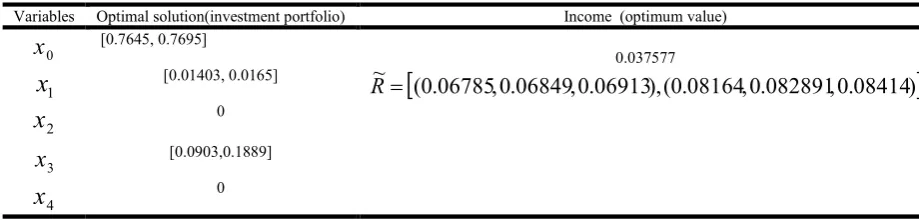
0Table6. The interval valued fuzzy investment portfolio and the corresponding income
Variables Optimal solution(investment portfolio) Income (optimum value)
0
x
[0.7645, 0.7695] 0.037577
(
0
.
06785
,
0
.
06849
,
0
.
06913
),
(
0
.
08164
,
0
.
082891
,
0
.
08414
)
~
R
1
x
[0.01403, 0.0165]2
x
03
x
[0.0903,0.1889]4
x
07.Concluding Remarks
In this paper, stock portfolio problem under uncertainty has been discussed. The study under uncertainty makes the investment portfolio more flexible, more close to reality and more practice to describe expected return rate, and risk loss rate. A solution method transformed the problem into triple- objective problem has been proposed. The advantages of the method are: Enable the investors able to choose the risk coefficient that is to reach the maximum value of the expected returns, and determine their own strategy portfolio selection.
Acknowledgements
The authors are very grateful to the anonymous reviewers for his/ her insightful and constructive comments and suggestions that have led to an improved version of this paper.
REFERENCES
Ammar, E.E., and Khalifa, H.A. 2003. Fuzzy portfolio optimization: A quadratic programming approach. Chaos, Solitons, and Fractal, (18): 1042- 1054.
Ashrafzadeh, S., Moradzadehfard, M., Ohadi, F. 2016. Fuzzy optimal portfolio selection based on multi- objective mean- variance- skewness model by using NSGA-II algorithm. Bulletin de la Societe Royale des Sciences de Liege, (85): 1090- 1101. Azizah, A., Rusyaman, E., and Supian, S. 2008. Optimization of investment portfolio weight of stocks affected by market index.
Banihashemi, S., Azarpour, A.M., and Kaveh, M. 2018. Multi- stage stochastic model in portfolio selection problem. Filomat, 32(3): 991- 1001.
Bellman, R., and Zadeh, L. A. 1970. Decision making in a fuzzy environment. Management Science, (17): 141-164. Dowd, K.2002. An Introduction to Market Risk Measurement. USA: John Wiley&Sons Inc.
Dubois, D. and Prade, H. 1980. Fuzzy Sets and Systems: Theory and Applications. Academic Press, New York.
Fang, Y., Wang, L., and Liu, X.2017. Reliable portfolio selection problem in fuzzy environment: An
m
measure based approach. Algorithms, 10, 43; doi: 10,3390/ a 10020043.Goh, J. W., Lim, G. K., Sim, M., Zhang, W. 2012. Portfolio value- at- risk optimization for asymmetrically distributed asset returns. European Journal of Operational Research, (221): 397- 406.
Gupta, P., Inuiguchi,2014).M., Mehlawat, M. K., and Mittal, G. 2013. Multiobjectivecredibilistic portfolio selection model with fuzzy chance – constraints. Information Science, (229): 1-17.
Hassuike, T., Katagiri, H., and Ishii, H. 2009. Portfolio selection problems considering fuzzy returns of future scenarios. International Journal of Innovative Computing Information and Control, (4): 2493- 2506.
He, F., Qu, R.2014. A two- stage stochastic mixed- integer program modeling and hybrid solution approach to portfolio selection problem. Information Sciences, (289): 190- 205.
Huang, X. X. 2012. An entropy method for diversified fuzzy portfolio selection. International Journal of Fuzzy Systems, (14): 160- 165.
Kaufmann, A. 1975. Introduction to the Theory of Fuzz Subsets, Vol. I. Academic Press, New York.
Kaufmann, A.,. and Gupta, M. M. 1988. Fuzzy Mathematical Models in Engineering and Management Science. Elsevier Science Publishing Company INC, New York.
Khalifa, H.A., and ZeinEldin, R.A.2014. Fuzzy programming approach for portfolio selection problems with fuzzy coefficients. International Journal of Scientific Knowledge, 4(7): 40- 47.
Lindberg, C. 2009. Portfolio optimization when expected stock returns are determined by exposure to risk. Bernoulli, 15(2): 464- 474.
Lv, S., Wu, Z., and Yu, Z. 2015. Contiguous- time mean- variance portfolio selection with random horizon in an incomplete market. Automatica, (69): 176- 180.
Markowitz, H. 1959. Portfolio selection: Efficient Diversification of investments. Yale University Press, Wiley. Markowitz, H.M. 1952. Portfolio selection. The Journal of Finance, 7(1): 77- 91.
Moore, E. R. (1979). Methods and applications of interval analysis (SIAM, Philadephia, PA).
Shaocheng, T. 1994. Interval number and fuzzy number linear programming. Fuzzy Sets and Systems, (66): 301- 306.
Shen,Y., Zhang, X., andSiu, T.K. 2014. Mean- variance portfolio selection under a constant elasticity of variance model. Operations Research Letters, (42): 337- 342.
Shi, Y., Cui, X., and Li, D.2015. Discrete- time behavioral portfolio selection under cumulative prospect theory. Journal of Economic Dynamics and Control, (61): 283- 302.
Tanaka, H., Ukuda, T., and Asai, K. 2000. Portfolio selection based on fuzzy probabilities distributions. Fuzzy Sets and Systems, (111): 387- 397.
Yin, D. 2018. Application of interval valued fuzzy linear programming for stock portfoliooptimization. Applied Mathematics, (9): 101- 113.
Zadeh, L. A. 1965. Fuzzy sets. Information Control, (8) 338- 353.
Zhang, P., and Zhang, W. 2014. Multiperiod mean absolute deviation fuzzy portfolio selection cardinality constraints. Fuzzy Sets and Systems, (255): 74- 91.
Zhang, M., and Chen, P.2016. Mean- variance portfolio selection with regime switching under shorting prohibition. Operations Research Letters, (44): 658- 662.