IJSRSET1734105 | Received : 08 August 2017 | Accepted : 19 August July- 2017 | July-August-2017 [(3)5: 404-409 ]
© 2017 IJSRSET | Volume 3 | Issue 5 | Print ISSN: 2395-1990 | Online ISSN : 2394-4099 Themed Section: Engineering and Technology
404
Performance Analysis of Cognitive Radio Sensor Networks
with Interference Temperature Constraint
Consideration over Rician Model
Maliha Mahbub
*1, Sultana Jahan Soheli
2*1Department of Computer Science and Engineering, Stamford University Bangladesh, Dhaka, Bangladesh 21Department of Information and Communiction Engineering, Noakhali Science and technology University, Noakhali,
Bangladesh
ABSTRACT
This paper investigates the effects of infusing the emerging Cognitive Radio Technology in the realm of Wireless Sensor Network to ensure optimum spectrum utilization. To evaluate the validity of the system, performance of decode and forward cognitive dual-hop system over Rician fading channels, with consideration of an interference temperature limit has been studied. Other performance metric such as distance between primary and secondary users and number of secondary nodes in the system has also been taken into account to evaluate the performance of the system.
Keywords : Cognitive Radio, Interference Temperature, Rician Fading.
I.
INTRODUCTION
Wireless communication technologies are now all over the world being used in a wide range of fields and providing convenient ways of communication. The electromagnetic radio spectrum which is a precious natural resource used by transmitters and receivers in wireless communications is of limited physical extent and licensed by governments. In reality, a large part of the licensed bands of the radio spectrum allocated for amateur radio, television broadcasting, and paging[1]. The licensed users of these bands get to use the bands solely by themselves all the time, which leads to the spectrum scarcity and spectrum access limitations for the rest of the wireless networks out there, which greatly hinders the development of future wireless communication systems. For instance, the fixed spectrum allocation approach ensures that wireless applications and devices do not cause any harmful interference with each other. This means the spectrum is heavily occupied by the licensed users most of the time regardless of the fact that whether this allocated spectrum is currently being used by its allotted user or not. One of the most promising solutions to overcome this problem is the cognitive radio (CR) technology. As CR technology offers an effective way of sharing the spectrum with secondary users without interfering with
and power constraints has not been taken into account here [3].
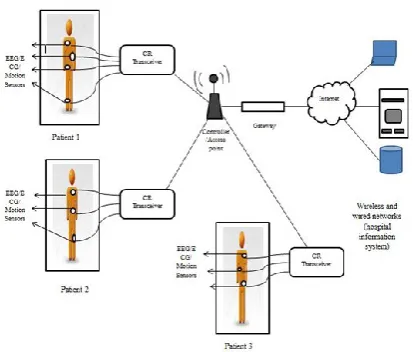
Figure 1. Wireless Body area Network(WBAN) infused with Cognitive Radio Technology
Another work by E Hossain et al. has focused on achieving higher data rates for cognitive radio selective cooperation in underlay cognitive networks over Rayleigh channels has been studied in [5]. But the maximum along with interference consideration. Design and engineering of multiuser cognitive radio networks and relaying as an aspect to improve performance deserved more attention here[4]. Performance analysis of transmit power constraint on unlicensed users has not been taken into account. The performance of a wireless sensor network (WSN) with an overlay cognitive radio (CR) has been studied in [6]. The works mainly proposed WSN by making use of the white spaces from a cellular system under a cognitive radio network, but a specific model and mathematical analysis for the proposed system was not provided. In another work by G.Thavaseela et al [7] an attempt has been made to enhance the outage performance of the cognitive user by incorporating multiple antenna and maximal ratio combining (MRC) scheme at the cognitive user and relays in the wireless environment to detect the presence of the primary user.
The wireless environment is assumed to be characterized by Nakagami fading. Another paper by S Majhi et al[8] provides a complete study of outage performance of opportunistic DF relaying networks over asymmetric fading channels, but power constraint on the channels and the effects of interference on the channels has not been considered here. Since the proposed scenario is based on wireless sensor networks, the direct
Line of Sight LOS consideration and smaller number of deep fades [9] are more appropriate in this case, which makes the Rician model more appropriate for this scenario. Also most of these studies have neglected the interference caused by PT which cannot be cancelled or ignored in underlay scenario that has been considered here.
II.
System Model
The proposed system scenario consisting of (WBAN) where wireless nodes form the Cognitive Radio network is depicted below. Here, the cellular network is considered as primary network and the sensory nodes act as the secondary or cognitive users which transmit information using decode and forward relying. This scenario is vaguely based on a typical CRSN(Cognitive Radio based Sensor Network) architecture with the feature that the relaying is offered only to the secondary node here, not to the primary users as we have considered the underlay approach to spectrum access. The secondary nodes in this system use the underlay technique of spectrum sharing with the primary users, i.e. concurrent primary and secondary transmissions may occur only if the interference generated by the secondary transmitters at the primary receivers is below some acceptable threshold.
A. System and Channel Model
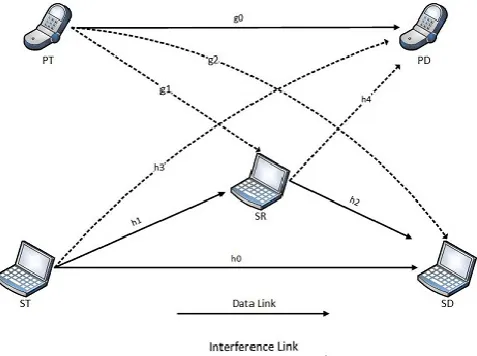
A primary transmitter (PT) that transmits data to the primary destination (PD) and over the same frequency band, a secondary source (ST) transmit data to a secondary destination (SD). A decode and forward secondary relay (SR) has considered to assist the ST in transmitting the data to SD to increase the access of secondary nodes to the primary band within a certain outage threshold. As shown in figure 1,
h0 = the channel coeffecient of data link between ST and SD,
h1 = the channel coeffecient between ST to SR
h2 = the channel coefficients of the data links between SR to SD respectively.
h4 and h5 = the channel coefficients of the interference link from ST to PR and SR to PR respectively.
g0 = the channel coefficient of the link between PT and PR
Figure 2. System Model
All the channels are considered to follow Rician distribution. The Probability Density Function (PDF) of a Rician channel is denoted as,
Where I0() is the 0th order modified Bessel function of
the first kind and ki is the rician factor and γi is the SNIR per symbol. To derive the Cumulative distribution function(CDF) of this channel we have to use the infinite series representation of Bessel function from [10, eq. 27.32 ] and the 0th order modified Bessel function is rewritten as,
Now the Cumulative Distribution Function (CDF) of γi
can be obtained from the Probability Density Function (PDF) of γi as follows,
from equation (1) and using the series representation of 0th power of modified Bessel function of first kind , we can write the PDF as,
From equation (4),it can be shown that ,
Using (5) and [10, eq 0.316] in 3.3 we get ,
Where Γ(x, y) is upper incomplete gamma function which is defined as ,
The final CDF of rician channel can be further expanded from equation (7). The obtained CDF can be expressed as the first order marcum Q function whose integral is given as,
So, the final CDF is derived as
B. Secondary and Primary User Power and interference
In the cognitive network, the secondary source and relay must adapt their transmit powers (Pst and Psr
respectively) below an interference threshold so that they do not cause any interference to the primary destination (PD). At the same time, since both PU and SU are sharing same channel, transmit power Ppu of PU
Where Ist is the interference threshold at secondary
source (ST) and Isr is the interference threshold at
secondary relay (SR).
In this model, the data transmission is divided into two time slots. In the first slot, ST transmits its data to SR and SD, The SNIR of received signal is compared to a threshold at the relay node. If the SNIR if received signal is greater than threshold, then relay transmits the signal to SD. Otherwise ST transmits signal to SD and relay does nothing.
If SR can successfully decode the signal, it will forward the signal to SD in the second time slot. The SNIR at RD and SD are,
Putting values of Pst Psr and Ppu , we get,
C. Mutual Information of Channel
The end to end mutual information of the system under decode and forward relaying is illustrated as,
Based on this, the end to end SNR at SD is,
III.
Outage Probability
For the evaluation of the system, the effect of interference temperature on the performance of the system is considered.
A. Outage of the channel
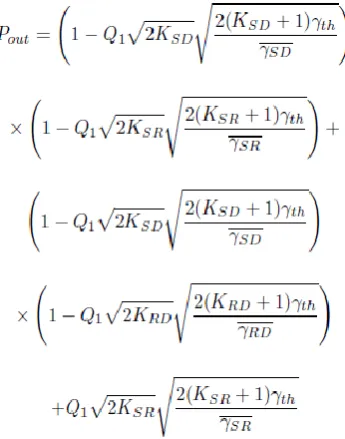
The outage probability is defined as the instantaneous probability that the channel capacity falls below a certain threshold, which can be denoted as,
[Complementary CDF of Fysr(yth)]
B. Interference Temperature Constraint
The interference metric used in this work requires to provide a strict constraint on the transmission power of the nodes. Therefore, we have focused on the deterministic Interference Temperature Constraints to be used as the interference metric for the transmission power control [11]. In an RF environment, the interference temperature is basically the temperature equivalent of the power available at the receiver antenna measured in unites of kelvin. The received power can be calculated as the product of the interference temperature and bandwidth
P = kTB , here, k is the boltzmann constant, T is the interference temperature. In our case, it is denoted as T
= P/kB.
IV.
Numerical Analysis and Result
In this section the simulation results and analysis on the network capacity and performance of the secondary nodes in presence of interference temperature constraint has been included.s the parameters for simulation, spectral efficiency (bps/Hz)of secondary nodes, Interference temperature (DB),network capacity of secondary node , distance of secondary nodes to primary receiver and number of secondary nodes. Fig 3 shows the effect of increasing the interference temperature on the secondary user’s network capacity. Increasing the interference temperature increases the network capacity upto a certain level and then it subsides to a steady level.
Figure. 3. Impact of Interference Temperature(Imax) on Network Capacity
Fig 4 shows the effect of increasing the interference temperature constraint on the data rate or spectral efficiency (bps/BW) of the secondary users. As the value of I increases from 1000 to 2000, so does the spectral efficiency of the system i.e. as the interference temperature constraint becomes loose, the data rate of secondary users increases.
Figure 4. Spectral Efficiency with different Imax value
Fig 5 shows the relation between the network capacity of the secondary nodes with the distance between secondary nodes and primary receiver. The simulation illustrates that the network capacity increases as the distance between PU and SU increases.
Figure 5. Impact of distance between Primary Receiver and Secondary Nodes on Network Capacity of
Secondary Network
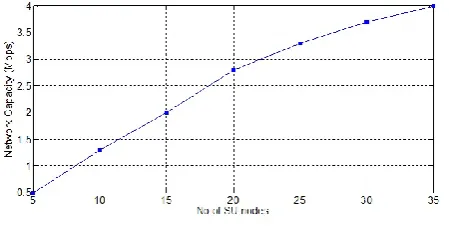
certain value of the number of secondary nodes, the network capacity increases, which in our case, is 35. After that, the network capacity decreases with the increase in the number of secondary nodes due to the increased interference caused by them.
Figure 6. Impact of the Number of Secondary Nodes on Network Capacity of
Secondary System
A. Analysis of result
The above simulations show the effects of using the Interference temperature model for imposing interference constraint on the secondary users transmit power. The simulation shows comparatively enhanced performance by the secondary net-work under the interference temperature model and also shows it’s relation with the number of secondary (in this case, sensor) nodes and distance between primary and secondary nodes. The results imply that as the interference limit is increased for the secondary users, the network capacity also increases thus allowing the transmit power to be less constrained for secondary nodes. The third simulation implies that the network capacity of secondary users increase with the distance between the primary and secondary nodes. The fourth graph shows that the network capacity increases with the increase of the number of secondary nodes but only upto a limit(35). After that, if the number of nodes increases, the performance degrades as the interference to primary nodes increases.
V.
CONCLUSION
Cognitive radio provides the effective solution to spectrum scarcity problem and enhances the wireless communication quality with opportunistic spectrum access capability and adaptability to the channel conditions. These salient features can also be exploited in resource-constrained sensor networks while focusing on the interference and power constraint issues. Based on this scenario, the outage probability of the proposed system and the effect of the interference temperature
constraint on the performance of the system in a Rician environment has been studied and demonstrated with different performance metric.
VI.
REFERENCES
[1]. FCC, Spectrum Policy Task Force, Tech. Rep. Nov. 2002
[2]. J. L. Hill, System Architecture for Wireless Sensor Networks, University of California, Berkeley, 2003. [3]. O. Simeone, Y. Bar-Ness, U. Spagnolini, "Stable
Throughput of Cog-nitive Radios With and Without Relaying Capability", Communications, IEEE Transactions on (Volume:55 , Issue: 12 ), Page(s): 2351-2360 ISSN : 0090-6778, Dec. 2007.
[4]. E Hossain, L Le, N Devroy, "Cognitive Radio: From Theory to Practical Network Engineering".
[5]. S.L. Hussain, M.M. Abdallah, M-S. Alouini, M. Hasna, K. Qaraqe, "Performance analysis of selective cooperation in underlay cognitive networks over Rayleigh channels", on IEEE 12th International Workshop on Signal Processing Advances in Wireless Communications (SPAWC), Page(s):116-120, ISSN :1948-3244, 26-29 June 2011.
[6]. H. A. Alcala Garrido, M. E. RiveroAngeles, I. Y -Flores, R. Rodriguez, "Performance Analysis of a Wireless Sensor Network for Seism Detection in an Overlay Cognitive Radio System", Communication Networks Laboratory, CIC-IPN.
[7]. B. Lakshmi Priya, G. Thavaseelan, "Outage Performance Enhancement of Cognitive Radio Under Nakagami m Fading", International Journal of Engineering Research and Applications (IJERA) ISSN: 22489622 www.ijera.com Vol. 3, Issue 2, March -April 2013.
[8]. P. Narasimha Murthy, R. V. S. Satyanarayana, "A Comparison of Rayleigh and Rician Fading Channels under Frequency-Selective Fad-ing", The IUP Journal of Electrical and Electronics Engineering, Vol. III, No. 4, pp. 44-50, November 21, 2010.
[9]. O. B. Akan, O. B. Karli, O. Ergul, "Cognitive Radio Sensor Networks", IEEE Network: The Magazine of Global Internetworking - Special issue title on networking over multi-hop cognitive networks archive,Volume 23 Issue 4, Pages 34-40, 26-29 June 2011.
[10]. S. L. M. R. Speigel and J. Liu, Mathematical Handbook of formulas and tables, Schaums outline series, 3rd edition. M. G. Hill, 2009.