• No results found

COMPARATIVE ANALYSIS OF THE PERFORMANCE OF ARTIFICIAL NEURAL NETWORKS (ANNs) AND AUTOREGRESSIVE INTEGRATED MOVING AVERAGE (ARIMA) MODELS ON RAINFALL FORECASTING

N/A
N/A
Protected

Academic year: 2020

Share "COMPARATIVE ANALYSIS OF THE PERFORMANCE OF ARTIFICIAL NEURAL NETWORKS (ANNs) AND AUTOREGRESSIVE INTEGRATED MOVING AVERAGE (ARIMA) MODELS ON RAINFALL FORECASTING"

Copied!
6
0
0

Loading.... (view fulltext now)

Full text

(1)

www.scienceworldjournal.org ISSN 1597-6343

Comparative Analysis of the Performance of Artificial Neural Networks (ANNS) and Autoregressive Integrated Moving Average (ARIMA) Models on Rainfall

Forecasting

COMPARATIVE ANALYSIS OF THE PERFORMANCE OF

ARTIFICIAL NEURAL NETWORKS (ANNs) AND

AUTOREGRESSIVE INTEGRATED MOVING AVERAGE (ARIMA)

MODELS ON RAINFALL FORECASTING

Peter Ayuba1 and Mubarak Abdullateef2

1,2Department of Mathematical Sciences, Kaduna State University, Kaduna – Nigeria

Corresponding author’s e-mail addresses: [email protected] or [email protected]

ABSTRACT

The forecasting of the occurrence of events such as a social phenomenon, a natural disaster, a physical observation, personal research, or otherwise based on historical data has helped individuals and organizations in making informed decisions and adequate arrangements for any eventuality that might occur. Rainfall is a physical event that occurs at certain periods, depending upon the geographical location. In the North West of Nigeria, rainfalls usually occur during the months of April to October. At earlier and late stages, the rainfall is usually characterized by strong winds which causes damages to houses, electricity installations and other monumental structures. Draught and flood are other problems associated with rainfall in the North West region of Nigeria. In this paper, two separate tools were employed to forecast the yearly rainfall of Kaduna metropolis which has suffered from severe problems of draught as well as flood in time past. The results obtained showed that Artificial Neural Network (ANN) technique outperformed Autoregressive Integrated Moving Average (ARIMA) technique in cyclical seasonal behavior with a minimum Mean Absolute Percentage Error (MAPE).

Key words: Forecasting, Autoregressive Integrated Moving Average (ARIMA), Artificial Neural Network (ANN), Mean Square Error (MSE), Mean Absolute Percentage Error (MAPE)

1. INTRODUCTION

Time series analysis and forecasting is an important tool in gaining more knowledge and understanding of stochastic processes, and has applications in meteorological phenomena, such as Temperature, Humidity, Rainfall, Drought, etc. Accurate information about rainfall is of great importance for planning, usage and management of water resources.

Rainfall is one of the most difficult and complex element of the water cycle to understand and to obtain accurate prediction of it (French, Krajewski and Cuykendall, 1992). It is often challenging to represent many natural phenomena which vary randomly with time with a physical model. The complexity of the atmospheric processes that generate rainfall makes quantitative forecasting of rainfall an extremely difficult task. In spite of many advances in weather forecasting in recent years, accurate rainfall forecasting is one of the greatest formidable challenges in operational hydrology (Gwangseob and Ana, 2001; Hung, Babel, Weesakul and Tripathi, 2008).

Rainfall is the most important natural factor that determines agricultural production in Nigeria, particularly in the North Western region of Nigeria. The variability of rainfall and the pattern of extreme high or low precipitation are very important for agriculture and the economy of Nigeria. It is well established that rainfall is changing on both regional and global scales due to global warming (Hulme, Osborn and Johns, 1998).

There are several methods often useful in time series data analysis and forecasting. Some of the most effective are Artificial Neural Network (ANN), Fuzzy times series model, Autoregressive Integrated Moving Average (ARIMA), Multilinear Regression (MLR), Random Forest Model, Exponential Smoothing, etc. Other methods such as the variance ratios, autocorrelation analysis, and spectral analysis have been used for the analysis of time series. However, these methods may fail when trends are present in the datasets (Otok and Suhartono, 2009)

The ARIMA model, also known as the Box-Jenkins methodology. It is a robust and effective approach for analyzing time series data. The model was introduced by Box and Jenkins (1976) and commonly used in analysis and forecasting. It is widely regarded as one of the most efficient forecasting technique in social sciences and is used extensively for time series (Bisgaard and Kulahci, 2011). Artificial Neural Networks (ANNs) is an emerging computationally powerful techniques with a very high degree accuracy and widely used as forecasting models in many areas such as engineering, social, finance, economic, stock and foreign exchange problems (Somvanshi et al., 2006). The ANN approach has several advantages due to its robustness and flexibility over conventional methods or semi-empirical models, they require known input data set with few prior assumptions (Nagendra and khare, 2006; Gardner and Dorling, 1998). Its robustness, predictability and self-adaptive potential is due to the several distinguishing features which includes, ability to learn a process without any prior knowledge about such phenomenon (i.e. image and sound recognition); ability to capture subtle functional relationships among the data even if the underlying relationships are unknown or hard to describe; ability to infer the unseen part of a population even if data contain noisy information; and many other features of ANNs that make them useful to researchers. (Gardner and Dorling, 1998)

In order to obtain a reliable prediction of rainfall in Kaduna Metropolis and its environs, and to ensure the right decision is taken based on the results obtained, it is expedient to undertake

Fu

ll L

en

gt

h Rese

ar

ch

Ar

(2)

Comparative Analysis of the Performance of Artificial Neural Networks (ANNS) and Autoregressive Integrated Moving Average (ARIMA) Models on Rainfall

Forecasting the comparative analysis of the performance of ANN and ARIMA in

forecasting rainfall in the region. In this paper, the need to forecast rainfall in Kaduna Metropolis and its environs was presented in section one. In section two, part of the problems associated with loss of lives and properties due to flood and drought in the region were discussed. Literature that discussed the use of ANN and ARIMA in predictions and comparative of both models were presented in section three. Methods and materials are discussed in section four. Section five, presents the analysis of results and discussions. In section six, conclusion was drawn based upon the analyzed results.

2. The Problem Statement

Many studies have all pointed to the ever-changing global climatic condition, amidst global warming (Goswami, Venugopal, Sengupa, Madhusoodanan and Xavier, 2006; Trenberth et al., 2007; Jayawardene, Sonnadra and Jayawardene, 2005). Niasse (2005) reported that the West Africa region has experienced a marked decline in rainfall up to 30% depending on the area. The trend was abruptly interrupted by a return of adequate rainfall conditions in 1994.

Two phenomenon are prevalent in the region, flood and drought which are due to high amount of rainfall or lack of rainfall. Over the years, Kaduna State, especially it metropolis had experienced flood which had cause adverse effect on lives and properties. The most ravaging one, which occurred on 23rd August, 2003, cause inundation of huge areas on the flood plain and as a result, over 5000 people were affected and more than 30,000 houses were submerged. This disaster cut across 12 LGA in Kaduna (Ijigah and Akinyemi, 2015). David and Aggarwal (2008) revealed that most of the areas lying close to River Kaduna’s flood plain are under severe threat to flooding in different flood return periods. Moses (2016) conducted a study which assessed the level of drought in Kaduna between 2000-2014, and reported that both rainfall and vegetation are generally decreasing in the State. Abaje, Ishaya and Usman (2010) reported that rainfall yield in Kafanchan, Jema’a Local Government Area has been experiencing a decline since from 1900 to 2010. The need to forecast rainfall in Kaduna Metropolis is vital for future planning in the State. Forecasting is a planning tool that helps in making the right decision due to the uncertainty of the future, relying mainly on data from the past and present and analysis of trends (Otok and Suhartono, 2009).

The use of ANN and ARIMA based on numerical computation and graphical representation performance were employed for forecasting total monthly rainfall in Kaduna Metropolis based on past observations. This would provide important actionable seasonal precipitation that would enable farmers and water resource managers in the region to make informed decisions

3. Review of Related Literature

Artificial neural networks (ANN) are a family of statistical learning algorithms. The ANN is an engineering concept of knowledge in the field of artificial intelligence akin to human brain and designed by adopting the human nervous system. They are generally presented as systems of interconnected artificial neurons (nodes) which can compute values from inputs, and are capable of machine learning as well as pattern recognition due to their adaptive nature (Alshaimaa, 2015). Learning often occurs through training by set of input/output data where the training algorithm iteratively adjusts the connection weights (synapses) and these

connections are also known as the hidden layers that store the knowledge necessary to solve specific problems (Hung et al., 2008).

Kyaw and Othman (2010) used ANN approach to model monthly, biannual, yearly and quarterly Malaysia rainfall using the Focused Time Delay Neural Network (FTDNN) to make one-step-ahead predictions. The result indicates that the yearly model gives the most accurate forecasts (94.25%). Multi-layer feed-forward neural networks and time delay neural networks were found to capture the dynamic structure of the rainfall process when ANNs were used to forecast the spatial distribution of rainfall in Sydney, Australia. The three types of ANNs implemented were multi-layer feed-forward neural networks (MLFN), time delay neural networks (TDNN) and partial recurrent neural networks to predict one-step-ahead. (Kin, Ball and Sharma, 2001) Previous studies have implemented ANNs using the Back Propagation algorithm in predicting the direction of stock market price. They each concluded that the method is a useful technique for stock index prediction because of its ability to capture trend and subtle functional relationships among empirical data (see, Kyaw and Othman 2010; Huang, Nakamori and Wang, 2005; Alshaimaa, 2015).

Box-Jenkins methodology was proposed by Box and Jenkins 1976 for analyzing time series data. It consists of 4 phases: i. model identification; ii. estimation of model parameters; iii. diagnostic checking; and iv. Forecast. The method aims to describe the autocorrelation in the data and can be applied to stationary and non-stationary time series. ARIMA consist of the Autoregressive (AR) of the order ‘p’ and Moving average (AR) part of order ‘q’ (Brockwell and Davis, 2002).

Traditionally, ARIMA is one of the widely used method for rainfall prediction due to its ability to predict k-step ahead based on past observations (Somvanshi et al., 2006). The Box-Jenkins approach was adopted by Emmanuel and Bakari (2015) to predict monthly rainfall for Maiduguri, North Eastern region of Nigeria. ARIMA (1,1,0) was found to best fit the 32 years’ data collected and forecast of 3 years and 8 months was made with this model. Generally, in the selection of goodness of fit among candidates of model under the Box-Jenkins methodology, the model with minimum Akaike Information Criteria (AIC) and Bayesian Information is considered as the best model. AIC and BIC Criteria are some of the model selection criteria mostly used to select the best model due to the in-sample fit to estimate the likelihood of a model to predict/estimate the future values. (Eni and Adeyeye, (2015) & Molla, Rana, Hossain and Nuruzzman (2016)). Several studies have applied ARIMA to predict monthly rainfall of various locations (see Ali (2013); Eni and Adeyeye (2015); Molla, et al., (2016)). These research studies found the method to be more desirable and its effectiveness in handling practical application. Lee, Sehwan and Jongdae (2007) compared the forecasting performance of ANN and ARIMA models in forecasting Korean Stock Price Index. The ARIMA model generally provided more accurate forecasts than the back-propagation neural network (BPNN) model used. The result obtained by Sterba and Hilovska (2010) revealed that ARIMA model achieved a good prediction performance than the ANN in prediction of linear time series, while ANNs perform better in prediction of nonlinear time series. Neural networks were compared to multiple regression and ARIMA models in a large metropolitan area to predict the maximum ozone concentration. Empirical results obtained by the authors also showed that the neural network model was

(3)

Comparative Analysis of the Performance of Artificial Neural Networks (ANNS) and Autoregressive Integrated Moving Average (ARIMA) Models on Rainfall

Forecasting statistically superior to both the regression and ARIMA models

(Prybutok, Yi and Mitchell, 2000). Somvanshi et al., (2006) and Shaymaa (2014) considered ANN and ARIMA to predict behavior pattern of rainfall. These studies split the observed dataset into two parts. The larger part for model calibration and the other for model evaluation of the trained model. They all found ANN to be far more superior than the other traditional model. Most comparative studies for evaluating and comparing models, adopts various evaluation criteria to validate the performance of models. These criteria may include Root Mean Square Error (RMSE), Mean Square Error (MSE), Mean Absolute Percentage Error (MAPE), etc. Moghaddasi and Badr (2008) assessed the statistical accuracy of alternative wheat prices forecast using structural and time series methodology. The model performance was evaluated using RMSE, MAE, and MAPE which revealed the supremacy of ARIMA over the other models considered. These basic evaluation criteria were also used by Assis, Amran, Remali and Affendy (2010) for univariate time series models in forecasting monthly average cocoa beans prices. The study revealed the time series data was influenced by a positive linear trend.

4. MATERIALS AND METHODS

4.1 Data set and study area

The total monthly rainfall, measured in millimeter (mm) was obtained from Nigerian Meteorological Agency (NIMET), Kaduna station from January, 1981 to December 2016 for a total period of 36 years. In the present study MATLAB (R2015a) was used for both the Artificial Neural Network and Autoregressive Moving Average development. R was also employed in data exploration for ARIMA development. The study area is part of Kaduna Township, located between latitude 10o27’15” N -10o13’5” N and longitude 7o21’48” E - 7o29’36” E. The vegetation of the area is the Guinea Savanna type; and the area is designated as Koppen’s Aw climate with two distinct seasons, a wet season in summer and a dry season in winter. These two seasons reflect the influences of tropical continental and equatorial maritime air masses, which sweep over the entire country. However, in Kaduna State, the seasonality is pronounced with the cool to hot dry season being longer than the rainy season. Rainfall occurs between the months of April to November with a peak in August (David and Aggarwal, 2008).

4.2 Methodology

4.2.1 ARIMA

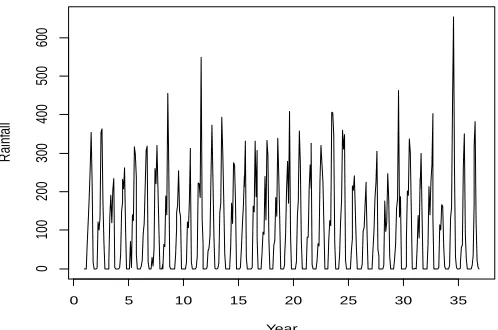
A time plot (see Fig. 1) of total monthly rainfall of the collected data for the period 1st January, 1981 to 31st December, 2016 (432 data points). Time plot is a graphical method of data exploratory to examine the general pattern and behavior of the series and to reveal whether it is stationary or non-stationarity. It is often difficult to represent the time series over past observation if it is time variant (i.e. the mean and variance are not constant). A confirmatory test by examining the Autocorrelation Function (ACF) and Partial Autocorrelation Function (PACF) correlogram will confirm the stationarity.

Fig. 1: Time Plot of Kaduna Metropolis Monthly Rainfall

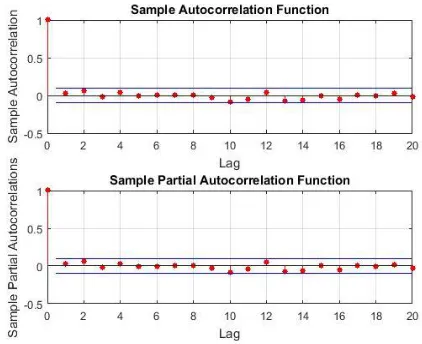
Modelling data such as rainfall, more often than not shows cycle of seasonality. The plot shows a strong seasonal cycle of the series. The seasonal fluctuations occur every 12 months, resulting in period of time series S = 12. The time-plot shows no noticeable trend hence it is flat. The correlogram of the time series was observed to be non-stationary as the spikes decayed gradually in a regular pattern, which confirmed the presence of seasonality (see Fig. 2).

Fig. 2: ACF and PACF Correlogram of Non-Stationary Rainfall data

The time plot of the rainfall data is not stationary. In identifying the model for the data, the time series data must undergo transformation to attain stationarity. In order to fit an ARIMA model, stationary data in both variance and mean are a necessary requirement.

An additive decomposition was applied to the nonstationary time series, to gain insight on the nature of transformation to apply for the differencing. This inform the decision to perform first differencing (D = 1) of the seasonal component of the time series. Finally, a confirmatory test of ACF correlogram and Augmented Dickey Fuller test revealed the series to be stationary.

ARIMA (p, d, q) is a class of a differenced ARMA (p, q) model. Where ‘p’ is the order of Autoregressive (AR) part, d is the

Year

R

ai

nf

al

l

0 5 10 15 20 25 30 35

0

100

200

300

400

500

600

0.0 0.5 1.0 1.5 2.0

-0

.5

0.

5

Lag

A

C

F

Series Rainfall

0.0 0.5 1.0 1.5 2.0

-0

.2

0.

2

0.

6

Lag

P

ar

tia

l A

C

F

Series Rainfall

(4)

Comparative Analysis of the Performance of Artificial Neural Networks (ANNS) and Autoregressive Integrated Moving Average (ARIMA) Models on Rainfall

Forecasting suitable number of difference applied and ‘q’ is the order of the

Moving average (MA) part of the model. A time series containing seasonality as contained in this research data requires incorporating the seasonality component into the model and thus yields the class called SARIMA (p, d, q) (P, D, Q) S. Therefore, SARIMA model (p,0, q) (P,1, Q)12 could be identified for further analysis.

Careful examination of ACF and PACF, identified the following five models for estimation: SARIMA

(0,0,0) (2,1,0)12, SARIMA (1,0,0) (0,1,0)12, SARIMA (0,0,0) (1,1,1)12, SARIMA (0,0,0) (1,1,0)12 and SARIMA (0,0,1) (0,1,1)12. These models were found to give significant result. The model with the minimum Akaike Information Criteria (AIC) value and Mean square error was evaluation criteria used to determined best model from the candidates of model.

The selected model SARIMA (0,0,1) (0,1,1)12 was further evaluated for goodness of fit. The correlogram of the residual and Ljung-Box was checked for adequacy of the model. The test confirmed the model as the best model to fit the stationary monthly rainfall data. This implied that the observed residual is white-noise.

4.2.2 ANN

The network design of the Artificial Neural Network method employed is a Multilayer Feed Forward Network (MLFN), trained using the Backpropagation learning algorithm. The Levenberg-Marquardt (lmtrain) backpropagation was the desired network training function used.

The network was created in an open loop form which has the ability to make a single-step prediction. However, the network was converted to a close-loop form, due to its efficiency for multistep prediction vis-a-vis our proposed method for evaluation of the model. The close-loop closes any open-loop feedback. The network topology is shown in figure 3 below.

Fig.3: ANN Topology of Monthly Rainfall.

Precautionary measures were taken against ‘over fitting’ or ‘under fitting’ of the data set. This can occur either by using greater number of neuron or lesser. Several experiments using different network parameters produces a better performance network configuration. The network divided the data set into 70% for training, 15% for validation and 15% for testing.

Performance accuracy was also verified using Mean Absolute Percentage Error (MAPE) for numerical error evaluation criteria adopted for both ANN and ARIMA approach.

5. RESULTS AND DISCUSSION

5.1 ARIMA Result

The results of all possible candidates of seasonal model having performed data exploratory and first seasonal differencing to make the data stationary. The model with the best goodness of fit formed the basis for selection as seen in table 1 below. The maximum likelihood technique was employed in the selection parameter estimation.

Table 1. Mean Square and AIC value for the Postulated Model

S/N SARIMA Model Mean Square

AIC

1. (0,0,0)(1,1,0)12 3779 4812.09

2. (0,0,0)(2,1,0)12 3614 4644.5

3. (0,0,0)(1,1,1)12 4962 4920.91

4. (0,0,0)(1,1,0)12 3896 4672.19

5. (0,0,1)(0,1,1)12 3726 4508.52

The selected model SARIMA (0,0,1) (0,1,1)12 with minimum MSE and AIC was subjected to adequacy and diagnostic test of its residual by ACF and PACF correlogram plot. These were essential to find the existence of no correlation between the residuals. It was verified that the plot does not depict any significant lag (see Fig. 2).

Fig.4: ACF and PACF Correlogram of Residuals

The parameter estimation for the selected SARIMA (0,0,1) (0,1,1)12 model in Table 2 further confirmed by Ljung-Box test with a p-value of 0.198.

(5)

Comparative Analysis of the Performance of Artificial Neural Networks (ANNS) and Autoregressive Integrated Moving Average (ARIMA) Models on Rainfall

Forecasting Table 2: Maximum Likelihood Estimate of the SARIMA Model and

their Standard Error

SARIMA (0,0,1)(0,1,1)12

Coefficient Estimates Standard

Error

MA1 -1 0.0047196

SMA1 -0.925065 0.0154112

2 e

)

= 3016, log Likelihood = -2319.25 and AIC = 4508.5,

For further evaluation and inter-comparison of the SARIMA model against the trained data, the graphical representation of the model for the predicted and observed data were plotted. Figure 4 shows the level of goodness of fit with observed data. The plot depicts a very good performance of the model as it produced almost perfect process of the rainfall data. Also, the MAPE of the model computed revealed a good performance of 0.324825.

Fig. 5: ARIMA Time Plot of Rainfall Values Versus Predicted Value

5.2 ANN Result

One of the rule of thumb in ANN model training is to carefully experiment with different network architectures by varying the number of hidden layers of the network. This approach resulted in the final selection of our model which gives best prediction accuracy and has the minimum MSE.

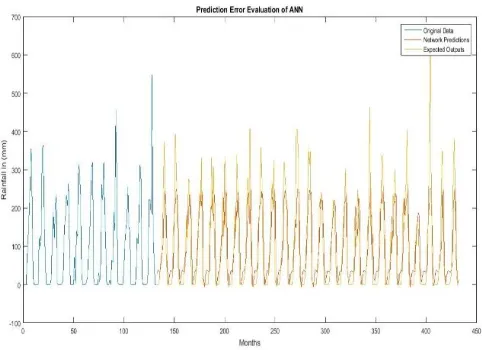
This model was used to perform multistep prediction of the monthly rainfall in Kaduna Metropolis. The evaluation of performance of the model was graphical presented in the figure 6 below against the actual value of the data set to show the correlation of the level of accuracy. The forecast error of the model using MAPE evaluation criteria demonstrated a good forecast performance with computed value of 0.2785.

Fig.6: ANN Time Plot of Rainfall Value Versus Predicted Value

5.3 Comparison of ARIMA and ANN results

From the above empirical results presented in Figures 5 and 6, we observed that the two model shows remarkably good performance in fitting the Monthly rainfall data set of Kaduna Metropolis. Also, judging from the forecast evaluation error of both model which are quite low. it can be adjudged that both models achieved good forecast performance. However, it can be concluded that the performance of ANN outperformed that of ARIMA model in terms of producing a very good cyclical seasonal behavior of the rainfall process by graphical evaluation. Furthermore, for the numerical method of evaluation, the ANN has a minimum value of MAPE compared to ARIMA.

This finding agrees with the work of Somvanshi et al., 2006. Which applied ANN and ARIMA model to predict mean annual rainfall of Hyderabad region in India.

6. Conclusion

In this study, the complex nature of Kaduna Metropolis monthly rainfall record for the period of 36 years, spanning from 1981 to 2016 was studied using ANN and conventional ARIMA approaches. The results revealed that both ANN and ARIMA model achieved good prediction performance of the observed data. Based on the results of inter-comparison of the models, it was concluded that ANN offers superior and consistent performance of the monthly rainfall as compared to the ARIMA model. ANN is therefore preferable as a robust prediction model for Kaduna Metropolis monthly rainfall that would enable farmers and water resource managers in the region to make informed decisions.

REFERENCES

Abaje, I.B., Ishaya, S. and Usman, S.U. (2010). An Analysis of Rainfall Trends in Kafanchan, Kaduna State, Nigeria.

Research Journal of Environmental and Earth Sciences. 2(2): pp. 89-96.

Ali, S.M. (2013). Analysis of Baghdad rainfall using ARIMA method. Iraki Journal of Science, 54(4): pp: 1136-1142. Alshaimaa, I.B. (2015). A combined Model Between Artificial

Networks and ARIMA. International Journal of Recent Research in Commerce Economics and Management.

2(2): pp. 134-140.

(6)

Comparative Analysis of the Performance of Artificial Neural Networks (ANNS) and Autoregressive Integrated Moving Average (ARIMA) Models on Rainfall

Forecasting Assis, K. Amran, A., Remali, Y. and Affendy, H. (2010). A

comparison of Univariate Time Series Methods for Forecasting Coco Bean Prices. Trends Agriculture Economics, 3(4): 207-215.

Bisgaard, S. and Kulahci, M. (2011). Time series analysis and forecasting by example. New Jersey. John Wiley & sons. Box, G.E.P. and Jenkins, G.M. (1976). Time Series Analysis:

Forecasting and Control. Revised Edition., Hoden-Day, San Francisco.

Brockwell, P. J. and Davis, R.A. (2002). Introduction to Time Series and Forecasting, (2nded). New York, NY: Springer-Verlag.

David, N.J and Aggarwal, S.P. (2008). Flood Inundation Hazard Modelling of the River Kaduna Using Remote Sensing and Geographic Information Systems. Journal of Applied Sciences Research. 4(12): p.1822-1833.

Emmanuel, S.B. and Bakari, H.R. (2015). An Application of Time Series Analysis in Modeling Monthly Rainafall Data for Maiduguri, North Eastern Nigeria. Journal of Mathematical Theory and Modeling. 5(11) ISSN 2225-0522.

Eni, D. and Adeyeye, F.J. (2015). Seasonal ARIMA Modelling and Forecasting of Rainfall in WarriTown, Nigeria. Journal of Geoscience and Environment Protection. 3: pp. 91-98. French, M. N., Krajewski, W. F. and Cuykendall, R. R. (1992).

Rainfall forecasting in space andTime using Neural Network, Journal of Hydrology.137: pp. 1–31.

Gardner, M.W. and Dorling, S.R. (1998). Artificial Neural Network (Multilayer Perceptron): A review of applications in Atmospheric science. Atmospheric Environment, 32: pp. 2627-2636.

Goswami, B.N., Venugopal, V., Sengupa, D., Madhusoodanan, M.S. and Xavier, P.K. (2006). Increasing Trend of Extreme Rain Events over India in a Warming Environment. Science, 314: p.1442-1445.

Gwangseob, K. and Ana, P.B. (2001). Quantitative Flood Forecasting Using Multisensor Data and Neural Networks. Journal of Hydrology, 246: pp. 45-62. Huang, W., Nakamori, Y. and Wang, S. (2005). Forecasting Stock

Market Movement Direction with Support Vector Machine. Computational Operations Research. 32(10): pp. 13–22. Hulme, M., Osborn, T.J. and Johns, T.C. (1998). Precipitation

Sensitivity to Global Warming: Comparison of Observations with HADCM2 Simulations. Geophysical Research Letters, 25: pp. 3379-3382.

Hung, N.Q., Babel, M.S., Weesakul, S. and Tripathi, N.K. (2008) An Artificial Neural Network Model for Rainfall Forecasting in Bangkok, Thailand. Hydrology and Earth System Sciences, 5: pp. 183-218.

Ijigah, E.A. and Akinyemi, T.A. (2015). Flood Disaster: An Empirical Survey of Causative Factors and Preventive Measures in Kaduna, Nigeria. International Journal of Environment and Pollution Research. 3: pp. 53-56. Jayawardene, H.K.W.I., Sonnadra, D.U.J. and Jayawardene, D.R.

(2005). Trends of Rainfall in Sri Lanka over the last Century, Sri Lankan Journal of Physics, 6: pp.7-17. Kyaw, K.H. and Othman. (2010). Rainfall Forecasting Model

Using Focused Time-Delay Neural Network. International Conference on Computer and Communication Engineering (ICCCE). 11-13 May, 2010.

Lee, C. K., Sehwan, Y. and Jongdae, J. (2007) Neural Network Model versus SARIMA model in Forecasting Korean Stock Price Index (KOSPI), Issues in Information System. 8(2), pp. 372–378.

Moghaddasi, R. and Badr, B. R. (2008). An Econometric Model for Wheat Price Forecasting in Iran. International Conference on Applied Economics – ICOAE: 671-677. Molla, M.R., Rana, S., Hossain, S. and Nuruzzman, S.M. (2016). Modelling Monthly Precipitation in Faridpur Region of

Bangladesh Using ARIMA. Journal of Environmental Science, Toxicology and Food Technology. 10(6): pp. 22-29

Moses, N.P. (2016). An Assessment of Drought in Kaduna State, Nigeria, Between 2000 and 2015. Open Air, Ahmadu Bello University Zaria. [online]. Available from: http://hdl.handle.net/123456789/8718 [Accessed 24/08/2017]

Nagendra, S.M.S. and Khare, M. (2006). Artificial Neural Network approach for Modeling Nitrogen Dioxide Dispersion from Vehicular Exhaust Emissions. Ecological Model. 190: pp. 99-115.

Niasse, M. (2005). Climate-Induced Water Conflict Risks in West Africa: [Online] Retrieved from: http://www.gechs.org/downloads/holmen/Niasse.pdf.(Acc essed date: September 16, 2017).

Otok, B.W. and Suhartono, F.R. (2009). Development of rainfall Forecasting model in Indonesia by using ASTAR, Transfer Function, and ARIMA Methods. European Journal of Scientific Research. 38(3): pp. 386–395. Prybutok, V. R. Yi, J. and Mitchell, D. (2000). Comparison of

Neural Network Models with ARIMA and Regression Models for Prediction of Houston’s Daily Maximum Ozone Concentrations. European Journal of Operational Research, 122(1), pp. 31–40.

Shaymaa, A.M.A. (2014). Prediction of Monthly Rainfall in Kirkuk Using Artificial Neural Network and Time Series Models. Journal of Engineering and Development. 18(1) ISSN 1813-7822.

Somvanshi, V.K., Pandey, O.P., Agarwal, P.K., Kalanker, N.V., Prakesh, M.R. and Chand, R. (2006). Modeling and Prediction of Rainfall using Artificial Neural Network and ARIMA Techniques. Journal of Indian Geophysical Union, 10(2) pp.141-151.

Sterba, J. and Hilovska, K. (2010). The Implementation of Hybrid RIMA Neural Network Prediction Model for Aggregate Water Consumption Prediction, Aplimat—Journal of Applied Mathematics, 3(3): pp. 123–131.

Trenberth, K.E., Jones, P.D. Ambenje, P. Bojariu, R., Easterling, D., Klein-Tank, A. Parker, D. Rahimzadeh, F. Renwick, J.A., Rusticucci, M., Soden, B. and Zhai, P. (2007). Observations: Surface and Atmospheric Climate Change. The Physical Science Basis, pp. 235-336.

Figure

Fig. 2: ACF and PACF Correlogram of Non-Stationary Rainfall data
Table 1. Mean Square and AIC value for the Postulated Model
Fig.6: ANN Time Plot of Rainfall Value Versus Predicted Value

References

Related documents

The CAP exposures, with either the combined fCAP exposures (at site I Bilthoven) or the combined u+fCAP exposures (at site II HIA) did not result in statistically significant changes

Regarding purpose and function, all CES provided clinical case consultation, six of seven provided education and training, six of seven assisted with organisational policy

Even though Facebook lacks a collaborative-project orientation (which is not its original vocation), the incredibly high uptake of this social networking site, combined with

assess the wind resource potential of Fort Beaufort, South Africa for the purpose of deploying BEWT

Pricing does not include transition services to a subsequent service provider. ARRA funds will not be utilized to fund this

These systems remove silver from solutions utilizing chemical recovery cartridges (CRCs) and produce a non-hazardous liquid that can be discharged to a municipal sewer system.

Palliativstationen und Hospize sehen in der subkutanen Gabe von Medikamenten und Flüssigkeit eine größere Erleichterung bei der Entlassung als die befragten

A very large increase in AE parameters for P92 and E911 alloy at 1000°C during cooling from this temperature has been related to cracking of oxide scale.. The oxidation specimen