www.scienceworldjournal.org
ISSN 1597-6343
Modification of Fuzzy Logic Rule Base in the Optimization of Traffic Light Control System
MODIFICATION OF FUZZY LOGIC RULE BASE IN THE
OPTIMIZATION OF TRAFFIC LIGHT CONTROL SYSTEM
Peter Ayuba1, Babangida Zachariah2 and Luhutyit Peter Damuut3
1,2,3 Department of Mathematical Sciences, Kaduna State University, Kaduna – Nigeria.
Corresponding authors’ e-mail address: [email protected]/[email protected]
ABSTRACT
Road intersections, bad roads, accidents, road construction works, emergencies, etc. are some of the primary causes of high traffic congestions in urban areas. In an attempt to solve some of these problems, traffic wardens and traffic light control systems are employed at road intersections to ensure that deadlocks are avoided. However, the use of traffic warden is associated with weariness which can lead to poor judgement in allocating the right of way to motorist. An alternative approach is to employ the use of Traffic light control system in the management of the increased traffic congestion that is always experience in urban areas. The use of dynamic phase scheduling traffic control system has proven more efficient as compared to the static phase scheduling traffic control system. In this paper, an attempt was made to improve upon an earlier optimized traffic light control system developed using simulation of urban mobility (SUMO) in conjunction with fuzzy inference system which played the role of optimizing the traffic light control system. The modified fuzzy rule based gave a superior average waiting time of 72.07% improvement as compared to an earlier average waiting time improvement of 65.35%. This is an indication that amongst other factors, the size of the fuzzy rule base plays a significant role when fuzzy logic is employed in the optimization of traffic light control systems.
Keywords: Fuzzy Logic Controller, Dynamic Automated Traffic Light System, Static Automated Traffic Light System
INTRODUCTION
The rate of vehicles being introduced into Nigerian roads are not proportionate to the sum total of existing roads and the newly constructed ones. This is primarily due to the fact that the cost of buying a vehicle is far less than the cost of constructing a kilometer of road. Secondly, the poor town planning system in Nigeria constitutes one of the major problems faced by motorist because of the lack of alternative routes. Thirdly, the capacity of most Nigerian roads cannot comfortable accommodate three vehicles on a lane in most major cities per unit time. More roads are usually being constructed to cater for the deficiency in available alternative routes to different destinations. The number of vehicles still supersedes the number of roads and their corresponding capacities. This has led to the problem of Nigerian roads becoming more and more congested on daily basis. The congestions of roads have equally led to robbery of motorist, crashes, deadlocks, emission of harmful gases, etc.
In order to solve the problems encountered as a result of road congestion, an efficient and effective traffic management approach must be employed on Nigerian roads. Several approaches have been in use; such as traffic warden officer who is usually deployed to assign motorist the right of way at an
intersection. The traffic warden uses his or her instinct in to assign the right of way to motorist. There are problems encountered by this approach; such as weariness on the part of the traffic warden. Impatience on the part of the motorist as a result of the waiting time in certain instances. The use of Automated Traffic Light System (ATLS) which may be static or dynamic in nature is an improvement over the traffic warden. In the static ATLS commonly referred to as the static phase scheduling of traffic light system (SPSTLS), a fixed amount of time is allocated in turn to each road direction or flow irrespective of whether there are vehicles in that direction or not. Whereas, in dynamic ATLS also referred to as the dynamic phase scheduling of traffic light system (DPSTLS), different times are allocated to road directions based upon the queue length. More time is allocated to flows with more vehicles on the queue. In both the static and dynamic ATLS, the traffic light system uses green, yellow and red signals to allocated the right of way, stop or move while safe and stop respectively (Salehi, Iman, & Yarahmadi, 2014; Babangida, Peter & Luhutyit, 2017).
In all these approaches the dynamic ATLS generally out performs the static ATLS. In the dynamic ATLS approach that improves on the static ATLS using the fuzzy inference system, the fuzzy rule base is of paramount importance in designing a fuzzy logic controller for the scheduling of traffic. When the size of the fuzzy rule base is very high, the problem of computational burden leads to performance issues. There should be a balance between the size of the rule base and the performance of the system. The
most recent work reported in Babangida et al., (2017) presented a
rule base size of 49 rules and the average percentage improvement of the dynamic ATLS (DPSTLS) over the static ATLS (SPSTLS) system was obtained as 65.35% waiting time. In this paper, a proposed model that modifies on the size of the rule based to ensure a reduction in the computational burden of the system and hence improved performance is presented.
This paper is organized in the following manner. A brief statement of the problem is presented in section II. In section III, a review of related literature is discussed. Section IV presents the materials and method. Section V presents the simulation and discussion of results. Section VI concludes the paper with further research directions for the improvement on the existing system.
The Problem Statement
Kaduna Refining and Petrochemical Company (KRPC) Limited a subsidiary of Nigerian National and Petroleum Corporation (NNPC) located at Chikun, Kaduna, Nigeria with location coordinates Latitude 10.41159 and Longitude 7.49065 has a daily production rates of Prime Motor Spirit (PMS)-3,857MT; Kerosene-1,686MT; Diesel-3,000MT and Asphalt-1,796MT (KRPC, 2018). These finished products are usually transported on daily basis to different deports in the entire Northern zone of Nigeria. The only
Fu
ll L
en
gt
h Rese
ar
ch
Ar
Modification of Fuzzy Logic Rule Base in the Optimization of Traffic Light Control System
intersection that connects KRPC with the rest of the neighboring routes always experience high rate of traffic congestions during the mornings hours and evening hours of week days. This is solely due to workers going to work and closing from work and also the lifting of finished products from KRPC. The increase in motorist on the KRPC junction without a corresponding increase in the capacity of the roads constitutes a lot of menace to the surrounding area. In order to solve this menace, traffic wardens and actuated ATLS have been deployed at the intersection to reduce the problems of crashes due to impatience of motorist, robbery of motorist due to traffic jam and pollution of the area due to excessive emission of harmful gases from exhaust pipes of vehicles. However, the problem of weariness associated with the traffic wardens is a major concern and the actuated ATLS suffers from the problem of uncertainty as the arrival time of vehicles follows a Poisson distribution. The dynamic ATLS proposed in
Babangida et al., (2017) has a very high size of Fuzzy Logic (FL)
rule base which might result in computational burden on the traffic light system. A small size FL rule base is proposed in this paper in order to optimize the traffic light control system (TLCS).
Review of Related Literature
In an effort to improve upon the existing traffic condition several works have been done in the area of decongesting traffic especially in urban areas. These works are primarily to solve problems such as accidents, pollution, changes in traffic conditions, emergency or priority issues, theft problems as a result of traffic congestion, etc. Kutadinata, Moase, Manzie, Zhang & Garoni (2016) developed an extremum- seeker in order to optimize a performance measure in real time using microscopic urban traffic simulator. The work looks at situations of TLS in urban areas and unimodal environments of traffic as contrast to
the use of simulation of urban mobility (SUMO) in Babangida et
al., (2017) which this work seeks to address the gap in knowledge
that exist.
Blokpoel and Vreeswijk (2016) reported that the queue length is the most important parameter for each traffic light control system to make informed decisions. The work uses the concept of cooperative awareness message to transmit the needed information. In the cooperative approaches, three algorithms were employed, the first being the Global Positioning System (GPS) used to gather data of oncoming vehicles. However, this approach is saddled with the problems of atmospheric disturbances that distort signals before they reach the receiver, reflections from buildings and other large, solid objects can affect the accuracy of the GPS including the time keeping accuracy (Peter, Tella & Gabriel, 2015). The second algorithm uses a model of the wave speed of accelerating vehicles. The speed of a wave can be altered by alterations in the properties of the medium through which it travels. This too can affect the data collected for decision making. The third algorithm concentrates on lower penetration and uses both the classical finish line recognition with cooperative recognition to calculate the queue length.
Jin, Ma & Kosonen (2017) reported that increased traffic congestion in urban areas and their consequences need efficient controls and management. They agreed that optimization approaches play a vital role in this regard. However, there is equally the need for a scientific computing framework in the optimization process. The model-based optimization framework simulated a simple road of two intersections while this work
simulates three lanes four-way intersections using SUMO.
In the work of Liu et al., (2017) they reported that the existing
intelligent TLCSs are bedevil with problems such as the avoidance of dense roadside sensors, attacking malevolent vehicles and avoiding single point disappointment. In addressing these challenges, they proposed fog computing and hash collision puzzle to solve these challenges. Their work considered mostly the problem of failure of the traffic light control systems as a result of denial of service attack and the weather conditions generated from fog that makes vehicles not very visible to intelligent traffic light control systems.
Vlasov (2017) proposed a model of cyclic balance which uses nonlinear programming and a module of genetic algorithm was applied to the request and supply of transportation networks in order to achieve an optimum traffic light control mode. However, the use of FL which is a universal approximator deals with uncertainty and nonlinearity than genetic algorithm (Peter and Tella, 2015).
Osigbemeh, Onuu and Asaolu (2017) said that the use of light emitting diodes (LEDs) for the purpose of traffic light control system causes problems such as poor visibility by road users and consequently leads to road traffic laws violation. In an attempt to solve these problems, they proposed the use of incandescent lightings and halogen bulbs which are extremely efficient and enable motorist obtain sufficient warning before reaching the point of decision. Queue length which is an important component in solving traffic problems was ignored in their work, they were only interested in solving visibility issues drivers face and not optimizing the problem of high traffic conditions.
The cost of implementing Traffic Light Systems (TLSs) directly is quite high, and the importance of its proficiency requires that it first be simulated by tools before been put to use (Hao, Xingguo & Xuan, 2014; Qing & Jun, 2015). There are different methods of implementing TLS. Amongst which is the static TLS based on past records gathered from observations (Little, 1966; Robertson, 1969). The collection of real time information by the use of cameras and sensors is referred to as dynamic TLS (Kok, Mamun, Mohd & Tae, 2013). Techniques such as Artificial Neural Networks (ANN), FL, Evolutionary computations and Genetic algorithms have been reported to be more efficient and effective
at managing road traffic problems (Kok et al., 2013). Habib, Ilhem,
Jorge, Ajith & Adel (2014) designed a static TLS using Ant-hierarchical FL model which confirm the potential of FL in road traffic management system based upon the results obtained. Average waiting times of motorist were drastically reduced when an hybridized approach of FL and dynamic programming techniques were used for optimizing traffic light system (Yi, Dongbin & Jianqiang, 2008).
MATERIALS AND METHODS
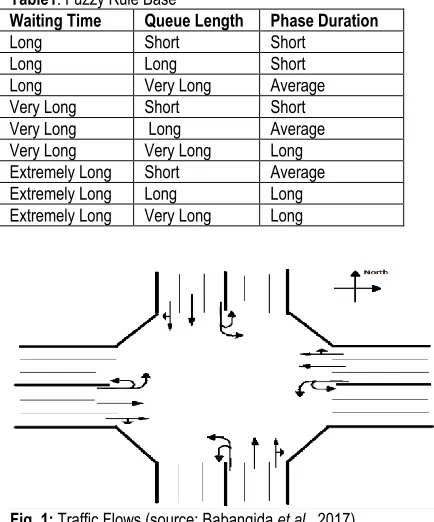
The basic materials used in this research work are Traci4MATLAB, SUMO and MATLAB software. Figure 1 is used as the system’s framework since this research work is an
improvement upon the work of Babangida et al., (2017). Fuzzy
Logic Controller (FLC) is the primary agent used to determine the optimum performance of a TLS. A FLC having two inputs (queue length and waiting time) and three Fuzzy Sets (FS) (Low, Medium and High) for both queue length and waiting time resulting in nine
Modification of Fuzzy Logic Rule Base in the Optimization of Traffic Light Control System
fuzzy rules in the rule base of the FLC. The FLC interfaces with the TLS and the Real-Time Traffic Data (RTTD) component through the Traci4Matlab implemented on MATLAB. The FLC obtains the queue lengths and maximum waiting times from RTTD to determine the optimal schedule of the traffic and send same to the TLS. The calculation of the optimal schedule decision is performed at the termination of the last phase. The Fuzzy rules used are in table 1.
Table1: Fuzzy Rule Base
Waiting Time Queue Length Phase Duration
Long Short Short
Long Long Short
Long Very Long Average
Very Long Short Short
Very Long Long Average
Very Long Very Long Long
Extremely Long Short Average
Extremely Long Long Long
Extremely Long Very Long Long
Fig. 1: Traffic Flows (source: Babangida et al., 2017)
Simulation and Discussion of Results
Three different simulation were implemented for this research work. High density traffic on all the four ways of the intersection was simulated, the simulation of two ways high density was implemented and one-way high density was simulated and flows that are normal was equally simulated. The control surface for the nine rule base is shown below in figure 2.
Fig. 2: Control surface of rule base
Case One: Four-Way High Traffic Density
In this simulation, high traffic was mimicked for all the four ways and the result of the average waiting time of 18.8 seconds was obtained for a non-optimized signal plan. For an optimized signal plan, a 7.36 seconds waiting time was obtained which gave an improvement of 61% which is highly above the corresponding
percentage (46.58%) obtained in (Babangida et al., 2017).
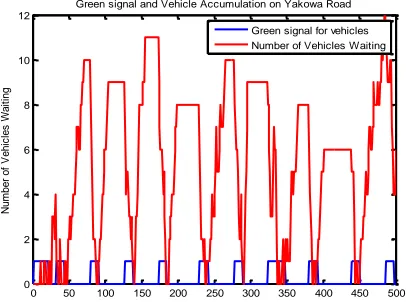
Figures 3A-D shows the optimized green phase duration it can be seen that there is a decrease in the number of vehicles waiting at the intersection as compared to the corresponding optimized
green phase durations in (Babangida et al., 2017).
Fig. 3A: Optimized Green Phase Duration on Refinery Road
Fig.3B: Optimized Green Phase Duration on Kaduna Road
Fig. 3C: Optimized Green Phase Duration on Kachia Road
0 50 100 150 200 250 300 350 400 450 500
0 2 4 6 8 10 12
Green Signal and Vehicle Accumulation on Refinery Road
t
N
u
m
b
e
r
o
f
V
e
h
ic
le
s
W
a
it
in
g
Green signal for vehicles Number of Vehicles Waiting
0 50 100 150 200 250 300 350 400 450 500
0 2 4 6 8 10 12
Green signal and Vehicle Accumulation on Kaduna Road
t
N
u
m
b
e
r
o
f
V
e
h
ic
le
s
W
a
it
in
g
Green signal for vehicles Number of Vehicles Waiting
0 50 100 150 200 250 300 350 400 450 500
0 2 4 6 8 10 12
Green signal and Vehicle Accumulation on Kachia Road
t
N
u
m
b
e
r
o
f
V
e
h
ic
le
s
W
a
it
in
g
Green signal for vehicles Number of Vehicles Waiting
Modification of Fuzzy Logic Rule Base in the Optimization of Traffic Light Control System
Fig. 3D: Optimized Green Phase Duration on Yakowa Road
Case Two: Two-Way High Traffic Density
In this simulation, 14.56 seconds was the waiting time for the static ATLS, whereas, 3.99 seconds was the waiting time for the dynamic ATLS, resulting in 72.60% improvement. Figures 3E-H shows the optimized green phase durations on the different roads. Though this result is slightly below the percentage (73.63%) improvement obtained in the corresponding case of
Babangida et al., (2017); however, the overall results gives a
better improvement.
Fig. 3E: Optimized Green Phase Duration on Yakowa Road
Fig.3F: Optimized Green Phase Duration on Kachia Road
Fig. 3G: Optimized Green Phase Duration on Kaduna Road
Fig. 3H: Optimized Green Phase Duration on Refinery Road
Case Three: One-Way High Traffic Density
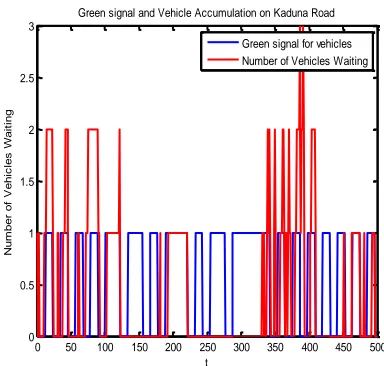
In the one-way high traffic density simulation, 13.00 seconds was obtained for the static ATLS, whereas, 2.26 seconds was obtained for the dynamic ATLS, giving an 82.62% improvement. Figures3I-L shows the optimized green phase duration on the different roads. This result is highly above the corresponding percentage (75.85%) obtained in Babangida et al., (2017).
Fig. 3I: Optimized Green Phase Duration on Refinery Road
0 50 100 150 200 250 300 350 400 450 500
0 2 4 6 8 10 12
Green signal and Vehicle Accumulation on Yakowa Road
t N u m b e r o f V e h ic le s W a it in g
Green signal for vehicles Number of Vehicles Waiting
0 50 100 150 200 250 300 350 400 450 500
0 0.1 0.2 0.3 0.4 0.5 0.6 0.7 0.8 0.9 1
Green signal and Vehicle Accumulation on Yakowa Road
t N u m b e r o f V e h ic le s W a it in g
Green signal for vehicles Number of Vehicles Waiting
0 50 100 150 200 250 300 350 400 450 500
0 1 2 3 4 5 6 7 8 9 10
Green signal and Vehicle Accumulation on Kachia Road
t N u m b e r o f V e h ic le s W a it in g
Green signal for vehicles Number of Vehicles Waiting
0 50 100 150 200 250 300 350 400 450 500
0 1 2 3 4 5 6 7 8 9 10
Green signal and Vehicle Accumulation on Kaduna Road
t N um be r of V eh ic le s W ai tin g
Green signal for vehicles Number of Vehicles Waiting
0 50 100 150 200 250 300 350 400 450 500
-1 -0.8 -0.6 -0.4 -0.2 0 0.2 0.4 0.6 0.8 1
Green Signal and Vehicle Accumulation on Refinery Road
t N u m b e r o f V e h ic le s W a it in g
Green signal for vehicles Number of Vehicles Waiting
0 50 100 150 200 250 300 350 400 450 500
-1 -0.8 -0.6 -0.4 -0.2 0 0.2 0.4 0.6 0.8 1
Green Signal and Vehicle Accumulation on Refinery Road
t N u m b e r o f V e h ic le s W a it in g
Green signal for vehicles Number of Vehicles Waiting
Modification of Fuzzy Logic Rule Base in the Optimization of Traffic Light Control System
Fig. 3J: Optimized Green Phase Duration on Kaduna Road
Fig. 3K: Optimized Green Phase Duration on Kachia Road
Fig. 3L: Optimized Green Phase Duration on Yakowa Road
The results of the various simulations based on the modification of the FL rule base are presented in table 2 as follows:
Table 2: The Mean Waiting Times of Static ATLS and Dynamic ATLS
Traffic Density
Static ATLS(s)
Dynamic ATLS(s)
%
Improvement
Four-Way 18.87 7.36 61.00
Two-Way 14.56 3.99 72.60
One-Way 13.00 2.26 82.62
Mean Percentage Improvement 72.07
The improvement in percentage (72.07%) performance of the dynamic ATLS (DPSTLS) over the static ATLS (SPSTLS) is a function of the optimization of the fuzzy rule base.
Conclusion
The improvement in performance of the dynamic ATLS (DPSTLS) over the static ATLS (SPSTLS) as seen in the percentage improvement of 72.07% over 65.35% obtained in an earlier work
done in Babangida et al., (2017) is credited to the modification of
the fuzzy rule base. This result has further shown the superiority of the dynamic ATLS over the static ATLS when fuzzy logic is utilized as the tool for optimizing performance which suggest the implementation of this approach in optimizing TLS. The future research direction is to optimize the TLCS using different membership functions and different fuzzy rule base in modeling the FLC.
REFERENCES
Babangida, Z., Peter, A. & Luhutyit, P. D. (2017). Optimization of Traffic Light Control System of an Intersection Using Fuzzy Inference System. Science World Journal. 12(4), 27-33.
Blokpoel, R. & Vreeswijk, J. (2016). Uses of Probe Vehicle Data in Traffic Light Control. Transportation Research Procedia. 14, 4572 – 4581.
Habib, M. K., Ilhem, K., Jorge, C., Ajith, A., & Adel, M. A. (2014). Adapt-Traf: An Adaptive Multiagent Road Traffic Management System Based on Hybrid Ant-hierarchical Fuzzy Model. Transportation Research Part C. 42,147– 167.
Hao, D., Xingguo, X., & Xuan, Z. (2014). Design and Implementation of a Real-time Traffic Light Control System Based on FPGA. ASEE 2014. Zone I Conference. USA: University of Bridgeport, Bridgpeort, CT.
Jin, J., Ma, X. & Kosonen, I. (2017). A Stochastic Optimization Framework for Road Traffic Controls Based on Evolutionary Algorithms and Traffic Simulation. Advances in Engineering Software 000, 1-13.
Kok, M. N., Mamun, B. I., Mohd, A. M., & Tae, G. C. (2013). A Brief Survey on Advances of Control and Intelligent Systems Methods for Traffic-Responsive Control of Urban Networks. Technical Gazette 20 (3), 555-562. KRPC. (2018). Kaduna Refining and Petrochemical Company At
a Glance. Retrieved February 20, 2018, From http://krpc.nnpcgroup.com/
Kutadinata, R., Moase, W., Manzie, C., Zhang, L. & Garoni, T. (2016). Enhancing the Performance of Existing Urban Traffic Light. Transportation Research Part C 62 ,1-20. Little, J. D. (1966). The Synchronization of Traffic Signals by
Mixed Integer- Linear-Programming. Operations
0 50 100 150 200 250 300 350 400 450 500
0 0.5 1 1.5 2 2.5 3
Green signal and Vehicle Accumulation on Kaduna Road
t
N
u
m
b
e
r
o
f
V
e
h
ic
le
s
W
a
it
in
g
Green signal for vehicles Number of Vehicles Waiting
0 50 100 150 200 250 300 350 400 450 500
0 0.5 1 1.5 2 2.5 3
Green signal and Vehicle Accumulation on Kachia Road
t
N
u
m
b
e
r
o
f
V
e
h
ic
le
s
W
a
it
in
g
Green signal for vehicles Number of Vehicles Waiting
0 50 100 150 200 250 300 350 400 450 500
0 0.1 0.2 0.3 0.4 0.5 0.6 0.7 0.8 0.9 1
Green signal and Vehicle Accumulation on Yakowa Road
t
N
u
m
b
e
r
o
f
V
e
h
ic
le
s
W
a
it
in
g
Green signal for vehicles Number of Vehicles Waiting
Modification of Fuzzy Logic Rule Base in the Optimization of Traffic Light Control System
Research. 14, 568–594.
Liu, J., Li, J., Zhang, L., Dai, F., Zhanga, Y., Menga, X., & Shen, J. (2017). Secure Intelligent Traffic Light Control Using Fog Computing. Future Generation Computer Systems.
http://dx.doi.org/10.1016/j.future.2017.02.017. 1-8.
Osigbemeh, M., Michael Onuu, M. & Asaolu, O. (2017). Design and development of an Improved Traffic Light Control System Using Hybrid Lighting System. Journal of Traffic and Transportation Engineering (English Edition). 4(1). 88-95.
Peter, A., Tella, Y. & Gabriel, L.D. (2015). An overview of Indoor Localization Technologies and Applications. Journal of Computing Technologies. 73 (4) 5, 2278 – 3814. Peter, A. & Tella, Y. (2015). Fuzzy Logic System for Indoor
Real-Time Symbolic Location Tracking Using Wi-Fi Access Point Receive Signal Strength Indication Values. International Journal of Artificial Intelligence and Mechatronic. 3(5), 254-262.
Qing, F., & Jun, Y. (2015). Design and Implementation of Traffic Lights Control System Based on FPGA. International Conference on Chemical, Material and Food Engineering (CMFE-2015), 822-825.
Robertson, D. I. (1969). TRANSYT Method for Area Traffic Control. Traffic Engineering Control. 10, 276–281. Salehi, M., Iman, S., & Yarahmadi, M. (2014). TLCSBFL: A Traffic
Lights Control System Based on Fuzzy Logic. International Journal of u- and e- Service, Science and Technology. 7(3), 27-34.
Vlasov, A. (2017). Features of Calculation of Traffic Light Control Modes in the Conditions of Intensive Road Traffic. Transportation Research Procedia 20, 676 – 682. Yi, T., Dongbin, Z., & Jianqiang, Y. (2008). A Fuzzy Logic
Controller with Adaptive Dynamic Programming Optimization for Traffic Signals. Fifth International Conference on Fuzzy Systems and Knowledge Discovery. IEE and Computer Society.191-195.