SLBN: A Scalable Max-min Fair Algorithm for
Rate-Based Explicit Congestion Control
Alberto Mozo
Dpto. Arquitectura y Tecnologíade Computadores
Universidad Politécnica de Madrid Madrid, Spain
Jose Luis López-Presa
DIATELUniversidad Politécnica de Madrid Madrid, Spain
Antonio Fernández Anta
Institute IMDEA NetworksMadrid, Spain [email protected]
Abstract—The growth of the Internet has increased the need for scalable congestion control mechanisms in high speed net-works. In this context, we propose arate-based explicit congestion controlmechanism with which the sources are provided with the rate at which they can transmit. These rates are computed with a distributed max-min fair algorithm, SLBN. The novelty of SLBN is that it combines two interesting features not simultaneously present in existing proposals:scalability andfast convergenceto the max-min fair rates, even under high session churn. SLBN is scalable because routers only maintain a constant amount of state information (only three integer variables per link) and only incur a constant amount of computation per protocol packet, independently of the number of sessions that cross the router. Additionally, SLBN does not require processing any data packet, and it converges independently of sessions’ RTT. Finally, by design, the protocol is conservative when assigning rates, even in the presence of high churn, which helps preventing link overshoots in transient periods. We claim that, with all these features, our mechanism is a good candidate to be used in real deployments.
I. INTRODUCTION
The goal of congestion control algorithms is to fairly share the bandwidth of network links among user flows. The growth of the Internet has increased the need for scalable congestion control mechanisms in high speed networks. For example, it has been observed that the current version of TCP suffers from performance degradation as the bandwidth-delay product increases [11], [21], [18]. This is mostly due to the slow convergence caused by the AIMD and slow-start mechanisms of TCP. The proposals to face this issue have mainly followed two paths. On the one hand, modified versions of TCP, which rely on packet drops or ECN bits, have been pro-posed to improve performance while maintaining scalability (e.g., [11], [12], [21], [25]). On the other hand, new explicit congestion control approaches, based on closed-control-loops, have been proposed (e.g., [10], [15], [18], [26]). These latter approaches provide the sources with explicit feedback about the congestion level of the network. The feedback sent by the routers to the sources is usually an explicit window size or an explicit sending rate. The goal of this explicit feedback is to achieve close to 100% link utilization, avoiding packet loss, and achieving quick convergence to a (typically max-min) fair sharing of the links’ bandwidths. These approaches
are claimed to achieve fast convergence and fair distribution of network resources among sessions. Unfortunately, we have experimentally observed that, even under moderate session churn, these mechanisms do not converge quickly to the exact max-min fair values. Moreover, they tend to oscillate around the exact max-min fair rates, causing link overshoots during transient periods. This results in packets being discarded and retransmitted, and, in the end, congestion at the network links. An alternative to the previous approaches are the explicit end-to-end rated-based flow-control (EERC) protocols that were developed for ATM networks. Unfortunately, existing EERC proposals (see, e.g., [8], [17]) need to store per-session information in each router link, precluding their deployment in a typical Internet scenario with hundreds of thousands of sessions crossing the backbone routers.
In this work we propose a rate-based explicit congestion controlmechanism with which the sources are provided with the explicit rates at which they can transmit. These rates are computed with a distributed max-min fair algorithm that we call SLBN (fromStateLess B-Neck). SLBN is, in essence, an EERC protocol. However, SLBN combines two interesting features, not simultaneously present in any existing mech-anism: scalability and fast convergence to the correct set of rates. Scalability is achieved because routers executing SLBN only need to store three integer variables per link, independently of the number of sessions that cross the link. This characteristic clearly differentiates SLBN from ATM EERC mechanisms. Additionally, with SLBN, the deviations of the rate assignments from their max-min fair values, and the convergence speed to the exact max-min fair rates, are both in the range of the best existing mechanisms, even under high session churn and arbitrary RTTs. They are similar to those obtained by distributed max-min fair algorithms that store per-session information, and much smaller than those obtained by closed-control-loop approaches.
A. Related Work
distributed among the other sessions. Many max-min fair al-gorithms have been proposed, both centralized and distributed. Among them, for scalability, only distributed algorithms can be applied to implement explicit rate congestion control in high speed networks.
Gallager [13] and Katevenis [19] achieved fairness by using, at each link, one queue per session and a round robin scheduler, but they did not compute the rates explicitly. With the advent of ATM, a large number of EERC distributed algo-rithms were proposed to calculate virtual circuit max-min fair rates in the Available Bit Rate (ABR) traffic mode (see, e.g. [8], [17], [16], [5], [7], [14], [24]). In general, these algorithms exhibit a good convergence speed that depends linearly on the number of bottlenecks of the network. (Informally, bottlenecks are links that limit the sessions’ rates.) Recently, a distributed max-min fair algorithm has been proposed, which has the nice property of stopping all control traffic after computing the rates [22]. All these algorithms require that routers store and classify per-session state information at each link to compute the max-min fair rates, what significantly limits their scalability when hundreds of thousands of different session flows can cross router links.
On the contrary, SLBN only needs to store three integer variables at each link to compute the max-min fair rates, independently of the number of flows crossing the link.
Cobb et al. [9] proposed a distributed max-min fair al-gorithm that does not need to store per-session information at each link. Unfortunately, this algorithm depends on a predefined constant parameter T that must be greater than protocol packet RTT. However, it is not easy to upper bound this value because protocol and data packets share the same network links, and RTT will grow when congestion problems appear. Moreover, we have run experiments in some non-trivial scenarios, that show that the algorithm does not always converge. Other reduced-state algorithms compute only ap-proximations of the rates [4], [3], [2], what can lead to large deviations from the max-min fair rates, since they are sensitive to small changes [1].
An alternative approach to attempt converging to the max-min fair rates is using algorithms based on closed-control-loops. In this case, it is not required to process, classify or store per-session information when a packet arrives to the router. Therefore, scalability is not compromised when a large number of sessions cross a router link. For instance, XCP [18] was designed to work well in networks with large bandwidth-delay products. It computes, at each link, window changes which are provided to the source. However, it was shown in [10] that XCP convergence speed to fair rates can be very slow, and short time duration flows could finish without reaching the fair rate. RCP [10], on its hand, explicitly computes the rates sent to the sources, what yields more accurate congestion information. Additionally, the computation effort needed in router links per arriving packet is significantly smaller than in the case of XCP. However, in [15] it was shown that RCP does not always converge, and that it does not properly cope with a large number of session arrivals. The authors of [15]
propose PIQI-RCP as an alternative to RCP, trying to alleviate the above drawbacks by being more careful when computing the session rates, considering recent rate assignments history. Unfortunately, all these proposals require processing each data packet at each router link to estimate the fair rates, what hampers scalability. Moreover, we have experimentally observed that they often take very long, or even fail, to reach a steady state, when the network topology is not trivial. Additionally, they tend to generate significant oscillations around the exact max-min fair rates during transient periods, causing link overshoots. A link overshoot scenario implies, sooner or later, a growing number of packets that are going to be discarded and retransmitted and, in the end, the appearance of congestion problems. All these problems are mainly due to the fact that, unlike they implicitly assume, data from different sessions arrive at different times (due to different and variable RTT), and hence, the rates (based on the estimation of the number of sessions crossing each link) are computed with data which is not synchronously updated.
B. Contributions
In this paper we achieve congestion control by providing the source of each session with an explicit rate that it can use to limit the traffic it injects in the network. This implies that the max-min fair rates must be explicitly computed. The cornerstone of our approach is the algorithm that we call SLBN, which calculates a rate for each session in real-time. These rates converge very quickly to the max-min fair rate assignment, even in the presence of sessions joining and leaving the network. Since current core routers must cope with packets from hundreds of thousands of different session flows, in order to achieve scalability, it is desirable to minimize the processing time and the storage required at the routers. SLBN does not require processing any data packet, and the RTT values of the sessions do not affect its convergence (unlike above mentioned control-loop-based protocols). Additionally, it is scalable because routers only maintain a small amount of state information (only three integer variables per link) and only incur a constant amount of computation per protocol packet, independently of the number of sessions that cross the router. This is mainly achieved by moving the per-session state (with respect to the above mentioned max-min fair algorithms, and in particular to the one proposed in [22]) from the routers to the session sources and protocol packets.
as possible if the access routers must control session traffic. Finally, by design, SLBN is conservative when assigning rates, even in the presence of high churn, what helps reducing link overshoots in transient periods.
C. Structure of the Rest of the Paper
Section II describes the system model. In Section III, the proposed algorithm SLBN is described and formally specified. In Section IV, the experiments carried out to evaluate the practical performance of the algorithm are presented. Finally, we present our conclusions in Section V.
II. DEFINITIONS ANDSYSTEMMODEL
We have a network composed by routers and hosts which have links connecting them. The network links may have different propagation delays and different bandwidths. Each host is connected to only one router via a dedicated link. Sessions follow a static path in the network. This path starts in a host called the source node, and ends in another host called the destination node. The intermediate nodes in the session’s path are routers. In our model, each host can only be the source node of one session. (This limitation is just for the sake of simplicity.) When a protocol packet follows the session’s path from the source to the destination, we say that it is sentdownstream. When it follows the session’s path from the destination to the source, we say that it is sent upstream. A rate-based explicit congestion control mechanism is de-signed, in which the sources are provided with the explicit rate at which they can transmit, using a max-min fair policy to share links’ bandwidth among sessions. Sessions are allowed to specify the maximum rate they need, and to change it dynamically. They are considered greedy in this context, i.e., they want to maximize their assigned bandwidth up to their requested maximum rate. Initially, it can be assumed that the whole bandwidth assigned to a session can be used for session data (considering that control packets use additional bandwidth capacity). However, being more realistic, later in the experiments, it is assumed that data and control packets from a session share the assigned bandwidth, limiting the control traffic to, approximately, 1% of the total.
Knowing when a session is active and when it is no longer active (in order to allocate and deallocate resources to it, the so-called use-it-or-lose-it principle) is key to the success of a rate control mechanism. Therefore, to avoid an explicit signaling of the arrival and departure of sessions, some of the max-min fair algorithms mentioned in section I-A estimate the number of sessions that cross a link to subsequently compute the bandwidth that must be assigned to each session. However, as previously noted, the max-min fair problem is very sensitive to small errors in one link, which can produce large errors in some other link [1]. Hence, the use of an estimation of the number of sessions may generate important oscillations in rate assignments. When these oscillations become permanent, they will eventually yield serious congestion problems, as it will be shown in our experiments.
To avoid these problems, we propose a mechanism where the source nodes participate in an active way, explicitly sig-naling the arrival and departure of sessions, providing for an exact computation of the number of sessions in the network. The sessions interact with the protocol by means of a set of primitives:
• API.Join(s, r): Sessionsjoins the system and requests
a maximum rater.
• API.Leave(s): Session sis no longer active.
• API.Change(s, r): Session s requests a new maximum
rate r.
• API.Rate(s, r): Used by the protocol to indicate that
sessions has been assigned a rater.
From a user point of view, this model could be seen as unrealistic because flows do not know if they are active or not. Our proposal is to take hosts away from the model, and to delegate in the first router (in the session path) the responsibility of implementing the above primitives. As it is commonly assumed (e.g. [28], [20]), access routers maintain information about each individual flow, while core routers, for scalability purposes, do not. Hence, explicitly signaling the arrival and departure of sessions does not compromise the scalability of the access router (e.g., an xDSL home router), since it only has to cope with a small number of sessions. Therefore, it is easy for this kind of routers to execute API.Join when they detect a new flow, orAPI.Leave when an existing flow times out. Stream oriented flows (e.g., TCP) explicitly signal connection establishment and termination. Hence, these routers can execute the corresponding primitives when they detect the corresponding packets (e.g., SYN and FIN in TCP). On their hand, datagram oriented flows (e.g., UDP) can be tracked down with the help of an array of active flows (e.g. identified by source-destination pairs), and an inactivity timer for each flow. Additionally, the source router can measure in real time differences between the assigned and the actual bandwidth used by a session, and execute API.Change if the actual rate is significantly lower than the rate assigned by the control congestion mechanism.
Reliable communication channels are assumed to be avail-able to transmit SLBN packets. If reliability is not guaranteed, classical techniques can be used to cope with communication errors keeping consistent the state in network nodes.
III. ALGORITHMSLBN
1 taskSourceNode(s, e)
2 varD;pendLeave
3
4 whenAPI.Join(s, r)do
5 D←r;pendLeave←FALSE;
6 send downstream Join(s,0,0, D,∅,−1)
7 end when 8
9 whenAPI.Leave(s)do
10 pendLeave←TRUE
11 end when 12
13 whenAPI.Change(s, r)do
14 D←r
15 end when 16
17 when receivedProbeAck(s,bw00,bw0,bw, B, b)do
18 ifpendLeave then
19 send downstreamLeave(s,bw00,bw0,bw, B, b)
20 else
21 API.Rate(s, bw)
22 send downstreamProbe(s,bw0,bw,min(bw, D), B, b)
23 end if 24 end when
Fig. 1. Task Source Node of SLBN.
of bandwidth that can be allocated to the session at every link in its path. When a session leaves the network, a Leave packet is sent downstream, which is dropped at the destination. When a session changes its bandwidth requirements, the new bandwidth is stored, and used in the next Probe cycle.
To simplify the protocol specification, assume that the band-width of the first link is always bigger than the rate requested by a session. (Otherwise, add a virtual link with infinite capacity before the actual first link.) The state information (per session) used by SLBN consists of two variables which are kept at the sources, three other variables kept at the routers, and the fields of the protocol packets. At the source, variable
D stores the rate requested by the session (Figure 1, lines 5 and 14). It will be used in the Probe cycles (Figure 1, lines 6 and 22). Another (boolean) variable pendLeave indicates that the session is leaving (Figure 1, line 10), so at the end of the current Probe cycle, aLeave packet will be sent downstream (Figure 1, line 19). Every protocol packet carries the following fields:
• s. The session to which this packet belongs.
• bw00. Bandwidth computed twoProbe cycles ago.
• bw0. Bandwidth computed in the previous Probe cycle.
• bw. Bandwidth being computed in thisProbe cycle.
• B. The set of bottlenecks for this session. Its size in bits is bounded by the diameter of the network.
• b. The latest bottleneck that was added toB (relative to
the path of the session).
During a P robe cycle, each router link must identify sessions crossing it as saturated or unsaturated. A session is identified as saturated if, given the current state at the link, the largest amount of bandwidth that can be allocated to the session at this link is at least that of the fieldbwof the protocol packets, and it is identified as unsaturated otherwise. The set of saturated sessions is denoted by F, and BF =P
i∈Fbwi
is the total bandwidth allocated to saturated sessions at this link, where bwi is the bandwidth allocated to session i. The
set of unsaturated sessions is denoted by R, and its size by NR =|R|. The variables stored at the routers are BF,NR, andN, which is the number of sessions that cross the link.
The largest amount of bandwidth that a router link can offer to a session at a specific moment is called theequitable shared bandwidth. Each link computes its equitable shared bandwidth using the following formula: shBW = Ce−BF
NR , whereCe is the bandwidth of the link. Therefore,shBW is the maximum bandwidth that the link can allocate to the unsaturated sessions (a.k.a. thebottleneck levelof the link). A link is abottleneckif it has at least one unsaturated session. At the end of aProbe cycle, the source receives the minimum value of shBW for all the links in its path. During transient periods, the values of BF are not stable. Hence, it could be possible thatBF > Ce.
In this case, the value ofshBW would be negative, what is not valid. To avoid this possibility,shBW is computed as
shBW ←max
C
e−BF
NR ,
Ce
N
,
where Ce
N is clearly a lower bound for the equitable shared
bandwidth. This limits oscillations in rate assignments, and improves convergence, because the exact max-min fair rate assignment of a session is always lower-bounded by Ce
N at the
most restrictive link.
We claim that scalability at links is guaranteed, since only three integer variables are used, whose length in bits
is O(log2(max(BF,NR, N)). Therefore, 64 bits for each of
them should be enough in practice.
As shown in Figure 1 (line 6), when a session joins the network, a Probe cycle starts in which bw00 and bw0 are initialized to 0, B is the empty set since there are no bottlenecks discovered yet, and the last discovered bottleneckb
is set to−1. When aProbecycle ends, if the session is leaving (marked with the flagpendLeave), then aLeavepacket is sent downstream, with the current values ofbw00,bw0,bw,B and
b. Otherwise, a new Probe cycle starts where bw00 is set to bw0,bw0 is set to bw, andbw is set tomin(bw, D), in order to adjust the requested bandwidth to the actual availability. It is possible to insert a delay between Probe cycles to reduce the protocol traffic. In WAN scenarios, RTT values may be large. Therefore, in order to make SLBN highly responsive to changes in the network state,equitable shared bandwidthsare computed during both the downstream and upstream phases of theProbe cycles.
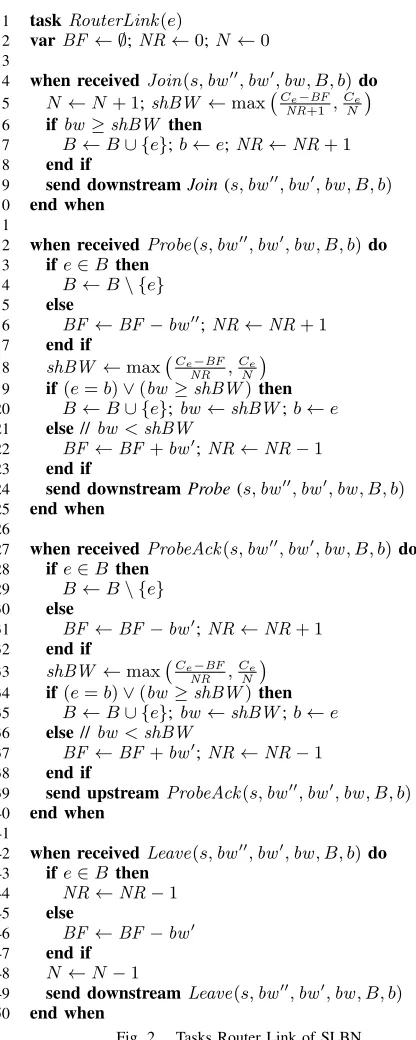
1 taskRouterLink(e)
2 varBF ← ∅;NR←0;N ←0
3
4 when receivedJoin(s,bw00,bw0,bw, B, b)do 5 N ←N+ 1;shBW ←max Ce−BF
NR+1 ,
Ce N
6 ifbw≥shBW then
7 B←B∪ {e};b←e;NR←NR+ 1
8 end if
9 send downstream Join(s,bw00,bw0,bw, B, b)
10 end when 11
12 when receivedProbe(s,bw00,bw0,bw, B, b)do 13 ife∈B then
14 B←B\ {e}
15 else
16 BF←BF−bw00;NR←NR+ 1
17 end if
18 shBW ←max Ce−BF
NR ,
Ce N
19 if(e=b)∨(bw≥shBW)then
20 B←B∪ {e};bw←shBW;b←e
21 else//bw<shBW
22 BF←BF+bw0;NR←NR−1
23 end if
24 send downstream Probe(s,bw00,bw0,bw, B, b)
25 end when 26
27 when receivedProbeAck(s,bw00,bw0,bw, B, b)do 28 ife∈B then
29 B←B\ {e}
30 else
31 BF←BF−bw0;NR←NR+ 1
32 end if
33 shBW ←max Ce−BF NR ,
Ce N
34 if(e=b)∨(bw≥shBW)then
35 B←B∪ {e};bw←shBW;b←e
36 else//bw<shBW
37 BF←BF+bw0;NR←NR−1
38 end if
39 send upstreamProbeAck(s,bw00,bw0,bw, B, b)
40 end when 41
42 when receivedLeave(s,bw00,bw0,bw, B, b)do 43 ife∈B then
44 NR←NR−1
45 else
46 BF←BF−bw0
47 end if 48 N ←N−1
49 send downstream Leave(s,bw00,bw0,bw, B, b)
50 end when
Fig. 2. Tasks Router Link of SLBN.
joins (Figure 2, line 7), when a session moves from F to
R during the downstream phase of a Probe cycle (Figure 2, line 16), or during the upstream phase of a Probe cycle (Figure 2, line 31). Likewise, it is decremented when a session moves from R toF (Figure 2, lines 22 and 37), and when a session that was in Rleaves (Figure 2, line 44).
Keeping BF up to date is a bit more involved. Recall that bw is computed during the Probe cycle, so it is not a stable value. Hence, bw0 is used to update BF when a session is identified as saturated in the downstream phase of a Probe cycle (Figure 2, line 22), or during the upstream phase (Figure 2, line 37). When a session must be moved
toR, BF must be decremented accordingly: in the upstream phase of a Probe cycle, since the value added to BF during the downstream phase wasbw0, that same value is subtracted fromBF (Figure 2, line 31). However, during the downstream phase, the value that has to be subtracted from BF is that which was added in the previous Probe cycle, i.e. bw00 (Figure 2, line 16). Likewise, when a session that was saturated leaves, the last valid value must be subtracted from BF; in this case, since the value ofbw0 is not changed at the source (Figure 1, line 19), it is used to updateBF (Figure 2, line 46). In the case of a session joining, nothing needs to be done with BF, sincebw0 andbw00 are 0.
Finally we focus on the update of B and b. Every time bw ≥shBW, this link is added to the set of bottlenecks B
for the session, and b is set to the link e (Figure 2, lines 7, 20, and 35). Adittionally, that is also done when this link was the last bottleneck identified for this session and it has increased itsshBW (Figure 2, lines 19 and 34). During both phases of aProbe cycle, this link is removed from the set of bottlenecks B of the session, until it is verified if it remains being a bottleneck for this session (Figure 2, lines 14 and 29). The pseudocode for the destination node is not included due to space restrictions. The destination node simply dropsLeave packets, and bouncesJoin andProbe packets back upstream as ProbeAck packets.
The convergence of SLBN relies on discovering and
stabilizing the bottlenecks of the network. The algorithm starts identifying and stabilizing the most restrictive bottleneck in the network (the one with the smallest bottleneck level). Then, the second most restrictive is identified, and this process continues until all bottlenecks are identified and stabilized. Therefore, in absence of session arrivals or departures in the network, SLBN convergence speed is upper bounded by O(b), whereb is the number of distinct bottleneck levels. Now we will give an intuition of how SLBN converges to the max-min fair rates.
Eventually, the set of sessions that cross the link with the most restrictive bottleneck level are notified of their exact rate assignment. Since allshBW values computed by router links are lower bounded by Ce/Ne, the lowest value returned by
a Probe cycle in the path of the unsaturated sessions at the most restrictive link b1 is
Cb1
Nb1
. (We extend the notation C,
N,BF with a subindex to specify to which link they apply.) However, this link could haveBFb1 >0, and then its current
shBW would be greater than the exact rate assignment. This implies that some session crossing it is restricted in some other link bi with a lower shBW. This situation is not possible,
because its shBW is lower bounded by Cbi/Nbi and this value is greater or equal to Cb1/Nb1 (recall that b1 has the
most restrictive bottleneck level in the network). Eventually, after some Probe cycles, the sessions crossing b1, currently
considered saturated, will also be considered unsaturated at
b1, and hence, Fb1 will become zero. Then, shBW at link b1 will be equal to
Cb1
Nb1
. Moreover, link b1 and the sessions
level in a different link.
During subsequent Probe cycles, this bottleneck level is propagated to the rest of the links in the path of the sessions bottlenecked at link b1, which will be identified assaturated
at the rest of the links belonging to their paths. These links will recompute their shBW values, and the links with the second most restrictive bottleneck level will be discovered and stabilized in the same way. This process continues in the same way in increasing order of bottleneck levels. Thus, all bottlenecks will be eventually identified and stabilized, and all sessions will be stabilized with their max-min fair rates.
IV. EXPERIMENTALEVALUATION
In this section, we experimentally compare the performance of SLBN with other congestion control algorithms. Two of them follow the closed-loop-control approach (namely RCP [10] and PIQI-RCP [15]), two use per-session state at the links (namely Erica [17] and BYZF [5]), and one follows a similar approach as SLBN (namely COBB [9]).
The algorithms have been coded in Java and have been run on top of jmyns, a home made discrete event simulator. The networks used in the experiments have been generated with thegt-itmgraph generator, with a typical Internet transit-stub model [27]. Different network topologies and sizes have been considered in the evaluation, but here we only consider WAN scenarios, because larger RTT appear in them, and so, the speed convergence of the algorithms is worse and more realistic. Therefore, we present the results for two WAN scenarios: one of Medium size (1,100 routers) used in the First Scenario, and a Large one with 11,000 routers for the Second Scenario. In both cases 200 hosts are connected to each access router. The link speeds have been set to 100 Mbps in the links connecting hosts and stub routers, to 1 Gbps in the links connecting stub routers, and to 5 Gbps in the links connecting transit routers. The propagation delay of the links has been established as follows: all internal links have been assigned random propagation delays chosen uniformly between 1 and 10 milliseconds, and the links between hosts and routers have a 1 microsecond propagation delay. Sessions are configured by choosing a source and destination hosts uniformly at random. The session route is a shortest path between them. In all experiments, the sessions inject data packets, observing the current rate assignment. In this way, we can analyze protocol stability when RTT values grow due to incorrect rate assignments which are greater than the exact rates.
The parameters we want to analyze in our experiments are: the accuracy of bandwidth assignments in the sources, the accuracy of the bandwidth assignments at the links, the completion time of sessions (when sessions are assigned different fixed amounts of data to transmit), and the stress induced on the link queues. In these experiments, one of our goals is to try to show potential link overshoot problems when high session churn appears in the network. We have used queues of unlimited size, so no packets are dropped at any link. However, if the queues grow, in a real scenario it would imply packet drops, and in the end, congestion problems.
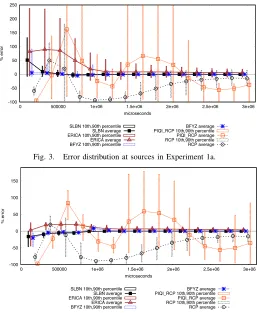
-100 -50 0 50 100 150 200 250
0 500000 1e+06 1.5e+06 2e+06 2.5e+06 3e+06
% error
microseconds
SLBN 10th,90th percentile SLBN average ERICA 10th,90th percentile ERICA average BFYZ 10th,90th percentile
BFYZ average PIQI_RCP 10th,90th percentile PIQI_RCP average RCP 10th,90th percentile RCP average
Fig. 3. Error distribution at sources in Experiment 1a.
-100 -50 0 50 100 150
0 500000 1e+06 1.5e+06 2e+06 2.5e+06 3e+06
% error
microseconds
SLBN 10th,90th percentile SLBN average ERICA 10th,90th percentile ERICA average BFYZ 10th,90th percentile
BFYZ average PIQI_RCP 10th,90th percentile PIQI_RCP average RCP 10th,90th percentile RCP average
Fig. 4. Error distribution at bottlenecks in Experiment 1a.
To measure the accuracy of bandwidth assignments at the sources, we look at the distribution of the relative error between the rate at the sources (only for sessions with a computed rate) with respect to the max-min fair rates, obtained with a centralized max-min fair algorithm. Let λs(t) be the
rate assigned to session s at timet, andλ∗s(t) the max-min fair assignment given the set of sessions at timet, the error of sessionsat timetis computed asEs(t) =
λs(t)−λ∗s(t)
λ∗
s(t) ×100. This error reflects the accuracy of the algorithm experienced by the sessions at each point in time.
To measure the accuracy of bandwidth assignments at the bottlenecks, we study the relative error between the rates assigned to the sessions that cross a link with respect to the link capacity. Let,Se(t)be the set of sessions that cross linke
at timet, andCethe bandwidth of linke. Then, the error of a
bottleneckeat timetisEe(t) =
P
s∈Se(t)λs(t)−Ce
Ce ×100.This error allows to evaluate the underutilization (or the overshoot) in the bottlenecks, with respect to their maximum capacity.
First Scenario. In this scenario the goal is to show that
SLBN, being as scalable as closed-loop-control proposals, exhibits a transient behavior which is better than theirs, and in the same range of the best per-session state proposals. Using theMediumtopology, we have carried out two different experiments1.
1The parameters used in RCP experiments areα = 0.1and β = 1 as
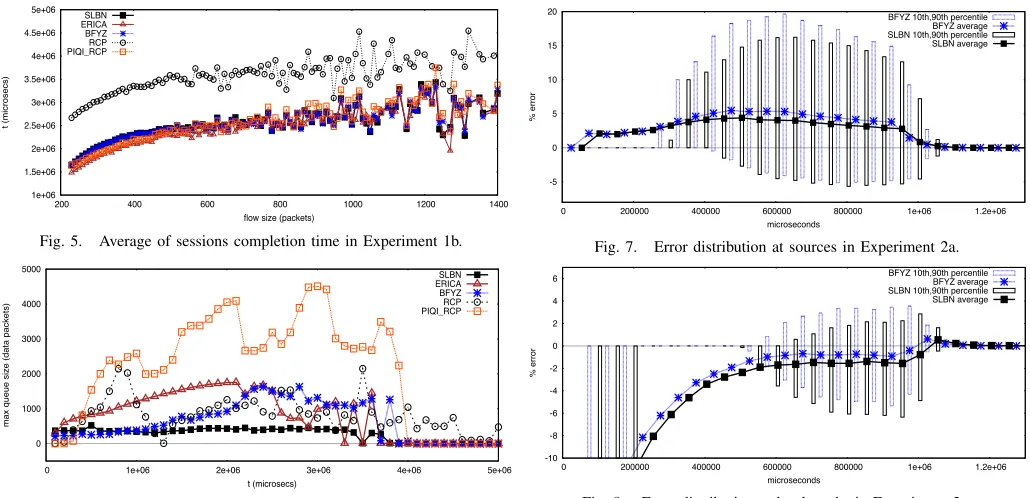
1e+06 1.5e+06 2e+06 2.5e+06 3e+06 3.5e+06 4e+06 4.5e+06 5e+06
200 400 600 800 1000 1200 1400
t (microsecs)
flow size (packets) SLBN
ERICA BFYZ RCP PIQI_RCP
Fig. 5. Average of sessions completion time in Experiment 1b.
0 1000 2000 3000 4000 5000
0 1e+06 2e+06 3e+06 4e+06 5e+06
max queue size (data packets)
t (microsecs)
SLBN ERICA BFYZ RCP PIQI_RCP
Fig. 6. Maximum queue sizes in Experiment 1b.
In Experiment 1a, 50,000 sessions are started during the first 500 milliseconds, then 10,000 sessions leave the network and 10,000 new sessions join it during the following 200 milliseconds. Figure 3 and Figure 4 show the accuracy of the rate assignments for all the protocols considered, at the sources, and at links. Percentile bars are used to show the deviation from the average. The results show that SLBN, with BYZF and ERICA, assign much more accurate bandwidths than COBB and the algorithms based on closed-control-loops (RCP and PIQI-RCP). In fact, RCP and PIQI-RCP show a quite erratic behavior with errors that are sometimes of 200%. COBB shows a non convergent behavior with average errors of approximately 500%, and values of −15%and1600% for the 10th and 90th percentiles respectively, during the whole experiment. Therefore, its results are not shown in the figures. Clearly, SLBN and BYZF show the better accuracy, with small deviations from the average, while ERICA tends to make rate assignments a little bit over the exact rate.
In Experiment 1b, during 500 milliseconds 50,000 sessions are started. The sessions are assigned fixed amounts of data to be transmitted, following a Pareto distribution with mean = 300packets of 2000 bytes each, andshape = 4. Firstly, in this experiment we show, in Figure 6, the evolution of the queues at the links of the network, to state the stress induced on the links. The most notable result is that SLBN is the only one that seems to be able to keep the maximum size of the queues bounded during the whole experiment, and COBB and PIQI-RCP are the ones that impose the biggest stress on the queues. COBB values (not shown in the figure) during the first three seconds are 5293, 8265 and 4775 data packets respectively. Secondly, we show, in Figure 5, the average of the completion times for the sessions of different sizes. SLBN, BYZF, ERICA, PIQI-RCP, and COBB (not shown in the figure) have similar completion times, while RCP has much worse completion
-5 0 5 10 15 20
0 200000 400000 600000 800000 1e+06 1.2e+06
% error
microseconds
BFYZ 10th,90th percentile BFYZ average SLBN 10th,90th percentile SLBN average
Fig. 7. Error distribution at sources in Experiment 2a.
-10 -8 -6 -4 -2 0 2 4 6
0 200000 400000 600000 800000 1e+06 1.2e+06
% error
microseconds
BFYZ 10th,90th percentile BFYZ average SLBN 10th,90th percentile SLBN average
Fig. 8. Error distribution at bottlenecks in Experiment 2a.
times. In the case of PIQI-RCP and COBB, it seems that the queues of unlimited size are assuming the congestion control, improving their final results.
Second Scenario. The goal of this scenario is to show how
independent is SLBN behavior with respect to different session churn patterns. In this scenario, we use theLargenetwork. In this case we compare SLBN only with BFYZ, since the results from the first scenario showed that COBB and the algorithms based on closed-control-loops had a much worse behavior than these two, and ERICA’s performance was also worse. In this scenario, we have carried out two experiments.
In Experiment 2a, 180,000 sessions are injected during the first second. The results of this experiment are shown in Figures 7 and 8. In them, it can be seen that SLBN performs as well as BFYZ, without the need of per-session information at the routers. Both algorithms quickly approach the max-min fair rates, what implies almost full utilization of the links but never overshooting them significantly. However, SLBN is a bit more conservative than BFYZ.
In Experiment 2b, initially in the first second 100,000 sessions are injected. After 9 seconds (when convergence has been reached), a mixture of 50,000 sessions arrive and 50,000 sessions leave in the next second. The results of this experiment are shown in Figures 9 and 10, where only the second phase of the experiment is shown (note that the behavior of the algorithms when a massive amount of sessions join the network has already been analyzed in Experiment 2a). Again, SLBN and BFYZ behave similarly: there is no significant overshooting at the links (BFYZ’s being higher, but always below 5%), and the session churn pattern does not affect the stability of the rates at sources and links.
-10 -5 0 5 10
9e+06 9.2e+06 9.4e+06 9.6e+06 9.8e+06 1e+07 1.02e+07 1.04e+07
% error
microseconds
BFYZ 10th,90th percentile BFYZ average SLBN 10th,90th percentile SLBN average
Fig. 9. Error distribution at sources in Experiment 2b.
-4 -3 -2 -1 0 1 2 3
9e+06 9.2e+06 9.4e+06 9.6e+06 9.8e+06 1e+07 1.02e+07 1.04e+07 1.06e+07
% error
microseconds
BFYZ 10th,90th percentile BFYZ average SLBN 10th,90th percentile SLBN average
Fig. 10. Error distribution at bottlenecks in Experiment 2b.
and links that are nearly constant during transient periods, and achieving a nearly full utilization of links but never overshooting them on average (the maximum of queue sizes is upper bounded by 3% of the link capacity).
V. CONCLUSIONS
We can conclude that SLBN is a good candidate to be used as a congestion control mechanism in real deployments in the Internet. SLBN controls congestion by providing the source of each session with an explicit max-min fair rate that it can use to limit the traffic it injects to the network. The novelty of SLBN is that it combines two interesting features not simultaneously present in existing proposals: scalability and fast convergence to the max-min fair rates, even under high session churn. SLBN is scalable because routers only maintain a constant amount of state information (only three integer variables per link), and only incur a constant amount of computation per protocol packet, independently of the number of sessions that cross their links. In our experiments, we have observed that, in the case of scalable protocols (RCP and PIQI_RCP), the inaccurate estimation of the number of sessions that cross a link leads to erratic behaviors during transient periods. Therefore, we propose that access routers explicitly signal the arrivals and departures of sessions. This way, SLBN convergence speed is similar to that of the fastest, but non-scalable, EERC protocols. Moreover, as our experi-ments show, SLBN is conservative when assigning rates, when compared with several well known existing proposals (ERICA, BYZF, COBB, RCP, and PIQI_RCP). As a consequence, no overshoot is produced at router links, and the sizes of the link queues are kept small and almost constant, even under high session churn. Finally, since SLBN control packets do not suffer significant delays when processed at link queues (due to the small size of queues), rates assigned during transient periods are very close to the optimal.
REFERENCES
[1] Y. Afek, Y. Mansour, and Z. Ostfeld. Convergence complexity of optimistic rate-based flow-control algorithms.J. Algorithms, 30(1):106– 143, 1999.
[2] Y. Afek, Y. Mansour, and Z. Ostfeld. Phantom: a simple and effective flow control scheme. Computer Networks, 32(3):277–305, 2000. [3] B. Awerbuch and Y. Shavitt. Converging to approximated max-min flow
fairness in logarithmic time. InINFOCOM, pages 1350–1357, 1998. [4] Y. Bartal, J. W. Byers, and D. Raz. Global optimization using local
information with applications to flow control. In FOCS, pages 303– 312, 1997.
[5] Y. Bartal, M. Farach-Colton, S. Yooseph, and L. Zhang. Fast, fair and frugal bandwidth allocation in atm networks.Algorithmica, 33(3):272– 286, 2002.
[6] D. Bertsekas and R. G. Gallager.Data Networks (2nd Edition). Prentice Hall, 1992.
[7] Z. Cao and E. W. Zegura. Utility max-min: An application-oriented bandwidth allocation scheme. InINFOCOM, pages 793–801, 1999. [8] A. Charny, D. Clark, and R. Jain. Congestion control with explicit rate
indication. In International Conference on Communications, ICC’95, vol. 3, pages 1954 – 1963, 1995.
[9] J. A. Cobb and M. G. Gouda. Stabilization of max-min fair networks without per-flow state. In volume 5340 ofLect. Notes in Comp. Science, pages 156–172. Springer, 2008.
[10] N. Dukkipati, M. Kobayashi, R. Zhang-Shen, and N. McKeown. Pro-cessor sharing flows in the internet. InIWQoS, pages 271–285, 2005. [11] S. Floyd. High-speed TCP for Large Congestion Windows. RFC 3649
(Experimental), Dec. 2003.
[12] S. Ha, I. Rhee, and L. Xu. Cubic: a new tcp-friendly high-speed tcp variant. SIGOPS Oper. Syst. Rev., 42:64–74, July 2008.
[13] E. L. Hahne and R. G. Gallager. Round robin scheduling for fair flow control in data communication networks. InIEEE International Conference in Communications, ICC’86, pages 103–107, 1986. [14] Y. T. Hou, H. H.-Y. Tzeng, and S. S. Panwar. A generalized max-min
rate allocation policy and its distributed implementation using abr flow control mechanism. InINFOCOM, pages 1366–1375, 1998.
[15] S. Jain and D. Loguinov. PIQI-RCP: design and analysis of rate-based explicit congestion control. InFifteenth IEEE International Workshop on Quality of Service, IWQoS 2007, pages 10 –20, June 2007. [16] L. Kalampoukas, A. Varma, and K. K. Ramakrishnan. An efficient rate
allocation algorithm for atm networks providing max-min fairness. In
Proc. of the IFIP Sixth International Conference on High Performance Networking VI, pages 143–154, London, UK, 1995.
[17] S. Kalyanaraman, R. Jain, S. Fahmy, R. Goyal, and B. Vandalore. The erica switch algorithm for abr traffic management in atm networks.
Networking, IEEE/ACM Transactions on, 8(1):87–98, 2000.
[18] D. Katabi, M. Handley, and C. E. Rohrs. Congestion control for high bandwidth-delay product networks. InSIGCOMM, pages 89–102, 2002. [19] M. Katevenis. Fast switching and fair control of congested flow in broad-band networks. IEEE Journal on Selected Areas in Communications, SAC-5(8):1315–1326, 1987.
[20] J. Kaur and H. Vin. Core-stateless guaranteed throughput networks. In
INFOCOM 2003. 22nd Annual Joint Conf. of the IEEE Computer and Communications. IEEE Societies, vol. 3, pages 2155–2165. IEEE, 2003. [21] T. Kelly. Scalable TCP: improving performance in high-speed wide area
networks. ACM SIGCOMM Comp. Comm. Rev., 33:83–91, 2002. [22] A. Mozo, J. L. López-Presa, and A. Fernández Anta. B-neck- a
distributed and quiescent max-min fair algorithm. InProc. 10th IEEE Int. Symp. on Network Computing and Applications (IEEE NCA 2011), Cambridge, Massachusetts, USA, Aug. 2011.
[23] D. Nace and M. Pióro. Max-min fairness and its applications to routing and load-balancing in communication networks: A tutorial.IEEE Communications Surveys and Tutorials, 10(1-4):5–17, 2008.
[24] W. K. Tsai and Y. Kim. Re-examining maxmin protocols: A fundamental study on convergence, complexity, variations, and performance. In
INFOCOM, pages 811–818, 1999.
[25] D. X. Wei, C. Jin, S. H. Low, and S. Hegde. Fast tcp: motivation, ar-chitecture, algorithms, performance.IEEE/ACM Trans. Netw., 14:1246– 1259, December 2006.
[26] Y. Xia, L. Subramanian, I. Stoica, and S. Kalyanaraman. One more bit is enough. IEEE/ACM Trans. Netw., 16:1281–1294, December 2008. [27] E. W. Zegura, K. L. Calvert, and S. Bhattacharjee. How to model an