Geschke Center
Doctoral Dissertations Theses, Dissertations, Capstones and Projects
12-2018
The Impact of Ancestral Language Maintenance on
Cultural Identity Among White Immigrant
Descendants: A Phenomenological Qualitative
Study
Micaella Elizabeth Colla
University of San Francisco
Follow this and additional works at:https://repository.usfca.edu/diss
Part of theBilingual, Multilingual, and Multicultural Education Commons, and theFirst and Second Language Acquisition Commons
This Dissertation is brought to you for free and open access by the Theses, Dissertations, Capstones and Projects at USF Scholarship: a digital repository @ Gleeson Library | Geschke Center. It has been accepted for inclusion in Doctoral Dissertations by an authorized administrator of USF Scholarship: a digital repository @ Gleeson Library | Geschke Center. For more information, please [email protected].
Recommended Citation
Colla, Micaella Elizabeth, "The Impact of Ancestral Language Maintenance on Cultural Identity Among White Immigrant Descendants: A Phenomenological Qualitative Study" (2018).Doctoral Dissertations. 475.
The University of San Francisco
THE IMPACT OF ANCESTRAL LANGUAGE MAINTENANCE
ON CULTURAL IDENTITY AMONG WHITE IMMIGRANT DESCENDANTS: A PHENOMENOLOGICAL QUALITATIVE STUDY
A Dissertation Presented to
The Faculty of the School of Education
International and Multicultural Education Department
In Partial Fulfillment
of the Requirements for the Degree Doctor of Education
by
ii
The Impact of Ancestral Language Maintenance on Cultural Identity Among White Immigrant Descendants
There is insufficient research on the cultural identity formation of White
immigrant descendants who have experienced ancestral language loss. This
phenomenological qualitative study conducted in San Francisco, California explored the
experiences and perceptions of seven White immigrant descendants in response to these
questions: (1) What is the role of L1 (mother tongue) maintenance on identity
maintenance among White immigrant descendants? (2) How do immigrant descendants
view their cultural identities in the absence of their ancestral languages? And (3) How
might educators encourage second language and culture acquisition, while protecting
students’ first languages and cultures? Research data included narratives from in-depth,
one-on-one semi-structured interviews with seven participants.
The qualitative findings of this study uncovered that when White immigrant
descendants have experienced ancestral language loss, their cultural identities are
exceptionally fragile. Factors such as familial relationships, community involvement,
and well-rounded education impacted these participants’ cultural identities. Additionally,
participants reported that their whiteness allowed them the privilege to choose their
cultural identities to some extent. They also described a desire to belong to their
linguistic cultural group, and for education to acknowledge the diversity and richness in
ancestral language and culture expression. An education rooted in student perspectives is
iii
This dissertation, written under the direction of the candidate’s dissertation committee
and approved by the members of the committee, has been presented to and accepted by
the Faculty of the School of Education in partial fulfillment of the requirements for the
degree of Doctor of Education. The content and research methodologies presented in this
work represent the work of the candidate alone.
Micaella Elizabeth Colla November 30, 2018
Candidate Date
Dissertation Committee
Dr. Sedique Popal November 30, 2018
Chairperson Date
Dr. Patricia Mitchell November 30, 2018
Date
Dr. Shabnam Koirala Azad November 30, 2018
iv
To my mother whose support, unconditional love, and personal determination inspired me to find the strength to complete this work.
To my father whose support, unconditional love, and sense of humor helped me to find the joy in this work.
v
ACKNOWLEDGMENTS
My dissertation process would have been plagued with worry and difficulty if it
was not for the expertise and guidance of my dissertation chairperson, Dr. Sedique Popal.
I am eternally grateful for his mentorship, direction, and patience during this process. He
made this experience a much richer one. I am also especially grateful to the members of
my dissertation committee, Dr. Patricia Mitchell, Dr. Betty Taylor, and Dr. Shabnam
Koirala Azad, whose insights made my research stronger. I am very honored to have
worked with the seven participants in this study and sincerely thank them for sharing
their stories, voices, experiences, and time with me. I am also so thankful for my sister,
brother, and friends whose laughter and support lit my way through this dissertation
process. Finally, I’m grateful to my aunt and uncle who supported my graduate
endeavors. This would not have been possible without all of you. Thank you from the
vi
TABLE OF CONTENTS
ABSTRACT ... ii
SIGNATURE PAGE ... iii
DEDICATION ... iv
ACKNOWLEDGMENTS ... v
LIST OF TABLES ... viii
CHAPTER I: THE RESEARCH PROBLEM ... 1
Introduction ... 1
Statement of the Problem ... 5
Background and Need for the Study ... 7
Purpose of the Study ... 9
Research Questions ... 10
Theoretical Framework ... 10
Whorfian Hypothesis (Linguistic Relativity) ... 10
Language Maintenance Hypothesis ... 12
Scope and Delimitation of the Study ... 12
Limitations of the Study ... 14
Significance of the Study ... 15
Definition of Terms ... 16
Summary ... 18
CHAPTER II: REVIEW OF THE LITERATURE ... 20
Introduction ... 20
Overview ... 20
Language and Thought ... 21
Linguistic Relativity Theory ... 21
Linguistic Identity ... 28
Language and Identity ... 28
Ancestral Language and Culture Maintenance ... 38
Summary ... 44
CHAPTER III: METHODOLOGY ... 47
Introduction ... 47
Restatement of the Purpose ... 47
Research Design ... 48
Research Setting ... 48
Participants ... 49
Instrumentation ... 50
Validation of the Instruments ... 50
Confidentiality ... 51
Procedures ... 51
vii
Consent Form ... 52
Data Collection ... 52
Collecting Demographic Information ... 52
First-round Participant Interviews ... 53
Transcription and Validation ... 55
Second-round Participant Interviews ... 55
Data Analysis ... 56
Protection of Human Subjects ... 56
Background of the Researcher ... 57
CHAPTER IV: FINDINGS ... 59
Overview ... 59
Research Question One ... 60
Research Question Two ... 68
Research Question Three ... 80
Summary ... 88
CHAPTER V: SUMMARY, DISCUSSION, CONCLUSIONS, IMPLICATIONS, AND RECOMMENDATIONS ... 91
Overview ... 91
Summary of Findings ... 91
Discussion ... 93
Findings of Qualitative Data Analysis ... 93
Current Findings and Previous Studies ... 94
Conclusions ... 97
Implications for Practice ... 100
Recommendations for Future Research ... 102
REFERENCES ... 105
APPENDICES ... 110
APPENDIX A: Consent Form ... 110
APPENDIX B: Permissions to Adapt Interview Guides ... 112
APPENDIX C: Demographic Questionnaire ... 116
APPENDIX D: Interview Guide ... 118
viii
LIST OF TABLES
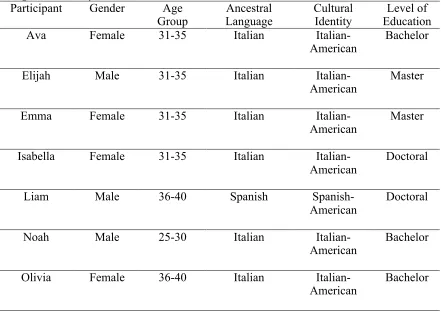
Table 1: Participants' Demographic Characteristics ... 50
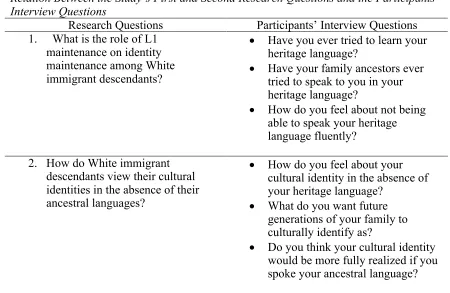
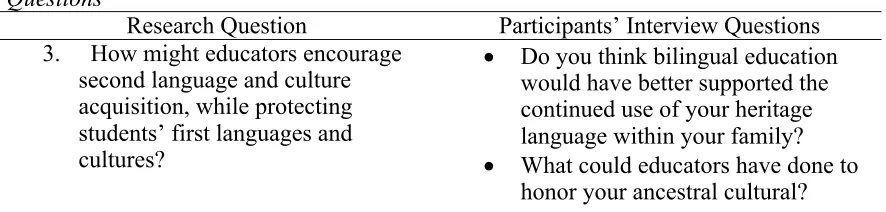
Table 2: Relationship between the Study's First and Second Research Questions and Participant Interview Questions ... 54
CHAPTER I
THE RESEARCH PROBLEM
Introduction
Globalization, a complex process in which individual countries have become
increasingly more interdependent, has greatly influenced immigration into the United
States and contributed to the need for a common universal language (Al Hosni, 2015;
Ortega & Verdugo, 2015; Raijman, 2013). English has emerged as the common global
language of the 21st century. Particularly in the United States where English, although
not the official language, has maintained its firm grip on the social, political, and
economic systems of the country. Deeply embedded in this phenomenon are historical
implications of linguistic colonization, heritage language loss, and cultural ambivalence
(Al Hosni, 2015; Medvedeva, 2012). For immigrants, and their descendants, the
intricacies of heritage language maintenance are profoundly connected to the cultural and
social identity of the home community. “Failure to maintain heritage language leads to
the inability to maintain cultural identity” (Lee, 2013, p.1576). Without an associated
cultural identity, immigrants and their descendants lose their ethnic ties and experience
(Fishman, 1989; Fishman ed., 1999).
As immigration into the United States continues, so does the existence of
anti-immigrant sentiment, anti-immigration laws, and English-only language policies (Cohen
& Wickens, 2015). Many immigrants strive to provide their children with access to vital
resources, such as education. However, the complex nature of bilingual education in the
United States is deeply entrenched in racialized perceptions of language, imperialistic
objectives, and a blatant disregard for the cultural legacy of a language’s people (Bale,
bilingual education as a schizophrenic double-bind in which the education of non-English
languages, and thus their people, are promoted when they benefit United States interests
(p. 15). Bale (2011) offered a further explanation of this phenomenon in stating:
At one extreme, a series of language education policies exists that restricts the use
in education of non-English community languages. These policies (viz., in
Arizona, California and Massachusetts) ensure that students develop English
language proficiency and literacy at the expense of the home language. (p. 2)
The reinforcement of dominant hegemonic English-only ideals neglects the beauty of
linguistic heritage and the cultural significance of linguistic identity (Cohen & Wickens,
2015).
In the 1980s and 1990s Ofelia Garcia (1992) proposed the flower garden analogy
in reference to language planning and bilingual education in the United States. In
reflecting upon the language garden, she described the nurturing and maintenance as
such:
The language garden was then seen as a planned space in which the flowers that
represented language were enclosed in patterned ways of displaying colors. It
was precisely the separate plots for different flowers that preserved the color... In
maintenance bilingual education it was the strict separation of languages that
enabled language minorities to preserve what was seen as their “mother tongue”...
The language garden couldn’t be monochrome, but its colorfulness came from
languages that were constrained in carefully planned enclosed spaces whose
colors were not always equally valued. (Garcia & Sylvan, 2011, pp. 6-7)
In the 2000s, Garcia (2011) reinvented the language garden analogy and coined the
“separate spaces and language colors that refer to another national space and a former
time is no longer appropriate in the United States” (p. 8). Language sustainability
becomes a vehicle for language maintenance, not in a language’s original form, but rather
in interaction with the social context of its speaker (p. 7). This framing of bilingual
education acknowledges a renewal of language teaching practices, while supporting the
linguistic development of future generations. In today’s globalized world, bilingual
education programs that normalize the dominance of English, while pushing other
languages to the periphery, only serve to reinforce hegemonic ideals of English-only
policies and simultaneously disregard speakers’ linguistic identity. In this interconnected
society, language teaching needs to focus on the sustainability of heritage languages
resulting in positive linguistic and cultural identity development.
Ewa Latecka (2013) used the term language ego to describe the formation of
identity based upon the use of a particular language. “In the cases of multilingual
speakers, awareness is always from a particular language identity’s point of view or, in
other words, from the speaker’s situatedness in the particular language” (p. 3). This
situatedness is shaped by the social context of the language, and in turn shapes the
linguistic and cultural identity of the speaker. It describes the ways in which the speaker
interprets his or her world. Zhang (2015) writes, “There is a dialectic relationship
between the speakers’ linguistic behaviors and the types of social contacts he or she has,
and in the meantime, the speaker negotiates a sense of self as he or she chooses to use
one language or the other in different speech contexts” (p. 201). It is critical to examine
this link between language choice and social connectedness. As an individual uses one
becomes imperative to maintain the heritage language in order to maintain the social and
cultural connectedness to their heritage identities.
Immigrant descendants who might identify with a particular cultural, ethnic, or
linguistic community (e.g., Spanish-American) may experience a sense of cultural
ambivalence without the continued use of their heritage languages (Bale, 2011; Fishman,
1989; Garcia, 1992). Without the heritage language, immigrant descendants are
potentially denied access to cultural networks. “The social network approach assumes
that individuals acquire language attitudes and language behaviors from particular social
networks they maintain ties or linkages with, and it is through language that a person
gains access to – or is denied access to – powerful social networks that give him or her
the opportunity to speak” (Zhang, 2015 p. 201). Without the opportunity to speak, and,
therefore, have a voice, immigrant descendants lose the opportunity to participate in
cultural affairs. Thus, learning English as a second language, without the encouragement
of maintaining the heritage language becomes problematic in the identity development of
immigrant descendants.
English education at school, without strong support for the heritage language, or
first language (L1), becomes the vehicle by which language shift begins (Kung, 2013).
Language shift is the loss of the L1 in favor of the L2, largely due to the assimilation
pressures of the new host country (Fishman, 1989). In order to prevent language shift
and foster language maintenance, it is imperative for parents and ethnic community
members to encourage the use of the heritage language in conjunction with the learning
of the L2. Research has shown that community and parent perceptions of the heritage
language are the greatest influence on L1 maintenance (Kheirkhah & Cekaite, 2015;
language maintenance, in that speakers are able to form a cohesive speech community
capable of resisting pressure, linguistic and social, from outside their group” (Zhang,
2015, p. 204). If immigrants’ cultural identities are to be maintained through the
generations, it logically follows that heritage language maintenance should be a priority
in preserving ethnic and cultural identity development.
Fishman (1977) states that language internalizes culture for its speakers, and
influences the ways in which a speaker views the world. The heritage language becomes
the pipeline to the heritage culture and identity. Without the use of the heritage language,
world perceptions and cultural markers begin to disappear through the generations.
Without the common use of the heritage language, the disconnect between the
worldviews of one generation and that of the next begin to appear. This creates a gap in
the cultural identity of generational community members, and thus cultural ambivalence
for future immigrant descendants.
It is fundamental to the success of the 21st century world, also described as the
interconnected global village, that heritage languages are maintained through the
generations (Brecht & Ingold, 1998; Kung, 2013). This language maintenance increases
the diversity of worldviews and belief systems, while fostering positive cultural identity
development through the generations. Kung (2013) argues, “One’s heritage language
should be carefully preserved and glorified for a more linguistically-diverse global
village” (Kung, 2013). Thus, an individual’s heritage language has the potential to be a
personal, societal, and national resource that goes beyond personal cultural identity.
Statement of the Problem
Language and identity are closely intertwined (Suarez-Orozco & Qin-Hilliard,
our values and beliefs, our age, and our socio-economic group (Bale, 2007; Coulmas,
2005; Xue & Han, 2014). To this extent, language and culture cannot be separated. To
learn one is to learn the other; to belong to one language group is to belong to that
cultural group as well (Fishman, 1964;Valdes, 1997). Today, where globalization and
mass immigration have contributed to the spread of languages and people across the
globe, the maintenance of one’s first language (L1) in a new country is vital to the
maintenance of one’s identity. As immigrants adjust to the demands of assimilation
pressures, subsequent generations of children often lose not only the mother tongue, but
also their cultural heritage (Coulmas, 2005; Fishman, 1989).
Although the United States does not have formal legislature enforcing the use of
English only, it is quite obvious that English has become the language of power
(Coulmas, 2005; Fishman, 1989; Valdes, 1997). Language shift, a process of replacing
the mother tongue with that of another, becomes almost inevitable for immigrant
descendants who choose to stay in the United States (Weinreich, 1953). Therefore,
intergenerational language continuity becomes a link to language and culture
maintenance (Fishman, 1989; Weinreich, 1953). For immigrant descendants, issues of
cultural ambivalence and cultural disconnect are largely related to the disappearance of
the mother tongue. As educators, it is critical to examine ways in which to maintain the
mother tongue and culture, while teaching a second language (L2) and culture.
Those ethnic White immigrant descendants who have assimilated into the
dominant Anglo-American society potentially encounter a cultural ambivalence that may
be more pronounced and discouraging. In order to better understand the importance and
significance of heritage language maintenance in sustaining the cultural identity of
immigrant descendants who have lost their mother tongues in favor of assimilation into
the dominant society.
Background and Need for the Study
According to Zong and Batalova (2015), in 2013 roughly 17.4 million children
under the age of 18 lived in the United States with at least one immigrant parent. These
children accounted for 25 percent of children under age 18 in the Untied States. United
States’ immigration trends suggest that these numbers will increase in the years to come.
With linguistically and ethnically diverse classrooms, it is important for educators to
acknowledge the existence of students’ cultural identities as a gateway to academic
success. In particular, it is important for English as a Second Language (ESL) educators
to understand the cultural complexities of L1 maintenance and second language
acquisition.
The acquisition of a second language also includes the acquisition of a second
culture, which may pose a threat to the maintenance of the first language and culture in a
new country (Xue & Han, 2014). Parameshwaran (2014) writes, “The proficiency and
use of origin-country languages are important indicators of the development and
preservation of an ethnic social identity”. Without the use and nurturing of heritage
languages, the potential for language shift is tremendous, and thus the loss of an ethnic
identity. Fishman (1989) argues that, as educators, it is important to understand the ways
in which language and culture are inextricably linked and to support L1 maintenance in
the classroom. Working towards understanding a model of multicultural and pluralistic
education could potentially benefit immigrant students and future generations in
Immigration into the United States has been a highly contested issue for centuries,
resulting in formal legislation that identifies groups of people on the basis of racial,
cultural, and linguistic characteristics (Bayor, 2003; Bayor, 2004; Caytas, 2012). This
identification has not created an environment of acceptance and multiculturalism, but
rather one of isolation in which the immigrant is seen as the other. Existing in the
marginalized space of the other, immigrants to the United States have been
systematically forced to assimilate, thus adopting cultural and linguistic values. “The
United States has aptly been described as a graveyard for languages because of its
historical ability to absorb immigrants by the millions and extinguish their mother
tongues within a few generations” (Rumbaut, Massey, & Bean, 2006). As such, it has
become a graveyard for the cultural identities of some immigrant descendants as well.
This phenomenon is as applicable to modern society as it was during the turn of
the twentieth century, when hordes of European immigrants entered the United States to
escape religious and political persecution. Parameshwaran (2014) explains this
occurrence by stating, “Historically, having one’s mother tongue be a language other than
English had often been associated with non-allegiance to U.S. national values and viewed
as a threat to national security”. For European immigrants fleeing their home countries in
search of a better life, being unfaithful to the United States, and it’s protection, was not
an option. Many immigrants encouraged their children to speak learn and speak English
in the hopes that these descendants would have advantages. In a country where economic
success is a main priority for its inhabitants, English language learning is viewed as a
positive step towards upward economic advancement (Parameshwaran, 2014). Indeed,
for immigrants, English is a pathway to the economic labor market and monetary gains
However, the expense at which these gains came is questionable for some. “The
increased intergenerational integration of ethnic minorities into the majority society
appears to encourage the dominance of L2, but at the expense of L1 survival outside of
the country of origin” (Parameshwaran, 2014). L1 survival becomes critical in
preserving the ancestral cultural values of ethnic White immigrant descendants. For
these immigrant descendants, assimilation and extinguishment of the heritage language is
particularly problematic as they are adopted into the hegemonic White United States
culture. This group of people, while identifying as part of a specific ethnic background,
becomes stripped of its ethnic identity due to language loss (Fishman, 1989). The lack of
the heritage language, in conjunction with a privileged ability to blend into White society,
results in significant cultural ambivalence for these individuals. There is a significant
lack of literature on the effects of language loss on White European immigrant
descendants’ cultural identity. Similarly, there is a significant lack of literature on the
effects of heritage language maintenance on the cultural identity of White European
immigrant descendants. Therefore, the present study is needed in order to better
understand the cultural identification of ethnic White immigrant descendants as a result
of heritage language loss. Deeply investigating the role of heritage language on ethnic
identity is significant to understanding cultural ambivalence among this population of
people.
Purpose of the Study
The purpose of this qualitative study was to investigate the experiences and
perceptions of White immigrant descendants regarding the loss of their ancestral
languages. This study aimed to understand the role of language in the maintenance of an
to protect and value students’ first languages, while teaching the second language. In
doing so, the study explored the connection between identity and language maintenance
and language loss. It attempted to better understand what factors cause language loss,
and the ways in which educators can help in encouraging the maintenance of students’
ancestral languages and cultures. Qualitative data was organized according to emerging
themes.
Research Questions
The research questions for this study included the following:
1. What is the role of L1 maintenance on identity maintenance among White
immigrant descendants?
2. How do White immigrant descendants view their cultural identities in the absence
of their ancestral languages?
3. How might educators encourage second language and culture acquisition, while
protecting students’ first languages and cultures?
Theoretical Framework
This study was based upon the following theories: the Whorfian Hypothesis
(Whorf, 1956) and the Language Maintenance Hypothesis (Fishman, 1991).
Whorfian hypothesis (linguistic relativity)
The Whorfian Hypothesis includes two distinct, yet related, perspectives. First,
Linguistic Relativity (the weak version) suggests that the ways in which a language is
structured impacts the realities and world-views of its speakers. In contrast, Linguistic
Determinism (the strong version) implies that the structure of a language determines the
speaker’s perceptions of the world (Whorf, 1956). For the purposes of this study,
Linguistic Relativity theory postulates that speakers’ world perceptions are
impacted by, not predetermined by, the structures of the languages they speak (Whorf,
1956). Therefore, White immigrant descendants who have lost their heritage languages
may have a different world perception than that of their ancestors due to the language
structures that contribute to their understanding of the world around them. This
difference in world perception, at the hand of language loss, is one that is worth
investigating. Intergenerational language continuity encourages the maintenance of
language and cultural identity. Whorf wrote:
The background linguistic system (in other words, the grammar) of each language
is not merely a reproducing instrument for voicing ideas but rather is itself the
shaper of ideas, the program and guide for the individual’s mental activity, for his
analysis of impressions, for his synthesis of his mental stock in trade. (Whorf,
1956, p. 212)
White immigrant descendants who have experienced a generational language shift lack
the grammar structures in which to interpret their world in line with their ancestors. This
change in perception results in cultural ambivalence (Fishman, 1991; 1999). Preservation
of heritage language includes the preservation of world perceptions and cultural identity.
However, it is significant to note that the Whorfian Hypothesis presents its own
challenges to the conceptualization of cultural ambivalence and language loss. “Indeed,
he [Whorf] may have overestimated the formative and the preservative role of language
in basic cultural behavior, but it is toward the fundamental appreciation of each and every
language in the humanizing as well as in the creativity of its speech community”
Hypothesis will be used to support the notion that language shapes and impacts, but does
not solely limit the perceptions of its speakers.
Language maintenance hypothesis
Fishman (1991) called for a cultural reconstruction in language learning. He
proposed that L1 maintenance is dependent upon intergenerational continuity and that
language shift must be reversed in order to preserve heritage languages. This framework
calls for the preservation of heritage languages through the generations and for a redesign
in language learning, where the heritage language is given as much nurturing as the
second language is given.
This model emphasizes the importance of the heritage language in preserving
cultural identity, and directly speaks to preventing the issues associated with cultural
ambivalence. Fishman wrote:
[The fact that] language is linked to culture brings us to the realization that there
must be yet another link between an ethnoculture and its traditionally associated
language: the link that is due to the fact that there is a partial identity between the
two, i.e. that parts of every culture are expressed, implemented and realized via
the language with which that culture has been most intimately associated. So
much of any culture is primarily verbally constituted. (Fishman, 1991, p. 23)
White immigrant descendants who have lost their heritage languages lack this intimate
link between culture and language. They lack the bond that language provides a
relationship between their personal identity and their cultural identity.
Scope and Delimitation of the Study
This study was confined by specific researcher delimitations. This study used a
essence of a shared experience through first-person points of view (Ellis, 2016).
Creswell (2013) states, “a phenomenological study describes the common meaning for
several individuals of their lived experiences of a concept or a phenomenon” (p. 76). In
other words, phenomenology allows the researcher to understand the essence, or the
meaning, of a specific lived experience through the lens of the research participants
(Creswell, 2013).
This approach allowed the researcher to describe and analyze the first-person
point of view lived experiences of White immigrant descendants and the potential impact
of heritage language loss on their cultural identity. Therefore, the phenomenon to be
examined was the link between ancestral language loss and cultural identity among White
immigrant descendants. Individual participant data was used to investigate this
phenomenon.
Phenomenology asks participants to explain how they perceive and make sense of
particular experiences, in order to identify and analyze a particular phenomenon (Roberts,
2013). Thus, a qualitative study of a small sample size of seven participants was used in
order to focus on the participants’ individual experiences in great depth (Ellis, 2016;
Creswell, 2013; Roberts, 2013). In this study, each research participant shared his or her
perceptions of particular experiences in order to identify specific themes that may speak
to a larger phenomenon. In-depth semi-structured interview questions allowed the
researcher to identify specific questions that aligned to the research questions, while
honoring the participants’ desire to tell their stories (Ellis, 2016).
Due to the insightful and analytical requirements of a phenomenological study,
participants consisted of seven individuals who are classified as third or fourth generation
research questions and the theoretical framework. These in-person interviews covered
personal experiences in an effort to unearth the real-life interpretation of the link between
ancestral language loss and cultural identity. This included interview topics such as:
family histories, family cultural identities, personal cultural identities, personal language
identities, and the personal experiences of not speaking an ancestral language. These
topics allowed the researcher to delve deeply into the phenomenon and explore its
possible implications for White immigrant descendants, allowing others to hear the
voices of this specific group of people. Additionally, these qualitative semi-structured
interviews were flexible and adjusted to the needs of the research participants as the
interview progressed, however they also aimed to capture the way in which these
participants interpret their experiences (Roberts, 2013).
As there were seven research participants, the study was confined to the attitudes,
perceptions, and self-reporting of the experiences of immigrant descendants in San
Francisco; generalizability to a larger population is not applicable. Additionally, these
participants only reported upon the ideas related to the research questions and theoretical
frameworks. Therefore, the study was confined to topics related to the relationship
between heritage language loss and cultural ambivalence. The research questions and
theoretical frameworks did not attempt to be inclusive of all hypothesizes and theories in
the field.
Limitations of the Study
The study was prohibited by uncontrollable limitations as well. As a qualitative
study, generalizability to a larger population of people is not applicable. Furthermore,
time constraints on the part of the research participants and the researcher existed. The
honesty of responses were integral in the collection of data but could have been
influenced by the nature of the study. Finally, qualitative research lends itself to a certain
level of researcher subjectivity. The research controlled for researcher subjectivity.
Significance of the Study
White immigrant descendants have both a privileged and isolating position within
hegemonic United States society. Therefore, White immigrant descendants can easily
blend into the fabric of a traditional English-speaking society with little or no question as
to their ethnic background. They are accepted simply by their appearance (Craciun,
2013). So, understanding the social and political implications of this privileged position
and how they might play out in a classroom environment, allows educators to nurture the
needs of diverse student bodies. If educators can understand a student’s world view, then
they are more likely to be successful in building an authentic classroom experience
(Morales, 2016; Whorf, 1956).
Alternatively, White immigrant descendants who culturally identify with a
specific ethnic group, are often times denied full access into that group due to language
loss (Fishman, 1991). This relationship between language loss and cultural ambivalence
is significant for educators to understand if they are to better serve their students. In
creating a space for students to explore their ancestral languages while learning the new
language, educators guide students on a new journey to honor and explore their own
cultural identities. For White immigrant descendants, this process can allow them to
regain ownership of a culture and language that had been lost.
Second language acquisition can be a difficult process that can be made even
more painful by the neglect of the heritage language. For White immigrant descendants
better understanding of the importance of students’ home cultures as tied to their heritage
languages and identities. It is significant in that it encourages the maintenance of the first
language (L1), while still teaching the second language (L2). If L1 proficiency leads to
L2 proficiency (Cummins, 1978), then a sincere regard for the L1 becomes central to the
teaching of the L2 and additive bilingualism models must be taken into consideration.
Through its findings, this study added to the body of research regarding language
and culture maintenance. By attempting to better understand the connection between
language maintenance and cultural identity development, this study informed educators
as to the importance of understanding and honoring their students’ heritage languages as
part of their cultural identities. Researchers, educators, administrators, counselors,
parents, and students are most interested in this research. Researchers, educators,
administrators, and counselors could be interested in the practical classroom applications
based upon this study’s findings. And, parents and students may be interested in the
personal and educational implications of the study, as they relate to student success in
and out of the classroom.
Definition of Terms
Acculturation: A process of change and modification of traditions, customs, beliefs, and
cultural representations due to the contact of two or more cultures. Acculturation
suggests that the heritage culture remains intact, to a certain, while the second culture is
learned and negotiated. In terms of language, acculturation posits that both the heritage
language and culture are influenced, but maintained through this process (Fer, 2015).
Assimilation: A process in which a native culture, after sustaining contact with a second
culture, begins to adapt to the cultural norms of the second culture. Piaget’s theory
experiences. Within the context of immigration and language learning, assimilation is
often viewed as a threat to heritage languages and cultures (Fer, 2015).
Cultural ambivalence: The cognitive state in which an individual feels confusion or
disconnect to her/his cultural identity. Largely referenced by Fishman (1991), cultural
ambivalence occurs when an individual cannot process or partake in cultural standards,
norms, and customs of her/his cultural group (Fishman ed., 1999; Fishman & Garcia eds,
2010).
Cultural identity: An individual’s self-conception of belonging to a particular cultural or
ethnic group. This includes participation in ethnic activities and customs, as well as a
self-perception that is related to ethnicity, nationality, or religion (Suarez-Orozco &
Qin-Hilliard, 2004).
Heritage language (ancestral language): A language that is different than the dominant
language(s) in a given social, political, or economic context. In the United States,
languages other than English are often referred to as heritage languages. The term
heritage language implies a cultural connection to a speaker’s language. Heritage
languages are sometimes referred to as community languages, home languages, or mother
tongues (Fishman & Garcia, 2010; Kelleher, 2010).
Language maintenance: The generational preservation of heritage languages, despite
contact with other languages and cultures (Fishman, 1991).
Language shift: The process by which the heritage language begins to dwindle in favor
of a new language. This change is often the result of immigration into a linguistically
different community or the formal teaching of a second language without regard for the
Linguistic identity (heritage identity): A cultural and social identity formed through
association with one or more spoken languages. This identity informs the ways in which
speakers of a language position themselves within given social contexts. Furthermore, the
term refers to a symbolic sense of belonging to one or more linguistic communities.
Linguistic identity is also referred to as linguistic heritage (Fishman, 1999; Park, 2012).
Mother tongue (L1): A language of familial ancestry that may no longer be fluently
spoken at home. This term refers to the language of one’s ancestors, prior to their arrival
in a new country (Fishman ed., 1999).
White immigrant descendants: A group of ethnically-white individuals whose ancestors
emigrated from a country different than the current country of home. Immigrant
descendants are associated with a certain level or cultural connection to the country of
origin, but may lack the mother tongue of their ancestors. These individuals may also be
referred to as immigrant generations, second-generation, or third-generation individuals
(Edwards, 2009; Craciun, 2013).
Summary
Cultural ambivalence and ancestral language loss among White immigrant
descendants is a topic that has largely been unaddressed in scholarly research. However,
in an increasingly interconnected world, it is critical to examine the ways in which
ancestral language maintenance preserves unique cultural identities. Furthermore,
preservation of cultural identities for White immigrant descendants becomes a connection
to an identity that extends beyond the classification of White.
The purpose of this qualitative study was to examine the relationship between
language loss and cultural ambivalence and, thus, the relationship between language
(1991) and Whorf (1956), the research questions attempted to clearly focus attention on
White immigrant descendants’ experiences with language loss and cultural ambivalence.
Additionally, the study aimed to enhance the body of knowledge surrounding bilingual
CHAPTER II
REVIEW OF THE LITERATURE
Introduction
The use of a specific language reveals significant elements of our social identity
(Edwards, 2009; Fishman, 1991; Fishman, ed., 1999). For immigrant descendants, issues
of cultural ambivalence and cultural disconnect are largely related to the disappearance of
the ancestral language (Fishman, 1991). While the relationship between language and
identity has been explored in several contexts, little research exists with regards to
experience of White immigrant descendants. For this group of people, the loss of the
ancestral language can be more detrimental to cultural identity. As White immigrant
descendants’ transition into a hegemonic United States society, they are perceived as
White and, thus, potentially lose their cultural identity (Antonsich, 2012). This lack of a
cultural marker becomes increasingly problematic in conjunction with the lack of an
ancestral language (Edwards, 2009). This study seeks to better understand the
experiences associated with ancestral language loss and cultural ambivalence for White
immigrant descendants.
Overview
This review of literature specifically focuses on the scholarly body of knowledge
that is relevant to this dissertation. This chapter is divided into three main sections. First,
it begins by investigating the relationship between language and thought. It particularly
focuses on those areas of research aligned to Linguistic Relativity Theory (Whorf, 1956).
Second, the chapter explores the relationship between linguistic identity and cultural
identity. In doing so, it investigates the impact of language assimilation, language shift,
speaks to Fishman’s (1991) theories on reversing language shift as a means to maintain
cultural identification. Finally, the chapter explores ancestral language maintenance and
bilingual education as factors for cultural identification for White immigrant descendants.
Language and Thought
Linguistic relativity theory
Linguistic Relativity theorists believe that the use of a specific language shapes a
speaker’s perception of the world (Whorf, 1956). In contrast, Linguistic Determination
theorists believe that a language’s structure (syntax, grammar, vocabulary) determine the
way a speaker interprets the world (Whorf, 1956). Barner, Inagaki, and Li (2009) tested
the hypothesis that syntactic differences in languages influence non-linguistic thought
and perceptions of the world; a strong-version hypothesis. In order to test this claim, the
researchers examined mass-nouns and count-nouns across different languages. In doing
so, Barner et al. (2009) examined English, a mass-nouns language, and Japanese and
Mandarin, classifier languages, in order to determine whether the syntactical structure of
the languages influenced speakers’ perceptions of meaning.
The researchers tested two sub-hypotheses to determine their main assertion.
First, they tested the claim that the effect of language on thought should exist in both the
early stages of language acquisition and into adulthood, as syntactic structures and word
meanings become engrained. A total of 122 native English speakers from the University
of Toronto and 89 native Japanese speakers from Osaka Prefecture University
participated. Both groups consisted of university freshman or sophomores majoring in
Human Sciences, Language and Culture, Nursing, or Comprehensive Rehabilitation. The
tests took place in campus labs or classrooms. In the first test, participants were asked to
second test, participants were shown pictures of people possessing either a set of objects
or a portion of a non-solid objects (e.g., eggs), and then asked to determine which person
had more of the relevant object. The two tests revealed no statistical significance
between Japanese and English interpretations of common nouns, therefore, refuting the
strong-version Linguistic Determination theory.
Barner et al. (2009) performed a second experiment to test the claim that the
effect of language on thought should affect the cognitive interpretation of an object and,
consequently, be independent of linguistic processing. The researchers tested advanced
bilingual speakers of English whose first language was Mandarin Chinese and compared
them to monolingual English speakers. The participants consisted of 48 native English
speakers and 32 bilingual Mandarin Chinese speakers. The participants were shown an
object and told that object’s name (the novel object). Then the participants were shown
the same object in a different shape, and then shown the same object comprised of a
different substance. The researchers then asked each participant to identify which was
the novel object. In total there were 12 different novel objects that the participants
reviewed.
Barner et al. found that the participants’ judgments differed significantly
depending upon which language they were tested. If the researchers used English during
the test, the participants were far more likely to classify the novel object based upon its
shape. However, if the researchers used Mandarin during the test, the participants were
far more likely to classify the novel object based upon its substance. The researchers
concluded that this provides limited support for Linguistic Relativity theory, because the
language used determined the speaker’s perception of an object. Barner et al. (2009)
language’s communicative use may impact cognitive perceptions. Boroditsky (2001)
specifically explored Linguistic Relativity with regards to the conceptualization of time
and cognitive perceptions.
Boroditsky (2001) tested the hypothesis that some aspects of time are left
undefined within an individual’s perception of the world. The researcher tested that this
conceptualization is largely due to the ways in which a language’s speaker talks about
time. Boroditsky (2001) asserted that different ways of discussing time lead to different
ways of thinking about it. The researcher noted that across all languages, people often
times uses spatial metaphors to discuss time; however, they rely upon their concepts of
space in order to attribute meaning to these metaphors. In testing her claim, the researcher
tested (a) whether or not using spatial language to talk about time have short-term
implications for cognitive processing and (b) whether or not using spatial language to talk
about time have long-term implications for cognitive processing.
To test her hypothesis, Boroditsky (2001) compared the English and Mandarin
Chinese languages. English speakers predominantly use horizontal metaphors to talk
about time (e.g., ahead, behind). On the other hand, Mandarin speakers use both
horizontal and vertical (e.g., up, down) metaphors to describe time. Boroditsky (2000)
suggested that people think about time in the manner in which they talk about it.
Participants included 26 native English speakers and 20 native Mandarin speakers, all of
whom were graduate or undergraduate students at Stanford University. All the native
Mandarin speakers spoke only Mandarin until they were at least 6 years old, and had a
mean English acquisition age of 12.8 years.
The study consisted of three separate experiments. First, participants answered
situations that were followed by a horizontal or vertical descriptive sentence, all of which
was visually displayed. Each participant answered a set of six practice questions and 64
experimental trials, consisting of two spatial prime questions. In total, participants
answered 128 prime questions, 32 target questions (true), and 16 filler questions (false),
all of which were true/false. Boroditsky (2001) found that both native English and native
Mandarin speakers answered horizontal primes faster than vertical primes. However,
Mandarin speakers were faster in answering vertical primes than were English speakers.
Statistically, the difference in response rate between the two groups of speakers was
significant.
In the second experiment, Boroditsky (2001) tested vertical bias in
Mandarin-English bilinguals. She hypothesized that Mandarin-Mandarin-English bilinguals, who learned
English later in life, would think about time more vertically than horizontally. In this
experiment, participants included 25 Mandarin-English bilinguals with different levels of
Mandarin and English proficiency. The age at which English acquisition began varied
from three to 13 years old. All participants had at least 10 years of English language
exposure. Additionally, they were all graduate or undergraduate students at Stanford
University. The same technique was used in this experiment as was used in first
experiment. However, in order to measure the amount of vertical bias in the participants’
responses, before/after target questions were omitted. In total, each participant answered
96 primes, 40 target questions, and 40 filler questions. Again, as in first experiment, all
testing was completed in English. Boroditsky (2001) found that there was no statistically
significant correlation between vertical bias and length of English language exposure.
Boroditsky (2001) noted that the difference in time metaphors between English
also to the difference in culture. The researcher proposed that this could account for the
statistically significant results found in the first experiment. The third experiment was
designed “to minimize differences in nonlinguistic cultural factors while preserving the
interesting difference in language” (Boroditsky, 2001, p. 16). Seventy native English
speaking Stanford undergraduates participated in this study. They were asked to use
vertical measurements to discuss time, and then make meaning from these metaphors.
The test was completed via computer and consisted of 90 true/false questions. Half of the
participants was given above/below phrases and the other half was higher than/lower
than questions. Participants then completed the first experiment’s exercises. The results
were that the trained native English speakers responded more like the Mandarin speakers
than the untrained English speakers. Boroditsky (2001) concluded that these results
confirmed that in the absence of cultural differences, differences in speaking impact
differences in thinking.
Fausey and Boroditsky (2011) further investigated this conclusion by testing
whether cross-linguistic differences impacted eye-witness memory of intentional and
accidental events. The researchers specifically focused on speakers of English, an
agentive language, and Spanish, a non-agentive language. Speakers of agentive
languages typically observe an event and describe the events using direct and assertive
word choice. On the other hand, speakers of non-agentive languages typically use less
abrasive and less direct word choice when recounting events. The researchers noted that
speakers of agentive languages often perceive non-agentive expressions to be evasive and
passive. However, non-agentive language speakers use these phrases to clearly
distinguish accident from intentional actions (p. 150). Previously existing research has
reasoning (Fausey & Boroditsky, 2011). However, this study researched whether
agentivity in event descriptions also affected eye-witness memory.
In the first study, Fausey and Boroditsky (2011) hypothesized that there is a
difference between Spanish and English speakers’ descriptions of the same causal events.
Sixty-eight monolingual English speakers, with a mean age of 31.49 years, and 29
monolingual Spanish speakers, with a mean age of 28.69 years, reported on a series of
video clips. The participants first read the instructions in their native language, and then
watched 16 video clips of unique accidental or intentional actions. The study was
conducted through an online portal and all instructions were translated by a
Spanish-English bilingual. In all the events an actor physically interacted with an object, but the
actor’s reaction differed depending upon the intentionality of the action. After watching
the video clips, the participants were asked to recall the events and specifically answer
the question “What happened?”.
If the participant’s response included a transitive expression (e.g., He popped the
balloon), it was coded as agentive. If the participant used an intransitive phrase (e.g., The
balloon popped), it was coded as non-agentive. All descriptions were coded by the first
author and an independent rater with roughly 98% reliability.
The researchers found that both Spanish and English speakers used agentive
phrases equally to describe intentional events, but that English speakers used agentive
phrases more often to describe accidental events as well. Spanish speakers used agentive
phrases to describe accidental events 59.61% of the time, while English speakers used
agentive phrases to describe the same events 74.55% of the time. The first study
supported the researchers’ hypothesis that there is a cross-linguistic difference between
In the second study, Fausey and Boroditsky (2011) investigated whether or not
these differences affected memory. One hundred and thirteen English speakers from
Stanford University, with a mean age of 19.13 years, and 109 Spanish speakers from the
Universidad de Chile, with a mean age of 20.85 years, participated in the second study.
This participant population was selected to ensure homogeneity among memory
performance. None of the participants had taken part in the first study, but, as in the first
study, they were all monolinguals.
The study consisted of two tasks. The first task measured memory performance
that was not predicted to be different across language groups through an
object-orientation memory task. The second task tested fro differences in non-linguistic
eye-witness memory between English and Spanish speakers through an agent memory task.
During each task the participants did not describe any of the images or events, and they
were not provided any linguistic descriptions.
During the first task, participants viewed 15 objects for two seconds each via
computer. In each picture the object was positioned in one of three possible orientations.
The participants were told to pay attention to these images because their memories would
be later tested. After this phase, participants were given a distracter task followed by the
memory test. In the memory test, participants viewed the three positions of each object
and asked to select which one they had previously seen.
During the second task, participants viewed the same 16 videos used in the first
study, but with a different actor. Again, participants were told to pay attention to the
events in the video and that their memories would later be tested. After the participants
had viewed all the videos, a distractor task was administered. The participants then
After each new clip, the participants were asked to identify who performed the action the
first time.
The second study revealed that intentional actions were remembered well by both
English and Spanish speakers, but that accidental actions were better remembered by
English speakers. Additionally, as predicted by the first study, the distinction between
memory for individuals involved in intentional and accidental events was more
pronounced for Spanish speakers. The researchers concluded that eye-witness memory
for causal events is influenced by linguistic patterns that differ among languages. Ways
of speaking impact eye-witness memory that attributes causal relationships and affect
which instances within an event that an individual remembers. This study furthermore
proved that language impacts speakers’ view of the world.
Linguistic Identity
Language and identity
Identity is a comprised of a complex process of socialization (Edwards, 2009;
Fishman Ed., 1999). It includes gender, religious belief, ethnic customs, age, and
nationality (Haller & Landolt, 2005). Edwards (2009) writes of identity: “It signifies the
sameness of an individual at all times or in all circumstances, as the dictionary tells us,
the fact that a person is oneself and not someone else. In other words, it signifies a
continuity that constitutes an unbroken thread running through the long and varied
tapestry of one’s life” (p. 19). Drawing upon the imagery of this unbroken thread, it
makes logical sense that identity involves the use of language as a means of
representation. Language becomes a vehicle by which the thread becomes a rope for
community members to tie themselves together. This rope unites individuals through
precisely then the most important signifying role of human beings... It is through
languaging and ethnifying that people perform their identifying” (Fishman & Garcia,
2010, p. 519). Garcia’s description of ethnifying and languaging implies ongoing action,
suggesting that speakers continually engage in specific languages in order to express
specific identities. Without this action, speakers become limited in their participation of
group membership on the basis of linguistic and ethnic identity.
Language becomes an identity marker as it creates and shapes the daily
interactions of community members. In doing so, it is socially and contextually
constructed, and creates the social and contextual construction of identity. “Another way
of saying this is that ethnic identity is contextually constructed. Given the common link
(link not equivalence) between language and ethnicity, the saliency of specific language
use is also contextually constructed” (Fishman ed., 1999, p. 154). Indeed, accent, dialect,
and language variations signify participation in and membership of specific community
circles, social classes, and ethnic and national groups (Edwards, 2009). Garcia claimed
that “language, as a social construction, is not only an instrument for communication but
also a semiotic and symbolic tool” (Fishman & Garcia, 2010, p. 520). Edwards (2009)
proposed that language is a system in which its users have agreed upon the language’s
meaning and symbolism within their relative speech communities. That is to say, that
language becomes representative of the experiences and social identities of its users.
Therefore, ancestral languages are the links to ancestral identities. Edwards (2009)
wrote, “it is in this way that we are always translating and interpreting when we speak,
and our ability to read between the lines, as it were, depends upon a cultural continuity in
which language is embedded, and which is not open to all” (p. 55). The ability to derive
Choi (2015) examined the connection between heritage language maintenance
and ethnic identity among multigenerational Korean-Americans in the United States.
Through his research, Choi found that identity and language are closely intertwined and
linked by the social contexts in which they exist, thus, supporting Fishman’s (1991)
language maintenance hypothesis. Choi’s research provided insight into the social
factors that affect language maintenance and identity formation, and also a general
critique of English as an international language.
A total of 181 Koreans and Korean descendants participated in questionnaires and
semi-structure interviews aimed at investigating the choice and motives behind their
linguistic and identity preferences. The participant group consisted of the following: 58
first-generation Koreans who were born in Korea and immigrated to the United States as
adults; 53 1.5-generation Koreans who immigrated to the United States between the ages
of one and twelve with their parents; and 70 second-generation Korean-Americans who
were born in the United States to first-generation Korean immigrant parents. In total, 76
males and 105 females, ranging in age from 18 to 78 years-old, participated in the study.
They all resided in the vicinity of Dallas, Texas and were recruited through Korean ethnic
community centers, such as churches, small business associations, educational
organizations, and family acquaintances. The distinction between the generational
participant groups was significant in the researcher’s attempt to investigate language shift
and maintenance.
A total of 400 questionnaires were originally distributed, of which 223 were
returned, and of which 42 were discarded due to lack of critical information (e.g., age,
gender, years of residency in the United States). The questionnaire was comprised of
the participant’s age, gender, profession, and educational level. The second set of
questions pertained to the participant’s language proficiency, language use, and language
choice. The final set of questions related to the participant’s identity, their perceptions of
the importance of heritage language maintenance, and their attitudes towards their
ancestral culture and mainstream culture. Each questionnaire included the following
response categories: very well, well, not well, and none. Because the questionnaires
required brief responses, semi-structured interviews were conducted to allow participants
the opportunity to elaborate on their insights and perceptions. The interview participants
were from all three generations and were randomly selected based upon their availability.
Korean speaking abilities among the participant generations was significant: 37.8
% of 1.5 generation participants and 62.9% of second generation participants reported
that their Korean language proficiency was not well or none (p. 246). Additionally, 66%
of 1.5-generation participants and 81.4% of second-generation participants indicated that
their Korean reading writing and reading abilities were not well or none. Nineteen
percent or first-generation participants responded that they had limited or lack of
ancestral language speaking ability and 3.5% of first-generation participants reported that
they had limited or lack of ancestral writing or reading ability. The 1.5-generation and
second-generation participants reported much higher levels of English speaking, reading,
and writing abilities, although 46.5% of first-generation participants indicated that they
had high levels of English proficiency as well.
Self-reporting emerged as a major limitation of this study. When analyzed for
significance, the self-reported language proficiency data was not consistent across the
generations. This inconsistency emerged as a major theme in the data collection and
heritage language maintenance. When examined throughout the generations, Choi (2015)
found that 87% of first-generation participants, 64.2% of 1.5-generation participants, and
34.3% of second-generation participants used Korean when their parents spoke to them.
Alternatively, when participants addressed their parents, Korean usage decreased across
the generations. Roughly 75.9% of first-generation participants, 41.5% of 1.5-generation
participants, and 7.1% of second-generation participants addressed their parents in
Korean (p. 246). Data revealed that English as a common language between parents and
children became most apparent in generation 1.5 children. Language shift between
second-generation participants and their parents was more apparent, as 90.9% of
participants use English only with their parents. Language shift between first-generation
participants and their parents was also evident, with 19.1% of participants indicating that
they use only English with their parents.
Sixty-nine percent of first-generation participants identify as Korean-Americans,
while 94.3% of 1.5-generation participants, and 95.7% of second-generation participants
identify as Korean-Americans. Age was a factor in ethnic identity evaluation as well;
participants ages 19 through 29 reported identifying as Korean-American or American
more frequently, across all generations, than did older participants. Gender appeared to
not be a factor in identification. The data revealed that identity and language proficiency
varied together. As heritage language skills decreased, the participants’ identity as
American or Korean-American increased and vice versa. Those participants who used
English as a means of informal and formal communication with community members
identified as American or Korean-American more frequently than did those who spoke
As Choi’s (2015) study indicated, as heritage language use decreases within
community interactions, so does a sense of heritage identity. Mercuri (2012) conducted
a qualitative ethnographic study of one Latina participant in order to determine the
impact of heritage language loss on her cultural identity. As a child, Mercuri’s
participant Irma, experienced heritage language loss through educational institutions, and
as an adult Irma regained her heritage language. Mercuri not only examined the
connection between heritage language loss and cultural identity, but also explored how
regaining heritage language skills contributed to a richer heritage identity.
The researcher used a non-probability sampling technique to find her participant.
Irma was selected from the potential participant pool because she met the life and
educational experience requirements, as required by the researcher. Three personal
interviewers, each an hour and a half in duration, allowed the researcher to explore the
participants perspectives on language loss and language socialization at home and at
school. Data was analyzed and coded according to emerging themes. Then, these themes
were used to understand the effect of English language ideology or socialization on
Irma’s cultural identity. The interview transcripts were cross-checked by a research
assistant and evaluated by the participant. The researcher and the participant had a prior
relationship to this study; therefore, issues of trust and confidentially were greatly
diminished.
Irma was a native Spanish-speaking immigrant who arrived in the United States
before she was old enough to attend school. The researcher did not indicate her actual
age. Irma enrolled in kindergarten as a monolingual Spanish speaker and was routinely
punished by her teachers when she spoke Spanish. Her parents understood that Spanish