Research on Improved Privacy Publishing Algorithm
Based on Set Cover
Haoze Lv1, Zhaobin Liu1, Zhonglian Hu1, Lihai Nie2, Weijiang Liu1, and Xinfeng Ye3 1 School of Information Science and Technology, Dalian Maritime University
China
Correspondence: [email protected]
2
Division of Intelligence and Computing, Tianjin University China
3
Department of Computer Science, University of Auckland New Zealand
Abstract. With the invention of big data era, data releasing is becoming a hot topic in database community. Meanwhile, data privacy also raises the attention of users. As far as the privacy protection models that have been proposed, the differential privacy model is widely utilized because of its many advantages over other models. However, for the private releasing of multi-dimensional data sets, the existing algo-rithms are publishing data usually with low availability. The reason is that the noise in the released data is rapidly grown as the increasing of the dimensions. In view of this issue, we propose algorithms based on regular and irregular marginal tables of frequent item sets to protect privacy and promote availability. The main idea is to reduce the dimension of the data set, and to achieve differential privacy protec-tion with Laplace noise. First, we propose a marginal table cover algorithm based on frequent items by considering the effectiveness of query cover combination, and then obtain a regular marginal table cover set with smaller size but higher data avail-ability. Then, a differential privacy model with irregular marginal table is proposed in the application scenario with low data availability and high cover rate. Next, we obtain the approximate optimal marginal table cover algorithm by our analysis to get the query cover set which satisfies the multi-level query policy constraint. Thus, the balance between privacy protection and data availability is achieved. Finally, extensive experiments have been done on synthetic and real databases, demonstrat-ing that the proposed method preforms better than state-of-the-art methods in most cases.
Keywords:Differential Privacy, Set Cover, Frequent Itemsets, Marginal Table.
1.
Introduction
the data while protecting the user’s personal privacy has become an important issue. In the scenario with privacy protection requirements, the differential privacy model is widely used because it doesn’t need attack hypothesis and background knowledge of attackers, but it can quantify and analyze the privacy risk[2] [3].
However, when publishing the multi-dimensional data sets, current privacy models often have low performances in both privacy protection and data availability. The reasons are explained as follows. First, the noise added into each dimension in the released data will undoubtedly increase when the dimension of the data becomes larger. Second, the query results are usually not very valid due to large cumulative noise of data. In view of this issue, we propose a privacy-preserving data releasing algorithm based on regular marginal tables to reduce the noise and improve the data availability.
To figure out the issue of regular marginal table, we propose a publishing algorithm to reduce the dimension of the cover data set in the same dimension marginal table, thus achieving differential privacy protection with Laplace noise[4]. We first introduces how to choose the dimensionkof marginal tables in a coverσ. Then we choose a smallest set ofk-marginal tables satisfying the cover on the condition of a properk. Different from the classic algorithms in this step, we use frequent item to measure the importance of the
k-marginal tables. The situation thatk-marginal tables with more frequent attributes are usually with higher data availability.
Meanwhile, we propose a differential privacy model with irregular marginal table partitioning and find the marginal table query cover set which satisfies the multi-level query policy constraint. This model is proposed to be used in application scenarios with low data privacy protection requirements and high cover requirements. Thus, the balance between privacy protection and data availability is achieved. The main contributions of this paper is summarized as follows.
1. We do many research on bounds ofk-marginal table cover and propose to use frequent attributes to increase the usability of the released data.
2. We present ak-marginal tables publishing algorithm based on frequent items and reg-ular marginal benefits, which is with lower time complexity and higher data usability. 3. We introduce improved marginal table differential privacy publishing algorithms based
on irregular marginal table in this paper in detail.
4. We conduct extensive experiments in both public databases, demonstrating that the presented algorithm always performs better than the state-of-the-art approaches. The rest of this paper is organized as follows. Section 2 shows the related work of this paper. Then we will present regular marginal table differential privacy publishing algorithm under frequent item set algorithms in Section 3. Another algorithm with some theorems and proofs we give in section 4 is used in the scenario of irregular marginal table. We make performance analysis by experiments in Section 5. Finally, Section 6 will draw some conclusions.
2.
Related Work
2.1. Differential Privacy
perhaps the most well-known algorithm is K-anonymous algorithm proposed by Sweeney in 2002 [8]. K-anonymous algorithm has the characteristic that a record can be pro-tected with at leastk−1other records with respect to the quasi-identifier. However, K-anonymous algorithm is only focused on identity protection. To overcome the drawback, Machanavajjhala et al.[9]proposed L-diversity algorithm inspired by K-anonymous al-gorithm to provide sufficient protection against attribute disclosure. However, the premise of data generalization is to know the background knowledge of the attacker, which is al-ways impossible. Thus the data privacy protection technology that encrypts the sensitive information is proposed.
Recently, the major efforts in this field are paid to reduce noise while protecting pri-vacy at the same time, including histogram [10]and contingency tables [11]. But with the increasing popularization of the big data, the amount of user information exploded. Querying the publishing data is a problem with high sensitivity because of large quantity noise. Therefore the Flat Method[12], Matrix[13], Data Cube[14]do not work with big data.
To solve the problem, Dwork etc. proposed a differential privacy protection model [15]using the Laplace mechanism. It is a common mechanism for achieving differential privacy by adding Laplace noise to numerical data. Therefore, the method is mainly used in the privacy protection release process of statistical data. Laplace differential privacy model solves the problem that the attacker can easily find the user’s privacy information through the normalized query strategy. Meanwhile, it can also achieve a high performance in big data.
The basic idea of the differential privacy model is to randomly perturb the published data, so that the attacker cannot obtain the private information of individual from the published data regardless of any background knowledge and any data mining and anal-ysis information. The advantages of this model are that there is no need to make special assumptions about the attacker’s background knowledge and the specific attack method. Thus, we use the privacy budget to analyze the risk of data disclosure quantitatively.
2.2. Set Cover Problem
Set Cover Problem (SCP) is a classical problem in combinatorial mathematics, computer science and computer complexity theory. This paper uses the idea of set cover to form mathematically model and improve the middle ware partitioning problem in the differ-ential privacy model. Therefore, this part will introduce the basic concepts of set cover problems. Set cover problem is divided into two categories based on the definition of the problem: the determinant problem[16]and the optimization problem of set cover [17]. The goal of set cover optimization problem is to find cover sets that meet the optimization conditions.
As early1970, Edmonds has proved that the greedy algorithm for linear functions must be optimal in the matroid structure [20]. However, the problem in practical ap-plications is not linear but a submodule function. The submodule function is a formal description of the “marginal utility decrement” in the set theory. In recent years, in the re-search of the modulo algorithm of the submodule function, Sagnol G proposed the mod-ulo algorithm of the submodule function in polynomial time[21], and applied it to the maximum cover problem. He proved that unlessP =N P is satisfied, the greedy algo-rithm is the best maximization algoalgo-rithm in polynomial time for the condition that satis-fies the submodule function. In order to solve the problem of finding the minimum sub-module cover set, Pengjun Wan et al. proposed MSC/SC (Minimum Submodular Cover with Submodular Cost)[22]. The pseudo code of the algorithm is shown in Algorithm1.
Algorithm 1: MSC
Input : a collection ofE Output: cover collectionX X←∅
1
while∃e∈Esuch that∆ef(X)>0do
2
selectx∈Ewith maximum∆ef(X)/c(x)
3
X←X∪ {x}
4
Nevertheless, there may be a risk that the usability of the data is reduced by mixing too much noise based on contingency table. To overcome this problem, Qardaji et al. proposed a differential privacy released algorithm based on marginal table[23]. Noise is effectively reduced based on marginal table differential privacy model. However, relevance of the real data set of attributes is not taken into account. The marginal table contains a part of invalid query combination, which reduces the data availability. In view of this problem, we propose marginal table differential privacy publishing algorithms based on frequent item sets.
There are many candidate methods for mining frequent items[24],[25],[26],[27],[28] and we choose well-known Apriori[29]to analyze the data set in practical application, considering about the marginal table support and marginal benefit. Then the majority of valid query combinations is covered by generated marginal table and the data availability of query middle ware is improved further.
2.3. Differential Privacy Publishing Algorithm based on Marginal Table
Middle Ware of Publishing Marginal Table The marginal table is a new type of query middle ware derived from the contingency table proposed by Wahbeh Qardaji. It can be obtained by splitting, extracting, and recombining the attributes included in the contin-gency table. It’s noise has been significantly reduced compared to the contincontin-gency table.
In the differential privacy publishing algorithm of the Laplace mechanism, the noise added in the analysis of the query middle ware can be reduced by publishing a low-dimensional marginal table. However, the shortcomings of the marginal table also exist. The marginal table implements dimension reduction by truncating the attributes of the contingency table, which certainly leads to a reduction in the scope of the query. However, in high-dimensional data sets, the noise error made by the contingency table publishing method will be too hard to estimated. What’s more, as the data dimension becomes higher, the contingency table may become more and more sparse, which means the result of multi-attribute queries will be0or lack of realistic query meaning. Therefore, we sacrifice some of the meaningless high-dimensional queries and use the marginal table instead of the contingency table publishing in the differential privacy publishing algorithm. It has certain practical application value in reducing noise and improving data availability.
Laplace Noise Error Analysis under Marginal Table The marginal differential privacy publishing algorithm publish a cover set of the originald-dimensional data set consisting of n k-dimensional marginal tables. At present, the noise mixing method used for the marginal table cover set is mainly the direct method. Since the middle ware is a combi-nation of multiple tables, in order to facilitate the noise error analysis, Wahbeh Qardaji proposed the ESE (Expected Squared Error) noise estimation method. This method esti-mates the noise error of the single marginal table by adding the each noise-added result
mij from each item to the variance of the real resultnij. The calculation formula is as
shown in Eq.1.
ESE=
2k
X
j=1
(mij−nij)2 (1)
The direct method is proposed by Dwork et al[31]. This method directly adds the noise ofLaplace(n/ε)to each item in the same-dimensional marginal table. It proves that the marginal table cover set proposed by the method satisfiesε-differential privacy, wheren
is the number of marginal tables. In generaln=Ck
d, which means all the marginal table
cover sets combined by thek-dimensional table are released, in this methodESEd =
2k×(Ck d/ε)
There is a large amount of redundant information between the marginal tables of the same dimension that is often unnecessary to be published in practice. At the same time, the larger the number of the marginal table, the huger Laplace noise will be mixed. Therefore, in the PriView algorithm, Wahbeh Qardaji et al proposed the marginal table dimension and quantity selection method based on the overlay design to complete the construction of the marginal table cover set. This method further reduce the number of marginal tables
nunder the cover requirement by reducing the cover relationship between the same di-mension tables, which reduces the overall noise. The expected variance of the method is
Issue of Former Method The PriView algorithm proposed by Wahbeh Qardaji et al completed the optimization of the number of marginal tables by the overlay design, but the method still has the following problems.
(1)PriView only gives the approximate range of the optimal marginal table dimension selection. It does not explicitly give the selection method of the marginal table dimension under different dimension data sets as well as the query cover rate the set can provide under this dimension.
(2)The method uses cover design to find thek-dimensional marginal table cover set, and complete the full cover of the query combination of thek−1dimension table. How-ever, the method is under the condition of the assumption that the relationships among the attributes in the data set are completely independent of each other. Actually, there is always a certain correlation between the attributes in the real data set. These correlations determine the validity of the query combination covered by the marginal table. Obviously, PriView’s marginal table lookup method has a certain degree of blindness, and will con-tain redundant invalid query combinations, which will increase the number of published marginal tables and reduce data availability.
To figure out these two problems, we propose a regular marginal table differential privacy publishing algorithm under frequent item sets in section 3. By analyzing the re-lationship between the dimension change of the marginal table and the cover rate, the algorithm gives the selection method of the table dimension under different query cover requirements. Meanwhile, this method estimates the support of the marginal table com-bined with the frequent item mining algorithm and establishes the weighted marginal table set cover model with the support degree. By improving the CMC algorithm, a marginal table cover algorithm based on support degree and query is proposed. Finally, it achieves targeting cover of valid query combinations, and reduces the number of marginal tables that further improves data availability.
(3)PriView only uses the same dimension table to publish the marginal table cover set, which can improve the data availability by sacrificing a part of the query scope. However, the cover method has certain limitations in the application scenario where the data privacy protection is not high and the query range cannot be reduced.
In order to overcome this shortcoming, we propose a differential privacy publishing algorithm based on irregular marginal table partitioning, which uses different dimension marginal tables to form a cover set in section IV. We control the amount of noise mixed in the publishing marginal table as much as possible to make a balance between privacy protection and data availability by constraining the multi-level query rules.
3.
RD-Privacy Algorithm
3.1. Algorithm Overview
The main idea of the proposed RD-Privacy method is to findn k-marginal tables, which can effectively cover the query set. To improve the availability of the published data, we want to reducenso as to add less noise, under the condition that the noise should obey the Laplacian distribution to satisfyε-differential privacy.
Assuming that there is a data setDwith dimensiond, then a marginal table withk
(k < d)dimension is a view of data setD (onlykattributes are shown) and naturally there are kdkinds ofkmarginal tables. Suppose UD is all the query collection ofD,
we can obviously obtain that|UD| = Pdi=1 di = 2d−1. We definemk is the query
collection set of allk-marginal tables andmik(1≤i≤ dk
)is the query collection set of thei-thk-marginal tables. Thenmk ={s:s⊂UD,|s| ≤k}, and
mik
= 2k−1.
It is easy to see that findingn k-marginal table equals to discovering subsets ofUD.
As shown in Eq.2, the query coverσis mainly related to the parameterk. We analyze it in Section 3.2, and propose a dimension selection method based on Eq.2.
σ=
Sn
i=1mik
|UD|
<n(2
k−1)
2d−1 . (2)
To satisfy differential privacy, we need to addLaplace(n/ε)noise into the marginal tables. The expected squared error ofnmarginal tablesESEnis shown in Eq.3.
ESEn = 2k+1×(n/ε)2. (3)
From Eq.3, we can see that whennis too large, the publishing middle ware which satisfy ε-differential privacy needs to be mixed into the excessive noise, resulting into lower data availability.
To have a clear understanding of notations, we give a summary of notation of in Table 1.
Table 1.Summary of notations
Name Notion
D Database
d dimension of DatasetD
k dimension of marginal table
UD query collection of DatasetD
mik query collection of thei-thkmarginal tables
mk query collection of all thekmarginal tables
ESEn the Expected Squared Error ofnmarginal tables
Mopt the optimal solution
Mapp the approximate solution ofMopt
m(.) function of calculating the marginal benefit
SinceESEn can be decreased by reducingn, we propose to obtain smaller sizek
-marginal tables based on frequent attributes. Firstly, we get the frequent item sets and corresponding support of attributes in data setD, and then use their support to weight marginal tables. By this way, we can filter out the ineffective marginal tables with low and little influence on querying. A more detailed description can be found in Section 3.3. In the following, we give the definition of our weightedk-marginal tables covering problem.
Definition1. For a data setD, the query collectionUDand the coverσ, our weighted
k-marginal tables covering problem is to findn k-marginal tables, so as to satisfy
S
n i=1m
i k
/|UD| ≥ σ, the support of thesek-marginal tablesP n
i=1Sup(m
i
k)as large
as possible, the expected squared errorESEnas small as possible.
This kind of problem has been proved to be NP-hard, so it is hard to find the optimal solutionMoptin polynomial time. To address this issue, we propose RD-Privacy
algo-rithm, which improves classic CMC algorithm[32]. Firstly, we generate candidate query collection of the k-marginal table fromD. Secondly, we weight each query collection
mi
k by their frequency. After that, the correspondingk-marginal tables are weighted by
their query collection. Thirdly, A algorithm FMC (Frequent item sets Marginal table Cov-ering algorithm) is presented to obtain a nearly optimalk-marginal tables through their weights. Finally, after the noising and consistency processing, we can get the released marginal table query middle ware.
PDUJLQDOWDEOH FRYHUVHW IUHTXHQF\
LWHPVHWZHLJKWHG
GDWDVHW (a) (b) UHOHDVHG
QRLVHG
(c)
SURFHVVRI FRQVLVWHQF\
(d)
Fig. 1.The flow chart of differential privacy release algorithm based on regular marginal tables
3.2. Selection for the marginal table dimensionk
The dimensionkof marginal table is a main factor to the query cover. In this subsection, we discuss about the selection ofkaccording toσ. The cover of marginal table cover set is
σk, and the number of count queries that can be performed onn k-dimensional marginal
tables. The coverσk is shown in Eq.4.
σk =
Sn i=1 k i
2d−1 (4)
Cover Upper Bound It is easy to understand thatσkcan get maximal value when allmik
are disjoint as Eq.5.
σd=
Pk
i=1
d i
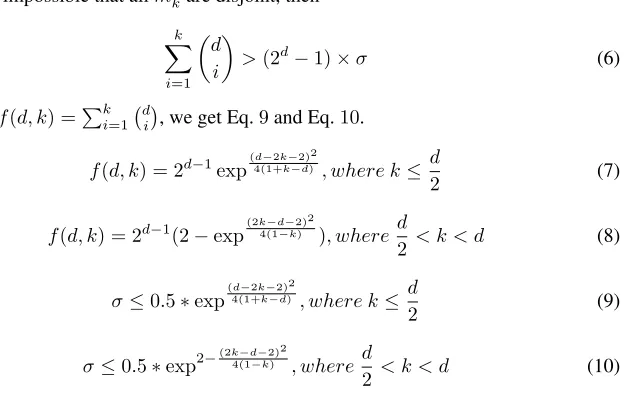
As it is impossible that allmi
kare disjoint, then k X i=1 d i
>(2d−1)×σ (6)
So, letf(d, k) =Pk
i=1
d i
, we get Eq.9and Eq.10.
f(d, k) = 2d−1exp(d
−2k−2)2
4(1+k−d) , where k≤ d
2 (7)
f(d, k) = 2d−1(2−exp(2k
−d−2)2
4(1−k) ), where d
2 < k < d (8)
σ≤0.5∗exp(d
−2k−2)2
4(1+k−d) , where k≤d
2 (9)
σ≤0.5∗exp2−
(2k−d−2)2
4(1−k) , where d
2 < k < d (10)
Cover Lower Bound Since the weighted set cover problem is NP-hard, the resultmapp
obtained from FMC algorithm is an approximation of the optimal setmopt, the
approxi-mate rate is1−1/e. The approximate cover is lower than optimal cover. As a result, we need to analyze the lower bound of optimal solution to choose the dimension of marginal table to avoid the loss caused by approximation of cover. The lower bound ofMoptis a
k-marginal table cover set which can cover allk-1 way marginal table query combination, soσopt>
Pk−1
i=1(
d i)
2d−1 . From Eq. 7 and Eq. 8, we can get the lower limit ofMappas shown
as Eq.11and Eq.12.
σapp>0.5(1−1/e)∗exp (d−2k)2
4(k−d) , where k≤ d
2 (11)
σapp>0.5∗(1−1/e) exp2+
(2k−d−4)2
4k , where d
2 < k < d (12) In summary, for a givenσ, we can get the marginal table of dimensionkaccording to Eq.11and Eq.12.
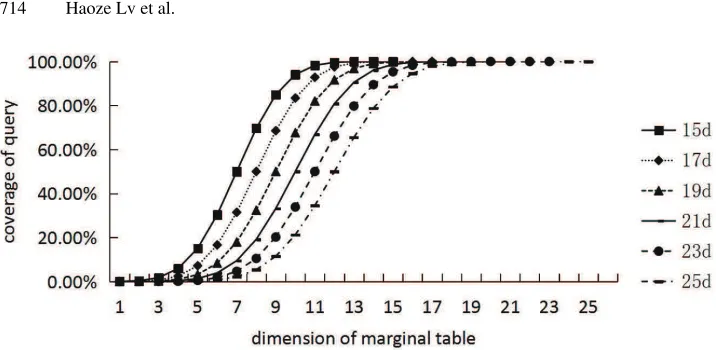
We give a verification for the efficiency ofk-marginal tables releasing. We use 6 test data whose dimensions are{15,17,19,21,23,25}, and use differential dimensional marginal table to form the cover set to analyze the distribution of cover. The distribution is shown in Fig. 2. We can observe that the cover benefit is getting slower when the dimen-sions are getting larger. In summary, releasing the marginal table is useful for dimensional reduction.
3.3. Selection of Marginal Table and Error Analysis
Fig. 2.Cover distribution of different marginal tables under different dimensions
into consideration. To improve this method, we analyze the released data set through fre-quent item sets. In this method, we can weight the marginal table, and the marginal bene-fits value of each marginal table are also taken into account. As a result, the marginal table is more reasonable to reduce the redundant marginal table and improve data availability.
Marginal Benefit We usem(S) to represent the marginal benefit of a collection of
k-marginal tablesS [33].M ben(E, S)represents the increasing marginal benefit when adding anotherk-marginal table toS.
M ben(E, S) =m(S∪E)−m(S). (13)
It is usually hard to accurately computeM ben(E, S)through Eq. 13. A good news is thatM ben(E, S)can be easily computed by the following Eq. 14, if only onek-marginal tables is contained inS.
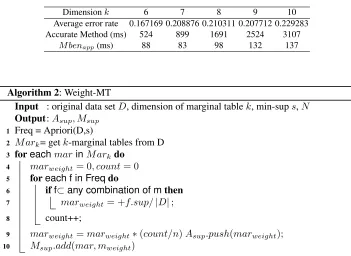
M ben(E, S) = (2s−1) + (2s−1)×(2v−1) = 2k−2v (14) Wherevis the size of the same attributes betweenEandS. Inspired by Eq. 14, we present a novel approach to approximately computeM ben(E, S)when there are more than onek-marginal tables inS. The approach is shown in Algorithm 4. In order to further verify this approach, we compare the traditional method with the proposed approximate method in Table 4.
Table 2.Error analysis table of marginal benefit estimation method
Dimensionk 6 7 8 9 10
Average error rate 0.167169 0.208876 0.210311 0.207712 0.229283 Accurate Method (ms) 524 899 1691 2524 3107
M benapp(ms) 88 83 98 132 137
Algorithm 2: Weight-MT
Input : original data setD, dimension of marginal tablek, min-sups,N Output:Asup, Msup
Freq = Apriori(D,s)
1
M ark= getk-marginal tables from D
2
foreachmarinM ark do
3
marweight= 0, count= 0
4
foreach f in Freqdo
5
iff⊂any combination of mthen
6
marweight= +f.sup/|D|;
7
count++;
8
marweight=marweight∗(count/n)Asup.push(marweight);
9
Msup.add(mar, mweight)
10
The dimension of original databaseDis17, and we choosekfrom6to10to observe the computing time (the first two rows) and the error respectively. From Table 4, it is clear to see thatM benappis computed more faster than traditional method. Meanwhile,
the relative error between the estimated value and the actual value is small. Although the relative error increases with the increase of the marginal table dimension, the error rate basically floats around0.2. In the experiment we find that the trend value of the marginal benefit value obtained by the estimation method is almost the same as the real result, so the effect of the average error rate on the validity of the estimated value can be neglected.
Noise Error Analysis Similar to PriView, we use the expected squared error to evaluate the noise error of RD-privacy, denoted asESERDin Eq. 15, wheremis the number of
the margin tables whose support are smaller than given threshold.
ESERD= 2k+1×
d
k
−m/ε
2
(15)
3.4. The Proposed Marginal Table Covering Algorithm
Algorithm 3: FMC
Input : original data setD, dimension of marginal tablek,Asup,Msup,coverσ.
Output: the collection of marginal tableM arres
M ark= getk-marginal tables from D
1
M ar=∅
2
M ben[mar]=∅
3
foreachmarinM ark do
4
M ben[mar] =M ben(mar, M arres)
5
fori = 1 to|M ark|do
6
s= get marginal table whose benefit = max(M ben[Asup]);
7
ifcover ofM arres≥σthen
8
Return;
9
ifMsup[s]< 2k2−1&&M BEN[s]< suptthen
10
Break;
11
deletesfrom MBen andsinM arres;
12
updateMBen according to algorithm 4
13
Algorithm 3 is the procedure of FMC. In line 1 to 3, it’s the data initialization phase, we get thekmarginal table candidateM ark from D, and then calculate each marginal
benefit ofkmarginal table toM ben[mar]. Line 7 to 13 is the detail process of filtering candidate marginal table. In the beginning ,M arres is empty, then all marginal benefit
is the same. So we choose the max support weight marginal table. With the change of
M arres, we update theM ben[Asup]in line 13 according to algorithm 4.
Algorithm 4: MBen
Input : marginal tablemark, the collection of marginal tableM ark, the length of
marginal tablek
Output: the marginal benefits Mben(mark,M ark)
min=∞
1
sum= 0
2
i = 0
3
forsinM arkdo
4
v = the number of same attribute in marginalmarkcompared withs
5
M ben=2k−2v
6
ifM ben < minthen
7
min=M ben
8
sum+ = 2v−1
9
i+ +
10
returnmin−(sum/i)
11
After obtain the marginal table cover setM arres, we can then calculate the size of
M arres. Add noise that followLaplace(|M arres|)into marginal tables to make the
3.5. Consistency Analysis ofk-marginal Tables
As the random noise is mixed, the direct publishing method of the marginal table covers the existence of inconsistent query results. Therefore, this section introduces consistency processing algorithms and the corresponding analysis.
We use the same way in PriView to consistency the query middle ware. However, the middle ware obtained by PriView is the query combination cover of the partial dimen-sion contained in the marginal table. The marginal table cover set proposed by the algo-rithm based on the frequent item sets is completely used for all the query combinations in the marginal table, involving more query combinations. Therefore, for the marginal ta-ble cover set handled by the method in the same way, the difference between the privacy properties and the noise error of the published marginal table is different. Therefore, in this section, we analyze the consistency of the process, the marginal of this article to cover the set of differential privacy model of the impact of the query results and noise error.
Differential Privacy Analysis After determining the harmonization process duplicates of each target, each target in accordance with an marginal table is normalized. This process is carried out after the mixing process with Laplace noise, so we need to analyze whether privacy protection has been changed.
In order to determine whether the marginal table middle ware still retains the nature of differential privacy protection, the post-processing inefficiencies of the differential pri-vacy model are introduced here, as shown in Theorem 1. Obviously, since the differential privacy model has post-processing inefficiencies, the subsequent consistency handling op-eration for the overlay marginal table satisfying the difference privacy does not affect the differential privacy protection feature of the overlay marginal table set itself.
T heorem1(post-processing inefficiencies): If the algorithmSsatisfiesε-differential privacy, then for any function, the new processing mechanismM =ϕ(S(D))still satis-fiesε-differential privacy.
Noise Error Analysis From previous literature[34]we can get following equation.
Q(Mc) =Q(Mc) +
U(A)−Q(M)
2|M|−|A| (16)
We can know from consistency processing, the first step is to calculate the target value of the same query paradigmAfrom different marginal tables. Set query results in original data set isU(A)and Laplace noiseδ. After noise added process, the result from ak-marginal tablesMi is shown in Eq. 17. If there arej k-marginal tables that satisfy
paradigmA, the consistent target is shown in Eq. 17.
Q(A) =µ+
|Mi|−|A|
X
i=1
δi(|A| ≤ |Mi|) (17)
U(A) =µ+1
j
j
X
j=1
|Mi|−|A|
X
i=1
According to the Eq. 16, Eq. 17 and Eq. 18 we can obtain Eq. 19. Letη=P|Mi|−|A|
i=1 δi.
As the added noise follows Laplace distribution, thenE(η)→0. Therefore, from the Eq. 19 we can see that, the whole of noise is reduced and valid of released data is improved while published data also satisfiesε-differential privacy.
Q(Mc) =µ+
|Mi|−|A|
X
i=1
δi+
P|Mi|−|A|
i=1 δi−1jP j j=1
P|Mi|−|A|
i=1 δi
2|Mi|−|A| (19)
4.
IM-Privacy Algorithm
In the previous description, the marginal table differential privacy publishing algorithm under frequent item sets uses manyk-dimensional tables of the same dimension to en-sure the data availability of the published data set at the expense of a certain cover rate. However, this method has certain limitations in the application scenario where the data privacy protection requirement is not high and the query range has high requirements. To solve this problem, we propose a differential privacy publishing algorithm partitioned by irregular marginal table to improve the PriView model from another perspective in this section. The algorithm composes a cover set by leveraging different marginal tables. By constraining the multi-level query rules, the amount of noise mixed in the publishing marginal table is controlled as much as possible to ensure the balance between privacy protection and data availability without sacrificing the scope of the query.
4.1. Global Sensitivity Analysis
The main idea of the proposed IM-Privacy method (Irregular partition Marginal table dif-ferential Privacy release algorithm) is to findnmarginal tables that has1toddimensions, which can completely cover all query combinations ofD. The method can achieve differ-ential privacy protection through the Laplace mechanism. The premise of the implemen-tation of the Laplace mechanism is that the middle wareFhas a clear global sensitivity. The calculation method is as shown in Eq.20.
S(F) = max
D1D2
(X
f∈F
|f(D1)−f(D2)|) (20)
WhereD1andD2are adjacent data sets, andfis arbitrary query onF. If the publish-ing middle wareMdcomposed of multidimensional marginal tables cannot determine the
query strategy, the global sensitivity under the middle ware cannot be determined, and the differential privacy protection based on the Laplace mechanism cannot be performed. If the global sensitivity is too high, the noise mixed into the middle ware will be large, which may directly reduce the data availability. To solve this problem, this paper proposes the following constraint on the query strategy of the irregularly divided marginal table cover set. We can use the same-dimensional marginal tables to perform the combined query of the same size. If the query result cannot be obtained with the same-dimensional marginal table, then the result of last-dimension marginal table is used to get the query result. Based on this constraint, the formula for querying the query sensitivity S(Md)of the middle
middle ware under the constraint isd+ 1, which means the query operation with ad−1 attribute combination needs to use thed-dimensional marginal table, and the global sen-sitivity isDat this time. Therefore, under this constraint,(S(Md)/λ)-differential privacy
can be satisfied when the Laplace noise distribution isLaplace(S(Md)/λ).
S(Md) = max(1, Ckk−1+ 1) (21)
In order to overcome this constraint, we need to further obtain the cover algorithm that satisfies the query policy constraint and minimizes the marginal table cover set ESE to get the irregular marginal table cover setMd. Therefore, this paper obtains the maximum
marginal benefit cover strategy for greedy approximation through the further analysis of ESE, and proposes an approximate optimal marginal table cover algorithm combining this strategy, which can get the approximate solutionρcompared with the optimal cover set
Md−optunder the premise of meeting the cover requirement.
4.2. Greedy Approximation Maximum Marginal Benefit Cover Strategy
In order to further improve the availability of the data, we need to find the optimal marginal table cover set that satisfies the query constraint, so that the ESE of the released middle ware is as small as possible. Obviously, the problem is a set cover problem that minimizes the objective function min (ESE). The definition of this minimization prob-lem is shown in Eq.22, whereEis an approximate solution andSis an optimal solution. Since the table of different dimensions is used to form the release middle ware, the overall noise intensity needs to be analyzed. The calculation ofESEmin this case is as shown in
the formula Eq.23, where|mi|represents the number ofi-dimensional marginal tables.
min{ESE(S) :S∈E} (22)
ESEm= 2d( d
X
i=1
|mi|)Laplace(S(Md)/ε) (23)
It is difficult to directly estimate the lower bound of the optimal solutionSbecause variables added are randomly distributed to the marginal table, so we cannot the estimate the approximate ratio of the approximation algorithm. However, it can be seen from Eq. 22that there are two values affecting the change ofESEm, the number of covered
con-centrated marginal tablesPd
i=1 | mi |and the query sensitivityS(Md). Therefore, we analyze the marginal benefit value that directly affects the number of marginal tables and query sensitivity, and then transform the ESE minimization problem into the optimization problem of marginal benefit.
In the set cover problem of the marginal table, thek-dimensional marginal table bene-fit value relative to the cover setM is equal to the number of query combinations covered by thek-dimensional table and not covered byM. For marginal benefit and global sen-sitivityS(Md), the description of global sensitivity is a combination of queries covered
Mdwhose global sensitivity isS(Md) =d+ 1needs to be added to thed-dimensional
marginal table. Therefor we can further derive Eq.24according to the Eq.23.
ESEm= 2d( d
X
i=1
|mi|)Laplace((d+ 1)/ε) (24)
It can be seen from the ESE estimation formula of the marginal table that, while the published data set dimensiondis determined, the overallESEmis only related to the
number of tables. Thus the smaller the number of covered concentrated marginal tables, the smaller the overall ESE, the higher its data availability. The greater the marginal ben-efit value, the higher the query cover rate that a single marginal table can provide, the smaller the number of marginal tables when conditions to reach the cover rate are satis-fied. As a result, the marginal benefit is inversely proportional to the number of marginal tables.
Therefore, the maximum marginal benefit can be obtained by the approximate solu-tion of the optimal marginal table cover set. The process is as follows. Firstly, we select the marginal table with the largest margin benefit value when filtering thek-dimensional table for the first time. Secondly, the remainingk-dimensional marginal table is iteratively searched until only one table with the marginal benefit value of1is left in the dimension. The table with the largest margin benefit value is selected in each iteration. Then enter the
k+ 1dimension search process. This is because the table with the residual margin benefit value of 1can only complete the cover of itself. Based on the query strategy proposed later of this paper, it can be covered by thek+ 1dimension marginal table.
In the choice of the overall idea of the algorithm, since the marginal benefit value of the marginal table changes to satisfy the submodule function, the greedy algorithm is se-lected to search the marginal table, and the approximate solution of the optimal marginal benefit value is obtained. In summary, this section transforms the ECE minimization prob-lem into the marginal benefit maximization probprob-lem, and the optimal cover setShas the marginal benefit valueM Ben(S) = 2d−1, which means the optimal set covers all the
query combination ofd-dimensional data under the constraint query condition. Assum-ing that the marginal benefit of the approximate solutionEobtained by the algorithm is
P
e∈EM Ben(e), the approximation rateρis as shown in Eq.25.
ρ= min
S:min−cov
P
e∈EM Ben(e)
M Ben(S) (25)
4.3. Approximate Optimal Marginal Table Covering Algorithm
and update the marginal benefit values of the remaining tables will be difficult to estimate. Assuming that the number of iterations isnand the original data set dimension isd, the time complexity of the no-grouped algorithm that isO(n(2d−1)2)in the worst case.
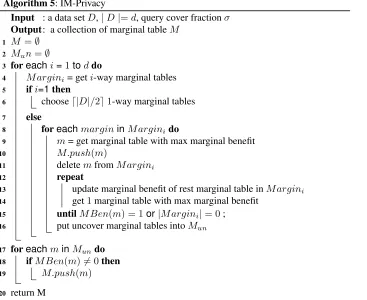
In order to reduce the time spent in marginal table traversal, we partition the tables according to their dimensions during algorithm implementation. We find the marginal table with the most marginal benefit in each group, and then iterate the remaining table until the marginal benefit value of the table is1or there is no remaining table. The pseudo code of the algorithm is shown in Algorithm5whose input is the original data setD, the query cover rate isσ= 1, and the output is the marginal table cover set that satisfies the cover requirement.
Algorithm 5: IM-Privacy
Input : a data setD,|D|=d, query cover fractionσ Output: a collection of marginal tableM
M =∅
1
Mun=∅
2
foreachi=1toddo
3
M argini= geti-way marginal tables
4
ifi=1then
5
choosed|D|/2e1-way marginal tables
6
else
7
foreachmargininM arginido
8
m= get marginal table with max marginal benefit
9
M.push(m)
10
deletemfromM argini
11
repeat
12
update marginal benefit of rest marginal table inM argini
13
get1marginal table with max marginal benefit
14
untilM Ben(m) = 1or|M argini|= 0;
15
put uncover marginal tables intoMun
16
foreachminMundo
17
ifM Ben(m)6= 0then
18
M.push(m)
19
return M
20
Algorithm5is the procedure of IM-Privacy. Line1to5are the data initialization and preparation phases, whereM represents the marginal table cover set andlevelrepresents the layer to be divided. We partition the group based on the dimensions of the marginal table. Line7 is the processing of the1-dimensional marginal table, and the firstdd/2e
table until the set is empty or only the table remains a marginal benefit value of1. Lines 17to20check the marginal table with a marginal benefit of 1. If there is a table with a marginal benefit of the relative cover setM greater than0, it can be directly inserted intoM to ensure the final published marginal table. The cover of the query set under the multi-level query strategy is100%.
4.4. Time Complexity Analysis
The approximate optimal marginal table covering algorithm is the key of the differential privacy publishing algorithm based on the irregular marginal table. We analyze the time complexity of the algorithm. The algorithm consists of two parts, the search process of the 1-to-d-dimensional marginal table and the inspection process of the table with the residual marginal benefit of1. The marginal table iterative search process is a traversal lookup in the marginal table of groups1tod, where the number of tables in the group isn=Ck
d.
In the lookup process, the time consumption of updating the marginal benefit value of the table is related to the solution set sizesof the marginal table cover set, and the time complexity of the process isO(d×n×s). For the marginal table setMun(|Mk|=m)
with the remaining marginal benefit value of1, the time complexity of the traversal check isO(m×s). We can figure out that the overall time complexity of the marginal table algorithm isO(s×(d×n+m)), wheredn. So the time complexity isO(s×(n+m))
5.
Experiment
In this section, we will compare and analyze the two marginal table-based differential pri-vacy publishing algorithms proposed in this paper. The experiment mainly analyzes the feasibility of differential privacy publishing algorithm based on improved cover set from two aspects: algorithm efficiency and data availability. By comparing with the represen-tative differential privacy model, the advantages of the proposed method in improving data availability are verified. The detail of the hardware used in experiment is shown in table 3. We use public data set MSNBC and Kosarak to design experiments and make performance analysis.
Table 3.Experimental configuration
CPU i7-6560U CPU @ 2.20GHz 2.21GHz
Memory DDR4 8GB
Disk 256GB SSD
System image Windows 10 64-bit operating system
Kosarak[36]: This data set records the click flow information of a Hungarian news web site, with 912,627 items. Each record in the data set represents a combination of news identifier that the user clicks.
Now, we describe the parameters used in the experiments, the privacy default budget
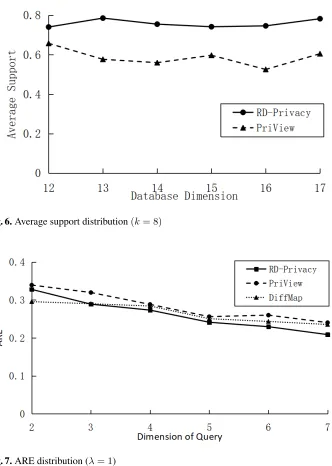
λ= 1and the dimension of marginal tablekis chosen from{6,8}for the default cases. In the rest of the section, we compare the proposed algorithm with the existing differ-ential privacy algorithm in data availability and efficiency. Firstly, we compare the number of marginal tables generated by RD-privacy with the state-of-the-art method. We analyze the average support of the obtained marginal tables between these two methods, and make the error analysis in the last subsection.
5.1. Results on RD-Privacy
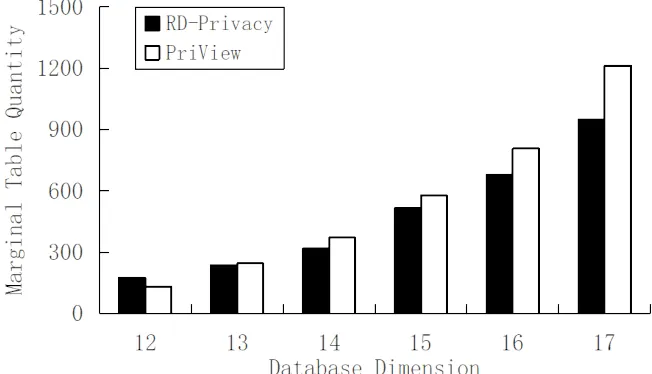
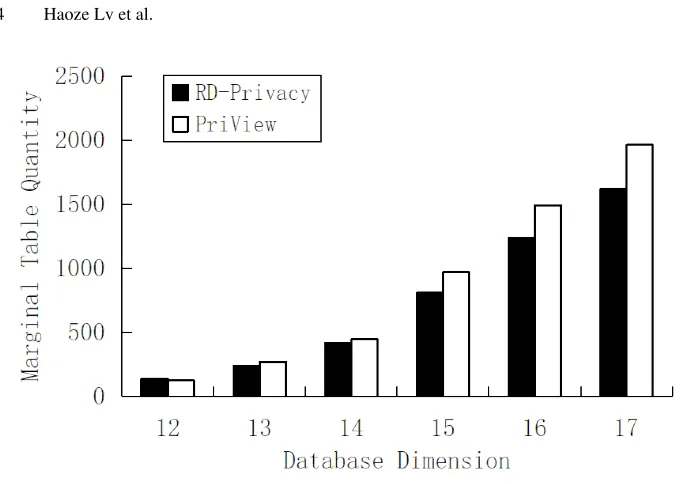
Analysis for Quantity of Marginal Table In this subsection, we select the SNBC to conduct experiment, which has 17-dimensional attributes. We use the Apriori algorithm to mine frequent itemsets (the Apriori algorithm sets the minsup as 0.005).
Fig. 3.Marginal table quantity distribution(k= 6)
Fig. 4.Marginal table quantity distribution(k= 8)
Fig. 5.Average support distribution(k= 6)
Fig. 6.Average support distribution(k= 8)
Fig. 7.ARE distribution (λ= 1)
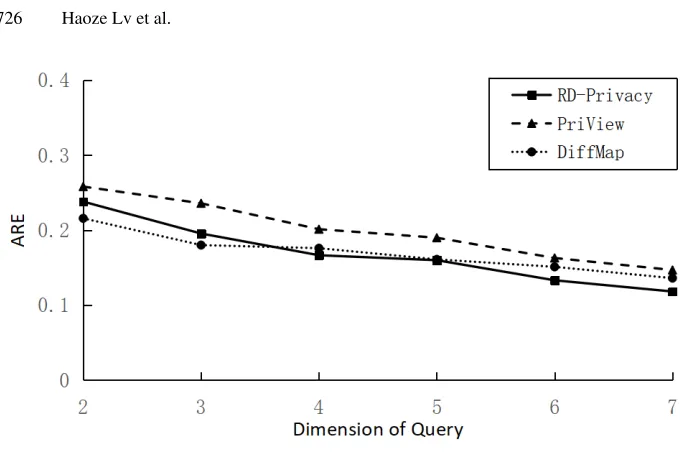
Analysis of ARE We definite ARE as following Eq. 26, whereAis the true value andB
is the obtained value.
ARE=|A−B|
Fig. 8.ARE distribution (λ= 2)
We can infer from Fig.7and Fig.8that, in the most of case, the presented algorithm can obtain marginal table with less errors. It is noticeable that when the dimension is small the ARE of RD-Privacy is larger than others. The reason is that the RD-Privacy can obtain more marginal tables based on frequent item sets and then more noises are added.
5.2. Results on IM-Privacy
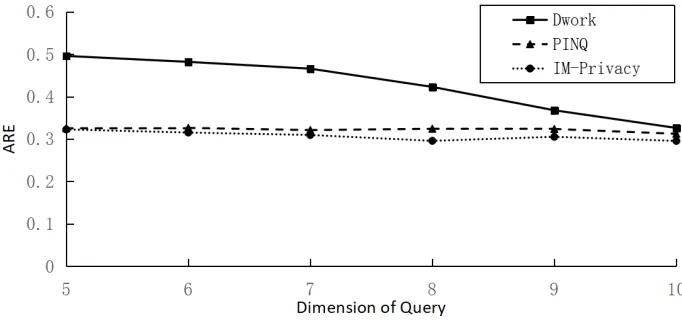
Experimental Analysis on IM-Privacy This part of the experiment is based on the com-parison of IM-Privacy with PINQ and Dwork differential privacy models whose models are differential privacy models with a query cover of100%. The comparative experiment uses these three algorithms to generate the query middle ware on the Kosarak data set, and then compares the average relative error between the query result and the true value.
The privacy budget in the experimentλ = 1, the data set used is a user click list of the first 21 categories of news from Kosarak. First, use the IM-Privacy, Dwork, and PINQ for the 21-dimensional Kosarrak data set to generate query middle ware that meets the same differential privacy strength. The IM-Privacy algorithm mainly publishes the middle ware of the marginal table query for the application scenario with high query cover requirements, and the algorithm uses the marginal table of different dimensions to construct the middle ware. There is no limitation of the query dimension by the RD-Privacy algorithm. In the comparative experiment of the algorithm, the setting of the query dimension is different from the former subsection. Due to the marginal table cover set obtained by the IM-Privacy algorithm, the query cover is wide. Therefore, this subsection needs to further investigate the data availability of the query middle ware under the higher query dimension.
shown in Eq.27. We record the results of each query with the actual values and then compare the average relative errors of the three different middle ware.
SELECT COU N T(∗)F ROM D W HERE A1∈S1AN D A2∈S2· · · Am∈Sm
(27)
Fig. 9.Comparison chart of ARE for IM-Privacy, PINQ, Dwork
Approximate Rate on IM-Privacy The approximate optimal marginal table covering algorithm in this paper is proposed for the optimal marginal table cover set. Its approxi-mation rate is affected by the size of the data set. Therefore, it is necessary to consider the approximate ratio of the algorithm. We should calculate the ratio between actual irregu-lar marginal table cover set and optimal one in theory. Meanwhile, in order to verify the availability of proposed algorithm, we will also figure out the effect of the change on data set size to approximate ratio stability.
The data set used in the experiment is MSNBC. We select13to17attributes randomly to form MSNBC of different dimensions and use the IM-Privacy algorithm to find the cover set composed of irregular marginal tables. Finally, we calculate the sum of the marginal benefit values of the marginal table and compare with the theoretical optimal marginal benefit value to analyze the approximation rate.
It can be seen from Table 4 that the overall marginal benefit value obtained by the al-gorithm is always between0.8and0.9as the increasing of data dimension, what’s more, the ratio is always higher than the theoretical optimal marginal benefit value. It is proved that the approximation algorithm has certain advantages in the stability of its approxima-tion degree and the availabilities of the algorithm.
Table 4.Change of approximation rate for IM-Privacy algorithm
Dimensionk 13 14 15 16 17
Optimal marginal benefit 8191 16383 32767 65535 131071 Actual marginal benefit 7127 14376 28881 58169 116467 Approximate rate 0.87010133 0.877494964 0.881405072 0.887602 0.88857947
6.
Conclusion and Overlook
The development of the information industry has brought convenience to the office and life of each of us, and it has also created hidden dangers of user data leakage. However, The data publishing process becomes less secure and may result in user privacy leaks. The traditional privacy protection method can not meet the privacy protection requirements in the current environment. Therefore, new differential privacy model is widely used in the data release process with privacy protection requirements. Traditional middle ware for statistical data-based differential privacy algorithms contain more noise and lower data availability due to the differential privacy model that uses the noise to protect data. At present, although the marginal table based differential privacy model effectively reduces the noise, it does not consider the relevance of the attributes in the real data set. Mean-while, the table cover set contains some invalid query combinations, which reduces the data availability. In the mean time, only the table of the same dimension is selected, which can not meet the needs of practical applications.
The differential privacy releasing algorithm based on regular marginal tables under frequent item sets uses Apriori algorithm to analyze the actual application data set, com-prehensively considers the marginal table support degree and marginal benefit, and pro-vides targeted cover for effective query combination, further improving the data availabil-ity of middle ware of the query.
Considering on the low requirements of data privacy protection but high requirements of the cover, a differential privacy publishing algorithm based on irregular marginal table partitioning is proposed. Using the approximate optimal marginal table covering algo-rithm proposed in this paper, we find that the multi-level edge is satisfied. The table query cover set of the table query policy constraint achieves a balance between privacy protec-tion and data availability to a certain extent.
The paper only studies the differential privacy model under the count query, we can further expand the algorithm to the field of subgraph area. The paper focuses on the re-search of differential privacy protection for numerical statistical data. We can further study the statistical data of multi-category and multi-valued attributes, and obtain a more appli-cable method of constructing the marginal table differential privacy model.
Acknowledgment Supported by the Double-class Construction Innovation Project 01431-90518. Supported by the National Nature Science Foundation of China 61370198, 6137-0199, 61672379 and 61300187. Supported by the Liaoning Provincial Natural Science Foundation of China NO. 2019-MS-028.
References
1. Lyu, M., Su, D., Li, N.: Understanding the Sparse Vector Technique for Differential Privacy, PVLDB, 637-648.(2017)
2. Kong, W., Lei, Y., Ma, J.: Data security and privacy information challenges in cloud computing, International Journal of Computational Science and Engineering, 16(3), 212-215.(2018) 3. Shynu, P. G., Singh, K. J.: Privacy preserving secret key extraction protocol for multi-authority
attribute-based encryption techniques in cloud computing, International Journal of Embedded Systems, 10(4), 287-300.(2018)
4. Dwork, C.: Differential Privacy, ICALP, 63(6), 1-12.(2006)
5. Atzori, M.: Weak k-anonymity: A low-distortion model for protecting privacy, International Conference on Information Security, 60-71.(2006)
6. Samarati, P., Sweeney, L.: Protecting privacy when disclosing information: k-anonymity and its enforcement through generalization and suppression, (1998)
7. Omran, E., Bokma, A., Abu-Almaati, S.: A k-anonymity based semantic model for protecting personal information and privacy, Advance Computing Conference, 2009. IACC 2009. IEEE International, 1443-1447.(2009)
8. Sweeney, L.: K-anonymity: A model for protecting privacy, Int. J. Uncertain. Fuzziness Knowl.-Based Syst, 10(5), 557-570.(2014)
9. Han, J., Yu, H., Yu, J.: An improved l-diversity model for numerical sensitive attributes, 2008 Third International Conference on Communications and Networking in China, 938-943.(2008) 10. Kroc, L., Sabharwal, A., Selman, B.: Leveraging belief propagation, backtrack search, and statistics for model counting, International Conference on Integration of Ai and Or Techniques in Constraint Programming for Combinatorial Optimization Problems, 127-141.(2008) 11. Ohkubo, J.: Basics of counting statistics, Ieice Transactions on Communications,
12. Wang, H., Chen, Y., Li, L., Pan, H., Gu, X., Liang, Z.: A novel colon wall flattening model for computed tomographic colonography: Method and validation, Comput Methods Biomech Biomed Eng Imaging Vis, 13(4), 1-14.(2014)
13. Li, C., Hay, M., Rastogi, V., Miklau, G., Mcgregor, A.: Optimizing linear counting queries under differential privacy, Twenty-Ninth ACM Sigmod-Sigact-Sigart Symposium on Principles of Database Systems, PODS 2010, June 6-11, 2010, Indianapolis, Indiana, Usa, 123-134.(2010) 14. Edoh-Alove, E., Bimonte, S., Pinet, F., Bdard, Y.: New design approach to handle spatial vague-ness in spatial olap datacubes, International Journal of Agricultural and Environmental Infor-mation Systems, 6(3), 29-149.(2015)
15. Dwork, C.: Differential privacy: a survey of results, International Conference on Theory and Applications of MODELS of Computation, 1-19.(2008)
16. Lu, S., Mandava, G., Yan, G., et al.: An exact algorithm for finding cancer driver somatic genome alterations: the weighted mutually exclusive maximum set cover problem, Algorithms for Molecular Biology, 11(1), 1.(2016)
17. Al-Shihabi, S., Arafeh, M., Barghash, M.: An improved hybrid algorithm for the set covering problem, Computers & Industrial Engineering, 85, 328-334.(2015)
18. Cheng, T. C. E., Shafransky, Y., Ng, C. T.: An alternative approach for proving the NP-hardness of optimization problems, European Journal of Operational Research, 248(1), 52-58.(2016) 19. Das, Aparna, Claire M.: A quasipolynomial time approximation scheme for Euclidean
capaci-tated vehicle routing, Algorithmica, 73(1), 115-142.(2015)
20. Feldman, M., Naor, J., Schwartz, R.: A unified continuous greedy algorithm for submodular maximization[C], Foundations of Computer Science (FOCS). IEEE, Palm Springs, CA, USA, 570-579.(2011)
21. Sagnol, G.: Approximation of a maximum-submodular-coverage problem involving spectral functions, with application to experimental designs[J], Discrete Applied Mathematics, 161(1), 258-276.(2013)
22. Wan, P. J., Du, D. Z., Pardalos, P., et al.: Greedy approximations for minimum submodu-lar cover with submodusubmodu-lar cost, Computational Optimization and Applications, 45(2), 463-474.(2010)
23. Qardaji, W., Yang, W., Li, N.: Priview:practical differentially private release of marginal con-tingency tables, 1435-1446.(2014)
24. Zhang, Q., Li, F., Yi, K.: Finding frequent items in probabilistic data, ACM International Con-ference on Management of Data (SIGMOD), 63(6), 819-832.(2008)
25. Bernecker, T., Kriegel, H. P., Renz, M.,Verhein, F., Zfle, A.: Probabilistic frequent pattern growth for itemset mining in uncertain databases, International Conference on Scientific and Statistical Database Management (SSDBM), 38-55.(2010)
26. Wang, L., Cheung, W. L., Cheng, R., Lee, S. D., Yang, X. S.: Efficient mining of frequent item sets on large uncertain databases, IEEE Transactions on Knowledge and Data Engineering, 2170-2183.(2012)
27. Tong, Y., Chen, L., Cheng, Y., Yu, P. S.: Mining frequent itemsets over uncertain databases, Proceedings of the Very Large Database (VLDB), 1650-1661.(2012)
28. Tang, P., Peterson, E. A.: Mining probabilistic frequent closed itemsets in uncertain databases, Southeast Regional Conference, 86-91.(2011)
29. Agrawal, R., Imieliski, T., Swami, A.: Mining association rules between sets of items in large databases, ACM SIGMOD Record, 22(2), 207-216.(1993)
30. Qardaji, W., Yang, W., Li, N.: PriView: practical differentially private release of marginal con-tingency tables, Proceedings of the 2014 ACM SIGMOD international conference on Manage-ment of data. ACM, Snowbird, UT, USA, 1435-1446.(2014)
32. Golab, L., Korn, F., Li, F., Saha, B., Srivastava, D.: Size-constrained weighted set cover, IEEE, 879-890.(2015)
33. Emek, Y., Rosn, A.: Semi-streaming set cover, International Colloquium on Automata, Lan-guages, and Programming, 453-464.(2014)
34. Hay, M., Rastogi, V., Miklau, G., Dan, S.: Boosting the accuracy of differentially private his-tograms through consistency, Proceedings of the Vldb Endowment, 3(1-2), 1021-1032.(2009) 35. http://archive.ics.uci.edu/ml/datasets/MSNBC.com+Anonymous+Web+Data
36. Frequent itemset mining data set repository, http://fimi.ua.ac.be/data/.
Haoze Lv is currently in school with the Department of Computer Science in Dalian Maritime University. His research mainly focuses on Big data and privacy protection.
Zhaobin Liu(corresponding author) received the Ph.D degree in computer science from Huazhong University of Science and Technology, China, in 2004. He is currently a Pro-fessor in the school of information science and technology, Dalian Maritime Univer-sity, China. He has been a Senior Visiting Scientist at The University of Auckland, New Zealand, in 2017, and a visiting scholar at University of Central Florida, USA, in 2014 and University of Otago, New Zealand in 2008 respectively. His research interests include big data, cloud computing and data privacy.
Zhonglian Huis currently pursuing the master’s degree with the Department of Com-puter Science in Dalian Maritime University. His research mainly focuses on Big data and privacy protection.
Lihai Nieis currently an doctoral candidate in the division of Intelligence and Comput-ing, Tianjin University, China. His research interests include data minComput-ing, artificial intel-ligence, network and clouding computing. He has published more than several papers in international journals and conferences.
Weijiang Liureceived the Ph.D. degree in computational mathematics from Jilin Uni-versity in 1998. From June 2004 to June 2006, he was a postdoctoral fellow of Post Doc-toral Station for Computer Science and Technology, Southeast University, China. He is currently a professor in School of Information Technology, Dalian Maritime University, China. He has published more than 80 papers and his current research interests include network measurement, network security, and mobile computing.
Xinfeng Yegained BSc in Computer Science from Hua Qiao University, China, in 1987, and MSc and PhD in Computer Science from The University of Manchester, England, in 1988 and 1991 respectively. He is currently a senior lecturer in the Department of Computer Science at The University of Auckland, New Zealand. His current research interests include cloud computing and system security.