A Novel Link Quality Prediction Algorithm for Wireless
Sensor Networks
Chenhao Jia1, Linlan Liu1, Xiaole Gu1, and Manlan Liu1
Internet of Things Technology Institute, Nanchang Hangkong University, 330063 Nanchang, China
[email protected] [email protected] [email protected] [email protected]
Abstract. Ahead knowledge of link quality can reduce the energy consumption of wireless sensor networks. In this paper, we propose a cloud reasoning-based link quality prediction algorithm for wireless sensor networks. A large number of link quality samples are collected from different scenarios, and their RSSI, LQI, SNR and PRR parameters are classified by a self-adaptive Gaussian cloud transformation algorithm. Taking the limitation of nodes’ resources into consideration, the Apri-ori algApri-orithm is applied to determine association rules between physical layer and link layer parameters. A cloud reasoning algorithm that considers both short- and long-term time dimensions and current and historical cloud models is then proposed to predict link quality. Compared with the existing window mean exponentially weighted method, the proposed algorithm captures link changes more accurately, facilitating more stable prediction of link quality.
Keywords:wireless sensor networks, link quality prediction, Gaussian cloud trans-formation.
1.
Introduction
Wireless sensor networks (WSNs) is multi-hop, self-organising network formed by a large number of inexpensive micro-sensor nodes which communicate with each other by ra-dio [6]. Their purpose is to collaboratively sense, collect and process information about objects in the network coverage area and pass it on to an observer. As they are usually required to work for long periods, it is important to reduce the nodes’ energy consump-tion. Because of the physical characteristics of the node and the volatile communication environment, the nodes are affected by multipath effects, signal attenuation and signal in-terference from other wireless communication protocols (Wi-Fi, GSM, Bluetooth). These uncertain spatial and temporal characteristics of data transmission present challenges for the evaluation and prediction of wireless link quality.
whole network. In WSNs energy management applications, LQP can predict changes of the current link, reduce node energy consumption, and improve the efficiency of network communication by selecting the appropriate transmission power.
This paper proposes a cloud reasoning-based link quality prediction algorithm based on multiple parameters, which classifies link quality parameters according to the cloud model. This algorithm overcomes the subjectivity of link quality classification, as differ-ent link quality parameters can represdiffer-ent differdiffer-ent aspects of link quality. The algorithm, named Apriori, mines association rules between physical parameters and link layer pa-rameter. In order to validate the algorithm, it is compared with the smoothed packet re-ceived ratio (SPRR) prediction method using a testbed platform. The results show that the proposed algorithm provides more stable prediction of link quality changes.
This paper makes two main contributions: 1) it uses a cloud model to eliminate sub-jective factors in the classification of link quality; 2) it proposes a cloud reasoning-based link quality prediction algorithm for wireless sensor networks. In This paper, we select PRR as an indicator of link quality and use cloud model to eliminate subjective factors in the classification of link quality. Based on cloud reasoning process, a novel link quality prediction algorithm is proposed for WSNs. Section 2 analyses the related researches of link quality prediction. Section 3 proposes the key algorithms in predicting the link qual-ity at the next moment. Section 4 describes the experimental scenarios and experimental results to verify the effectiveness of the algorithm. Section 5 makes conclusions.
2.
Related Work
Methods of WSNs link quality prediction fall into three categories-based on communi-cation link characteristics, probability estimation and intelligent learning. The physical layer parameters involved in prediction include the received signal strength indication (RSSI), link quality indicator (LQI) and signal-to-noise ratio (SNR). Link layer param-eters involved in the prediction include the packet reception ratio (PRR). The prediction methods based on probability estimation predict successful reception probability of the future packets. The prediction methods based on intelligent learning are related to pattern recognition, Bayesian networks, support vector machines (SVM) and so on.
Due to the resource consumption problem caused by asymmetric links, paper [13] applied dual-tree topology to record the receiving and the transmitting link quality pa-rameters of the two nodes. The experiment showed that this algorithm can effectively reduce the hop from the source node to destination node. Paper [11] proposed a built-in learning-based WSNs link quality estimation algorithm that input link quality parameters (RSSI, SINR and PRR), node energy information, the expected number of transmissions (ETX), the expected energy consumption (EEC) and the expected number of retransmis-sions (ENR) to predict link quality. This method can improve the transmission rate but has poor real-time performance. Paper [3] proposed a link quality prediction algorithm based on fuzzy comprehensive theory and the Bayesian network. While it solved the marginal-ization problem of link quality, the algorithm required parameters that are independent of each other, and lacked assessment of link quality variability. Paper [10] proposed a generic link quality evaluation framework based on machine learning and was verified by LQI. The experimental results showed that the method is accurate for evaluating stable links, but not fluctuating ones.
Paper [20] applied a neighbourhood-based non-negative matrix factorization algo-rithm to predict link quality in WSNs. It learned latent features of the nodes from the information of past data transmissions combing with local neighborhood structures. Pa-per [2] fully considered the reliability, volatility and asymmetry of link and channel qual-ity to construct corresponding link indicators. It applied the theory of fuzzy to obtain a fuzzy link quality estimator (F-LQE). Paper [15] compared reliability, stability and agility performance of ETX, 4-Bit and F-LQE. It noted that F-LQE is more reliable and stable, but has less agility for smart grid environment monitoring. Paper [16] combined a fuzzy theory and SVM to put forward a link quality prediction model that can reduce the effects of noise and outliers. It used a chaotic particle swarm optimisation algorithm to optimise the parameters of the SVM model. The model had better prediction performance than a backward propagation (BP) neural network. Paper [5] applied a Markov chain model to describe packet loss in wireless links, pointing out that link package rates tended to be the same over very short periods of time. Paper [19] proposed a window mean exponen-tially weighted moving average (WMEWMA) link quality evaluation algorithm based on exponentially weighted moving average (EWMA) filter. This algorithm can predict the next-moment PRR through a historical set of PRRs, but the lack of physical parameters can lead to lower accuracy.
Cloud models are widely applied for evaluation, prediction and algorithm improve-ment [14] because of their advantages of fuzzy and stochastic processing. Considering the randomness of links and the fuzziness of link quality in WSNs, this paper proposes a novel link quality prediction algorithm. The self-adaption Gaussian transformation al-gorithm is used to classify link quality parameters. Association rules between physical layer parameters and link layer parameters are mined by the Apriori algorithm [1]. A novel cloud reasoning-based link quality prediction algorithm is proposed by combining historical cloud and current cloud information.
3.
Cloud Reasoning-based Link Quality Prediction Algorithm
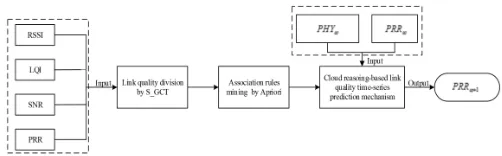
estab-lishment of a prediction model. The self-adaptive Gaussian transformation (S GCT) al-gorithm is used to classify link quality parameters. The Apriori alal-gorithm is applied to find out rules between the physical-layer parameters (RSSI, SNR, LQI) and the link-layer parameter PRR. A cloud reasoning-based algorithm is proposed to predict link quality. Fig. 1 illustrates a flowchart of the prediction model.
Fig. 1.Cloud reasoning-based link quality prediction algorithm
3.1. Division of Link Quality Parameters
The S GCT algorithm automatically forms multiple concepts consistent with human cog-nition, and appropriate granularity based on the statistical distribution of the actual data. This process can reflect the process of human cognition from low to high levels. The self-adaptive Gaussian transformation is iteratively convergent by calling the heuristic Gauss cloud transformation algorithm (H GCT), and the Gauss cloud transformation strategy is formulated according to the confusion degree (CD). The confusion degree can be used to characterise the degree of dispersion of the Gauss cloud distribution. Larger CDs usu-ally involve greater overlap of adjacent Gauss clouds, hence, concepts are poorly defined. Conversely, smaller CDs involve less overlap, so that concepts easily reach consensus. The threshold of the general CD is 0.5. The CD can be calculated according to Equation (1).
CD= 3He
En (1)
WhereHerepresents the hyper-entropy of the cloud model, andEnrepresents the entropy of the cloud model.
The S GCT algorithm specifies the Gauss cloud transformation strategy according to the CD, and the basic area between adjacent concepts will not overlap (CD≤0.5) through iteration. The self-adaptive Gaussian transformation algorithm is set out as Algorithm 1.
Algorithm 1S GCT(p Eve,β)
Input: p Eve: sample set for every parameter,β: confusion degree Output: p Clu: list of M cloud model parameters
1: initial M,M >0
2: repeat
3: compute Gauss cloud digital featuresH GCT(p Eve, M)
4: add Gauss cloud digital features to the listp Clu.Add(Ex, En, He, CD)
5: untilp Eveis empty 6: repeat
7: clear listp Clu.Clear()
8: the Gauss component is reduced by 1M=M−1
9: repeat
10: compute Gauss cloud digital featuresH GCT(p Eve, M)
11: add Gauss cloud digital features to the listp Clu.Add(Ex, En, He, CD)
12: untilp Eveis empty 13: ifM== 1thenclose 14: end if
15: untilCDk<β
3.2. Association Rules Mining
The link quality prediction algorithm based on cloud reasoning is essentially a kind of regression reasoning prediction. In this paper, the Apriori algorithm is applied to mine the association rules between the physical parameters and link layer parameter.
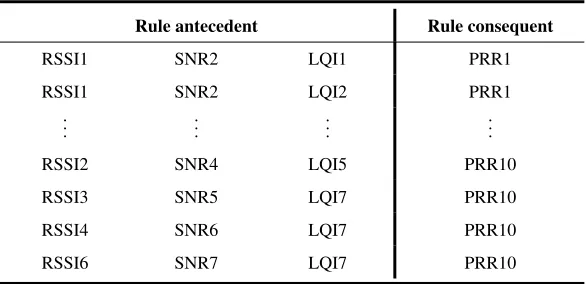
Firstly, we save the divided data in the database D. Secondly, we find out rules with the Apriori algorithm, like{RSSI1, LQI2, SNR1, PRR1}. The rule is defined as “If RSSI low and LQI low and SNR low then PRR low”. More rules will be shown in Table 1.
Table 1.Partial association rules
Rule antecedent Rule consequent
RSSI1 SNR2 LQI1 PRR1
RSSI1 SNR2 LQI2 PRR1
..
. ... ... ...
RSSI2 SNR4 LQI5 PRR10
RSSI3 SNR5 LQI7 PRR10
RSSI4 SNR6 LQI7 PRR10
3.3. Link Quality Prediction with Time Series
In this paper, a cloud reasoning-based link quality prediction algorithm is used to predict link quality by considering short and long term dimensions. The short term dimension generates the current cloud through the current physical parameters, while the long term dimension generates the historical cloud through the link layer parameter. The current cloud and the historical cloud are integrated into an integrated cloud model which is used to predict link quality [4].
For the current physical layer parameters, we determine the maximum membership degree of association rules by the three condition single-rule cloud generator algorithm (3CSR CG). Corresponding to the link layer parameters in the maximum membership degree rule, the cloud model is selected as the current cloud. The 3CSR CG algorithm is shown as Algorithm 2.
Algorithm 23CSR CG(X1,X2,X3,Y,x)
Input: X1: the first front cloud model parameters,X2: the second front cloud model parameters,
X3: the third front cloud model parameters,Y: the back cloud model parameters,x: the specific vector
Output: u: membership degree,b: the drop
1: computer the first random variableEsx1=N ORM(Enx1, pow(Hex1,2)) 2: computer the second random variableEsx2=N ORM(Enx2, pow(Hex2,2)) 3: computer the third random variableEsx3=N ORM(Enx3, pow(Hex3,2)) 4: computer the membership of xu=membership(x, Esx1, Esx2, Esx3) 5: computer the back cloud random variableEsy=N ORM(Eny, pow(Hey,2))
6: ifupthen
7: b=Ey−deviate(u, Esy)
8: close 9: end if
10: b=Ey+deviate(u, Esy)
We selectNlatest PRR values as drops, and the cloud model is identified as a historical cloud by using the no-degree backward Gaussian cloud algorithm (NB GCT), shown as Algorithm 3.
Algorithm 3NB GCT(p Eve) Input: p Eve: sample set
Output: p Clu: cloud model parameters
1: computer sample set meanEx=M EAN(p Eve)
2: computer first order absolute central momentC=F irstM oment(p Eve)
3: computer second order absolute central momentS=SecondM oment(p Eve)
4: computer entropy of sample setEn=sqrt(pi/2)×C
5: computer hyper entropy of sample setHe=sqrt(S−pow(En,2))
A integrated cloud can be obtained by combining current cloud with historical cloud. Then a set of PRR value can be obtained by using the forward Gaussian cloud algorithm (F GCT) shown as Algorithm 4.
Algorithm 4F GCT(p Clu,N)
Input: p Clu: cloud model parameters,N: the number of drop Output: V: list of drop and membership degree
1: initialn,n= 0
2: repeat
3: computer the random variable of expected valueEs=N ORM(En, He)
4: computer the random variable of drops=N ORM(Ex, Es)
5: computer membership of dropy=membership(s, p Clu)
6: add drop and membership to listp Clu.add(s, y)
7: n increased by 1n=n+ 1
8: untiln≥N
The cloud reasoning-based link quality prediction algorithm sets InputN as the input
vector: InputN=[PRRN,PHYN], where PRRN is the historical PRR value of the latest
N moments before the prediction point. Other than PRRN, which is historical, PHYN
consists of values of RSSI, LQI and SNR at the present time. InputN is inputed into the
prediction algorithm and the drops can be output from Algorithm 2 and Algorithm 4.
4.
Experiments and Analysis
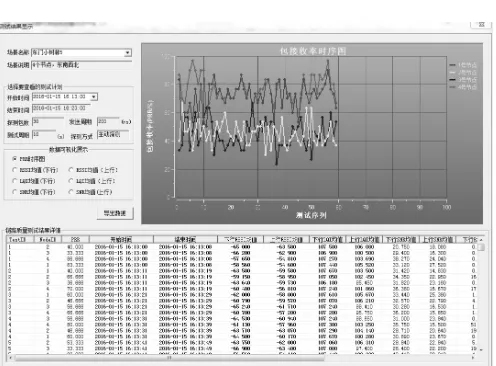
The testbed consists of a single-hop network with four TelosB TX (transmitter) nodes and one TelosB RX (receiver) node positioned in outdoor and indoor environments, re-spectively. These nodes are equipped with a CC2420 wireless transceiver chip designed according to IEEE802.15.4. The RX node is connected to a computer via a USB port. We developed link quality test platform to monitor and analyse the experimental results (Fig. 2). The software tools we used include MATLAB and SPSS. Experimental parame-ters are shown in Table 2.
4.1. Design of Experimental Scenes and Data Collection
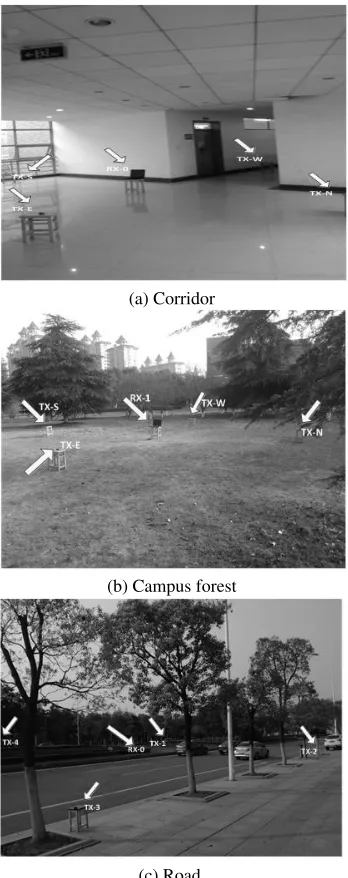
In WSNs, sensing data is easily affected by environmental noise, channel interference and multipath propagation in the process of transmission. In order to guarantee the diversity of the data samples and consider the influence of various interference sources, the exper-iments are conducted in three scenarios, such as a corridor in a building, a forest on the university campus and a road (Fig. 3). In each scenario, a miniature star WSNs network is deployed to test the link quality.
Table 2.Testbed parameter settings
Parameter Value
Transmit 0 dBm
Channel 26
Modulation mode DSSS-O-QPS
Transmission speed 250kbits/s
Number of packets 30
Packet sending interval 0.2 Second
Test cycle 10 Senconds
Number of nodes 4
Location East,West,South,North
(a) Corridor
(b) Campus forest
(c) Road
affected by multipath propagation caused by obstacles. The road scene simulates intel-ligent transportation applications. Here, interference mainly comes from environmental noise, which subjects radio link signals to reflection, refraction and diffraction, etc..
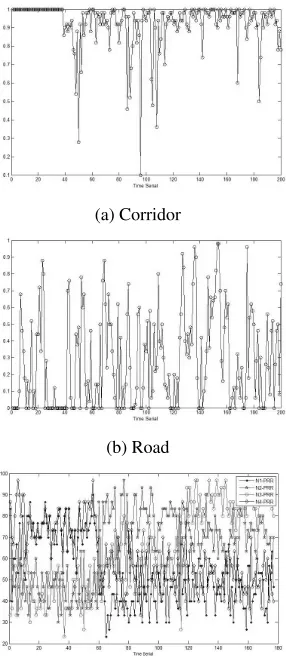
Experimental data are collected from all scenes, and PRR timing diagrams are drawn using MATLAB to facilitate analysis of the WSNs link characteristics (Fig. 4).
(a) Corridor
(b) Road
(c) Campus forest
Fig. 4.The PRR in different scenes
four of the PRR timing diagram. Compared with the road scene, the interference in the campus forest is static, and the sources are mainly multipath propagation caused by trees, stones and other obstacles. Therefore, the volatility of the link quality is relatively large, but the communication link is relatively stable with relatively small burst.
4.2. Experimental Results of Link Quality Parameters Classification
The S GCT algorithm is used to classify link quality parameters on the basis of different link quality parameter data sets. The corresponding Gauss curves and digital features are shown in Fig. 5 and Table 3 to Table 6. As we can see, different link quality parameter data sets result in different levels.
Table 3.Digital features of the cloud classification of SNR
Concept Expectation Entropy Hyper-entropy CD
Lower 5.0 3.10 0.30 0.29
Low 16.1 1.70 0.20 0.35
Medium 22.2 1.30 0.20 0.46
High 29.1 2.70 0.40 0.44
Higher 32.3 3.0 0.50 0.50
As shown in Table 3, SNR finally generates 5 concepts. The distribution of the first four concepts’ expectation is relatively dispersed with less confusion degree. The fifth concept has highest confusion degree and its expectation is close to that of the fourth concept. Meanwhile, it can be inferred that SNR is not particularly good at distinguishing very good links from very good links.
Table 4.Digital features of the cloud classification of RSSI
Concept Expectation Entropy Hyper-entropy CD
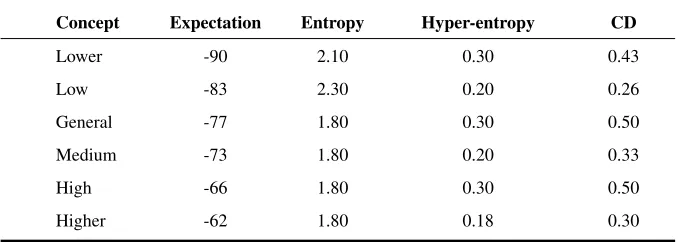
Lower -90 2.10 0.30 0.43
Low -83 2.30 0.20 0.26
General -77 1.80 0.30 0.50
Medium -73 1.80 0.20 0.33
High -66 1.80 0.30 0.50
(a) SNR Gauss curve
(b) RSSI Gauss curve
(c) LQI Gauss curve
(d) PRR Gauss curve
As shown in Table 4, RSSI finally generates 6 concepts. The distribution of the all concepts’ expectation is relatively uniform. When RSSI is low, its confusion degree is relatively small, which shows that RSSI has better ability to distinguish the lower links from the low links. Compared with SNR and LQI, the entropy and hyper-entropy of RSSI is small, which shows that RSSI has better ability to distinguish link quality than SNR and LQI.
Table 5.Digital features of the cloud classification of LQI
Concept Expectation Entropy Hyper-entropy CD
Very low 64 2.6 0.30 0.35
Lower 71 2.5 0.30 0.36
Low 79 3.0 0.40 0.40
General 83 2.7 0.35 0.39
High 90 2.1 0.25 0.36
Higher 97 2.0 0.15 0.23
Very high 106.9 3.0 0.50 0.50
As shown in Table 5, LQI finally generates 7 concepts. The confusion degree of the all concepts expectation is relatively high. While LQI has a smaller granularity, the ex-pectation of low concept and general concept are close, and LQI is hard to distinguish the lower links from general links.
Table 6.Digital features of cloud classification of PRR
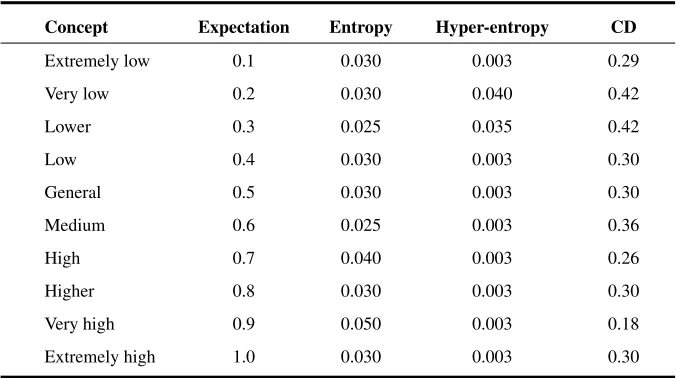
Concept Expectation Entropy Hyper-entropy CD
Extremely low 0.1 0.030 0.003 0.29
Very low 0.2 0.030 0.040 0.42
Lower 0.3 0.025 0.035 0.42
Low 0.4 0.030 0.003 0.30
General 0.5 0.030 0.003 0.30
Medium 0.6 0.025 0.003 0.36
High 0.7 0.040 0.003 0.26
Higher 0.8 0.030 0.003 0.30
Very high 0.9 0.050 0.003 0.18
As shown in Table 6, PRR finally generates 10 concepts. The distribution of the all concepts’ expectation is uniform very well. The entropy of all concepts is almost same, and the CDs of all concepts are lower, which indicate PRR has good ability to distinguish the link quality.
Compared with SNR, RSSI and LQI, the entropy and the hyper-entropy of PRR are the lowest, which means link layer parameters of WSNs are the best indicator of link quality.
4.3. The Experimental Result
According to the current trend of the link, the cloud reasoning-based link quality predic-tion algorithm we proposed is practical and effective. In order to verify the effectiveness of the prediction algorithm, we select two 50 groups PRR prediction obtained by SPRR and the proposed prediction algorithm respectively. The SPRR is based on the principle of WMEWMA. Int this experiment, the window size to 5, the factor is set to 0.5, the value of the previous historical time is set to 5. The experimental results are shown in Fig. 6.
Fig. 6.Comparison of SPRR, PRR and CT-PRR
In Fig. 6, M-PRR represents the experimental measurement values of PRR, and SPRR represents the PRR prediction values based on the SPRR prediction algorithm. CT-PRR represents the PRR prediction values based on cloud reasoning-based link quality predic-tion algorithm. The experimental results show that the two predicpredic-tion algorithm have little difference in stability. For the prediction of sensitivity, the CT-PRR values are relatively good, such as predicted values in sample interval 22 to 24 and sample interval 35 to 40. Because the cloud model of the time series takes into account both short- and long-term time dimensions, CT-PRR relative to SPRR can predict the dynamic link more effectively.
5.
Conclusions
a Gaussian cloud transform algorithm. By establishing association rules between physical layer parameters (RSSI, LQI, SNR) and the link layer parameter PRR, we can use LQI, SNR and RSSI information to predict the future PRR values. Compared with the existing method based on WMEWMA, the experimental results demonstrate that the proposed algorithm more accurately captures link changes, leading to more stable predictions of link quality.
Acknowledgments.This work is supported in part by the National Natural Science Foundation of China (Grant No. 61363015, 61762065, 61501218, 61262020), the Jiangxi Natural Science Foun-dation of China (Grant No. 20171ACB20018, 20171BAB202009, 20171BBH80022), the Key Re-search Foundation of Education Bureau of Jiangxi Province (Grant No. GJJ150702), and the Inno-vation Foundation for Postgraduate Student of Jiangxi Province(Grant No. YC2016-S356).
Grateful thanks are due to the participants of the survey for their invaluable help in this study.
References
1. Agrawal, R., Srikant, R.: Fast algorithms for mining association rules in large databases. In: the 20th International Conference on Very Large Data Bases (VLDB), San Francisco, USA, pp. 487–499 (1994)
2. Baccour, N., Kouba, A., Youssef, H., Jama, M.B., Rosrio, D.D., Alves, M., Becker, L.B.: F-lqe: A fuzzy link quality estimator for wireless sensor networks. In: the 7th European Conference on Wireless Sensor Networks (EWSN), Coimbra, Portugal, pp. 240–255 (2010)
3. Guo, Z.Q., Wang, Q., Wan, Y.D., Li, M.H.: A classification prediction mechanism based on comprehensive assessment for wireless link quality. Journal of Computer Research and Devel-opment 50(6), pp. 1227–1238 (2013)
4. Jiang, R., Li, D.Y., Chen, H.: Time-series prediction with cloud models in DMDK. Journal of PLA University of Science and Technology 1574(2), pp. 525–530 (2000)
5. Keshavarzian, A., Uysal-Biyikoglu, E., Lal, D., Chintalapudi, K.: From experience with indoor wireless networks: A link quality metric that captures channel memory. IEEE Communications Letters 11(9), pp. 729–731 (2007)
6. Liang, W., Huang, Y., Xu, J.B., Xie, S.Y.: A distributed data secure transmission scheme in wireless sensor network. International Journal of Distributed Sensor Networks 13(4), pp.1–11 (2017)
7. Liang, W., R, Z.Q., Tang, M.D.: A secure-efficient data collection algorithm based on self-adaptive sensing model in mobile internet of vehicles. China Communications 13(2), pp. 121– 129 (2016)
8. Liu, T., Cerpa, A.E.: Foresee (4c): Wireless link prediction using link features. In: the 10th In-ternational Conference on Information Processing in Sensor Networks (IPSN), Chicago, USA, pp. 294–305 (2011)
9. Liu, T., Cerpa, A.E.: Talent: Temporal adaptive link estimator with no training. In: the 10th ACM Conference on Embedded Network Sensor Systems (SensSys), Toronto, Canada, pp. 253–266 (2012)
10. Marinca, D., Minet, P.: On-line learning and prediction of link quality in wireless sensor net-works. In: the 59th Global Communications Conference (GLOBECOM), Austin, USA, pp. 1245–1251 (2015)
11. Mitra, S., Roy, S., Das, A.: Parent selection based on link quality estimation in WSN, In: the 2nd International Conference on Computer and Communication Technologies (ICECCT), Tamil Nadu, India, pp. 1245–1251 (2016)
13. Pengwon, K., Komolmis, T., Champrasert, P.: Solving asymmetric link problems in WSNs us-ing site link quality estimators and dual-tree topology. In: the 13th International Conference on Electrical Engineering/electronics, Computer, Telecommunications and Information Technol-ogy (ECTI-CON), Chiang Mai, Thailand, pp. 1–4 (2016)
14. Qiong, Y.E., Li, S.W., Zhang, Y.H., Shu, X.W., Ni, D.P.: Cloud model and application overview. Computer Engineering and Design 32(12), pp. 4198–4201 (2011)
15. Rekik, S., Baccour, N., Jmaiel, M., Drira, K.: Low-power link quality estimation in smart grid environments. In: the 11th International Conference Wireless Communications and Mobile Computing (IWCMC), Dubrovnik, Croatia, pp. 1211–1216 (2015)
16. Shu, J., Tang, J., Liu, L.L., Hu, G., Liu, S.: Fuzzy support vector regression-based link quality prediction model for wireless sensor networks. Journal of Computer Research and Develop-ment 52(8), pp. 1842–1851 (2015)
17. Sikora, A., Groza, V.F.: Coexistence of IEEE802.15.4 with other systems in the 2.4 GHz-ISM-Band. In: the 20th Instrumentation and Measurement Technology Conference (IMTC), Ottawa, Canada, pp. 1786–1791 (2006)
18. Wang, Y., Martonosi, M., Peh, L.S.: Predicting link quality using supervised learning in wire-less sensor networks. ACM SIGMOBILE Mobile Computing and Communications Review 11(3), pp. 71–83 (2007)
19. Woo, A., Culler, D.: Evaluation of efficient link reliability estimators for low-power wireless networks. In: UCB Technical Report. pp. 1–20 (2003). [Online]Available: https://www2.eecs.berkeley.edu/Pubs/TechRpts/2003/CSD-03-1270.pdf (current July 2017) 20. Zhao, Y., Li, S., Hou, J.: Link quality prediction via a neighborhood-based nonnegative matrix
factorization model for wireless sensor networks. International Journal of Distributed Sensor Networks 2015(1), pp. 1–8 (2015)
Chenhao Jia received the Bachelor degree in electronic and information engineering from the Jiangxi University of Science and Technology, Ganzhou, China, in 2015. He is currently a postgraduate, Internet of Things Technology Institute, Nanchang Hangkong University, Nanchang, China. His research is focused on wireless sensor networks.
Linlan Liu received the Bachelor degree in computer science from the National Uni-versity of Defense Technology, Changsha, China, in 1988. Currently, she is a full Pro-fessor, Internet of Things Technology Institute, Nanchang Hangkong University, Nan-chang, China. She was a Visiting Scholar at Wilfrid Laurier University, Waterloo, Ontario, Canada. She has authored/coauthored more than 60 papers. Her research interests include wireless sensor networks and embedded system.
Xiaole Gu received the Bachelor degree in electronic engineering from the Nanchang Hangkong University, Nanchang, China, in 2013, He is currently a postgraduate, Internet of Things Technology Institute, Nanchang Hangkong University, Nanchang, China. His research is focused on wireless sensor networks.
Manlan Liureceived the Bachelor degree in information engineering from the Linyi Uni-versity, Linyi, China, in 2015. She is currently a postgraduate, Internet of Things Technol-ogy Institute, Nanchang Hangkong University, Nanchang, China. Her research is focused on wireless sensor networks.