RESEARCH ARTICLE
A STUDY ON IMPACT OF SOCIAL MEDIA ON CONSUMER BEHAVIOR
*1
Muthiah, S. and
2Dr. Kannan, K.V.
1
Happy Valley Business School, Velandavalam Road, Off - Palakkad Highway, Coimbatore - 641 105, India
2Department of Business Administration, Government Arts College, Dharmapuri, Salem District, India
ARTICLE INFO
ABSTRACT
Research Issue: Who are the people interacting online and how engaged are they in online activities?
Research Objective:
To study the factors which influence the impact of social media on consumer behavior
To analyze the impact of demographic variables on purchase behavior using social media
To classify the social media users based on their social media activities
Research Tools: Factor analysis and One way Anova
Findings: To identify the different types of users, a segmentation of these users and a linear model to
examine how different predictors related to social networking sites have a positive impact on the respondents perception of online advertisements.
Practical Implications: This study suggests different approaches for online marketers and managers
looking to invest in advertising on social networking sites and hence improve their ads’ performance regarding clicking the advert and generating positive reactions towards it.
Copyright © 2015Muthiah and Kannan.This is an open access article distributed under the Creative Commons Attribution License, which permits unrestricted
use, distribution, and reproduction in any medium, provided the original work is properly cited.
INTRODUCTION
In recent years the online environment is viewed by users from a new perspective, in a commercial way. Its development and the emergence of online stores have turned users into consumers. Also the most important role of social media has changed the way of how consumers and marketers communicate. Informational society influences affects the consumer decision processes and product evaluations. Social media provides a new channel to acquire product information through peer communication. Moreover, by using social media, consumers have the power to influence other buyers through reviews of products or services used. Consumers are also influenced by other psychosocial characteristics like: income, purchase motivation, company presentation, company or brand's presence on social networks, demographic variable (age, gender, income etc.), workplace method of payment, type of stores (online or physical), etc.
This paper covers the impact of social media on consumer behavior. The emergence of Web is one of the most formidable developments in the history of commerce. Social media, another buzzword that came along with, is an evolution based on the Web, where not only it encourages user-generated contents, but also extends the focus to the users by allowing them to exhibit contents to share among networks.
*Corresponding author:Muthiah, S.,
Happy Valley Business School, Velandavalam Road, Off - Palakkad Highway, Coimbatore - 641 105, India.
This particular technical revolution during the last decade has drastically revolutionized the traditional marketing approaches and brought marketers to a new era. In the new marketing era, the social media has likely to revolutionize the relationships marketers have with retailers, channels of distribution, their ultimate consumers, etc. It is an Information Age, and consumers are inundated with overwhelming quantities of information each and every day. Based on the findings from McKinsey (2011), it has revealed that when companies go about their business and interact with individuals, they are generating a tremendous amount of digital “exhaust data,” i.e., data that are created as a by-product of other activities. Social media sites, smart phones, and other consumer devices have allowed billions of individuals around the world to contribute to the amount of big data available.
Social media such as Facebook, Twitter and YouTube are dynamic tools that facilitate online relationships (Golden, 2011). It is a relatively low cost form of marketing and allows organizations to engage in direct and end-user contact (Kaplan and Haenlein, 2010). Given the choices made available to consumers and the influential role of social media marketing, the brands and consumers have a changing role to play in the organization’s strategy in that they now have an economic impact (Lindermann, 2004; Mayfield, 2008). Brands influence customer choice. Customers influence other customers. These chains of events affect repurchases, which further affect future earnings and long term organisational sustainability (Oliveira and Sullivan, 2003).
ISSN: 0976-3376
Vol.06, Issue, 12, pp.2151-2156, December,Asian Journal of Science and Technology 2015SCIENCE AND TECHNOLOGY
Article History:
Received 16th September, 2015
Received in revised form
24th October, 2015
Accepted 06th November, 2015
Published online 30th December, 2015
Key words:
In particular, peer communication through social media, a new form of consumer socialization, has profound impacts on consumer decision making and thus marketing strategies. Consumer socialization theory predicts that communication among consumers affects their cognitive, affective and
behavioral attitudes. Social media, especially social
networking sites, provides a virtual space for people to communicate through the internet, which also might be an important agent of consumer socialization.
This research provide insights to the social media literature and online consumer behavior, in general, and online socializing and interacting activities users engage with on a virtual platform, which are interesting for both academics and online marketing practitioners. The aim of this research is to empirically investigate what type of social media users appreciate and have a positive outlook regarding advertising on social networking websites. Particularly, this study considers a segmentation of social media users. Finally, in the last section of the paper, the contributions of the research, the managerial implications, and limitations of the research has been provided.
By looking at the enormous amount of social media campaigns, e-commerce websites, sales emails, forums, etc., it appears that companies of all sizes have been translating their marketing approaches to the Internet because of its accessibility to their target audience and the money required to do so. (Chui and Manyika 2012.) By contrast, the traditional advertising approach of mass media communication, for instance newspaper, magazines, and televisions, aims at 7 conveying messages to a broader group of audience in the hope of reaching the few interested ones.
With more stimuli bombardments, individuals are more cautious and adept in allocating attention to information; thus it is essential for marketers to find the reasons that speak to particular customers’ concerns, and to seek ways to speak to customers individually, or in smaller communities. Internet offers favorable solutions to marketers these days. Marketing through social media would be an alternative perspective of interfacing with individuals, and yet the most influential applications of social technologies in the global economy are largely untapped. Social media puts consumers back to the center of the business world and provides marketers a new set of tools to interact with consumers and to integrate them into the brands through innovative ways. In essence, marketers have to understand how the social media has influenced consumer buying behavior.
Social Media can be defined as a group of Internet-based
applications that is build on the ideological and technological foundations of the Web and that allow the creation and exchange of user-generated content. Social media is
ubiquitously accessible, and enabled by scalable
communication techniques. As social media become more and more prevalent, connecting people and facilitating the exchange of information, consumer behavior is shifting. Through social media, consumers now can easily watch an interesting advertisement on YouTube, while posting their own opinions on Twitter and sharing it with friends on Facebook. Therefore, it’s necessary for the service providers to understand how social media is affecting current consumers
and how they are going to react. In this new era, one-way messages to the customers are simply not enough. Today’s customer can be heard loud and clear. The customer’s voice can be heard everywhere, including review websites, blogs, YouTube videos, Tweets, Facebook updates, and other social media outlets. And the companies have to pay attention because social media is changing the way customers do business. It’s influencing the entire buying process. If they don’t pay attention, they risk losing customers.
The advent of social media has opened a new avenue of marketing for corporations. The traditional 'word-of-mouth' publicity has been replaced by the 'word-of-web', as consumers are increasingly referring to social media sites before making a purchase, greatly influencing buying behavior. Though most companies these days have an official website which has complete information about their products, consumers usually engage with a company after reading reviews and feedback from hobbies, shopping, support etc) interest (Food, fashion, family recreation) and opinions (about themselves, Business, Products). Before buying a product, every consumer wants to make sure that the product is the best in its class, and offers good value for money. Advertisements don't always give a fair idea, as almost every company claims its product to be the very best. This is where social media plays an important part in defining consumer behavior. People who have already used the product describe their experience - its strengths, weaknesses etc., and this helps in disseminating information. People are more likely to trust those who give an impartial account of a product rather than a celebrity who is paid to endorse the product. Social media enables people from all over the world to form a community of consumers, giving them the power to harm or herald a company.
Consumers today serve as retailers on eBay, media producer-directors on YouTube, authors on Wikipedia, and critical reviewers on Amazon; they do all of this and more on Facebook and YouTube. And they no longer require their computer to do so– through high-tech mobile phones, portable computers and portals such as Twitter, real-time information exchange has become an integral element of consumer behavior anywhere and anytime. User-generated content has become a mass phenomenon, with Facebook, MySpace, YouTube, Wikipedia, and Twitter. From the consumers’ viewpoints, it’s convenient and easy to get the desired information from the enormous database of social media. Only by a few clicks, users can collect nice photos on Flickr, watch the latest drama on YouTube or download the PDF file of an engaging novel from Book Crossing. The best of all is that it’s all for free! Therefore, it’s quite understandable that consumers would search for freebies online first rather than directly go to online or physical shops. For the retailers, the good news is that it’s possible for a product or service becomes popular overnight on social media, which reduces tremendous marketing and promotion cost. However, the downside is that it becomes more difficult for retailers to manage the copyright-protected materials sharing between the uncontrollable users.
Consumers now own increasingly unrestricted time and space for sharing and possess access to timely and frequent updates as per the change in the market. Due to the transparency and the reliability of social media, consumers became more and more powerful than before. Most of the consumers would gather information first on the social media before an
important purchasing. Plus, the ever-changing new
technology, such as smart phones, further enhanced this power, which placed consumers in an advantageous position regarding purchasing. To deal with this situation, the retailers should dump the past preconceptions about the consumers and the out-of-date marketing models. Instead, they have to stand in the consumers’ shoes and try to engage as many people as possible in an interactive way.
Customers are being influenced by social media and the companies want them to be influenced positively, they need to build a strong social media presence. That doesn’t mean spamming a bunch of people. Building a strong social media presence requires consistency. It requires actually engaging with the company’s target demographic, building relationships that help the company to earn their trust and their business. And it requires having actual goals and strategy for social media campaign by the company.
MATERIALS AND METHODS
Research Design
As stated in the beginning of the research, the researcher tries to examine the relationship between social media and consumer behavior from a consumer perspective, therefore, there are many questions subjected to individuals’ beliefs and attitudes, which are expressed in the form of scale questions. Considering the matter of subjectivity, the use of close questions was critical in order to allow statistical conclusions to be made in a relatively objective manner; likewise, a few open-ended questions allow individuals to develop own responses, and may reveal attitudes or facts. It is empirical research which studies the influence of social media on consumer buying behavior.
Sample Method
The most frequently used approaches for statistical analysis of survey data and estimation of input/output relationship using rank analysis and factor analysis are based on Convenience sampling method for data collection. Unfortunately simple random sampling is rarely practical in large scale surveys.
Sample Size
The primary data for the study is collected from the pre-tested interview schedule. The samples are chosen by the method of Convenience sampling without sample replacement. 220 samples have chosen from the study area which is Coimbatore.
Population
The respondents who had purchased from the online and these respondents from Coimbatore area are selected as respondents for this research. A pilot survey was carried out in the field situation to assess the effectiveness and consistency of the
questionnaire. The pilot survey was done in the different convenience areas of the study. The sample was selected by using Convenience sampling method. Many observations were raised on different questions after the pilot survey. Some questions were modified after the pilot surveys. And at the final stage some questions were found irrelevant and therefore dropped from questionnaire. This way it was tried to ensure a complete and uniform data for the study. The questionnaire used in this study was developed in English, but interview schedule was used when necessity demanded.
In order to validate the questionnaire for data collection, the data gathered from pilot survey was used and reliability test had been administered for the same. The reliability coefficient of the questionnaire was computed using Corn Bach’s Alpha and the value is 0.912, which shows that the instrument is reliable.
Tools and Techniques used for Analysis
For the purpose of analyzing the data, appropriate statistical techniques are used in consultation with the research supervisor. In the analysis part of the present study is made by using the various statistical tool tests namely, Rank Analysis, Factor analysis, Descriptive Analysis, ANOVA (analysis of variance).
1. Factor Analysis
The main applications of factor analytic techniques are: (1)
to reduce the number of variables and (2) to detect
structure in the relationships between variables, that is
to classify variables. Therefore, factor analysis is applied
as a data reduction or structure detection method
2. Analysis of variance (ANOVA)
Analysis of variance (ANOVA) is a collection of statistical models and their associated procedures and in which the observed variance is divided into components due to different explanatory variables. Model for a simplified ANOVA with one type of treatment at different levels is shown here.
SS Total = SS Error + SS Treatments
The number of degrees of freedom (abbreviated df) can be partitioned in a similar way and specifies the chi-square distribution which describes the associated sums of squares.
Df Total = df Error + df Treatments
Case Processing Summary
N %
Cases Valid 20 100.0
Excludeda 0 .0
Total 20 100.0
a. List wise deletion based on all variables in the procedure.
Reliability Statistics
Cronbach's Alpha N of Items
Analysis and Findings
The following table and charts gives the results of the research. The Descriptive statistics and factor analysis results are presented below:
From the above table and chart it is inferred that the majority of the respondents who uses FB is contributing about 65.5%, Twitter is contributing about 11.8%, LinkedIn is contributing about 5.5% ,Instagram is contributing about 6.4%, YouTube is contributing about 10.9%. and the chart below shows the time spent on social media by the respondents per week.
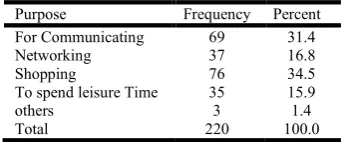
Table No.2. Table showing the usage of social networks sites
Purpose Frequency Percent
For Communicating 69 31.4
Networking 37 16.8
Shopping 76 34.5
To spend leisure Time 35 15.9
others 3 1.4
Total 220 100.0
From the above table and chart it is inferred that the majority of the respondents who uses the social network sites For communicating is about 31.4%,for networking is about 16.8%,for shopping is about 34.5%,for spending leisure time is about 15.9% and for others 1.4%. After undergoing the Factor Analysis, using the Principal Component Analysis and the Varimax Rotation Method with Kaiser Normalization, five factors emerged. These five factors represent the basis for an understanding of the respondents’ activities on social media sites.
Factor 1- Reliable and interactive factor Factor 2-Social media as Advertisement tool Factor 3- Social media as Informative tool Factor 4- Blogivity
Factor 5- Social media interactivity
Table No.5. Table showing the purchased items based on the ads on social media
Items Frequency Percent
Electronic Gadgets 84 38.2
Apparels 84 38.2
Home and Kitchen wares 30 13.6
Books and Media 19 8.6
Baby and kids products 3 1.4
Total 220 100.0
After undergoing the Factor Analysis, using the Principal Component Analysis and the Varimax Rotation Method with Kaiser Normalization, four factors emerged.
Table No.1. Frequency of social media users
Social Medias Frequency Percent
FB 144 65.5
Twitter 26 11.8
LinkedIn 12 5.5
Instagram 14 6.4
YouTube 24 10.9
Total 220 100.0
Table No.3. Factor analysis of social media behavior
Statements 1 2 3 4 5
Advertisements through social media are more Interesting than traditional advertising. .877
Social media advertisements are more interactive than traditional advertising. .820
Social media is a effect and powerful platform for consumers to communicate with each other and with the companies.
.834
I change my attitude towards a particular brand/ product/ service after reading a positive comment. .845
I use social media to view online Advertisement. .729
I use social media to seek opinions about product/services .798
Social media advertising is more informative than traditional advertising. .922
Social media advertising is more informative than traditional advertising. .855
Organizations that use social media for marketing purpose are more innovative than others who are not using it. .817
I am a regular reader of blogs on Internet. .934
I use social media to write blogs. .929
I use social media for interacting with others .781
Table No.4. Factor analysis of social media activities
Statement Factor 1 Factor 2 Factor 3
Adding labels (or) tags to photo online .672
Contribution to online forums and discussion groups .706
Voting on various sites .721
Watching / uploading video on YouTube .695
Search for information on social media .765
Adding comments to various blog spots .815
Adding comments to other people's social media profile .823
Table No.6. Ranks of social media used more
Social Media Rank 1 Rank 2 Rank 3 Rank 4 Rank 5 Total Sum Rank
Face Book 145 41 16 6 12 220 359 1
Twitter 13 34 72 49 52 220 753 3
Online Forum/ Community Blogs 13 44 46 57 60 220 767 4
Social book marking sites 20 34 37 68 61 220 776 5
These four factors represent the basis for an understanding of the respondents’ activities on social media sites. The respondents that formed the first factor have been named
Expressers and Informers. They get involved in the online
environment but they are mostly focused on them, on providing information about themselves through blogging, Twitter and uploading wiki articles. However, Expressers and Informers are individuals who stay current, particularly by using the RSS, and then by staying current with different sources of information. The second factor is entitled Engagers
because they seek and read different forums and reviews, but they also get involved by posting comments and reviews, rate sites, products and services.
They always what to know more, but they also want to let others know about their opinions regarding different subjects. The third factor has been entitled Networkers or Socializers
because they are particularly involved in social media sites like Facebook, Twitter workers are very vocal and engage in actions like updating their profiles regularly, posting comments to their friends and tagging pictures. The final factor has been named Watchers and Listeners because it consists of internet users who have a minimum activity online.
They only choose to engage in online activity that are entertainment-driven, namely watching movies, TV shows, videos, listening to music, and download music or video. From the above table it is inferred that the majority of the respondents who purchase in social network sites on Electronic Gadgets is about 38.2%, Apparels is about 38.2%, Home and Kitchen wares is about 13.6%, Books and Media is about 8.6% and Baby and kids product is about 1.4%. From the above table and chart it is inferred that the Facebook carries rank one, among the respondents.
Suggestions
Today, any marketer or business owner understands the importance of internet marketing. Marketing a business on the web implies leveraging social media to create a lot of buzz in relation to a brand. Social media platforms offer immense possibilities for fostering relationships with consumers in an online environment. This study suggests different approaches for online marketers and managers looking to invest in advertising on social networking sites and hence improve their ads’ performance regarding clicking the advert and generating positive reactions towards it. One approach implies understanding the sources of trust in online information provided by sources social media users may or may not know, and how their concern for privacy influences their reactions to online advertising.
Managers should be aware of the importance of social media sites in influencing online shopping by identifying and targeting different types of customers and taking initiatives to recognize and highlight customer interests. In order to be successful in social media marketing, companies need to create a buyer persona and then develop and constantly adjust the online marketing strategy according to the interests of customers for long-term success. Figuring out what goes best for which particular audience leads to success. Regarding these aspects, companies can use online reputation systems in order to provide the right online incentives to the right online
customers (Dellarocas, 2010). True customer engagement means commitment-focused, not transaction-focused. The companies that master this aspect are the ones that are truly successful. They undergo continuous online marketing research and must be sensitive to changes in consumer behavior patterns and to identify new areas of consumer values and interest.
Conclusion
This research is subject to some limitations which may provide fruitful avenues for future research. Firstly, certain limitations arise from the choice of the sample and the measurement of the variables used. Regarding the sample choice, this study presented responses gathered from people form a small city. The respondents do not, therefore, reflect customer attitudes and behaviors related to social media users in other countries. Moreover, given the sample, the research did not include in its analysis demographic variables, such as sex, age, social class, and ethnicity. Therefore, this is another area in which the research could be improved and extended, perhaps using these demographic variables as mediation variables.
The buying decision of the respondents is much more affected by Facebook than any other Social Networking Website. Additionally, the continuous increase of the amount of time people spend online directly affects their behavior in sharing and interacting. Accordingly, we reason that influence from social networks on individual behavior may become even more important in the future. We see strong tendencies how the individual consumer’s shopping behavior may be affected and changed by the emergence of social networks.
This is backed by the observation that numerous web-based social communities have allowed consumers to share their personal experiences by writing reviews, commenting and rating others’ reviews for many years now. However, it became also clear that consumers are more likely to believe recommendations from people they know and trust, friends and family-members, rather than strangers or recommender systems.
REFERENCES
Akrimi, Y. and Khemakhem, R. 2012. What Drive Consumers to Spread the Word in Social Media? Journal of Marketing Research and Case Studies, 2012, 1-14.
Al Kailani, M. and Kumar, R. 2011. Investigating Uncertainty Avoidance and Perceived Risk for Impacting Internet Buying: A Study in Three National Cultures. International Journal of Business and Management,6(5), 76-92.
Anandya and Dudi, 2010. The Direct and Indirect Effect of Exchange to Build Customer Loyalty in Social Network Sites, September 22,http://ssrn.com/abstract=1680754. Brengman, M., Geuens, M., Weijters, B., Smith, S. M., and
Swinyard, W. R. 2005. Segmenting Internet shoppersbased on their Web-usage-related lifestyle: a cross-cultural validation. Journal of Business Research, 58,79-88. Drury, G.N. 2008. Social Media: Should marketers engage and
Evans, D. 2008. Social Media Marketing: An Hour a Day. N.J, USA: John Wiley and Sons.
Weber, L. 2009. Marketing to the Social Web: How digital customer communities build your business. Second Edition. N.J, USA: John Wiley and Sons.
Weinberg, T. 2009. The New Community Rules: Marketing on the Social Web. Sebastopol, CA: O’Reilly Media Inc. Zarrella, D. 2010. The Social Media Marketing Book.
Sebastopol, CA: O’Reilly Media Inc.