RESEARCH ARTICLE
SOCIO-ECONOMIC ANALYSIS FOR THE IMPACT OF ADOPTION & DIFFUSION OF MAJOR
VEGETABLE CROP (ONION) IMPROVE SEEDS AT JEBEL MARRA RURAL DEVELOPMENT PROJECT-
CENTRAL DARFUR STATE-SUDAN
1
Abduelsalam Gumaa Abduelaziz,
1Hussein Mohamed Badawi,
1Fteemaezzeldin and
2,*Mohammed Abdallah Teabin
1
Department of Agricultural Extension and Rural Development, Faculty of Agriculture, University of Zalingei,
Zalingei Town, Central Darfur State, Sudan
2
Department of Agricultural Economics, Faculty of Agriculture, University of Zalingei, Zalingei town, Central
Darfur State, Sudan
ARTICLE INFO
ABSTRACT
This study was carried out from 2012- 2014 at Jebel Marra rural development Project (Central Darfur State)-Sudan. To assess the impact of grassroots participation on how it facilitates the adoption and diffusion of agricultural innovations packages (improved onion seeds). As well as how personal characteristics equipped impact on adoption and diffusion of new technology packages transferred among the targeted population.
To achieve the objectives of this study, the area were divided into three clusters: Zalingei, Wadi Salih and Nyertete respectively. Targeted farmers were selected followed: accidental simple random sampling due to security situation. Beside geographical division for the purpose of questionnaire distribution and filled by 200 farmers. Who constitute 10% of the sample size to represent the studded population at the (State Level)? To who were mostly internally displace persons (IDPs), in camps due to Darfur Crisis since (2003). Observation field visits and market survey was used during the study was followed up. Data analyzed used, Statistical Packages for Social Sciences (SPSS), table’s repeatability and percentages. The results were discussed with comprehensive interpretation and summarized comments.
Study revealed that three over four of the targeted farmers are men while before (JMRDP) intervention in1980, onion growers were predominantly women. Therefore, further studies and researches are needed to develop strategies encouraging women effective participation in adoption and diffusion of agricultural innovations packages practices.
In addition to agricultural lands is under the lease systems that reduced women participation in agricultural practices. The study showed that the area of onions agricultural land was expanded and the agricultural inputs prices were gradually increased mainly onion improved seeds. In addition to irrigation tools and cultivation of land preparations taxes was increase due to mechanized system introduced instate of man power before by using hand digging hoe (touria). The outcome of the study identified the gap of assets which is difficult to psoriasis by population self-reliant. This study reviewed the literature of project and focused on the impact community participation in the adoption and diffusion of agricultural technologies, on its historical long run operated background benefited the study succession.
The identification of the role of the major farmers (key informant) whom they hold and handling what they learn previously as a new technology from the JMRDP specialist concern adoption and diffusion tool as important element, for identifying and alleviating the constraints affecting adoption and diffusion of agricultural innovations. The study used community participation element and analyzed the role of farmers in knowledge transferred and skilled learned. This study showed that successful technology adopted and transferred is dependent on the equipped of wide range of factors, the most important being the network of research centers, training and development farmers groups that come from origin villages background and indigenous knowledge. Farmers’ characteristics like sex, farm size and land ownership. Access promotion of information, environmental awareness, membership in local groups, and utilization of social networks emerge as some of the variables that are more often positively associated with adoption of technologies. Likewise complexities of technologies, labour constraints, and weak policies have negative and significant influences on the technology transferred. The study recommended that farmer’s adoption rates will be improved by subsidies on strengthening influential farmers’ networks and promoting technology into communities with genuine support and supervision from the government institutional and intervention of university extension, research centers and contact farmers partnership.
The study also recommended that farmers were knowledgeable enough to continue and hold transferring technologies to the others counterparts, including newly acquired knowledge and expertise through their participation in the activities and programs of the Jebel Marra Rural development project which they received from their previous rural resettlement sites or origin villages.
Finally, the study recommended that: social analysis for women group as gender analysis is requested to strengthen their role on agriculture. Assessing policies and formulating new technology that environmentally, socially accepted like Jebel Marra Animal Traction (JMAT) Donkey Plough. The continuations of financial support were requested for the project. On the other hand promotion and develop the principles, methods that raise up the efficiency of work and strive to provide improved onion seeds production locally as well as means of irrigation and pest control materials with agricultural research funding opportunities to expand and bring out an ideal development with tingable results on the grassroots level of the rural community to promote their welfare on the base of worldwide standards and measurements.
Copyright © 2015Abduelsalam Gumaa Abduelaziz et al.This is an open access article distributed under the Creative Commons Attribution License, which
permits unrestricted use, distribution, and reproduction in any medium, provided the original work is properly cited.
INTRODUCTION
Socio-Economic Analysis for the Impact Adoption & Diffusion
Normal continuation growth of the communities elsewhere; Local Government-officials and community leaders are
*Corresponding author: Mohammed Abdallah Teabin,
Department of Agricultural Economics, Faculty of Agriculture, University of Zalingei, Zalingei town, Central Darfur State, Sudan.
constantly challenged by the need to balance fiscal, social, economic, environmental goals and needs. One aspect of this challenge is deciding how much and what types of new development the community can accommodate without compromising the day-to-day quality of life for residents and nomads groups whom their system were affecting with the seasonal changes (shifting Methods). Socio-economic impact analysis is designed to assist communities in making decisions
ISSN: 0976-3376
Asian Journal of Science and Technology
Vol.06, Issue, 11, pp.2010-2018, November,2015
SCIENCE AND TECHNOLOGY
Article History:
Received 14st August, 2015
Received in revised form 05th September, 2015
Accepted 02ed October, 2015
Published online 30th November, 2015
Key words:
that promote long-term sustain-ability, including economic prosperity, a healthy community, and social well-being in general services meanly the social wince. Socio-economic impacts analysis requires both quantitative and qualitative measurements of the impact of a proposed development. For example, a proposed development may increase employment in the community and create demand for more affordable housing. Both effects are easily quantifiable to introduce changes. Also of importance, however, are the perceptions of community members about whether the proposed development is consistent with a commitment to preserving the rural character of the community.
Analyzing community perceptions about development requires the use of methods capable of revealing often complex and unpredictable community values as customs and traditions to consider. This paper provides an overview of socio-economic impact analysis, including what it is, why it is important and guidance on how to conduct a socio-economic impact
assessment analyze the gathering data under
consideration. Because socio-economic impact assessment is designed to estimate the effects of a proposed development on a community’s social and economic welfare, the process should rely heavily on involving community members who may be affected by the development introduce either top down or bottom up approach. Others who should be involved in the process include community leaders and others who represent diverse interests in the community such as community service organizations, development and real estate interests, minority and low income groups, and local environmental components. In addition, local agencies or officials should provide input into the process of assessing changes in the social environment that may occur as a result of the proposed development (e.g.,
providing estimates and information demographics,
employment and service needs). Furthermore need
assessments is essential within community participation umbrella to find out plans with their priorities included and agreed on to follow what they mentioned.
Central Darfur State which The Jebel Marra Rural Development Project is allocates. Within the period of Darfur
Crisis (2003) basically social services sectors and
infrastructures were damaged in their nine localities. Therefore official and non official efforts mostly and highly in need to be shared in a manner that the community welfare must repack or bring back as development aspects to occur. Through preparatory need assessments with gender base analysis (GBA), in the whole project area of the (JMRDP) In order to be adaptive for livelihoods of the community and modulate in a mutter of the resources around to represent the situation view according to the future perspectives.
MATERIALS AND METHODS
Study area: Jebel Marra area was described and documented in many reports (FAO, 1968 Mohamed, 1997 and Adam, 1998) which diversity in climate, soil and crops and animals (Salam, 2014). The high massif of mountains modifies its climate and increases the amount of participation, particularly on western slopes. Rainfall normally occurs during may- September with more than 60% of the rain occurring July-Auguest.the variation in the amount of the annual rainfall is very limited.
Temperature decreases by approximately 6 C per 1000metres rise (FAO1968). The average maximum temperature is about 30C while the minimum is around 6 C (Mohamed1997). The importance of Jebel Marra from an ecological view and from the great potential resources it has, makes it a rich area for study and development. The total area of Jebel Marra is estimated to be about 2000km2. And Great Darfur is about 549000km2 with the size of the population approximately eight million (Dosa, 2013).
Sampling and data collection
To success the study achievements the whole area were divided in to three sectors mainly: Zalingei, Wadisalih and Nyertete which are mostly base of internally displacement persons (IDPs) Camps temporary. Approximately 2000 farmers in the State level practices agricultural activities, so the study targeted 10% for sample size to enable distribution of the questionnaire form for 200farmers by accidental random selection and geographically directed. Primary and secondary methods used, followed by observations and direct contact with farmers during field survey were covered.
Data analysis
The data from the questionnaire survey were analyzed using statistical packages for social sciences (SPSS), joint with frequency table’s repeatability percentages.
RESULTS AND DISCUSSION
The current project area had been changed according to the newly establish of state which basically divided from the western Darfur. Now the whole project map covered the Central Darfur State (2012). The results of the socio-economic survey indicated the status of some of the main aspects that highlight important personal characteristics of the respondents of study as showed below to represent and model zed the overall study results.
Availability of Land Cover and Use
Mostly the farmers mentioned were rain fed agriculturalist traditionally used the three major agricultural systems operated in Darfur: sedentary rain-fed agriculture, sedentary irrigated agriculture, and nomadic pastoralist. Northern Darfur consists
primarily of three ecological zones: goz (sandy soil areas);
wads (areas around water resources that fill after rainfall); and
tobacco (tobacco-growing area). The northernmost zone is the
most ecologically fragile of the three and the most acutely impacted by drought. Southern Darfur consists primarily of three agrarian zones: agro-pastoralist in semi-arid savannah; agro-pastoralist with high production; and agro-pastoralist and cash crop (mainly groundnuts). The central belt of Darfur, including the Jebel Marra massif (approximately 8000 feet high), is the richest and most stable area in terms of soil fertility and water resources available.
The progress of Agriculture in Darfur
Various studies indicated the ability of the Fur people to adopt mechanisms to cope with the changing environmental conditions what is known (climate change) and food crisis. Expansion in cultivated area to compensate for the decline in
grain production, (Elnour, 2007), which is initiated the
practice on vegetable production mainly Onion to avoid the shortage of rainy season crops production. Jebel Marra is an important place in Darfur region and in the Sudan, rich with diversity of resources. It is characterized by abundant plants, trees, animals and fertile land. The plenty water flowing down from the large catchment location, Jebel Marra mountain constitutes the most important water catchment and forms the North-South divide separating the Nile and lake Chad Basins
(FAO1968” Mie he 1986). In 2003, the majority of the
Sudanese population depended on subsistence agriculture, which employed over 80% of the workforce and contributed
35 %t of the nation’s Gross Domestic Products(GDP).
The economy of Darfur is also largely agrarian. Its main
consumption crops are millet, followed by sorghum. Groundnuts, tobacco, vegetables, and watermelons are the main cash crops. Before (2003), the main household food sources were localized subsistence agricultural production (45–60%), livestock (10–30%), and market purchases (15– 30%). Most communities farm according to the following calendar: planting in July- August, weeding in September - October, and harvesting in November-December, sometimes January. Vegetables normally need less time to ripen than cereals. Majority of the Sudanese population depended on subsistence agriculture, which employed over 80% of the workforce and contributed 35 %t of the nation’s Gross Domestic Products (GDP).
Table1.Consist the head of localities sample size that the targeted respondents were represented three sectors. The two localities Wadisalih and Nyertete according to natural similarities and population activities mainly in rainy season are divided equally with the sample size. To match the other side in Zalingei to complete the total number 200 of the respondents studied.
According to the climate and soil type these three localities classified the communities in to different types of activities, In Zalingei rainy season and winter is basic. But in the other two localities there is a similarity which is rainy season, crops grown like millet, sour gum, sesame and groundnut…etc. and for example Onion is the main annual crops grown under irrigation winter season, particularly in the Alluvial Valleys and the lower mountain slopes (JRDP, Annex 1V Agriculture, December 1977).
Table 2. Distribution of gathered Respondents according to their cumulative State level Sample
Central Darfur State ( CDS) Freq %
Sample Size was 10% from the targeted farmers 200 100
Source: Field Survey, 2014
Table 2. Showed 10% of sample size from the state level Central Darfur State (CDS) consist nine localities named as (Zalingei, Azoum- Nyertete, Golo and Rokero - Wadisalih, Bendisi, Mukjar and Umdohken). As Mentioned above, the climate and Natural factors classify the agricultural activities among the communities. But there is a similarity between sector (B and C) in Agricultural crops practices in the rainy season. For Sector A and B there is a similarity in soil type and water basement, but usage of this of sources is defer in both of it.
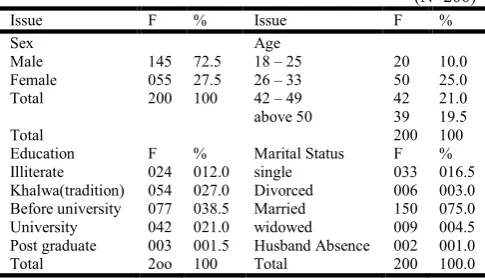
Table. 3Showed that: 72.5 % respondents were male and 27.5
% Female and this variation Indicate that the methods of agricultural facilities has been changed and highly priced like mechanizes used, Land rent and improved seeds adopted, in addition to displacement situation. Family responsibilities and ability to pay the taxes of tools or agricultural in puts male have a wide chance more than female also in lawns and bank
Total Numbers of households, farmers and population estimate for dry season 1988 in the project Area with and added population estimate of IDPs (2014)
Name of the Council HHs Farmers Popul= IDPS/ HH
Nyertete Locality Centre ) 9399 21901 69838 40688
Golo- sub unit 6067 13286 33125 Non*insecurity
Rokero ( Locality 7329 16637 48812 Non*insecurity
Zalingei ( Head of the State ) 15103 35642 96355 124449
ZamiBaya (Wadisalih area) 8134 20578 47989 67360
Mukjar (Locality) 13746 30242 76292 23606
Azum ( Locality ) 13826 32905 79635 7352
Zalingei Town ( Locality ) 7157 9117 35788 2258 ** UoZ
Umdohken ( Locality ) 36600 22000 183000* 65756
Bendisi( Locality ) 37000 18000 185000 *** 19744
Total 154361 220308 855834 351213 * WFP
Source: Jebel MRDP Post harvests Survey -1988 Updated in2014 with the last added Colum/each ** Source: University of Zalingei. September, 2011***HH=HAC/ August2015 *Commissioner Office 28August2015
Table 1.Distribution of Respondents according to
their locality
Localities Freq %
Zalingei (Head of State) 100 50.0
Wadi Salih (Head of other three localities) 050 25.0
Nyertete ( Head of other two localities) 050 25.0
Total 200 100
Table 3. Distribution of respondents according to their sex, age, educational level & marital status
(N=200)
Issue F % Issue F %
Sex Age
Male 145 72.5 18 – 25 20 10.0
Female 055 27.5 26 – 33 50 25.0
Total 200 100 42 – 49 42 21.0
above 50 39 19.5
Total 200 100
Education F % Marital Status F %
Illiterate 024 012.0 single 033 016.5
Khalwa(tradition) 054 027.0 Divorced 006 003.0
Before university 077 038.5 Married 150 075.0
University 042 021.0 widowed 009 004.5
Post graduate 003 001.5 Husband Absence 002 001.0
Total 2oo 100 Total 200 100.0
lends system share there for the cause need successful gender
analysis (SGA) for equal power sharing to strengthen women
participation.
61% respondents had formal education before university
up to post graduate followed by 27% of Khalwa traditional education system and 65.5% share in agricultural activity in compared with 21% university level involved in
agricultural activities looking for life standard
improvement
Showed that the Age of the respondent’s variations is range
between 33- 49 years which indicate that 50% of the respondents were youth and more productive in agricultural activities due to age factor and responsibilities. But 10% were under 18-25 years and most of them are school years students.
-75% of the respondents were married, it indicated that
their responsibilities let them to be well committed with agricultural activities and professionalism on the process by traditional background suitability in the whole state either to be farmer or mix with livestock herders. On the other hand single respondents followed by 16. 5% it showed the youngest groups among the targeted sample of study and not socially engages means youth. 8.5% were Divorced, widowed and Husband Absence.
Agricultural extension Services
52.5% of the respondents agreed that the extension unit presences in their areas, was decrease due to Darfur crisis (2003). 44.5% of respondents were represent residence in IDPs camp and not yet under extension services coverage. 3% of the respondents were not mentioned. What mentioned revealed that coverage done by the 60 extension services units? But changes happen after 1994 when Grater Darfur divided in to three States, which expand the coverage area by JMRDP.
73% of the respondents mentioned that the real number of field agents was one person per each agricultural extension unit and 12% they said two people per unit. But 15% of the respondents were said nothing. For technical assistant one field agent will cover 5-7 villages which is depend on households and distance between the villages. 60% of respondents showed that 1-2 villages were covered by one field agent and this should reflect that some villages were
displaced within (Darfur Crisis, 2003). But 40% of the
respondents were out of extension services due to Darfur resent situation. 55% of the respondents are used communication channels against 45% who did not used due the Darfur recent circumstances. Before the communication revolution in the year 2000 the project used the communication channels available like writing letters, office and field visits…etc.
78% of the respondents used this communication channels like: written messages, field visits and frequent office visits, But 22% said somehow. The project did a lot to success the signed goals through these methods which reflect the vice versa of community participation. 60.5% of respondents mentioned that the effective communication channels used as followed: training and field visits, 8.5% office visits and 28% no effective methods available, 3.5% did not answer.
Training and field visits both of it can be seen as educational methodology, because within behavior will change and new technology were transfer and adopt to diffuse.
95.5% of respondents mentioned that, they Progress on production by improved Onion seeds in the project area. 4.5% of the respondents were not mentioned. Al farms mostly introduced the improved onion varieties (Bafteam and American) with expansion of the crop land. 84% of the respondents mentioned that their area is suitable for Onion production; with long life experience and inclusive project activities were key factors which facilitated onion practice in the project area and 16% mentioned trade value influence. In sector B Wadisalih probably (certainly) awareness for the community is the priority because they follow the transitional trade and not much in the agricultural process.
Social Services and infrastructure situation in the Project Area
67% of the respondents mentioned that the population density in their areas ranged from very high to high, against 33% who said it was medium in density. The fact can classified in to two groups the first allow to be seen at that time when the villages was settled while the second revealed the case of the camps situation which shows the gathered people from deferent areas. 81.5% of the respondents mentioned that the number of households in their areas were above one thousand and half in the area of study. 18.5% of the respondents mentioned less than one thousand and half. It gives the same resemblance of previous results above, but due to Darfur crisis some of the households decrease regarding to war side effects. 96% of the respondents mentioned that education situation in the area were increased. And 4% of respondents said education situation decrease in the area. Education percentages increase gradually from 2003 up to now for many reasons like accessibility of school facilities, environment and teacher with quantity and quality in towns that the camps were is closed.
This result reflects the benefit of the improved onion seeds, due to early maturity and higher production (economic factors).
95.5% of the respondents had knowledge and background about agricultural innovations and according to the awareness, the respondents were chose these options: fertilizers and insecticides, improved onion seeds treated, animal traction tools used and advanced irrigation tools were introduced in the project area. And 4.5% were said nothing. The results show that the communities were aware about the innovations, due the right options selection.
Market Analysis in the Project Area
From the result intervention for investment will be allow mainly in the peak period according to the crop production higher rate is available to introduce other value chain process for the product to incentive farmers to increase their product and productivity. Footnote: Market survey gives very details picture on how much the whole area at the three sectors massage suggested, the priority is: initiation for intervention to establish advance stores investment process within the peak period of onion production, to support farmers and rice up the productivity vertically and horizontally through the adoption of agricultural techniques. The result also resemblance that March, April and May were show the suitable period of time that the investment my required for value chain process regarding Onion crop.
Onion Prices per Sector/ monthly- From December to November 2013/2014 Sector (A) Zalingei – Production Area / year 2014
Month Farm Price/SDG/Sac Market Price/SDG/Sac Remarks
Dec 630 660 New product Appearance
Janu 400 450 New production concussion
Feb 280 320 New production concussion
March 130 140 New production concussion
April 60 100 Peak production period direct market price
May 90 120 Start period of last harvest/ commerce or storage
June 220 230 Final Harvest time/ commerce or storage
July 300 350 Storing period
August non 460 Early onion growing
Sept non 400 Start period of cultivation / opening of stores
Oct non 650 opening of stores and commerce the old onion
Nove non 600 opening of stores and commerce the old onion
Resource: Field Survey with contact person the farmer / Jamal Mohammed Adam Abduelaziz, 2014
Onion Prices per Sector/ monthly- From December to November 2013/2014 Sector (B) Wadi Salih (Garsila) Medium production Area / year 2014
Month Market Price/ SDG/Sac Remarks
Dec 600 Direct market price
Janu 330 New production sailing
Febr 250 New production sailing
March 200 New production sailing
April 90 Peak production period not much Areas
May 100 Final harvest for the product
June 120 Start of rainy season
July 150 Rainy season crop period
August 500 Preparation of onion seedlings nursery
Sept 550 End of rainy season
Oct 600 Showers rain
Nov 650 Harvest of rainy season crops
Resource: Field Survey with contact person the farmer / Kaltoum Osman Abdelkareem, 2014
Onion Prices per Sector/ monthly- From December to November 2013/ 2014 Sector (C) Nyertete as a low production Area / year 2014
Month Market Price/SDG/Sac Remarks
December 320 Direct Market price
January 300 Direct Market price
February 240 Direct Market price
March 130 Direct Market price
April 130 Peak production period not much Areas
May 170 Peak production period not much Areas
June 200 Last harvest period
July 450 Start of rainy season
August 500 Heavy rainy season
September 550 End of rainy season
October 600 Showers rain
November 650
Sector (A) Zalingei –as a higher Production Area / year 2014
Sector (B) Wadi Salih (Garsila) Medium production Area / year 2014
Sector (C) Nyertete as a low production Area / year 2014
Agricultural Assistants by (INGOs) in Darfur during Vulnerable situation: War- affected population in Darfur, early 2008
State Total affected IDPs Residents
Northern Darfur 1.340.869 521.012 819.857
Southern Darfur 1.628.275 1.185.012 443.263
Western Darfur 1.301.235 745.952 555.283
Total 4.270.379 2.451.976 1.818.403
Source: OCHA
Number of Population Benefited from Humanitarian Agricultural Aid
Quantity of seed aid and number of beneficiaries reached over the years:
Like food aid, seed aid has been provided in Darfur since the beginning of the conflict in 2003. Between 2005 and 2011, FAO, the Government of Sudan, international Committee of the Red Cross (ICRC) and international NGOs distributed over 21433 tones of assorted crops seeds and over 84.99 tones of assorted vegetable seeds to over 3.500.000 IDPs returnees and vulnerable households (see the table below). In 2011, seed aid to Darfur witnessed a substantial decrease in volume as a result of good harvest realized in the 2010 summer season in addition to improvement in the security situation.
Volume of seed aid and number of beneficiaries – reached
Year Assorted Crop seeds
distributed / T
Assorted Vegetable seeds distributed / T
Total Number of beneficiaries
2005 2450 15.79 472030
2006 3742 13.00 660430
2007 4658 9.80 707258
2008 3520 15.81 700132
2009 2208 15.85 486261
2010 2657 12.23 346446
2011 2198 2.51 179383
Total 21433 84.99 3.551.940
Source: FAO, June 2011
Vegetables Prices in Khartoum 1n October 2015
Source: Next Day Daily News Paper, Khartoum, Sudan 15 October 2015, No= (955)
Conclusion
In addition, to reveal other relevant factors that will be developed and encouraged to strengthen the rural community in participation adoption and diffusion of improved onion seeds (JMRDP). The study concentrates on the trials of (JMRDP) to assess the successful of knowledge and innovations transfer to the targeted community. Appropriate sampling is essential for this purpose and careful studies are conducted to obtain meaningful generalization results. The study revealed that three over four (3/4) of the targeted farmers are men while before (JMRDP) intervention in1980, onion growers were predominantly women therefore, studies and research are needed to develop strategies to encourage women effective participation in adoption and diffusion of agricultural innovations packages.
The study recommended and highlighted the active need for involvement of private sectors and relevant institutions for investment and facilitation of timely deliverance of agricultural inputs, Such as improved onion seeds.
Recommendations
For National Ministry of Agriculture
To Update strategies and plans that will recover the needs
of the grassroots development gap, mainly in the field of agriculture and socio-development.
To Promote and activate the national plans that has
tangible effects on Agriculture and socio economic priorities.
To Engage national and state level plans with very close
coordination and consider priorities to confirm matching.
To Encourage the investment by community base
organization (CBOs) sector in the field of agriculture mainly vegetables production.
To Strengthen agricultural production marketing (export to
boarder countries).
For State Ministry of Agriculture
1/ To Assist and support Diffusion and adoption policies that related with the project recommended objectives.
2/ To Encourage Gathering of efforts between ministry of agriculture and the project in order to manage resources through coordination plans and optimal used of assets.
3/ To Recheck the project plans with continuous monitoring and evaluation system or tools.
For Jebel Marra Rural Development Project
To Strengthen agricultural extension services in the project
area and cooperate with agricultural research centers to promote innovations transfer, in order to diffuse and adopt.
Accommodation of improved onion seeds to be produce
locally.
Provision of irrigation tools mainly water pumps and
concrete wells.
Provision of insecticides and agricultural machineries,
furthermore creation of awareness among farmers is necessary to know how to manage it usages.
Rehabilitate the experimental centers to strengthen its
operation.
For UN Agencies & Donors
provision of fund facilities to rebuild rural development
project base that has socio-economic effects locally.
Cooperate and work together with grassroots organizations
to encourage community participation process.
For Further Research
Formulation of new assessments and surveys that will
adapted local situation in the present time to encourage the agricultural production investment.
Provision of water harvest programmes were requested in
the project area.
Encourage integrated rural development were requested in
the project area.
Strengthen the field work with demonstration farm, to
enable the scientific research succession.
Develop and maintain the vital feeder roads which linked
the production areas with the consumption locations.
Finally on the Historical Agricultural Point of View
The Green Revolution was the technological response to a world-wide food shortage which became threatening in the period after WWII. The Green Revolution transformed farming practice in many regions of the tropics and sub-tropics where the principal food crops were rice, wheat and maize, but the brief account that follows will be mainly focused on the Indian sub-continent. From 1900 to 2000, the amount of energy put into agriculture worldwide increased 80 times due to the shift from human and animal labor to the use of large machines. The increase in energy consumption and the dependency on more fossil fuels has resulted in pollution and has caused harm to the environment. In addition to the environmental impacts of the period, the Green Revolution also had impacts on society. As we now know, as a result of advances in agricultural technology, commercial farms were able to produce more food and sell it at lower prices. On the other hand, many small, low-income farms were not able to afford the new technologies and, therefore, did not reduce their costs or prices.
This made it very difficult for small farms to compete with commercial farms, and eventually many small farms were forced to sell their land. As they did so, a part of history and tradition in the United States was lost. Although the Green Revolution has been successful in producing more food, it is only a temporary solution. Some scientists are calling for a second Green Revolution, and are referring to it as the Doubly Green Revolution. In this revolution, they want to develop new technologies and agricultural methods that will increase overall production, through adoption and diffusion of new technologies, but will also conserve natural resources and limit the effects on the environment. By developing new technologies that are more sustainable, it may be possible to provide food for the ever-increasing population without destroying the environment.
REFERENCES
Abdel Muti Mohammed Assaf - Development Administration
(comparative analysis), the second edition-Kuwait
University.
Abdel Muti Mohammed Assaf, development and analytical study compared the management, calculated Library, College of Commerce and Economics, KuwaitUniversity-1998.
Abdu Mokhtar mosy, the Darfur crisis of state to the Great Powers, Aldararabh Sciences conflict, the first edition, Doha, Qatar 0.2009 m.
Abduelaziz Abduelsalam Gumaa 2010. Rural Development Project and Sustainability challenges case study at Jebel Marra rural development project MSc. Thesis. Sudan University of science and technology. 2/ Castro, A. P.; Taylor, D. ; Brokensha, D. W.
Agricultural Higher Education until 1950 were only four colleges in the two states Egypt / Iran.
Awad Ibrahim Abdurrahman Alhvian - the foundations of rural development and the role of agriculture in Sudan, Khartoum University House Publishing, i 1.1995 m. Badry, A.A.K. 1984. Horticulture production in the Sudan,
past, present and future. Acta Hort. 143:25-29.
Be hairy Zaki, the Darfur crisis and the repercussions of the assets of the International Criminal Court, Dar sun printing, Ain Shams-Egypt 0.2008 m.
Book Climate change and threatened communities:
vulnerability, capacity and action 2012 pp. 81-92 ISBN 978-1-85339-735-6 Record Number 20123247929
Branch, K., D.A. Hooper, J. Thompson, and J. Creighton. 1984. Guide to Social Assessment: A Framework for Assessing Social Change. Westview Press: Boulder. Burden, R.J. 1995. A Community Guide to Social Impact
Assessment. University of Illinois: Urbana.
Burden, R.J., P. Fricke, K. Finsterbusch, W.R. Freudenberg, R. Gramling, A. -Holden, L. Llewellyn, J.S. Petterson, J. Thompson, and G. Williams. 1995. Guidelines and Principles for Social Impact Assessment. Environmental Impact Assessment Review. 15:11–43. Elsevier Science, Inc.: New York.
Canter, L. W. 1985. Socio-economic Factors Used in Environmental Impact Studies. In Canter L.W., Impact of Growth: A Guide for Socio-economic Impact Assessment and Planning, pp. 328–394. Lewis Publishers: Chelsea, MI. Chadwick, A. 1995. Socio-economic Impacts 2: Social Impacts. In Morris, P. And R. Shrivel, Methods of Environmental Impact Assessment, pp. 29–49. University of British Columbia Press: Vancouver.
Chenoweth, R. 1999. Integrating information technologies for citizen-based land use decision-making. College of Agricultural and Life Sciences, University of Wisconsin. Christensen, K. Social Impacts of Land Development: An
Initial Approach for Estimating Impacts on Neighborhood Usages and Perceptions. The Urban Institute: Washington D.C. Environmental Protection Agency, Office of Wastewater Management and Region V. 1990. Urban Runoff Management Information/Education Products. OWEC (EN–366). Washington, D.C.
Department of Plant Genetics and Biotechnology, Horticulture Research International, Well seaborne CV35 9EF, UK. [email protected] 2002 Nov;
Federal Ministry of Agriculture and Forestry (2008), Annual reports (200-2008), Department of Horticulture.
Freudenberg, W.R. 1986. Social Impact Assessment. Annual Review of Sociology. 12:451–78.
Genief, A.A. 1984a. Purification and characterization of local hot peppers in Sudan. Acta Hort. 143:161-173.
Genief, A.A. 1984b. Tapping natural genetic variability of okra in the Sudan. Acta Hort. 143:175-181.
Genief, A.A., M.K. Ahmed, S.A. El Hussein and H.M.A. Dinnar. 1986.
Genief. 1984. Indigenous horticultural germplasm of western Sudan. Plant Genet. Resource. Newsl. 59:4-11.
Govindan Parayil, “The Green Revolution in India: A Case Study of Technological Change,” Technology and Culture, v. 33, no. 4 (1992), pp. 738-739.
Hassan, M.S., A.A. Genief, M.K. Ahmed, S.A. El Hussein, H.M.A. Dinnar and F. Attere. 1983. Horticultural crops collected in Sudan. Plant Genet. Resource. Newsl. 56:33-41.
Hassan, M.S., H.M.A. Dinnar, S.A. El Hussein, M.K. Ahmed and A.A.
Horticultural germplasm of northern Sudan. Plant Genet. Resource. Newsl. 64:10-13.
Husted, R.J., R. Shaffer, G. Plover. 1993. Community Economic Analysis: A How-to Manual. North Central Regional Center for Rural Development. Ames, Iowa. Jebel Marra project ten years of Rural Development –
Khartoum office 0.1990 m- Sudan.
Kamal Tabie - Studies in Rural Sociology, the Anglo-Egyptian Library, Cairo, i 1 ', 2001.
Lincoln and reportedly Kalssa- agricultural extension, Franklin Foundation for printing and publishing, Cairo, Egypt, i 1.1957, i 2.1963 m.
Mandoor Salam Fathallah, tools and techniques of education, the first edition - Saudi Arabia 2004.
Mohamed Awad Ahmed Saleh - agricultural extension - concept and application in the third world countries - University of Sennar, Sudan 0.2005 m.
Mohammad Omar Tnoby Akharon- and agricultural extension, National Library Aloutnah- Omar Al-Mukhtar University, Benghazi - Libya 0.1995 m.
Mohammed Aladdin Abdakadir- aware of contemporary Rural Sociology and recent trends in rural development studies, facility knowledge, of Alexandria, Egypt, 2003.
Mohammed Awad Jalaluddin - achieving sustainable
development and anti-poverty, Mohammad Omar
Basharelldrasat center of Sudan, Omdurman University civil 0.2003 m.
Mohammed, El Tahir Ibrahim. 1991. Okra genetic resources in Sudan. Pp. 34-35 in International Crop Network Series No. 5. IBPGR, Rome, Italy.
Nabil Mohammed Tawfiq Samalouti - development and modernization issues in the science of modern sociology, 1st Floor, 2nd Floor, Al-Azhar University, Egypt. Periodicals:
Nabil Ramzy Axander- development, how? ... And why? - Thought Dar University, Alexandria, Egypt - July 23, 1992 AD.
Ohm, B.W. 1999. Guide to Community Planning in Wisconsin. Department of Urban and Regional Planning, University of Wisconsin–Madison.
Onion Seed Production Techniques (FAO, 2010).
Rahim Ahmed Bilal - social issue and civil society in Sudan, Darazh for publication and distribution, Khartoum, Sudan 0.2005 m.
Recommended uses of pesticides (PhD), Pacific Tajuddin Sulaiman, Sudan University 0.2009 m.
Robert Chambers, rural development, put the top end, i 1, translation restricted age, Nicosia 0.1990 m.
Ryan, B. J. Braatz and A. Bruit. 1998. Retail Mix in Wisconsin’s Small Downtowns: An Analysis of Cities and Villages with Populations of 2,500–15,000. Center for Community Economic Development, University of Wisconsin-Extension.
Sabine Damkusky, seven steps of effective training (translation: Khalid Al Ameri,Daral-FaruqEgyptAdakky-St.,2009).
Salih Awad Omar, Moss am Basher, agricultural development strategies 0.2002 m.
Sayf al-Din Abdul Rahman Dawood - design and implementation of sustainable development projects, i 1, Kassala for printing and publishing, Sudan 0.2001 m. Source: Next Day Daily News Paper, Khartoum, Sudan 15
October 2015, No= (955)
Strategic annual report of 2004, the Center for Middle Eastern and African Studies - Kherzawm- Sudan. Master's thesis entitled:
Sustainable Development: (in conditions of underdevelopment and poverty which we live) Mohammed Awad Jalaluddin - Mohammad Omar Basher Center, 2007
The impact of participating in the activities of local organizations to have access to the means of production Master's thesis, University of Sudan, Hassan Mohamed Ahmed lamp 0.2004 m supervision: Badawi Mohammed Hussein.
The impact of productive activities to improve the situation of rural women, to the children of Fazul Abdullah, the supervision of the University of Sudan: Safe Ahmed mercy 0.2004 m.
The role of social services project in the island of rural development, Sohrhassan Mohammed Yasin, the Institute of Studies and Research Alanmaúah- University of Khartoum, 2008.
Trusty, W. 1999. Land use planning, design, and design review: essential components for maintaining countryside character. Prepared for the Planning Committee and Town Board of Lyons, Walworth County. January 6. Urban Land Institute. Development Impact Assessment. Chapter 6. Social Impact Analysis.