Available online on 15.11.2018 at http://jddtonline.info
Journal of Drug Delivery and Therapeutics
Open Access to Pharmaceutical and Medical Research© 2011-18, publisher and licensee JDDT, This is an Open Access article which permits unrestricted non-commercial use, provided the original work is properly cited
Open Access
Research Article
Formulation development and optimization of fast dissolving film
containing carvedilol nanocrystals for improved bioavailability
Anju Sharma*, Sriganesan P
Department of Pharmaceutical Sciences, RIMSR, CPAS, Kottayam , Kerala – 686009, India
ABSTRACT
In this work, fast dissolving films (FDF) were prepared using nanocrystal formulations in order to optimise dissolution properties of lipophilic, poorly soluble drug Cavedilol. Drug nanocrystals are crystals with a size in the nanometer range, meaning that they are nanoparticles with a crystalline character. Carvedilol nanosuspensions were prepared using a high-pressure homogenizer, and then encapsulated in to films by solvent casting method using polymers such as maltodextrin and PVA in different concentrations. Propylene glycol used as a plasticizer. This study aimed to develop and evaluate the formulation of FDF containing Carvedilol nanocrystals for enhanced bioavailability and better compliance. The formulation of FDF was optimized by Box-Behnken Design (BBD) (design expert 11.03).In this design, 13 formulas were performed. One of the formula were suggested by design expert desirability = 1.
Keywords: Carvedilol, Nanocrystal, FDF, Box-bhenken optimization, in-vitro drug dissolution study,
Article Info:Received 27 Sep 2018; Review Completed 25 Oct 2018; Accepted 27 Oct 2018; Available online 15 Nov 2018 Cite this article as:
Sharma A, Sriganesan P, Formulation development and optimization of fast dissolving film containing carvedilol nanocrystals for improved bioavailability, Journal of Drug Delivery and Therapeutics. 2018; 8(6):74-81
DOI:http://dx.doi.org/10.22270/jddt.v8i6.2017
*Address for Correspondence:
Anju Sharma, Department of Pharmaceutical Sciences, RIMSR, CPAS, Kottayam , Kerala – 686009, India
INTRODUCTION
Fast dissolving oral drug delivery system are solid dosage form which Fast-dissolving drug -delivery systems came into existence in the late 1970’s as an alternative to tablets, capsules and syrups for pediatric and geriatric patients who experience difficulties in swallowing traditional oral solid-dosage forms 1-5. Fast-dissolving oral delivery
systems are solid dosage forms, which disintegrate or dissolve within 1 min when placed in the mouth without drinking or chewing. They offer advantages such as administration without water, ease of swallowing, rapid onset of action and convenience of dosing. For fast dissolving active pharmaceutical ingredients, absorption is possible through the oral mucosa and may improve bioavailability1, 6-9.
One of the major problems associated with poorly soluble drugs is very low bioavailability.
The problem is even more complex for which are poorly soluble in both aqueous and non aqueous media, belonging to BCS class II as classified by biopharmaceutical classification system. Formulation as nanosuspension is an attractive and promising alternative to solve these problems. Preparation of nanosuspension is simple and
applicable to all drugs which are water insoluble. Advantages of nanosuspension are 8-11;
Enhance the solubility and bioavailability of drugs. Enhance the physical and chemical stability of drugs. Higher drug loading can be achieved.
Dose reduction is possible.
In this study, the nanosuspension was mixed with an aqueous solution containing fast dissolving film components and the final blend was casted by solvent casting method and dried, thus obtaining a nanocrystal-loaded FDF.
were used as film forming polymers in different concentrations and propylene glycol is used as a plasticizer. Mannitol was used as a sweetening agent. Cross povidone is as a super disintegranting agent, citric acid as a saliva stimulating agent to avoid pre systemic metabolism3, 4, 10.
MATERIALS AND METHODS Materials
The drug Carvedilol was purchased from Yarrow Chem Products, Mumbai. Maltodextrin was obtained from Tokyo Chemical Industry Co., Ltd, Japan. Span 80 was obtained from Chemdyes Corporation, Rajkot, Gujarat. The other chemicals and reagents used were of analytical grade.
Preparation of Carvedilol nanosuspension 3. 4. 12-15
Preparation CVD nanosuspensions were prepared by high pressure homogenization. 5% (w/w) CVD coarse powder was dispersed in water with 1% (w/w) Tween 80 and disintegrated into micro suspensions by a high shear homogenizer at 8000 rpm for 30 min. Obtained micro suspensions were homogenized at high pressure using a homogenizer with a pressure guage. At first, 6 cycles at 500 bar were conducted as pre-milling step, and then 30 cycles at 1000 bar were run to obtain the nanosuspension. The obtained nanosuspensions were Freeze dried or directly used to obtain fast dissolving films containing CVD nanocrystals.
Preparation of different formulations of fast dissolving
films 13-17
Fast dissolving oral films were prepared by using a combination of polymers by solvent casting technique. The formulations were prepared as per table no.1. The hydrophilic polymers namely Maltodextrin (MD) and Polyvinylalchol (PVA) were accurately weighed and dissolved in distilled water and propylene glycol (PG) was added as a plasticizer. Nanosuspension and other ingredients were added to the polymeric dispersion under constant stirring with a magnetic stirrer and the resultant homogeneous solution was poured into a petridish. Then the films were dried in an oven at 50ºC for 24 h. The dried films were wrapped in a butter paper, covered with an aluminum foil and kept in a desiccator.
Evaluation of Carvedilol nanosuspension 11-13
To evaluate the effects of formulation processes on drug crystalline properties, the solid state of bulk CVD, freeze dried CVD nanocrystals, CVD nanocrystal-loaded film was investigated by XRD and shape and surface morphology analysed by SEM .
Evaluation of Fast dissolving films 14-16
Physical appearance;
All the films were visually inspected for Colour, clarity, flexibility and smoothness.
Morphology study
The morphology of the films was studied using scanning electron microscope (SEM), at definite magnification. Thickness uniformity of the films
The thickness of the film (2×2 cm2) was measured using
screw gauge (thickness tester) at three different places; averages of three values and standard deviation were also calculated.
Surface pH
The surface pH of fast dissolving films was determined in order to investigate the possibility of any side effects in vivo. As an acidic or alkaline pH may cause irritation to the oral mucosa, it was determined to keep the surface pH as close to neutral as possible. The films were allowed to swell in closed petridish at room temperature for 30 minutes in 5ml of distilled water. Solution was placed under digital pH meter.
Folding endurance
Folding endurance measures the ability of patch to withstand rupture, higher the folding endurance lower was chance of film to rupture easily and vice versa. It was determined by repeatedly folding a small strip of film of 2×2 cm2at the same place until it broke. The number of
times the film could be folded at the same place without breaking/cracking gave value of folding endurance. Drug content Uniformity of the film
Drug content determination of the film was carried out by dissolving the film of 4 cm2 in 100 ml of pH 6.8 phosphate
buffer using magnetic stirrer for 30 minutes. The drug concentration was then evaluated spectrophotometrically at 241nm. The determination was carried out in triplicate for all the formulations and average with standard deviation was recorded.
Tensile strength
Mechanical properties of polymeric fast dissolving film were conveniently determined by measuring their tensile strength. Tensile strength of films was determined using an apparatus fabricated in laboratory. A small film strip (1cm2) was cut and fixed to assembly. The weight required
to break the film was noted and simultaneously film elongation was measured.
Tensile strength =
a, b, L = width, thickness and length of the strip. ΔL = elongation at break.
In-vitro disintegration time
In vitro disintegration time was determined visually in a beaker containing 25 ml of pH 6.8 phosphate buffer with swirling every 10 sec. The disintegration time is the time when the film starts to break or disintegrates.
In-vitro drug release
The dissolution study was carried out using USP basket type XXIV dissolution apparatus. The dissolution was carried out in 900 ml of pH 6.8phosphate buffer maintained at 37 ± 0.50C at 50 rpm. The samples (5 ml)
were taken at various time intervals and replaced with fresh buffer (pH 6.8) solution. The samples were filtered though whattman filter paper, diluted with buffer and analyzed by UV spectrophotometer at 241nm.
Stability studies
Optimization by BOX-BEHNKEN factorial design 5, 15 In this optimization design, three factors were evaluated, each at two levels. The independent factors were amount of Maltodextrin (X1) and polyvinyl alchol (X2) propylene glycol (X3) and the response variables were percentage drug release (Y1), Tensile strength (Y2). Thirteen formulations were prepared according to the Factorial
design. The responses obtained from the design matrix were statistically evaluated using statistical software trial package design expert 11.03
RESULTS AND DISCUSSION XRD Analysis
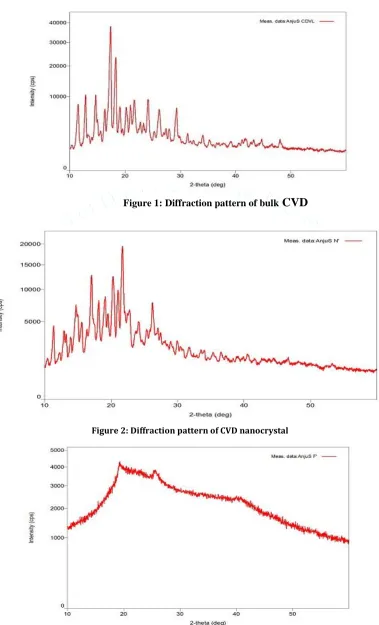
Figure 1: Diffraction pattern of bulk
CVD
From this study,The freeze-dried nanocrystal diffractograms showed some diffraction peaks attributed to crystalline CVD although a few peaks were shifted. The differences in peak relative intensities and the partial amorphisation are probably due to the high pressure homogenization process. Indeed, as pre-viously demonstrated, during homogenization, cavitation forces as well as collision and shear forces determine break down of the drug particles down to the nanometer range. The XRD pattern of pure drug Carvedilol shows peaks which are intense and sharp shows the crystalline nature of the drug. The XRD pattern of CVD nanocrystal loaded fast dissolving film showed undefined, broad peaks with less intensity The peak of diminished intensity shows the decrease in Crystallinity of the drug and the nature of the drug converted to amorphous form and thus improved solubility of the drug.
Shape and surface morphology SEM Analysis:
The surface morphology was observed by Scanning Electron Microscopy and was found to be as in the figure4,5,6. Nanocrystal (figure 5) s Film disclosed (Figure 6) a rough surface and showed, mixed with film matrix, several CVD nanocrystals arranged in different positions and orientations.
Figure4: SEM Analysis of bulk CVD
Figure5: SEM Analysis of CVD nanocrystals
Figure6: SEM Analysis of CVD nanosuspension loaded fast dissolving film
Optimisation of fast dissolving film
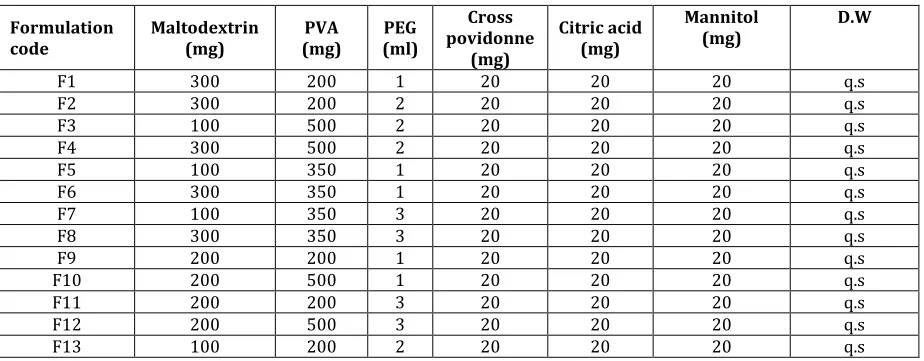
Table 1:formulation table for the fast dissolving film as per the factorial (adjusted) design
Formulation
code Maltodextrin (mg) (mg) PVA (ml) PEG
Cross povidonne
(mg)
Citric acid (mg)
Mannitol
(mg) D.W
F1 300 200 1 20 20 20 q.s
F2 300 200 2 20 20 20 q.s
F3 100 500 2 20 20 20 q.s
F4 300 500 2 20 20 20 q.s
F5 100 350 1 20 20 20 q.s
F6 300 350 1 20 20 20 q.s
F7 100 350 3 20 20 20 q.s
F8 300 350 3 20 20 20 q.s
F9 200 200 1 20 20 20 q.s
F10 200 500 1 20 20 20 q.s
F11 200 200 3 20 20 20 q.s
F12 200 500 3 20 20 20 q.s
In vitro drug release study
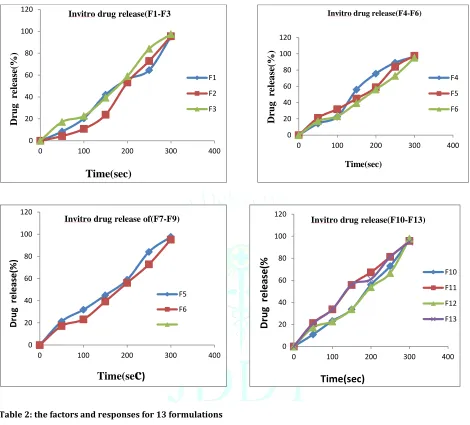
The in vitro drug release profiles of the formulations in pH 6.8 phosphate buffer show differences depending on their composition as given in following tables. A rapid
dissolution of all the film preparations was observed by the dissolution test, in whichabove 90% of CVD was released within 5 min. The formulation F8 shows maximum drug release (98.01) within 5 minutes
Comparison of thein-vitro drug diffusion profile of formulationsF1-F13
Table 2:the factors and responses for 13 formulations
FORMULATION
CODE
FACTORS RESPONSES
X1
Maltodextrin(mg) Alcohol (mg) X2-Polyvinyl X3-Propylene glycol(ml) release(%) Y1-Invitro Y2- Tensile strength (mg/cm2
)
F1 300 200 1 95.12 14253.2
F2 300 200 2 95.61 9661.8
F3 100 500 2 97.49 16483.5
F4 300 500 2 96.43 12558.8
F5 100 350 1 97.68 13300
F6 300 350 1 95.22 11111.1
F7 100 350 3 96.12 14128.7
F8 300 350 3 98.01 11235.9
F9 200 200 1 95.75 13227.5
F10 200 500 1 97.01 14814.8
F11 200 200 3 95.81 11441.6
F12 200 500 3 97.91 13550.1
F13 100 200 2 94.96 12374.5
0 20 40 60 80 100 120
0 100 200 300 400
F1
F2
F3
Time(sec)
Invitro drug release(F1-F3
Drug re lea se( %) 0 20 40 60 80 100 120
0 100 200 300 400
F4
F5
F6 Invitro drug release(F4-F6)
Time(sec) Drug re lea se( %) 0 20 40 60 80 100 120
0 100 200 300 400
F5
F6
Invitro drug release of(F7-F9)
Time(se
c
)
Dr u g r e lea se (% ) 0 20 40 60 80 100 120
0 100 200 300 400
F10
F11
F12
F13
Invitro drug release(F10-F13)
Tensile strength
Mechanical properties of polymeric fast dissolving film were conveniently determined by measuring their tensile
strength.The film film showing a good Tensile strength. The formulation F8 shows maximum Tensile strength 11235.9 mg/cm2
.
Contour plot and Response surface plot for the effect of Maltodextrin and PVA and PG on Drug release
Contour plot and Response surface plot for the effect of Maltodextrin , PVA and PG on Tensile strength
Development of the optimum batch
Based on the statistical evaluations the software suggested a good number of combinations of which we selected one as optimum batch.
Maltodextrin(mg) Propylene
Glycol(ml)
Polyvinyl
alcohol(mg) Tensile strength(mg/cm) In-vitro(%) release Desirability
300 3 350 11235.9 98.01 1.0
0 2000 4000 6000 8000 10000 12000 14000 16000 18000
F1 F2 F3 F4 F5 F6 F7 F8 F9
F1
O
F11 F12 F13
Evaluation of optimized formulation of Fast dissolving film
Appearance of films:
Appearances of films were evaluated by visual observation such as transparent or opaque. The fabricated films were thin, flexible, elastic, smooth and transparent.
Figure 7: Formuliation 8 Thickness of film:
Results showed that thickness of all formulations was varied from 0.19 to 0.26. Low deviation value in film thickness measurements ensured uniformity of patches prepared by solvent evaporation technique.
Surface pH:
The surface pH of the films was ranging from 6.72 -7.35. Since the surface pH of the films was found to be around the neutral pH, there will not be any kind of irritation to the oral mucosa.
Folding endurance:
In order to evaluate the flexibility, the films were subjected to folding endurance studies. The values were above 250 in all batches. This revealed that the prepared films were having capacity to withstand the mechanical pressure along with good flexibility.
Drug content uniformity:
The percentage drug content in optimised formulation found to be 98.78 ±0.64%. The drug content was found to be in acceptable range indicating uniform distribution of drug.
In vitro disintegration time:
In-vitro disintegration time studies as shown that films prepared had in-vitro disintegration time below 30 sec and was thus, acceptable in range.
Stability Study
From the results it was found that formulation F8 was the best formulation amongst the nine formulations. Thus formulation F1 was selected for stability studies. No major differences were found between evaluated parameters before and after storage and all were in acceptable limits. The formulations showed satisfactory physical stability at 40°C at 75 % RH
CONCLUSION
Carvedilol nanocrystal loaded fast dissolving films were successfully developed and evaluated. Nanocrystals of drug were prepared by thigh pressure homogenisation method using Tween 80 and water. It was evaluated for the XRD and SEM analysis. Fast dissolving films were prepared by using solvent casting method. Optimization of the prepared fast dissolving film was done by Box bhenken method using design expert 11.03.The optimized Films were found to be satisfactory when evaluated for thickness, in-vitro
drug release, folding endurance, drug content, disintegration time and Tensile strength .The surface pH of all the films was found to be neutral. The in-vitro drug release in optimized formulation F8was found to be 98.01% in 5 min and Tensile strength was found to be 11235.9mg/cm2. The optimized formulation F8 also
showed satisfactory pH, drug content (98.78 ±0.64 %), effective), disintegration time of 23 seconds and satisfactory stability. Fast dissolving film can be a potential novel drug dosage form for pediatric, geriatric and also for general population.
FUTURE ASPECT
Films with different compositions need to be studied.
By altering the methodology, we could further reduce the particle size, thereby improve the kinetic profile. Further studies including animal experiments need to
be studied for analyzing the efficacy of the formulation.
Further studies for the determination of an appropriate dose based on clinical trials.
REFERENCES
1. Liu C et al. Oral fast-dissolving films containing lutein nanocrystals for improved bioavailability: formulation development, in vitro and in vivo evaluation. AAPS PharmSciTech; 2017.
2. Francesco C et al. Fast dissolving films made of maltodextrins. Eur J Pharm Biopharm 2008:894-900.
3. Kranthi kumar V et al .Formulation and evaluation of Carvedilol fast dissolving sublingual films.IJPAR.2015; 4(2):116-128
4. Venkateswarlu1 et al Formulation Development and evaluation of Fast Dissolving Tablets of Carvedilol. J. Chem. Pharm. Res., 2010; 2(1):196-210
5. Chaudhary H et al Development and optimization of fast dissolving orodispersible films of granisetron HCl using Box– Behnken statistical design. Bulletin of Faculty of Pharmacy, Cairo University. 2013; 193–201.
6. PANDEY GS et al. Effects of Maltodextrin and Glycerin on Mechanical Properties of Oral Fast Dissolving Film of Salbutamol Sulphate. IJAPBC. 2014; 3(1):199-209
7. Jitendra P. Patel. K.R., Patel N.M. Review on Fast Dissolving Film. International Journal of Universal Pharmacy and Bio Sciences. Jan-Feb2013; 2(1):2319-8141.
8. Ravi Kumar K and Mercy Sulochana M, Fast dissolving films: a unique strategy for drug delivery. Asian J. Pharm. Res. 2014; 4(1):47-55.
9. Bankim Chandra Nandy et al An overview on fast dissolving drug delivery system. AJPSR. 2011; 2(1)
10. Yin J., Burgess C., Shu L., Shumyak S., Raymond N., Xu L., Li L., He S.M. Estrogen anchored nanomicelles for combinational drug delivery with enhanced therapeutic efficacy: a proteomics guided investigation for multifunctional nanotherapeutics. Journal of Drug Delivery and
Therapeutics, 2018; 8(2):41-53.
https://doi.org/10.22270/jddt.v8i2.1662
12. Suman Katteboinaa et al Drug nanocrystals: a novel formulation approach for poorlysoluble drugs. IJPRIF.2009; 1(3):682-694.
13. Francesco Cilurzo et al Nicotine Fast Dissolving Films Made of Maltodextrins: A Feasibility Study. AAPS PharmSciTec.2010; 11(4):1511-1517.
14. Patil P, Shrivastav SK. Formulation, evaluation and optimization of fast dissolving oral film of selective antihypertensive drug.WJPPS.2014; 3(8):996-1060.
15. Tandale KP. Fast dissolving strips: A novel approach for the delivery of verapamil. Journal of Pharmacy and Bioallied Science. 2010; 2( 4) 325-328.
16. Mohana. M. Nair, Shajan. A, Leena Jacob. Formulation and evaluation of mouth dissolving film of a poorly soluble antihypertensive drug International Journal of Pharmacy & Technology. 2016; 8(4):21635-21661.