INTRODUCTION
Biodegradation technology uses microorganisms to reduce, eliminate or transform the benign contaminants and their products which are present in soil, sediments, water and air. Evidence of kitchen middens (ancient household garbage dumps) and compost piles dates back to 6000 B.C. demonstrating that some form of biodegradation and bioremediation was practiced by humans since the beginning of recorded history. Biodegradation was used over 100 years ago with the opening of the first biological sewage treatment plant in Sussex, UK, in 1891 however, the word “Biodegradation” is fairly new; first appeared in a peer-reviewed scientific literature in 1987.
Biodegradation can be a cost efficient and reliable method for removing hazardous waste from heavily contaminated sites with organic compounds. For the last decade researchers have also discovered that biodegradation technology can be used at sites contaminated with solvents, explosives, polycyclic aromatic hydrocarbons (PAHs), and polychlorinated biphenyls (PCBs). More recently, researchers have discovered that microbial processes can be used to cleanup radioactive and metallic compounds.
Isolation and Characterization of
Bio-Degrading Bacteria from Soil Samples
T. ESWAR GANESH BABU and S.A. MASTAN
P.G. Department of Biotechnology, P.G Courses and Research Centre, DNR College, Bhimvaram - 534 202 (India).
(Received: March 20, 2011; Accepted: April 25, 2011) ABSTRACT
In the present study, a total of four species of biodegrading bacteria namely Bacillus subtilis, Eschericia coli, Staphylococcus aereus and Pseudomonas putida were isolated from soil samples collected from the sites where lead and mercury were discharged. The effect of various physico-chemical parameters on growth of these bacteria was also studied.
Key words: Biodegradation, Bacteria, Soil Sample.
Staphylococcus, Bacillus, Pseudomonas, Citrobacteia, Klebsilla, and Rhodococcus are organisms that are commonly used in biodegradation and bioremediation mechanisms. (Al-Maghrabi et al., 1998). These mechanisms include bioaugmentation, in which microbes and nutrients are added to the contaminated site, and biostimulation, in which nutrients and enzymes are added to supplement the intrinsic microbes of the site. For example Alcaligenes and Pseudomonas have been used in the biodegradation of chromium (Barkay and Colwell, 1983). Likewise, there are records that organisms like Escherichia and Pseudomonas are used in the biodegradation of copper (Barkay and Cowell,1983). Currently, more research is being performed on the use of microbes to degrade metals. It is anticipated that government as well as private industries will invest heavily to clean up polluted environments.
MATERIAL AND METHODS
Collection of Soil Samples for Bacterial Strains Isolation
The soil samples containing the bacteria were collected from different areas of Tadaepalli and Mangalagiri, Guntur District of Andhra Pradesh where there was an accumulation of the petroleum spills for Lead deposits and where as for Mercury degradation samples were collected from Seashore of Suryalanka, Baptla, Guntur District, and Andhra Pradesh. The soil sample was collected from a depth of 15 inches depth in to the soil where there was high moisture content, because the Bacteria need moisture content for growth. The soil sample collected was dispensed in the sterile bags and sealed and the sample was brought to the laboratory.
Screening of Lead and Mercury Degrading Bacteria
Soil samples were collected from the sites where lead and Mercury effluents were discharged. Different media like Nutrient Agar, Lauria Bertani agar plates containing Lead and Mercury to a final concentration of 5.0ppm and 7.5ppm respectively. Ten fold serial dilutions of the soil samples were made in distilled water and 0.1ml of 10-5 to 10-9
dilutions were plated on different media. The plates were incubated at 37°C for 24 hours and observed
for clearance of degradation surrounding the colonies after incubation. The colonies, which cleared the degradation, were transferred to similar agar plates containing 5.0ppm of Pbcl2 for single colony isolation of Lead degrading organism. In another set of plates 7.5ppm concentration of HgCl2 is used for Single colony isolation. The isolated colonies were streaked on Nutrient agar slants for growth and maintenance. Stock cultures were sub cultured monthly and stored at 4°C. The cultures were confirmed based on morphology by Grams staining and performing various biochemical tests. Identification of the Bacteria
The isolated bacteria were identified using different staining techniques and var ious biochemical techniques. Such as Gram Staining, Indole production test, Methyl red and Voges proskauer tests, Gelatin Hydrolysis (Production of Gelatinase), Starch hydrolysis, Oxidase Production and Catalase Activity.
Effect of various factors such as pH , temperature and Nacl concentration were also studied on growth isolated bacteria.
RESULTS
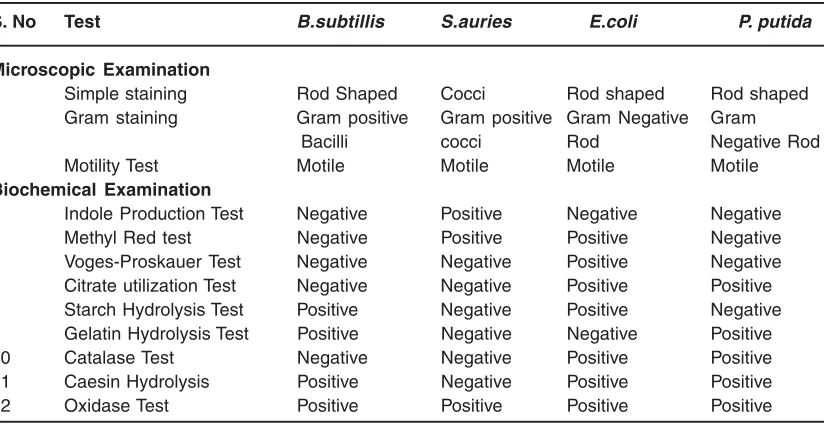
In the present study, a total of four species of bacteria were isolated from soil sample collected Table 1: showing physico-chemical parameters of heavy metals degrading bacteria
S. No Test B.subtillis S.auries E.coli P. putida
Microscopic Examination
1 Simple staining Rod Shaped Cocci Rod shaped Rod shaped
2 Gram staining Gram positive Gram positive Gram Negative Gram
Bacilli cocci Rod Negative Rod
3 Motility Test Motile Motile Motile Motile
Biochemical Examination
4 Indole Production Test Negative Positive Negative Negative
5 Methyl Red test Negative Positive Positive Negative
6 Voges-Proskauer Test Negative Negative Positive Negative 7 Citrate utilization Test Negative Negative Positive Positive 8 Starch Hydrolysis Test Positive Negative Positive Negative 9 Gelatin Hydrolysis Test Positive Negative Negative Positive
10 Catalase Test Negative Negative Positive Positive
11 Caesin Hydrolysis Positive Negative Positive Positive
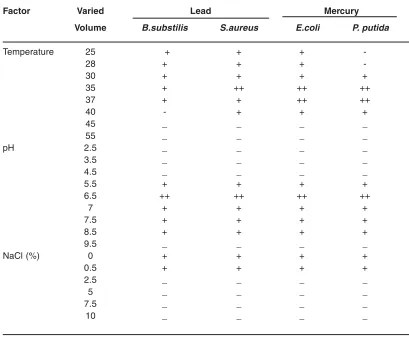
Table 1: Studies on the effect of Physico-chemical parameters (Temperature, pH and NaCl) on the growth of degrading bacteria Factor Varied Lead Mercury
Volume B.substilis S.aureus E.coli P. putida
Temperature 25 + + +
-28 + + +
-30 + + + +
35 + ++ ++ ++
37 + + ++ ++
40 - + + +
45 _ _ _ _
55 _ _ _ _
pH 2.5 _ _ _ _
3.5 _ _ _ _
4.5 _ _ _ _
5.5 + + + +
6.5 ++ ++ ++ ++
7 + + + +
7.5 + + + +
8.5 + + + +
9.5 _ _ _ _
NaCl (%) 0 + + + +
0.5 + + + +
2.5 _ _ _ _
5 _ _ _ _
7.5 _ _ _ _
10 _ _ _ _
from different areas of Tadepalli, Mangalagiri, Suryalanka, Guntur Dt. and Vijayawada Corporation, Andhra Pradesh. The isolated bacterial species were identified as Bacillus subtilis, Escherichia coli, Staphylococcus aureus and Pseudomonas putida. The morphological and biochemical characters exhibited by bacteria are given in the Table 1. Bacillus subtilis
From the microscopic examination it is found that Bacillus subtilis is a rod shaped gram positive bacterium and it is motile. All biochemical characters are identified through various tests which gave positive results to starch hydrolysis test, gelatin hydrolysis test, catalase test, casein hydrolysis and oxidase test and negative results to indole production test, methyl red test, voges proskauer, citrate utilization and catalase negative. (Table 1)
Eshcherichia coli
Morphological examination shows that E.coli is a gram positive, motile and coccus bacterium. It showed positive results to indole production test, methyl red test and oxidase test and showed negative results to Voges-Proskauer, citrate utilization, starch utilization, gelatin hydrolysis test, catalase test and casein hydrolysis. (Table 1) Pseudomonas putida
4.Staphylococcus aureus culture 3. Pseudomonas putida culture
2. E.coli culture 1. Bacillus subtilis culture
E. Coli
Above graph represents Bacillus which shows maximum growth between 2 to 4 hrs Bacillus subtilis
Staphylococcus aereus
Above graph represents Staphylococcus which shows maximum growth between 2 to 4 hrs Pseudomonas putida
Above graph represents E.coli which shows maximum growth between 2 to 4 hrs
Staphylococcus aureus
Staphylococcus is a gram positive cocci and motile bacter ia. Biochemical tests are performed with this strain and it has given positive results to methyl red test, voges Proskauer, citrate utilization, starch hydrolysis, catalase hydrolysis, casein hydrolysis and oxidase test and negative results to indole production test and gelatin hydrolysis test. (Table 1)
Effect of various physico-chemical parameters on growth of Bacteria
Effect of various physico-chemical parameters such as temperature, PH and NaCl were studied on the growth of degrading bacteria involved was carried out during the present investigation. The results obtained indicate the effect of physico-chemical parameters on the growth of the three bacteria involved in degrading lead and mercury, namely, Bacillus substilis, Staphyloccus aureus, and E. coli and P. putida.
Growth pattern of the Bacterial strain
Effect of temperature in the growth of bacteria All the bacteria involved in the present
study when autoclaved have shown good growth at temperature ranging between 25 to 40 degrees C while they have not shown any growth above 40 degrees C. Good growth rate was observed in between 35 - 37 degrees C in cultures of S. aureus, E.coli, and P. putida.
Effect of pH on growth of bacteria
All four types of bacteria are susceptible to the pH ranging between 5.5 and 8.5 and none of them showed growth below pH 5.5 and above pH8.5. Optimal growth of all the bacteria studied was noted at pH 6.5.
Effect of NaCl on the growth of bacteria Good growths of S. aureus, B. subtilis, E. coli and P. putida are obtained in 0 to 0.5 percentage of NaCl solution. Growth was not observed in 2.5 and above concentration of NaCl solution.
DISCUSSION
industrial process utilization metal as catalysts, have generated large amounts of aqueous effluents that contain high levels of heavy metals, these heavy metals include Cadmium, Chromium, Cobalt, Copper, iron, Mercury, Nickel, Silver and Zinc. Metal polluted industrial effluents discleavsed into sewage treatment plants could lead to high metal concentrations in the activated sludge.
Microbial population in metal polluted environment contain microorganisms which have adapted to toxic concentrations of heavy metals and become metal-resistance . At present, metal polluted industrial effluents are mostly treated by the chemical method such as chemical precipitation, electrochemical treatment and ion exchange. These methods provide only partially effective treatment and are costly to implement, especially when the metal concentration is low. Thus biosorption (which is removal using sorption into living/dead organisms) for the removal and recovery of toxic metals from industrial effluents can be economical and effective methods for metal removal. The metal removal ability of microorganisms including bacteria ( Bizily et al.,2000), microalgae and fungi (Bizily et
al.,1999)has been studied extensively. The heavy metal removal capacity is higher than those conventional methods. And uptake of heavy metals can be selective (Furukawa and Tonomura., 1972). Microbial cells can also be supplied inexpensively as waste in industrial fermentation processes as well as biological waste water treatment plants ( Bizily et al., 1999).
In the present study, the isolated bacteria exhibited the same biochemical characters described by Buchanan and Gibbon (1987). By virtue of these biochemical characters the isolated bacteria have confirmed up to the species level.
In the present investigation it has been found that different physico – chemical parameters such as temperature, pH and Nacl etc have their influence in the growth of bacteria. Good growth observed at 37°C temperature, while in case of pH 6.5 is optimum for the four species of bacteria. In case of Nacl for the four species of bacteria the concentration is 0 to 0.5 percentage of Nacl was favorable for the good growth of four species of bacteria.
1. Al-MaghrabiI. M.A,O.Chaalal and M.R.Islam, Thermophilic bacteria in UAEenvironment can enhance biodegradation and miligate wellbore problems.Proc.SPE. ADIPEC 98 , 228pp. Abu Dhabi (1998).
2. Barkay, T and R.R.Cowell. Altered mercury transpor t in mutant of Psedomonas fluorescens B69.J.Gen.Microbiol, 129: 2945-2950 (1983).
3. Bizily,SP,CL.Rugh and RB.Meagher, Phytodetoxification of hazardous organomercurial by genetically engineered plants. J. Nat. Biotech, 18: 213-217 (2000). 4. Bizily ,SP.CL.Rugh and A O.Summer and
RB.Meagher, Phytoremediation of methylmercury pollution ,merB expression in
Araabidopsis thhhhaliana confers resistance of organomercurials, Proc .Nat. Acad.of sci,96: 6808-6813 (1999).
5. Buchanan,R.E.and N.E.Gibbon, Bergeys Manual of determinative Bacteriology(8th )
Ed.,Baltimore,Williums and Welkins,New York,pp 2220 (1974).
6. Chang, JS, Hong, J.Ogunseitan, OA,Olson,BH, Interaction of mercuric ions with the bacterial growth medium and its effects on enzymatic reduction of mercury, J.Biotech.Prog. 9: 526-532 (1993).
7. Furukawa ,K and.K.Tonomura, Metallic mercury releasing enzyme in mercur y resistant Psedomonas, J. Agri. BiolL. Chemi. 36: 217-226 (1972).