A single cohort prospective trial of the immediate
effects of spinal manipulation on visual acuity
Michelle Athaide, BSc, DC, MSc
1Carol Rego, B.Kin (Hons), DC
1Brian Budgell, DC, PhD
21 Private practice, Toronto, Canada
2 Canadian Memorial Chiropractic College, Toronto, Canada
Corresponding author: Brian Budgell
Graduate Education and Research Programs, Canadian Memorial Chiropractic College 6100 Leslie Street, Toronto, Ontario, Canada M2H 3J1
Tel: +1 416 482-2340 ext 151 Email: [email protected] © JCCA 2015
Introduction: There is no high quality evidence on
which to judge the generalizability of isolated reports of improvement in vision following manipulation. The current paucity of research results also precludes the thoughtful design of a controlled, prospective clinical study. Hence, the purpose of the current study was to test the feasibility of conducting a clinical trial of the acute effects of spinal manipulation on visual acuity.
Methods: New adult patients presenting to a community based chiropractic clinic were recruited into a single cohort prospective trial to determine the immediate effects of cervical spinal manipulation on visual acuity.
Results: The experimental protocol was well accepted by patients and caused minimal or no disruption of the clinic routine. By some measures, chiropractic treatment was accompanied by statistically significant improvements in visual acuity.
Introduction : Il n’y a pas de preuves de grande
qualité permettant d’évaluer la généralisation de quelques rapports d’amélioration de la vision après la manipulation. La rareté actuelle des résultats de recherche empêche également la conception réfléchie d’une étude clinique éventuelle contrôlée. Par
conséquent, l’objectif de la présente étude était de tester la faisabilité d’un essai clinique sur les effets aigus de la manipulation vertébrale sur l’acuité visuelle.
Méthodologie : De nouveaux patients adultes
qui s’étaient adressés à une clinique chiropratique communautaire ont été recrutés dans une étude de cohorte prospective afin de déterminer les effets immédiats de la manipulation vertébrale cervicale sur l’acuité visuelle.
Discussion: The results of this study indicate that it is quite feasible to conduct a prospective, community based clinical study of the acute effects of spinal manipulation on visual acuity.
(JCCA. 2016;60(1):88-92)
k e y w o r d s: chiropractic; feasibility; pilot study;
visual acuity; spinal manipulation
Discussion : Les résultats de cette étude montrent qu’il est tout à fait possible de mener dans une communauté une étude clinique prospective des effets aigus de la manipulation vertébrale sur l’acuité visuelle.
(JCCA. 2016;60(1):88-92)
m o t s c l é s : chiropratique; faisabilité; étude pilote;
acuité visuelle; manipulation vertébrale
Introduction
A number of intriguing case studies have reported instan-ces of visual disorders which apparently commenced at the time of a spinal injury and/or were relieved following manual treatment of a spinal disorder. The particular dis-orders have been diverse and include glaucoma or other-wise restricted visual fields1-8, scotoma9,10, diminished
vis-ual acuity6,11 and diplopia12. In some instances it is unclear
whether recovery was promoted by or merely coincident with treatment. In other cases, the temporality of events strongly suggests that the treatment contributed to relief of the visual complaint.1,2,5,8,12 Nonetheless, it is uncertain
whether the lessons learned from these interesting cases are generalizable to the wider population. Are respond-ers to spinal manipulation highly prevalent in the general population or are they quite rare?
The generalizability of treatment effects is best de-termined by prospective studies employing relatively large sample sizes.13 To date, there has been only one
prospective cohort study examining the effects of spin-al manipulation on visuspin-al acuity.14 While that study did
report some improvement with spinal manipulation, the outcome measure which the authors used was novel and did not take into account the logarithmic scaling of the Snellen eye chart used to measure acuity. Additionally, there was no statistical correction for the multiple com-parisons that the authors used, and there was no control cohort. Thus, to date, there is little clinical evidence on which to advocate the consideration of spinal manipula-tion as an intervenmanipula-tion in patients with visual disorders. The most convincing primary research design in sup-port of a therapeutic intervention is, of course, a random-ized controlled trial. Randomization to treatment and control cohorts substantially reduces the influence of bias,
and corrects for non-specific effects and natural variabil-ity.13,15 However, randomized controlled clinical trials are
complex to manage and expensive to conduct. It would be challenging to justify this expense on the basis of the meager clinical evidence currently available, and without estimates of treatment effects it would be difficult to de-termine appropriate cohort sizes.16
Hence, the purpose of the current study was to test the feasibility of conducting a clinical trial of the acute effects of spinal manipulation on visual acuity, to obtain estimates of treatment effect size, and to determine the effects of small changes in methods of data analysis.
Methods
Patient recruitment
This study was approved by the Research Ethics Board of Canadian Memorial Chiropractic College. Between September 2012 and February 2013, consecutive new pa-tients presenting to a community based chiropractic clinic in Toronto, Canada were recruited by the clinic reception-ist into a single cohort prospective trial to determine the immediate effects of cervical spinal manipulation on vis-ual acuity. Patients were required to be 18 years of age or older, and to have not received cervical spinal manipula-tion in the previous 3 months. Patients with frank eye dis-ease, other than diminished visual acuity, were excluded. No other exclusion criteria were applied. Twenty-three patients who elected to participate in the study provided written informed consent.
Experimental procedure
investiga-tors, both chiropractic interns, using a Snellen eye chart. Patients were requested to remove eye glasses before test-ing, and to stand 20 feet away from a wall-mounted eye chart. With one eye covered, they were then instructed to read the letters on the Snellen chart beginning from the top and largest letter and proceeding to the smallest line they could read. This process was then repeated for the other eye. The visual acuity and Snellen line values for each eye were recorded as the smallest line for which more than half of the letters were read correctly.
Patients were then escorted to the treatment room where they received chiropractic treatment according to their individualized treatment plans and including, but not limited to, cervical spinal manipulation. The treating doctor was unaware of the results of the visual exam. Im-mediately following treatment, visual acuity was meas-ured again and the patients were released.
Data analysis
Two analyses of the data were performed. First, visual acuity scores for the left and right eyes prior to and fol-lowing treatment, were compared using the paired, two-tailed t-test and the Wilcoxon signed rank test, where a p-value of 0.05 or less was considered statistically
sig-nificant. Subsequently, data for patients with an initial Snellen fraction of 20/20 or better were deleted, and the remaining pooled data for the two eyes were compared, pre- and post-treatment, with the Wilcoxon signed rank test. Cohen’s d was calculated as a measure of treatment effect size.
Results
Within the recruitment period, 23 subjects were enrolled and completed the study. There were no drop-outs. The process of vision testing apparently caused minimal or no disruption of the normal clinic routine and was well accepted by patients. In this study, there was no attempt to record adverse events, and none were spontaneously reported by patients. The subjects consisted of 6 males and 17 females aged 22- to 71-years old (mean 43 years, S.D. 17 years). Thirteen subjects routinely wore eyeglass-es which were removed prior to teyeglass-esting. One subject wore contact lenses which were not removed. Fifteen of the subjects were naïve to spinal manipulation.
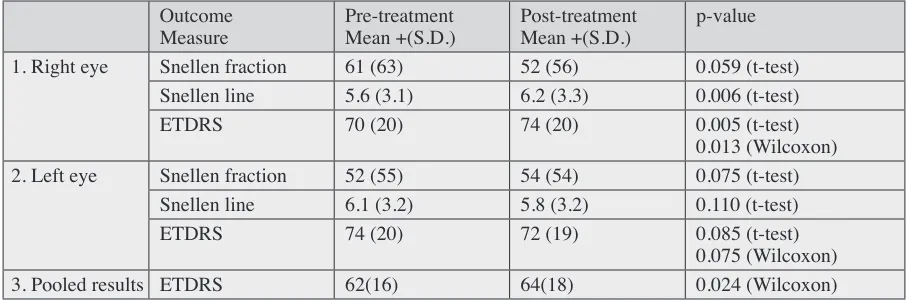
Raw visual acuity data are attached as supplementary file #1. Table 1 shows the summary results for right and left eyes (mean + standard deviation) in terms of Snellen visual acuity fractions, Snellen line scores and ETDRS Table 1.
Visual acuity pre- and post-treatment.
Outcome
Measure Pre-treatmentMean +(S.D.) Post-treatmentMean +(S.D.) p-value
1. Right eye Snellen fraction 61 (63) 52 (56) 0.059 (t-test)
Snellen line 5.6 (3.1) 6.2 (3.3) 0.006 (t-test)
ETDRS 70 (20) 74 (20) 0.005 (t-test)
0.013 (Wilcoxon)
2. Left eye Snellen fraction 52 (55) 54 (54) 0.075 (t-test)
Snellen line 6.1 (3.2) 5.8 (3.2) 0.110 (t-test)
ETDRS 74 (20) 72 (19) 0.085 (t-test)
0.075 (Wilcoxon)
3. Pooled results ETDRS 62(16) 64(18) 0.024 (Wilcoxon)
Legend: Segregated outcomes for the (1.) right and (2.) left eyes were Snellen fraction, Snellen line and
(Early Treatment Diabetic Retinopathy Study) scores. There were no statistically significant changes in any measure of visual acuity in the left eye using either the paired, two-tailed t-test or the Wilcoxon signed rank test (Cohen’s d = -0.10). For the right eye, there were statis-tically significant changes in the Snellen line score and the ETDRS score (Cohen’s d = 0.21), but not in the Snel-len fraction score.
When data were removed for eyes with an initial Snel-len fraction score of 20/20 or better, and the remaining data for the 2 eyes were pooled (‘Pooled results,’ Table 1), there was a significant improvement (p=0.018 per Wilcoxon signed rank test) in visual acuity for the ET-DRS score (Cohen’s d = 0.11). There were insufficient remaining data for separate statistical analyses of the left and right eyes.
Discussion
This study measured immediate changes in visual acuity following chiropractic treatment which included cervic-al manipulation. Perhaps due to the convenience of the testing process and the fact that pre- and post-treatment measures were taken in a single visit, there were no drop-outs and no incomplete data sets. By some measures, with the caveats discussed below, there were immediate improvements in visual acuity following treatment. A number of previous studies of spinal manipulation and visual acuity have employed eye charts as evaluation tools.6,11,14 However, caution must be exercised when
in-terpreting the data.17 The Snellen fraction represents
acu-ity based on the distance at which the subject can resolve a symbol. On the other hand, the physiological basis for acuity is the ability to resolve two points within the visual field (or more precisely on the spherically shaped retina) and hence could more properly be described in terms of angles rather than distance. Thus, Snellen fractions and line scores are logarithmic and cannot be directly inter-preted using conventional statistical methods, so that our apparent finding of an improvement in Snellen line score for the right eye (Table 1) is in fact spurious. The same considerations would affect the conclusions of the previ-ous study by Kessinger and Boneva14 and those case
stud-ies which reported raw eye chart data.
In order to apply conventional statistical analyses, such as a t-test or Wilcoxon signed rank test, Snellen data must first be converted to values on a scale which
reflects the arc subtended by a line joining two points in the visual field. One such scale is the Early Treatment Diabetic Retinopathy Study (ETDRS) scale.18 In the
current study, when Snellen data were converted to ET-DRS scores, there remained a convincing improvement in visual acuity in the right eye according to the paired, two-tailed t-test (p=0.005) or the Wilcoxon signed rank test (p=0.013). Based on a Cohen’s d = 0.21, this would be considered a small effect. Given the small number of subjects in this pilot study, it is not possible to determine whether or not the data were truly normally distributed, and so the Wilcoxon test, which is more parsimonious, provides a more rigorous test of statistical significance. Analyzing the data from the two eyes separately is also appealing in terms of statistical rigour, as it allows for a laterality to the clinical phenomena. This would occur in the unlikely event that all left eyes were, on average, inherently different in some regard from right eyes. Ana-lyzing the eyes separately also allows for the less unlikely possibility that eyes respond differently to contralateral versus ipsilateral adjustment and the clinician had a bias (in the scientific sense) for adjusting on one side versus the other.
In our second statistical analysis, we pooled data for the two eyes as if the response of one eye would be in-dependent of the response of its contralateral mate. This may or may not be true in any given patient depending in part upon the cause of their visual deficit. It may, nonethe-less, be the preferred practical approach since in everyday life functional visual acuity is essentially determined by the acuity of the ‘best’ eye.19 In the second analysis, we
Conclusions
In summary, this study suggests that it is feasible to measure acute responses to chiropractic treatment in a community-based clinic. Furthermore, a small but statis-tically significant treatment effect may be achieved with a relatively small number of subjects. In this instance, the treatment effect was quite small, and is of uncertain clin-ical significance. These results do not speak to long term effects. Additionally, there was no control group in this study and so it is not possible to determine the contribu-tion of a non-specific treatment effect. Overall, however, given the promising pilot data, it would appear reason-able to conduct a larger controlled study of the effects of spinal manipulation on visual acuity and to anticipate convincing acute results, either negative or positive, with a manageable number of subjects. The outcome measure should be a linear measure of visual acuity, such as the ETDRS score, and consideration should be given to the influence of a ceiling effect and to the appropriateness of a non-parametric statistical analysis.
Competing interests:
All authors declare that they have no competing interests.
Authors’ contributions:
MA, CR and BB all contributed to the design of this study. MA and CR conducted data collection. BB con-ducted data analysis. MA, CR and BB all contributed to and approved the final manuscript.
Acknowledgements:
The authors would like to thank Dr. Brian Fitzgerald for making his clinic available for this study. This study was supported by internal research funds from Canadian Me-morial Chiropractic College.
References:
1. Gorman R, Anderson R, Bilton D, Favoloro R, AJ. P. Case report: spinal strain and visual perception deficit. Chiropr J Aust. 1994;24:131-134.
2. Gorman R. Monocular visual loss after closed head trauma: immediate resolution associated with spinal manipulation. J Manip Physiol Ther. 1995;18(5):308-314.
3. Stephens D. A chiropractor validates the ‘tunnel vision information’: a report on three patients. The Ophthalmic Research Institute of Australia Meeting; December 1995. 4. Stephens D, Gorman F. The prospective treatment of visual
perception deficit by chiropractic spinal manipulation: a
report on two juvenile patients. Chiropr J Aust. 1996; 26:82-88.
5. Stephens D, Gorman F. The association between visual incompetence and spinal derangement: an instructive case history. J Manip Physiol Ther. 1997;20(5):343-350. 6. Stephens D, Gorman F, Bilton D. The step phenomenon in
the recovery of vision with spinal manipulation: a report on two 13-yr-olds treated together. J Manip Physiol Ther. 1997;20(9):628-633.
7. Conway C. Chiropractic care of a pediatric glaucoma patient: a case study. J Clin Chiropr Ped. 1997;2(2):155-156. 8. Wingfield B, Gorman R. Treatment of severe glaucomatous
visual field deficit by chiropractic spinal manipulative therapy: a prospective case study and discussion. J Manip Physiol Ther. 2000;23:428-434.
9. Gorman R. Monocular scotomata and spinal manipulation: the step phenomenon. J Manip Physiol Ther.
1996;19(5):344-349.
10. Gorman R. The treatment of presumptive optic nerve ischemia by spinal manipulation. J Manip Physiol Ther. 1995;18(3):172-177.
11. Stephens D, Pollard H, Bilton D, Thomson P, Gorman F. Bilateral simultaneous optic nerve dysfunction after periorbital trauma: recovery of vision in association with chiropractic spinal manipulation therapy. J Manip Physiol Ther. 1999;22(9):615-621.
12. Tymms G. Visual recovery from diplopia in a 13-year-old following chiropractic intervention. J Clin Chiropr Ped. 2011;12(1):876-878.
13. Papageorgiou S, Antonoglou G, Tsiranidou E, Jepsen S, Jager A. Bias and small-study effects influence treatment effect estimates: a meta-epidemiological study in oral medicine. J Clin Epidemiol. 2014;67:984-992. 14. Kessinger R, Boneva D. Changes in visual acuity in
patients receiving upper cervical specific chiropractic care. J Vertebral Subluxation Res. 1998;2(1):43-49.
15. Zhao W. Selection bias, allocation concealment and randomization design in clinical trials. Contemp Clin Trials. 2013;36:263-265.
16. Whitehead A, Sully B, Campbell M. Pilot and feasibility studies: Is there a difference from each other and from a randomized controlled trial. Contemp Clin Trials. 2014;38:130-133.
17. Kaiser P. Prospective evaluation of visual acuity assessment: a comparison of Snellen versus ETDRS charts in clinical practice (an AOS thesis). Trans Am Ophthalmol Soc. 2009;107:311-324.
18. Gregori N, Feuer W, Rosenfeld P. Novel method for analyzing Snellen visual acuity measurements. Retina. 2010;30:1046-1050.