Using Smart-Contracts
Xiaohu Zhou, Yousif Hafedh, Yonghao Wang, Vitor Jesus
School of Computing and Digital Technology, Birmingham City University, Birmingham, United Kingdom
Abstract. Biometric authentication, and notably using fingerprints, are now common. Despite its usability, biometrics have however a caveat which is the impossibility of revocation: once the raw fingerprint is breached, and depending on the technology of the reader, it is impossible to stop an illegitimate authenti-cation. This places a focus on auditing both to detect fraud and to have clear in-dications that the fingerprint has been breached. In this paper we show how to take advantage of the immutability property of Blockchains to design an audita-ble protocol based on Diffie-Hellman key exchange with applications to finger-print authentication.
Keywords: biometrics, authentication, security, blockchains, smart-contracts, auditing
1
Introduction
Fingerprint biometrics are nowadays a mature and widespread technology for authen-tication. It has several advantages being the two most important its usability (by being inherent to virtually any human) and accuracy since two people having the same fin-gerprint pattern is extremely rare. Finfin-gerprint authentication has also seen commercial use in access control and application security and an example of such is seeing many modern mobile phones supporting it. There is however an important caveat which is the relative easiness of capturing fingerprints and later re-creating (say with wax fin-gers) and, post-incident, the impossibility of revoking a lost fingerprint in its original form.
hu-man has been illegitimately used, allowing bank transfers purely based on it is per-haps not advisable but viewing a bank statement is likely to meet the risk profile.
Audit trails, in the form of reliable and authoritative data on the process, along with real-time notifications, thus play a key role. Following the bank account example, after an incident has been recorded, it is likely that the bank will want to know where the vulnerable step happened; for example, if the authentication was successful be-cause the fingerprint did match or whether it was deeper in the process and a mis-matching fingerprint (or any other form of authentication) was accepted.
This paper proposes and discusses how blockchains can be used to provide an au-thoritative mechanism to prove, beyond any arbitrary level of doubt, that an illegiti-mate but successful identification took place at the fingerprint scan stage. Blockchains have the inherent property that, if enough time has elapsed (that depends on its size), whatever data is stored in it becomes immutable thus providing an excellent medium to store audit trails and reliable access notifications upon which one can act on.
The challenge we tackle is how to involve a blockchain in the authentication pro-cess. We do so by creating a protocol similar to Diffie-Hellman key exchange that, instead of running peer-to-peer, is ran intermediated by a blockchain. Considering that blockchains, whatever its form, typically require private keys to interface it, this scheme inherently provides multi-factor authentication. We envision our work to be, in fact, generic to any type of biometric authentication that relies on pre-acquired templates (such as images of fingers or iris) but we will keep the scope to fingerprints in order make the problem easy to discuss.
In section 2 we present the technical background on fingerprint biometrics and blockchains. In section 3 we present our approach and in section 4 we illustrate with an implementation strategy using Ethereum and the Solidity language, a public block-chain supporting smart-contracts. We conclude our paper in section 5.
2
Background
This section gives a technical background on fingerprint biometrics and blockchains; it further discusses related work in the area.
2.1 Fingerprint biometrics
determine a matching score which, given a threshold, will then make a decision to accept or not.
Storing the templates of users is a central problem because, if breached in the raw form, it is impossible to revoke in the sense of revoking a certificate or changing a password. Cancellable biometrics is a key technique to help with this problem. In-stead of storing the raw image or template, a distorted version is used either using a non-invertible transformation or biohashes [2] with the latter offering convenient fixed sizes templates.
2.2 Blockchains and Smart Contracts
Blockchains are a recent, and still maturing, technology having its first appearance to solve the “double-spending problem” in a digital currency and later recognised to solve the more generic “two generals’ problem”. It has evolved from its first applica-tion, Bitcoin, to now support generic scripting (smart contracts) as is the case of Ethereum. Whether it is information, in the sense of a ledger as in Bitcoin, or algo-rithmic methods and execution state, such as in Ethereum, Blockchains have the dis-ruptive property of immutability: once stored, data is subject to cryptographic opera-tions that are virtually impossible to reverse without abundant computing resources which is made further harder as time passes and as blocks (holding information) are added since they are interlinked. Therefore, if enough time is elapsed (i.e., enough computing effort is spent) it becomes virtually impossible to modify or destroy a rec-ord which brings auditing potential [3].
2.3
Related Work
Whereas literature is rich and abundant in biometrics authentication [4][5], and Blockchains are already being analysed in research and academic literature, beyond commercial applications, very few works have approached the combination of the two techniques. Hammudoglu et al [6] propose a mobile biometric-based authentication system for a self-sovereign identity solutions. It integrates a permissionless block-chain with identity and key attestation to be used in mobile phones. This work, how-ever, is focused on how to implement self-sovereignty but storing secret and bio-metric material in full user control rather than the generic scenario of ours which is enhancing current biometric systems with auditing capabilities of blockchains. A similar remark can be made for Nandakumar et al [7] which design a fairly complete system relying on private blockchains and mixing the blockchain’s consensus layer with biometric material so that the decision of matching is distributed. This is further made secure by using secret sharing techniques such as Shamir’s.
2.4 Problem Statement
The trace of the authentication is the central point of this paper. Our attacker model is simple: finger can be stolen or a copy of the fingerprint can be re-created. Our ap-proach does not directly mitigate this problem; rather, it gives trusted means for a user to be notified and later audit the security breach since an adversary cannot delete rec-ords. Another possible attack vector is an inside malicious actor: no authentication was done but it is claimed to have happened. Since the insider is able to manipulate the logs, there is no way to credibly dispute or disprove there was, or was not, authen-tication via fingerprint. If an authenauthen-tication point has been compromised, there will be no trace left in the blockchain.
3
Approach
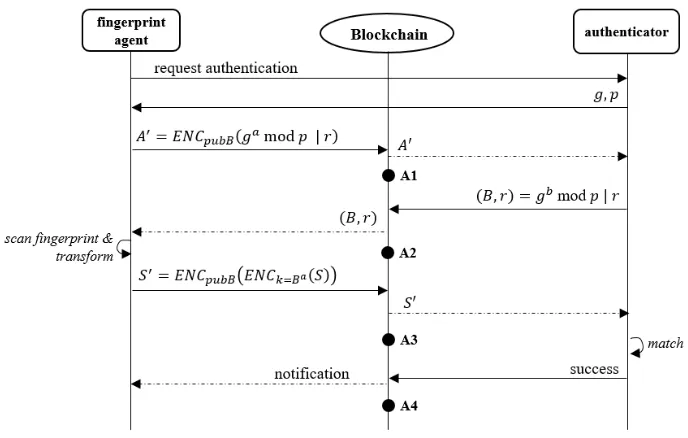
Our approach is based on Diffie-Hellman Key Exchange (DHE) which allows the generation of a shared secret between two parties over an insecure channel. In order to make the authentication process auditable, while protecting the biometric material, we use the blockchain as a secure and immutable medium on which messages exchanged cannot be modified once written and enough time has elapsed. Fig. 1 shows our scheme.
The user, previously enrolled, request authentication by using an agent application. This could be a mobile application. The authenticator responds with the following. It initiates the protocol by sending (random) parameters for the protocol (݃, ) and (not shown in the diagram), the location of the smart-contract such as its address. It is assumed the user has secret keys to access the smart-contracts which, effectively, acts as a second-factor for the authentication process. The public key of the authenticator, perhaps obtained in real-time from a certificate sent by the authenticator (e.g., using TLS), is used to encrypt both the remaining material of DHE and also to send a ran-dom nounce, ݎ. Shown in dashed lines is the implicit broadcast process of a block-chain: once the block is mined, it is broadcast to all participating nodes. At this point, an audit point A1 is created proving the user possesses the keys to interact with the blockchain.
com-promised agent that is preventing notifications is reduced.
The result of this process is there will now be an undeletable trace on the block-chain of an authentication attempt, whether successful or not.
Fig. 1. Signalling diagram and audit points.
4
Evaluation
We used SourceAFIS [8] framework as the fingerprint authenticator. We’ve
built a simple client that is fed with fingerprint images which, when compared
the ones in the database produces, a matching score. We’ve complemented
with an interface to Ethereum that executes the protocol in
Fig. 1
and executes
the various stages on a Smart-Contract.
4.1 Implementation
The (simplified) smart-contract code is shown in
Fig. 2
. The code simply acts
as a medium to exchange messages by implementing two generic methods for
message passing of the two peers, called Alice and Bob. We assume, although
it is not necessary, that a new contract will be created for every authentication
attempt. When the contract is created by the authenticator, the user’s address
USER_ADDRESS
will be hardcoded in the contract for control purposes. This
contract Authentication { String message;
constructor() public { supplicant = USER_ADDRESS; user_authenticated = false; }
function bob( string msg ) public { if (msg.sender == authenticator) { message = msg;
} }
function alice( string msg ) public { if (msg.sender == supplicant) { message = msg;
} }
function auth_result() {
if ( msg.sender == authenticator ) user_authenticated = true;
}; }
Fig. 2. Simplified smart-contract code.
4.2 Evaluation
5
Conclusions and Outlook
This paper discussed the usage of a blockchain, and smart-contracts, to enable
trusted audits of fingerprint biometrics. As seen, any biometric process that
requires exchange of media can take advantage of this protocol to guarantee
that actions leave an unmodifiable audit trail that can later be analysed.
Our scheme needs improvement, nevertheless, given its impracticalities,
notably using the blockchain to store the candidate fingerprint. Furthermore,
the time it takes to authenticate a user is also of consideration which may
de-feat the typical usability of biometrics as an authentication vector. These and
other issues are the subject of our current and future work.
References
1. Jain, AK & Nandakumar, K., Biometric authentication: system security and user privacy,
IEEE Computer, vol 45, pp. 87-92., 2012
2. Ratha, N. K., Chikkerur, S., Connell, J. H. & Bolle, R. M., 2007. Generating Cancelable fingerprint templates. IEEE Transactions on pattern analysis and machine intelligence, 29(4), pp. 561-572.
3. Abreu, P., Aparicio, M. & Costa, C., Blockchain technology in the auditing environment, Caceres, CISTI, 2018
4. Pakutharivu, P. & Srinath, M. V., A Compehensive Survey on Fingerprint Recognition Sys-tems, Indian Journal of Science and Technology, vol 8, issue 35, 2015
5. Weizhi Meng, Duncan S. Wong, Steven Furnell, Jianying Zhou, Surveying the Develop-ment of Biometric User Authentication on Mobile Phones, IEEE Communications Surveys & Tutorials, Volume: 17 , Issue: 3, 2015
6. Hammudoglu, J.S., Sparreboom, J., Rauhamaa, J.I., Faber, J.K., Guerchi, L.C., Samiotis, I.P., Rao, S.P. & Pouwelse, J.A., Portable trust: biometric-based authentication and blockchain storage for self-sovereign identity systems., June 2017: online available at http://cn.arxiv.org/pdf/1706.03744
7. Nandakumar, K., Ratha, N., Pankanti, S. & Darnell, S., 2017. Secure one-time biometric tokens for non-repudiable multi-party transactions. IEEE Workshop on Information Fo-rensics and Security (WIFS), Rennes France, December 2017