Bullying, Harassment & Undermining
in Vascular Training
Working Group Report
Authors
Mr Iain Roy
Rouleaux Club President 2017/18
Prof Robert Fisher
VSGBI Working group Lead
Page 1 of 34 - Version 1.1 (25/11/18)
Contents
Acronyms ... 2
Executive Summary ... 3
Acknowledgements ... 4
Working Group Meeting Dates ... 4
BHU Working Group – Actions ... 5
Quantifying the type, frequency and severity of BHU behaviour in vascular training ... 6
Summary of Survey Results ... 6
Conclusion ... 7
Propose (and implement) a strategy to reduce the frequency and severity of BHU behaviour ... 8
The open admittance that there is a BHU problem in vascular training ... 8
Education ... 8
Summarise strategies and pathways open to those witnessing or experiencing BHU behaviours and how to challenge or report it ... 9
Method to monitor the progress of the above strategy ... 10
Appendix 1: Summary of initial UK vascular trainees BHU survey ... 11
Responses ... 11
Appendix 2: Newly appointed Consultant survey on BHU in training. ... 15
Free text examples: ... 17
Free Text: If not reported, why? ... 17
Free text :The respondents were asked how they would respond to witnessing a trainee being bullied? ... 18
Appendix 3: BHU section 2017 annual survey ... 21
Appendix 4: Letter from VSGBI President & vSAC Chair July 2017 ... 23
Appendix 5: EJVES Editorial ... 24
Appendix 6: Letter to individual Arterial Centres ... 29
Appendix 7 – E-mail to Rouleaux Club Members on publication of this report ... 31
Page 2 of 34 - Version 1.1 (25/11/18)
Acronyms
VSGBI – Vascular Society of Great Britain & Ireland
RC – Rouleaux Club (UK & Ireland vascular Trainee association) vSAC – Vascular Specialty Advisory Committee
Page 3 of 34 - Version 1.1 (25/11/18)
Executive Summary
The Bullying, Harassment and Undermining (BHU) Working Group was created November 2017 by agreement of the Vascular Society of Great Britain & Ireland (VSGBI), Rouleaux Club (RC) and Vascular Specialty Advisory Committees (vSAC) in response to an anonymised survey of vascular trainees carried out by the RC in June – Oct 2017. This survey demonstrated an unacceptably high prevalence of these behaviours being experienced by current vascular trainees.
The working group was tasked to:
1. Quantify the type, frequency and severity of BHU behaviour in vascular training
2. Propose (and implement) a strategy to reduce the frequency and severity of BHU behaviour 3. Propose a method to monitor the progress of the above strategy
BHU behaviour is, by its very nature likely to be, underreported and it is extremely difficult to quantify. The recurrent barrier of trainees fearing personal detriment, as a result of reporting the behaviour, was encountered.
The working group undertook a survey of newly appointed Vascular Consultants, in an attempt to overcome this fear, and also considered the initial anonymised trainee survey and the subsequent BHU section of the RC 2017 annual trainee survey. The incidence of BHU behaviour is believed, based on these surveys, to be approximately 20% per year and 50% of trainees will experience BHU behaviour over the course of their training.
This working group in agreement with the VSGBI, RC & vSAC have proposed and implemented the following broad strategy to tackle BHU behaviour:
1. Open declaration of the existence of the problem 2. Raise awareness of what constitutes BHU
3. Publish resources for those witnessing or experiencing BHU behaviours on strategies to challenge and report it.
Page 4 of 34 - Version 1.1 (25/11/18)
Acknowledgements
The following individuals have attended or been involved in some or all of the working group process. Their inclusion here is not necessarily an indication of their agreement with all the working group’s recommendations or actions.
Mr Ayoola Awopetu RC ASiT Representative
Mr Jonathan Boyle vSAC Chairman 2016-2018, VSGBI council member Prof Robert Fisher VSGBI Lead BHU Working Group & Council Member Mr Andrew Garnham vSAC Member, VSGBI council Member
Mrs Hannah Jordon RC vSAC Representaive Mrs Olivia McBride Vice President RC
Mrs Anna Murray RC Affiliate Representative
Mr Iain Roy President RC 2017/18
Mr Philip Stather President RC 2016/17
Working Group Meeting Dates
The majority of work was conducted by e-mail but the following key dates indicate when the working group met.
12/06/2017 - Initial Survey results presented by RC to vSAC
Working group proposed
26/06/2017 – Initial Survey results presented by RC to President and Exec committee of VSGBI
Working Group Creation agreed
Decision later ratified by full VSGBI committees
23/11/2017 – Initial contact of Key working group members & agreement of first meeting
25/01/2018
11/04/2018 – Working Group Teleconference meetings 10/10/2018
Page 5 of 34 - Version 1.1 (25/11/18)
BHU Working Group – Actions
12/06/2017 Vascular SAC Meeting
The Rouleaux Club President, Mr P Stather, presented their trainee survey on bullying, undermining and harassment to the Vascular SAC.
Survey was not complete, and Mr Stather agreed to encourage more trainee participation.
Mr Boyle and Mrs Lay provided an overview of the work that the JCST was undertaking via it’s short life working group on bullying and undermining in surgical training and the JCST plans to publish a position statement later in the year.
It was agreed that Mr Boyle would arrange to write a joint statement with the Vascular Society to raise awareness about the bullying, undermining and harassment concerns.
16/07/2017 Joint statement from president of VSGBI and vSAC chair sent to all VSGBI members (Appendix 1)
12/09/2017 Vascular SAC Meeting
Hannah Travers the SAC trainee representative presented the completed trainee survey.
The establishment of a Vascular Society and SAC Joint working group on BHU was agreed following the discussions at the VS Council meeting at BSET. The SAC agreed this was a good idea and the SAC Chair, Mr Boyle, would represent the SAC.
Mr Boyle in his role as Associate Editor of the EJVES had invited Mr R Fisher and the Rouleaux club to write a manuscript on BHU for the EJVES. (This manuscript has now been published in the EJVES)
It was agreed that Hannah Travers would present the Rouleaux Survey to the TPDs meeting in Wolverhampton in September 2017.
23/11/2017 Joint RC / VSGBI session at the annual VSGBI Annual scientific meeting.
The Joint Session focused on Bullying, Harassment and Undermining and was Chaired by the Presidents of the Vascular Society, Professor R Sayers and the Rouleaux Club, Mr P Stather.
Mr Boyle, The SAC Chair, presented data on Recruitment and Retention in Vascular Surgery.
Mr Awopeto, Presented the Rouleaux Club Trainee Survey
Miss R Barnes Presented the Results of the Consultants Survey and on Instigating Change
December 2017. Mr Boyle wrote to all SAC liaison members and all Vascular TPDs and asked them to complete the RCS of Edinburgh’s E-module on BHU.
26/01/2018 Vascular SAC
Megan Wilson confirmed most of the SAC LMs and Vascular TPDs had completed the RCSEd E-Module on BHU.
All TPDs and LMs had been sent the RCS England’s booklet on unconscious bias.
The SAC Chair underlined the importance of effecting a culture change around these behaviours.
The SAC Chair reported the list of issues raised by the trainees at the joint teleconference with the VS and Rouleaux.
Page 6 of 34 - Version 1.1 (25/11/18)
Quantifying the type, frequency and severity of BHU behaviour in
vascular training
The working group’s initial focus was to define the extent and nature of the BHU problem in vascular training. This was felt to be important as it would allow better targeting of strategies to combat the behaviours that are most prevalent/serious, and it would also stand as a baseline to assess the impact of the working groups strategy.
The Working Group agreed with the definitions that BHU used by the RC in their initial survey. These definitions are, with minor adaptations, those of the Advisory, Conciliation and Arbitration Service (ACAS), and are generally accepted in the UK working environment. They are:
Bullying
Offensive, intimidating, malicious or insulting behaviour, an
abuse or misuse of power through means intended to undermine,
humiliate, denigrate or injure the recipient.
Harassment
Unwanted behaviour or conduct either persistent or singularly,
directed at a person or persons which creates an environment which is
intimidating, hostile, degrading, humiliating or offensive.
Undermining
To make someone less confident, less powerful, or less likely
to succeed.
The initial survey instigated by Mr Ayoola Awopetu and Miss Rachel Barnes and conducted (June-October 2017) by the RC provide the largest and most in-depth dataset. A summary of the complete data is available in Appendix 1. It was a totally anonymised survey e-mailed to members of the RC. The anonymous nature resulted in an inability to identify geographical areas or individual centres of concern, which was a potential weakness. The high response rate was however likely due to its anonymised nature.
The working group arranged for a further confidential but identifiable survey to be sent via email to newly qualified (within 5 years) Consultants who were members of the VSBGI . In addition to being a further corroborating data source, it was anticipated that the job security of their Consultant post might mean they would be willing to identify training centres in which they had experienced BHU behaviours.
A summary of the complete data is available in Appendix 2. Unfortunately, this survey received a low response and whilst some centres were identified, no individual centre had a particularly high incidence and some centres did not feature at all in the training of the respondents. Therefore it was felt inappropriate to include names of any centres in this report .
Finally the RC end of year (2017) survey was conducted and provided further data for analysis
including data identifiable to region regarding BHU behaviour. A summary of the complete BHU data is available in Appendix 3.
Summary of Survey Results
The 3 surveys consistently show that approximately 20% of trainees will suffer BHU behaviour in any given placement/year. Overall ~50% will suffer BHU behaviour during their training.
Page 7 of 34 - Version 1.1 (25/11/18)
Approximately two thirds of the experienced behaviour was undermining, however forms of bullying including physical incidents or harassment are reported. Legally protected characteristics (Age, Gender, Sexual Orientation, Race or physical characteristics) were thought to be the motivation in >10% of cases.
Only ~25% of incidents were ever reported and trainees felt that the BHU and their welfare were poorly dealt with following reporting.
Conclusion
The working group believe the overall incidence of BHU behaviour to be in the region of 20% of trainees experiencing the behaviour per a training year. There is a detectable rate of very serious cases (physical or BHU as the result of a legally protected characteristic). The most frequent BHU behaviour is undermining, which free text examples suggest may be the result of a lack of
Page 8 of 34 - Version 1.1 (25/11/18)
Propose (and implement) a strategy to reduce the frequency and
severity of BHU behaviour
The working group was tasked to develop a strategy to reduce the incidence of BHU in vascular training. The group agreed that this strategy should fall into 3 main areas.
1. The open admittance that there is a BHU problem in vascular training and its impact. This is intended to de-normalise the behaviour and to raise awareness of its negative impacts. 2. Education.
There is persistent reporting in the surveys of victims believing that many perpetrators are simply not aware that their behaviour constitutes BHU. This was also highlighted at the VSGBI ASM session in November 2017.
3. Publish resources for those witnessing or experiencing BHU behaviours on strategies to challenge or report it
Survey data and feedback from the VSGBI ASM session suggested that there was a lack of awareness of the possible routes (of varying formality) in which BHU behaviour can be challenged or reported. The hope is that this will increase reporting levels.
The open admittance that there is a BHU problem in vascular training
From the presentation of the initial survey results to the SAC and VSGBI it was felt to be imperative to make as much data as possible and the response to it available to the vascular community at large. This has been achieved by:
1. Presentation of the survey data to the full VSGBI and vSAC committee meetings 2. Joint letter from VSGBI & SAC chair to the VSGBI community (Appendix 4) 3. Presentation and discussion of BHU data at the 2017 VSGBI ASM session 4. Publication of an editorial in EJVEVS (Appendix 5)
5. Letters to the clinical lead in each individual arterial centre (Appendix 6)
6. E-mail to all RC (Appendix 7) & VSGBI (Appendix 8) documenting the publication of this working group report and action plan for individual members.
Education
The working group became aware that there is eLearning module that is available free on the RCSEd website that is CPD accredited that informs what constitutes BHU in medical/surgical environments. We felt this was ideally suited to educating the greater vascular community. This has been encouraged by:
1. The SAC chair requesting all SAC members to complete this module – this includes all regions TPD’s. Many TPDs have gone on to request the same of their regions education supervisors.
2. Highlighting and advocating the completion of the RCSEd e-learning module: The Newsletter article sent to all VSGBI members
The EJVEVS Editorial
The letters to each individual arterial centre -requesting they consider the inclusion of this module as a requirement for the next annual appraisal
Page 9 of 34 - Version 1.1 (25/11/18)
portfolio. The RCSEng TrACE course was identified as a good resource for those who felt they required further training in this area.
Summarise strategies and pathways open to those witnessing or experiencing BHU
behaviours and how to challenge or report it
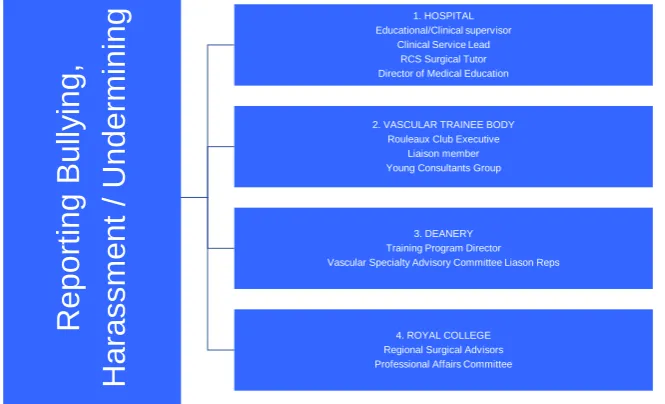
Summary Graphics been identified / created for those witness / experience / dealing with reports of BHU on the various levels of formality and places that BHU can be raised and routes to challenge / report / deal with this behaviour. These are included below. The actual processes undertaken are the prevue of the departments / institutions and deaneries involved.
We would highlight the Freedom to Speak up Guardians in each trust (www.cqc.org.uk/national-guardians-office/content/national-guardians-office) and a Rouleaux Trainee representative who are universally available and can confidentially discuss any concerns an individual may have.
Reporting
Bul
ly
ing,
Harass
ment
/ Undermi
ni
ng
Educational/Clinical supervisor1. HOSPITAL Clinical Service LeadRCS Surgical Tutor Director of Medical Education
2. VASCULAR TRAINEE BODY Rouleaux Club Executive
Liaison member Young Consultants Group
3. DEANERY Training Program Director Vascular Specialty Advisory Committee Liason Reps
Page 10 of 34 - Version 1.1 (25/11/18)
Method to monitor the progress of the above strategy
The working group explored multiple options regarding monitoring the progress in tackling BHU behaviour in vascular training. The only option discussed that was felt to be a robust methodology was intermittent surveys of the trainee population (with an anonymised option) administered by RC (the trainee body). It was also felt keeping the same methodology as previously would offer the best comparison as to the impact of the above work.
Page 11 of 34 - Version 1.1 (25/11/18)
Appendix 1: Summary of initial UK vascular trainees BHU survey
The survey was undertaken of all the Rouleaux Club’s membership who were in full time vascular training. It was sent to a total of 131 e-mail addresses. A total of 71 responses where received, giving a response rate of 54%. Responses where received between June & Oct 2017, with over 80% of responses received in the first 2 weeks.
Therewas no way to trace responses back to individuals and respondents were able to skip any questions they felt uncomfortable answering.
Responses
Age
Sex
Experienced BHU ever
Page 12 of 34 - Version 1.1 (25/11/18)
How regularly do you see these behaviours?
Who was the perpetrator?
If a doctor what was their grade?
Page 13 of 34 - Version 1.1 (25/11/18)
Was the incident physical?
Was it related to a legal protected characteristic?
Race/Religion
Gender or sexual Orientation
A physical characteristic (including pregnancy) or a disability
Page 14 of 34 - Version 1.1 (25/11/18)
Was the incident reported to the responsible educational supervisor?
Page 15 of 34 - Version 1.1 (25/11/18)
Appendix 2: Newly appointed Consultant survey on BHU in training.
Rouleaux Club Junior Consultants survey results
This survey was conducted over a 3-month period. There were 32 respondents, comprising of 87.5% Male (n = 28) and 12.5% Female (4). 30 of these Junior Consultants were UK trained. Currently, the job roles of these individuals comprise of 90.1% Substantive Consultants (29), 6.25% Locum Consultants (2) and 3.13% Other (1).
50% of respondents experienced bullying during their training. The individual centres were identified however no individual centre appeared to have identifiable severe incidence once response rate had been considered.
Each line is an identified centre (percentage of respondents who worked in that centre that reported BHU):
(25%) n=8 (16%) n=6 (20%) n= 5 (67%) n=3 (100%) n=2 (50%) n=2 (50%) n=2 (50%) n=2 (100%) n=1 (100%) n=1 (100%) n=1 (100%) n=1 (33%) n=1
Page 16 of 34 - Version 1.1 (25/11/18)
Perpetrator
Was the bullying perpetrated by an Educational Supervisor?
Was the BHU physical
Was it related to race or religion?
Was it related to sex or sexual orientation?
Page 17 of 34 - Version 1.1 (25/11/18)
Was it reported to the Educational Supervisor?
If Reported did you feel:
Free text examples:
“At *** I was backed against a wall by a tirade of expletive laden abuse on my first day for not having visited the department before starting despite only being given a week’s notice of placement and being on holiday at the time. At **** iIwas informed by one consultant that he could ruin my career if he so chose as he sat on all consultant interview panels and that if he chose Iwould fail as a surgeon. This individual has been known to do this to others”
“Not allowed to operate with a particular Consultant as I criticised his organisation of the illegal rota! Was forced to assist the very junior non-trainee or Consultant rather that actually do any operating” “In *** the individual was a cultured bully, with an impenetrable arrogance and uncaringly
contemptuous of everyone - in short sociopathic, there is no hope here. In *** the individual was simply a childish bully who was over-opinionated, poorly observant of his own considerable frailties and offered little other than a negative role model, there seemed to be a purposeful seeking out of trainees to belittle - this appeared to be enjoyed”
Free Text: If not reported, why?
Page 18 of 34 - Version 1.1 (25/11/18)
himspending time in disciplinary hearings and not training me wouldn’t have helped me. Just an angry outburst but definitely threatening and bullying behaviour. Second was the regional TPD idle threat. Actually discussed the incident moments later with another Consultant in the department. Again Ifelt no personal threat as he had a reputation and wasn’t respected due to this. Just a bully trying to exert power. Different trainee may have had a different outcome and certainly felt threatened and undermined and bullied. Both now retired or left surgery.”
“felt powerless as it was decided that I was a failing traineeand motions had been set in place already by the trainer to defend their decision that I was a failing trainee”
“Reporting I felt would impact my future training”
“I was advised to organise so that I did not have to attend the particular Consultant’s theatre sessions (Which I did). Incidentally I was also told not to bother applying for a Consultant position at the Trust by my Educational Supervisor in case the Consultant I complained about was on the shortlisting interviewing panel because I would Not be given the job. Incidentally I also reported the bullying at my ARCP and I also documented incidents contemporaneously in the reflection section of my ISCP portfolio and made it visible to my TPD.”
“It would have been detrimental to my career progression”
“1998 to 2003 one did not report this sort of thing if one wished to continue training”
“I am referring this to the *** experience. In *** the individual was notoriously disliked anyway and will no longer be a problem to trainees. In *** I have no doubt an official bullying report would have been taken seriously by those who were chosen as Educational or Clinical Supervisors, however, you have respect for a unit as much as an individual and there was fear of losing respect from those who mattered and indeed causing them trouble in reporting as they would then have to deal with it. Some episodes were laughable if they had not been so personal. I think it was understood by the other Consultants that it was happening but they would only act if complaint was made and it wasn’t. The individual had a considerable fear of his seniors and contemporaries and in the end has very little to offer both trainees and the greater vascular surgery. This has made for some cracking stories“
Free text :The respondents were asked how they would respond to witnessing a
trainee being bullied?
“Speak to colleague and the trainee separately”
“Explore, support and revisit. Offer formal pathway via HR/Deanery.” “Intervene”
“Make sure the trainee is Ok. Explain to colleague how their actions came across in case they did not realise. Have a more in depth conversation if it was habitual. Raise the issues with management if not improved.”
“Report to line manager”
“Speak to colleague and / or HoD”
Page 19 of 34 - Version 1.1 (25/11/18)
“I have already supported a junior colleague through a bullying case by escalating through the chain of command.”
“Definitely stop it and address / escalate”
“Iwould talk with my colleague and discuss their behaviour and also talk with the trainee and support them if needed.”
“take them aside and speak to them and make clear in no uncertain terms that they should stop their behaviour”
“I will have a word with my colleague and warn that bullying will not be tolerated and report it to clinical director if still persisting”
“Stand up for my colleagues/trainee. However I only feel I can do this since I’ve completed my training.”
“Would advise to report as this type of behaviour is completely unacceptable.” “speak to the colleague, advice colleague/trainee, report it if no change in behaviour” “Challenge behaviour”
“Report it to the educational supervisor”
“Step in. Nobody should feel undermined at work.” “Intervene directly or report to a more senior individual” “Intervene mostly. Discuss with trainee always. Report rarely” “I would discuss it with both separately”
“Quiet word with both parties separately in first instance” “If it was that bad I might have a word in private.”
“I am concerned about this as there are some colleagues who can be approached about this and some who cannot even as a Consultant (there is also a junior / senior Consultant bullying in a mild form which has been noticed). There is also an interpretation issue - what is it that an individual actually thinks bullying is? Could it be that not offering operations regularly is seen as taking it out on a trainee. I have, however, been lucky that I have not really been in a situation to say I have seen bullying but if seen I would need to speak to the individual in question on an informal basis to air my concerns as a colleague and a friend and if something sickens me, as it did when I was a trainee, I now know they listen”
“challenge them, report to CD/ medical director” “speak to them”
Page 20 of 34 - Version 1.1 (25/11/18)
“Get the facts, both sides and escalate as appropriate”
“Speak with colleague and trainee to understand reasons. If appropriate, report the colleague bullying”
Page 21 of 34 - Version 1.1 (25/11/18)
Appendix 3: BHU section 2017 annual survey
The survey elicited 129 responses from 174 e-mails invitations sent out, response rate of 74%. There was a relatively even spread of trainees in different years of training. Military, Less than fulltime and academic trainees were all represented.
Have you felt bullied, harassed or undermined during your 12 month placement?
Have you witnessed anyone else being bullied, harassed or undermined during your 12 month placement?
Page 23 of 34 - Version 1.1 (25/11/18)
Page 24 of 34 - Version 1.1 (25/11/18)
Appendix 5: EJVES Editorial
This manuscript is published at https://doi.org/10.1016/j.ejvs.2018.06.041 © 2018.
This manuscript version is made available under the CC-BY-NC-ND 4.0 license http://creativecommons.org/licenses/by-nc-nd/4.0/
Title:
Bullying, undermining and harassment in vascular surgical training in the UK: How can it be confronted? Revision EJVES12690
Authors:
RK Fisher (Vascular Society GB&I) O McBride (Rouleaux Club) A Murray (Rouleaux Club) A Awopetu(Rouleaux Club)
On behalf of the Vascular Society of Great Britain and Ireland and The Rouleaux Club.
Corresponding Author: Robert K Fisher MD, FRCS. Dept of Vascular Surgery
Royal Liverpool University Hospital Prescot Street
Liverpool L78XP UK
Wordcount 1246
Page 25 of 34 - Version 1.1 (25/11/18)
Manuscript.
Understanding the Problem
The performance of surgery to the highest standard relies upon ongoing education, a fundamental principle of which is the creation of a safe learning environment. The responsibility for this lies with both the trainer and trainee, although it is the trainer who holds the duty of care. A recent
unpublished report by the Rouleaux Club membership (the vascular surgical trainee body in GB&I) identified an issue with bullying and harassment in current UK training. In a national survey of 120 vascular trainees, of whom 60% responded, 46% reported experiencing or witnessing bullying, undermining or harassment and over 85% recorded that unsatisfactory action was taken to address it. Whilst this has not been previously recognised in the UK vascular specialty, it has been reported in other specialties both in Britain and internationally.
The Royal Australasian College of Surgeons, in June 2015, commissioned a national survey of all members in Australia and New Zealand.1 Some 3516 individuals (47.8%) responded from all surgical specialties, of whom 81% were male and 15% were trainees. Almost half confirmed personal
experience of bullying (39%), harassment (19%), discrimination (18%) and sexual harassment (7%) in the workplace. Of the trainees, 88% reported experiencing one or more of these behaviours. For those that took action, the commonest outcome was a continuation of the behaviour. The greatest barrier to taking action was the potential detrimental effect on future career.
Similar alarming data were reported in a study on bullying and sexual discrimination in the Greek health care system, with 50% of trainees experiencing verbal abuse, 38% threatening behaviour, 20% sexual harassment and only 15% of institutions reporting official support mechanisms.2 Furthermore, within the UK, the Royal College of Obstetricians and Gynaecologists performed an email survey of consultants and fellows working in the UK and 44% reported being persistently bullied or undermined.3
In the face of growing evidence of bullying, undermining and harassment in training, a response to change current practice is necessary. In order to instigate change, one must understand the
problem, starting with the definition of bullying. Whilst numerous definitions exist depending on the social environment, the core principles remain. A widely accepted definition is that provided by ACAS (Advisory, Conciliation and Arbitration Service: http://www.gov.uk/>acas): bullying may be characterised as offensive, intimidating, malicious or insulting behaviour, an abuse or misuse of power through means that undermine, humiliate, denigrate or injure the recipient.
Page 26 of 34 - Version 1.1 (25/11/18)
service may also be highly relevant in raising the work pressures experienced by the surgical trainer. There are constant conflicts and opposing forces between service delivery and training/education which are bourn largely by the trainer and may compound all the other pressures, resulting in adverse behaviour towards the trainee. Whilst there is some understanding of these pressures and sympathy toward the difficult working and learning environment they create, bullying behaviour, as a consequence, is never acceptable and cannot be tolerated by the profession. Not only does it detract from training and productivity, there is also good evidence of potential harm to trainees and patients.4 As such, it is beholden upon us to recognise those areas we can change and evolve. Honest personal reflection of ones practice as an educator and multisource feedback can enlighten the surgeon to their behaviour as a trainer. Collaborative team working can also highlight issues within a unit, and addressing any problem areas is essential.
Facilitating Change
Educating the educator is a principle that has evolved over the last two decades and the Royal Colleges now have specialty specific courses in place such as Training the Trainers and Training and Assessment in the Clinical Environment {TrACE}. The benefit of these over locally run, generic courses is the recognition of the unique pressures that the surgical specialty exerts on the trainer, which may represent the key issue driving behavioural traits. These courses can be invaluable in supporting the trainer in delivering the required education in a challenging environment, and understanding the needs of the trainee, the assessment tools and systems utilised. They also highlight the potential for bullying and harassment, how to recognise it and what resources are available. The surgical community should mandate that their educators have the relevant training, and the health institutions should financially support this. This will facilitate objective feedback and assessment that is more robust than subjective criticism. Understanding these processes promotes honest discussion in a more professional and productive manner. The authors do not advocate a submissive or undermined role of the trainer but more one of an informed, considered professional that has an awareness of the modern educational environment.
The Academy of Medical Educators and the General Medical Council (GMC) have implemented an educational appraisal and revalidation mechanism to improve training in the UK. This incorporates 7 domains that, when fulfilled, provide evidence of good practice, including feedback from colleagues and trainees.(www.hee.nhs.uk).
Changing the culture within surgery may be challenging. Recognising the problem and how
Page 27 of 34 - Version 1.1 (25/11/18)
The Royal College of Surgeons of Edinburgh recognised the issues of bullying, harassment and undermining and developed a comprehensive website offering valuable information and support for trainees and trainers (https://www.rcsed.ac.uk/professional-support.../bullying-and-undermining-campaign). The Vascular Society of GB&I, in collaboration with the Rouleaux Club, has also invested time in formulating a support network to address bullying within vascular training. A pathway for referral of problems has been constructed, utilising local, regional and national bodies (figure 1). In addition, a Young Consultant Group has been developed to offer advice and mentorship to trainees and new consultants. Appropriate training is important, and relevant courses have been
recommended to the group, such as Mentorship and Assertiveness training.
Furthermore, statements from the GMC and the Joint Committee for Surgical Training (JCST), on behalf of the Royal Colleges of Great Britain and Ireland offer advice on recognising and dealing with bullying, undermining and harassment. Evidence exists of adverse behaviours in other European countries and the respective trainees may find support from their national societies or draw on the resources offered in this editorial.
Summary
Bullying, undermining and harassment occurs in surgical training at an unacceptable rate and the response to the growing evidence has, to date, been inadequate. The reluctance of individuals to identify the problems is clear and the surgical community needs to address these issues in order to change the training culture and environment.
Taking personal responsibility for ones performance as an educator is imperative, and through personal reflection and feedback we can improve our delivery. Understanding our own learning styles and drivers at work, as well as our personality traits is important. The individual interaction between trainer and trainee will be influenced by multiple factors and their recognition and acceptance by both parties encourages appropriate behaviour and avoids conflict. We must all be prepared to evolve and adapt to the changing environment and educational needs of vascular surgery and address behavioural issues without fear of recrimination.
Action Plan
1. Ensure Educational Supervisors have appropriate accreditation as stipulated by GMC (recommendation for RCS Eng Training the Trainers and TrACE courses).
2. Notify trainees of the referral pathway in event of bullying behaviour.
3. Trainee and new consultant mentorship through the Young Consultants Group.
4. Develop simulation based education session on bullying, harassment and undermining for first year Trainee Induction.
Page 28 of 34 - Version 1.1 (25/11/18)
Figure 1:Referral pathway for Bullying.
References
1.Cebbin W, Cambell G, Hillis D, Watters DA. Prevalence of bullying, discrimination and sexual harassment in surgery in Australasia.
ANZ J Surg 2015;85:905-909.
2.Chrysafi P, Simou A, Makris M, Malietzis G, Makris GC. Bullying and sexual discrimination in the Greek health care system. J Surg Ed 2017 (Aug); 74(4):690-697.
3.Wise, J. Significant numbers of consultant obstetricians and gynaecologists report bullying. BMJ 2016;353:i3576.
4.Paice E, Smith D. Bullying trainee doctors is a patient safety issue. Clin Teach 2009; 1:13-17. Com/doi/10.1111/j.1743-498X.2008.00251.x/full
5.Gostlow H, Vega CV, Marlow N, Babidge W, Maddern G. Do surgeons react?: A retrospective analysis of surgeons’ response to Harassment of a college during simulated operating theatre scenarios. Ann Surg 2017 Jul 24. DOI: 10.1097/SLA.0000000000002434 [Epub ahead of print].
Reporting
Bul
ly
ing,
Harass
ment
/ Undermi
ni
ng
Educational/Clinical supervisor1. HOSPITAL Clinical Service LeadRCS Surgical Tutor Director of Medical Education
2. VASCULAR TRAINEE BODY Rouleaux Club Executive
Liaison member Young Consultants Group
3. DEANERY Training Program Director Vascular Specialty Advisory Committee Liason Reps
Page 29 of 34 - Version 1.1 (25/11/18)
Appendix 6: Letter to individual Arterial Centres
Bullying, Harassment and Undermining in vascular training
Dear Clinical lead/Director of Medical Education/TPD
A Rouleaux Club 2017 survey identified that each year 20% of UK vascular trainees experienced bullying, harassment or undermining behaviour. During their entire training 50% of trainees experienced such behaviour and nearly all the perpetrators were doctors, with 25% being educational supervisors. These results are corroborated in the literature from other surgical specialties and highlight a very real issue with our training and the medical working environment in general. A second survey of recently appointed vascular consultants reported similar incidence and named several institutions. The data are not substantive enough to pursue individual centres, however a general communication to key stakeholders was felt appropriate through this letter.
The Vascular Society and SAC have been working with the trainee body, the Rouleaux club, to address the issues around bullying and has published a comprehensive document on the society website (http:www.vascularsociety.org.uk) summarising the results of the surveys, the actions taken and the proposed pathways to address the issue.
We are encouraging every arterial centre to reflect on their position on bullying, harassment and undermining so that we can change the learning culture within vascular surgery.
To this end we are specifically suggesting two action points:
1. All surgeons involved in surgical education undertake the e-module on Bullying, Harassment and Undermining available from the Royal College of Surgeons of Edinburgh
website(https://www.rcsed.ac.uk) as part of their medical and educational appraisal. 2. Local departmental/deanery induction material is created to include the definitions of
Bullying, Harassment and Undermining and the different ways this can be raised if encountered. This should also include the details of the trusts Freedom to speak up Guardian.
The summary graphics in the report on the VS website may support this.
We consider it appropriate for institutions to highlight these to their workforce and encourage engagement in the process of cultural change through appraisal.
Page 30 of 34 - Version 1.1 (25/11/18)
In addition, the Vascular Society / Rouleaux Club members will all receive a newsletter on this matter highlighting the proposals and directing them to the VS and RCSEd websites for educational and reference material.
Through raised awareness, action from institutions and personal engagement from the vascular community, it is hoped that we will see an improved working and training environment and so a safer patient experience. Further surveys will be undertaken to review the situation and identify centres that remain a problem.
We are grateful for your involvement in this project and would welcome any feedback, as we are always happy to work with individual institutions in addressing such matters.
Kind regards
Prof Robert Fisher
VSGBI BHU Working group Lead
Mr Iain Roy
Rouleaux Club President 2017/18
Prof Mark McCarthy Vascular SAC Chair 2018
Prof Ian Loftus
Page 31 of 34 - Version 1.1 (25/11/18)
Appendix 7: E-mail to Rouleaux Club Members on publication of this
report
Rouleaux Club Statement
In 2017 the Rouleaux Club undertook a survey to understand the prevalence of Bullying, Undermining and Harassment (BUH) in UK Vascular training. Just under half of those who responded stated they had suffered these behaviours during their vascular training.
These findings were shared with the Vascular SAC and Council of the Vascular Society and their response was encouraging, resulting in a dedicated session at the Vascular Society ASM in 2017. A position statement declared their acknowledgement that such behaviour was a problem in vascular training and was not acceptable. This year a joint Rouleaux Club and Vascular Society session will focus on the importance of fostering a positive and healthy working environment.
Rouleaux Club, Vascular Society and SAC members have been working on a strategy to tackle this negative behaviour.
This report{linked} focuses on raising awareness of what constitutes BUH behaviour, promoting higher levels of training in those involved in the educational process, highlighting reporting mechanisms and providing a further contact point outside the local environment.
We all have a responsibility to ensure a positive, supportive working environment that is safe for patients and I would encourage all trainees to undertake the RCSEd online training module on BHU here.
Below is a summary graphic of the various routes available to report BUH behaviour. In addition each trust also has a freedom to speak up guardian who can confidentially discuss options locally. We all have a role to play; by tolerating such behaviour we simply perpetuate future cases.
If you have been affected by this type of behaviour, the Rouleaux Club SAC representative can provide advice on how best to proceed.
I hope we will all, over time, see an end to these behaviours in UK vascular practice. Best Wishes
Iain Roy
Rouleaux Club President 2017/18
Repor
ti
ng
Bul
ly
ing,
Harass
m
ent
/
Undermi
ni
ng
1. HOSPITAL Educational/Clinical supervisorClinical Service Lead Director of Medical Education
2. VASCULAR TRAINEE BODY Rouleaux Club Executive
Liaison member Young Consultants Group
3. DEANERY Training Program Director Vascular Specialty Advisory Committee Liason Reps
Page 32 of 34 - Version 1.1 (25/11/18)
Appendix 8: VSGBI Newsletter update 2018.
Following the highly successful session on Bullying, Harassment and Undermining at the VS ASM in November, the working group has met to review the Vascular Society’s position. The latest results from a new consultant’s survey corroborates the findings of the trainees survey with 50% having been exposed to such behaviour. Some examples were given and institutions named, however no individual or patient was deemed at immediate risk. The institutions will be alerted to the fact that bullying behaviour has been identified by their trainees, with advice regarding resources for
improving behaviour in the workplace and appropriate accreditation for trainers (e.g. RCS Ed online bullying module: https://www.rcsed.ac.uk/professional-support.../bullying-and.../what-can-you-do; RCS Eng TrACE
course:https://www.rcseng.ac.uk/.../training-and-assessment-in-the-clinical-environment-trace). In addition there is
clear advice offered in a statement to be posted on the VS website that includes the process of escalation for anyone that is concerned about bullying. This includes communication with Clinical and Educational Supervisors, the trust and deanery representatives, the SAC and ultimately Professional Affairs and GMC. In addition there are Freedom to Speak up Guardians in each trust (www.cqc.org.uk/national-guardians-office/content/national-guardians-office) and a Rouleaux Trainee
representative ([email protected]) who can confidentially discuss any concerns an individual may have.
Page 33 of 34 - Version 1.1 (25/11/18)
The working group will continue to identify good practice and evidence areas of poor behaviour with recommendations on how to improve the training environment. The presence of bullying is