ReseaRch aRticle
F
UELM
OISTURED
IFFERENCES IN AM
IXEDN
ATIVE ANDN
ON-N
ATIVEG
RASSLAND:I
MPLICATIONS FORF
IRER
EGIMESAmy C. Livingston1, 3* and J. Morgan Varner2, 4
1 Wildland Fire Laboratory, Department of Forestry and Wildland Resources, Humboldt State University, One Harpst Street, Arcata, California 95521, USA
2 Department of Forest Resources and Environmental Conservation, Virginia Tech, 310 West Campus Drive, Blacksburg, Virginia 24061, USA
3 Current address: Trinity County Resource Conservation District, #1 Horseshoe Lane, Weaverville, California 96093, USA
4 Current address: USDA Forest Service Pacific Northwest Research Station, Pacific Wildland Fire Sciences Laboratory,
400 North 34th Street, Suite 201, Seattle, Washington 98103, USA.
* Corresponding author: Tel.: +1-530-623-6004; e-mail: [email protected]
ABSTRACT
Non-native plants have far-reaching ef-fects on many terrestrial ecosystems. There are several examples of non-na-tive species altering fire regimes, either by increasing or decreasing the poten -tial intensity and severity of fires. To investigate this phenomenon, we sam-pled fuel moisture content of four na -tive grass species (Festuca californica Vasey, Danthonia californica Bol.,
Elymus glaucus Buckley, and Bromus
carinatus Hook. & Arn.) and four non-native grass species (Phalaris
aquatica L., Cynosurus echinatus L.,
Arrhenatherum elatius [L.] J. Presl & C. Presl, and Anthoxanthum odoratum L.) in northern California grasslands across the 2012 growing season. No significant differences in moisture con-tent were found between native and non-native groups (P = 0.337). Across all dates, moisture content of the eight
RESUMEN
Las plantas no-nativas tienen efectos de gran alcance en muchos ecosistemas terrestres. Hay varios ejemplos de especies de plantas no-nativas que alteran los regímenes de fuego, tanto por aumentar o disminuir la intensidad potencial y la severidad de los fuegos. Para in-vestigar este fenómeno, nosotros muestreamos el contenido de humedad del combustible de cuatro especies de gramíneas nativas (Festuca
californica Vasey, Danthonia californica Bol.,
Elymus glaucus Buckley, y Bromus carinatus
Hook. & Arn.) y cuatro especies de gramíneas no-nativas (Phalaris aquatica L., Cynosurus
echinatus L., Arrhenatherum elatius [L.] J.
significativa-grass species differed (P < 0.001). The non-native annual Cynosurus echinatus had the lowest moisture content in Au-gust (21 %), and fell well below ignition thresholds before the other grasses.
Phalaris aquatica, an aggressive peren
-nial non-native, had the highest mois-ture content for all months and differed significantly from all species for all dates (P < 0.05). Our results suggest that some non-native species have the capacity to alter fire behavior by either increasing or decreasing fire intensity and rate of spread. These findings re-veal another way non-native species complicate restoration and management of fire-dependent ecosystems.
mente (P < 0.001). La especie no-nativa anual Cynosurus echinatus tuvo el contenido de humedad más bajo en agosto (21 %), que fue por debajo del límite de ignición de otras gramíneas. Phalaris aquatica, una especie no-nativa perenne y agresiva, tuvo el conteni-do más alto de humedad en toconteni-dos los meses y se diferenció significativamente de todas las especies en todas las fechas (P < 0.05). Nues-tros resultados sugieren que algunas especies no-nativas tienen la capacidad de alterar el comportamiento del fuego incrementando o disminuyendo la intensidad del fuego y la ve -locidad de propagación. Estos hallazgos re-velan otra forma en que las especies no-nati-vas complican la restauración y el manejo de ecosistemas dependientes del fuego.
Keywords: California, ecological restoration, Festuca californica, flammability, grasslands,
inva-sive grasses, Phalaris aquatica, prescribed fire
Citation: Livingston, A.C., and J.M. Varner. 2016. Fuel moisture differences in a mixed native and non-native grassland: implications for fire regimes. Fire Ecology 12(1): 73–87. doi: 10.4996/ fireecology.1201073
INTRODUCTION
Non-native plant invasions are responsible for a broad range of ecological effects, includ -ing the alteration of fire regimes (Brooks 1999, Davies and Nafus 2012, McDonald and McPherson 2013). In extreme cases, non-na-tive plant invasions may cause community level changes, or even complete transforma -tions of ecosystems by either increasing or de -creasing the prevalence of fire (Mack and D’Antonio 1998, Brooks et al. 2004). For ex-ample, where non-native grasses invade desert shrubland, they create a novel fuel source that has dramatic consequences for these ecosys-tems (Brooks 1999, D’Antonio 2000, Davies and Nafus 2012). In cases in which non-na-tive species differ only subtly from nanon-na-tive spe -cies in the communities that they invade, they may have small effects on biomass, moisture content, or other fuel properties, causing sub
-tle changes to fire regimes (Mack and D’Anto-nio 1998, D’AntoD’Anto-nio 2000, Brooks 2008, Mc-Granahan et al. 2013).
Husn.) has caused similar changes to fire re-gimes in the Mojave Desert, USA, threatening native plants and altering habitat and food plants of the endangered desert tortoise ( Go-pherus agassizii Cooper; Brooks and Esque 2002). Two invasive grasses in south Florida slash pine (Pinus elliottii Engelm. var. densa Little & K.W. Dorman) savannas, cogongrass
(Imperata cylindrica [L.] P. Beauv.) and silk
reed (Neyraudia reynaudiana [Kunth.] Keng), alter fuelbed properties due to their large bio -mass relative to native species, resulting in in -creased fire intensity harmful to native species (Platt and Gottschalk 2001). Similarly, in arid and semi-arid parts of the world, buffelgrass
(Pennisetum ciliare [L.] Link) dramatically
in-creases fuel loads leading to greater fire inten-sity, also to the detriment of native species (McDonald and McPherson 2013). The inva-sion of gamba grass (Andropogon gayanus Kunth.), in northern Australia, increased fuel loads resulting in a six-week extension of se-vere fire season (Setterfield et al. 2013). In other cases, non-natives diminish aspects of fire regimes including spread or intensity. The Brazilian pepper tree (Schinus terebinthifolius Raddi) invades fire-maintained Florida prairies at such high densities that it suppresses under -story fuels necessary to maintain fire (Mack and D’Antonio 1998), as has Chinese tallow
(Triadica sebifera [L.] Small) in temperate
grasslands of North America (Bruce et al. 1997).
Fire behavior in grasslands is affected by particle properties of live fuels including foliar moisture content, surface area-to-volume ratio, and heat content (Brooks et al. 2004, Dibble et al. 2007, Davies and Nafus 2012,
McGranah-an et al. 2013). The moisture content of the
species composing a fuelbed determines whether it functions as a heat sink or a heat source influencing the ignitability and com-bustibility of fuels, and the spread rate and in -tensity of fire (Chuvieco et al. 2004, Dimitra -kopoulos et al. 2010). By decreasing the moisture content of the fuelbed it has invaded,
cheatgrass has expanded the fire season by ap-proximately 30 days in southeastern Oregon, USA (Davies and Nafus 2012). Conversely, the invasion of the cool season (C3) grass tall fescue (Festuca arundinacea Schreb.) into tallgrass prairie composed of native warm sea-son (C4) species decreases fire intensity and spread (McGranahan et al. 2013). This damp-ening effect is due to the asynchronous phe -nology of tall fescue compared to the native species, which results in its higher moisture content during the fire season (McGranahan et al. 2013). Similarly, the high moisture content of invasive iceplant (Carpobrotus edulis [L.] L. Bolus) decreases the ignitability of the na-tive, fire-dependent chaparral (D’Antonio 2000, Brooks et al. 2004).
Several non-native grass species have suc-cessfully invaded the coastal grasslands and neighboring oak savannas and woodlands of the Bald Hills in Redwood National Park, Cal-ifornia, USA (Sugihara and Reed 1987, Ar-guello 1994). Frequent, low intensity fires are necessary for the persistence of these fire-de-pendent ecosystems that are otherwise suscep-tible to encroachment from native conifers and potential shift to conifer forest (Sugihara and Reed 1987, Agee 1993, Fritschle 2008, Engber et al. 2011). In the Bald Hills and elsewhere in the Pacific Northwest (Tveten and Fonda 1999, Hosten et al. 2006, Engber and Varner 2012), managers rely on prescribed fires for the maintenance of these communities, adding to the importance of understanding the effects that non-native species may have on these fire regimes.
native and four non-native grasses during the 2012 growing season. Our findings have im-plications for California grasslands and per -haps more broadly, where mixtures of native and non-native grasses occur.
METHODS
Study Site
We collected fuels in the grasslands of the Bald Hills of Redwood National Park, in northwestern California, USA (41° 12′ N, 123° 54′ W; Figure 1). The Bald Hills span a broad, five-kilometer long ridge dividing the Klamath River and Redwood Creek watersheds. The Bald Hills contain 1700 ha of grasslands and oak (primarily Quercus garryana Hook.) sa-vannas and woodlands composed of a mix of native and non-native herbaceous species. The climate is mediterranean, with approximately 90% of the approximately 200 cm of precipi -tation falling as rain between October and May. A strong Pacific Ocean influence causes summer fog that usually clears by late morn -ing. The mean daily high temperature in July
is 25 °C, with temperatures rarely exceeding 38°C (USDI Redwood National Park 1992).
Fires in the Bald Hills were historically caused by both lightning ignitions and by Na-tive American burning (Agee 1993). NaNa-tive Americans routinely burned the prairies and woodlands of the Bald Hills to favor plants for human consumption, sustain basketry materi -als, and attract wildlife (Underwood et al. 2003, Hosten et al. 2006). European settlers arrived in the late 1860s and began grazing sheep and cattle (Underwood et al. 2003). A study from the early twentieth century indi-cates that, prior to European settlement, the prairies in the Bald Hills were likely dominat-ed by native bunchgrasses, including species
of Danthonia DC., Stipa L., Melica L., Poa L.,
and Festuca L., mixed with annual and
peren-nial clovers (Trifolium L. spp.) (Davy 1902). Livestock grazing in the Bald Hills continued until 1978 and had a dramatic influence on vegetation. Many non-native grass and forb species were introduced as a result of grazing and have since become widespread (Saenz and Sawyer 1986, Sugihara et al. 1987, Grenier 1989). Fire suppression, which began after European settlement, also contributed to a shift in species composition (Underwood et al. 2003).
By the early 1990s, tall oatgrass ( Arrhen-atherum elatius [L.] J. Presl & C. Presl), sweet vernal grass (Anthoxanthum odoratum L.), and dogtail (Cynosurus echinatus L.), were among the most dominant non-native species in the grasslands of the Bald Hills (Saenz 1983, Gre-nier 1989, Arguello 1994). Harding grass
(Phalaris aquatica L.) was first detected in the
park at this time, and quickly spread through-out the grasslands. Due to its tendency to form dense monocultures, Harding grass is current -ly the most problematic non-native grass in the park (S. Samuels, National Park Service, Orick, California, USA, personal communica -tion). A prescribed fire program was initiated in the early 1990s to control invasion of the native conifer Douglas-fir (Pseudotsuga
ziesii [Mirb] Franco var. menziesii) and to maintain native herbaceous species richness (Underwood et al. 2003). The fire season for the area spans early summer to late fall; pre-scribed fires typically occur between Septem-ber and early NovemSeptem-ber each year.
To compare fuel moisture of native and non-native grasses, we sampled eight grass species during the 2012 growing season. We concentrated sampling over 131 days from 6 June through 14 October 2012 within in a 150 m × 150 m area within the East and West Wil-liams Ridge burn units. The study site is rep-resentative of a typical grassland in the Bald Hills, based on the species composition (Fig -ure 1). Away from edges of oak woodlands and conifer forest, grasslands in the Bald Hills are largely devoid of woody fuels (Engber et al. 2011). The burn units were 22.5 km inland from the Pacific Ocean at an elevation of 730 m. Both units were located within 1 km of a remote automated weather station (RAWS) lo-cated at Schoolhouse Peak (SHUC1). Wil-liams Ridge West was burned in 1992, and both units were burned in 1995, 1997, 2005, and on 19 October 2012. One study species, Harding grass, was not abundant in the Wil-liams Ridge burn units so a population was se-lected in a separate burn unit within 1 km of the other species. Following sampling in June, the initial patch of Harding grass selected for our study was accidentally sprayed with herbi-cide. For all other months, sampling occurred approximately 10 m downslope of the original population.
Field Data Collection
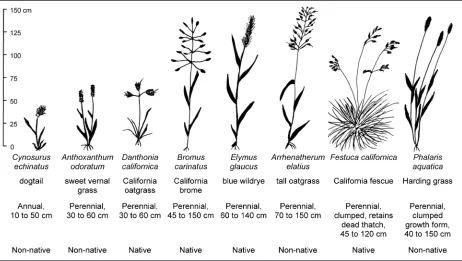
The grasslands in the Bald Hills are domi -nated by perennials, though several annual grasses are also present, the majority of which are non-native (Livingston 2014). The eight species chosen for this study were selected based on their prevalence. The native species studied were California brome (Bromus
cali-fornica Hook. & Arn.), blue wildrye (Elymus
glaucus Buckley), California oatgrass (Dan-thonia californica Bol.), and California fescue
(Festuca californica Vasey) (Figure 2). The
non-native species studied were Harding grass, dogtail, tall oatgrass, and sweet vernal grass (Figure 2). All study species are perennial with the exception of dogtail, a small-statured annual, and all are physiologically similar, cool season (C3) species. All of the species have a generally cespitose, or at least tufted, growth form, and several are sometimes also rhizomatous. Harding grass is rhizomatous, and sweet vernal grass and tall oatgrass are sometimes rhizomatous. Blue wildrye some-times has rhizomes or short stolons. Califor-nia fescue is an exceptionally robust native grass, with a clump-like growth form that re-tains abundant dead thatch. It is considered important in regional fire regimes because it is a highly flammable native species (Hastings et al. 1997, Engber et al. 2011).
relative differences in stature throughout the growing season. After collection, we trans-ported all grass samples directly to the labora -tory. With the exception of 14 October, when the weather was partly cloudy, sampling oc-curred on clear days between 1130 hr and 1700 hr. Our sampling window was slightly longer than what others have considered ideal for minimizing variation in environmental conditions (Countryman 1974, Rice 1989, Agee et al. 2002); however, the large amount of sampling necessitated expanding the win-dow. To determine wet weight, we weighed each specimen inside the pre-weighed polyeth-ylene bag, and then subtracted the bag weight to determine actual wet weight. After weigh-ing, we dried grasses in a convection oven at 70°C for 48 h until dry weight stabilized. We weighed all dry samples to determine dry weight (gravimetric basis).
The grass populations sampled, for all spe -cies except Harding grass, were spread throughout a 150 m × 150 m area; the Harding
grass population was less than 1 km away. Species were sampled in the same order on each date to maximize efficiency and maintain consistency. To evaluate the effect that time of collection had on fuel moisture values, we sampled from a subset of four species every two hours over an eight-hour period, on a sin-gle day on 10 October 2012. Two native spe-cies, California fescue and blue wildrye, and two non-native species, Harding grass and sweet vernal grass, were sampled. We sam-pled these species at two-hour intervals be-tween 0900 hr and 1700 hr. Due to the small amount of Harding grass remaining at our study site, only two to three samples of this species were collected at each interval. The number of samples collected for the other spe -cies depended upon the abundance of easily accessible material; three samples were col-lected for blue wildrye, four for California fes-cue, and five for sweet vernal grass. Through-out the eight-hour sampling period, the air temperature ranged from 12.8 °C to 16.7 °C,
relative humidity ranged from 62 % to 80 %, and wind speeds ranged from 3.2 km h-1 to 9.7 km h-1.
Data Analysis
To evaluate differences in grass moisture content ( %) among the eight grass species, across the six sampling dates, and for the spe -cies and date interaction, we used a two-way analysis of variance (ANOVA). A two-way ANOVA was used instead of a time series analysis because of the small number of sam -pling dates, and due to the fact that the dates increased in frequency during peak fire season. Residual plots were evaluated and assump-tions for normality and homogeneity of vari -ance were met (Zar 1999). When differences were detected, we used the conservative Tukey HSD (Honest Significant Difference) multiple comparison test to compare all pairwise differ-ences. Significance for all statistical analyses was determined using α = 0.05.
A hierarchical, linear mixed effects model with binomial error structure and logit link was used to evaluate differences among the mean moisture content of the native species and non-native species across all sampling dates, with the eight species nested into a na-tive or non-nana-tive group type. Our model in-cluded a single fixed effect categorical vari-able for native or non-native species. Mois-ture content was the response variable. Sam-pling date and species were designated as ran-dom effects (Crawley 2013). Residual plots were assessed, revealing that the model met the assumptions for normality and homogene -ity of variance (Zar 1999). Diurnal sampling results were evaluated by comparing mean and standard error of moisture content of each spe -cies at each interval over the eight-hour sam-pling period.
RESULTS
The mean monthly moisture content of the native grass species did not differ significantly
from the non-native grasses across all six sam-pling dates (fixed-effects ANOVA; F1,6 = 1.088, P = 0.337). There was, however, a sig-nificant difference in moisture content among the eight species across the sampling dates (F47 = 179.4, P < 0.001). Harding grass had higher mean moisture content on all sampling dates compared to the other seven species (Tukey
HSD P < 0.05); it was the only species that
differed from all other species across all sam -pling dates. The mean moisture content of Harding grass was 303 % in June while the mean moisture content of all other species ranged from 107 % to 266 %. As the growing season progressed, the gap between mean moisture content of Harding grass and all oth -er species widened (Figure 3). On 25 Septem-ber, when Harding grass was driest, its mean moisture content was still more than double that of California fescue (116 % compared to 49%). The mean moisture content of Harding grass was several times higher than all the oth-er species, which ranged from only 6 % to 19%.
The non-native dogtail had significantly lower mean moisture content than all other species except sweet vernal grass and Califor-nia oatgrass (Tukey HSD P < 0.05). On 6 Au-gust, the mean moisture content of dogtail and California oatgrass were 21 % and 42 %, re-spectively. They were the only species to fall below an ignition threshold at this date, as-suming a conservative moisture of extinction value of 55 % (Dimitrakopoulos et al. 2010). Mean moisture content of all other species ranged from 57 % to 182 % in August. By the next sampling date, 5 September, the mean moisture content for all other species except Harding grass and California fescue ranged from 6 % to 29 % (Figure 3) and fell below a probable threshold for moisture of extinction. On this date, the mean moisture content of California fescue was 59 %, while the moisture content of Harding grass remained much high -er with a mean of 117 %.
dif-ferent extents. The native California fescue’s mean moisture content varied the least across the sampling period. Its mean moisture con-tent was highest in June (107 %) and lowest in late September (50 %). Harding grass had the next smallest amount of change across the season, from a high average of 304 % to a low of 117 %. Dogtail had the largest range of mean moisture content values, ranging from a high of 224 % in June, to a low of 6 % in early September.
The moisture content of all eight grass spe -cies followed the seasonal precipitation trends for 2012, and a significant interaction was found between species and date (F288 = 179.4, P < 0.001). Precipitation in 2012 was higher than the 10-year average, according to data from the Schoolhouse Peak weather station, and the moisture content values likely reflect this. Precipitation during March was double the 10-year average, and April and June had slightly more precipitation than average.
During July, 26 mm of rain fell, nearly twice the 10-year average. Mean moisture content of all species was highest in June and July when precipitation was still occurring (Figure 4), and declined in August after rainfall ended for the season. The moisture content of all species except blue wildrye increased by the 14 October sampling date after a cumulative 10.4 mm of rain had fallen. Mean moisture content of blue wildrye was 19 % in late Sep-tember and 18 % on 14 October.
Results from sampling diurnal moisture content confirmed that influence from weather variation was minimal after late morning (1100 hr) and that our fuel sampling window (1130 hr to 1700 hr) was appropriate for these grasses. Three of the four species we sampled showed a large decrease in moisture content between the 0900 hr and 1100 hr morning col-lection times. Between 1100 hr and 1700 hr, the moisture content of all species sampled were relatively stable. Data from diurnal sam-0
50 100 150 200 250 300 350
Jun Jul Aug Sep early Sep late Oct mid
M
oi
st
ur
e cont
ent
(%
)
Sampling date
tall oatgrass sweet vernal grass dogtail
Harding grass California brome California oatgrass blue wildrye California fescue
non-native
native
pling on 10 October were not analyzed with the data we collected regularly between 1130 hr and 1700 hr throughout the growing season.
DISCUSSION
In many ecosystems, non-native grass spe-cies have been implicated in altering fire re-gimes, particularly where they invade areas with no native analogues (Brooks 1999, D’An-tonio 2000, Brooks et al. 2004, Brooks 2008). In the Bald Hills, potential effects on the fire regime are complex, depending to a large ex -tent on the degree to which the composition of the fuelbed has shifted with species invasions. Of the four non-native species that we studied, one of these, Harding grass, sustained high moisture content throughout the growing sea-son and may act to delay ignition and dampen
fire spread and intensity. In contrast, the non-native annual dogtail might decrease fuel moisture levels and increase their ignitability earlier in the fire season compared to most na-tive perennial species. Two of the non-nana-tive species that we studied, sweet vernal grass and tall oatgrass, did not differ from the native spe -cies’ moisture contents.
The only annual species that we studied, the non-native dogtail, had significantly lower moisture content than all other study species across all dates except for the non-native sweet vernal grass and the native California oatgrass, which also had relatively low moisture con-tent. These three grasses are relatively small-statured (Figure 2). Dogtail reached its maximum height early and flowered quickly, fitting with its sharp decline in moisture con-tent early in the growing season. After this
0 0.5 1 1.5 2 2.5 3
6/1/2012 7/1/2012 8/1/2012 9/1/2012 10/1/2012
Preci
pi
tatio
n (cm)
Precipitation
Precipitation
0 0.5 1 1.5 2 2.5 3
6/1/2012 7/1/2012 8/1/2012 9/1/2012 10/1/2012
Preci
pi
tatio
n (cm)
Precipitation
native
non-native
0 50 100 150 200 250 300 350
Moi
sture
con
ten
t (%)
tall oatgrass sweet vernal grass dogtail
Harding grass California brome California oatgrass blue wildrye California fescue
1 Jun 2012
Mo
istu
re
co
nten
t (%
)
1 Jul
2012 1 Aug 2012 1 Sep 2012 1 Oct 2012
species senesced (at approximately the end of July), samples of this species contained pri-marily dead material. California oatgrass is unique among the study species because, when its seeds are mature, the dried culms detach from the still-green basal leaves and fall on the ground. This occurred between the 6 August and 5 September sampling dates, when the moisture content for this species decreased sharply (Figure 3). For the remainder of sam-pling dates, both basal leaves and detached culms were included in samples. With the ex-ception of Harding grass, the moisture content of the four larger perennials (Figure 2; the na-tive California brome, blue wildrye, California fescue, and the non-native tall oatgrass) did not differ significantly from each other.
Due to its substantial mass and the dead fuel it retains, California fescue is considered a highly flammable fuel in oak woodland under-stories, capable of burning with high intensity where it is dominant (Hastings et al. 1997). In the Bald Hills, this species is considered to be an exceptional fuel, contributing to the fast moving, low intensity fires that prohibit young conifers from invading (Engber et al. 2011). We did not find a difference in the moisture content for California fescue across all sam -pling months compared to the other robust pe -rennial species (with the exception of Harding grass, which was significantly higher). Cali-fornia fescue’s reputation as an exceptional fuel source is partially dependent on its mass. Oak woodland understory dominated by Cali-fornia fescue in the Bald Hills had more than double the herbaceous mass of mixed grass -lands, and a positive correlation was found be-tween herbaceous fuel mass and surface fire temperatures in this ecosystem (Engber et al. 2011). Given the large amounts of dead thatch that this species retains, much of which is held close to the ground, it may have responded dif -ferently to the wetter than average year com-pared to the other species, and perhaps it had higher moisture content values than it other -wise would have. Like-wise, the low variabili-ty in moisture content of this species may also
be related to its growth form and the dead thatch it retains.
In stark contrast to the patterns in moisture content found in the seven other species, the non-native Harding grass had much higher moisture content than all other species throughout the growing season. Even on its driest sampling date, the moisture content of Harding grass was still more than double a probable value for moisture of extinction. One caveat to our findings is that limited pilot sam-pling on 28 June 2013 confirmed that the new Harding grass location we moved to in July was more mesic than our original Harding grass location. Mean moisture content for Harding grass at our initial location was 239 % compared to 290 % at the location we moved to (a 18 % difference relative to the new loca-tion). Harding grass was also sampled from two other locations in the Bald Hills that had mean moisture contents of 201 % and 203 %, a 31% and 30 % difference relative to our new Harding grass location, respectively. On 25 September 2012, however, the relative differ-ence between six of the grass species and Harding grass ranged from 84 % to 95 % (rela-tive to Harding grass), and the rela(rela-tive differ-ence between Harding grass and California fescue was 58 % (relative to Harding grass). It is unlikely that sampling in the more mesic lo -cation would negate the general pattern we re-ported, as the magnitude of difference between Harding grass and the other species was so large. Additionally, at our sampling location, Harding grass culms were noticeably greener late into the fall compared to the other co-oc-curring species. Although the inferences we are able to make from a single study location are somewhat limited, the patterns that we ob-served are still noteworthy.
De-pending on the density and extent of Harding grass infestations, combined with burn-day weather conditions of wind speed and relative humidity, as well as topographic position, this species may act to dampen fire intensity. Be-cause of the other threats it poses to native species, park managers are currently trying to eradicate this species from the Bald Hills. The potential impediments that this species may pose to prescribed burning may serve as addi -tional motivation for managers to eradicate this species from fire-dependent ecosystems.
The relative dominance of non-native spe-cies in a fuelbed will have a significant impact on the overall contribution of the species on the fire regime. A survey of understory vege-tation in the oak woodlands of the Bald Hills found that the mean cover of dogtail was 9 % (Livingston 2014). Comparatively, mean cov-er for tall oatgrass, sweet vcov-ernal grass, Califor-nia brome, blue wildrye, and CaliforCalifor-nia fescue in oak woodland understories ranged from only 1 % to 4 %. California oatgrass occurred in woodland understory sampling rarely, and Harding grass was not detected in this survey (Livingston 2014). California oatgrass is one of the more common native grass species in the prairies of the Bald Hills, however, and Harding grass has primarily invaded prairies. Although its overall cover was low in the oak woodland understory survey, California fescue is dominant in several areas of the Bald Hills (Engber et al. 2011), and where it does occur, its cover is generally very high. The non-na-tive species that we studied commonly invade other grasslands and woodlands ecosystems in the Pacific Northwest (Dennehy et al. 2011, Stanley et al. 2011) and elsewhere (Hitchcock 1971), making the results of this study relevant at broader geographic scales.
The non-native dogtail and the native Cal-ifornia oatgrass were the first species to fall below a probable threshold for moisture of ex-tinction, and the moisture content of dogtail was much lower than all other study species on 6 August. Depending on the density of
dogtail, it may decrease fuel moisture levels and increase ignitability earlier in the fire sea-son. Although the moisture content of Cali-fornia oatgrass was twice that of dogtail in August (21 % and 42 % respectively), Califor-nia oatgrass had possibly cured sufficiently to be ignitable based on the more conservative values for moisture of extinction estimated for grass species (Burrows et al. 1991). Although still common in the Bald Hills, California oat -grass is patchily distributed in the prairies, and it is thought to be less dominant now than it was historically (cf. Davy 1902). Potential effects on the fire regime in the prairies of the Bald Hills caused by dogtail may be reduced because of the diminished dominance of Cali -fornia oatgrass. Although the species selected for this study are among the most dominant, there are several other grass species in the Bald Hills, including many other non-native annuals: oats (Avena L. spp.), bromes (Bro-mus L. spp.), rattail six-weeks grass (Festuca myuros L.), brome fescue (Festuca bromoides L.), and silver hair grass (Aira caryophyllea L.), and a few native annuals (e.g., Poa how-ellii Vasey & Scribn), that we did not study (Livingston 2014). If other annual species have moisture content values similar to those that we observed for dogtail, they might have an additive effect on the ignition potential of fuel early in the fire season. As our study was not comprehensive, speculation on the net ef -fects of fuel moisture change with invasion is difficult.
sea-son moisture content was compared (Agee et al. 2002). Large differences in the moisture content among individual native herbaceous species have been reported from quaking as-pen understories in Wyoming (Brown et al. 1989) as well as from the Great Lakes region (Loomis et al. 1979).
The relative changes in moisture content that we observed at two-hour intervals during our sampling window of 1130 hr and 1700 hr are consistent with relative changes reported for crown foliage and forest floor fuel mois-ture (Agee et al. 2002, Banwell et al. 2013). Our diurnal sampling showed that the early morning (between 0900 hr and 1100 hr) changes in fuel moisture were, however, dra-matically greater than changes observed for these other fuel types. The moisture content of one-year-old foliage in the Pacific Northwest varied only 4 % to 12 %, depending on species, when sampled at two-hour intervals from 1000 hr to 1600 hr (Agee et al. 2002). Over a twen-ty-four-hour period in the Lake Tahoe Basin, moisture content of forest floor fuels (1 hr woody fuels, litter, and pine cones) underwent a similar 3 % to 11 % relative change in mois -ture content (Banwell et al. 2013). The large decrease in moisture content that we observed for three of our four study species (relative change ranged from 40 % to 84 %) likely re-sulted from the clearing of coastal fog often present in the morning at our study site, which increases nocturnal moisture content and slows morning drying. Not surprisingly, her-baceous fuels like grasses are much more re -sponsive to ambient moisture.
A definitive value for moisture of extinc-tionthe fuel moisture content at which fire will not spread, or when the probability of ig-nition is 1 %has not been widely agreed upon for grasses (Dimitrakopoulos et al. 2010). Fire ignition and spread was difficult when moisture content approached 35 % for spinifex grass fuel in Australia, primarily hard spinifex (Triodia basedowii E. Pritz.) and soft spinifex (Plectrachne schinzii Henrard) (Bur-rows et al. 1991). Laboratory ignition tests
for grass samples consisting primarily of Im-perata cylindrica in Indonesia found moisture of extinction to be 40 % for dead grass and 44 % for live grass (de Groot and Wang 2005). Recent field experiments in Greece estimated the moisture of extinction for slender oat ( Av-ena barbata Link.) at 55.5 %
(Dimitrakopou-los et al. 2010). Day of burn weather and
topographic conditions also influence mois-ture of extinction, particularly wind speed, which has been shown to overwhelm ignition potential when fuel moisture is high (Dimitra-kopoulos et al. 2010). Morphological proper-ties of individual species, including size of culms and leaves, as well as residual dead fu-els (not part of our sampling) may also in-crease the probability of ignition and affect spread, particularly in the robust bunchgrasses (i.e., California fescue).
LITERATURE CITED
Agee, J.K., C.S. Wright, N. Williamson, and M.H. Huff. 2002. Foliar moisture content of Pacific Northwest vegetation and its relation to wildland fire behavior. Forest Ecology and Manage-ment 167: 757-766. doi: 10.1016/S0378-1127(01)00690-9
Agee, J.K. 1993. Fire ecology of Pacific Northwest forests. Island Press, Washington, D.C., USA.
Arguello, L.A. 1994. Effects of prescribed burning on two perennial bunchgrasses in the Bald Hills of Redwood National Park. Thesis, Humboldt State University, Arcata, California, USA.
Banwell, E.M., J.M. Varner, E.E. Knapp, and R.W. Van Kirk. 2013. Spatial, seasonal, and diel forest floor moisture dynamics in Jeffrey pine-white fir forests of the Lake Tahoe Basin, USA. Forest Ecology and Management 305: 11-20. doi: 10.1016/j.foreco.2013.05.005
Brooks, M.L. 1999. Alien annual grasses and fire in the Mojave Desert. Madroño 46: 13-19. Brooks, M.L. 2008. Plant invasions and fire regimes. Pages 33-46 in: K. Zouhar, J. Kapler
Smith, S. Sutherland, and M.L. Brooks, editors. Wildland fire in ecosystems: fire and nonna-tive invasive plants. USDA Forest Service General Technical Report RMRS-GTR-42-vol-ume 6, Rocky Mountain Research Station, Ogden, Utah, USA.
Brooks, M.L., C.M. D’Antonio, D.M. Richardson, J.B. Grace, J.E. Keeley, J.M. DiTomaso, R.J. Hobbs, M. Pellant, and D. Pyke. 2004. Effects of invasive alien plants on fire regimes. Bio-Science 54: 677-688. doi: 10.1641/0006-3568(2004)054[0677:EOIAPO]2.0.CO;2
Brooks, M.L., and T.C. Esque. 2002. Alien annual plants and wildfire in desert tortoise habitat: status, ecological effects, and management. Chelonian Conservation and Biology 4: 330
-340.
Brown, J.K., G.D. Booth, and D.G. Simmerman. 1989. Seasonal change in live fuel moisture of understory plants in western US aspen. Pages 406-412 in: D.C. MacIver, H. Auld, and R. Whitewood, editors. Proceedings of the 10th Conference on Fire and Forest Meteorology. Forestry Canada, Petawawa National Forestry Institute, Chalk River, Ontario, Canada.
Bruce, K.A., G.N. Cameron, P.A. Harcombe. 1997. Introduction, impact on native habitats, and management of a woody invader, the Chinese tallow tree (Sapium sebiferum [L.] Roxb.). Natural Areas Journal 17: 255-260.
Burrows, N., B. Ward, and A. Robinson. 1991. Fire behaviour in spinifex fuels on the Gibson Desert Nature Reserve, Western Australia. Journal of Arid Environments 20: 189-204.
Chuvieco, E., I. Aguado, and A.P. Dimitrakopoulos. 2004. Conversion of fuel moisture content values to ignition potential for integrated fire danger assessment. Canadian Journal of Forest Research 34: 2284-2293. doi: 10.1139/x04-101
ACKNOWLEDGEMENTS
Countryman, C.M. 1974. Moisture in living fuels affects fire behavior. Fire Management Notes 35: 10-14.
Crawley, M.J. 2013. The R book. Second edition. Wiley, West Sussex, England, United Kingdom. D’Antonio, C.M. 2000. Fire, plant invasions, and global changes. Pages 65-93 in: H. Mooney
and R. Hobbs, editors. Invasive species in a changing world. Island Press, Washington, D.C., USA.
D’Antonio, C.M., and P.M. Vitousek. 1992. Biological invasions by exotic grasses, the grass/fire cycle, and global change. Annual Review of Ecology and Systematics 23: 63-87. doi:
10.1146/annurev.es.23.110192.000431
Davies, K.W., and A.M. Nafus. 2012. Exotic annual grass invasion alters fuel amounts, continu-ity, and moisture content. International Journal of Wildland Fire 22: 353-358. doi: 10.1071/
WF11161
Davy, J.B. 1902. Stock ranges of northwestern California: notes on the grasses and forage plants and range conditions. USDA Bureau of Plant Industry Bulletin 12, Washington, D.C., USA.
doi: 10.5962/bhl.title.65141
de Groot, W.J., and Y. Wang. 2005. Calibrating the fine fuel moisture code for grass ignition po-tential in Sumatra, Indonesia. International Journal of Wildland Fire 14: 161-168. doi:
10.1071/WF04054
Dennehy, C., E.R. Alverson, H.E. Anderson, D.R. Clements, R. Gilbert, and T.N. Kaye. 2011. Management strategies for invasive plants in Pacific Northwest prairies, savannas, and oak woodlands. Northwest Science 85: 329-351. doi: 10.3955/046.085.0219
Dibble, A.C., R.H. White, and P.K. Lebow. 2007. Combustion characteristics of north-eastern USA vegetation tested in the cone calorimeter: invasive versus non-invasive plants. Interna-tional Journal of Wildland Fire 16: 426-443. doi: 10.1071/WF05103
Dimitrakopoulos, A.P., I.D. Mitsopoulos, and K. Gatoulas. 2010. Assessing ignition probability and moisture of extinction in a Mediterranean grass fuel. International Journal of Wildland Fire 19: 29-34. doi: 10.1071/WF08124
Engber, E.A., and J.M. Varner. 2012. Reversing conifer encroachment with prescribed fire: shift-ing mortality models toward restoration targets. Restoration Ecology 20: 665-668. doi:
10.1111/j.1526-100X.2012.00900.x
Engber, E.A., J.M. Varner, L. Arguello, and N. Sugihara. 2011. The effects of conifer encroach-ment and overstory structure on fuels and fire in an oak woodland landscape. Fire Ecology 7(2): 32-50. doi: 10.4996/fireecology.0702032
Fritschle, J.A. 2008. Reconstructing historic ecotones using the public land survey: the lost prai-ries of Redwood National Park. Annals of the Association of American Geographers 98: 24
-39. doi: 10.1080/00045600701734018
Grenier, K.H. 1989. Vegetation patterns in grasslands of Redwood National Park, California. Thesis, Humboldt State University, Arcata, California, USA.
Hastings, M.S., S. Barnhart, and J.R. McBride. 1997. Restoration management of northern oak woodlands. USDA Forest Service General Technical Report PSW-GTR-160, Pacific South-west Research Station, Albany, California, USA.
Hitchcock, A.S. 1971. Manual of the grasses of the United States. Dover, Mineola, New York, USA.
Livingston, A.C. 2014. Plant community responses to fire exclusion, species invasions, and res-toration in California woodlands and grasslands. Thesis, Humboldt State University, Arcata, California, USA.
Loomis, R.M., P.J. Roussopoulos, and R.W. Blank. 1979. Summer moisture contents of under-story vegetation in northeastern Minnesota. USDA Forest Service Research Note NC-RN-179, North Central Experiment Station, St. Paul, Minnesota, USA.
Mack, M.C., and C.M. D’Antonio. 1998. Impacts of biological invasions on disturbance re-gimes. Trends in Ecology and Evolution 13: 195-198. doi: 10.1016/S0169-5347(97)01286-X
McDonald, C.J., and G.R. McPherson. 2013. Creating hotter fires in the Sonoran Desert: buffel-grass produces copious fuels and high fire temperatures. Fire Ecology 9(2): 26-39. doi:
10.4996/fireecology.0902026
McGranahan, D.A., D.M. Engle, J.R. Miller, and D.M. Debinski. 2013. An invasive grass in-creases live fuel proportion and reduces fire spread in a simulated grassland. Ecosystems 16: 158-169. doi: 10.1007/s10021-012-9605-4
Platt, W.J., and R.M. Gottschalk. 2001. Effects of exotic grasses on potential fine fuel loads in the groundcover of south Florida slash pine savannas. International Journal of Wildland Fire 10: 155-159. doi: 10.1071/WF01016
Rice, C. 1989. Live fuel moisture sampling methods for Chiricahua National Monument. Coop-erative National Park Resources Studies Unit, University of Arizona Technical Report No. 27, Tucson, Arizona, USA.
Saenz, L. 1983. Quercus garryana woodland/grassland mosaic dynamics in northern California. Thesis, Humboldt State University, Arcata, California, USA.
Saenz, L., and J. Sawyer. 1986. Grasslands as compared to adjacent Quercus garryana wood-land understories exposed to different grazing regimes. Madroño 33: 40-46.
Setterfield, S.A., N.A. Rossiter-Rachor, M.M. Douglas, L. Wainger, A.M. Petty, P. Barrow, I.J. Shepard, and K.B. Ferdinands. 2013. Adding fuel to the fire: the impacts of non-native grass invasion on fire management at a regional scale. PLoS ONE 8: e59144. doi: 10.1371/journal. pone.0059144
Stanley, A.G., P.W. Dunwiddie, and T.N. Kaye. 2011. Restoring invaded Pacific Northwest prai-ries: management recommendations from a region-wide experiment. Northwest Science 85: 233-246. doi: 10.3955/046.085.0212
Sugihara, N.G., and L.J. Reed. 1987. Vegetation ecology of the Bald Hills oak woodlands of Redwood National Park. Redwood National Park Research and Development Technical Re-port Number 21, Arcata, California, USA.
Sugihara, N.G., L.J. Reed, and J.M. Lenihan. 1987. Vegetation of the Bald Hills oak woodlands, Redwood National Park, California. Madroño 34: 193-208.
Tveten, R.K., and R. Fonda. 1999. Fire effects on prairies and oak woodlands on Fort Lewis, Washington. Northwest Science 73: 145-158.
Underwood, S., L. Arguello, and N. Siefkin. 2003. Restoring ethnographic landscapes and natu-ral elements in Redwood National Park. Ecological Restoration 21: 278-283. doi: 10.3368/ er.21.4.278
USDI [US Department of the Interior] Redwood National Park. 1992. Bald Hills vegetation management plan. Redwood National Park, Orick, California, USA.