Open Access
Research
Immune response to pneumococcal polysaccharides 4 and 14 in
elderly and young adults. I Antibody concentrations, avidity and
functional activity
Kris Kolibab
1, S Louise Smithson
1, Anne K Shriner
1, Sadik Khuder
1,
Sandra Romero-Steiner
2, George M Carlone
2and MA Julie Westerink*
1Address: 1Department of Medicine, Medical College of Ohio, Toledo, OH, USA and 2Respiratory Diseases Branch, Division of Bacterial and
Mycotic Diseases, National Centers for Infectious Diseases, Centers for Disease Control and Prevention, Atlanta, GA 30333, USA
Email: Kris Kolibab - [email protected]; S Louise Smithson - [email protected]; Anne K Shriner - [email protected];
Sadik Khuder - [email protected]; Sandra Romero-Steiner - [email protected]; George M Carlone - [email protected]; MA Julie Westerink* - [email protected]
* Corresponding author
Abstract
Streptococcus pneumoniae is a serious worldwide pathogen and the focus of numerous vaccine development projects. Currently the most widely accepted surrogate marker for evaluating the efficacy of a given vaccine is to utilize ELISA. Measurement of antibody concentration by ELISA without reduction in cross-reactive antibodies causes an overestimation of antibody concentration and therefore protection, this is most notable in the aged, an at risk group for this infection. We compared the immune response to the pneumococcal polysaccharides (PPS) 4 and 14 of 20 young to 20 elderly adults. Pre-and post-vaccination IgG antibody concentrations and antibody avidity against PPS4 and PPS14 were measured using two different enzyme-linked immunosorbant assay (ELISA) absorption protocols. All sera were pre-absorbed with either cell-wall polysaccharide (CPS), or CPS and serotype 22F polysaccharide.
Pre- and post-vaccination IgG antibody concentrations for serotype 4, but not 14, were significantly lowered with the additional absorption with serotype 22F polysaccharide in both age groups. Young and elderly demonstrated a significant increase from pre- to post-immunization antibody concentration, using either absorption method; and opsonophagocytic antibody titers in response to both PPS4 and PPS14. The correlation coefficients between ELISA and opsonophagocytic assays were improved by additional absorption with serotype 22F in response to serotype 4, but not serotype 14 in all age groups. Opsonophagocytic antibody titers in a sub-group of elderly (>77 years of age) were significantly lower than the opsonophagocytic antibody concentrations in young adults.
These results suggest the importance of eliminating cross-reactive antibodies from ELISA measurements by absorption of serum and an age-related impairment in the antibody response to pneumococcal polysaccharides.
Published: 27 June 2005
Immunity & Ageing 2005, 2:10 doi:10.1186/1742-4933-2-10
Received: 20 April 2005 Accepted: 27 June 2005
This article is available from: http://www.immunityageing.com/content/2/1/10
© 2005 Kolibab et al; licensee BioMed Central Ltd.
Background
Streptococcus pneumoniae is a major human pathogen responsible for serious infections in all age groups world-wide. Pneumococcal infections are estimated to cause around 40,000 deaths per year [1], and are a leading causes of death in the United States [2]. The highest inci-dence of pneumococcal infections occurs at the extremes of age, in the very young and in the elderly. The mortality rate of invasive pneumoccoal disease increases with age and is estimated to be 20% in those 65 years of age and 40% in those 85 years of age or older. Moreover, S. pneu-moniae, is the most common cause of community acquired pneumonia among the elderly [3] and the fifth leading cause of death in those 65 years and older [4,5]. Pneumococcal capsular polysaccharide (PPS) is a major virulence factor of S. pneumoniae and reduces phagocyto-sis in the host [6,7]. The currently licensed pneumococcal vaccine consists of 23 purified PPS serotypes, which account for 76–90% of IPD causing strains [8,9]. The cap-sular PPS vaccine is based on the observation that anti-bodies against the capsule protect against disease by enhancing complement dependent phagocytosis [6]. Pneumococcal vaccination is recommended for all per-sons 65 years and older in the United States, however, effi-cacy studies indicate decreased protection among this target population despite protective levels of anti-pneu-mococcal antibodies [10,11]. The underlying causes of the reduced vaccine efficacy merit investigation.
Reports of the diminished vaccine efficacy in the elderly may reflect either poor functionality of vaccine induced anti-PPS specific antibodies or inconsistent antibody measurements. Protection is measured by in vitro analysis of opsonophagocytosis by anti-polysaccharide antibodies and serves as a surrogate marker of clinical protection [12]. However, the opsonophagocytic assay is labor inten-sive and difficult to perform and therefore impractical, when analyzing large numbers of samples. Therefore, alternate methods for measuring pneumococcal antibody concentrations, namely ELISA, have been developed. More practical than opsonophagocytic assays, the polysaccharide-specific antibody concentrations meas-ured by ELISA do not necessarily correlate with functional antibody activity. The development of an ELISA method that accurately reflects functional antibody activity and can serve as a surrogate marker of protection is of utmost importance.
The enzyme-linked immunosorbant assay (ELISA) method used to measure PPS-specific antibody concentra-tions has changed considerably over the past 20 years. The presence of cell wall polysaccharide (CPS), covalently linked to the type-specific polysaccharide, led to poor cor-relations between antibody concentration and
pneumo-coccal vaccine efficacy [13,14]. The realization that the measurement of anti-CPS antibodies caused an overesti-mation of anti-PPS antibody concentration led to a mod-ification of the pneumococcal ELISA procedure to include an absorption step, removing cell wall polysaccharide directed antibodies [13,15]. Recent studies have demon-strated that the additional absorption of sera with CPS and serotype 22F PPS significantly increases the correla-tion between antibody concentracorrela-tion and opsonophago-cytic activity compared to CPS absorption alone [16]. Previously, a study performed in elderly adults demon-strated a significant decrease in opsonophagocytic activity in response to PPS4 despite normal antibody concentra-tions [17]. The decrease in functional antibody activity increased with age and was serotype specific. The immune response to PPS14, as determined by antibody concentra-tion and opsonophagocytic antibody activity, was well conserved in the elderly. However, in this study, an older version of the PPS-ELISA relying solely on CPS absorption was used to determine antibody concentration. Therefore, non-specific cross-reactive antibodies may have been responsible for the discrepancy between antibody concen-tration and opsonophagocytic activity to PPS4.
The aim of this study was to re-assess the response of eld-erly (>65 years old) adults to PPS4 and PPS14 employing the recently modified PPS-specific ELISA. We have under-taken the present study to further elucidate the nature of the elderly immune response to PPS in an effort to define correlates of protection in the ageing population. Should the elderly response contain a significant proportion of low avidity, cross-reactive antibodies as previously sug-gested [17] one would expect that absorption with PPS 22F would have a greater impact on antibody concentra-tion and avidity measurements in the elderly than young.
Results
All volunteers were considered immune competent based on health history, complete blood cell counts, total immunoglobulin levels and quantitative B-cell and T-cell subset studies. There was no quantitative difference in number of B-cells or CD4+ and CD8+ T cells in the young versus elderly participants (Table 1).
Anti-pneumococcal Antibody Concentrations
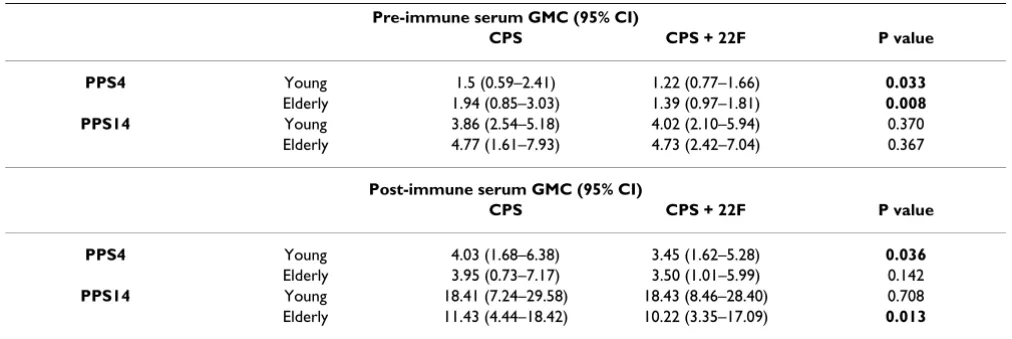
significant reduction in antibody concentration was observed following CPS + PPS22F absorption in young volunteers' pre-and post-immune sera (18.6 %, p = 0.033 and 14%, p = 0.036 respectively) and elderly volunteers' pre-immune (28.4, p = 0.008) but not post-immune sera (11.4%, p = 0.142). There was no significant difference in the antibody levels detected between young and elderly volunteers in pre-or post-immunization sera using either absorption method, although young pre-immune sera tended to demonstrate lower geometric mean concentra-tions (GMC). However, more young than elderly demon-strated a two-fold or greater increase pre-post immunization (83% compared to 50%).
In response to PPS14, a similar significant increase in pre-to post-immunization antibody concentration was detected in all groups (p range 0.001–0.006). When both ELISA methods were compared there was no significant difference in IgG concentrations in young sera using either method. However, in the elderly the addition of PPS22F absorption significantly reduced the IgG concentration
detected in post-(10.6%, p = 0.013) but not pre-immuni-zation sera (0.8%, p = 0.367). There was a tendency towards lower antibody concentrations in the pre-immune sera of the young in comparison to the elderly, although this was not significant. The post-immune anti-PPS14 antibody concentrations were also not significantly different between young and elderly groups. However, more young than elderly demonstrated a two fold or greater increase in serum IgG concentrations, 90% and 55% respectively.
Our study was designed to compare the immune reaction to PPS in young adults (18 – 30 years old) to elderly (>65 years of age). However, several studies [17,18] indicate that the oldest elderly (>77 years of age) demonstrate a significant decrease in the immune response to PPS. We thus analyzed the results obtained for a subgroup of eld-erly >77 years old within our study population. In this small subgroup (n = 6) additional absorption with PPS22F resulted in a substantial but not significant decrease in measured antibody concentration of 28% in
Table 1: Measurement of T and B cell parameters in young and elderly volunteers.
CD4+ T cells GMN (95% CI)
CD8+ T cells GMN (95% CI)
B cells GMN (95% CI)
Total IgG GMC (95% CI)
Normal Range 430 – 1185 180 – 865 25 – 285 591–1540
Young 879 (758–1000) 573 (487–659) 235 (156–314) 838 (757–919) Elderly 817 (692–942) 396 (303–489) 164 (93–235) 993 (956–1030)
GMC = geometric mean concentration (ug/ml), GMN geometric mean number per ml. There was no significant difference (P>0.05) between young and elderly for all values.
Table 2: Specific anti-PPS IgG antibody levels in young and elderly.
Pre-immune serum GMC (95% CI)
CPS CPS + 22F P value
PPS4 Young 1.5 (0.59–2.41) 1.22 (0.77–1.66) 0.033
Elderly 1.94 (0.85–3.03) 1.39 (0.97–1.81) 0.008 PPS14 Young 3.86 (2.54–5.18) 4.02 (2.10–5.94) 0.370 Elderly 4.77 (1.61–7.93) 4.73 (2.42–7.04) 0.367
Post-immune serum GMC (95% CI)
CPS CPS + 22F P value
PPS4 Young 4.03 (1.68–6.38) 3.45 (1.62–5.28) 0.036
Elderly 3.95 (0.73–7.17) 3.50 (1.01–5.99) 0.142
PPS14 Young 18.41 (7.24–29.58) 18.43 (8.46–28.40) 0.708 Elderly 11.43 (4.44–18.42) 10.22 (3.35–17.09) 0.013
pre-immune and 15.6% in post-immune sera in compar-ison to young adults. A significant increase from pre-to post-immunization antibody concentration in response to PPS4 was only found when sera were absorbed with CPS (p = 0.05) but not when sera were absorbed with CPS + PPS22F (p = 0.069). There was no significant increase in pre-to post-immunization antibody levels against PPS14 for either method (p = 0.094 for both). Although, the post-immunization anti-PPS14 IgG GMC of the young adult group was not significantly different from the erly, it was significantly higher than the sub-group of eld-erly >77 years old using both absorption methods (p = 0.035 and p = 0.022). There was a reduction in the pro-portion of this subgroup that demonstrated a two-fold or greater increase in IgG levels pre-post immunization, in response to both PPS4 (29%) and PPS14 (43%) than either all elderly (50% and 55% respectively) and young (83% and 90% respectively).
Immunoglobulin Isotype and Subclass
The predominant immunoglobulin isotype expressed in response to both PPS4 and PPS14 consisted of IgG. Despite a significant increase from pre-to post-immuniza-tion, the GMC of the PPS-specific IgM and IgA antibody concentrations in response to both PPS did not exceed one microgram per millilitre in young or elderly. Moreo-ver, there was no significant difference in either IgM or IgA antibody concentrations in young versus elderly. Addi-tional absorption with PPS22F reduced both IgM and IgA concentrations in young and elderly alike, but not signifi-cantly so.
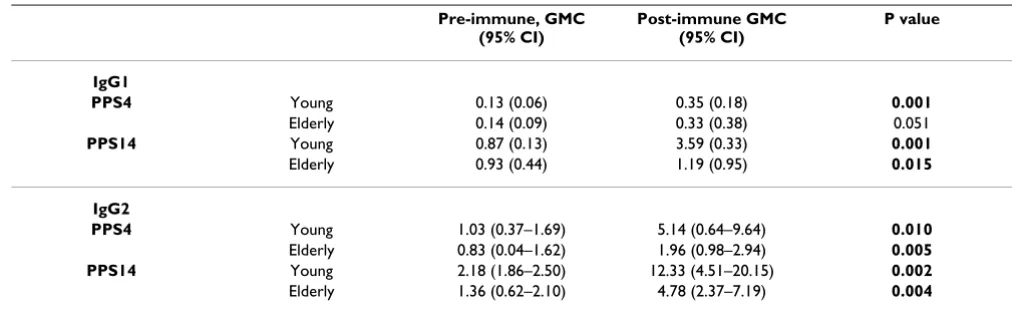
As shown in Table 3, the IgG response to PPS4 and PPS14 was dominated by the IgG2 subclass in young and elderly adults as previously reported [19,20]. In response to PPS4,
67.5 to 80.5 % of the total IgG antibody concentration measured consisted of IgG2, with no significant difference between young and elderly or pre-to post-immunization. Similarly, of the pre-and post-immune total PPS14-spe-cific IgG antibody, 63.7 to 73% of the response consisted of IgG2 with no significant difference between age groups. PPS-specific IgG1 antibodies were also readily detectable and increased significantly post-vaccination in both age groups. Overall, IgG1 antibodies represented 9.5 to 11.2% of total IgG antibodies in response to PPS4 and 18.7 to 25.4% of total IgG antibodies measured in response to PPS14. There was no significant difference detected in either IgG1 antibody concentration or percent usage between young and elderly.
Additional absorption of sera with PPS22F did not affect either pre-or post-immunization IgG1 PPS4 or PPS14 concentrations in either age group or the IgG2 response to PPS14. However, in response to PPS4, absorption with PPS22F significantly reduced pre-and post-immunization IgG2 concentrations in both young and elderly (17 to 27% with p = 0.019 to 0.025).
Opsonophagocytic Activity
Opsonophagocytic activity was measured in pre-and post-immunization sera against pneumococcal serotypes 4 and 14. Geometric mean titers (GMT) and ranges are shown in Table 4.
In response to serotypes 4 and 14 both young and elderly demonstrated a significant increase pre-to post-immuni-zation (p range 0.0003–0.001). There was no significant difference between the opsonophagocytic titers in young and elderly for either polysaccharide (p range 0.203–
Table 3: Anti-PPS specific IgG isotype levels in young and elderly.
Pre-immune, GMC (95% CI)
Post-immune GMC (95% CI)
P value
IgG1
PPS4 Young 0.13 (0.06) 0.35 (0.18) 0.001
Elderly 0.14 (0.09) 0.33 (0.38) 0.051
PPS14 Young 0.87 (0.13) 3.59 (0.33) 0.001
Elderly 0.93 (0.44) 1.19 (0.95) 0.015
IgG2
PPS4 Young 1.03 (0.37–1.69) 5.14 (0.64–9.64) 0.010
Elderly 0.83 (0.04–1.62) 1.96 (0.98–2.94) 0.005 PPS14 Young 2.18 (1.86–2.50) 12.33 (4.51–20.15) 0.002
Elderly 1.36 (0.62–2.10) 4.78 (2.37–7.19) 0.004
0.754). However, when the eldest subgroup was analyzed separately there was a significant increase in opsonophagocytic activity only in response to serotype 14 (p = 0.04) but not in response to serotype 4 (p = 0.214). The post immunization titers for the eldest subgroup for serotype 4 (GMT 35.92) and 14 (90.51) were significantly lower than in young donors (p = 0.03 and 0.02), all eld-erly donors (p = 0.01 for both) and the younger group of elderly (p = 0.002, 0.001).
Antibody Avidity Measurements
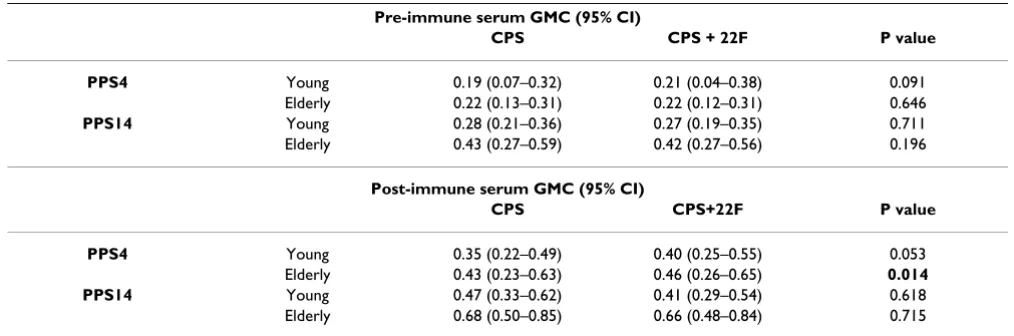
Antibody avidity was determined using sodium thiocy-anate (NaSCN) in both ELISA methods as described. Geo-metric mean concentrations (GMC, M NaSCN) and ranges are given in Table 5. The addition of PPS22F to the assay did not significantly change the avidity measure-ments, pre-or post-immunization, in young or elderly (p range 0.053 – 0.715) except in young anti-PPS14 post immunization sera (p = 0.04). In response to PPS4 there was no significant difference between young and elderly in any group analyzed (p range 0.32 – 0.93). In response
to PPS14 a significant difference was detected between young and elderly pre-immune sera when absorbed with CPS alone (p = 0.03) and post-immune sera when absorbed with CPS and PPS22F (p = 0.03).
Anti-PPS4 antibodies demonstrated a significant increase in avidity pre-to post-vaccination in elderly volunteers by both methods (p = 0.01, 0.003) but not in the young (p = 0.147, 0.257). Young anti-PPS14 antibodies showed a significant increase pre-to post-immunization when sera were absorbed with CPS alone (p = 0.015) but not CPS and PPS22F (p = 0.061). Avidity of elderly anti-PPS14 antibodies pre-and post-immunization was significantly different by both methods (p = 0.007, 0.002).
In the oldest subgroup of elderly PPS4, but not anti-PPS14, antibodies, when absorbed with CPS and 22F demonstrated a significant increase pre-to post-immuni-zation (p = 0.03). There was no significant difference between avidity measurements in this subgroup com-pared to either young, all elderly or the youngest elderly.
Table 4: Opsonophagocytic activity in young and elderly.
Pre-immune GMT (95% CI)
Post-immune GMT (95% CI)
P value
PPS4 Young 10.2 (4.43–15.97) 93.6 (-19.63–206.89) 0.001
Elderly 14.9 (2.74–27.12) 147.0 (-16.63–310.70) 0.001 PPS14 Young 16.7 (-33.03–66.36) 245.8 (82.50–409.05) 0.0004
Elderly 26.9 (-104.78–158.60) 265.03 (115.74–414.32) 0.0003
Geometric mean titer of serotype specific opsonophagocytic activity in pre-and post-immunization serum, from young and elderly volunteers. Significance of increase from pre to post-immunization was calculated using two tailed paired students T-test.
Table 5: Avidity of anti-PPS antibodies from young and elderly.
Pre-immune serum GMC (95% CI)
CPS CPS + 22F P value
PPS4 Young 0.19 (0.07–0.32) 0.21 (0.04–0.38) 0.091
Elderly 0.22 (0.13–0.31) 0.22 (0.12–0.31) 0.646
PPS14 Young 0.28 (0.21–0.36) 0.27 (0.19–0.35) 0.711 Elderly 0.43 (0.27–0.59) 0.42 (0.27–0.56) 0.196
Post-immune serum GMC (95% CI)
CPS CPS+22F P value
PPS4 Young 0.35 (0.22–0.49) 0.40 (0.25–0.55) 0.053
Elderly 0.43 (0.23–0.63) 0.46 (0.26–0.65) 0.014 PPS14 Young 0.47 (0.33–0.62) 0.41 (0.29–0.54) 0.618 Elderly 0.68 (0.50–0.85) 0.66 (0.48–0.84) 0.715
Correlation between Opsonophagocytic Antibody Activity and Antibody Concentrations
Correlation coefficients of association (r values) were determined between log2 IgG antibody levels and log2
opsonophagocytic titers for PPS4 and PPS14 by absorbing sera with CPS or CPS and PPS22F (Table 6). In response to PPS4, the correlation coefficient increased following CPS+ PPS22F absorption in young adults from an r value of 0.64 (CPS absorption) to 0.81 (CPS+ PPS22F absorp-tion). A similar increase from 0.69 with CPS and 0.79 with CPS+PPS22F absorption was noted in the elderly. The sub-group of elderly >77 years of age showed a corre-lation coefficient of 0.73 following absorption with CPS that increased to 0.87 following absorption with CPS and PPS22F. Thus, all age groups demonstrated a significant correlation between antibody concentration and opsonophagocytic antibody response that improved by additional absorption with CPS and PPS22F.
In addition, all age groups demonstrated a relatively high correlation between antibody concentration and func-tional antibody activity in response to PPS14. Addifunc-tional absorption with PPS22F did not improve the correlation coefficients of association between IgG antibody concen-trations and opsonophagocytic titers for PPS14. All age groups showed a significant correlation between antibody concentrations and opsonophagocytic antibody activity as previously reported in adults [16].
Correlation between Opsonophagocytic Antibody Activity and Antibody Avidity
We also determined the correlation coefficients of associ-ation (r values) between concentration of NaSCN neces-sary to reduce ELISA optical density by 50% and log2 opsonophagocytic titers for PPS4 and PPS14. In response to PPS4, all groups showed a relatively poor correlation between avidity and opsonophagocytic activity (Table 7) that improved marginally after absorption with CPS and PPS22F. In the sub-group of elderly >77 years the correla-tion of associacorrela-tion was very poor, however the r value improved markedly from 0.069 to 0.25 by additional absorption with PPS22F.
In response to PPS14, the correlation coefficients of asso-ciation were better than those in response to PPS4 (Table 7). The additional absorption with PPS22F however, did not significantly affect the correlation coefficients of association.
Discussion
Recent improvements in the ELISA method used to meas-ure anti-pneumococcal polysaccharide-specific antibod-ies, aimed at removing non-specific antibodantibod-ies, have resulted in a significant increase in the correlation between antibody concentration and opsonophagocytic activity [16]. Although this methodology has been exten-sively evaluated in healthy adults [16] the effect of
addi-Table 6: Correlation between opsonophagocytic titers and antibody concentration.
CPS CPS + PPS22F P value
PPS4 Young 0.64 0.81 0.28
Elderly 0.69 0.79 0.51
PPS14 Young 0.90 0.88 0.78
Elderly 0.75 0.72 0.85
Correlation coefficients of association (r values) between post-immunization opsonophagocytic titer and antibody concentration following absorption with CPS or CPS + 22F in young and elderly volunteers. There was no significant difference between absorption techniques by Fisher's Z transformation.
Table 7: Correlation between opsonophagocytic titers and antibody avidity.
CPS CPS + PPS22F P value
PPS4 Young 0.39 0.44 0.86
Elderly 0.52 0.53 0.97
PPS14 Young 0.51 0.49 0.94
Elderly 0.64 0.59 0.81
tional serum absorption with PPS22F on the measured antibody response in elderly adults has not been deter-mined. The presence of non-serotype specific, poorly functional antibodies may in fact explain the discrepancy between measured antibody concentrations and func-tional antibody activity in the elderly.
The results of the present study indicate that both young and elderly adults respond to pneumococcal vaccination with a significant increase in PPS-specific antibody con-centration, although the fold increase in antibody concen-tration was lower in elderly. Additional absorption with PPS22F resulted in a significant reduction in antibody concentration to PPS4 but did not affect the antibody con-centration measurements to PPS14. It is likely that PPS14 does not contain cross-reactive antigens or contaminants as described for other pneumococcal polysaccharides [16,21,22]. The decrease in measured anti-PPS4 antibody resulted in an increased correlation between antibody concentration and functional antibody activity, consistent with previous studies [16]. Although the decrease in anti-PPS4 antibody was more pronounced in pre-immune sera, it was not significantly different between young and all elderly and did not affect fold-increase in antibody concentration post-immunization. The results of previous studies [18,23] however, indicate that an impaired immune response to PPS is limited to the oldest elderly. Although small in number (n = 6), separate analysis of elderly > 77 years of age showed a decrease in significance of the increase from pre-post when the sera was absorbed with PPS22F. In addition fewer volunteers in this age group demonstrated a two fold or greater increase in anti-body concentration pre-post than either the young or eld-erly. These results suggest that previous studies may have shown an overestimation of antibody concentration and that this may be particularly critical in the oldest elderly population. The additional absorption with PPS22F thus revealed a potential impairment in quantitative antibody response to PPS4 in the oldest age group.
Several studies have demonstrated that reduced or absent functional antibody activity is directly related to low anti-body avidity and not necessarily a result of low antianti-body concentration [24,25]. Specifically, it has been demon-strated that post-vaccination sera from elderly with low opsonophagocytic activity correlate with low IgG anti-body avidity [23]. Additional absorption with PPS22F, which serves to remove non-specific antibodies with pre-sumably low avidity, should in principle result in increased avidity measurement. In response to PPS4, absorption of sera with CPS and PPS22F increased anti-body avidity in young and elderly adults, although this increase was only significant in the young. However, the moderate correlation between opsonophagocytic anti-body titers and antianti-body avidity in both young and
eld-erly, did not improve significantly following absorption with PPS22F. These data suggest that high avidity antibod-ies are not necessarily functional, or conversely, opsonophagocytic antibodies are not necessarily of high avidity. In contrast, in response to PPS14, there was a strong correlation between opsonophagocytic antibody titers and antibody avidity in all age groups, including eld-erly > 77. Similarly, Romero-Steiner, et al. [23] found a significant correlation between serum opsonophagocytic activity and antibody avidity, particularly in response to PPS14. In most elderly individuals, specifically those > 77 years of age, low opsonophagocytic antibody activity was directly related to low antibody avidity.
Opsonophagocytic activity is dependent on both anti-body avidity and antianti-body concentrations. In the elderly, particularly those > 77 years old, lack of correlation between functional antibody activity and antibody avidity was generally attributable to low antibody concentra-tions. In contrast, some of the young volunteers with low opsonophagocytic activity demonstrated moderate to high antibody concentrations with moderate or high anti-body avidity. These data suggest that young adults in par-ticular, may generate high levels of high avidity antibodies, not directed at opsonophagocytic epitopes. Based on these data, we propose that at least two different mechanisms may be responsible for the discrepancy between antibody concentration and functional antibody activity, namely, poor antibody avidity and antibodies directed at non-opsonophagocytic epitopes present on the pneumococcal polysaccharide.
While overall there was no statistical difference between the response in young and elderly there was a trend towards a reduced response which increased with age. Less of the eldest subgroup of elderly responded to the vaccine with a two fold or greater concentration of anti-body than either all elderly or young. Immunosenescence is an ongoing process with age; as the patient ages the immune system continues to decline. Thus, in studies aimed at detecting the most differences with ageing, future studies should aim to enroll older elderly, i.e. those over 75 years of age.
Conclusion
Methods
Human Volunteers/Vaccination
Healthy young adults (<30 years old) and elderly volun-teers (>65 years old) were asked to participate in this study. Elderly volunteers were recruited from the commu-nity as well as from the general internal medicine clinic at Medical College of Ohio. Young volunteers were recruited from the student population at MCO. Each individual was questioned concerning prior pneumococcal vaccination, medications, previous illness and present health. In addi-tion, we obtained complete blood count (CBC), compre-hensive chemistry profile including renal and liver functions and serum albumin, total B cells, T cell subsets and total IgG, IgM and IgA levels in all study candidates. Individuals previously immunized with the pneumococ-cal vaccine and any individual considered to be immuno-compromised on basis of medication (chemotherapy, steroid preparations, immunosuppressive agents includ-ing anti-TNFa agents), previous/present illness (previous pneumococcal disease, splenectomy, auto-immune dis-ease, end-stage renal or liver disdis-ease, HIV positivity, organ transplant or cancer) and those with abnormal CBC, chemistries, B or T cells or immunoglobulin levels did not qualify. Informed consent was obtained from all partici-pants using protocols reviewed and approved by Institu-tional Review Board of Medical College of Ohio.
Pneumococcal Polysaccharide ELISA
ELISA was used to determine the anti-PPS specific human antibodies, isotypes and subclasses, in all volunteers before and 6 weeks after vaccination [23,26]. Comprehen-sive details regarding this procedure are found in the web document: http://www.vaccine.uab.edu. US reference Pneumococcal Antiserum 89SF, courtesy of Dr Carl Frasch CBER/FDA, was used as a control throughout.
Briefly, Nunc microtiter plates were coated with PPS4 or PPS14 (ATCC, Rockville, Md.). Human sera were absorbed with 5 µg/ml of cell wall polysaccharide (CPS) or with 5 µg/ml of CPS and 10 µg/ml of serotype 22F polysaccharide (ATCC) and incubated for 30 minutes [26]. Serial dilutions of absorbed sera were added to the wells and incubated. Horse-radish peroxidase labeled anti-human isotype and subclass specific conjugates were added and reaction developed with σ-phenylenediamine (Sigma, St. Louis), absorbance was read at 490 nm.
Antibody Avidity ELISA
Avidity of IgG antibodies to PPS4 and PPS14 was deter-mined by sodium thiocyanate (NaSCN), a chaotropic agent that interferes with antigen-antibody interaction [27]. The molarity of NaSCN required to elute 50% of bound antibody was used as a measure of avidity, the rel-ative strength of antigen-antibody binding. ELISA was per-formed as previously described [23]. Microtiter plates
were set up with NaSCN molarity ranges from 4 M to 0.0625 M. Controls consisted of uninhibited serum sam-ples and blanks. All serum samsam-ples were tested in dupli-cate. Avidity was expressed as the molarity of NaSCN required to inhibit 50% of binding of uninhibited serum.
Opsonophagocytic Assays
Opsonophagocytic assays were performed as previously described [23,28] to measure the functional antibodies against PPS4 and PPS14. Briefly, viable pneumococci were allowed to pre-opsonize with serially diluted heat-inacti-vated sera. Newborn rabbit serum (Pel-Freez, Brown Deer, WI) was added as source of complement (12.5%). Washed, differentiated cells were added at a 400:1 effec-tor: target cell ratio. After incubation, to allow phagocyto-sis to occur, an aliquot was plated and incubated overnight at 37°C with 5% CO2. The opsonophagocytic titer was determined as the reciprocal of the dilution with >50% killing when compared to the control wells without serum.
Statistics
Geometric mean concentrations of IgG reactive with PPS4 and PPS14 were calculated for each group. Pre-to post-immunization values were compared using paired Stu-dent's T test, young and elderly were compared using two sample, unpaired Student's T test. Correlation coefficients and p values were calculated using Fisher's Z transforma-tion using log2 base of opsonophagocytic titers and anti-body concentrations. P values less than 0.05 were considered to be significant. Statistical calculations were performed with use of SPSS software 11.5.1.
Competing interests
None of the authors of this paper have a commercial or other association that might cause conflict of interest.
Authors' contributions
KK: performed ELISAs, collated data, wrote initial draft of manuscript
SLS: adapted assays for laboratory, critical revision of manuscript, final revision of manuscript
AKS: performed opsonophagocytic assays SK: provided key statistical help and advice
SRS: consultant regarding opsonophagocytic assay, pro-vided cell lines and controls
Publish with BioMed Central and every scientist can read your work free of charge "BioMed Central will be the most significant development for disseminating the results of biomedical researc h in our lifetime."
Sir Paul Nurse, Cancer Research UK
Your research papers will be:
available free of charge to the entire biomedical community
peer reviewed and published immediately upon acceptance
cited in PubMed and archived on PubMed Central
yours — you keep the copyright
Submit your manuscript here:
http://www.biomedcentral.com/info/publishing_adv.asp
BioMedcentral
MAJW: conceived of the study, critical revision of manuscript
Acknowledgements
This work was supported by Public Service Grant, AG15978, from the National Institute of Aging.
References
1. Vlasich C: Pneumococcal infection and vaccination in the elderly. Vaccine 2001, 19:2233-2237.
2. Sisk JE, Moskowitz AJ, Whang W, Lin JD, Fedson DS, McBean AM, Plouffe JF, Cetron MS, Butler JC: Cost-effectiveness of vaccina-tion against pneumococcal bacteremia among elderly people. Jama 1997, 278:1333-1339.
3. Ruiz-Gonzalez A, Falguera M, Nogues A, Rubio-Caballero M: Is Streptococcus pneumoniae the leading cause of pneumonia of unknown etiology? A microbiologic study of lung aspirates in consecutive patients with community-acquired pneumonia. Am J Med 1999, 106:385-390.
4. Marrie TJ: Community-acquired pneumonia in the elderly.
Clin Infect Dis 2000, 31:1066-1078.
5. Jackson LA, Neuzil KM, Yu O, Benson P, Barlow WE, Adams AL, Han-son CA, Mahoney LD, Shay DK, ThompHan-son WW: Effectiveness of pneumococcal polysaccharide vaccine in older adults. N Engl J Med 2003, 348:1747-1755.
6. Bruyn GA, Zegers BJ, van Furth R: Mechanisms of host defense against infection with Streptococcus pneumoniae. Clin Infect Dis 1992, 14:251-262.
7. Austrian R: Some observations on the pneumococcus and on the current status of pneumococcal disease and its prevention. Rev Infect Dis 1981, 3:S1-17.
8. Butler JC, Breiman RF, Campbell JF, Lipman HB, Broome CV, Facklam RR: Pneumococcal polysaccharide vaccine efficacy. An evalu-ation of current recommendevalu-ations. JAMA 1993, 270:1826-1831. 9. Robbins JB, Austrian R, Lee CJ, Rastogi SC, Schiffman G, Henrichsen J, Makela PH, Broome CV, Facklam RR, Tiesjema RH, et al.: Consid-erations for formulating the second-generation pneumococ-cal capsular polysaccharide vaccine with emphasis on the cross-reactive types within groups. J Infect Dis 1983,
148:1136-1159.
10. Rubins JB, Janoff EN: Pneumococcal disease in the elderly: what is preventing vaccine efficacy? Drugs Aging 2001, 18:305-311. 11. Hirschmann JV, Lipsky BA: The pneumococcal vaccine after 15
years of use [see comments]. Arch Intern Med 1994,
154:373-377.
12. Musher DM, Chapman AJ, Gorce A, Jonsson S, Briles D, Banghu RE:
Natural and vaccine-related immunity to Streptococcus pneumoniae. J Infect Dis 1986, 154:245-256.
13. Siber GR, Priehs C, Madore D: Standardization of antibody assays for measuring the response to pneumococcal infec-tion and immunizainfec-tion. Pediatr Infect Dis J 1989, 8:S84-S91. 14. Koskela M: Serum antibodies to pneumococcal C
polysaccha-ride in children: response to acute pneumococcal otitis media or to vaccination. Pediatr Infect Dis J 1987, 6:519-526. 15. Musher DM, Luchi MJ, Watson DA, Hamilton R, Baughn RE:
Pneu-mococcal polysaccharide vaccine in young adults and older bronchitics: determination of IgG responses by ELISA and the effect of adsorption of serum with non-type-specific cell wall polysaccharide. J Infect Dis 1990, 161:728-735.
16. Concepcion NF, Frasch CE: Pneumococcal type 22f polysaccha-ride absorption improves the specificity of a pneumococcal-polysaccharide enzyme-linked immunosorbent assay. Clin Diagn Lab Immunol 2001, 8:266-272.
17. Romero-Steiner S, Musher DM, Cetron MS, Pais LB, Groover JE, Fiore AE, Plikaytis BD, Carlone GM: Reduction in functional anti-body activity against Streptococcus pneumoniae in vacci-nated elderly individuals highly correlates with decreased IgG antibody avidity. Clin Infect Dis 1999, 29:281-288.
18. Rubins JB, Puri AK, Loch J, Charboneau D, MacDonald R, Opstad N, Janoff EN: Magnitude, duration, quality, and function of pneu-mococcal vaccine responses in elderly adults. J Infect Dis 1998,
178:431-440.
19. Anttila M, Voutilainen M, Jantti V, Eskola J, Kayhty H: Contribution of serotype-specific IgG concentration, IgG subclasses and
relative antibody avidity to opsonophagocytic activity against Streptococcus pneumoniae. Clin Exp Immunol 1999,
118:402-407.
20. Lottenbach KR, Mink CM, Barenkamp SJ, Anderson EL, Homan SM, Powers DC: Age-associated differences in immunoglobulin G1 (IgG1) and IgG2 subclass antibodies to pneumococcal polysaccharides following vaccination. Infect Immun 1999,
67:4935-4938.
21. Coughlin RT, White AC, Anderson CA, Carlone GM, Klein DL, Tre-anor J: Characterization of pneumococcal specific antibodies in healthy unvaccinated adults. Vaccine 1998, 16:1761-1767. 22. Yu X, Gray B, Chang S, Ward JI, Edwards KM, Nahm MH: Immunity
to cross-reactive serotypes induced by pneumococcal conju-gate vaccines in infants. J Infect Dis 1999, 180:1569-1576. 23. Romero-Steiner S, Musher DM, Cetron MS, Pais LB, Groover JE,
Fiore AE, Plikaytis BD, Carlone GM: Reduction in functional anti-body activity against Streptococcus pneumoniae in vacci-nated elderly individuals highly correlates with decreased IgG antibody avidity [see comments]. Clin Infect Dis 1999,
29:281-288.
24. Sun Y, Hwang Y, Nahm MH: Avidity, potency, and cross-reactiv-ity of monoclonal antibodies to pneumococcal capsular polysaccharide serotype 6B. Infect Immun 2001, 69:336-344. 25. Usinger WR, Lucas AH: Avidity as a determinant of the
protec-tive efficacy of human antibodies to pneumococcal capsular polysaccharides. Infect Immun 1999, 67:2366-2370.
26. Wernette CM, Frasch CE, Madore D, Carlone G, Goldblatt D, Plikaytis B, Benjamin W, Quataert SA, Hildreth S, Sikkema DJ, Kayhty H, Jonsdottir I, Nahm MH: Enzyme-linked immunosorbent assay for quantitation of human antibodies to pneumococcal polysaccharides. Clin Diagn Lab Immunol 2003, 10:514-519. 27. Pullen GRFMGHCS: Antibody avidity determination by ELISA
using thiocyanate elution. Journal of Immunological Methods 1986,
86:83-87.
28. Romero-Steiner S, Libutti D, Pais LB, Dykes J, Anderson P, Whitin JC, Keyserling HL, Carlone GM: Standardization of an opsonophagocytic assay for the measurement of functional antibody activity against Streptococcus pneumoniae using differentiated HL-60 cells. Clin Diagn Lab Immunol 1997,