Open Access
Research article
Incorporating and evaluating an integrated gender-specific
medicine curriculum: a survey study in Dutch GP training
Patrick W Dielissen*
1, Ben JAM Bottema
1, Petra Verdonk
2and
Toine LM Lagro-Janssen
3Address: 1Department of Primary Care and Community Care, Radboud University, Nijmegen Medical Centre, PO Box 9101, intern code 166,
6500 HB Nijmegen, the Netherlands , 2Faculty of Health, Medicine and Life Science, Social Medicine, Maastricht University, PO Box 616, 6200
MD Maastricht, the Netherlands and 3Department of Primary Care and Community Care/ Women's Studies in Medicine, Radboud University,
Nijmegen Medical Centre, PO Box 9101, intern code 118, 6500 HB Nijmegen, the Netherlands
Email: Patrick W Dielissen* - [email protected]; Ben JAM Bottema - [email protected]; Petra Verdonk - [email protected]; Toine LM Lagro-Janssen - [email protected] * Corresponding author
Abstract
Background: We recently set standards for gender-specific medicine training as an integrated part of the GP training curriculum. This paper describes the programme and evaluation of this training.
Methods: The programme is designed for GP registrars throughout the 3-year GP training. The modules emphasize interaction, application, and clinically integrated learning and teaching methods in peer groups. In 2005 - 2008, after completion of each tutorial, GP registrars were asked to fill in a questionnaire on a 5-point Likert scale to assess the programme's methods and content. GP registrars were also asked to identify two learning points related to the programme.
Results: The teaching programme consists of five 3-hour modules that include gender themes related to and frequently seen by GPs such as in doctor-patient communication and cardiovascular disease. GP registrars evaluated the training course positively. The written learning points suggest that GP registrars have increased their awareness of why attention to gender-specific information is relevant.
Conclusion: In summary, gender-specific medicine training has been successfully integrated into an existing GP training curriculum. The modules and teaching methods are transferable to other training institutes for postgraduate training. The evaluation of the teaching programme shows a positive impact on GP registrars' gender awareness.
Background
Gender-specific medicine (GSM) studies the relationship between gender and health. It is concerned with the pro-motion of equal opportunity and fair treatment of men
and women and aims to redress current gender disparities or gender bias in the healthcare system. Both genders will benefit when GPs deliver healthcare based on education on the role of sex and gender in health and illness. [1]
Published: 8 September 2009
BMC Medical Education 2009, 9:58 doi:10.1186/1472-6920-9-58
Received: 12 June 2009 Accepted: 8 September 2009
This article is available from: http://www.biomedcentral.com/1472-6920/9/58 © 2009 Dielissen et al; licensee BioMed Central Ltd.
Various studies have revealed the importance of consider-ing sex and gender issues when providconsider-ing patient care in general practice. For instance, gender has implications in the presentation of chronic obstructive pulmonary disease (COPD). Women with COPD show higher levels of anxi-ety and depression and worse symptom-related quality of life than their male counterparts[2,3] A healthcare view focused on men is not unusual in medical decision-mak-ing. For example, under-representation of women in stud-ies on cardiovascular disease (CVD) and misinterpretation of women's CVD symptoms results in inadequate diagnoses and suboptimal management in women. [4,5] Furthermore, the physicians' gender as well as patients' gender influence medical communication. Female physicians appear to be stronger in relational communication and conversation facility with their patients which explains partially the higher satisfaction for female physicians. [6] Studies reveal that physicians and medical schools are ill-prepared to recognize these gender-related factors in patient-doctor encounters. [7-9] These findings imply the necessity to train physicians gen-der issues in GP training.
In the last decade, the field of gender-specific medicine has focussed on training educational professionals, and on reforms aimed to include gender aspects in the curric-ula of medical schools, and in health research. [10-12] Although many medical educators have called for medical schools to institute training in gender issues, most medi-cal institutions have confined the teaching of gender-spe-cific medicine to optional courses or electives that lack the structure and recognized place to ensure success. [13,14] Innovative ideas to position gender-specific medicine into the medical curriculum often failed to gain long-term commitment from those involved and failed to spread comprehensively throughout their target organizations. [9,15,16]
The influence of gender of physician and patient occurs on all levels of medical encounters and it often comes about unintentionally. Education on knowledge about gender-related processes will likely not be enough to pre-vent gender disparities in patient care. It is also necessary to address physicians' attitudes and preconceived notions about roles of men and women. The complexity of teach-ing the subject gender necessitates to go beyond biomed-ical factors and to include the social context of men and women. That acknowledgement implies that a full inte-gration of a training programme about gender issues may be a necessary condition to getting change and acceptance among GP registrars. One of the methods medical educa-tors can use to ensure future GPs' competency in gender issues is to offer training over time, with reflection on the action, and integrated into clinical practice. [17] Interac-tive and clinically integrated teaching and learning
activi-ties have been shown to be more effective in improving knowledge, skills, attitudes and behaviour in postgradu-ates than standalone teaching. [18] Although there is a growing awareness of the importance of gender-specific medicine training, to our knowledge no study has docu-mented an integral curriculum on gender-specific medi-cine in GP training.
Recently, the department of Women's Studies Medicine and the Institute of Postgraduate Training in General Prac-tice at Radboud University Nijmegen Medical Centre launched an initiative for the development of an interac-tive, long-term training programme in gender-specific medicine. Our goal as teachers is to move GP registrars along a gender sensitivity scale and to (a) enable GP reg-istrars to understand basic concepts of gender, (b) sensi-tize GP registrars to gender as determinant of health, and (c) ensure that GP registrars attain a reasonable under-standing of why gender-specific medicine is relevant. These goals are in line with recent consensus statements which underscore the significance of gender as a key deter-minant of health and advocate gender equity[19,20] We developed and evaluated an integrated, interactive training programme to teach GP registrars about gender-specific medicine. In this paper we describe and evaluate this training programme.
Methods
Context and objectives
The training programme was developed by four GPs with expertise in and a commitment to gender issues. They syn-thesized and outlined the training programme in close collaboration with the department of Women's Studies Medicine at Radboud University Medical Centre. The group worked on the specific areas to be covered and edu-cational methods to be used. The experts have been guided by the following questions:
1. Is the topic relevant for and frequently seen by GPs? 2. Does the topic have gender-specific aspects that impact practice?
3. Is there underlying evidence for the gender-specific aspects?
problem-based learning. Our framework for gender needs assess-ment is partially based on gender concepts written by Phillips [21]
After the course, GP registrars will be able to:
1. consider the ways in which gender aspects and dif-ferences have an impact on health and illness, and an understanding of how gender-related issues may bias the provision of healthcare.
2. consider gender aspects and gender differences in epidemiology, presentation, diagnostic management, and treatment strategies in primary care.
3. understand the impact of doctors' gender in rela-tionships and communication, and model reflective practice around gender issues.
Learning and teaching methods
Teaching and learning in general practice takes place pri-marily at work. The key to productive learning in post-graduate training is to focus on the experiences of GP registrars in their practice and to connect theoretical edu-cation to these experiences[22] The tutorials are founded on adult learning theory and emphasize interaction, application, reflection, and problem-centred learning. Recent new insights in effective medical education sup-port this strategy. [23] For our training programme it means that we interrelate and clarify gender issues for health conditions in actual contact with patients (e.g., knowledge, judgement, norms). We try to identify and discuss factors that impede change in behaviour toward gender issues (e.g., gender stereotyped perceptions). We promote discussion about approaches to provide appro-priate gender sensitive care. In the tutorials we propose that identification and removal of gender-related barriers (e.g. resistance) are important steps toward improving change. Substantial evidence supports interactive and clinically integrated teaching over other teaching meth-ods. [24]
Reflection on gender issues supports GP registrars to understand complex situations by considering them in a larger context, and to identify their particular needs. [25,26] Reflection is a key feature of our training pro-gramme. We use reflection to know what registrars do, or neglect to do, with the role of sex and gender in daily prac-tice. Reflection is used in a way of gaining access to percep-tions and judgements on gender issues that often escape our awareness.
We work in small-group sessions with 10 to 15 GP regis-trars who are familiar with each other to facilitate comfort. We used a mix of video-consultations, paper cases, role
plays with simulated patients, and reading gender-related articles or narratives. We choose different methods of learning over time as a variety of educational experiences can be more stimulating.
Our GP-supervisors have special skills and specific exper-tise in teaching gender-specific medicine. They know available resources on gender-specific medicine. Further-more, they are familiar with resistance and know how to cope with defensive postures of GP registrars when they touch gender issues.
Structure
The training programme consists of five 3-hours tutorials. An introductory tutorial discusses the intent of the course including the basic concepts of gender, and four specific tutorials address clinical topics in general practice. The sequence used within the tutorials proceeds from an introduction of the topic and an icebreaker exercise, fol-lowed by reflection upon experiences and stimulation of self-assessment, to an interactive assignment with a ple-nary discussion. Typically, the tutorial ends with an over-view of the knowledge acquired.
Content of the curriculum
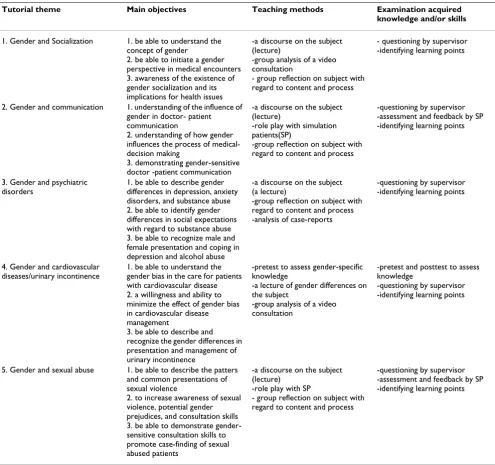
Tutorial one and two of our training programme are fol-lowed in first year (general practice), tutorial three in sec-ond year (hospital, psychiatric department, and nursery home), and tutorial four and five in third year (general practice) of GP training. The key features of each tutorial are shortly outlined hereafter and the main factors are pre-sented in table 1.
Tutorial one, gender and socialization, introduces the con-cepts of gender and sex. The purpose is to initiate a gender issue perspective into GP registrars' medical encounters. For example, gender differences in life experiences and the influences of family, peers, and media on gender roles. Factors of gender-related attitudes and themes with regard to doctor-patient encounters are discussed to help facili-tate a heightened level of gender awareness.
to gender that can influence the provision of care to oth-ers. Also we focus and clarify the differences of social expectations for appropriate behaviours of men as com-pared to women as is the case for alcohol consumption. Tutorial four deals with gender differences in cardiovascular disease (CVD) and urinary incontinence (UI). Here, we explain the persistent gender differences in cardiovascular disease and the potential biases in the care for patients with CVD such as the stereotypical conceptualisation of CVD as a male disease. GP registrars are taught the impor-tance to reflect on their own and others interpretations, reactions, and conduct in patient care with regard to
coro-nary risk factors in men and women. We address gender differences in patients' beliefs with urinary incontinence for example despite incontinence in men being less severe they experience more distress than women.
Tutorial five, recognizing and responding to sexual abuse, addresses sexual violence, a serious and widespread prob-lem for women with a number of social and gender-related barriers that make it hard for GPs to identify such abuse. For example doctor's availability for abused women differs by gender as female doctors tend to restrict their availability due to distress it brought about and male doctors because of time constraints.
Table 1: The main factors of the gender-specific medicine curriculum in GP training
Tutorial theme Main objectives Teaching methods Examination acquired
knowledge and/or skills
1. Gender and Socialization 1. be able to understand the concept of gender
2. be able to initiate a gender perspective in medical encounters 3. awareness of the existence of gender socialization and its implications for health issues
-a discourse on the subject (lecture)
-group analysis of a video consultation
- group reflection on subject with regard to content and process
- questioning by supervisor -identifying learning points
2. Gender and communication 1. understanding of the influence of gender in doctor- patient communication
2. understanding of how gender influences the process of medical-decision making
3. demonstrating gender-sensitive doctor -patient communication
-a discourse on the subject (lecture)
-role play with simulation patients(SP)
-group reflection on subject with regard to content and process
-questioning by supervisor -assessment and feedback by SP -identifying learning points
3. Gender and psychiatric disorders
1. be able to describe gender differences in depression, anxiety disorders, and substance abuse 2. be able to identify gender differences in social expectations with regard to substance abuse 3. be able to recognize male and female presentation and coping in depression and alcohol abuse
-a discourse on the subject (a lecture)
-group reflection on subject with regard to content and process -analysis of case-reports
-questioning by supervisor -identifying learning points
4. Gender and cardiovascular diseases/urinary incontinence
1. be able to understand the gender bias in the care for patients with cardiovascular disease 2. a willingness and ability to minimize the effect of gender bias in cardiovascular disease management
3. be able to describe and recognize the gender differences in presentation and management of urinary incontinence
-pretest to assess gender-specific knowledge
-a lecture of gender differences on the subject
-group analysis of a video consultation
-pretest and posttest to assess knowledge
-questioning by supervisor -identifying learning points
5. Gender and sexual abuse 1. be able to describe the patters and common presentations of sexual violence
2. to increase awareness of sexual violence, potential gender prejudices, and consultation skills 3. be able to demonstrate gender-sensitive consultation skills to promote case-finding of sexual abused patients
-a discourse on the subject (lecture)
-role play with SP
- group reflection on subject with regard to content and process
Programme Evaluation
After each tutorial, GP registrars were asked to indicate their level of agreement with initially 5 and later 7 state-ments to evaluate the course. Each statement was designed to assess the quality of and their opinion on the learning and teaching methods, the perceived relevance for practice, and the usefulness of the applied knowledge. GP registrars' participation was voluntary. We did not assess demographic features with the exception of their sex. We used Likert scales where 1 = totally disagree, and 5 = totally agree. Data were analysed in the SSPS 16.0. Answers were dichotomized so that a response of 1, 2 or 3 suggested a rejection of the program and a response of 4 or 5 implied acceptance of the programme. Significance (p
< 0.05) was assessed with the use of Chi square test. Sim-ilarly, the learning points were evaluated after each tuto-rial. They were coded and analysed according to the three objectives of the course by the first author (PD).
Ethical approval
This study fell within the domain of programme evalua-tion. Consequently ethical approval was not required according to the current regulations at our university.
Results
In the period February 2005 - September 2008, we col-lected 442 surveys (response rate 49%). 32,8% of the GP registrars were male (n = 145), 64,7% were female (n = 286). 11 GP registrars did not disclose their sex (2,5%). The methodology and the supervisors of the GSM pro-gramme were well received by the GP registrars. GP regis-trars' evaluation of the learning methods was in average positive. Overall, more than 80% of the GP registrars pos-itively rated the learning methods used in the programme, the supervisor's role and the approach of the topic. Also, GP registrars appraised gender issues as significant for their learning programme (male 79.5% vs. female 87.2%; X2 = 2.42; ns). Gender-specific information provided in
the programme was highly beneficial to their practice (male 82.1% vs. female 89.6%, X2 = 2.72; ns). There were
no significant gender differences between the evaluations of the programme but female GP registrars valued the pro-gramme consistently higher than male GP registrars. GP registrars noted 743 learning points on 442 readable evaluation forms. Three main themes were identified in the GP registrars' learning points: gender as a determinant of health, gender bias in healthcare, and gender in communi-cation and relationships. Many learning points were about gender differences in epidemiology, presentation, and treatment strategies in primary care (male 39% vs. female 41%). General comments included an increasing aware-ness of gender issues in general practice or gender-related disease presentation. The learning points dealing with
gender bias were about diagnostic management, current lack of gender knowledge and dealing with delicate situa-tions as sexual violence. The theme "understanding of gender bias in healthcare" was almost equal mentioned by male and female GP registrars (male 34% vs. female 31%). Also, both male GP registrars as well as female GP registrars (male 27.1% vs. female 27.3%) described learn-ing points concernlearn-ing differences between male and female patients and doctors in communication and work-ing patterns. There were remarks about traditional gender roles of doctors and patients in their consultation e.g. in the perception of disease presentation.
Although the evaluation did not confirm negative atti-tudes about the gender-specific programme on a regular basis, GP registrars did report negative comments on the evaluation forms. For example, some male as well as female GP registrars were of the opinion that the teacher occasionally focussed too much on the backlog of women. Both male and female GP registrars made nega-tive comments on the evaluation forms from time to time that fit into all the types of resistance against gender issues (e.g. simplifications, avoidance, and neglect).
Discussion
This paper describes the development and pilot-evalua-tion of a teaching programme in gender-specific medicine for GP training. We present a successful implementation of a mandatory training programme, extended over time, and integrated in the full three-year period of the Dutch GP training. Both male and female GP registrars evaluated the training in gender-specific medicine positively and were satisfied with the education. GP residents considered the education relevant for their learning and daily prac-tice. Based on these outcomes, it demonstrates the feasi-bility and usefulness of incorporating gender-specific medicine in the curriculum of GP training on a regular basis.
fac-ulty development. Institutional support, skilled supervi-sors, and availability of gender-specific information made it possible to embed the GSM teaching programme as a mandatory part of the GP training curriculum - which is undoubtedly beneficial to the teaching results.
Our GSM teaching programme is aimed at all GP regis-trars and it intends to offer a suitable framework to address gender-specific medicine. Therefore the teaching programme provided a comprehensive overview of medi-cal conditions pertinent to both men and women in pri-mary care. Usually it is either women or men in teaching gender issues in medical education[33,34] We found that both female and male GP registrars were keen about gen-der-specific medicine. Female GP registrars evaluated the GSM teaching programme slightly more positively than their male colleagues. It is in line with previous positive results about teaching gender awareness in medical educa-tion at Radboud University [35] Nevertheless, a lack of interest in gender issues has also been reported previously from students as well as physician teachers elsewhere. [36,37] Introducing novel and innovative education like gender-specific medicine will undoubtedly involve resist-ance, neglecting or doubt among GP registrars. We inter-preted the negative comments of our GP registrars to the novelty of the field of gender issues in medical education and challenged us continuously to rethink about how we could best teach and engage GP registrars in gender issues. It also stimulated us to employ well trained GP supervi-sors who are trained in approaches to overcome resistance or barriers of GP registrars.
We feel that the success of our teaching programme is also based on the light the programme sheds on the complex way in which men and women are advantaged and disad-vantaged by biological and social factors in health issues and the successful clarification of it by the programme. The programme captured the specific gender-related proc-esses and pathways that leads to health outcomes and emphasized strongly on gender socialization. It went beyond the biomedical framework and discussed gender-related life-experiences concerning health and disease. [38,39] We expanded the historical concept that women's health only relates to reproductive hormones and organs to issues of gender-related medicine of which both men and women can benefit. We wanted to make the case that gender issues in health and in everyday choices and understanding these issues requires integrating social, psychological, and biological perspectives in education. This educational view was in line with evidence that sug-gests that both biological systems and social processes underlie gender patterns. [40,41] The programme also offered time to try out the new knowledge, to register it, and to review on experiences. GP registrars were offered time for new learning opportunities inside or outside
gen-eral practice after a tutorial. We expected this teaching approach to be more fruitful to help GP registrars to real-ize and understand the importance of sex and gender aspects and differences in primary care.
The training programme as presented seems to work well but we have to point out some limitations. Our evaluation is not rigorous partly because of the low response rate. The assessment and ideas of the GP registrars who did not complete the survey, their assessment of the programme, and indeed their ideas about gender, may differ from those of the GP registrars who did complete the survey. Also, the evaluation did not include a sound assessment of the acquired knowledge and skills. This limits the scope of the evaluation of the programme. Demographic data of non-responders are not available, so comparisons between responders and nonresponders could not be per-formed. Furthermore, some of our GP registrars who were undergraduate students at Radboud University Nijmegen Medical Centre already have had the opportunity to learn about GSM by following courses in the undergraduate curriculum. Those GP registrars may therefore be some-what more aware of gender-related issues than GP regis-trars who were undergraduate students at universities elsewhere.
The next step in incorporating GSM in medical education is to take new initiatives to teach also GP trainers and to include gender-related issues in GP registrars' examina-tions. GP trainers entrusted with the educational supervi-sion of GP registrars have a special responsibility for inculcating the principles of good medical practice includ-ing gender-specific medicine. If the GP trainer does not share these new insights, it is hard to implement change for GP registrars. [42,43] Also, teaching and learning needs assessment. Current examinations in Dutch GP training do not systematically include gender-specific knowledge. Monitoring what has been learned is a good way of providing feedback. Teaching and learning GSM needs assessment of the applied knowledge of sex and gender differences in GP registrars' examinations.
Conclusion
Teaching and learning gender-specific medicine is feasible in GP training. GP registrars found gender-specific medi-cine important and interested to learn. We recommend and encourage stakeholders of medical schools to provide learning opportunities in GSM to GP registrars.
Competing interests
Authors' contributions
TLJ developed the design of the study and the training programme. PD carried out the analysis and wrote the first draft of the manuscript. All authors were involved in crit-ically revising the manuscript, and have read and approved the final manuscript.
Acknowledgements
We wish to thank Marijke Botden for her contribution in collecting the data and Niels Lous for proof reading the manuscript.
References
1. Pinn VW: Sex and gender factors in medical studies: implica-tions for health and clinical practice. JAMA 2003, 289:397-400. 2. Chapman KR, Tashkin DP, Pye DJ: Gender bias in the diagnosis
of COPD. Chest 2001, 119:1691-1695.
3. Han MK, Postma D, Mannino D, Giardino ND, Buist S, Curtis JL, Mar-tinez FJ: Gender and COPD: Why it Matters. Am J Respir Crit Care Med 2007, 177:1179-84.
4. Adams A, Buckingham CD, Lindenmeyer A, McKinlay JB, Link C, Marceau L, Arber S: The influence of patient and doctor gender on diagnosing coronary heart disease. Sociol Health Illn 2008,
30:1-18.
5. Chapman KR, Tashkin DP, Pye DJ: Gender bias in the diagnosis of COPD. Chest 2001, 119:1691-1695.
6. Roter DL, Hall JA, Aoki Y: Physician gender effects in medical communication: a meta-analytic review. JAMA 2002,
288:756-764.
7. Henrich JB, Viscoli CM: What do medical schools teach about women's health and gender differences? Acad Med 2006,
81:476-482.
8. Keitt SK, Wagner C, Tong C, Marts SA: Positioning women's health curricula in US medical schools. Med Gen Med 2003,
5:40.
9. Verdonk P, Mans LJL, Lagro-Janssen AL: How is Gender inte-grated in the Curricula of Dutch Medical School? A quick-scan on gender issues as an instrument for change. Gender and Education 2006, 18:399-412.
10. Hatala R, Case SM: Examining the influence of gender on med-ical students' decision making. J Womens Health Gend Based Med
2000, 9:617-623.
11. Lagro-Janssen AL: [Sex, gender and health: developments in scientific research]. Ned Tijdschr Geneeskd 2007, 151:374-378. 12. Phillips SP: Measuring the health effects of gender. J Epidemiol
Community Health 2008, 62:368-371.
13. Hamberg K: Gender bias in medicine. Womens Health (Lond Engl)
2008, 4:237-243.
14. Lagro-Janssen T, Lo Fo Wong S, van den Muijsenbergh M: The importance of gender in health problems. Eur J Gen Pract 2008,
14(Suppl 1):33-37.
15. Henrich JB: Women's health education initiatives: why have they stalled? Acad Med 2004, 79:283-288.
16. Nicolette J, Jacobs MB: Integration of women's health into an internal medicine core curriculum for medical students.
Acad Med 2000, 75:1061-1065.
17. Steinert Y, Mann K, Centeno A, Dolmans D, Spencer J, Gelula M, Pri-deaux D: A systematic review of faculty development initia-tives designed to improve teaching effectiveness in medical education: BEME Guide No. 8. Med Teach 2006, 28:497-526. 18. Coomarasamy A, Khan KS: What is the evidence that
postgrad-uate teaching in evidence based medicine changes anything? A systematic review. BMJ 2004, 329:1017.
19. Report to AFMC Board of Directors from Special Resource Committee on Gender and Equity March 23, 2007 [http:// www.afmc.ca/pdf/pdf_2007_report_board_directors_gei.pdf]. 20. Lent B, Cohen M, Dunn S, Levitt CA: Promoting gender equity in
family medicine. Can Fam Physician 2007, 53:1415-1418. 21. Phillips S: The social context of women's health: goals and
objectives for medical education. CMAJ 1995, 152:507-511. 22. Coomarasamy A, Khan KS: What is the evidence that
postgrad-uate teaching in evidence based medicine changes anything? A systematic review. BMJ 2004, 329:1017.
23. Satterlee WG, Eggers RG, Grimes DA: Effective medical educa-tion: insights from the Cochrane Library. Obstet Gynecol Surv
2008, 63:329-333.
24. Khan KS, Coomarasamy A: A hierarchy of effective teaching and learning to acquire competence in evidenced-based medi-cine. BMC Med Educ 2006, 6:59.
25. Branch WT Jr, Paranjape A: Feedback and reflection: teaching methods for clinical settings. Acad Med 2002, 77:1185-1188. 26. Mann K, Gordon J, Macleod A: Reflection and reflective practice
in health professions education: a systematic review. Adv Health Sci Educ Theory Pract 2007 [http://www.springerlink.com/con tent/a226806k3n5115n5/].
27. Doyal L: Sex, gender, and health: the need for a new approach. BMJ 2001, 323:1061-1063.
28. Miers M: Developing an understanding of gender sensitive care: exploring concepts and knowledge. J Adv Nurs 2002,
40:69-77.
29. Henrich JB: Women's health education initiatives: why have they stalled? Acad Med 2004, 79:283-288.
30. Henrich JB, Viscoli CM: What do medical schools teach about women's health and gender differences? Acad Med 2006,
81:476-482.
31. Keitt SK, Wagner C, Tong C, Marts SA: Positioning women's health curricula in US medical schools. Med Gen Med 2003,
5:40.
32. Nicolette J, Jacobs MB: Integration of women's health into an internal medicine core curriculum for medical students.
Acad Med 2000, 75:1061-1065.
33. Harris MF, McKenzie S: Men's health: what's a GP to do? Med J Aust 2006, 185:440-444.
34. Henrich JB, Chambers JT, Steiner JL: Development of an interdis-ciplinary women's health training model. Acad Med 2003,
78:877-884.
35. Celik HH, Klinge II, Weijden TT, Widdershoven GG, Lagro-Janssen TA: Gender sensitivity among general practitioners: results of a training programme. BMC Med Educ 2008, 8:36.
36. Hamberg K, Johansson EE: Medical students' attitudes to gender issues in the role and career of physicians: a qualitative study conducted in Sweden. Med Teach 2006, 28:635-641.
37. Risberg G, Johansson EE, Westman G, Hamberg K: Attitudes toward and experiences of gender issues among physician teachers: a survey study conducted at a university teaching hospital in Sweden. BMC Med Educ 2008, 8:10.
38. Lagro-Janssen AL: [Sex, gender and health: developments in scientific research]. Ned Tijdschr Geneeskd 2007, 151:374-378. 39. Lent B, Bishop JE: Sense and sensitivity: developing a gender
issues perspective in medical education. J Womens Health 1998,
7:339-342.
40. Hamberg K: Gender bias in medicine. Womens Health (Lond Engl)
2008, 4:237-243.
41. Rieker PP, Bird CE: Rethinking gender differences in health: why we need to integrate social and biological perspectives.
J Gerontol B Psychol Sci Soc Sci 2005, 60(Spec No 2):40-47. 42. Paice E, Heard S, Moss F: How important are role models in
making good doctors? BMJ 2002, 325:707-710.
43. Stern DT, Papadakis M: The developing physician--becoming a professional. N Engl J Med 2006, 355:1794-1799.
Pre-publication history
The pre-publication history for this paper can be accessed here: