R E S E A R C H A R T I C L E
Open Access
Relationship between the genetic
polymorphisms of
vicR
and
vicK
Streptococcus mutans
genes and early
childhood caries in two-year-old children
Pei Lin Zhuang
1,2, Li Xia Yu
2,3, Juan Kun Liao
1, Yan Zhou
2,3and Huan Cai Lin
2,3*Abstract
Background:The VicRK two-component signalling system regulates virulence and cariogenicity inStreptococcus mutans(S. mutans). The purpose of this study was to explore the genetic polymorphisms of thevicRandvicK genes, which are associated with dental caries in children withS. mutans.
Methods:In this study, 121 (from each group) clinicalS. mutansstrains were isolated from caries-free children and children with high-severity caries to sequence thevicRandvicKgenes. Genomic DNA was extracted fromS. mutans strains and amplified using PCR. The PCR products were purified and sequenced. A chi-squared test and ABI Variant Reporter software were used to analyse the sequencing results.
Results:The 242 clinically isolatedS. mutansstrains contained the full-lengthvicRandvicKgenes. No nucleotide sequence insertions or deletions were observed in the two genes. Four silent point mutations were identified in the vicRgenes, and no missense mutations could be detected. Forty-one mutations were identified in thevicKgenes. In addition to 32 silent mutations, 9 missense mutations at the 173, 337, 470, 1051, 1132, 1258, 1260, 1277, and 1348 bp positions were found. The distribution frequencies of the missense mutations were not significantly different between the groups, except for the C470T mutation. The frequency of the C470T missense mutation was higher in the high-severity caries group than in the caries-free group.
Conclusions:vicR sequences are highly conserved inS. mutansclinical isolates. The locus 470 missense mutation of thevicKgene may be related to caries in children withS. mutans.
Keywords:Dental caries, Genetic polymorphism, Missense mutation,Streptococcus mutans
Background
The human oral microbial ecosystem is one of the most complex bacterial communities known. Approximately 700 bacterial species are estimated to exist in the oral cavity [1, 2]. Among these bacteria, Streptococcus mutans (S. mutans) is one of the few species that have been consistently linked with dental caries [3, 4]. From the initial colonization stages onward,S. mutans under-goes continuous dynamic challenges, such as changes in
pH, temperature, and nutrient levels, to which it must respond and adapt. Generally, in bacteria, two-component regulatory systems (TCRSs) are used as“ mo-lecular switches” in response to environmental changes [5,6]. These regulatory networks are essential for bacter-ial adaptation, survival, and virulence.
Based on the genome sequence, 13 TCRSs have been identified inS. mutansUA159 [7]. One of these TCRSs, the VicRK signal transduction system, affects various virulence attributes of S. mutans [8, 9]. The system is composed of a histidine kinase sensor protein (VicK) lo-cated in the membrane and a cytoplasmic response regulator protein (VicR). Through phosphorylation reac-tions, extracellular signals are sensed by VicK, and then
* Correspondence:[email protected] 2
Guangdong Provincial Key Laboratory of Stomatology, Sun Yat-Sen University, 74 2nd Zhongshan Road, Guangzhou 510055, China
3Department of Preventive Dentistry, Guanghua School of Stomatology, Sun
Yat-Sen University, 56 Lingyuan Road West, Guangzhou 510055, China Full list of author information is available at the end of the article
the VicK histidine kinase transmits the message to VicR, which modulates gene expression [10,11].
vic genes regulate the expression of several virulence-associated genes that affect synthesis and adhesion to polysaccharides, including gtfBCD, ftf, and gbpB [12]. Moreover, compared with the wild-type UA159 strain, strains without vicK form aberrant biofilms, with a re-duced rate of total glucan formation [12]. In addition, the inactivation of vicKproduces a reduced level of lac-tic acid and enhances the acid tolerance of S. mutans [13]; a vicK knockout mutant has been shown to be more sensitive to H2O2than the wild-type [8].
A vicR null mutation is apparently lethal toS. mutans. VicR acts directly on the promoter regions of the gtfB, gtfC, and ftf genes. Overproduction of the VicR tran-script upregulates these genes [12]. In addition, VicR binds specifically to the comC gene, thereby negatively affecting the transcription of comC, comDE, comX, and nlmC [10]. Moreover, genes such as atlA, bmsH, glnQ, copy,wapA,relR,gcrR,plsX, andnlmC,demonstrate dir-ect binding byS. mutansVicR. Among these genes, VicR negatively regulatesnlmC and copYand positively regu-latesatlA, bmsH[14].
Early childhood caries (ECC) remains one of the most common chronic diseases of childhood [15,16], particu-larly in China. Many reports have stated that S. mutans demonstrates a strong relationship with ECC [17, 18]. However, not every individual colonized by S. mutans will have dental decay. The DNA loci associated with strains isolated from children with ECC are different from those found in caries-free children [19, 20]. The VicRK system is important to S. mutans growth and virulence; therefore, the purpose of this study was to ex-plore the genetic polymorphisms of the vicR and vicK genes found in S. mutans, which are associated with a distinct caries experience in children.
Methods
Bacterial strains
This study, which is a continuation of a previous study [21], primarily aimed to explore the connections be-tween the missense mutations of vicR and vicK genes and the severity of caries in children withS. mutans. A case-control group study design was used, and the sam-ple was the same as that used in the previous study [21], in which the sample capacities were set after calculation. All statistical tests were two-sided, and the value of α was set at 0.05. The study subjects were selected from our previous study, which was performed in the Huadu District of Guangzhou in South China. The study proto-col was approved by the Ethics Committee of Guanghua School of Stomatology, Sun Yat-sen University (ERC-[2012]-13). The procedures used were previously de-scribed [21]. Briefly, 121 caries-free children who wereS.
mutans-positive were selected as the caries-free group using a simple random sampling method. Each S. mutans-positive sample was numbered in the caries-free group, and then 121 samples were selected according to the random numbers generated by the computer. To de-termine the between-group genetic differences in the vicRand vicK genes of S. mutans, children who wereS. mutans-positive and had a distinct caries status (dmft ≥6) formed the high-severity caries group. The dmft score in the high-severity group was based on the cat-egory used in a previous study [22]. In this study, one isolatedS. mutansstrain was selected from each child.
Extraction of chromosomal DNA
Plaque samples from the children were mixed, sonicated and then dispersed to obtain 10−3 dilutions. The S. mutans strains were identified according to the colony morphology, and the colonies were tested for their abil-ity to ferment mannitol, sorbitol, raffinose, melibiose, and aesculin as well as for their ability to hydrolyse ar-ginine. The S. mutans strains were cultured in 2 ml of brain-heart infusion broth and incubated under anaer-obic conditions (85% N2, 5% CO2, and 10% H2) at 37 °C
for 18 h. The bacterial cells were harvested by centrifu-gation at 5000 rpm (~ 2800×g) for 5 min. Cells were re-suspended in 5% Chelex100 buffer (containing 1% Tween-20, 0.03% SDS and 1% NP40). To lyseS. mutans, the suspension was treated with 10 units of proteinase K (20 mg/ml) at 37 °C for 1 min. The mixture was incu-bated at 56 °C for 1 h, followed by boiling for 10 min and immediate cooling on ice for 3 min. The DNA sam-ple was collected according to the protocol of TIANamp Bacteria DNA Kit (Tiangen, Beijing, China). The ob-tained samples were measured with a UV spectropho-tometer at 260 nm and 280 nm to detect the quality and quantity of DNA.
Amplification of thevicRandvicKgenes
S. mutans UA159 was used as a reference strain. The total length of the vicR gene was 708 bp (Gene ID: 1028759), and the vicKgene length was 1353 bp (Gene ID: 1028760). ABI Primer Designer V3.0 was used to de-sign the PCR primers. ThevicRgene was PCR-amplified using the paired primers 5’-CGGGATCCATGAA GAAAATTCTAATCGTTGACGA-3′(BamHI site italic)
and 5’-CCGCTCGAGTTAGTCATATGATTTCATGTA
ATAAC-3′ (XhoI site italic). The vicK gene was PCR-amplified using the paired primers 5’-CGGGATCCAT GACTAATGTGTTTGAATCAAGTC-3′(BamHI site italic)
and 5’-CCGCTCGAGTCATGATTCGTCTTCATCTTCTT
CC-3′(XhoI site italic).
100–300 ng of genomic DNA as a template, and 2 U of Platinum® Taq DNA Polymerase (Invitrogen, Carlsbad, CA, USA). The PCR cycling profile included an initial preheating step at 95 °C for 5 min, followed by denatur-ation at 95 °C for 30 s, annealing at 60 °C for 30 s, and elongation at 72 °C for 50 s. A total of 30 cycles were performed, followed by a final elongation step at 72 °C for 5 min. The PCR amplification product was analysed by electrophoresis in a 1.5% agarose gel.
Sequencing of thevicRandvicKgenes
The PCR products were purified using a QIAquick Gel Extraction Kit (QIAgen, Hilden, Germany), according to the manufacturer’s protocol. Ultimately, sequencing was performed with a 3730XL DNA analyser platform (Shanghai Life Technologies Biotechnology Company, Life Technologies, Shanghai, China). The PCR product sequences were compared with known vicR and vicK gene sequences from the UA159 strain in GenBank using Variant Reporter software.
Statistical analysis
Data analysis was performed using the SPSS 20.0 soft-ware. A Chi-square test was used to analyse single nu-cleotide polymorphisms of thevicRand vicKgenes inS. mutansin the high-severity caries group and the caries-free group. AP-value < 0.05 for the chi-squared test was considered statistically significant.
Results
All 242 clinically isolatedS. mutansstrains included the vicR andvicK genes. No nucleotide sequence insertions or deletions were observed in the two genes.
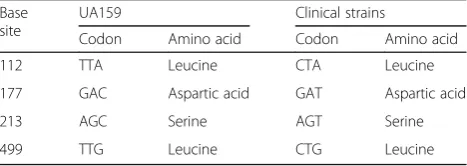
Amino acid transversion, according to the vicR gene codons, is shown in Table1.Four silent point mutations were identified. No missense mutations were found. The distribution frequencies of the silent mutation sites of the vicR gene in the high-severity caries and caries-free groups are shown in Table2.
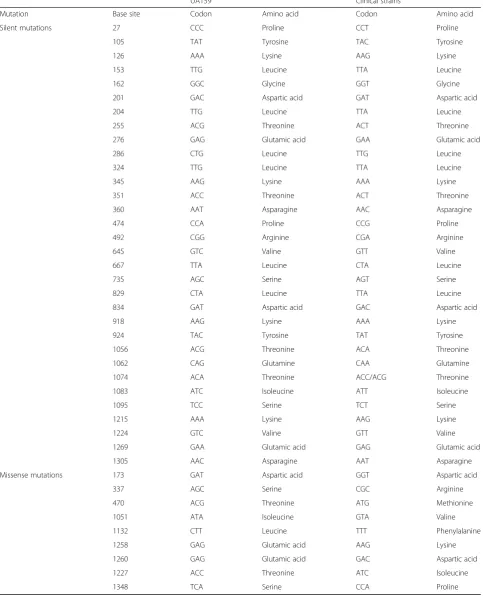
Amino acid transversion, according to the vicK gene codons, is shown in Table 3. A total of 41 mutations were identified. In addition to the 32 silent point muta-tions, 9 point mutations were found, resulting in mis-sense mutations at the 173, 337, 470, 1051, 1132, 1258,
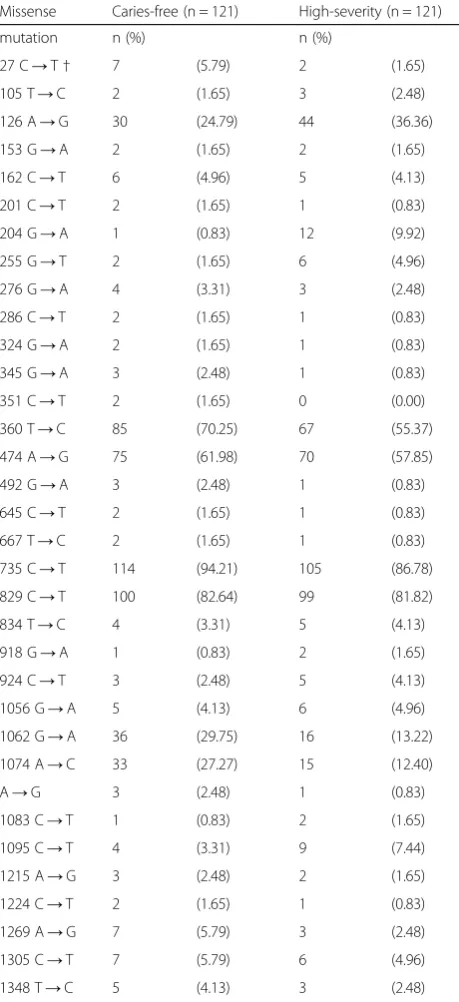
1260, 1277, and 1348 bp positions. The distribution fre-quencies of the mutation sites of the vicK gene in the high-severity caries and caries-free groups are shown in Table 4. The distribution of the C470T missense muta-tions was higher in the high-severity caries group than in the caries-free group (P= 0.002), and the other mis-sense mutation rates in the two groups did not demon-strate any statistically significant differences (Table 5). The C470T missense mutation denotes a C base at the 470th base in thevicKgene ofS. mutansUA159, while a T base is substituted in thevicKgene of clinical isolates.
Discussion
The profound effects of genetic polymorphisms of viru-lence factors onS. mutanshave been a focus of caries re-search for many years [23, 24]. The vicRK signal transduction system is essential forS. mutansby modulat-ing gene expression. However, all prior studies have focused on constructing mutants of laboratory reference strains, and little is known about the gene variation in clinical iso-lates and its relationship with caries. Compared to labora-tory reference strains, clinical isolates are closer to the true disease state.
Hence, in this study, we sequenced the vicRand vicK genes of S. mutansstrains isolated from children with a distinct caries status to analyse the effects of vicR and vicKpolymorphisms on the risk of ECC. Mutational ana-lysis showed that VicR in S. mutans plays an essential role in the viability of this bacterium [12]. In our study, all 242 clinical isolates had a full-length vicR gene, and no missense mutations were found, which indicated that the vicR gene was highly conserved among the clinical isolates. This ubiquitous distribution and sequence con-servation of vicR among the S. mutans clinical isolates may suggest that it plays an important role inS. mutans biology.
The overall structure of VicK is a long-rod dimer that anchors four connected domains: HAMP (aa 36– 86), PAS (aa 87–198), DHp (aa 199–269) and CA (aa 278–450) [25]. Compared to S. mutans UA159, all 242 clinical isolates had a full-length vicK gene, and nine missense mutation sites were found. All missense
Table 1Transversion of amino acids due to silent mutations, according to thevicRgene codons
Base site
UA159 Clinical strains
Codon Amino acid Codon Amino acid 112 TTA Leucine CTA Leucine 177 GAC Aspartic acid GAT Aspartic acid 213 AGC Serine AGT Serine 499 TTG Leucine CTG Leucine
Table 2Details of the silent mutation sites of thevicRgene in the high-severity caries and caries-free groups
Silent mutation
Caries-free (n= 121) High-severity (n = 121) n (%) n (%)
112 T→C† 5 (4.13) 7 (5.79) 177 C→T 6 (4.96) 7 (5.79) 213 C→T 3 (2.48) 3 (2.48) 499 T→C 116 (95.87) 101 (83.47)
Table 3Transversion of amino acids, according to thevicKgene codons
UA159 Clinical strains
Mutation Base site Codon Amino acid Codon Amino acid Silent mutations 27 CCC Proline CCT Proline
105 TAT Tyrosine TAC Tyrosine 126 AAA Lysine AAG Lysine 153 TTG Leucine TTA Leucine 162 GGC Glycine GGT Glycine 201 GAC Aspartic acid GAT Aspartic acid 204 TTG Leucine TTA Leucine 255 ACG Threonine ACT Threonine 276 GAG Glutamic acid GAA Glutamic acid 286 CTG Leucine TTG Leucine 324 TTG Leucine TTA Leucine 345 AAG Lysine AAA Lysine 351 ACC Threonine ACT Threonine 360 AAT Asparagine AAC Asparagine 474 CCA Proline CCG Proline 492 CGG Arginine CGA Arginine 645 GTC Valine GTT Valine 667 TTA Leucine CTA Leucine 735 AGC Serine AGT Serine 829 CTA Leucine TTA Leucine 834 GAT Aspartic acid GAC Aspartic acid 918 AAG Lysine AAA Lysine 924 TAC Tyrosine TAT Tyrosine 1056 ACG Threonine ACA Threonine 1062 CAG Glutamine CAA Glutamine 1074 ACA Threonine ACC/ACG Threonine 1083 ATC Isoleucine ATT Isoleucine 1095 TCC Serine TCT Serine 1215 AAA Lysine AAG Lysine 1224 GTC Valine GTT Valine 1269 GAA Glutamic acid GAG Glutamic acid 1305 AAC Asparagine AAT Asparagine Missense mutations 173 GAT Aspartic acid GGT Aspartic acid
mutation sites identified in the present study were distributed in the HAMP, PAS and CA domains. No missense mutation sites were found in the DHp do-main. The statistical analysis of the missense muta-tions was worthy of attention because these changes could affect protein activity. The statistical analysis showed that the differences in missense mutation
rates between the caries-free and high-severity caries groups were not significant, except for that of the C470T mutations. The frequency of the C470T mis-sense mutation was higher in the high-severity caries group than in the caries-free group. The cytosine (C) to thymine (T) mutation at the 470th bp in the vicK gene leads to a mutation of threonine (T) to methio-nine (M) at the amino acid residue at position 157 in the VicK amino acid sequence. The 157-amino acid residue belongs to the PAS domain. The PAS domain is a major sensor, with adopted canonical folds and dyad symmetry. The effect of the mutation at site 470 (aa 157) on the activity and function of the VicK pro-tein requires further study.
The present study has some limitations. First, a dmft level of≥6 was set as the cut-off value, which may have narrowed the selection of candidates for the high-severity caries group. However, this experiment was ex-ploratory in nature. Children with a distinct caries status were utilised to explore and compare the genetic poly-morphisms in thevicRandvicKgenes ofS. mutans. Sec-ond, the sample size was relatively small; therefore, a larger sample size may be required for additional between-group analysis.
Conclusions
The present study provided knowledge of the genetic di-versity of the vicR and vicK genes ofS. mutans in chil-dren with two distinct caries experiences: caries-free and high-severity caries. The results indicated that in chil-dren, sequences of vicR are highly conserved in S. mutans clinical isolates and the C470T missense muta-tion of thevicKgene may be related to caries experience withS. mutans.
Table 4Details of the silent mutation sites of thevicKgene in the high-severity caries and caries-free groups
Missense Caries-free (n = 121) High-severity (n = 121) mutation n (%) n (%)
27 C→T† 7 (5.79) 2 (1.65) 105 T→C 2 (1.65) 3 (2.48) 126 A→G 30 (24.79) 44 (36.36) 153 G→A 2 (1.65) 2 (1.65) 162 C→T 6 (4.96) 5 (4.13) 201 C→T 2 (1.65) 1 (0.83) 204 G→A 1 (0.83) 12 (9.92) 255 G→T 2 (1.65) 6 (4.96) 276 G→A 4 (3.31) 3 (2.48) 286 C→T 2 (1.65) 1 (0.83) 324 G→A 2 (1.65) 1 (0.83) 345 G→A 3 (2.48) 1 (0.83) 351 C→T 2 (1.65) 0 (0.00) 360 T→C 85 (70.25) 67 (55.37) 474 A→G 75 (61.98) 70 (57.85) 492 G→A 3 (2.48) 1 (0.83) 645 C→T 2 (1.65) 1 (0.83) 667 T→C 2 (1.65) 1 (0.83) 735 C→T 114 (94.21) 105 (86.78) 829 C→T 100 (82.64) 99 (81.82) 834 T→C 4 (3.31) 5 (4.13) 918 G→A 1 (0.83) 2 (1.65) 924 C→T 3 (2.48) 5 (4.13) 1056 G→A 5 (4.13) 6 (4.96) 1062 G→A 36 (29.75) 16 (13.22) 1074 A→C 33 (27.27) 15 (12.40) A→G 3 (2.48) 1 (0.83) 1083 C→T 1 (0.83) 2 (1.65) 1095 C→T 4 (3.31) 9 (7.44) 1215 A→G 3 (2.48) 2 (1.65) 1224 C→T 2 (1.65) 1 (0.83) 1269 A→G 7 (5.79) 3 (2.48) 1305 C→T 7 (5.79) 6 (4.96) 1348 T→C 5 (4.13) 3 (2.48)
†C→T, C represents the 112 locus base in UA159, and T represents the 112 locus base in the clinical strains
Table 5The distribution frequencies of the missense mutation sites of thevicKgene in the high-severity caries and caries-free groups
Missense Caries-free (n = 121) High-severity (n = 121) x2 P -valuea
mutation n (%) n (%)
173 A→G† 0 0.00 3 2.48 3.308 0.247b
337 A→C 118 97.52 115 95.04 1.309 0.499b
470 C→T 1 0.83 12 9.92 9.836 0.002a
1051 A→G 115 95.04 115 95.04 0 1.000b
1132 C→T 2 1.65 0 0.00 2.017 0.498b
1258 G→A 5 4.13 0 0.00 5.105 0.060b
1260 G→C 3 2.48 0 0.00 3.308 0.247b
1277 C→T 6 4.96 1 0.83 3.678 0.120b
1348 T→C 6 4.96 3 2.48 1.309 0.499b †A→G, A represents the 23 locus base in UA159, and G represents the 23 locus base in the clinical strains
a
Chi-square test
b
Abbreviations
dmft:Decayed, missing and filled teeth; DNA: Deoxyribonucleic acid; ECC: Early childhood caries; PCR: Polymerase chain reaction; S.
mutans: Streptococcus mutans; TCRSs: Two-component regulatory systems
Acknowledgements
We are grateful for the support of participants of the research group.
Funding
This work was supported by Grant No. A2015419 from Medical Scientific Research Foundation of Guangdong Province, and Grant No.
2016A020215067 and No. 2014A020212092 from Guangdong Provincial Science and Technology Plan Project, China. The funding bodies had no role in the design of the study and collection, analysis, and interpretation of data and in writing the manuscript.
Availability of data and materials
The datasets generated and/or analysed during the current study are not publicly available due to anonymity considerations but are available from the corresponding author on reasonable request.
Authors’contributions
PLZ and LXY contributed to the study design, the experiment conduct and manuscript preparation. JKL and YZ analysed and interpreted focus data. HCL contributed to the study conception and design, general research group supervision, and critical manuscript revision. All authors have read and approved the final version of this manuscript.
Ethics approval and consent to participate
Human subject approval was received from the Ethical Review Committee of Guanghua School of Stomatology, Hospital of Stomatology, Institute of Stomatological Research, Sun Yat-Sen University. Written informed consent was given by all focus group participants.
Consent for publication
Not applicable.
Competing interests
The authors declare that they have no competing interests.
Publisher’s Note
Springer Nature remains neutral with regard to jurisdictional claims in published maps and institutional affiliations.
Author details
1Guangdong Provincial Key Laboratory of Malignant Tumor Epigenetics and
Gene Regulation, Department of Stomatology, Sun Yat-Sen Memorial Hospital, Sun Yat-Sen University, 107 Yanjian Road West, Guangzhou 510120, China.2Guangdong Provincial Key Laboratory of Stomatology, Sun Yat-Sen
University, 74 2nd Zhongshan Road, Guangzhou 510055, China.3Department
of Preventive Dentistry, Guanghua School of Stomatology, Sun Yat-Sen University, 56 Lingyuan Road West, Guangzhou 510055, China.
Received: 20 June 2017 Accepted: 5 March 2018
References
1. Aas JA, Paster BJ, Stokes LN, Olsen I, Dewhirst FE. Defining the normal bacterial flora of the oral cavity. J Clin Microbiol. 2005;43(11):5721–32. 2. Paster BJ, Olsen I, Aas JA, Dewhirst FE. The breadth of bacterial diversity in
the human periodontal pocket and other oral sites. Periodontol 2000. 2006; 42:80–7.
3. Krzysciak W, Jurczak A, Koscielniak D, Bystrowska B, Skalniak A. The virulence of Streptococcus mutans and the ability to form biofilms. Eur J Clin Microbiol Infect Dis. 2014;33(4):499–515.
4. Nicolas GG, Lavoie MC. Streptococcus mutans and oral streptococci in dental plaque. Can J Microbiol. 2011;57(1):1–20.
5. West AH, Stock AM. Histidine kinases and response regulator proteins in two-component signaling systems. Trends Biochem Sci. 2001;26(6):369–76.
6. Wolanin PM, Thomason PA, Stock JB. Histidine protein kinases: key signal transducers outside the animal kingdom.Genome Biol. 3(10):2002, REVIEWS3013.
7. Ajdic D, McShan WM, McLaughlin RE, Savic G, Chang J, Carson MB, Primeaux C, Tian R, Kenton S, Jia H, et al. Genome sequence of
Streptococcus mutans UA159, a cariogenic dental pathogen. Proc Natl Acad Sci U S A. 2002;99(22):14434–9.
8. Deng DM, Liu MJ, Ten Cate JM, Crielaard W. The VicRK system of Streptococcus mutans responds to oxidative stress. J Dent Res. 2007;86(7): 606–10.
9. Tremblay YDN, Lo H, Li YH, Halperin SA, Lee SF. Expression of the Streptococcus mutans essential two-component regulatory system VicRK is pH and growth-phase dependent and controlled by the LiaFSR three-component regulatory system. Microbiology. 2009;155(9):2856–65. 10. Senadheera DB, Cordova M, Ayala EA, Chavez De Paz LE, Singh K, Downey
JS, Svensater G, Goodman SD, Cvitkovitch DG. Regulation of Bacteriocin production and cell death by the VicRK signaling system in Streptococcus mutans. J Bacteriol. 2012;194(6):1307–16.
11. Biller SJ, Wayne KJ, Winkler ME, Burkholder WF. The putative hydrolase YycJ (WalJ) affects the coordination of cell division with DNA replication in Bacillus subtilis and may play a conserved role in Cell Wall metabolism. J Bacteriol. 2011;193(4):896–908.
12. Senadheera MD, Guggenheim B, Spatafora GA, Huang YC, Choi J, Hung DC, Treglown JS, Goodman SD, Ellen RP, Cvitkovitch DG. A VicRK signal transduction system in Streptococcus mutans affects gtfBCD, gbpB, and ftf expression, biofilm formation, and genetic competence development. J Bacteriol. 2005;187(12):4064–76.
13. Senadheera D, Krastel K, Mair R, Persadmehr A, Abranches J, Burne RA, Cvitkovitch DG. Inactivation of VicK affects acid production and acid survival of Streptococcus mutans. J Bacteriol. 2009;191(20):6415–24.
14. Ayala E, Downey JS, Mashburn-Warren L, Senadheera DB, Cvitkovitch DG, Goodman SD. A biochemical characterization of the DNA binding activity of the response regulator VicR from Streptococcus mutans. PLoS One. 2014; 9(9):e108027.
15. Parker EJ, Jamieson LM, Broughton J, Albino J, Lawrence HP, Roberts-Thomson K. The oral health of indigenous children: a review of four nations. J Paediatr Child Health. 2010;46(9):483–6.
16. Folayan MO, Chukwumah NM, Onyejaka N, Adeniyi AA, Olatosi OO. Appraisal of the national response to the caries epidemic in children in Nigeria. Bmc Oral Health. 2014;14:76.
17. Saraithong P, Pattanaporn K, Chen Z, Khongkhunthian S, Laohapensang P, Chhun N, Pattanaporn W, Gaw HY, Li Y. Streptococcus mutans and Streptococcus sobrinus colonization and caries experience in 3- and 5-year-old Thai children. Clin Oral Investig. 2015;19(8):1955–64.
18. Parisotto TM, Steiner-Oliveira C, Silva CM, Rodrigues LK, Nobre-dos-Santos M. Early childhood caries and mutans streptococci: a systematic review. Oral Health Prev Dent. 2010;8(1):59–70.
19. Saxena D, Caufield PW, Li Y, Brown S, Song J, Norman R. Genetic classification of severe early childhood caries by use of subtracted DNA fragments from Streptococcus mutans. J Clin Microbiol. 2008;46(9):2868–73. 20. Zhou Q, Qin X, Qin M, Ge L. Genotypic diversity of Streptococcus mutans
and Streptococcus sobrinus in 3-4-year-old children with severe caries or without caries. Int J Paediatr Dent. 2011;21(6):422–31.
21. Yu LX, Tao Y, Qiu RM, Zhou Y, Zhi QH, Lin HC. Genetic polymorphisms of the sortase a gene and social-behavioural factors associated with caries in children: a case–control study. Bmc Oral Health. 2015;15(1)
22. Martins-Junior PA, Vieira-Andrade RG, Correa-Faria P, Oliveira-Ferreira F, Marques LS, Ramos-Jorge ML. Impact of early childhood caries on the oral health-related quality of life of preschool children and their parents. Caries Res. 2013;47(3):211–8.
23. Napimoga MH, Hofling JF, Klein MI, Kamiya RU, Goncalves RB. Tansmission, diversity and virulence factors of Sreptococcus mutans genotypes. J Oral Sci. 2005;47(2):59–64.
24. Lemos JA, Quivey RJ, Koo H, Abranches J. Streptococcus mutans: a new gram-positive paradigm? Microbiology. 2013;159(Pt 3):436–45.